Anthem by Ayn Rand Summary, Characters and Themes
Anthem by Ayn Rand is a short dystopian novel about a future society where the individual has been erased in the name of the collective. People are denied personal names, private choices, independent thought, romantic love, and even the word “I.” The story follows Equality 7-2521, a young street sweeper whose intelligence and curiosity make him dangerous to the world he lives in.
Through secret study, forbidden discovery, and love for Liberty 5-3000, he begins to understand that freedom begins with the self. The book is both a rebellion story and a statement about individualism.
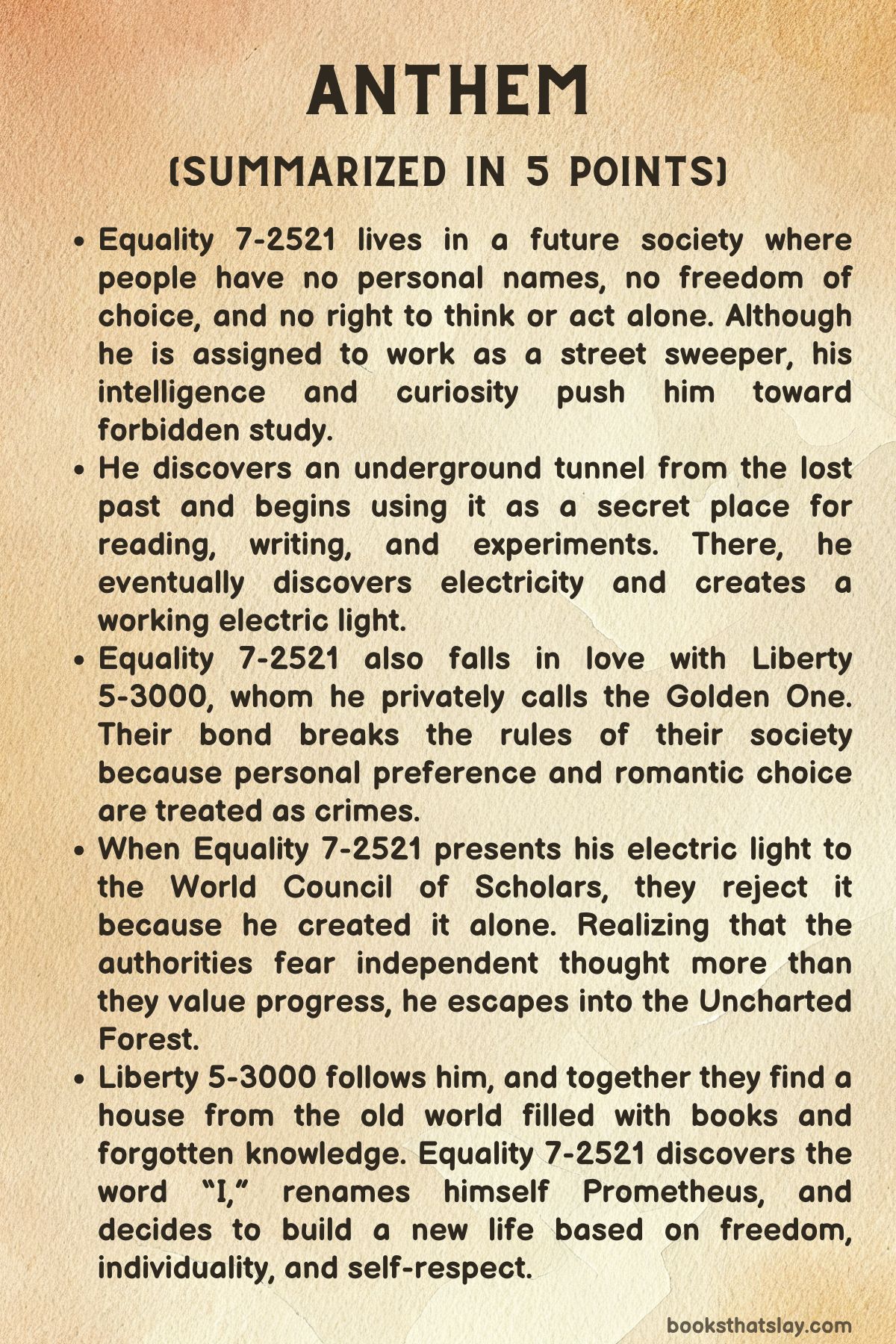
Summary
Anthem is set in a dark future where society has destroyed almost every trace of personal identity. People do not live as individuals but as parts of a single collective body.
They are given numbers instead of names, assigned jobs by the authorities, and taught that their only purpose is to serve their brothers. The word “I” has disappeared from human language, and people are required to speak of themselves as “we.” Personal preference, independent thought, friendship, curiosity, love, and solitude are treated as crimes because they separate one person from the group.
The main character is Equality 7-2521, a young man of twenty-one who knows from childhood that he is different. He is taller than others, quicker to learn, and filled with questions that no one wants him to ask.
In the Home of the Students, he tries to hide his intelligence because being brighter than others is considered shameful. He wants to study science and join the scholars, but the Council of Vocations assigns him to be a street sweeper.
In this world, a person’s work is not chosen by talent or desire. It is decided by the state, and obedience is expected without complaint.
At first, Equality 7-2521 accepts his assignment as a chance to make up for what he sees as his sin of being different. He follows the daily routine of work, meetings, public entertainment, and sleep in a shared hall.
Still, he cannot silence his mind. He notices that people around him are afraid and joyless, even though they are told they must be happy.
Some cry at night. Some scream in their sleep.
No one speaks honestly because honest speech might reveal a forbidden thought.
While working one day with International 4-8818, a fellow street sweeper, Equality 7-2521 discovers an underground tunnel from the forgotten past. The tunnel belongs to the time before the current society, a period called the Unmentionable Times.
The authorities have forbidden all discussion of that earlier world because it held knowledge, words, and ways of living that the present rulers want erased. International 4-8818 is frightened and thinks they should report the tunnel, but Equality 7-2521 refuses.
He knows the discovery would be destroyed and that he would be punished. International 4-8818 agrees to keep the secret, choosing loyalty to Equality 7-2521 over obedience to the collective.
The tunnel becomes Equality 7-2521’s private world. Each night he slips away from the required social activities and works there alone.
He steals candles, paper, and materials discarded by the scholars. He reads, writes, studies, and experiments.
His secret life is dangerous, but it brings him peace because it is the first thing that belongs to him. In the tunnel, he is not merely a street sweeper.
He is a thinker, a maker, and a person acting by his own judgment.
During his street-sweeping route, Equality 7-2521 notices Liberty 5-3000, a young woman who works in the fields. Men and women are not allowed to choose one another, and desire is controlled by the state through a system of forced mating.
Children are taken from their mothers and raised by the government. Yet Equality 7-2521 is drawn to Liberty 5-3000 immediately.
He watches her from a distance, and she notices him too. Their early connection is quiet, built from glances, smiles, and small gestures.
In his mind, he calls her the Golden One because her beauty and spirit seem bright to him.
Eventually they speak, breaking another law. Equality 7-2521 tells her that she is beautiful and that, among all women, he would look only at her.
She later tells him that she has named him the Unconquered. Their private names for each other are important because naming is an act of personal judgment.
They are beginning to see each other not as members of a collective but as singular beings. Their feelings do not yet have the right language, but they know that what they share is real.
Meanwhile, Equality 7-2521’s experiments lead him to a major discovery. While studying a dead frog and metal wires, he notices movement caused by a force he does not yet understand.
He continues testing with metals, wires, and other materials until he discovers electricity. He learns that this hidden power can move through metal, affect instruments, and produce light.
Eventually he builds a glass box that gives off electric light without flame. In a society where the candle is considered a great invention, this discovery could transform human life.
Equality 7-2521 does not plan to keep the light for himself. He believes the scholars will honor the discovery and allow him to join them.
He hopes they will see that the electric light can help everyone. This hope shows that he has not yet fully broken free from the values of his society.
He still wants acceptance from its leaders and still believes that truth will be welcomed if it benefits the group.
His secret is nearly lost when he stays too long in the tunnel and misses the required evening gathering. When he returns late, the authorities question him.
He refuses to reveal where he has been. He is taken to the Palace of Corrective Detention, where he is beaten and whipped, but he protects the tunnel and the light.
The prison is poorly guarded because the rulers assume no one would dare escape. Equality 7-2521 does escape, returning to the tunnel in time to bring his invention before the World Council of Scholars.
When he appears before the scholars, he is injured, dirty, and still full of hope. He shows them the electric light and offers it as a gift.
Instead of wonder, the scholars respond with fear and anger. They are offended that a street sweeper has thought and worked alone.
To them, the discovery is not valuable because it was not created collectively. They also fear its practical effects.
Electric light might threaten the makers of candles, reduce labor, and disturb the fixed order of society. Rather than study the invention, they decide it must be destroyed.
This is the turning point for Equality 7-2521. He finally sees that the rulers do not care about truth, progress, or human happiness.
They care about control. When they move to destroy his light, he seizes it, calls them fools, and runs.
He escapes into the Uncharted Forest, a place feared by everyone in the city. The forest represents the unknown, but for Equality 7-2521 it becomes the first true space of freedom.
At first he expects to die there because he has been taught that a person cannot survive alone. Instead, he discovers that he can live by his own effort.
He sleeps under the open sky, finds water, kills a bird for food, builds a fire, and feels pride in feeding himself. He sees his reflection for the first time and recognizes his own face as strong and worthy.
Away from society, he begins to understand that solitude is not evil. It can be the condition in which a person meets himself.
Liberty 5-3000 follows him into the forest. When she hears that he has escaped, she chooses to leave the city and find him, even though she knows she can never return.
Their reunion marks her own rejection of the collective world. They kiss, travel together, and begin a life shaped by choice rather than command.
They no longer see their love as shameful. They understand it as natural, joyful, and personal, though their old language still limits them.
Liberty 5-3000 tries to say that she loves him as one person loving another, but the word “we” cannot carry the truth she wants to express.
Together they continue through the forest and eventually find a house from the lost world. It stands in the mountains, filled with objects they do not understand at first: mirrors, rooms for private living, books, and signs of a life built for two people rather than a crowd.
The house becomes their home. It also becomes a bridge to the past, because its library holds the knowledge that the rulers failed to destroy.
Through reading, Equality 7-2521 discovers the missing word: “I.” This discovery changes everything. He now understands that the self is real, sacred, and primary.
He rejects the idea that he exists only to serve others. He decides that happiness does not need permission and that love must be earned, not granted automatically to all people simply because they exist.
He sees the word “we” as dangerous when it is used to erase judgment, freedom, and personal responsibility.
Equality 7-2521 gives himself the name Prometheus, after the figure who brought fire to humanity, and he gives Liberty 5-3000 the name Gaea. She learns the language of the self too and tells him, “I love you.” Their new names mark their rebirth as individuals.
Prometheus plans to study electricity and the books of the old world. He wants to build a new life in the house, raise his future child in freedom, and eventually rescue others who still have independent spirits, including International 4-8818.
By the end of Anthem, Prometheus understands that the deepest conflict is not simply between one man and one government. It is between the individual and every system that demands the surrender of the self.
He believes the world was ruined when people gave up the word “I” and accepted the rule of the collective. His final purpose is to restore that word, defend the ego, and create a future where each person may live for his or her own sake.
Characters
Equality 7-2521
Equality 7-2521 is the central figure of Anthem, and his character represents the struggle of an individual mind against a society built to erase individuality. From childhood, he is marked as different because he is taller, more intelligent, more curious, and more restless than those around him.
In his world, these qualities are not praised; they are treated as moral defects because they set him apart from the collective. His early guilt shows how deeply the society has trained him to distrust himself.
He tries to be ordinary, tries to accept his assigned place, and even sees his work as a street sweeper as a form of punishment that might cleanse him of his desire to know more.
Yet Equality 7-2521 cannot destroy the part of himself that seeks knowledge. His secret experiments in the underground tunnel reveal the true nature of his character: disciplined, brave, inventive, and unwilling to surrender his mind.
He does not rebel at first out of hatred. He rebels because thinking is natural to him, and because discovery gives him a sense of peace that society cannot offer.
His invention of electric light is important not only because it is a scientific achievement but because it proves that one person, working alone, can create something powerful and meaningful.
His emotional growth is just as important as his intellectual growth. His love for Liberty 5-3000 teaches him to value personal choice, desire, and attachment.
He begins by thinking of himself through the language of his society, but gradually he learns that his happiness, his body, his mind, and his love belong to him. When the scholars reject his invention, he finally understands that the system does not want progress; it wants obedience.
His escape into the forest becomes a movement toward self-knowledge. By the end of the book, he has discovered the word “I,” chosen the name Prometheus, and accepted the self as the foundation of freedom, love, and purpose.
Liberty 5-3000
Liberty 5-3000 is the main female character in the book and serves as both a romantic figure and a symbol of independent choice. Like Equality 7-2521, she is different from the people around her, though her rebellion is quieter at first.
She works in the fields, under the control of the same collectivist society, yet she carries herself with a spirit that draws Equality 7-2521’s attention. Her beauty matters in the story, but it is not only physical beauty.
To Equality 7-2521, she appears strong, proud, and separate from the dull fear that defines most people in their world.
Her relationship with Equality 7-2521 develops through small but meaningful acts of defiance. She looks at him, smiles at him, speaks to him, accepts the private name Golden One, and gives him the name Unconquered.
Each act breaks the rules of a society that forbids personal preference. Her willingness to name him shows that she sees him as a singular person, not merely as one more member of the collective.
This makes her love an act of recognition. She does not love him because society permits it; she loves him because she chooses him.
Liberty 5-3000’s greatest act of courage comes when she follows Equality 7-2521 into the Uncharted Forest. She leaves behind the only world she knows, with no guarantee of safety, because life without personal love and freedom has become impossible for her.
In the forest and later in the mountain house, she changes from a controlled citizen into Gaea, a woman who can say “I love you” with full understanding. Her transformation is quieter than Prometheus’s intellectual awakening, but it is equally important.
She represents the emotional side of individualism: the right to love, choose, desire, and belong to another person by free will rather than by command.
International 4-8818
International 4-8818 is Equality 7-2521’s friend, although friendship itself is forbidden in their society because it implies preference. His role in the book is brief but meaningful, since he shows that human loyalty can survive even under a system designed to crush personal bonds.
International 4-8818 is different from others in his own way. He smiles too much, draws pictures, and has a gentle, creative nature that does not fit the rigid expectations of the collective.
Like Equality 7-2521, he has traits that would be gifts in a free society but become liabilities in a controlled one.
When he and Equality 7-2521 discover the hidden tunnel, International 4-8818 first responds with fear. This reaction is understandable because the society has trained its citizens to report anything unusual and to fear punishment more than falsehood.
Yet when Equality 7-2521 asks him not to reveal the tunnel, International 4-8818 chooses his friend over the law. This is one of the clearest signs that the collective ideology has not fully conquered human nature.
He knows that keeping the secret is dangerous, but he would rather share guilt with someone he cares about than be “good” in the eyes of a cruel society.
International 4-8818 also helps define Equality 7-2521’s character. Through him, readers see that Equality 7-2521 is capable of affection, trust, and loyalty before he has the language to understand individuality.
Later, when Prometheus imagines returning to rescue people from the city, International 4-8818 is among those he wants to save. This shows that International 4-8818 is not just a minor companion but a sign that other independent spirits may still exist inside the collective world.
Collective 0-0009
Collective 0-0009 is the oldest member of the World Council of Scholars and one of the clearest representatives of institutional authority in the novel. He is not a seeker of truth, despite belonging to a body that calls itself scholarly.
Instead, he protects the rules, traditions, and power structure of the collective society. His reaction to Equality 7-2521’s electric light reveals the intellectual corruption at the heart of the system.
A true scholar would be curious, amazed, and eager to understand the invention. Collective 0-0009 is offended because the discovery was made by one person working alone.
His character shows how collectivism in the story does not simply limit politics; it damages thought itself. Collective 0-0009 cannot judge the electric light by whether it is true, useful, or brilliant.
He judges it by whether it was approved by the group. Because Equality 7-2521 acted independently, the invention must be condemned.
This makes Collective 0-0009 a symbol of authority without wisdom. He has status, age, and official power, but he lacks imagination and courage.
Collective 0-0009’s fear is especially important. The scholars are not merely angry at the light; they are frightened by it.
The invention threatens their belief that all knowledge must come from committees and councils. It also threatens the economic and social order built around old methods, such as candle-making.
Through Collective 0-0009, the book criticizes systems that fear innovation because innovation often begins with a single mind. He is an antagonist not because he is personally violent in every scene, but because he speaks for a world that would rather destroy genius than admit that one individual can surpass the collective.
The Saint of the Pyre
The Saint of the Pyre is the man Equality 7-2521 remembers seeing executed when he was a child. Though he appears only through memory, his influence on the story is powerful.
He had discovered the Unspeakable Word, the forbidden word “I,” and for that discovery he was burned publicly. His death shows the extreme violence the society uses to protect its central lie.
The rulers understand that if people recover the idea of the self, the entire collectivist structure may collapse.
To young Equality 7-2521, the Saint of the Pyre is unforgettable because he does not die in fear. His calmness gives him moral strength.
Equality 7-2521 senses that the dying man is trying to pass something on, as if the word he discovered must not disappear from the earth. This memory becomes more meaningful later, when Equality 7-2521 discovers the same word for himself.
He comes to see the Saint of the Pyre as a predecessor, almost a spiritual ancestor in the fight for individual freedom.
The Saint of the Pyre represents martyrdom for truth. He does not survive physically, but his courage survives in Equality 7-2521’s memory and helps prepare the way for Prometheus’s awakening.
His character also proves that rebellion did not begin with the protagonist. Others before him had found fragments of lost truth and suffered for it.
In this sense, the Saint of the Pyre connects the past, present, and future of resistance in Anthem.
Union 5-3992
Union 5-3992 is one of Equality 7-2521’s fellow street sweepers and functions mainly as a contrast to the more independent characters. He is described as physically and mentally weak, and he suffers from convulsions.
In a society that claims all people are equal and united, his condition exposes the emptiness of that claim. The collective does not truly care for the individual person.
It assigns roles, demands obedience, and treats citizens as replaceable parts of a larger machine.
Union 5-3992 is important because he reflects the damage done by a world that refuses to recognize personal needs or differences. He does not seem capable of strong rebellion, but that does not make him unimportant.
His presence shows that collectivism does not create strength in everyone. It can produce fear, dependence, and helplessness.
While Equality 7-2521’s difference takes the form of intelligence and courage, Union 5-3992’s difference takes the form of vulnerability. The system fails both of them because it has no room for the individual in any form.
He also appears during the discovery of the tunnel, when his convulsions leave Equality 7-2521 and International 4-8818 to continue working without him. This moment indirectly allows the central act of discovery to happen.
Union 5-3992 does not actively shape the plot, but he helps define the social world of the book. Through him, readers see the weakness and suffering hidden beneath the slogans of unity.
Fraternity 2-5503
Fraternity 2-5503 is another minor character who reveals the emotional sickness of the society. He is known for crying suddenly and without explanation.
In a world where everyone is told that happiness is mandatory, his uncontrollable sadness becomes a quiet accusation against the system. The authorities may demand cheerfulness, but they cannot manufacture inner peace.
Fraternity 2-5503’s tears show that the collective has not solved human suffering; it has only made honest expression forbidden.
His character matters because he suggests that many citizens are not truly content, even if they obey. They may not have Equality 7-2521’s courage or Liberty 5-3000’s willingness to flee, but their bodies and emotions reveal the truth.
Fraternity 2-5503 cries because something in him resists the life he has been forced to live. He may not understand the reason for his own misery, yet his sadness shows that human beings cannot be made whole by being stripped of choice, privacy, love, and selfhood.
When Prometheus later thinks of rescuing others from the city, Fraternity 2-5503 is among those he remembers. This suggests that Prometheus sees him as someone who might still be saved.
Fraternity 2-5503 represents the wounded individual: not openly rebellious, but clearly harmed by the denial of personal freedom.
Solidarity 9-6347
Solidarity 9-6347 is a minor but disturbing figure in the book because he screams for help in his sleep. His character shows the fear buried beneath the surface of collective life.
During the day, citizens follow routines, repeat slogans, and obey the councils. At night, when control weakens, hidden terror emerges.
Solidarity 9-6347’s cries suggest that the society’s peace is false. It is not built on happiness but on repression.
His name is ironic because “solidarity” implies unity and mutual support, yet he appears isolated in his suffering. No one can truly help him because no one is allowed to speak honestly about fear, pain, or private thought.
His nighttime screams make visible what the society tries to hide: people are not naturally content in a world without freedom. The collective may control language and behavior, but it cannot fully control the unconscious mind.
Solidarity 9-6347 also helps Equality 7-2521 understand that he is not the only one who suffers under the system. Other people show signs of inner conflict, even if they cannot name it.
Like Fraternity 2-5503, Solidarity 9-6347 becomes one of the people Prometheus hopes to rescue in the future. His character represents those who are trapped, frightened, and unable to rebel on their own, but who may still have a human self worth saving.
The Council of Vocations
The Council of Vocations is not a single character in the usual sense, but it functions as a collective authority with a major effect on Equality 7-2521’s life. This council assigns each person a career, ignoring personal talent, desire, or ability.
Its decision to make Equality 7-2521 a street sweeper is one of the earliest examples of how the society punishes individuality. He is clearly suited to study and invention, but the council places him in manual labor, partly because the system values obedience over excellence.
The Council of Vocations represents the theft of personal destiny. In a free life, work can express a person’s mind, skills, and ambitions.
In this society, work is a command. By denying people the right to choose their path, the council makes adulthood an extension of childhood control.
No one is allowed to become what they are capable of becoming.
Its role also shows the inefficiency of the collective order. A society that assigns a brilliant scientific mind to sweep streets wastes its own human potential.
This is one of the book’s central criticisms of collectivist planning: when individuals are not allowed to act according to their abilities, everyone loses. The Council of Vocations harms Equality 7-2521 personally, but it also harms the society that might have benefited from his genius.
The World Council of Scholars
The World Council of Scholars represents the failure of knowledge under authoritarian collectivism. These scholars are supposed to preserve learning and guide progress, but they have become guardians of stagnation.
Their most recent great achievement is the candle, and even that belongs to a world that has fallen far behind the knowledge of the past. When Equality 7-2521 brings them electric light, they react not as thinkers but as officials defending a system.
Their rejection of the invention is one of the most important moments in Anthem because it reveals that the society’s anti-individualism is stronger than its desire for advancement. The scholars would rather destroy a useful discovery than accept that one man working alone has surpassed them.
Their fear of the light is also fear of the independent mind that created it. They cannot permit the invention because it proves their worldview false.
As a character group, the World Council of Scholars shows how institutions can become enemies of the very ideals they claim to serve. They claim to represent knowledge, but they reject evidence.
They claim to serve humanity, but they oppose a discovery that could improve human life. They claim to value unity, but their unity is based on fear, conformity, and intellectual surrender.
Themes
Individuality and the Discovery of the Self
The central conflict of Anthem grows from the destruction of individual identity. People are not allowed personal names, private desires, chosen friendships, independent work, or the word “I.” This absence of selfhood is not a minor social custom; it is the foundation of the entire society.
The rulers know that a person who can say “I” can also say “I think,” “I choose,” “I love,” and “I refuse.” Equality 7-2521’s journey is therefore not only a physical escape from the city but a mental recovery of the self. At first, he believes his differences are sins because he has been trained to treat personal excellence as a threat to others.
His curiosity, intelligence, and happiness all make him feel guilty. Gradually, however, he learns that these qualities are not crimes but signs of life.
The discovery of the word “I” gives language to what he has felt all along. It allows him to understand that his mind belongs to him, that his happiness does not need collective approval, and that moral worth cannot come from self-erasure.
The theme argues that identity is the starting point of freedom.
Knowledge, Innovation, and the Independent Mind
Scientific discovery in the book depends on solitude, curiosity, and personal courage. Equality 7-2521’s invention of electric light happens because he dares to ask questions that his society forbids.
The councils claim that all useful knowledge must come from approved groups, but their world is technologically backward and intellectually frozen. This contrast shows that forced conformity does not create progress.
It prevents progress by punishing the very qualities that discovery requires. Equality 7-2521 studies in secret, tests materials, observes results, and follows evidence even when he lacks the official language to explain what he has found.
His work proves that truth is not decided by rank or vote. One person looking honestly at reality can see what an entire council refuses to see.
The scholars’ reaction to the electric light exposes their fear of independent thought. They do not ask how the invention works or how it might improve life.
They ask whether it was permitted. The theme suggests that knowledge grows when individuals are free to think, experiment, fail, and create without needing permission from those who value control more than truth.
Love as Personal Choice
Love in the story is dangerous because it depends on preference, and preference is forbidden. Equality 7-2521’s attraction to Liberty 5-3000 breaks the law not because it harms anyone, but because it proves that one person can matter more to him than others.
The society wants all human relationships to be impersonal, regulated, and equal in the coldest possible sense. Mating is assigned, children are taken away, and romantic attachment is treated as shameful.
Against this background, Equality 7-2521 and Liberty 5-3000’s relationship becomes a rebellion. Their private names for each other are acts of recognition.
He sees her as the Golden One; she sees him as the Unconquered. These names reveal that love begins when one person truly sees another as unique.
Their bond also helps both characters understand themselves. Equality 7-2521’s love teaches him that desire is not evil, and Liberty 5-3000’s decision to follow him into the forest proves that love must be chosen freely.
By the time she can say “I love you,” the phrase carries the full meaning that their old language could not express: one self choosing another self.
Collectivism, Control, and Fear
The society in the book presents collectivism as moral unity, but its daily reality is fear. Citizens are watched, assigned, corrected, and punished until they learn to distrust their own thoughts.
The collective does not create brotherhood; it creates obedience. People live together in shared halls, attend required meetings, and repeat slogans, yet they are deeply alone because honest personal expression is forbidden.
Characters such as Fraternity 2-5503 and Solidarity 9-6347 reveal the emotional damage beneath the surface. One cries without explanation, while another screams in his sleep.
These details show that the system has not removed suffering; it has removed the right to speak about suffering truthfully. Control also damages moral judgment.
The scholars condemn electric light not because it is false or harmful, but because it was made outside collective approval. The councils fear anything that proves an individual can think, choose, or create independently.
This theme shows that a society built on forced sameness must eventually become hostile to excellence, love, knowledge, and happiness. Its greatest enemy is not violence from outside but the free mind within.