An Unkindness of Ghosts Summary, Characters and Themes
An Unkindness of Ghosts by Rivers Solomon is a science fiction novel set aboard Matilda, a generation ship traveling through space while repeating the brutal social structures of the old world. The ship is divided by class, race, gender, labor, and power, with the ruling upper decks living off the forced work of the lower decks.
At the center is Aster, a brilliant healer from the lower decks, who studies medicine, engineering, and her dead mother’s coded journals. As power failures spread and a cruel new leader rises, Aster begins to uncover the truth about Matilda’s course, her mother’s death, and the possibility of escape.
Summary
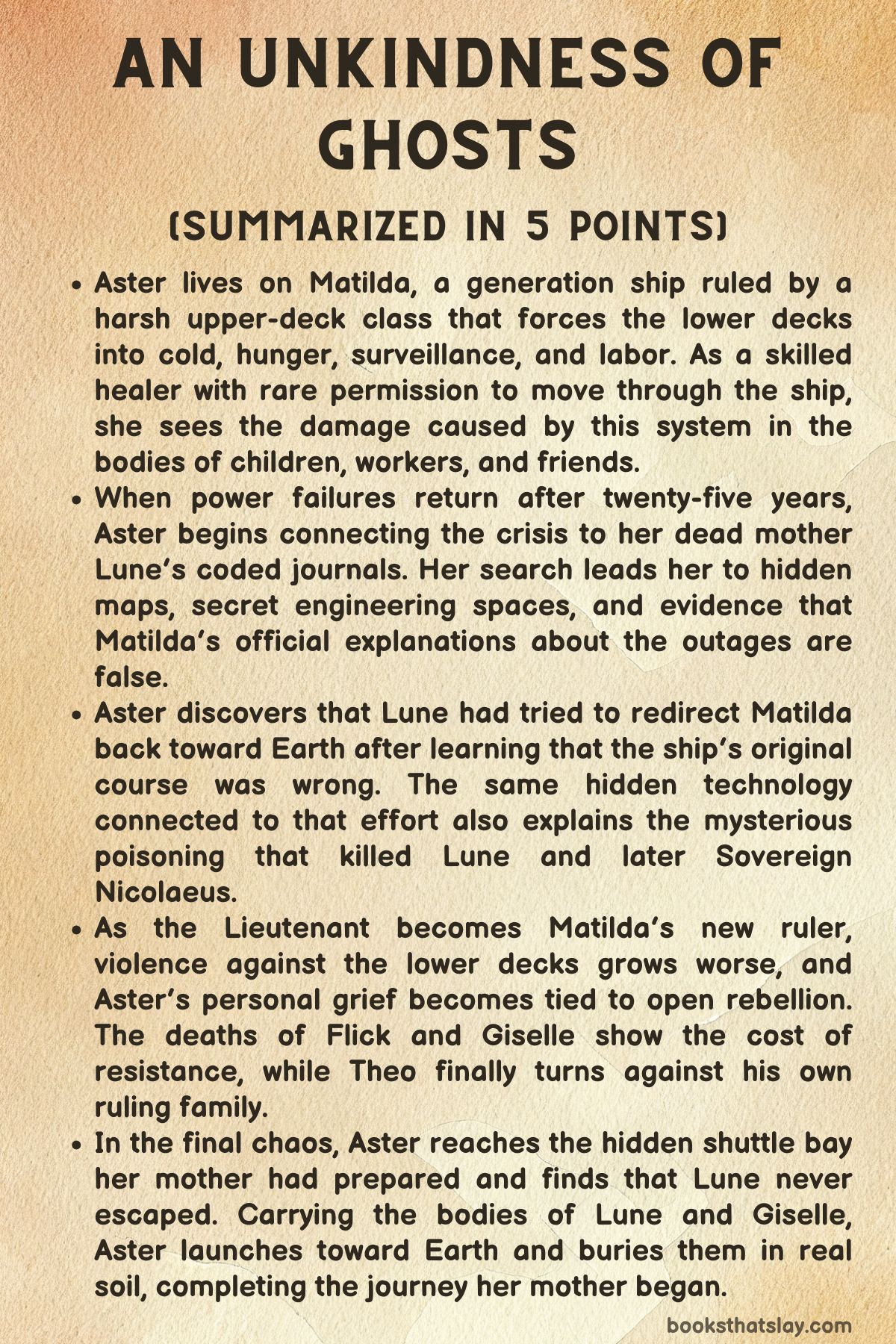
Aster lives on Matilda, a huge generation ship whose people have been traveling through space for generations. The ship is arranged as a rigid hierarchy.
The upper decks hold wealth, authority, warmth, and military power, while the lower decks provide labor, food, and bodies for punishment. People from different decks rarely move freely, and each lower-deck region has developed its own customs, language patterns, and social rules.
Aster comes from one of these lower decks, but she has an unusual pass that lets her travel because she is useful as a medical worker.
The lower decks are suffering through severe cold because of power shortages. This has happened before, twenty-five years earlier, around the time Aster’s mother, Lune, died.
Aster does not know exactly what happened to Lune, but she has her mother’s engineering journals and keeps them close. Aster is precise, difficult to intimidate, intensely observant, and often literal in her understanding of people.
She survives by studying, treating the sick, and hiding parts of herself from those who would use them against her.
At the beginning, Aster performs an amputation on Flick, a child whose foot has become gangrenous from the cold. The operation shows both Aster’s skill and the cruelty of Matilda’s system: a child is losing a foot because the ruling class allows the lower decks to freeze.
Flick’s elder gives Aster a cloak afterward, a gesture of care among people who have very little. Aster keeps the amputated foot, a choice that later becomes an act of protest.
Aster has a hidden botanarium in an abandoned part of the ship. It is one of the few spaces where she can think, experiment, and preserve life on her own terms.
Her closest friend, Giselle, finds her there. Giselle is brilliant in her own way, but unstable, wounded, and drawn toward danger.
She questions Aster about why the botanarium has heat when the rest of the lower decks do not. Aster knows the accusation is unfair, but she also understands the anger behind it.
She would warm the lower decks if she could. She would also destroy the upper-deck regime if she had the power.
Aster’s other important relationship is with Theo Smith, known as Surgeon. Theo belongs to the ruling class but is not fully safe within it.
He is the nephew of the Lieutenant, a powerful and vicious man who is expected to take control if the current Sovereign dies. Theo and Aster share medical work, intellectual respect, and a complicated bond that neither of them can easily define.
Theo asks Aster to help treat Sovereign Nicolaeus, who is suffering from strange symptoms: blindness, confusion, and mental disturbance. Aster refuses at first because Nicolaeus is part of the system that harms her people.
Theo warns her that the Lieutenant would be even worse.
Giselle notices that Nicolaeus’s symptoms resemble descriptions hidden in Lune’s journals. She also realizes that the journals are not just technical notes.
They are coded records containing personal and dangerous information. This discovery pushes Aster to study the notebooks more closely.
She begins to suspect that her mother understood the ship’s failures in ways no one else does.
Aster’s daily life remains shaped by violence. Guards inspect the bunks and punish lower-deck women at will.
One drunken guard attempts to assert control, but Aster uses her association with Theo to frighten him off. Later, during field labor under Matilda’s artificial sun, called Baby, Aster is injured in a mechanical accident.
She uses the injury as a chance to see Theo and to get access to the engineering area connected to Baby, where her mother once worked.
In the engineering section, Aster learns that the official explanation for the ship’s failures is false. Baby is functioning properly.
The outages are not simply the result of a failing artificial sun. One engineer suggests that a powerful magnet may be involved, both in the crisis twenty-five years ago and in the current disruptions.
Aster also sees that her mother’s map does not match the official maps. Lune had marked a hidden area, one that may hold the key to what happened.
Meanwhile, Nicolaeus dies, and the Lieutenant prepares to become Sovereign. Theo tells Aster about the death and asks whether she was involved.
She was not. He wants her help with the autopsy.
On her way through the ship, Aster encounters an upper-deck woman who gets lost and demands assistance. Aster refuses.
The woman complains to a guard, the same one Aster had humiliated earlier. He corners Aster and prepares to assault her.
Giselle appears with an old rifle and shoots him dead. The two escape through the ducts, but Giselle speaks cryptically, saying she has been with Aster’s mother.
At the autopsy, Aster’s inherited radiolabe, a device she thought was useless, activates near Nicolaeus’s body. She realizes that Nicolaeus and Lune were both killed by a rare heavy metal poisoning.
The substance, later identified as siluminium, has unusual properties connected to space, time, and the ship’s propulsion. This links Lune’s death to the ruling class and to Matilda’s hidden engineering systems.
Aster follows the clues to the secret area on her mother’s map. There she finds Giselle in a sealed-off shuttle bay.
The room contains Lune’s notes, star charts, and evidence that Lune had been trying to escape Matilda. It also has an unshielded window, like one in Nicolaeus’s chambers.
Exposure to radiation and siluminium explains the illnesses that killed both Nicolaeus and Lune. Aster learns that Matilda’s original course was badly miscalculated and that the ship has been operating on automatic pilot since a collision.
Lune had discovered the truth and tried to redirect the ship.
The larger truth becomes clearer: twenty-five years earlier, Lune used a powerful magnet to change Matilda’s course back toward Earth, known to the ship’s inhabitants as the Great Lifehouse. That action caused the previous power crisis.
Now Matilda is nearing its destination, and a braking system has activated, drawing power from the ship and causing the new outages. The suffering of the lower decks is not random.
It is tied to the hidden mechanics of the ship’s return.
As the Lieutenant becomes Sovereign, conditions worsen. The lower decks face more work, less food, and harsher religious control.
Aster attends the coronation disguised in Theo’s clothes, passing as a man to move safely among the upper decks. She leaves Flick’s preserved foot as a gift for the Lieutenant, with a message condemning the cold forced on the lower decks.
It is a quiet but dangerous act of defiance.
The Lieutenant responds with greater cruelty. He threatens Aster directly and warns her away from Theo.
Soon after, he stages a public execution meant to break the lower-deck people and punish Aster emotionally. Flick, already weakened and maimed by the system, is brought before the crowd and killed for minor offenses.
Theo tries to stop it but fails. The lower-deck crowd resists and is beaten back.
Aster is devastated and retreats into silence in her botanarium.
Aster later returns to action. With Theo’s help, she attends an upper-deck lecture in disguise and traces the name Ludnecki, which appears in connection with a missing book about light-speed travel.
She meets Cassidy Ludnecki, who leads her toward Seamus Ludnecki. Seamus had known Lune and helped her work on shuttles.
He gives Aster books that help her understand Lune’s plan and the mechanics behind Matilda’s return to Earth.
Aster, Giselle, and their bunkmates begin preparing for rebellion. Giselle helps assemble old rifles based on the weapon she used before.
Aster’s search for answers is no longer only about her mother. It has become part of a larger uprising against the ship’s rulers.
But the risks grow. The Lieutenant’s guards capture Aster, and he smashes her hand with a hammer.
Theo treats her afterward, and the two finally admit their love for each other.
Giselle, meanwhile, is breaking under the pressure of trauma, jealousy, and despair. She visits Aster’s botanarium, reads letters between Aster and Theo, and sets a fire that she hopes will destroy both the space and herself.
Theo saves her, but she is captured. The Lieutenant plans to execute her publicly.
Aster and Theo devise a plan to save Giselle by replacing the execution poison with an anesthetic that will make her appear dead. But the plan fails when the Lieutenant changes the method to hanging at the last moment.
A fight breaks out. Giselle is killed by a knife in the Lieutenant’s hand.
When the Lieutenant turns his threat toward Aster, Theo kills him with the poison meant for Giselle. The crowd erupts against the guards, and the rebellion finally breaks open.
In the chaos, the lower-deck people guide Aster to the shuttle bay. A shuttle is ready for her departure, prepared through the work and knowledge Lune left behind.
Inside, Aster finds her mother’s bones. Lune never escaped Matilda.
Aster takes Lune’s body and Giselle’s body with her. After struggling with the controls, she enters the override and sends the shuttle toward Earth.
The journey is brief. Aster lands and buries her mother and Giselle in real soil.
The ending does not erase the violence that brought her there, nor does it show the full fate of everyone left on Matilda. But Aster completes the path her mother began.
She carries the dead with her, reaches the planet that had become almost mythical to the people of the ship, and claims a future outside the machine that tried to own her.
Characters
Aster
Aster is the central force of An Unkindness of Ghosts, a character defined by intelligence, discipline, anger, tenderness, and survival. She lives under a system designed to reduce lower-deck people to laboring bodies, yet she refuses to let the ruling order define the limits of her mind.
Her medical skill is one of her most visible strengths, but her deeper power lies in her ability to observe patterns others miss. She reads bodies, machines, coded journals, maps, chemical reactions, and social danger with the same alert seriousness.
Aster’s literal way of thinking often separates her from others emotionally, but it also gives her a rare clarity. She does not soften the truth for comfort, and she does not mistake cruelty for order.
Her journey is not simply about solving her mother’s death; it is about understanding the machinery of oppression and finding a way beyond it.
Aster’s relationship with care is complicated. She heals people, amputates Flick’s foot to save their life, treats injuries, and protects her bunkmates when she can.
Yet she is not sentimental about her role. She knows healing has limits when the system keeps producing wounds faster than she can mend them.
Her preserved botanarium shows another part of her: she wants to create and protect life, even in a ship built on deprivation. Her eventual escape to Earth does not feel like a simple victory.
It is marked by grief, death, and inheritance. Aster carries Lune’s unfinished work and Giselle’s body with her, suggesting that survival is never purely individual.
She becomes the one who completes a path opened by the dead.
Giselle
Giselle is one of the most troubled and emotionally charged figures in the book. She is Aster’s closest friend, almost a sister, but their bond is marked by pain, envy, dependence, loyalty, resentment, and love.
Giselle’s instability is not presented as an isolated personal flaw; it is tied to the violence she has endured and the ship’s ongoing brutality. She has been harmed so often that her understanding of herself becomes fragmented.
Her actions can be reckless and destructive, but they also carry a desperate honesty. She sees things that others refuse to name, and she often pushes Aster toward uncomfortable truths.
Giselle’s violence is both defensive and tragic. When she shoots the guard who threatens Aster, she saves Aster’s life.
When she later burns the botanarium, the act comes from jealousy, despair, and a desire to destroy the neatness and order Aster clings to. Giselle cannot accept being left behind emotionally, and Theo’s bond with Aster deepens her sense of abandonment.
Still, she is not only a symbol of damage. She is clever, brave, and essential to the rebellion’s preparation.
Her death is devastating because it shows how rebellion can begin too late for some of the people most harmed by the old order. Giselle’s body goes with Aster to Earth, making her part of the future even though she does not live to see it.
Theo Smith
Theo Smith occupies a difficult and morally strained position in An Unkindness of Ghosts. As a member of the upper decks and the nephew of the Lieutenant, he benefits from the same structure that crushes Aster and the lower-deck people.
Yet he is also alienated within that structure because of his gender expression, emotional nature, and refusal to fully become what his family expects. Theo is compassionate and intelligent, but his compassion is limited by his position.
He often wants to protect Aster, but protection from within the ruling class can easily become control. His love for her is sincere, yet it exists inside a political imbalance he cannot completely erase.
Theo’s self-punishment reveals the depth of his internal conflict. He feels guilt for what he is, what he has, and what he cannot prevent.
His relationship with Aster grows through shared medicine, shared knowledge, and mutual recognition, but it is never free from danger. He admires her mind and repeatedly acknowledges her brilliance, which matters in a world that tries to deny lower-deck people intellectual authority.
His final act of killing the Lieutenant marks a break from hesitation. Theo moves from sympathy to direct rebellion, though the act comes after great loss.
He is not the savior of the story, but he becomes someone who chooses, at last, to betray the power that raised him.
Lune
Lune, Aster’s mother, is physically absent for most of the novel, but her presence shapes nearly every major discovery. She is a scientist, engineer, mother, rebel, and ghostly guide whose work outlives her.
Through her coded journals, hidden maps, preserved notes, and star charts, she becomes both a mystery and a mentor to Aster. Lune understood Matilda’s true condition long before others did.
She discovered that the ship’s path was wrong and took action to redirect it toward Earth, even though the consequences brought suffering, danger, and eventually her own death.
Lune’s character is powerful because she represents a form of rebellion rooted in knowledge. She does not only resist through anger; she resists by calculating, recording, planning, and preserving information.
Her secret shuttle bay shows that she was searching for escape, but finding her bones there changes the meaning of that dream. She never reached freedom herself.
Instead, she left behind the tools that might allow someone else to do so. As Aster uncovers Lune’s work, she also learns that inheritance is not only blood or memory.
It can be a set of unfinished instructions, a hidden map, a coded warning, and a responsibility to continue what the previous generation could not complete.
Melusine
Melusine is a mother figure whose life shows the emotional cost of Matilda’s racial and class hierarchy. She raised Aster and Giselle, but she is also Theo’s biological mother, though he was taken from her because he could pass among the upper decks.
This gives her character a painful double vision. She has lost a child to the ruling order, yet she also understands that his removal may have spared him some of the suffering forced on lower-deck children.
Her feelings toward Theo are therefore mixed: grief, relief, longing, distance, and guarded care all exist together.
Melusine’s role as a nanny to upper-deck children sharpens the cruelty of the ship’s social structure. She is trusted to care for the children of the powerful while being denied full claim to her own son.
Her labor is intimate but not honored. She helps Aster by finding books and by maintaining connections that become important to the search for Lune’s truth.
She is not a loud revolutionary, but her actions matter. She preserves, nurtures, remembers, and quietly supports those who may be able to change things.
In a novel full of violence, Melusine represents the endurance of care under conditions meant to break it.
Lieutenant
The Lieutenant is the clearest human face of organized cruelty in the book. He is not merely a bad man who abuses power; he is a person shaped perfectly for a system that rewards domination.
His violence is political, personal, and theatrical. He wants obedience, but he also wants humiliation.
His threats against Aster, his execution of Flick, and his treatment of the lower decks are designed to remind everyone that the ruling class controls not only labor and food, but also fear, dignity, and life itself.
What makes the Lieutenant especially dangerous is that he believes cruelty is a form of order. He sees lower-deck people as beings to be disciplined rather than as full people.
His disgust toward Aster is intensified by the fact that she refuses the role assigned to her. She is too intelligent, too defiant, too connected to Theo, and too close to the truth.
His hatred of her is therefore also a fear of what she represents. When Theo kills him, the act carries symbolic force because it ends more than one man’s life.
It strikes at the family structure, political hierarchy, and ideology that protected him.
Sovereign Nicolaeus
Sovereign Nicolaeus is important less for his active presence than for what his illness and death reveal. As Matilda’s ruler before the Lieutenant, he represents the established upper-deck order, but he is also a victim of the same hidden forces that killed Lune.
His symptoms connect the ruling chambers to dangerous exposure, secret technologies, and the ship’s buried history. Through Nicolaeus, the novel shows that power does not always protect its holders from the consequences of the systems they maintain.
Nicolaeus’s death opens the way for the Lieutenant’s rise, which proves Theo’s warning correct: one oppressive ruler can be replaced by someone even more brutal. His body becomes evidence.
During the autopsy, Aster discovers the heavy metal poisoning that links him to Lune. In that sense, Nicolaeus becomes useful only after death, when his body tells a truth the living regime would conceal.
He is not presented as sympathetic, but his decline shows that Matilda’s leadership is not in control of the forces beneath its own authority. The ship’s secrets have been poisoning both the oppressed and the powerful, though never equally.
Flick
Flick is a child whose suffering gives the book one of its clearest images of lower-deck cruelty. Their gangrenous foot is not just a medical problem; it is the result of neglect, cold, scarcity, and political indifference.
Aster’s amputation saves their life temporarily, but it cannot save them from the wider system. Flick’s later execution by the Lieutenant is meant to frighten the lower decks and punish Aster emotionally.
That makes Flick both a person and a symbol of the regime’s willingness to destroy the vulnerable in public.
Flick’s role is brief but deeply important. Through them, the story shows that oppression is not abstract.
It enters the body as frostbite, infection, hunger, disability, fear, and death. The preserved foot becomes a message that the ruling class cannot ignore.
When Aster leaves it for the Lieutenant, she turns evidence of suffering into accusation. Flick’s death also marks a turning point for Aster.
It intensifies her grief and guilt, but it also helps move the story toward open revolt. Flick represents the children sacrificed by systems that demand obedience and labor while refusing basic care.
Seamus Ludnecki
Seamus Ludnecki is a quiet but important link between Lune’s hidden past and Aster’s present investigation. He once knew Lune through practical work, helping her with shuttles while also protecting his own secret trade in false identities.
This places him in the morally gray middle of Matilda’s society. He is not a heroic rebel in a grand sense, but he participates in small illegal systems that allow people to move, hide, or survive outside official control.
Seamus matters because he preserves knowledge. The books he received from Lune help Aster understand the ship’s course, the light-speed technology, the magnet, and the truth behind the power disruptions.
He shows that resistance often depends on people who keep records, pass along objects, and remember debts. His connection to Lune also helps humanize her.
She was not working entirely alone; she formed practical alliances with people who had their own risks and motives. Seamus’s contribution is not dramatic, but without the information he provides, Aster’s understanding of Matilda’s return to Earth would remain incomplete.
Cassidy Ludnecki
Cassidy Ludnecki serves as a bridge between social worlds. At first, he appears to belong more comfortably to the mid or upper sections of the ship, but Aster recognizes traces of lower-deck speech and behavior in him.
This recognition changes their interaction. Cassidy’s character shows that identity aboard Matilda is not always as fixed as the ruling order pretends.
People may pass, conceal origins, adapt speech, or move through uncertain social positions in order to survive.
Cassidy’s importance lies in guiding Aster toward Seamus. He is not central in terms of emotional weight, but he helps open a path to crucial knowledge.
His guardedness also makes sense within the world of the novel. Trust is dangerous, especially when class boundaries are watched and punished.
Cassidy’s presence reminds the reader that Matilda contains more than a simple divide between upper and lower decks. There are hidden crossings, compromised positions, and people whose lives complicate the official hierarchy.
Flick’s Great-Meema
Flick’s great-meema represents the older generation of lower-deck endurance. Her gift of a cloak to Aster after the amputation is practical, generous, and morally significant.
In a world where warmth is scarce, giving someone protection from the cold is an act of solidarity. She understands survival as a shared responsibility.
Her words and actions suggest a worldview shaped by deprivation but not emptied of dignity.
Her character also helps frame Aster’s medical work as part of a larger community. Aster may be unusually skilled, but she is not separate from the people she treats.
The cloak reminds her that care moves in more than one direction. Even those with very little can give something necessary.
Flick’s great-meema also carries spiritual patience, speaking of surviving long enough to see what the spirits have planned. This belief does not erase suffering, but it gives the lower-deck people a language for endurance beyond the ship’s official religion.
Themes
Oppression as a Built Environment
In An Unkindness of Ghosts, oppression is not only enforced through laws, guards, and punishments; it is built into the physical design of Matilda. The ship’s decks organize human value by height, access, temperature, food, and movement.
The upper decks receive comfort and authority, while the lower decks endure cold, hunger, surveillance, and forced labor. This structure makes inequality feel permanent because it is embedded in corridors, passes, work rotations, sleeping quarters, and heating systems.
Aster’s limited ability to travel between decks shows how controlled movement becomes a tool of power. Even language and culture are shaped by isolation, as different lower decks develop distinct customs and pronouns because people are kept apart.
The ship’s environment also turns neglect into bodily harm. Flick’s lost foot, Aster’s injuries, and the constant cold show that political decisions become medical realities.
The ruling class can claim that shortages are technical problems, but the book reveals that suffering is distributed according to hierarchy. Matilda’s architecture is therefore not neutral.
It is a social order made metal, machinery, and air. The rebellion must challenge not only individual rulers but the entire arrangement of space that allows some people to live by consuming the labor and bodies of others.
Knowledge, Secrecy, and Survival
Knowledge in the novel is dangerous because it gives the oppressed a way to see beyond the official story. Aster’s intelligence threatens the ruling order because she can read what others have hidden: wounds, symptoms, maps, journals, machines, and lies.
Her mother’s coded notebooks are central to this theme. Lune understood that truth could not be left in plain sight, so she buried it in engineering records that required patience and skill to interpret.
Aster’s investigation becomes an act of survival because the ship’s authorities depend on ignorance. If the lower decks do not know why the power failures are happening or where Matilda is headed, they remain easier to control.
Secrecy serves both oppression and resistance. The rulers hide the ship’s true condition, the dangers of siluminium, and the history of Lune’s intervention.
At the same time, lower-deck people hide weapons, identities, journals, routes, medical skills, and forbidden relationships. The difference lies in purpose.
The ruling class uses secrecy to preserve domination, while Aster and her allies use it to preserve life and create the possibility of escape. The search for knowledge is not presented as detached curiosity.
It is practical, urgent, and political. To learn the truth is to recover choices that the system tried to remove.
The Body as Evidence of Power
Bodies in the story carry the record of Matilda’s violence. The ruling class may use religion, rank, and procedure to justify its control, but the truth appears in damaged flesh.
Flick’s gangrenous foot reveals the cost of cold and neglect. Giselle’s injuries reveal the routine sexual and physical violence used against lower-deck people.
Aster’s smashed hand shows the Lieutenant’s desire to punish not only her body but also her skill, since her hands are instruments of healing and knowledge. Nicolaeus’s poisoned body, examined after death, exposes a hidden connection between the ship’s leadership, dangerous technology, and Lune’s fate.
Aster’s role as a healer makes this theme especially powerful. She understands bodies scientifically, but she also understands that wounds have social causes.
Treating an injury is never enough when the same structure keeps producing more injury. The body becomes a kind of archive, preserving truths that official records deny.
Amputation, caning, poisoning, hunger, rape, and execution are not isolated acts. They are methods through which power writes itself onto people.
Yet bodies also resist. They heal, run, hide, fight, disguise themselves, and carry memory.
Aster’s escape with Lune’s and Giselle’s bodies insists that the dead are not discarded evidence. They are witnesses.
Inheritance, Memory, and Unfinished Freedom
Aster’s journey is shaped by what previous generations leave behind. Lune does not give her daughter safety, but she leaves maps, coded records, scientific insight, and an unfinished route to Earth.
This inheritance is difficult because it comes with grief and unanswered questions. Aster must learn who her mother was through fragments, and each discovery brings both intimacy and pain.
Lune becomes more than a lost parent; she becomes proof that someone before Aster saw the ship clearly and tried to change its fate. The past is not dead in the novel.
It is hidden in journals, bones, books, tools, and stories that continue to act on the present.
Memory also belongs to the community. Melusine remembers children taken and children raised.
Giselle carries memories of harm that shape her unstable present. The lower decks carry cultural memory through language, rituals, and shared survival.
Freedom, then, is not achieved by one person simply escaping alone. Aster reaches Earth because of Lune’s work, Giselle’s protection, Theo’s final break from his family, Melusine’s care, Seamus’s preserved books, and the rebellion of the lower decks.
The ending honors unfinished freedom rather than easy closure. Aster’s burial of Lune and Giselle in real soil suggests that memory must be carried into any future worth having.