Apeirogon by Colum McCann Summary, Characters and Themes
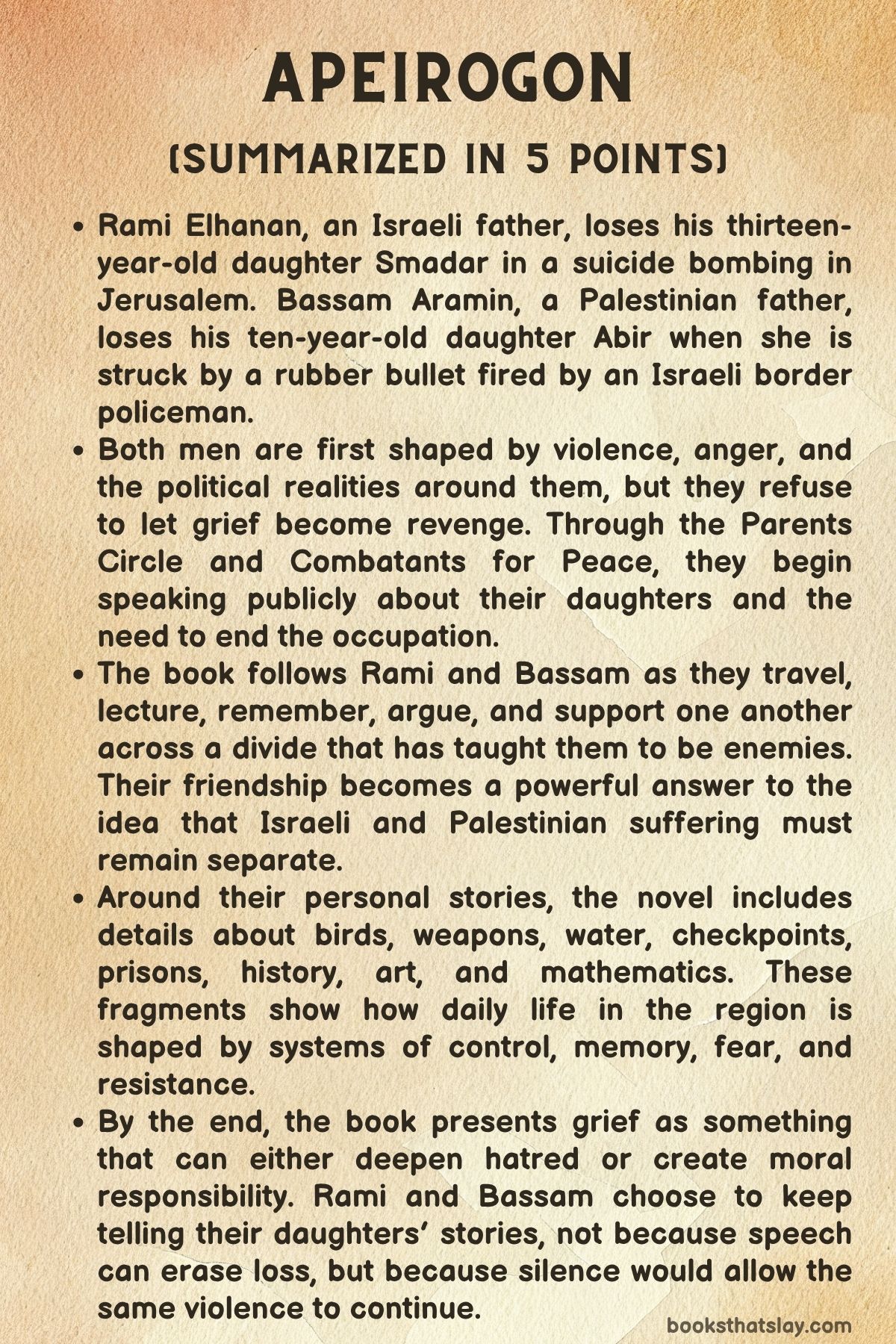
Apeirogon by Colum McCann is a novel built from history, memory, grief, politics, and testimony. At its center are two real men: Rami Elhanan, an Israeli father whose daughter Smadar is killed in a suicide bombing, and Bassam Aramin, a Palestinian father whose daughter Abir is killed by a rubber bullet fired by an Israeli border policeman.
McCann shapes their lives through fragments, facts, images, and personal stories, showing how loss can harden people or push them toward moral courage. Apeirogon is about friendship across an imposed divide, and about choosing speech over revenge.
Summary
Apeirogon follows the lives of Rami Elhanan and Bassam Aramin, two fathers from opposite sides of the Israeli-Palestinian conflict who become bound by the same unbearable wound: the death of a daughter. Rami is Israeli, a former soldier, a graphic designer, a husband, and a father.
Bassam is Palestinian, a former prisoner, a peace activist, a husband, and a father. Their stories move through war, occupation, memory, family life, imprisonment, public speaking, and private grief, gradually showing how two men trained by history to see one another as enemies come to call each other brothers.
The book opens with Rami riding his motorcycle through the West Bank. He is older now, practiced in crossing difficult roads, passing through spaces shaped by checkpoints, soldiers, walls, delays, and suspicion.
He notices that his watch and the clock on his motorcycle are an hour apart, a small sign of the absurd division between Israel and Palestine, where even time can be split by politics. He is on his way to meet Bassam, and the journey becomes a frame for the larger story of both men’s lives.
Bassam’s daughter Abir is ten years old when she is shot in the back of the head by a rubber bullet while walking near her school in Anata. She had gone to buy candy.
The bullet crushes her skull. Bassam races with her toward medical help, but the road is blocked, and every delay becomes another form of violence.
The ambulance and the family must navigate traffic, checkpoints, permissions, fear, and confusion. Abir is eventually transferred to Hadassah Hospital in Ein Kerem, but she survives only a short time.
Bassam and his wife, Salwa, are left with the shock of a child who had been gifted, lively, and full of promise being reduced by the state to a dispute over evidence.
Abir’s death is followed by misinformation. Officials claim no shots were fired, or suggest she was hit by a stone.
Bassam refuses to accept these claims. He insists on an autopsy, pays for it himself, and begins a legal struggle to prove how his daughter died.
It takes years before a court recognizes that Abir was killed by a rubber bullet fired by an Israeli border policeman. The family receives compensation, but the money has no power against the loss.
Bassam’s fight is not about payment. It is about truth, dignity, and the right to say clearly what happened.
Rami’s daughter Smadar dies ten years before Abir, in 1997, in a suicide bombing in Jerusalem. She is thirteen.
Rami hears news of the bombing while driving and begins calling home, trying to account for everyone in his family. He learns that Smadar had gone downtown.
He and his wife, Nurit, rush to the scene. In the chaos after the explosion, they search for her and eventually find her body.
The bombing kills several people, and the street is filled with emergency workers, body parts, rumors, and panic. Smadar’s face is largely unharmed, and investigators believe she may have had her back turned or may have been running away when the blast reached her.
After Smadar’s death, Rami is consumed by rage. His first thought is revenge.
He admits that he once saw Palestinians as distant and abstract, people outside the circle of his own pain. But revenge does not answer the questions that begin to press on him.
Killing someone else will not bring Smadar back. Causing another family to suffer will not reduce his own suffering.
This realization leads him to the Parents Circle, a group of bereaved Israelis and Palestinians who have lost family members in the conflict and choose dialogue instead of retaliation. At first, Rami cannot understand how a Palestinian parent’s grief could stand beside his own.
Then he sees a Palestinian woman holding a photograph of her dead child, and something changes. Her grief is not foreign.
It is the same grief.
Bassam’s path to peace work begins from a different place. As a young man, he resists the Israeli occupation and is arrested after taking part in militant activity.
He spends seven years in prison, where he is beaten, humiliated, and stripped of freedom. Yet prison also becomes a place of education.
Bassam learns Hebrew so he can understand guards and doctors. He studies English, geography, Zionist history, politics, and resistance.
He encounters ideas of civil disobedience and begins to understand that force alone cannot lead to freedom. One important moment comes when he sees a documentary about the Holocaust.
Until then, he had believed the Holocaust was a false story used by Jews. Watching the film forces him to confront Jewish suffering as real.
He later says that Palestinians became victims of victims, a recognition that does not erase Palestinian pain but complicates the moral field around it.
In prison, Bassam also forms an unlikely connection with a guard named Hertzl Shaul. Their early relationship is tense, but it slowly changes through conversation, poetry, and small acts of protection.
Hertzl refuses to participate in some of the violence against prisoners and even shields Bassam from a blow. This relationship becomes one of the book’s early signs that human contact can resist the machinery of hatred, even inside a brutal system.
After his release, Bassam marries Salwa and builds a family. Abir becomes one of their children, bright, playful, strong in memory and mathematics.
Bassam eventually helps found Combatants for Peace, a group made up of former fighters from both sides who reject violence and oppose the occupation. Through peace activism, he enters the same moral world that Rami later joins through bereavement.
The two men meet at a gathering connected to Combatants for Peace and the Parents Circle. Their first meetings are shaped by caution, pain, and the weight of their histories, but over time they become close.
They travel together, speak together, and learn each other’s stories so well that each can finish the other’s account.
The book gives special attention to the act of telling. Rami repeats the story of Smadar’s death again and again because speaking keeps her present and makes his grief useful.
Bassam also tells Abir’s story repeatedly, often holding the candy bracelet she had bought before she was shot. On one hot day, the candy stains his hand pink, and police later detain and question him because pink residue can be associated with explosives.
This detail captures the cruelty and absurdity of living under suspicion: even a father holding his dead daughter’s candy can be treated as a threat.
Both fathers become public witnesses. They speak in schools, halls, meetings, and foreign countries.
They face sympathy, anger, protest, and disbelief. Some listeners are moved; others accuse them of betrayal.
Bassam tells audiences that he does not hate Jews and does not hate Israel, but he hates the occupation and the daily humiliation it creates. Rami says that silence supports the system that killed his daughter.
Both men come to believe that the occupation destroys Palestinians directly and corrupts Israelis morally. Their activism is not sentimental.
It is difficult, repetitive, exhausting work carried out by men who know that peace language can sound weak beside bloodshed, yet choose it because they have seen where revenge leads.
The novel widens beyond the two men into history, science, art, weapons, birds, water, mathematics, and memory. Migrating birds cross the same sky that soldiers, drones, bullets, and surveillance systems occupy.
Slingshots, once used to protect flocks, become weapons. Tear gas made in the United States reaches Palestinian streets.
Rubber bullets, rifles, checkpoints, walls, and riot-control technologies become part of everyday life. The Jordan River weakens under human control, and Palestinian families conserve water while soldiers sometimes shoot water tanks for sport.
These details show that the conflict is not only an event but an environment.
Rami’s own past includes military service in the Yom Kippur War. He drives through fear, death, and confusion, carrying ammunition and bodies.
At one point he fights with a Kalashnikov, the enemy’s gun, and kills a soldier. He never tells Smadar this.
His life after the war seems ordinary for a time: marriage to Nurit, children, work, family routines. But beneath ordinary life is a country shaped by recurring violence.
Nurit, herself a fierce critic of Israeli policy, refuses to let political leaders use Smadar’s death for nationalist symbolism. When Benjamin Netanyahu sends gifts of condolence, she and Rami reject the gesture, even smashing one bowl and sending it back with a note that something is broken.
Bassam’s family also tries to continue after Abir’s death. Salwa keeps the household moving, cares for the children, and carries her own grief in quieter ways.
Abir’s height mark remains on a doorframe, and Bassam darkens it each year on her birthday. Even after the family moves, he feels that missing mark inside him.
A playground called Abir’s Garden is later built in Anata, giving local children a place to play in her memory. The garden stands against the fact of her death, not as compensation, but as a living refusal to let violence have the final word.
The book’s title refers to a shape with an infinite number of sides. An apeirogon can seem circular when seen as a whole, while a small section may look like a straight line.
This becomes a way to understand the book’s structure and its moral vision. Each fragment, fact, memory, and image is one side of a much larger form.
No single story can contain the conflict, and no single death explains all the others. Yet every point is connected.
Rami and Bassam’s friendship does not solve history, but it proves that movement is possible inside history.
By the end of Apeirogon, the central action remains simple: two fathers keep going. They ride roads, cross borders, speak to strangers, return home, answer messages, water gardens, and prepare to speak again.
Bassam texts Rami that he is home, and Rami answers that he will see him tomorrow. That small exchange carries the force of the book.
After prison, war, bombings, bullets, trials, public anger, and private sorrow, the men continue to choose each other. Their bond does not erase the dead.
It honors them by resisting the future that killed them.
Characters
Rami Elhanan
Rami Elhanan is one of the central figures in Apeirogon, and his character is built around the long, painful movement from rage to witness. He begins as an Israeli man shaped by his country’s wars, by military service, by family life, and by a political reality he has often accepted as ordinary.
His life changes permanently when his thirteen-year-old daughter, Smadar, is killed in a suicide bombing in Jerusalem. At first, his grief produces the desire for revenge.
He admits that he once saw Palestinians as distant, faceless, and separate from his own humanity. This honesty is crucial to his character because the book does not present him as naturally peaceful or morally pure.
Instead, he is a man who must fight his way out of inherited hatred and immediate anger.
Rami’s transformation begins when he joins the Parents Circle and encounters Palestinian parents who have also lost children. Seeing that their grief is equal to his own forces him to reconsider the boundaries he has been taught to accept.
His character becomes defined by the decision to speak, again and again, about Smadar’s death, not to keep himself trapped in suffering, but to turn suffering into moral action. He is repetitive because grief is repetitive.
He tells the same story because the world keeps producing the same violence. Rami is also marked by contradiction: he is a former soldier who becomes a peace activist, a grieving father who refuses revenge, an Israeli who condemns the occupation, and a man who carries both guilt and love.
His friendship with Bassam becomes one of the book’s strongest signs that personal loss can become a force against political cruelty.
Bassam Aramin
Bassam Aramin stands at the heart of the book as a Palestinian father, former prisoner, activist, and moral counterpoint to cycles of vengeance. His early life is shaped by occupation, anger, resistance, and imprisonment.
As a young man, he takes part in militant resistance and is arrested, then spends seven years in prison. The prison experience exposes him to humiliation, violence, and physical abuse, but it also becomes a place where his mind changes.
He studies Hebrew, learns about Zionism, reads, listens, thinks, and begins to understand the power of disciplined resistance. One of the defining moments in his development is his recognition of the reality of the Holocaust.
This does not weaken his Palestinian identity; rather, it deepens his understanding of suffering and history.
Bassam’s greatest wound is the death of his ten-year-old daughter, Abir, who is struck by a rubber bullet while on her way to buy candy. His response to her death shows the depth of his character.
He does not turn to revenge, though he has every reason to be furious. Instead, he insists on truth.
He demands an autopsy, fights the official denial of responsibility, takes the case to court, and refuses to let Abir’s death be hidden under false explanations. Bassam’s activism is grounded in dignity, not passivity.
He hates the occupation because he sees it as a system that degrades Palestinians and damages Israelis. His bond with Rami is not simple forgiveness; it is a deliberate political and human choice.
In Apeirogon, Bassam becomes a figure of disciplined grief, showing how pain can be shaped into resistance without surrendering to hatred.
Smadar Elhanan
Smadar Elhanan is physically absent from much of the novel, but emotionally she is one of its most powerful presences. She is Rami and Nurit’s daughter, thirteen years old when she is killed in a suicide bombing in Jerusalem.
The book remembers her not only through the fact of her death, but through small, living details: her face, her laughter, her hair, her interest in boys, her grandfather’s watch, her place in the family. These details matter because they protect her from becoming only a political symbol.
She is not merely a victim in an argument about Israel and Palestine; she is a child whose life had texture, movement, personality, and future.
Smadar’s death exposes the violence done not only to the body but to memory. Political leaders, news reports, and public narratives try to turn her death into something useful for their own purposes.
Nurit fiercely resists this, and Rami’s activism grows from a similar refusal. Smadar becomes the reason her father speaks, but he does not speak in order to justify more violence.
Her memory pushes him in the opposite direction. Through Smadar, the book asks what it means to honor the dead.
Rami’s answer is that honoring her cannot mean producing another grieving parent. Her character remains fixed in youth, but her influence keeps expanding through the lives of those who loved her.
Abir Aramin
Abir Aramin is Bassam and Salwa’s daughter, ten years old when she is killed by a rubber bullet. Like Smadar, she is not treated merely as a political casualty.
The book gives her a vivid place in the family: she is intelligent, playful, strong at memorization, gifted in mathematics, and full of ordinary childhood energy. She buys candy, plays with friends, wears dresses, goes to school, and has her height marked on a doorframe by her father.
These details make her death even more devastating because they emphasize the normal life that is violently interrupted.
Abir’s death also becomes a test of truth. The official attempts to deny or blur what happened reveal the coldness of systems that protect themselves at the expense of the dead.
Bassam’s struggle to prove that she was killed by a rubber bullet becomes a struggle to protect her reality from being erased. Abir’s presence continues after her death through the candy bracelet, the court case, the height mark, and Abir’s Garden, the playground built in her memory.
She represents the children whose lives are shaped by forces they did not create. Her character gives the book one of its clearest moral centers: no political explanation can justify the destruction of a child.
Nurit Peled-Elhanan
Nurit Peled-Elhanan, Rami’s wife and Smadar’s mother, is one of the strongest moral voices in the book. She comes from a prominent Israeli family and is the daughter of Matti Peled, a military general who later became a critic of the occupation.
Nurit’s grief after Smadar’s death is fierce, intelligent, and politically uncompromising. She refuses to let the Israeli state claim her daughter as a nationalist symbol.
When Benjamin Netanyahu tries to offer condolences and memorial gestures, Nurit rejects him because she sees the state’s policies as part of the system that produces the violence that killed Smadar.
Nurit’s character is defined by clarity. She does not soften her anger to make others comfortable.
Her scholarship, especially her work on representations of Palestine in Israeli schoolbooks, shows her commitment to exposing how children are taught to see others. This matters because the book is deeply concerned with inherited narratives: what children are told, what citizens are trained to believe, and how language prepares people for violence.
Nurit’s grief does not silence her; it sharpens her speech. She is not presented as gentle or conciliatory, and that is part of her power.
She insists that mourning must not become obedience.
Salwa Aramin
Salwa Aramin, Bassam’s wife and Abir’s mother, carries a quieter but deeply important form of strength in the book. Her grief is not always public in the same way Bassam’s is, but it shapes the emotional life of the Aramin family.
When Abir is injured, Salwa is thrown into fear, confusion, and helpless waiting, trying to find out where her daughter and husband are. After Abir’s death, she continues the hard work of keeping the family alive in daily ways.
She cares for the children, preserves routines, and faces the absence of her daughter inside the home.
Salwa’s character shows how political violence enters domestic life. It is not confined to the street, the checkpoint, the courtroom, or the lecture hall.
It follows families into clothing, meals, birthdays, doorframes, and memories. Her act of dressing Hiba in Abir’s clothes as the younger girl grows older shows grief moving through the body of the family.
Salwa also represents the private cost behind public activism. Bassam speaks across the world, but Salwa lives with the same loss in the intimate spaces of motherhood.
Her presence reminds the reader that survival after a child’s death is not one grand act, but a long sequence of ordinary tasks performed under the weight of absence.
Elik Elhanan
Elik Elhanan, Rami’s son, plays a significant role as a bridge between Rami and the peace groups that change his life. He is the one who invites Rami into the world of Combatants for Peace, helping create the conditions under which Rami eventually meets Bassam.
Elik’s place in the book also shows how grief affects siblings, not only parents. Smadar’s death is not simply Rami and Nurit’s tragedy; it marks the entire family and changes the emotional structure of their lives.
Elik’s military background also connects him to the larger Israeli system that the book examines. Like many young Israelis, he is shaped by compulsory service and by the practical lessons of soldiering, including how to manage fear, discipline, and survival.
Yet he is not reduced to that role. His involvement with peace work suggests a younger generation trying to find another language beyond military duty and inherited suspicion.
Through Elik, the book shows that families are not fixed political units. A son can lead a father toward a room where enemies become mourners, and mourners become partners.
Yigal Elhanan
Yigal Elhanan is Rami and Nurit’s younger son, only a child when Smadar is killed. His character matters because he represents the siblings who grow up in the shadow of loss.
A child who loses an older sister does not experience grief in the same way as an adult, but the loss becomes part of his development. He grows into a world where family memory, public politics, and private sorrow are inseparable.
When Yigal later speaks alongside Araab, Bassam’s son, the moment carries great emotional force. The two sons stand as living witnesses to two families damaged by different forms of violence.
Their shared appearance suggests that grief is inherited, but also that response can be chosen. Yigal’s presence in the book helps broaden the meaning of bereavement.
It is not only the parents who must decide what to do with pain. The children who remain must also learn how to live beside absence and how to understand the choices their parents make in the name of the dead.
Araab Aramin
Araab Aramin, Bassam and Salwa’s son, is important both as Abir’s brother and as a young Palestinian growing up under occupation. As a child, he is once caught throwing stones, and Bassam reacts with anger, making him promise on the Qur’an that he will not take part in riots.
This moment reveals Bassam’s fear that his son could be pulled into the same cycle of anger, confrontation, punishment, and imprisonment that marked Bassam’s own youth. Araab’s character therefore reflects the pressure placed on Palestinian children, who grow up surrounded by soldiers, checkpoints, humiliation, and the constant temptation to answer force with force.
When Araab later speaks publicly alongside Yigal, his role changes from endangered child to witness. He becomes part of the next generation forced to carry the memory of a dead sister.
His character shows how violence keeps moving outward from the original event. Abir’s death does not end with Abir.
It enters her brother’s identity, his family’s future, and the moral education his father tries to give him. Araab’s presence makes clear that Bassam’s activism is also an attempt to protect the living children from being consumed by the same system that killed Abir.
Hiba Aramin
Hiba Aramin, Abir’s younger sister, appears as a child who grows up in the space left by Abir’s death. Her character is especially moving because she is connected to Abir through clothing, memory, and family grief.
Salwa dressing Hiba in Abir’s clothes shows how the dead remain present in the lives of the living. Hiba is not a replacement for Abir, but her body becomes a painful reminder of the life Abir was not allowed to continue.
Through Hiba, the book shows how a family’s grief changes over time. As she grows older, the gap between her life and Abir’s frozen childhood becomes more visible.
Hiba continues into ages and stages that Abir never reached. This creates a quiet form of sorrow for her parents, who must love the child before them while remembering the child who is gone.
Hiba’s role is not large in terms of action, but emotionally she helps show how death remains active inside a household long after public attention has moved elsewhere.
Matti Peled
Matti Peled, Smadar’s grandfather and Nurit’s father, is a complex figure because he embodies both Israeli military power and later political dissent. As a general, he is connected to the military history of Israel and to the strategies that helped shape the region’s modern conflicts.
Yet he later becomes a critic of the occupation and a supporter of peace. This contradiction makes him one of the book’s most important background figures.
He shows that people are not locked forever into the politics of their past.
His influence on Smadar is tender and personal. He teaches her English and Arabic, and his watch becomes an object of memory after his death.
Smadar’s attachment to the watch connects family history, time, inheritance, and loss. Matti’s burial beside Smadar strengthens the sense that generations are linked by both love and political consequence.
His character also helps explain Nurit’s courage and clarity. She inherits not only a military legacy but also a willingness to challenge the state from within Israeli society.
Hertzl Shaul
Hertzl Shaul, the prison guard who develops a relationship with Bassam, is a minor character with major symbolic importance. At first, he belongs to the system that imprisons and controls Bassam.
He is a guard, and Bassam is a prisoner. Their relationship begins within a clear imbalance of power.
Yet Hertzl gradually becomes someone capable of seeing Bassam as a human being rather than merely as an inmate or enemy. Their bond over poetry and conversation allows a small space of recognition to open inside the prison.
Hertzl’s refusal to join in certain acts of abuse makes him stand apart from other guards. When he protects Bassam from being beaten, he risks violence from his own side.
This act matters because the book repeatedly asks what it means to resist the role assigned to you. Hertzl does not dismantle the prison system, but he refuses complete obedience to its cruelty.
His character suggests that moral action can begin with a single interruption, a single refusal, a single moment of placing one body between another person and harm.
Yitzhak Frankenthal
Yitzhak Frankenthal is the founder of the Parents Circle and one of the people who helps redirect Rami’s grief. He has also lost a child, and this gives him the authority to approach Rami not with abstract peace slogans but with the knowledge of bereavement.
His invitation to Rami becomes a turning point. Through him, Rami enters a room where Israeli and Palestinian parents sit together with photographs of their dead children.
Frankenthal’s character represents organized grief transformed into public action. He understands that mourning can isolate people, but it can also connect them if given the right structure.
The Parents Circle becomes a place where grief is not ranked by nationality. This is crucial to Rami’s awakening, because he initially doubts whether Palestinian suffering can be equal to his own.
Frankenthal helps create the conditions in which that false separation breaks down. His role in the book is brief compared with Rami and Bassam’s, but his influence is lasting.
Youssef Shouli
Youssef Shouli is associated with the suicide bombing that kills Smadar, and his character is presented with disturbing complexity. He is not treated only as a faceless killer.
The book includes details about his background, including his study of graphic art and his interest in making art from protest materials. He is arrested and imprisoned before the bombing, and his life is shaped by political anger, punishment, and radicalization.
This complexity does not excuse his actions. Smadar’s death remains devastating and unjustifiable.
But the book’s treatment of Youssef shows how people who commit violence also come from histories, pressures, choices, and systems. His character forces the reader to confront a difficult truth: understanding the conditions that produce violence is not the same as forgiving violence.
In Apeirogon, Youssef represents the terrifying point at which humiliation, ideology, revenge, and death become fused into a single act that destroys innocent lives.
Michael Sharia
Michael Sharia, the ambulance driver involved in the attempt to save Abir, appears later as a man still carrying the memory of that day. During one of Bassam and Rami’s lectures, he recognizes Bassam, is overcome with emotion, and later sends a donation to the Parents Circle.
His character shows that traumatic events affect more than the immediate family. Witnesses, drivers, doctors, bystanders, and helpers also carry fragments of the dead.
Michael’s later gesture is quiet but meaningful. He does not try to make himself central.
He simply acknowledges the connection and offers support. In a book filled with public speeches, court cases, and historical accounts, his character represents the private burden of having been present at someone else’s worst moment.
His grief is secondary, but it is real. He becomes part of the wider circle of people marked by Abir’s death.
Munib al-Masri
Munib al-Masri appears as a wealthy Palestinian whose home and archaeological discovery add another layer to the book’s treatment of history, identity, and perception. When workers building his house discover ancient remains, he preserves the site and raises the house above it, turning the discovery into something public.
His wealth and polished appearance surprise people who hold narrow assumptions about Palestinians, and this reaction frustrates him.
His character challenges stereotypes. He represents a Palestinian identity that outsiders do not always expect: cosmopolitan, wealthy, historically conscious, and deeply connected to place.
The ancient monastery beneath his house also reflects one of the book’s repeated concerns: the land is crowded with histories that cannot be reduced to one people’s claim or one moment’s politics. Munib’s role is not central to the plot, but he helps widen the book’s sense of Palestinian life beyond victimhood alone.
Benjamin Netanyahu
Benjamin Netanyahu appears not as a fully developed private character but as a political figure whose presence sharpens the moral anger of the Elhanan family. After Smadar’s death, he contacts Nurit, but she refuses to receive him as a mourner.
To her, his condolences cannot be separated from policies and political choices that continue the conditions of violence. His repeated memorial gestures, including gifts sent to the family, are received not as comfort but as an attempt by the state to claim Smadar’s death.
In the book, Netanyahu functions as a symbol of official power and public narrative. He represents the political habit of turning private grief into national justification.
Rami and Nurit’s rejection of his gestures shows their refusal to let Smadar be used in this way. His character’s importance lies less in personal psychology and more in what he reveals about the conflict between state memory and family memory.
John Kerry
John Kerry appears briefly but significantly when Bassam meets him in Boston. Bassam tells him that American power is not innocent in Abir’s death, pointing to the role of U.S. support, weapons, diplomacy, and political alignment in sustaining the conditions of occupation.
This moment places Bassam’s grief in an international frame. His daughter’s death is not only a local tragedy; it is linked to global systems of funding, policy, and responsibility.
Kerry’s role is important because he becomes a listener with power. Bassam’s confrontation is direct, but it is not theatrical.
It comes from a father who wants those far from the checkpoint and the hospital to understand their connection to what happened. Kerry’s promise not to forget cannot undo anything, but the scene shows Bassam’s ability to speak truth upward, even to powerful political figures.
His character’s presence helps show that the conflict is never only between two peoples living beside each other; it is also shaped by decisions made elsewhere.
Philippe Petit
Philippe Petit, the high-wire artist who performs in Jerusalem, appears in one of the book’s most memorable historical episodes. His walk across a divided space becomes a performance of balance, danger, and symbolic hope.
His search for doves and his discovery that there seem to be no doves in Jerusalem add an ironic sadness to the event. The bird he releases does not behave as expected, landing on his head instead of flying away, turning the intended symbol into something unpredictable.
Petit’s character functions as an artist trying to create an image of peace in a place where peace is difficult even to stage. His high-wire act mirrors the emotional and political balance required of figures like Rami and Bassam.
One wrong movement can be disastrous. Yet the attempt itself matters.
Petit’s presence adds a visual metaphor for the book’s larger concern with risk, performance, and the fragile possibility of crossing a divide.
Themes
Grief as a Force for Moral Action
Grief in the story does not remain only private, even though its deepest pain belongs to the family. Rami and Bassam both lose daughters, and each man must decide what shape that loss will take in the rest of his life.
Rami’s first instinct is revenge, which shows how grief can easily become another link in the chain of violence. His later decision to speak publicly marks a radical change: he turns mourning into witness.
Bassam’s grief follows a different path because he does not seek revenge after Abir’s death, but he does seek truth with relentless determination. He demands an autopsy, pursues the court case, and refuses official denial.
In both men, grief becomes active. It does not heal them in any simple sense, and it does not free them from sorrow.
Instead, it gives them a duty. Their speeches, travels, meetings, and friendship are all forms of mourning that have been given direction.
The book suggests that grief can either shrink the moral imagination or enlarge it. Rami and Bassam choose enlargement, but the choice is shown as difficult, costly, and ongoing.
The Human Cost of Occupation
Occupation is presented not as an abstract political condition but as an intimate force that enters bodies, homes, roads, schools, hospitals, and memories. It shapes how people travel, how children move through streets, how ambulances are delayed, how water is controlled, how families wait at checkpoints, and how ordinary actions become dangerous.
Bassam’s life is marked by imprisonment, humiliation, searches, surveillance, and the daily pressure of being treated as a threat. Abir’s death grows out of this environment, where a child buying candy can be placed in the path of state violence.
At the same time, the occupation damages Israeli life as well, though not in the same way or with the same power imbalance. Rami comes to believe that it corrupts the occupier by training people not to see Palestinians fully.
The book’s critique is therefore moral as well as political. It shows that domination does not stay outside the self; it changes language, fear, education, memory, and conscience.
Apeirogon argues through its characters that no lasting safety can be built on another people’s humiliation.
Seeing the Other as Human
The movement from abstraction to recognition is one of the story’s strongest concerns. Rami admits that before entering the Parents Circle, he did not truly see Palestinians as people whose suffering could equal his own.
They were distant to him, part of a political category rather than a human reality. That changes when he sees Palestinian parents holding photographs of their dead children.
Bassam’s development also involves a painful expansion of understanding. In prison, when he watches a documentary about the Holocaust, he is forced to recognize Jewish suffering as real, not as a story invented for political use.
These moments matter because they do not erase difference or injustice. Bassam remains Palestinian, Rami remains Israeli, and the power imbalance between their worlds remains central.
Yet both men refuse the lie that the other side’s grief is unreal. Their friendship is built on this recognition.
The book shows that dehumanization is not only hatred; it is also distance, simplification, and inherited language. To see the other clearly is not to abandon one’s own people.
It is to reject the moral laziness that makes violence easier.
Storytelling, Memory, and Resistance
Telling the story becomes one of the main forms of resistance in the novel. Rami and Bassam repeat their daughters’ stories in public because official narratives, media reports, political speeches, and legal systems often distort or erase the truth.
Smadar can be turned into a national symbol. Abir can be falsely described as the victim of a stone rather than a rubber bullet.
Against these distortions, the fathers insist on detail: the candy bracelet, the street, the hospital, the phone calls, the body, the height mark on the doorframe. Memory is not passive in the book.
It must be protected, spoken, corrected, and carried. The repeated telling also keeps the dead from becoming statistics.
Each account restores the child as a person with a family, habits, intelligence, and a future that was taken. Storytelling does not bring justice in a complete way, and it does not end the conflict.
Still, it pushes against silence. In a world where violence is often explained away, the act of saying exactly what happened becomes a moral obligation.