Arsenic and Old Lace Summary, Characters and Themes
Arsenic and Old Lace by Joseph Kesselring is a dark comedy about the strange Brewster family, whose charm hides a shocking secret. Set mostly inside the Brooklyn home of Abby and Martha Brewster, the story turns a respectable household into a stage for murder, mistaken sanity, family panic, and absurd moral logic.
Mortimer Brewster, a theater critic newly engaged to Elaine Harper, discovers that his beloved aunts have been quietly poisoning lonely old men as an act of “charity.” What follows is a fast, comic battle to control scandal, danger, and family madness before the police uncover the truth.
Summary
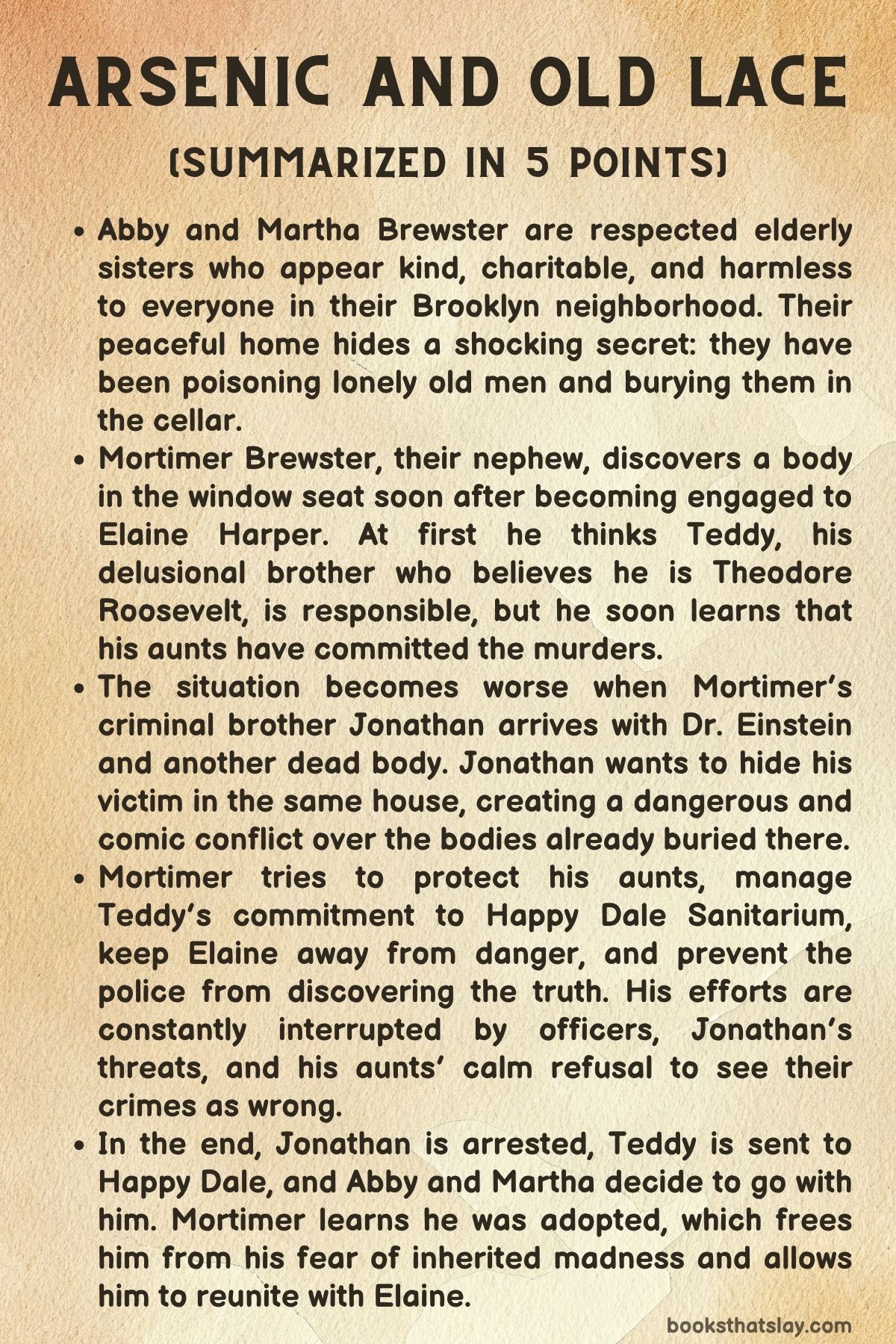
Arsenic and Old Lace begins in the Brewster family home in Brooklyn, where Abby and Martha Brewster are known in the neighborhood as gentle, generous, churchgoing women. They are elderly sisters who live with their nephew Teddy, a man who believes he is President Theodore Roosevelt.
Teddy’s harmless delusion has become part of the household routine. He charges up the stairs as if leading troops, blows a bugle, and digs in the cellar, believing he is working on the Panama Canal.
The sisters are visited by Reverend Dr. Harper, whose daughter Elaine is romantically involved with Mortimer Brewster, another of the sisters’ nephews. Harper is uneasy about Mortimer because Mortimer works as a theater critic and moves among actors, playwrights, and other people Harper considers unsuitable company for Elaine.
Abby and Martha, however, are delighted by the match. They are warm toward nearly everyone, and the neighbors and police officers who stop by treat them with deep respect.
Officers Brophy and Klein arrive to collect toys the sisters have prepared for charity, reinforcing the public image of the Brewster sisters as models of kindness.
Beneath this peaceful surface, the household is already strange. Harper has brought papers that will allow Teddy to be committed to Happy Dale Sanitarium after the sisters die.
Abby and Martha care for Teddy, but they understand that he will need supervision when they are gone. Soon after, Mortimer arrives and proposes to Elaine.
She accepts, and their engagement seems to promise happiness. Mortimer is excited to share the news with his aunts, who are thrilled.
The mood changes when Mortimer searches the house for notes connected to his writing. He opens the window seat and finds a dead body inside.
Horrified, he assumes Teddy must have killed the man, since Teddy’s behavior is the most obviously irrational thing in the house. Mortimer rushes to his aunts in panic, but Abby and Martha calmly explain that Teddy has nothing to do with the corpse.
They killed the man themselves.
Their explanation is both shocking and absurd. Abby and Martha have been poisoning lonely elderly men with elderberry wine laced with arsenic, strychnine, and cyanide.
They see this not as murder, but as a merciful service. Years earlier, a lonely old man died peacefully in their home, and the sisters decided that other isolated men deserved the same release.
They have since killed a dozen men and buried them in the cellar. Teddy digs the graves while believing he is digging locks for the Panama Canal.
The latest victim, Mr. Hoskins, is waiting in the window seat until he can be taken below.
Mortimer is horrified. His engagement has barely begun, and already he is trapped in a crisis involving murder, family loyalty, and fear of scandal.
Elaine returns for their theater date, but Mortimer is too distracted to explain what is wrong. He tries to send her away, and she becomes hurt and angry.
Meanwhile, Abby and Martha nearly poison another prospective lodger named Gibbs after learning that he has no close family. Mortimer catches them in time and drives Gibbs out of the house before he can drink the wine.
He scolds his aunts, but they do not understand his moral outrage. To them, their actions remain charitable.
Mortimer must leave briefly because of his work obligation at the theater, but he begs the sisters not to let anyone into the house. Almost as soon as he goes, another threat arrives: Jonathan Brewster, Mortimer’s criminal brother, appears with his accomplice, Dr. Einstein.
Jonathan has been surgically altered by Einstein to avoid the police, and his new face resembles the actor Boris Karloff, a comparison that enrages him. Jonathan is violent, cruel, and dangerous, the opposite of the sisters’ public sweetness.
Jonathan and Einstein have their own corpse to hide: Mr. Spenalzo, their driver, whom Jonathan killed after being compared to Karloff. They need a place to dispose of the body and quickly realize that the Brewster home may serve their purpose.
Teddy’s freshly dug “canal” in the cellar is the perfect size for a grave. Abby and Martha are frightened by Jonathan and do not want him in the house, remembering his cruelty as a child, but Martha softens when he praises her cooking.
He pushes his way into staying for dinner and hints that he plans to use the house for a criminal plastic surgery business.
The situation becomes increasingly chaotic. Abby and Martha want to bury Mr. Hoskins.
Jonathan and Einstein want to bury Mr. Spenalzo. Each pair tries to control the house while hiding a body from the other.
Jonathan and Einstein move Mr. Spenalzo through the window, but interruptions keep preventing them from finishing the job. Elaine arrives and encounters Jonathan, who attacks her when he fears she may have seen too much.
Abby, Martha, and then Mortimer return, interrupting the violence.
Mortimer is horrified to see Jonathan back in the house. He is also frightened by the discovery that the window seat now contains a different body.
At first he thinks his aunts have killed another man, but Abby insists Mr. Spenalzo is not one of their victims. Mortimer realizes Jonathan has brought murder into a house already full of murder.
His attempts to protect his aunts become more complicated because Jonathan can expose them, while Mortimer can expose Jonathan.
Elaine, confused and hurt by Mortimer’s behavior, wants answers. Mortimer, overwhelmed by the violent history of the Brewster family, decides he cannot marry her.
He believes madness and brutality run through his bloodline. He thinks Teddy’s delusion, Jonathan’s cruelty, and his aunts’ murders prove that the family is cursed.
Elaine leaves wounded and angry, not fully understanding the danger around her.
Officer O’Hara then enters after hearing noise. Mortimer tries to get rid of him quickly, but O’Hara recognizes Mortimer as a theater critic and begins talking about a play he wants to write.
Mortimer desperately tries to keep him away from the cellar and the window seat. Jonathan and Abby both attempt to manage their respective bodies while O’Hara remains inconveniently present.
Mortimer finally sends him away by promising to meet him later to discuss the play.
Jonathan soon learns the truth about the cellar: Abby and Martha have killed twelve men, matching his own number of victims. This wounds Jonathan’s pride.
He wants to surpass them and decides that Mortimer will become his next victim. Abby and Martha, meanwhile, are offended by Jonathan’s attempt to bury Mr. Spenalzo among their “gentlemen.” They see their victims as proper guests and Mr. Spenalzo as an intruder.
Mortimer returns with signed commitment papers for Teddy. He hopes to protect his aunts by letting authorities believe Teddy is responsible for the bodies in the cellar.
Abby and Martha refuse this plan. They do not want Teddy blamed, and they are more concerned with removing Jonathan and Mr. Spenalzo from their home.
Mortimer promises to get Jonathan out by morning, but Jonathan decides to kill him first.
Jonathan and Einstein tie Mortimer to a chair. Jonathan plans to torture and kill him using a method from his criminal past.
Einstein, less vicious than Jonathan, warns Mortimer to leave, but Mortimer does not understand the seriousness of the warning until it is too late. Just when Jonathan is preparing to harm him, Teddy’s bugle sounds, bringing O’Hara back into the house.
O’Hara finds Mortimer tied up, but Einstein explains it away as something Mortimer did while discussing theater. O’Hara accepts the excuse and begins describing his play at exhausting length.
By morning, O’Hara is still talking. Mortimer remains trapped, Jonathan has fallen asleep, and Einstein is barely alert.
Officers Brophy and Klein arrive looking for O’Hara, who failed to report back to the station. They free Mortimer.
The police also complain that Teddy’s bugle and behavior have become too disruptive and say he must be sent away. Mortimer uses the moment to move forward with Teddy’s commitment.
Jonathan panics and tries to expose the bodies in the cellar, but the police do not believe him. His resemblance to Boris Karloff provokes him again, and he attacks Klein.
The officers subdue him. Lieutenant Rooney arrives and recognizes Jonathan as a wanted prison escapee from Indiana.
Because Jonathan is a known criminal, Rooney dismisses his claims about bodies in the cellar as an obvious lie. Even when Teddy mentions thirteen “Yellow Fever victims,” Rooney still does not take the warning seriously.
Elaine returns with Mr. Witherspoon, the superintendent of Happy Dale Sanitarium, who has come to evaluate Teddy. Mortimer convinces Teddy that his presidential term has ended and that he is being sent on an official trip.
Teddy accepts the idea and prepares to leave for Happy Dale. Abby and Martha wake to find their home full of police, Elaine, Witherspoon, and the restrained Jonathan.
They are distressed that Teddy will be taken away and ask to go with him.
The sisters then openly admit that there are bodies in the cellar, explaining that twelve belong to them and one belongs to Jonathan. This finally makes Rooney reconsider.
Mortimer seizes the opportunity and suggests that Abby and Martha commit themselves to Happy Dale as well. Witherspoon agrees that they can enter the sanitarium if a doctor signs the necessary papers.
Einstein, trying to escape unnoticed, is forced by Mortimer to sign as the doctor. Ironically, the police are looking for Jonathan’s German accomplice and do not realize Einstein is standing in front of them.
He is allowed to leave.
Before departing, Abby and Martha reveal one last family secret to Mortimer and Elaine: Mortimer is not biologically a Brewster. He was adopted.
Instead of being upset, Mortimer is delighted. The discovery releases him from his fear that he has inherited the Brewster family’s violence and insanity.
His relationship with Elaine is restored, and he leaves happily with her.
Jonathan is taken away by the police, still obsessed with the fact that his murder count equals the sisters’ total. Abby and Martha prepare to go to Happy Dale with Teddy, treating the move almost like a social outing.
In the final comic turn, they meet Witherspoon, who mentions that he has few friends and no family nearby. The sisters respond with familiar hospitality and offer him a glass of their elderberry wine.
The ending suggests that even under official supervision, Abby and Martha’s cheerful logic may remain dangerously unchanged.
Characters
Abby Brewster
Abby Brewster is one of the central comic contradictions in Arsenic and Old Lace: she is gentle, polite, charitable, and also a serial killer. In the play, she represents the unsettling gap between public goodness and private moral delusion.
The neighborhood sees her as a model of kindness, and that reputation is not entirely false. She gives to charity, treats visitors warmly, cares for Teddy, and maintains the manners of a respectable older woman.
Yet her kindness has become detached from ordinary morality. Abby truly believes that poisoning lonely old men is an act of mercy, not a crime.
This makes her both frightening and comic, because she speaks about murder with the calm domestic language of hospitality. She is not driven by greed, revenge, or hatred; she is driven by a warped version of compassion.
Her character shows how dangerous certainty can become when a person never questions the goodness of her own intentions.
Martha Brewster
Martha Brewster closely resembles Abby, but she has a slightly softer and more anxious quality. She shares Abby’s murderous “charity,” yet she often feels more domestic and emotional in her reactions.
In the play, Martha’s identity is tied to home, cooking, family routine, and religious respectability. These ordinary qualities make her crimes even more absurd, because she treats the disposal of bodies almost as part of household management.
Martha is affectionate toward Mortimer, protective of Teddy, and initially frightened by Jonathan, which shows that she is not without fear or conscience in a normal social sense. Her problem is that her conscience has been trained to accept a terrible idea as benevolent.
She worries about proper burial, hymns, and whether the cellar is being treated respectfully, but she does not recognize the larger horror of murder. Martha’s character strengthens the play’s dark comedy by making evil appear in the language of politeness, duty, and family care.
Mortimer Brewster
Mortimer Brewster is the character through whom the audience experiences the madness of the Brewster household. He begins as a witty, confident theater critic who thinks he understands drama, absurdity, and human behavior, but his own family quickly overwhelms him.
His discovery of the corpse in the window seat turns him from a detached critic into a frantic participant in a nightmare far stranger than the plays he reviews. Mortimer’s main conflict is not simply solving the problem of the bodies; it is deciding what loyalty means when the people he loves have committed monstrous acts.
He is horrified by Abby and Martha’s crimes, yet he also tries to protect them from punishment. His fear that violence and insanity run in his family nearly destroys his engagement to Elaine.
Mortimer is comic because he keeps trying to impose practical solutions on impossible circumstances, and serious because he is forced to confront the limits of love, family pride, and personal identity.
Teddy Brewster
Teddy Brewster believes he is Theodore Roosevelt, and his delusion gives the play one of its most memorable comic devices. He charges up the stairs as if storming San Juan Hill, blows his bugle, and thinks the cellar is Panama, where he is digging locks for the canal.
Teddy is not malicious, and unlike Jonathan or the aunts, he does not understand the true function of his actions. His innocence makes him useful to Abby and Martha, who rely on his digging to hide the bodies.
In this way, Teddy becomes both a victim of the household’s madness and an accidental helper in its crimes. His presence also allows the family to hide real danger behind visible eccentricity.
Because Teddy seems obviously unstable, Mortimer first assumes he must be responsible for the dead body. The play uses Teddy to question how society identifies insanity: he is the most openly irrational person in the house, but he is far from the most dangerous.
Jonathan Brewster
Jonathan Brewster is the most openly threatening figure in Arsenic and Old Lace. Unlike Abby and Martha, he knows exactly what he is doing when he kills.
He is cruel, violent, vain, and easily provoked, especially when people compare his surgically altered face to Boris Karloff. Jonathan’s criminality is not softened by misguided kindness; he enjoys power and intimidation.
His arrival changes the energy of the play because he brings a more recognizable form of danger into a home already filled with hidden violence. At the same time, he is also comic because his ego is ridiculous.
When he learns that Abby and Martha’s number of victims equals his own, he treats murder almost like a competition. Jonathan exposes the strange moral imbalance of the story: the sweet aunts are socially beloved despite killing many men, while Jonathan is feared because his evil looks and sounds more conventional.
He is a villain, but he also serves as a mirror that makes the aunts’ crimes impossible to ignore.
Dr. Einstein
Dr. Einstein is Jonathan’s nervous accomplice, a criminal surgeon who has helped him change his face and evade the police. He is not innocent, but he is less brutal than Jonathan and often seems trapped by his association with him.
In the play, Einstein brings a weary, anxious comic energy. He understands danger clearly, and he often sees the absurdity of the situations around him more quickly than the others.
His fear of Jonathan gives him a human quality, even though he has helped with criminal acts. He is practical, self-preserving, and frequently drunk or exhausted, which makes him seem like a man who has spent too long surviving beside someone worse than himself.
His warnings to Mortimer show that he has some remaining moral instinct, though not enough courage to fully oppose Jonathan. Einstein’s character adds to the farce by being both guilty and strangely sympathetic, a man who wants escape more than domination.
Elaine Harper
Elaine Harper represents normal life, romantic hope, and emotional clarity outside the Brewster household’s chaos. She loves Mortimer and accepts his proposal, but she is repeatedly pushed aside because Mortimer cannot explain the crisis without exposing his family.
In the play, Elaine is not simply a passive romantic figure. She notices when things are wrong, challenges Mortimer’s strange behavior, and reacts with understandable hurt when he rejects her without a full explanation.
Her encounter with Jonathan also shows her vulnerability within the dangerous house, but she does not become merely decorative. Elaine’s importance lies in what she offers Mortimer: a future beyond the Brewster family’s violence and secrecy.
When Mortimer believes he is biologically tied to the family’s madness, he feels unworthy of marrying her. Once he learns he was adopted, his relationship with Elaine becomes possible again.
She is the emotional counterweight to the family’s disorder and a sign of ordinary life waiting outside the house.
Reverend Dr. Harper
Reverend Dr. Harper is Elaine’s father and a figure of social respectability. His early conversation with Abby and Martha helps establish how deeply trusted the Brewster sisters are in their community.
He sees them as examples of kindness and generosity, which makes the later revelation of their crimes much more ironic. In the play, Harper also represents conventional judgment.
He worries about Mortimer’s theatrical career and fears that Elaine may be exposed to unsuitable people through him. This concern is comic because the real danger is not the theater world but the supposedly respectable Brewster home.
Harper’s limited role still serves an important purpose: he helps frame the contrast between appearance and truth. His trust in Abby and Martha shows how easily public virtue can hide private horror when people judge character through manners, reputation, and social class rather than deeper moral understanding.
Officer O’Hara
Officer O’Hara is one of the play’s funniest obstacles because he arrives at exactly the wrong time and refuses to leave. Instead of uncovering the murders, he becomes absorbed in his own ambition to write a play.
His enthusiasm traps Mortimer in conversation when Mortimer desperately needs action. In the play, O’Hara’s theatrical dreams create a sharp comic reversal: Mortimer, the professional critic, is stuck listening to an amateur storyteller while surrounded by real danger.
O’Hara is not stupid, but he is comically self-involved. He notices odd things, such as Mortimer tied to a chair, yet accepts ridiculous explanations because he is more interested in discussing his plot.
His presence increases the farce because he represents law and order without actually producing order. O’Hara’s character also satirizes theatrical vanity, showing how someone can miss reality when he is too focused on the drama inside his own imagination.
Officers Brophy and Klein
Officers Brophy and Klein are local policemen who admire Abby and Martha and treat the Brewster home as a place of harmless warmth. Their friendly presence early in the story helps build the sisters’ respectable public image.
Later, their inability to understand the truth adds to the comedy. In the play, they are not corrupt or cruel; they are simply guided by ordinary assumptions.
Sweet elderly women cannot be murderers, Teddy’s talk about bodies must be nonsense, and Jonathan’s claims are easy to dismiss because he is already suspicious and violent. Brophy and Klein show how social expectations can blind people to evidence.
They are comfortable with the version of the Brewsters they think they know, and that comfort prevents them from seeing the reality beneath it. Their role also keeps the tone comic, because the police repeatedly stand close to the truth without recognizing it.
Lieutenant Rooney
Lieutenant Rooney brings a more authoritative police presence, but he too is shaped by assumptions. He recognizes Jonathan as an escaped criminal and therefore treats Jonathan’s claims about the cellar as lies meant to distract the police.
In the play, Rooney’s practical experience helps him identify one danger while missing another. His mistake is understandable, which makes the comedy sharper.
A known murderer accusing sweet old ladies of hiding bodies sounds absurd, even though it is true. Rooney’s character shows that authority does not always equal insight.
He wants to restore order quickly, remove Teddy, and deal with Jonathan, but he has entered a situation where normal police logic fails. His role helps push the ending toward comic resolution, since his disbelief gives Mortimer time to manage the crisis before the full truth can explode in a more conventional legal way.
Mr. Witherspoon
Mr. Witherspoon, the superintendent of Happy Dale Sanitarium, appears near the end as the representative of institutional care. He arrives to assess Teddy, but his role quickly expands when Abby and Martha decide they want to accompany him.
In the play, Witherspoon is polite, professional, and somewhat unaware of the full danger he is facing. He becomes part of the final joke because the sisters see him as another lonely man who might benefit from their deadly hospitality.
His position should make him a guardian against madness, yet he may become its next target. Witherspoon’s character is important because he turns the ending into a final dark laugh.
The Brewster sisters may be leaving their home, but their habits, beliefs, and cheerful confidence are not necessarily ending. His loneliness makes him vulnerable to the same twisted kindness that doomed the sisters’ earlier victims.
Gibbs
Gibbs is a minor character, but his brief appearance is important because it shows Abby and Martha’s method in action. He is a prospective lodger, and once the sisters learn that he has no close family, they quickly become interested in giving him their poisoned wine.
In the play, Gibbs helps prove that the sisters’ murders are not a past mistake or an exaggerated story. They are ready to continue.
His near-death also gives Mortimer a chance to see how casually Abby and Martha move from hospitality to murder. Gibbs is ordinary and unsuspecting, which makes the scene both comic and alarming.
He represents the type of lonely man the sisters target, and his escape depends entirely on Mortimer’s frantic interruption. Through him, the play shows how the sisters’ pleasant manners function as a trap.
Mr. Hoskins
Mr. Hoskins is already dead when Mortimer discovers him, but he remains central to the action. He is the body in the window seat that reveals Abby and Martha’s secret.
In the play, he represents the hidden truth inside the Brewster household. His presence turns the home from a place of comfort into a place of horror, even though the sisters continue treating the situation with calm politeness.
Mr. Hoskins also creates Mortimer’s first major misunderstanding, since Mortimer assumes Teddy must be responsible. Though Mr. Hoskins has no active voice, his body drives the plot by forcing secrets into the open and setting Mortimer’s panic in motion.
He is one of the sisters’ “gentlemen,” which shows how they rename their victims in a way that makes murder sound like hospitality.
Mr. Spenalzo
Mr. Spenalzo is Jonathan’s victim, and his body creates a second layer of danger inside the Brewster house. Unlike Mr. Hoskins, who belongs to Abby and Martha’s private system of “charity,” Mr. Spenalzo is connected to Jonathan’s criminal violence.
In the play, the conflict over where to put his body becomes a darkly comic struggle for control of the cellar. Abby and Martha object to his burial not because murder is wrong, but because he is not one of their chosen lonely men.
Mr. Spenalzo’s presence exposes the strange pride and order behind the sisters’ crimes. He also gives Jonathan leverage over Mortimer and creates the threat that all the bodies may be discovered.
As a silent figure, he helps intensify the farce by turning the house into a crowded space where every room seems to hide another secret.
Themes
Respectability and Hidden Evil
Respectability in Arsenic and Old Lace becomes one of the strongest disguises for wrongdoing. Abby and Martha are trusted because they fit the image of harmless, charitable older women.
They donate toys, speak politely, welcome visitors, care for family, and maintain ties with church and community. These signs of goodness are so convincing that police officers, neighbors, and religious figures cannot imagine them as criminals.
The comedy depends on this contradiction, but the idea beneath it is serious: people often judge morality by surface behavior. The sisters’ manners make their crimes seem impossible to others, even when evidence is close at hand.
Jonathan, by contrast, looks and behaves like a villain, so everyone is more prepared to suspect him. The play uses this contrast to show that evil does not always announce itself through ugliness, anger, or open cruelty.
Sometimes it hides behind soft voices, proper clothing, and charitable habits. The Brewster home appears safe because society has already decided what goodness looks like.
That assumption protects Abby and Martha far more effectively than any clever plan could.
The Danger of Misguided Kindness
Abby and Martha do not see themselves as murderers. They believe they are helping lonely old men escape sadness, isolation, and fear.
This belief makes their actions more disturbing because they have converted compassion into violence. Their kindness is real in many ordinary ways, but it has lost contact with moral limits.
The play shows that good intentions can become dangerous when people stop questioning the results of their actions. Abby and Martha are not motivated by money or revenge; they are motivated by a private idea of mercy.
That makes them comic, but it also makes them frightening. They speak of death as if it were a cup of tea, a funeral arrangement, or a charitable visit.
Their language softens the horror until they can no longer recognize it. This theme asks whether kindness is still kindness when it denies another person the right to live.
The sisters’ certainty becomes their greatest flaw. Because they believe they are doing good, they feel no guilt, and because they feel no guilt, they are ready to continue.
Family Loyalty and Moral Responsibility
Mortimer’s crisis is built around the painful conflict between family loyalty and moral responsibility. He loves Abby and Martha, and his affection for them is not false.
They raised him with care, support his engagement, and treat him warmly. Yet once he learns they have killed multiple men, his love becomes a trap.
He knows the murders are wrong, but his first instinct is not to turn them in. Instead, he tries to hide the evidence, manage Teddy’s commitment, and prevent public scandal.
This makes Mortimer morally compromised even though he is the most reasonable member of the family. The play uses his panic to show how family bonds can pressure people into protecting wrongdoing.
Mortimer’s fear is not only legal; it is personal. If his family is insane or violent, what does that make him?
His terror about inherited madness affects his relationship with Elaine and his sense of self. The later revelation that he was adopted releases him emotionally, but it also exposes how strongly he has connected identity to bloodline.
The story treats family as a source of love, embarrassment, danger, and denial all at once.
Sanity, Madness, and Social Judgment
The play repeatedly questions how people decide who is sane and who is dangerous. Teddy is openly delusional, so everyone recognizes him as mentally unwell.
He believes he is Theodore Roosevelt and treats the cellar as the Panama Canal. Yet Teddy is not the real threat.
Abby and Martha appear sane, polite, and socially useful, but they have killed many men. Jonathan is visibly dangerous, but his accusations about the cellar are dismissed because they sound too wild to be true.
These reversals create much of the humor while also challenging easy judgments. Sanity in the story is not measured by appearances, manners, or even social function.
The people who seem most orderly may be morally disordered, while the person who seems most absurd may be relatively harmless. Institutions like the police and Happy Dale are meant to classify and control madness, but they also misunderstand what is happening.
The result is a world where truth sounds insane and insanity sometimes protects the truth. By the end, the line between normal and abnormal feels less stable than it first appeared.