Art as Experience Summary and Analysis
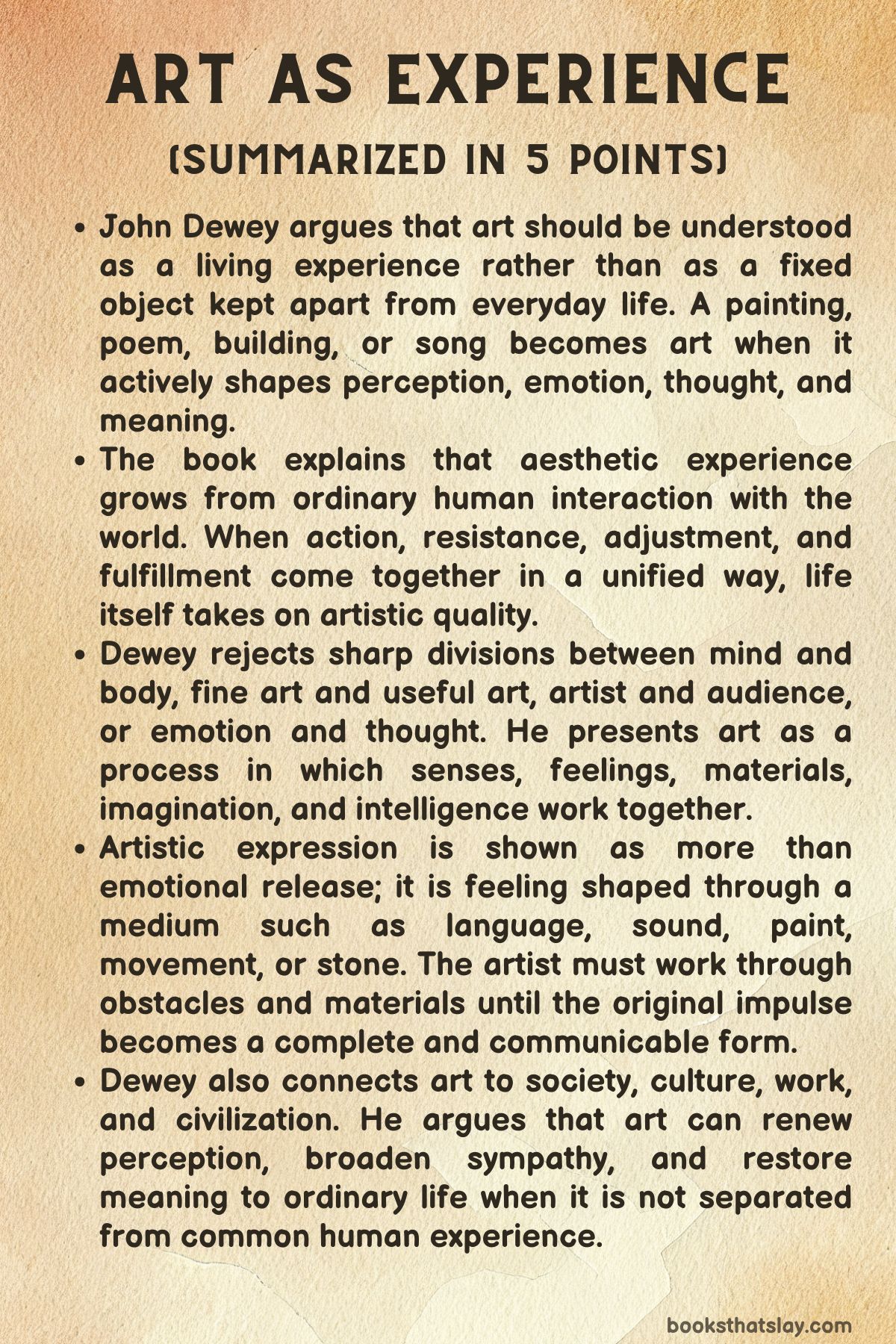
Art as Experience by John Dewey is a major work of aesthetic philosophy that argues art should not be treated as a distant luxury, museum object, or rarefied intellectual category. Dewey presents art as a living form of experience rooted in ordinary human activity: sensing, making, feeling, thinking, struggling, and finding completion.
The book challenges divisions between fine art and everyday life, between mind and body, and between artist and audience. Dewey’s central claim is that art matters because it organizes life’s energies into meaningful, shared, and fully felt experience.
Summary
John Dewey’s Art as Experience argues that art cannot be understood if it is separated from the conditions of life that produce it and from the experiences through which people receive it. Dewey begins by challenging the habit of treating artworks as isolated objects placed on pedestals, preserved in museums, or admired as rare treasures.
For him, the true work of art is not merely the painting, poem, building, or song as a physical thing. It is what that object does in experience.
A work becomes art when it enters into active perception, when it is felt, interpreted, and completed by someone who engages with it.
Dewey wants aesthetic theory to return art to the ordinary rhythms of life. He argues that aesthetic experience grows from the same processes by which living creatures interact with their environments.
Human beings constantly face disruption, tension, adjustment, and recovery. When these movements reach a satisfying close, experience gains unity and intensity.
This pattern is already present in daily life, but art heightens and clarifies it. Art is not an escape from life; it is life brought to a fuller order.
A central idea in Art as Experience is the difference between scattered experience and “an experience.” Much of ordinary life passes in fragments, distractions, routines, and unfinished actions. By contrast, an experience has unity.
It moves from beginning to end with direction. Its parts belong together, and its conclusion feels earned rather than accidental.
This can happen in making a meal, solving a problem, watching a storm, reading a novel, or listening to music. In such moments, action and reception are joined.
A person does something, undergoes the consequences, adjusts, and continues. Art intensifies this rhythm of doing and undergoing.
Dewey rejects the separation of art from the senses. He believes the senses are not passive channels through which the mind receives information.
They are active ways of participating in the world. Seeing, hearing, touching, and moving are forms of contact between self and environment.
When institutions or philosophies divide mind from body, spirit from matter, or high culture from everyday need, they weaken the fullness of experience. Art restores the unity of sense, emotion, action, and meaning.
Expression, for Dewey, is not the same as emotional release. A cry of anger or a burst of excitement may discharge feeling, but it is not yet art.
Expression begins when inner energy meets resistance from the world and is shaped through material. The artist does not simply pour emotion into a medium.
The artist works with paint, stone, sound, movement, language, or gesture, allowing the material itself to guide and transform the original impulse. Obstacles matter because they slow down immediate reaction and make form possible.
Through this process, feeling becomes organized, communicable, and meaningful.
The expressive object is therefore both personal and shared. It comes from an individual history, but it uses materials drawn from a common world.
A painting of a landscape, for example, is not a copy of the landscape. It reorganizes color, line, memory, and perception so that the viewer may experience the world in a renewed way.
Dewey distinguishes this from ordinary signs. A sign points to something beyond itself, but an artwork presents meaning through its own qualities.
Its lines, rhythms, tones, and relations do not merely refer; they carry experience.
Dewey also argues that form and substance cannot be separated. Form is not an empty pattern imposed on raw material.
Substance is not content waiting to be decorated. In genuine art, material and organization become one.
The subject of a work is not enough to explain its artistic value. A poem, building, or painting matters because of what it achieves in experience, not because of its topic alone.
Titles and themes may help identify a work socially, but the artwork’s real substance lies in the unified effect created by its medium, structure, and feeling.
The development of form depends on relation, rhythm, tension, and resolution. Dewey sees form as something dynamic rather than fixed.
Parts of a work press against one another, support one another, prepare for later developments, and preserve what has already occurred. Aesthetic experience requires both continuity and surprise.
If there is no resistance, the experience becomes mechanical. If there is no order, it falls into confusion.
Art succeeds when it balances movement and control, novelty and coherence.
Rhythm becomes one of Dewey’s most important ideas. He does not define rhythm as simple repetition.
True rhythm involves variation, accumulation, pause, release, and return. It exists in nature, in bodily processes, in work, in dance, in speech, in architecture, in painting, and in music.
The arts organize energies through rhythm, allowing experience to grow toward completion. Even still arts, such as painting or architecture, involve time because perception unfolds gradually.
The viewer’s eye moves, anticipates, remembers, and compares. Likewise, temporal arts such as music and literature create spatial relations of nearness, distance, balance, and depth.
Dewey rejects rigid classifications of the arts. Divisions such as spatial versus temporal, useful versus fine, representative versus nonrepresentative, or decorative versus expressive often hide more than they reveal.
Every art uses a medium to shape experience, and every medium has its own possibilities. Architecture works with mass, space, function, and communal life.
Sculpture gives form to volume and presence. Painting organizes light, color, and visible relations.
Music shapes sound into tension and release. Literature uses language, already rich with social meaning, to transform private experience into shared communication.
These differences matter, but they do not justify treating the arts as sealed categories.
For Dewey, all subject matter can become art. Older traditions often ranked noble, religious, heroic, or historical subjects above scenes of ordinary life.
Dewey rejects that hierarchy. Apples, dancers, villagers, domestic struggles, rituals, buildings, songs, and common labor can all become art if they are shaped with sincere interest and expressive coherence.
The artist’s task is not to choose an officially elevated subject but to discover the qualities in experience that can be intensified through form.
The audience has an active role. Perception is not simple recognition.
To recognize a portrait as a person, a melody as familiar, or a building as a temple is only the beginning. Aesthetic perception requires the viewer, reader, or listener to reconstruct the movement of the work.
The audience must follow relations, tensions, pauses, accents, and resolutions. In this sense, reception is creative.
The work is completed in experience each time someone truly perceives it.
Dewey’s account of imagination also departs from older theories. Imagination is not fantasy detached from reality.
It is the power that fuses past and present, sense and meaning, old materials and new possibilities. All perception contains imagination because the present is always shaped by memory and expectation.
In art, imagination becomes especially clear because it reorganizes experience into a new whole. It gives ordinary materials a wider value without removing them from the world.
The book also challenges philosophy. Dewey criticizes theories that reduce art to imitation, pleasure, dream, play, moral instruction, knowledge, or access to a higher realm.
Each theory captures something but fails when it isolates one element from the whole. Art includes pleasure, knowledge, play, feeling, imagination, and form, but it cannot be reduced to any single one of them.
Its power lies in integration. Aesthetic experience shows philosophy what complete experience looks like: sense, emotion, thought, action, and meaning working together.
Dewey gives special attention to criticism. He opposes criticism that acts like a court, issuing verdicts based on fixed rules, prestige, or inherited standards.
Such criticism often fails to recognize new art because it measures living work by dead conventions. At the same time, he rejects purely impressionistic criticism that treats private response as enough.
Good criticism begins in direct perception, studies how the work organizes its medium, and helps others see more fully. Its purpose is not to dominate taste but to educate perception.
In the closing movement of Art as Experience, Dewey places art within civilization. Art records the quality of a culture because it expresses how people live, worship, work, celebrate, remember, and imagine.
Ancient rituals, Greek drama, church music, Renaissance painting, folk forms, and modern experiments all show how art carries collective meaning. Art allows people to enter imaginatively into other times and cultures, weakening prejudice and expanding sympathy.
Dewey is critical of modern industrial society because it separates useful labor from aesthetic satisfaction. When work becomes mechanical and life is divided into production, consumption, ownership, and display, art is pushed to the margins.
Museums and galleries may preserve objects, but they can also reinforce the false idea that art belongs apart from common life. Dewey’s hope is for a society in which more forms of making, working, and sharing carry aesthetic value.
Ultimately, Art as Experience presents art as a mode of living rather than a special class of objects. Art emerges when human beings organize the energies of life into forms that can be felt, understood, and shared.
It renews perception, clarifies meaning, expands imagination, and returns people to the world with a deeper sense of connection.
Key Figures
John Dewey
John Dewey is the central intellectual figure in the book, acting as the guiding voice whose ideas shape every argument. In Art as Experience, Dewey appears as a philosopher determined to bring art down from the isolated pedestal on which institutions often place it and return it to the ordinary processes of living.
He resists the idea that art belongs only to museums, experts, collectors, or refined cultural spaces. His thinking is democratic at its core: art should be understood through experience, perception, labor, emotion, and the shared life of human beings.
Dewey’s role in the book is that of a reformer of aesthetic thought. He challenges older divisions between fine art and useful activity, mind and body, artist and audience, matter and form.
His intellectual personality is patient, practical, and corrective. He does not dismiss tradition, but he refuses to let inherited categories block a living understanding of art.
Through him, the book argues that aesthetic experience is not rare or separate from life; it is life made more complete, organized, and meaningful.
The Live Creature
The “live creature” is one of the most important conceptual figures in the book because it gives Dewey’s theory a biological and experiential foundation. This figure represents the human being not as a detached mind observing the world from a distance, but as an active organism constantly interacting with an environment.
The live creature faces resistance, need, pressure, satisfaction, loss, adjustment, and recovery. These movements form the basis of experience.
Through this figure, Dewey explains that art begins in the same rhythms that shape ordinary life: tension followed by resolution, action followed by consequence, disturbance followed by restored balance. The live creature is important because it breaks down the false separation between art and nature.
Art is not presented as something added artificially to life; it grows out of the same processes by which living beings survive, adapt, feel, and make meaning. In this sense, the live creature becomes Dewey’s answer to abstract theories of beauty.
Aesthetic experience is not an idea floating above life. It is rooted in the body, the senses, and the living exchange between self and world.
The Artist
The artist in the book is not portrayed as a mysterious genius who simply releases emotion into a finished product. Dewey’s artist is a maker, experimenter, perceiver, and worker.
The artist begins with an inner drive or pressure, but that impulse becomes art only when it is shaped through resistance and material. Paint, sound, stone, movement, language, and rhythm do not merely carry a pre-existing feeling; they transform it.
The artist must remain alert to what the medium allows, resists, and suggests. This makes artistic creation a process of discovery rather than mechanical execution.
Dewey’s artist is also someone who acts as their own audience during creation, judging whether each part contributes to the whole. This figure is significant because it shows that art depends on both emotion and discipline.
Feeling alone is not enough, and technique alone is not enough. The artist’s achievement lies in organizing experience so that it can be perceived by others as a unified, expressive object.
In Art as Experience, the artist becomes a model for meaningful action: someone who turns pressure, memory, skill, and material into communicable form.
The Audience or Perceiver
The audience is one of Dewey’s most important figures because the book refuses to treat perception as passive. A viewer, reader, or listener does not merely receive an artwork as information.
The audience must actively reconstruct the movement of the work. To perceive a painting, poem, building, or song aesthetically is to follow its relations, rhythms, pauses, tensions, and resolutions.
Recognition is not enough. Simply knowing what a painting depicts or what a poem refers to falls short of true perception.
Dewey’s audience must bring memory, bodily readiness, emotion, and attention into the encounter. This makes the audience a collaborator in the life of art.
The physical object may exist independently, but the work of art comes alive only in experience. This figure is essential because it democratizes art without making it shallow.
Dewey is not saying that every casual reaction has equal depth. He is saying that aesthetic value depends on engaged perception, and such perception can be educated.
The audience, when fully active, completes the work by undergoing its organized experience.
A.C. Barnes
A.C. Barnes appears as one of the major intellectual influences behind Dewey’s thinking. Though he is not the subject of the book, his presence matters because Dewey acknowledges his conversations and educational work at the Barnes Foundation as deeply important to the development of his aesthetic philosophy.
Barnes represents a practical and educational approach to art, one that treats perception as something that can be trained through attention to form, color, rhythm, and relation. His influence supports Dewey’s resistance to purely academic or prestige-based views of art.
Barnes helps embody the idea that art education should not revolve around status, ownership, or historical labeling alone. Instead, it should help people see how works are organized and how their elements act on experience.
As a figure in the book’s intellectual background, Barnes strengthens Dewey’s belief that criticism and education should open perception rather than impose rigid judgments. He stands for a way of approaching art that is disciplined but not lifeless, serious but still grounded in direct experience.
William James
William James is an important background figure because the book grew out of lectures delivered in his memory. His presence gives the work a philosophical lineage.
Dewey’s connection to James is not accidental; both thinkers are associated with pragmatism and with an emphasis on lived experience rather than abstract systems detached from life. James’s influence can be felt in Dewey’s insistence that meaning emerges through action, consequence, perception, and felt reality.
The memorial context matters because Dewey’s aesthetic theory carries forward a Jamesian respect for the flow of experience and the richness of human consciousness. James represents a philosophical atmosphere in which thought is not separate from life but part of how living beings navigate the world.
In this way, he becomes more than a name in the preface. He is part of the intellectual inheritance that allows Dewey to argue that art should be understood not as a fixed object or isolated category, but as a heightened form of experience.
The Critic
The critic is a major figure in the book because Dewey uses criticism to show how art should and should not be judged. The false critic behaves like a legal authority, issuing verdicts based on rules, prestige, precedent, or fixed standards.
Dewey strongly opposes this model because it often blocks new forms of art and protects old habits of seeing. The better critic begins with perception.
This critic studies how a work organizes its medium, how its parts contribute to the whole, and how it creates a unified experience. The critic’s task is not to dominate public taste but to help others perceive more deeply.
Dewey also rejects criticism that is merely personal impression. A critic may begin with feeling, but that feeling must be clarified through attention to the object.
This figure is important because it reflects Dewey’s broader belief that art is public, sharable, and open to intelligent discussion. In Art as Experience, the critic becomes a guide of perception rather than a judge of cultural rank.
The Worker
The worker is an implied but crucial figure in Dewey’s social argument. Dewey is concerned that modern industrial life has separated labor from aesthetic satisfaction.
In healthier forms of work, making would involve rhythm, skill, attention, fulfillment, and pride. Under industrial conditions, however, labor is often reduced to mechanical production, while enjoyment is postponed or displaced into consumption.
The worker therefore represents one of the book’s deepest social concerns: the loss of art from daily activity. Dewey does not believe art should be confined to professional artists while most people perform lifeless tasks.
The worker shows what is at stake when useful activity is cut off from aesthetic meaning. If labor lacks wholeness, rhythm, and completion, then human life itself becomes fragmented.
Through this figure, Dewey’s aesthetics becomes social criticism. Art is not only about paintings, poems, or music; it is also about the possibility of a civilization where ordinary making can carry dignity, satisfaction, and expressive value.
The Community or Civilization
The community is a broad figure in the book because Dewey treats art as a record and force of collective life. Art does not arise from isolated individuals alone.
It carries the marks of shared rituals, beliefs, technologies, habits, conflicts, and hopes. Ancient Greek drama, church art, Renaissance painting, folk music, and modern experiments all show how communities express themselves through sensory and imaginative forms.
The community is also the audience across time, receiving works from other cultures and expanding its own perception through them. Dewey’s view of civilization is not romantic or simple.
He knows that modern society often fragments life, separates art from work, and turns artworks into possessions or museum objects. Still, he sees art as one of the strongest means by which people can communicate across historical, cultural, and linguistic barriers.
The community matters because it shows that art is never only private. Even the most individual work draws from a shared world and returns to that world with new meanings.
Themes
Art as a Living Experience
Dewey treats art as something that happens within experience rather than something confined to an object. A painting, poem, building, or song may exist physically, but it becomes art only when it is actively perceived and felt.
This idea shifts attention away from art as possession, display, or cultural status and toward art as an event in human life. Dewey is especially concerned with the way museums, galleries, markets, and elite traditions can isolate artworks from the living conditions that gave rise to them.
When this happens, people admire art from a distance instead of experiencing it as part of the same world in which they work, struggle, sense, and communicate. The theme is powerful because it broadens what counts as aesthetic.
Dewey does not lower art by connecting it to ordinary life; he raises ordinary experience by showing that it can contain order, intensity, rhythm, and fulfillment. Art becomes a heightened form of living, not a decorative escape from it.
In Art as Experience, this argument changes the meaning of both art and life: art is not separate from experience, but experience brought to a more complete and expressive form.
The Unity of Doing and Undergoing
Experience becomes meaningful when action and reception are joined. Dewey repeatedly emphasizes that human beings do not simply act upon the world, nor do they merely receive impressions from it.
They do something, meet consequences, absorb those consequences, adjust, and continue. This rhythm of doing and undergoing is central to aesthetic experience.
An artist makes a mark, hears a sound, shapes a phrase, or alters a form, then perceives what has happened and responds to it. The audience follows a similar process while encountering the finished work.
This theme matters because it rejects two incomplete views of life: restless action without reflection and passive observation without engagement. Both fail to produce full experience.
Dewey’s model requires participation, attention, and responsiveness. A meaningful experience develops when each part leads into the next and when the whole moves toward a satisfying close.
This is why aesthetic experience is not limited to art objects. It can occur anywhere life gains unity through active engagement and receptive awareness.
Dewey’s account makes art a model for how people might live more attentively.
Expression, Resistance, and Form
Expression is not mere emotional release. Dewey makes a careful distinction between discharging feeling and giving it form.
A person may cry, shout, or react strongly, but such acts are not yet artistic expression. Expression begins when feeling is sustained, shaped, and transformed through contact with material and resistance.
This theme is central to Dewey’s understanding of artistic creation. The artist does not simply transfer an inner emotion into paint, music, stone, movement, or language.
The medium pushes back. It has limits, textures, possibilities, and demands.
These obstacles force the original impulse to change and become more definite. Resistance is therefore not an enemy of art; it is one of the conditions that makes art possible.
Without it, feeling would remain raw and passing. Through form, emotion becomes communicable.
This theme also applies beyond professional art. Social conduct, labor, education, and daily making can become more meaningful when impulses are not merely spent but organized into thoughtful action.
Dewey’s theory of expression shows why discipline and feeling must work together. Art needs emotion, but it also needs patience, selection, and structure.
Art, Society, and Civilization
Art reflects the quality of the civilization that produces it. Dewey sees artworks as records of collective life, carrying the marks of rituals, institutions, beliefs, labor, values, and social arrangements.
This does not mean that art is simply a document of history. It also reshapes perception and allows people to enter imaginatively into experiences beyond their own time or culture.
Art can weaken prejudice because it makes unfamiliar forms of life available to feeling and perception, not only to abstract thought. At the same time, Dewey is sharply critical of modern industrial society.
He believes that industrial and economic systems often separate useful work from aesthetic satisfaction. Labor becomes mechanical, art becomes isolated, and enjoyment is treated as something separate from production.
This division damages both art and ordinary life. A healthier civilization would not reserve aesthetic meaning for museums or leisure alone.
It would create conditions in which more people could participate in meaningful making and perception. Dewey’s social vision gives aesthetics a moral and civic importance: art expands imagination, renews shared life, and reveals what a culture values.