Artemis by Andy Weir Summary, Characters and Themes
Artemis by Andy Weir is a fast-moving science fiction novel set in the first city on the Moon. The story follows Jasmine “Jazz” Bashara, a sharp, restless porter and smuggler who wants more than the cramped, cash-strapped life she has in Artemis.
When a wealthy businessman offers her a fortune to sabotage a lunar mining operation, Jazz accepts and steps into a problem far bigger than a simple illegal job. The novel mixes crime, engineering, lunar survival, and political pressure, all through Jazz’s blunt, funny, risk-taking voice.
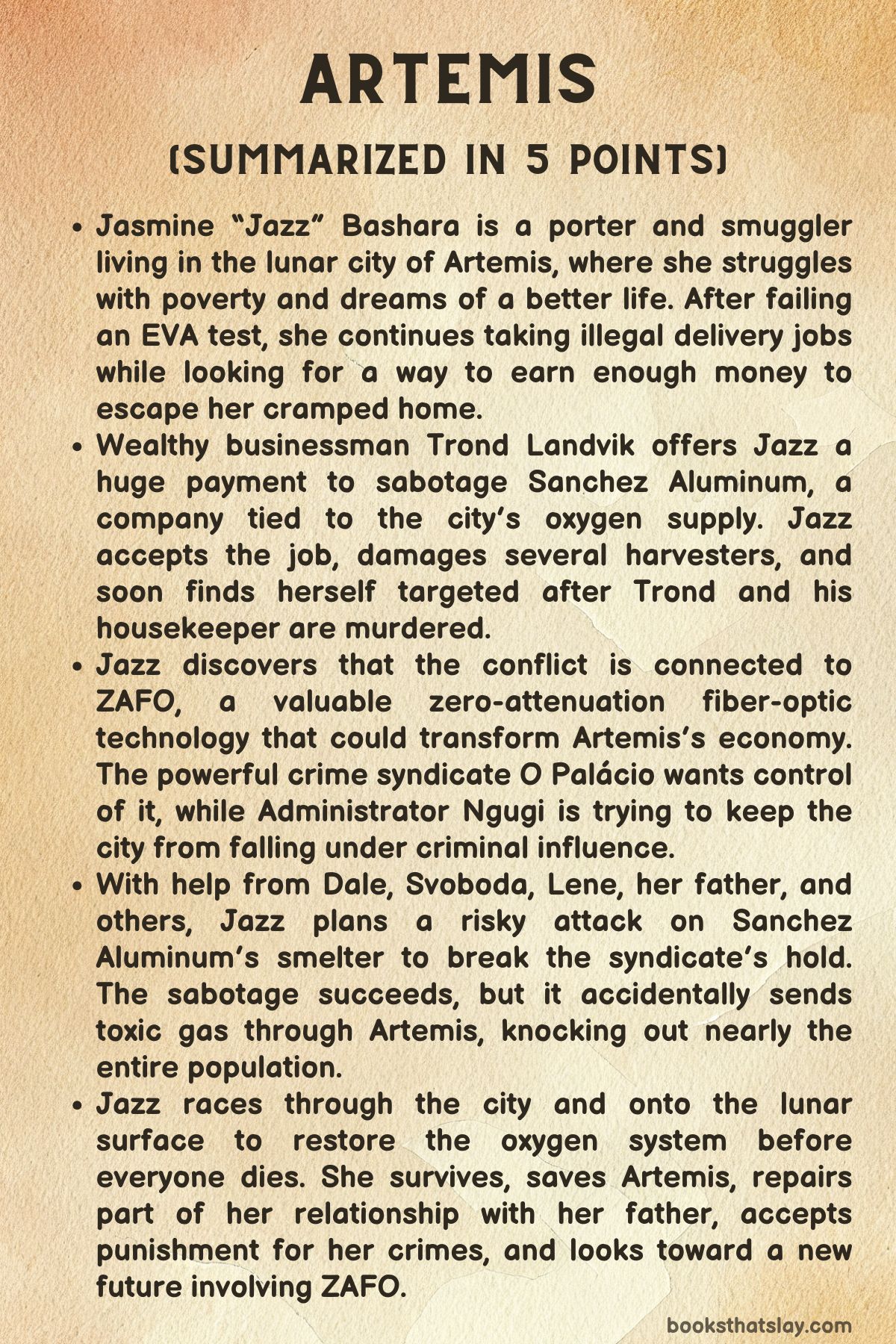
Summary
Artemis begins with Jasmine “Jazz” Bashara nearly dying during a training test on the lunar surface. Jazz is trying to qualify for the EVA Guild, which would let her perform solo spacewalks and take better-paying work outside the city.
Her suit is compromised, and she has to rush back to the airlock while arguing with Bob Lewis, the guild official overseeing the test. She survives, but Bob fails her.
Jazz is furious, yet she has to accept the result. For now, she remains a porter, hauling goods around Artemis and earning money through both legal deliveries and smuggling.
Artemis is a city made of five connected bubbles, each with its own function and class divide. Jazz lives in Conrad, the poorest bubble, in a tiny capsule home so small that she calls it a coffin.
Wealthier residents and tourists live and shop in more comfortable areas. Jazz dreams of having enough money to move into a real condo, with standing room and a private bathroom.
Her daily life is shaped by that dream, by her strained relationship with her father Ammar, and by her habit of taking illegal jobs to make ends meet.
Jazz receives a shipment that includes contraband cigars for Trond Landvik, a rich Norwegian businessman. Trond is meeting with a man named Jin Chu, who has brought something mysterious marked “ZAFO.” Jazz notices the package but does not yet know what it means.
Later, Trond calls her back and offers her a dangerous job. He plans to take over Sanchez Aluminum, a major company that processes lunar rock.
The company also provides oxygen to Artemis as a byproduct of aluminum production, which makes it central to the city’s survival. Trond wants Jazz to sabotage the company’s anorthite harvesters so Sanchez will break its supply agreement.
Jazz first refuses, insisting she is a smuggler, not a saboteur, but when Trond offers one million slugs, she accepts.
Jazz prepares carefully. She studies harvester designs, recruits her awkward but brilliant friend Martin Svoboda to build a device she needs, and borrows welding materials from her father under false pretenses.
Her relationship with Ammar is tense because of past mistakes. Years earlier, Jazz and her friends accidentally burned down his workshop, wrecking both his livelihood and their trust.
Jazz still carries guilt over that, but she hides it under sarcasm and stubbornness.
To carry out the sabotage, Jazz borrows a hull-inspection bot, uses a disguise to hide her movements, and gets the bot outside Artemis. She then leaves the city in an EVA suit and waits for the Sanchez harvesters.
Her plan is to damage the machines so they fail beyond repair. At first, the plan works, but the situation quickly becomes dangerous.
One harvester crushes her spare oxygen supply, cutting down her time. Worse, the machines begin watching and responding to her, which means Sanchez knows someone is attacking them.
Jazz improvises, using explosions to destroy the harvesters, but she cannot finish the job completely. She escapes by clinging to a train bound for the Apollo 11 visitor area.
Dale, an EVA Guild member and former friend, catches her when she comes through the airlock.
Dale does not report Jazz, but he forces her to rebuild their broken friendship. Jazz is still hurt because Dale had a relationship with her former boyfriend Tyler, but Dale wants to repair what was lost.
Jazz agrees to meet him for weekly drinks in exchange for his silence. Soon after, Rudy DuBois, Artemis’s head of security, confronts Jazz.
He suspects she sabotaged the harvesters and believes Trond hired her. Rudy warns her that Sanchez Aluminum is not just a company.
It is tied to O Palácio, a powerful Brazilian crime syndicate using the business to launder money.
Jazz goes to Trond’s apartment to discuss the unfinished job, but she finds signs of violence and blood. She reports it to Rudy and runs.
News soon confirms that Trond and his housekeeper Irina have been murdered. Jazz realizes the killers may come for her next, since she was part of Trond’s plan.
She contacts Kelvin, her long-time pen pal and smuggling partner in Kenya, and asks for help creating a new identity. She hides in a maintenance area and warns her father to stay away from home.
Jazz decides she needs to understand what Trond was really after. The key is the mysterious ZAFO sample Jin Chu brought to Artemis.
She tracks Jin to a hotel, disguises herself, breaks into his room, and finds a dangerous man waiting there. The attacker, whom Jazz calls Lefty, tries to kill her.
Jazz fights him off, searches the room, and opens the safe. Inside, she finds the ZAFO box, which contains a fiber-optic cable.
She takes it to Svoboda for analysis.
Svoboda discovers that ZAFO means zero-attenuation fiber optic. It is a cable that can transmit light without losing signal strength over distance.
This would make it incredibly valuable, because it could replace Earth’s existing telecom cables. Jazz begins to understand why Trond wanted control of Sanchez Aluminum.
The Moon is an ideal place to make ZAFO because of its lower gravity and abundant glass materials. Whoever controls production could make a fortune and reshape Artemis’s economy.
Jazz tries to trap Lefty by leaving her Gizmo in a public area, but Rudy appears and explains more about O Palácio. When Lefty comes for the device, Jazz thinks Rudy has betrayed her, but Rudy actually chases the killer.
Jazz survives and later sets up a meeting with Jin at her father’s welding shop. Jin admits he sold ZAFO information to Trond, then sold Trond out to O Palácio, and also gave them Jazz’s name.
He has brought Lefty with him. Jazz acts quickly, setting off a fire alarm and flooding the room with gas that knocks them unconscious.
Rudy arrests Jin and Lefty. Administrator Fidelis Ngugi orders Jin deported and Lefty sent away to face justice for the murders.
Jazz then confronts Ngugi, realizing the administrator knows more than she has admitted. Ngugi reveals that she told O Palácio how to find Jazz’s Gizmo.
She used Jazz as bait to expose the syndicate’s moves. Ngugi explains that Artemis is financially fragile and needs a major industry to survive.
ZAFO could save the city, but if O Palácio controls it, the syndicate could take over Artemis. Jazz is furious that she has been manipulated, but she also understands the scale of the threat.
Jazz decides to finish what Trond started by destroying Sanchez Aluminum’s smelter and breaking O Palácio’s hold on Artemis. She gathers a small crew: Dale, Svoboda, Lene Landvik, Bob, Ammar, and others.
Lene, now grieving her father, agrees to help. The group studies the Sanchez facility plans that Kelvin provides from KSC archives.
Jazz explains that they can sabotage the smelter by tricking its temperature controls and blocking the emergency release, forcing a catastrophic failure. Everyone understands the risk but agrees because O Palácio’s control would be worse.
Jazz and Dale travel outside Artemis in a rover and create a makeshift tunnel into the Sanchez bubble. Ammar coaches Jazz through the welding work, and Bob delays the worker train so she has time to complete the entry.
Once inside, Jazz triggers a chlorine alarm to evacuate the workers. She then alters the smelter, but before escaping she sees Loretta Sanchez still inside.
Loretta refuses to leave, believing she can save her life’s work. Jazz fights with her, then convinces her that the smelter is beyond saving.
Jazz, Dale, and Loretta flee just before the explosion.
The explosion has an unexpected consequence. Toxic gases are drawn into Artemis’s life-support system, knocking out almost the entire city.
Jazz realizes she has accidentally endangered everyone. With Dale and Loretta outside and the population unconscious inside, she enters Artemis and races to Life Support.
She steals Rudy’s Gizmo to unlock the system but is attacked by Lefty, who has escaped custody. Jazz manages to defeat him and continues onward.
At Life Support, Jazz tries to clear the air using backup oxygen, but Artemis does not have enough stored oxygen to flush out the toxins. She realizes Trond’s private oxygen supply is connected to the system and can save the city.
She reaches the outside valves using a tourist lunar ball, but the final valve will not turn. Jazz has a metal pipe that could give her leverage, but it is inside the ball.
To use it, she has to puncture her own protective shell in vacuum. She says goodbye to Dale, forgives him, asks him to tell her father she loves him, and stabs the ball.
She turns the valve but is blasted away across the lunar surface.
Jazz wakes in the medical bay with her father beside her. She learns that Dale and Loretta rescued her, and the people of Artemis survived.
Some suffered temporary health effects, but the city is safe. Lene has paid Jazz the million slugs her father promised, but Jazz’s victory is short-lived.
Administrator Ngugi prepares to punish her for the sabotage and the danger she caused. Jazz argues that she belongs on Artemis and that her smuggling, if managed with care, helps the city.
Ngugi lets her stay but fines her heavily and keeps a signed confession as leverage.
Jazz uses part of her money to rent a new workshop for her father, replacing what she destroyed years earlier. Ammar accepts the gift, and their relationship begins to heal.
Jazz also starts moving toward a romantic relationship with Svoboda, who has stood by her throughout the crisis. By the end of Artemis, Jazz is poor again but no longer stuck in quite the same way.
She has saved the city, made peace with parts of her past, and found a path forward. In her final message to Kelvin, she tells him to invest in the future ZAFO industry and come visit her on the Moon.
Characters
Jasmine “Jazz” Bashara
Jasmine Bashara is the central force of Artemis, and the book builds much of its energy around her intelligence, anger, humor, ambition, and poor judgment. Jazz is a porter and smuggler who lives in a cramped capsule home and wants enough money to escape poverty.
She is not presented as a simple hero. She lies, breaks laws, manipulates people, and takes reckless risks, but she also has a strong personal code.
She smuggles contraband, yet she cares about the city and refuses to hurt ordinary people for profit. Her failed EVA test at the start shows both her skill and her weakness: she is brave and capable, but she sometimes cuts corners and resents authority when it exposes her mistakes.
Jazz’s hunger for money comes from more than greed. She wants dignity, space, safety, and independence.
Her poverty has shaped her into someone who sees every opportunity in terms of survival and advancement. This explains why Trond’s offer tempts her so strongly.
One million slugs represents not just wealth but escape from a life of cramped rooms and limited choices. Yet the job also reveals her moral growth.
What begins as a paid act of sabotage becomes a battle against a crime syndicate that threatens the whole city. Jazz’s arc is driven by responsibility.
She starts out trying to get rich and ends up risking her life to save everyone.
Her relationships reveal the softer parts of her personality. With her father, she carries guilt over the fire that destroyed his workshop, but she hides that guilt behind sarcasm and distance.
With Dale, she is wounded by betrayal but slowly learns to forgive. With Svoboda, she lets herself be cared for without turning everything into a joke.
Jazz’s voice is defensive because she has been hurt, embarrassed, and underestimated. By the end of the book, she remains flawed and sharp-tongued, but she has earned a deeper sense of belonging.
She does not become respectable in a conventional way; instead, she becomes more honest about who she is and what she owes to the people around her.
Ammar Bashara
Ammar Bashara, Jazz’s father, represents discipline, faith, craftsmanship, and wounded love. He is a skilled welder whose life has been damaged by Jazz’s past irresponsibility.
The fire that destroyed his workshop created a lasting break between them, and much of their relationship is shaped by unspoken guilt. Ammar does not stop loving Jazz, but he no longer trusts her easily.
His suspicion when she comes to borrow materials is not cruelty; it is the reaction of a father who has seen his daughter waste talent and make dangerous choices.
Ammar’s character also gives the story a moral center. He works with patience and care, and his craft requires precision, responsibility, and respect for consequences.
These are qualities Jazz often lacks early in the novel. His faith is also important because it shows his rootedness.
Even while living on the Moon, he works on a device that will help him orient himself toward Mecca for prayer. This detail makes him more than a disappointed parent; he is a man trying to preserve identity, belief, and order in a strange environment.
His eventual reconciliation with Jazz is one of the most satisfying emotional movements in the book. Jazz’s gift of a new workshop is not only financial repayment.
It is an apology in physical form. She gives back what she once destroyed, and Ammar’s acceptance of it suggests that forgiveness is possible even after years of pain.
Their relationship does not become perfect, but it becomes more honest. Ammar matters because he reminds Jazz that intelligence without responsibility can damage the people one loves most.
Martin Svoboda
Martin Svoboda is one of the book’s most endearing characters because he combines technical brilliance with social awkwardness and genuine loyalty. He is an electrical engineer, and Jazz repeatedly turns to him when she needs devices, analysis, or scientific understanding.
His skills are vital to the plot, especially in relation to the sabotage equipment and the ZAFO cable. He helps translate strange technology into practical knowledge, making him one of the people who allows Jazz to understand the true stakes of what is happening.
Svoboda’s awkwardness often provides comedy, but the story does not reduce him to a joke. He is odd, nervous, and sometimes inappropriate, yet he is also kind, generous, and emotionally sincere.
His reusable condom invention is absurd and funny, but it also reflects his inventive mind and his strange way of trying to connect with Jazz. He does not help her because he expects profit.
In fact, he is insulted when she treats his help as something that can simply be bought. That reaction shows that he values friendship and trust more than money.
His relationship with Jazz grows because he sees her vulnerability when others see only her bravado. When she is overwhelmed after learning how badly she has been used, she goes to Svoboda, and he gives her a safe place to rest.
This moment is important because Jazz usually avoids needing anyone. Svoboda becomes someone she can rely on without feeling judged.
Their developing romantic connection feels unusual but believable because it grows from trust, shared danger, and emotional safety rather than instant attraction.
Dale Shapiro
Dale Shapiro is important both as a practical ally and as a figure from Jazz’s painful past. He is a member of the EVA Guild, which means he has the professional status and access Jazz wants but does not yet have.
At first, he appears mostly as someone who teases her and reminds her of failure. His connection to Tyler, Jazz’s former boyfriend, makes him even harder for her to tolerate.
Dale’s past relationship with Tyler hurt Jazz deeply, and she has treated Dale as a betrayer.
However, Dale becomes more complex as the story continues. When he catches Jazz after her sabotage mission, he does not turn her in.
Instead, he asks for renewed friendship. This demand is revealing.
Dale does not want money as much as he wants repair. He knows Jazz is angry, but he also seems to understand that their broken friendship matters.
His insistence on weekly drinks is awkward, but it is also his way of forcing open a door that Jazz would otherwise keep shut.
Dale proves his loyalty during the later mission against Sanchez Aluminum. He accompanies Jazz outside the city, helps her set up the dangerous entry tunnel, and remains ready to save her if something goes wrong.
Near the climax, he becomes one of the people Jazz trusts with her life. Their relationship is not healed through speeches but through action.
Dale stands by her when it matters, and Jazz’s forgiveness of him before risking her life shows that she has finally let go of an old wound.
Bob Lewis
Bob Lewis is a stern but fair figure who represents professional standards. He fails Jazz during her EVA test, not because he dislikes her, but because she has not met the required level of safety and discipline.
Jazz resents him, yet the book makes clear that Bob’s judgment is justified. Space is unforgiving, and small errors can kill.
Bob understands that better than Jazz does at the beginning.
His role becomes more sympathetic as the story develops. He is not merely an obstacle to Jazz’s ambitions.
He is part of the community’s safety structure, and his decisions are rooted in responsibility. During emergencies, such as the fire response and later the operation against Sanchez Aluminum, Bob shows competence and commitment.
He is willing to help when he understands the danger O Palácio poses, which means he is not blindly loyal to rules. He values rules because they protect people, but he can also act outside ordinary procedure when the city itself is threatened.
Bob’s relationship with Jazz is built on grudging respect. He sees her talent but also her carelessness.
In that sense, he functions as a measure of her growth. Early in the story, Jazz wants the privileges of EVA work without fully accepting the discipline.
By the later sections, she has learned through danger that Bob’s standards exist for a reason. Bob’s character reinforces one of the novel’s practical moral ideas: skill matters, but judgment matters more.
Trond Landvik
Trond Landvik is the wealthy businessman whose offer changes Jazz’s life. He is charming, powerful, and calculating, a man who sees economic opportunity before others do.
His plan to take over Sanchez Aluminum is not random corporate greed. He understands that control of aluminum production connects to oxygen, industrial power, and the future of ZAFO manufacturing.
Trond sees the Moon as a place where fortunes can be made by those bold enough to act first.
Yet Trond is also morally compromised. He hires Jazz to sabotage essential industrial equipment, knowing the act could have major consequences.
He does not personally perform the dirty work, which shows how wealth allows him to transfer risk onto poorer people. Jazz accepts the job, but Trond’s position gives him far more protection than she has.
His death exposes the danger of playing power games with criminal forces. He thinks he can outmaneuver others through money and planning, but O Palácio responds with violence.
Trond’s importance continues after his murder. His ambition sets the plot in motion, and his discovery of ZAFO’s potential reveals the future economic direction of Artemis.
He is not simply a victim, nor is he purely a villain. He is a visionary opportunist whose intelligence is matched by arrogance.
His love for his daughter Lene adds a human side to him, but his choices place both her and Jazz in danger.
Lene Landvik
Lene Landvik begins as a secondary presence in her father’s wealthy household but becomes more important after Trond’s murder. Her disability and dependence on controlled living conditions make her especially vulnerable, and the loss of her father leaves her emotionally and practically exposed.
However, Lene is not written only as someone to be pitied. She has intelligence, anger, and a growing sense of agency.
Her decision to continue her father’s fight against Sanchez Aluminum and O Palácio is a turning point. Lene could retreat into grief and wealth, but instead she chooses action.
Her willingness to pay Jazz, even though Jazz did not fully complete the original sabotage job, shows that Lene understands honor in a direct way. A deal was made, work was done, and she believes Jazz should be compensated.
This makes her seem more principled than many of the adults around her.
Lene also represents inheritance in a broader sense. She inherits not only Trond’s money but also the consequences of his ambition.
The watch Jazz resizes for her becomes a symbol of that transfer. Lene must decide what kind of person she will become with the power left to her.
By choosing to help bring down the syndicate’s influence, she moves from sheltered daughter to active participant in the city’s future.
Fidelis Ngugi
Fidelis Ngugi is one of the most politically complex figures in Artemis. As the administrator of the city, she is responsible for its survival, growth, and stability.
Her backstory links her to the Kenya Space Corporation and the political vision that made the lunar city possible. She is intelligent, practical, and deeply aware that the settlement’s future is economically fragile.
Her decisions are shaped by the fear that without a strong industry, the city may not survive as a serious human settlement.
Ngugi’s moral complexity comes from the methods she uses. She wants to stop O Palácio from taking control, but she is willing to manipulate Jazz and place her in danger to do it.
She gives information to the syndicate and uses Jazz as bait, which is a severe betrayal. At the same time, Ngugi is not acting for personal wealth.
Her goal is to protect the city and secure its future through ZAFO production. This makes her unsettling because her reasoning is partly convincing even when her actions are cruel.
Her final judgment of Jazz reflects the same balance of pragmatism and authority. She cannot ignore Jazz’s crimes, especially after the sabotage nearly kills the population, but she also recognizes Jazz’s value.
Instead of deporting her, Ngugi fines her and keeps a confession as leverage. Ngugi’s character shows the harsh compromises of leadership in a place where one bad decision can endanger everyone.
She is neither a simple protector nor a simple manipulator; she is a leader who believes survival may require morally ugly choices.
Rudy DuBois
Rudy DuBois is the head of security, and he brings law, intimidation, and unexpected fairness into the story. He is physically imposing and often frightening, but he is not corrupt in the way Jazz sometimes suspects.
His style of justice can be rough, as shown by his handling of violent offenders, yet he is strongly committed to protecting the city. He knows Jazz is involved in smuggling and later suspects her involvement in sabotage, but his attitude toward her is more complicated than simple opposition.
Rudy understands the difference between petty crime and threats that could destabilize the settlement. This is why he becomes more focused on Trond and Irina’s killer and the syndicate behind Sanchez Aluminum.
His warning to Jazz about O Palácio shows that he grasps the larger danger before she does. Jazz often assumes Rudy is against her personally, but his actions show that he is trying to manage a city where formal law, practical enforcement, and survival needs do not always match neatly.
His presence also raises questions about justice in a frontier society. Deportation, informal punishment, and administrative authority carry enormous weight because the city is small and fragile.
Rudy works within that system, sometimes brutally, but usually with a clear sense of purpose. By the end, his respect for Jazz has increased, though he still wants accountability.
He is one of the characters who makes the city feel like a functioning society rather than just a setting.
Jin Chu
Jin Chu is a catalyst for much of the conflict. He arrives with the ZAFO sample and information, making him the link between a scientific breakthrough and the criminal struggle to control it.
He is intelligent enough to understand the value of what he carries, but he lacks loyalty and courage. Instead of choosing a side with conviction, he sells information repeatedly to whoever can benefit him or protect him.
Jin’s betrayal of Trond, O Palácio, and Jazz marks him as a deeply self-serving character. He does not use violence himself, but his choices lead directly to violence.
By informing the syndicate about Trond and later giving up Jazz, he places others in deadly danger while trying to preserve his own safety. His apologies do little to redeem him because they are not matched by sacrifice or courage.
He is sorry, but he still cooperates with Lefty when pressured.
His character represents the danger of knowledge without ethics. ZAFO could help build a new economic future, but in Jin’s hands it becomes a commodity to sell regardless of the consequences.
He is not the most physically dangerous figure in the book, but his cowardice and greed make him destructive. Through Jin, the story shows how betrayal can be as damaging as direct violence.
Loretta Sanchez
Loretta Sanchez is the mind behind the aluminum operation and the smelting process that helps sustain the city. She is a scientist, engineer, and industrial leader whose work is vital to the settlement’s oxygen supply and manufacturing economy.
Although Sanchez Aluminum is tied to O Palácio, Loretta herself is not presented simply as a criminal puppet. She has pride in her work and a deep attachment to the factory she built.
Her confrontation with Jazz inside the smelter is one of the strongest moments for her character. Loretta refuses to flee because she believes she can fix the system and save her life’s work.
Her stubbornness mirrors Jazz’s own recklessness. Both women are brilliant, proud, and resistant to being told what to do.
Their fight is not just physical; it is a clash between two people who believe they understand the situation better than the other.
Loretta’s later role in helping Jazz respond to the toxic gas crisis gives her a measure of redemption and complexity. She is not reduced to being part of the enemy side.
Once the danger becomes clear, she helps solve the problem. Loretta represents the way systems can trap skilled individuals inside corrupt structures.
Her knowledge is essential, even when the company around her has become part of something dangerous.
Marcelo Alvarez, known as Lefty
Marcelo Alvarez, whom Jazz calls Lefty, is the book’s most direct physical threat. He is the killer connected to O Palácio, and his presence turns the business conflict into immediate personal danger.
Unlike Trond, Jin, or Ngugi, Lefty does not operate through planning, negotiation, or political calculation. He represents the syndicate’s willingness to use violence when money and influence are not enough.
Lefty’s injured arm makes him visually distinctive, but it does not make him weak. He attacks Jazz more than once and remains dangerous even after being captured.
His escape during the citywide crisis shows that he is persistent and opportunistic. Jazz’s encounters with him are important because they force her into survival mode.
She cannot outtalk or outscheme him in the usual way; she has to improvise under direct threat.
As a character, Lefty is less psychologically developed than many others, but he serves a clear purpose. He gives O Palácio a human face and makes the syndicate’s danger concrete.
Without him, the criminal organization might feel abstract. Through Lefty, the story shows that corporate control and organized crime are backed by real violence against real people.
Kelvin Otieno
Kelvin Otieno is Jazz’s long-distance pen pal, friend, and smuggling partner on Earth. His letters with Jazz give the book a wider emotional and historical frame.
Through their correspondence, the reader sees Jazz growing up, making mistakes, falling in love, losing trust, and learning how to survive. Kelvin’s presence also connects the Moon to Earth, especially to Kenya and the Kenya Space Corporation.
Kelvin is ambitious, practical, and loyal. He wants to build a better life for himself and his family, and like Jazz, he understands financial pressure.
Their smuggling operation grows partly because both of them need money. Yet Kelvin’s friendship with Jazz is not merely transactional.
He listens to her, jokes with her, worries about her, and helps her when she is in danger. When she needs a new identity and later needs facility plans, he provides crucial support.
Kelvin also works as a contrast to Jazz. He is hardworking in a steadier way, while Jazz often relies on raw talent and improvisation.
Their friendship lasts because each respects something in the other. By the end of Artemis, Kelvin remains part of Jazz’s future plans.
Her final message to him suggests that their partnership will continue, but now with a larger opportunity tied to ZAFO and the city’s changing economy.
Irina
Irina, Trond’s housekeeper, has a smaller role, but her death has major emotional and plot significance. She is part of Trond’s household and appears as a controlled, watchful presence in his wealthy world.
Because she is not a powerful player in the business scheme, her murder emphasizes the cruelty of O Palácio’s response. The syndicate does not only target the person making the deal; it also kills someone caught near that power.
Irina’s death changes the tone of Jazz’s situation. Until then, the sabotage job is dangerous but still feels like a criminal business arrangement.
After Jazz finds signs of violence at Trond’s apartment and learns Irina has been killed, the stakes become far more personal and frightening. Irina’s fate proves that the forces involved are willing to murder without hesitation.
Her character also matters because she reminds the reader that secondary people often pay for the ambitions of the powerful. Trond seeks control, Ngugi maneuvers politically, Jin sells secrets, and Jazz takes the job, but Irina is one of the people who pays with her life.
Her limited presence does not reduce her importance; it sharpens the moral cost of the plot.
Sean
Sean belongs mainly to Jazz’s past, but he helps explain some of her emotional damage and life choices. He was Jazz’s boyfriend after the fire that drove her away from her father’s home.
Their relationship placed her in a rougher and more unstable environment. Sean is connected to gambling and sexual betrayal, and his behavior with a minor marks him as exploitative and morally corrupt.
Sean’s importance lies in how he shapes Jazz’s distrust and defensiveness. Her time with him is part of the period when she drifts away from legitimate opportunities and toward survival through illegal work.
He is not the only reason Jazz becomes a smuggler, but he belongs to the chain of events that hardens her. His betrayal also contributes to her complicated feelings around sex, trust, and intimacy.
The punishment Sean receives through vigilante justice also reveals something about the city’s social order. In a small, fragile settlement, formal law does not always function the way it does on Earth.
Community enforcement can be swift and brutal. Sean’s character therefore serves two purposes: he shows part of Jazz’s painful history and helps define the rough moral climate of the lunar city.
Tyler
Tyler is Jazz’s former boyfriend and the person whose relationship with Dale caused the break between Jazz and Dale. He does not dominate the present action, but he matters because his betrayal still affects Jazz’s emotional life.
Jazz’s anger toward Dale is tied to Tyler, and until she deals with that pain, she cannot rebuild an important friendship.
Tyler functions as a symbol of Jazz’s vulnerability. She often acts as though nothing can hurt her, but her reaction to Dale shows that she was deeply wounded by what happened.
The end of her relationship with Tyler left her feeling humiliated and replaced, which helps explain why she keeps emotional distance from people. Her eventual forgiveness of Dale does not excuse the hurt, but it shows that she is no longer willing to let Tyler’s betrayal control her relationships.
Themes
Survival in an Artificial World
Life in Artemis depends on machines, sealed habitats, oxygen systems, pressure controls, fire protocols, and careful engineering. The Moon is not merely a backdrop; it is an environment where human life is always conditional.
A damaged suit, a faulty airlock, a fire, a broken smelter, or a contaminated life-support system can threaten lives within minutes. This creates a version of survival that is both physical and social.
People survive because technology works, but technology only works when people follow procedures, respect expertise, and accept limits.
Jazz’s early failure in the EVA test becomes meaningful in this context. She is capable and brave, but those qualities are not enough in a place where carelessness can kill.
The same lesson returns on a larger scale when her sabotage of Sanchez Aluminum creates an unforeseen disaster. She intends to target a corrupt industrial power, yet the interconnected systems of the city turn that act into a threat to everyone.
The theme shows that in a closed environment, no action is truly isolated. Survival requires intelligence, but also humility.
The city exists because humans have mastered extraordinary technology, yet it remains fragile because every system depends on another.
Poverty, Ambition, and Moral Compromise
Jazz’s choices are shaped by poverty from the beginning. Her cramped home, low-paying work, and constant financial calculations make her ambition understandable even when her decisions are illegal.
She does not want luxury in an abstract sense; she wants space, privacy, comfort, and the freedom that money gives. The offer of one million slugs is powerful because it promises escape from humiliation and limitation.
Her willingness to accept Trond’s job grows out of a world where legal effort has not given her a fair path upward.
The book does not excuse every choice Jazz makes, but it does show how poverty narrows moral options. Jazz is smart enough to succeed in many fields, yet pride, past mistakes, class barriers, and the structure of the city push her toward smuggling.
Trond’s wealth allows him to hire risk while remaining protected, while Jazz has to put her body and future on the line. This contrast reveals how class shapes danger.
Rich people make plans; poor people carry them out.
At the same time, Jazz is not only a victim of circumstance. She makes reckless choices and sometimes chooses money over judgment.
Her growth comes when she begins acting not for profit but for responsibility. The theme becomes richer because ambition is shown as both necessary and dangerous.
Wanting more can drive survival, but it can also make a person ignore consequences until those consequences become impossible to avoid.
Power, Corruption, and Control of the Future
The fight over ZAFO is really a fight over who will control the city’s future. The cable represents a technological breakthrough that could transform the economy and make the Moon central to Earth’s communication infrastructure.
Because of that, every major power in the story wants influence over it. Trond sees profit, Ngugi sees civic survival, O Palácio sees domination, Jin sees a secret he can sell, and Jazz gradually sees the danger of letting the wrong people control it.
Corruption in the novel is not limited to obvious criminals. O Palácio is the clearest example because it uses Sanchez Aluminum for money laundering and violence, but other characters also cross moral lines.
Trond hires sabotage for business gain. Jin sells secrets without regard for the consequences.
Ngugi manipulates Jazz and exposes her to danger for what she believes is the greater good. The story presents power as something that almost always demands compromise.
What makes the theme effective is that control of the future is tied to control of infrastructure. Oxygen, aluminum, telecom cables, transport, and law enforcement are not separate from politics.
Whoever controls essential systems controls the lives of the people who depend on them. The conflict asks whether a society can remain free when its survival depends on industries that can be captured by wealth or crime.
Jazz’s actions are chaotic, but they disrupt a future in which the city might become a corporate-criminal possession.
Guilt, Forgiveness, and Repair
Jazz carries guilt from long before the main plot begins. The fire that destroyed her father’s workshop is one of the defining wounds in her life.
Rather than face that guilt directly, she turns it into distance, sarcasm, and avoidance. Her relationship with Ammar shows how damage can continue for years when apology is delayed and pride gets in the way.
The eventual gift of a new workshop matters because it is not just a gesture of generosity. It is Jazz finally trying to repair something concrete that she broke.
Forgiveness also shapes her relationship with Dale. Jazz’s anger over Tyler and Dale’s betrayal is real, and the book does not ask her to dismiss it quickly.
Dale has to prove his loyalty through action, and Jazz has to decide whether holding onto resentment is still protecting her or only keeping her isolated. Their renewed friendship is messy but important because it shows forgiveness as a process rather than a single emotional decision.
The theme also appears in Jazz’s view of herself. She often acts as though she expects people to judge her, so she gives them reasons to do it first.
By the end, she has not become innocent, but she has become more willing to repair harm. She saves the city after endangering it, helps her father rebuild, accepts punishment, and allows herself to form closer bonds.
The story treats repair as imperfect but necessary. People cannot undo the past, but they can choose what they build after it.