Artemis Fowl Summary, Characters and Themes
Artemis Fowl by Eoin Colfer is a fantasy adventure about a twelve-year-old criminal genius who treats magic as a system to be hacked. Artemis wants to rebuild his family’s lost fortune, and his plan leads him to the hidden world of fairies, police forces, ancient rules, and dangerous technology.
The story stands out because its young hero is not noble or innocent; he is brilliant, cold, and often ruthless. Yet the book also shows cracks in his armor, especially through his bond with Butler and his grief over his missing father and ill mother.
Summary
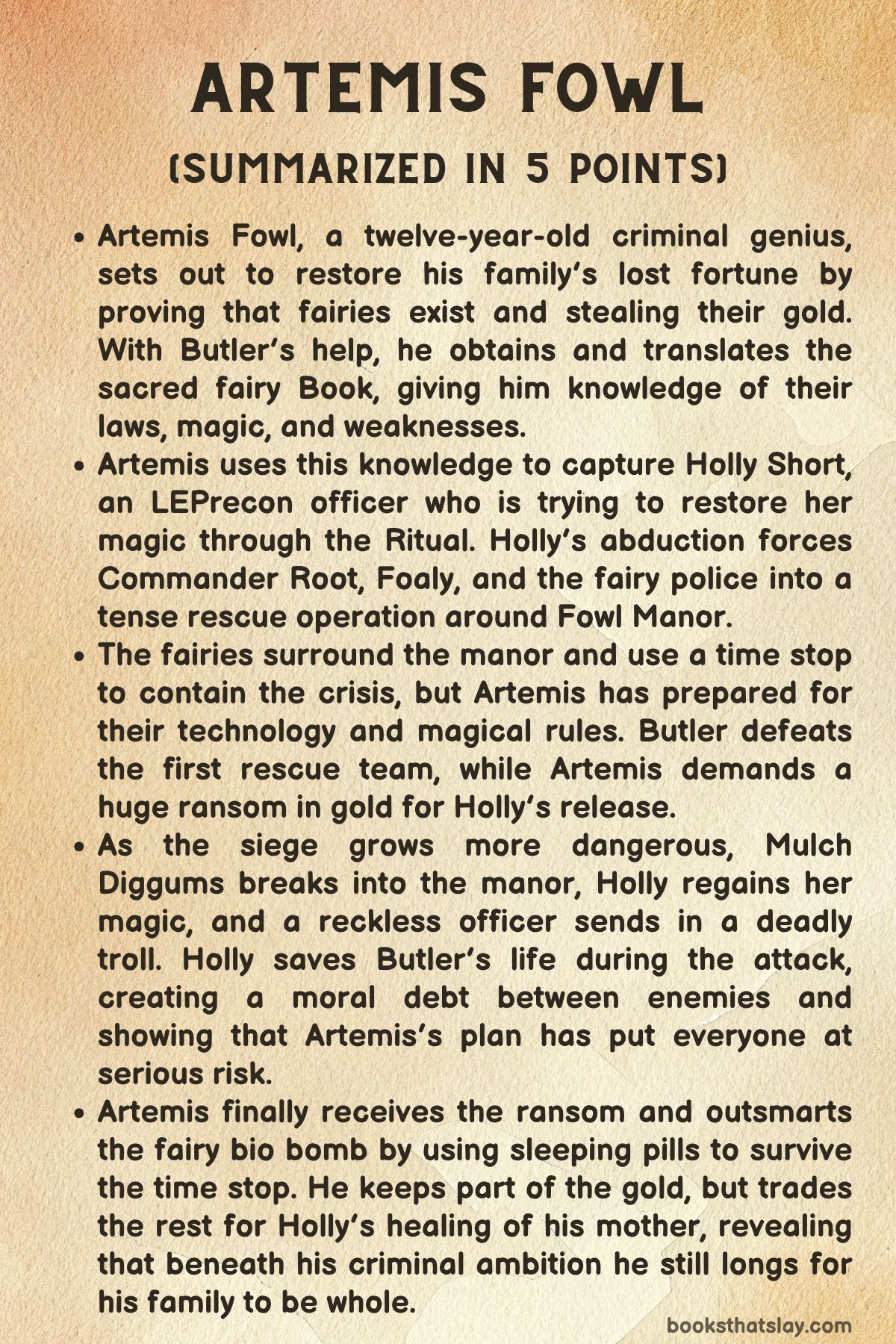
Artemis Fowl follows Artemis Fowl II, a twelve-year-old Irish prodigy from a long line of criminals, as he attempts to restore his family’s fading fortune by stealing fairy gold. Artemis is not an ordinary child.
He is rich, disciplined, calculating, and almost frighteningly intelligent. His father has disappeared after a criminal shipping venture went wrong, and his mother, Angeline, has become mentally unwell from grief.
With the family’s power weakening, Artemis decides to use his mind to do what generations of Fowls have done through crime: take what he wants.
His plan begins with research into fairy legends. Artemis notices that many stories mention a sacred Book carried by fairies, a text containing their laws, history, and magical rules.
He believes that if he can obtain and translate this Book, he can understand the fairy world well enough to exploit it. With his loyal bodyguard, Butler, he travels to Ho Chi Minh City, where he finds a fairy healer who has fallen into addiction and lives among humans.
Artemis bargains with her, but the bargain is built on pressure and manipulation. He gives her holy water disguised as alcohol, then offers her the antidote and a cure in exchange for temporary access to her Book.
She assumes no human can read it, but Artemis has Butler photograph every page.
Back at Fowl Manor, Artemis turns the photographed pages into a translation project. The fairy language is complex, arranged in unusual patterns and filled with symbols, but he eventually breaks it.
The Book gives him the knowledge he needs: fairy customs, magical limits, and especially the Ritual, the process fairies use to restore their magic. Artemis now knows that if he waits in the right place at the right time, he may be able to capture a fairy.
The story then shifts to Holly Short, an elf and officer in LEPrecon, the Lower Elements Police reconnaissance unit. Holly is the first female officer in her division and feels constant pressure from her superior, Commander Root.
Root is harsh, angry, and demanding, but he also knows Holly has skill. Holly has a serious problem: she has neglected the Ritual for years, leaving her magic dangerously low.
During a mission to stop a troll on the surface, her lack of magic nearly exposes the fairy world to humans. She manages to save people, but Root discovers she lied about her condition and orders her to complete the Ritual immediately.
Holly travels to Ireland, where she finds the right place to renew her magic. Artemis and Butler have spent months watching possible Ritual sites, and this is the moment they have been waiting for.
Holly begins the Ritual, but Butler shoots her with a tranquilizer dart before she can finish. Artemis approaches her, protected from the mesmer by mirrored sunglasses.
Holly tries to control him, but the trick fails. She is captured and taken to Fowl Manor.
The kidnapping triggers a crisis below ground. Commander Root and the fairy authorities realize Holly has been taken by humans who already know too much.
Artemis anticipates their response and tricks them by planting Holly’s locator on a ship with a bomb attached. Root follows the signal and narrowly escapes the explosion, confirming that Artemis is a dangerous opponent, not a lucky child.
At Fowl Manor, Holly wakes as a prisoner. Juliet, Butler’s younger sister, guards her while wearing mirrored glasses to avoid fairy mind control.
Artemis visits Holly and explains that he wants the fairy ransom fund: one ton of gold. He also lies to her, saying she has been drugged with truth serum and has already revealed secrets.
Holly is furious, but Artemis uses what he learned from the Book to stay ahead. Because fairy law limits what fairies can do inside human homes, Artemis believes he has the advantage.
The LEP surrounds Fowl Manor and freezes the estate inside a time stop, hoping to contain the situation before human authorities notice. Root enters as a negotiator, but Artemis remains calm.
He knows about the time stop and claims he can escape it. Root threatens the use of a bio bomb if Artemis refuses to surrender Holly, but Artemis still demands the gold.
The fairies cannot simply storm the manor because Artemis has prepared for their invisibility shields and magical methods. Butler defeats a squad of fairy officers, proving that force will not easily solve the problem.
Root then turns to Mulch Diggums, a criminal dwarf with a talent for tunneling. Mulch has lost his magic because he has repeatedly broken fairy law, which makes him useful: he can enter the human dwelling without the same restrictions.
He digs into Fowl Manor and searches for information. While inside, he steals Artemis’s copy of the Book and escapes by faking his death.
Mulch’s actions add chaos to the siege, but they also show that Artemis is not the only clever criminal in the story.
Meanwhile, Holly discovers that the acorn she had been holding during the interrupted Ritual is still in her boot. She breaks through the concrete floor of her cell and finds enough earth to complete the Ritual.
Her magic returns. She uses the mesmer on Juliet and escapes her room.
Artemis sees the situation changing but remains confident because Holly is still bound by his earlier command to remain inside the house.
The fairy command structure grows unstable when Cudgeon takes control from Root and decides to send a troll into Fowl Manor. This plan is reckless and cruel, since the troll cannot be controlled and may kill everyone inside, including Holly.
The troll breaks into the manor and attacks. Butler, one of the most dangerous humans alive, faces it but is badly wounded.
Holly, despite being Artemis’s prisoner, chooses to help. She fights the troll and heals Butler when he is near death.
Butler then returns to battle wearing armor and defeats the creature, though Holly persuades him not to kill it.
This moment changes the emotional balance of the story. Butler now owes his life to Holly, and Artemis must face the fact that the fairy he kidnapped has shown more mercy than he has.
Still, he continues with the ransom demand. The LEP, now under Root’s command again after Cudgeon’s failure, agrees to send in the gold.
Artemis bargains with Holly and asks what it would cost to buy a wish. He gives up half the ransom so Holly will heal his mother.
Holly leaves the manor with half the gold, and the fairies prepare to use the bio bomb once she is clear. Artemis has already predicted this.
He drugs himself, Butler, and Juliet so that they fall asleep inside the time stop. From his study of fairy history, he has reasoned that a person’s state of consciousness remains fixed during the time stop.
By entering it asleep, they stay asleep and avoid the effects of the bomb when time resumes. The fairies enter afterward and become sick because Artemis is still alive, meaning they have entered without proper invitation.
Holly finds that Artemis has survived and kept the remaining gold. He has won.
Yet his victory is not complete in a simple villainous sense. Holly keeps her bargain and heals Angeline Fowl.
Artemis’s mother returns to herself, apologizes to her son, and recognizes him again. For Artemis, this matters more than the gold, even if he hides that feeling behind calculation.
Butler is angry that Artemis drugged Juliet without consent, but he forgives him after understanding the plan and makes him promise not to steal from fairies again.
The book ends by framing the whole story as a fairy case file. Fairy psychologist Dr. J. Argon suggests that Artemis may have saved his mother for selfish reasons, such as avoiding foster care, and warns that Artemis remains a threat to the People.
Holly, however, has already proven that she can stand against him. By the end, Artemis Fowl has shown Artemis as both criminal mastermind and lonely child: someone capable of cruelty, brilliance, and a small but important act of love.
Characters
Artemis Fowl
Artemis is the central figure of the book and one of the most unusual child protagonists in fantasy fiction. He is only twelve, but he behaves with the discipline, emotional control, and strategic mind of an adult criminal mastermind.
In Artemis Fowl, his intelligence is presented almost like a weapon: he studies fairy mythology, decodes a secret language, predicts enemy tactics, and manipulates both humans and fairies with unsettling calm. Yet he is not simply a cold villain.
His actions are driven by the collapse of his family, the disappearance of his father, and the illness of his mother. He wants gold, power, and control, but beneath those goals is a frightened child trying to repair a broken home.
His kidnapping of Holly shows his cruelty and ambition, while his decision to use a wish to heal his mother reveals that he is still capable of love. This contradiction makes him morally complicated.
He is brilliant enough to defeat an entire fairy police force, but emotionally immature enough to treat people as pieces in a game. By the end of the story, Artemis has won the ransom and restored his mother, but the book leaves him in an uncertain place: not redeemed, but not untouched by conscience either.
Butler
Butler is Artemis’s bodyguard, protector, and closest human companion. He is trained to serve the Fowl family with total loyalty, but his relationship with Artemis goes beyond employment.
He acts almost like a father figure, especially because Artemis’s real father is absent and his mother is unable to care for him for much of the story. Butler is physically powerful, highly skilled, and calm under pressure, making him the perfect contrast to Artemis’s intellectual control.
While Artemis plans, Butler executes. Yet Butler is not merely muscle.
He has judgment, loyalty, and a moral awareness that Artemis often lacks. His discomfort with kidnapping Holly and later with Juliet being drugged shows that he has boundaries, even if he often obeys Artemis despite them.
His fight with the troll is one of the clearest examples of his courage. He nearly dies protecting Juliet, and his survival depends on Holly, the very person his side has imprisoned.
That moment changes the emotional tension around him because he must recognize the humanity, or personhood, of an enemy. Butler’s strength is not only physical; it also lies in his devotion, endurance, and ability to forgive Artemis while still demanding better from him.
Holly Short
Holly Short is one of the most important characters in the novel because she challenges Artemis on every level. She is brave, proud, impatient, skilled, and deeply committed to her duty as an officer.
As the first female officer in LEPrecon, she carries the pressure of proving herself in a system that doubts her. Commander Root’s harsh treatment of her is partly professional discipline and partly unfair scrutiny, which makes Holly’s position even more difficult.
Her early mistake, neglecting the Ritual and lying about her magic, shows that she is flawed and sometimes reckless. However, her courage repeatedly outweighs her errors.
She pursues the troll to protect humans, survives captivity, restores her magic under terrible pressure, and later chooses to save Butler even though he is one of her captors. Holly’s moral clarity is especially important because it exposes Artemis’s selfishness.
While Artemis often thinks in terms of victory, leverage, and reward, Holly acts from duty and compassion. In Artemis Fowl, she becomes both a prisoner and a moral counterforce, refusing to let fear or anger destroy her principles.
Her strength lies in her refusal to become cruel simply because cruelty has been used against her.
Commander Root
Commander Root is the hard-edged leader of the LEP forces, and his personality is defined by anger, discipline, and responsibility. At first, he seems like a typical furious superior who constantly criticizes Holly, but the book gradually shows that his harshness comes from the dangerous nature of his job.
He has to protect the secrecy of the fairy world, manage political pressure, and make decisions in crises where a single mistake could expose the People to humans. His treatment of Holly is complicated.
He is unfair to her at times and openly admits that she has to perform better because she is the first female officer, yet he also knows she is capable and gives her chances to prove herself. Root’s leadership is tested during the siege of Fowl Manor.
He prefers control and procedure, but Artemis forces him into a situation where fairy law, technology, and military tactics are all being used against him. Root’s refusal to immediately use the most destructive option shows that he is not heartless, even if he is severe.
His conflict with Cudgeon also reveals his integrity. Root may be aggressive and difficult, but he is not careless with lives, and he understands the weight of command.
Foaly
Foaly, the centaur technical expert, brings intelligence, humor, and scientific creativity to the fairy side of the story. He is responsible for much of the LEP’s advanced technology, including surveillance systems, tracking devices, weapons, and equipment used during the siege.
His habit of wearing a tinfoil hat because he fears human monitoring makes him comic, but it also points to the fairy world’s deep anxiety about human discovery. Foaly’s role is important because he mirrors Artemis in some ways.
Both are brilliant, suspicious, and skilled at using information as power. The difference is that Foaly works within a protective system, while Artemis works for private gain.
Foaly often sees patterns that others miss, and he becomes one of the few fairy characters capable of appreciating just how dangerous Artemis is. He also provides a more relaxed contrast to Root’s temper.
Through Foaly, the fairy world feels modern rather than purely mythical. He shows that magic and technology coexist underground, and that fairies are not ancient storybook figures but a hidden civilization with science, bureaucracy, and security problems of their own.
Juliet
Juliet is Butler’s younger sister and serves the Fowl household while still being in training. She is less experienced than Butler, but she is not helpless.
Her role in guarding Holly shows that Artemis trusts her with serious responsibility, even though she sometimes seems cheerful, casual, or less severe than the people around her. Juliet’s youth matters because she reflects what Artemis lacks: a more ordinary kind of adolescence.
She can be playful and emotional in a way Artemis rarely allows himself to be. Her presence also deepens Butler’s character, because his loyalty to Artemis is tested when Juliet is placed in danger.
During the troll attack, she becomes one of the innocent people caught in the consequences of Artemis’s plan. Artemis may claim control over events, but Juliet’s danger proves that his schemes put real lives at risk.
Her character also helps humanize the Fowl household. Without Juliet, the manor could feel like only a criminal fortress.
With her there, it becomes a place where family-like bonds exist, even under strange and dangerous circumstances.
Angeline Fowl
Angeline Fowl is Artemis’s mother, and her illness is one of the emotional foundations of the book. After her husband’s disappearance, she withdraws into grief and confusion, often failing to recognize Artemis or understand reality clearly.
Her condition creates a painful absence in Artemis’s life. She is physically present in Fowl Manor, but emotionally unreachable for much of the story.
This helps explain why Artemis has become so controlled and self-reliant. With his father gone and his mother unwell, he has had to become the head of the household while still being a child.
Angeline’s scenes reveal the sadness beneath the criminal plot. Artemis can face fairies, decode ancient languages, and outthink trained officers, but he cannot simply reason his mother back to health.
His wish for Holly to heal her is one of the strongest signs that his love for her remains genuine. Angeline’s recovery at the end changes the future for Artemis.
It restores part of his family, but it also means he can no longer operate with the same freedom. Her return brings comfort, but also accountability.
Artemis Fowl Senior
Artemis’s father is mostly absent, but his influence is felt throughout the story. His disappearance after a failed criminal business venture leaves the Fowl family weakened, both financially and emotionally.
Artemis’s desire to restore the family fortune is tied to his father’s legacy, and his constant monitoring of news channels shows that he has not fully accepted the possibility that his father may be gone forever. Artemis Senior represents the old criminal identity of the Fowl family.
His choices helped create the crisis that Artemis now tries to solve through even more dangerous methods. At the same time, his absence leaves a space that Artemis tries to fill too early.
The boy becomes colder, more secretive, and more ambitious because he is acting as heir, strategist, and family protector all at once. Artemis Senior does not need to appear often to shape the novel.
He is the missing figure behind Artemis’s hunger for control and his fear of losing what remains of his family.
Mulch Diggums
Mulch Diggums is a criminal dwarf whose comic behavior hides a sharp survival instinct. He has broken fairy law many times, lost his magic, and become highly skilled at theft, escape, and underground movement.
His tunneling abilities are described in grotesque and humorous terms, making him one of the strangest and most memorable figures in the book. Mulch’s role in the siege is practical because he can enter Fowl Manor in ways the LEP cannot.
He also disrupts both sides’ plans. He steals Artemis’s copy of the Book, tricks the LEP into thinking he has died, and escapes with his own interests protected.
Mulch is not noble, but he is clever and independent. He belongs to the criminal side of fairy society, which helps broaden the world beyond official officers like Holly, Root, and Foaly.
His presence also shows that Artemis is not the only trickster in the story. Mulch may not have Artemis’s grand strategy, but he has street-level cunning, boldness, and a gift for turning chaos into opportunity.
Briar Cudgeon
Cudgeon is an ambitious and self-serving LEP officer whose desire for glory makes him dangerous. Unlike Root, who is harsh but responsible, Cudgeon is more interested in authority and reputation than in protecting lives.
His decision to send a troll into Fowl Manor shows his recklessness. He knows the creature is difficult to control, but he chooses a dramatic show of force because he wants to win quickly and claim credit.
Cudgeon’s behavior makes him a useful contrast to both Root and Artemis. Like Artemis, he wants control, but he lacks Artemis’s discipline and intelligence.
Like Root, he holds command authority, but he lacks Root’s sense of responsibility. His failure proves that power without judgment creates disaster.
Cudgeon’s actions also push Holly, Butler, and Artemis into a more intense crisis, forcing enemies to recognize each other’s courage. He is not the central villain of the book, but his ambition makes him one of its clearest examples of institutional danger from within.
Nguyen
Nguyen is a minor but useful character who helps lead Artemis and Butler to the fairy healer in Ho Chi Minh City. His role is brief, but it reveals much about Artemis.
Artemis identifies him almost immediately despite his disguise as a waiter, showing the boy’s observational skill and confidence. Nguyen also demonstrates how Artemis uses people as tools.
He is paid for information and then dismissed once he has served his purpose. Through Nguyen, the opening of the story establishes the world Artemis moves through: secretive, transactional, and morally gray.
Even before the fairies fully enter the plot, the reader sees Artemis operating like a professional criminal rather than a child. Nguyen’s fear and uncertainty also help highlight the unusual power dynamic of the scene.
Artemis may be young, but adults around him often react as if he is the one in control.
The Fairy Healer
The fairy healer in Ho Chi Minh City is a tragic early figure in the story. She lives away from her people, weakened by addiction and cut off from the protection of fairy society.
Artemis exploits her vulnerability to obtain the Book, using both threat and bargain to get what he wants. Her presence reveals that the fairy world has outcasts and failures, not just disciplined officers and magical wonders.
She also shows the moral cost of Artemis’s methods. He does cure her addiction and save her life, but he does so because it benefits his plan and reduces evidence, not because he is acting from kindness alone.
The scene with her establishes the ethical pattern that follows throughout the novel: Artemis can do something useful or even beneficial while still acting in a manipulative way. She is important because she gives Artemis access to fairy knowledge, but she also marks the first clear sign that his mission depends on taking advantage of the weak.
Trouble Kelp
Trouble Kelp is a LEP officer involved in the attempted rescue at Fowl Manor. Though he is not as central as Holly, Root, or Foaly, he helps show the discipline and danger of the fairy police force.
His presence during the siege gives the LEP response a broader military structure. He is part of a trained unit that expects fairy technology and invisibility to give them an advantage, only to discover that Artemis and Butler have already prepared for those methods.
Trouble’s encounter with Butler is especially important because it proves that the fairies have underestimated the human side. His defeat shows Butler’s skill and Artemis’s planning, but it also adds to the LEP’s growing realization that this is not a normal hostage situation.
Trouble represents the professional officer caught between orders, danger, and an enemy who understands fairy tactics too well.
The Troll
The troll functions less as a thinking character and more as a force of violence that exposes the choices of the people around it. It is dangerous, powerful, and difficult to control, which makes Cudgeon’s decision to release it into Fowl Manor especially reckless.
The troll attack strips away strategy for a moment and leaves the characters facing immediate physical danger. Butler’s bravery, Juliet’s vulnerability, Holly’s compassion, and Artemis’s dependence on others all become clearer because of the troll.
Most importantly, Holly’s decision to heal Butler during the fight changes the moral shape of the story. The troll is frightening, but it also becomes the reason enemies are forced into a moment of cooperation.
By sparing the troll at Holly’s request, Butler acknowledges her moral authority and his debt to her. In that sense, the creature’s role is not only to threaten lives but to reveal character under pressure.
Dr. J. Argon
Dr. J. Argon appears through the case-file frame at the end, giving the events a clinical fairy-world interpretation. His conclusion about Artemis is skeptical and somewhat cold.
He suggests that Artemis’s decision to heal his mother may have been selfish rather than loving, because it helped him avoid being placed in foster care. This interpretation matters because it prevents the ending from becoming too simple.
The reader has seen signs of Artemis’s affection, but Argon reminds us that Artemis is still manipulative and dangerous. His role also reinforces the idea that the events of the book are being studied by the fairy authorities as a serious security case.
In Artemis Fowl, Argon’s viewpoint leaves Artemis morally unresolved. He may be changing, but the fairy world has good reason not to trust him.
Themes
Intelligence Without Morality
Intelligence in Artemis Fowl is powerful, but the book repeatedly shows that brilliance does not automatically lead to wisdom or goodness. Artemis can decode the fairy language, predict military responses, manipulate ancient rules, and defeat a society with far greater technology than his own.
His mind allows him to do what adults and experts would consider impossible. Yet the same intelligence also makes him dangerous because he uses it without enough concern for the people affected by his plans.
Holly becomes a hostage, Juliet is placed in danger, Butler is nearly killed, and the fairy world is pushed toward extreme violence because Artemis treats the situation as a contest to be won. The book does not condemn intelligence itself; Foaly and Holly also rely on quick thinking and specialized knowledge.
Instead, it questions what happens when intelligence is separated from empathy. Artemis’s mind gives him control, but it cannot heal his mother, replace his father, or remove his loneliness.
His eventual wish for Angeline’s recovery suggests that his intelligence must be guided by emotional truth if he is to become more than a successful criminal.
The Cost of Control
Artemis wants control because his life has been shaped by loss. His father has disappeared, his mother is mentally unwell, and his family fortune has been damaged.
Rather than admit fear or helplessness, he builds a plan that lets him dominate a hidden magical civilization. Control becomes his way of coping with grief.
He studies, prepares, predicts, and manipulates until even the fairy time stop becomes part of his strategy. However, the story shows that control has limits.
Artemis can plan the kidnapping, the ransom, and the escape, but he cannot fully control Holly’s courage, Mulch’s theft, Cudgeon’s recklessness, or Butler’s moral discomfort. The troll attack is especially important because it breaks through the illusion that everything is part of Artemis’s design.
Suddenly, people he depends on may die, and survival requires Holly’s mercy rather than Artemis’s planning. The book suggests that control may protect Artemis from feeling powerless, but it also isolates him from trust and compassion.
His victory is impressive, but it comes at the cost of fear, betrayal, and danger to people close to him.
Prejudice, Duty, and Proving Oneself
Holly’s position in the LEP brings forward a theme of prejudice within institutions. She is the first female officer in her division, and she is constantly judged not only as an individual but as a test case.
Root’s treatment of her is complicated because he believes pressure will make her stronger, but his expectations are also unfair. Holly knows that her mistakes will be used against more than just herself.
If she fails, others may treat her failure as proof that women do not belong in the role. This pressure shapes her pride, secrecy, and determination.
Her lie about her magic is wrong, but it comes from a fear of being dismissed before she can prove her worth. The book also shows that true competence is not the same as perfection.
Holly makes errors, but she also saves lives, resists captivity, restores her magic, and acts with courage when others choose violence. Her story challenges the idea that authority always recognizes merit fairly.
She earns respect not by being flawless, but by showing strength, judgment, and compassion under conditions designed to make her fail.
Family, Loyalty, and Emotional Debt
Family loyalty drives much of the story, even when characters hide it behind duty or strategy. Artemis claims to be motivated by gold and family status, but his deeper pain comes from his father’s disappearance and his mother’s illness.
His criminal plan is partly an attempt to restore the Fowl name, yet his wish for Angeline’s healing reveals that emotional need matters more to him than he admits. Butler’s loyalty is also central.
He serves Artemis because of family tradition, but his care for the boy feels personal, almost parental. At the same time, Juliet’s danger forces Butler to confront the cost of that loyalty.
He trusts Artemis, but he is not blind to the harm Artemis can cause. Holly introduces another kind of debt when she saves Butler’s life.
That act creates a moral bond between enemies and complicates the simple division between captor and captive. The book presents loyalty as powerful but not always clean.
It can protect, excuse, endanger, and redeem. The strongest relationships in the story are not based only on obedience, but on the difficult moments when characters choose whether someone else’s life matters more than winning.