The Autobiography of Benjamin Franklin Summary and Analysis
The Autobiography of Benjamin Franklin is Benjamin Franklin’s account of his rise from a printer’s apprentice to one of the most respected figures in colonial America. Written across different periods of his life, the book presents Franklin as a man shaped by self-education, discipline, ambition, public service, and practical morality.
It is not only a life story but also a record of how Franklin understood success: as the result of industry, careful habits, useful friendships, civic responsibility, and constant self-improvement. The work also captures early American social life, printing culture, religious debate, scientific curiosity, and the growing tension between the colonies and Britain.
Summary
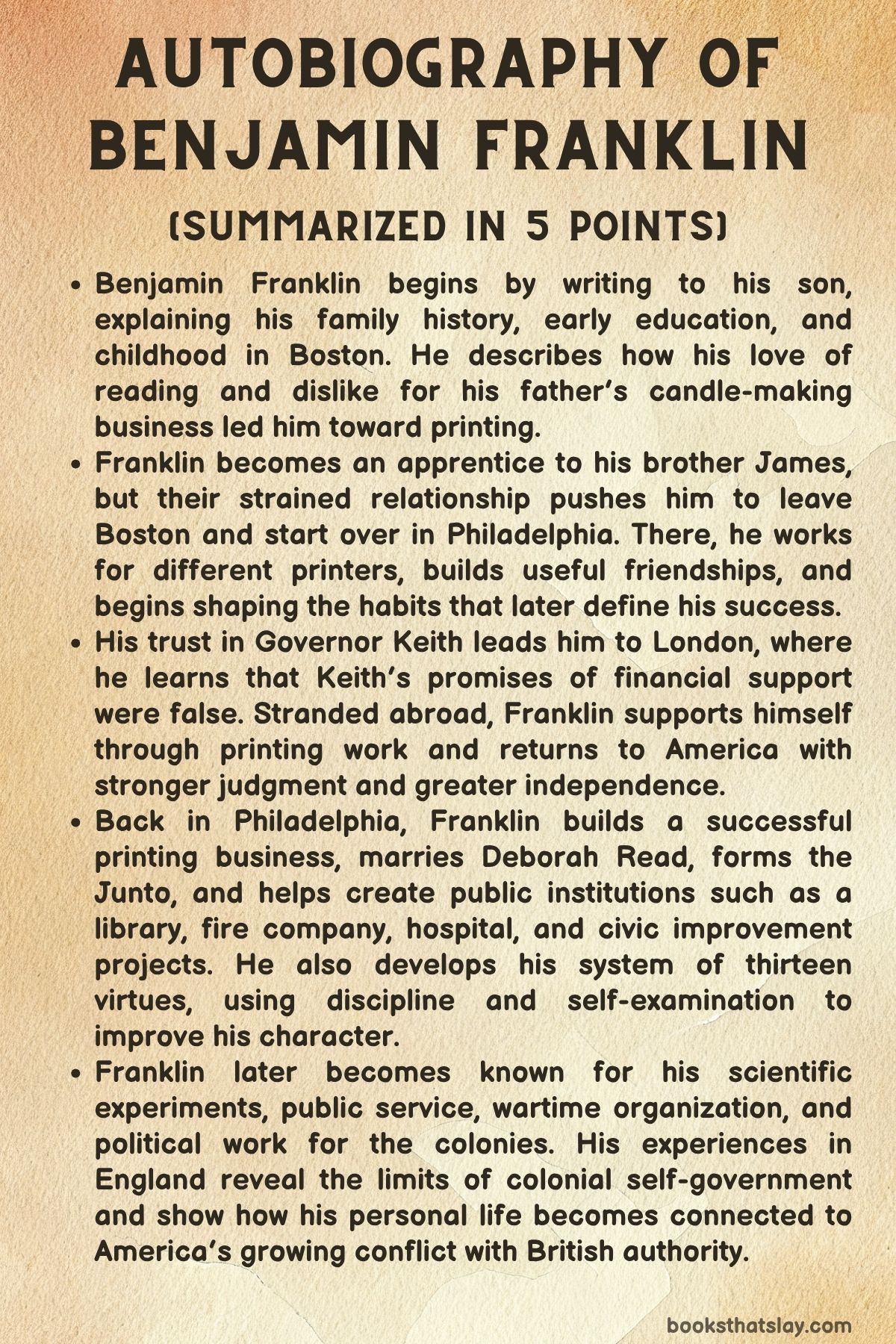
Autobiography of Benjamin Franklin begins with Franklin writing to his son, William, in 1771. He explains that he wants to record the circumstances of his life, both for family memory and for the possible benefit of others.
Franklin openly admits that writing about himself satisfies his vanity, but he treats vanity with humor rather than shame. He believes that remembering one’s life through writing can give it a kind of second existence.
From the start, he presents his life as one guided by effort, good habits, and divine providence.
Franklin begins with his ancestry. He studies family notes left by an uncle and describes his father’s move to New England.
His father, Josiah Franklin, marries twice, and Benjamin is born into a large family. As a boy, Franklin first attends grammar school because his family considers preparing him for the church.
That plan changes because of financial limits, and by age ten he returns home to assist in his father’s soap and candle business. Franklin dislikes this work and dreams of becoming a sailor, but his parents prevent him from going to sea.
His early independence appears when he organizes other boys to build a wharf, though they use stolen materials from a construction site. The incident becomes an early lesson in judgment and honesty.
Franklin deeply admires his father, especially his intelligence, fairness, and practical wisdom. Josiah teaches him how to discuss issues carefully and listen to different views.
Franklin’s love of reading soon becomes clear, and his father arranges for him to be apprenticed to his older brother James, a printer. This change suits Franklin much better than candle making.
He reads widely, writes poetry, imitates respected essayists, and studies the style of publications such as the Spectator. He also sharpens his debating skills through exchanges with John Collins, a friend who enjoys argument and intellectual competition.
James Franklin begins publishing one of the first newspapers in America, The New England Courant. Benjamin secretly submits an essay, and it is accepted.
When he later reveals that he wrote it, James reacts badly and sees his younger brother as vain and proud. The relationship worsens.
After James is imprisoned for publishing material that offends the Assembly, Benjamin helps keep the newspaper running. Eventually, Franklin decides to leave his brother’s service.
Since James blocks him from finding printing work in Boston, Franklin secretly leaves for New York and then Philadelphia. He arrives in Philadelphia poor, tired, and poorly dressed, but this moment marks the beginning of his independent adult life.
In Philadelphia, Franklin meets William Bradford, who cannot hire him but helps him find work with another printer, Keimer. Franklin quickly judges both Bradford and Keimer as weak printers, yet he works for Keimer and begins to build a life in the city.
He lodges with John Read, whose daughter Deborah later becomes important in his life. Franklin also forms friendships with young people who share his interest in reading and ideas.
His writing earns attention beyond his immediate circle. Robert Holmes, Franklin’s brother-in-law, urges him to return to Boston.
When Holmes shows Franklin’s letter to Sir William Keith, the governor of Pennsylvania, Keith is impressed and encourages Franklin to open his own printing business. Keith even sends Franklin to Boston with a letter meant to persuade Josiah Franklin to support the plan.
Josiah refuses because Franklin is still too young, though he praises his son’s ability and tells him that he may help if Franklin saves enough money by age twenty-one.
On the way back to Philadelphia, Franklin becomes entangled in one of the mistakes he later calls an “erratum.” A man named Vernon entrusts him with money, but Franklin’s friend John Collins repeatedly borrows from him to support his drinking. Franklin spends money that was not his, and this weighs on him as a serious error.
Around the same time, Governor Keith promises to support Franklin’s printing business and sends him to London to buy equipment. Franklin trusts Keith, but when he reaches London, he discovers that the promised letters of credit do not exist.
Keith has deceived him. Stranded in London, Franklin spends about a year working in a print shop and learning from experience.
Before returning fully to his business story, Franklin reflects on his religious and moral views. As a young man, he becomes a Deist, believing in God while questioning parts of organized religion.
He values truth, sincerity, integrity, and moral conduct. These principles become central to how he presents himself.
When he returns to Philadelphia, he leaves Keimer and starts a printing business with Meredith, another former employee. Franklin also forms the Junto, a discussion club for men interested in moral, political, and scientific questions.
This club becomes important not only for conversation but also for business connections and civic projects.
Franklin’s printing career grows. He buys Keimer’s failing newspaper, gains work as the official printer for the Pennsylvania Assembly, pays debts, and builds financial security.
His pamphlet on paper currency helps his reputation. As his career stabilizes, he thinks about marriage.
He reconnects with Deborah Read, who had married another man who abandoned her. Franklin sees marrying Deborah as a way to repair an earlier mistake, since he had left for London while courting her.
Their marriage brings him domestic stability. He then turns toward public improvement by helping establish a subscription library through the Junto, which he later presents as the beginning of an important American institution.
The first part ends with Franklin noting that some family details may not interest the public and that the American Revolution interrupts his writing. The second part begins with letters from Abel James and Benjamin Vaughan, both encouraging him to continue.
They believe his life can serve as a useful example. Vaughan especially praises Franklin as a wise man whose conduct may instruct others.
Franklin resumes his account in France in 1784. Because he lacks his earlier papers, he quickly returns to the library project and to the poor state of printing in the colonies when he first left Boston.
He explains that modesty helped him persuade others to support his plans. He also reflects on the benefits of reading, which he calls his only amusement.
Franklin’s ambition is practical: he seeks wealth, usefulness, reputation, and independence, though he did not foresee that he would someday meet kings.
A major section concerns Franklin’s program of moral improvement. He lists thirteen virtues: temperance, silence, order, resolution, frugality, industry, sincerity, justice, moderation, cleanliness, tranquility, chastity, and humility.
He creates a system to practice one virtue at a time, marking his faults in a chart. The virtue that troubles him most is order, because real life constantly disrupts plans.
His daily schedule shows his belief that time should be used carefully. Franklin credits this system with much of his happiness.
He even considers writing a book called The Art of Virtue. Humility is added after a friend points out Franklin’s pride, and Franklin admits that pride remains one of the hardest faults to defeat.
In the third part, Franklin explains that he has returned to Philadelphia and lost many papers during the war. He describes an unrealized plan for a “united Party for Virtue,” an international group built around moral conduct and belief in God.
He then turns to his publications, especially Poor Richard’s Almanac, first issued in 1732. Franklin uses the almanac and his newspaper to spread practical advice, proverbs, and moral instruction to ordinary readers.
His printing business expands. He sends workers to other colonies to establish printing houses.
In Charleston, one employee handles accounts badly, but after his death, the widow manages the business with great accuracy. This experience leads Franklin to argue for better education for women.
He also discusses religion again. Though he does not attend church regularly, he is drawn for a time to the sermons of Hemphill, an Irish preacher whose controversial style attracts him.
He studies languages, including French, Italian, Spanish, and Latin.
Franklin revisits Boston after ten years and makes peace with his brother James. James, near death, asks Franklin to care for his son.
Franklin agrees. He also suffers personal loss when one of his young sons dies of smallpox.
This strengthens his belief in smallpox inoculation, since he later regrets that his son had not been protected.
Franklin’s civic influence grows through the Junto, the Pennsylvania Assembly, the postal system, and public projects. He becomes clerk of the Assembly, then deputy postmaster in Philadelphia.
These roles help his newspaper circulate. He proposes improvements to the city watch and helps form a fire company.
He also develops a friendship with the preacher George Whitefield, despite disagreement over Whitefield’s plans and the suspicion others have toward him. Franklin helps raise support for Whitefield’s orphanage in Georgia after first resisting the appeal.
In the 1740s, Franklin works to establish a college in Philadelphia and supports the creation of a philosophical society. During conflict involving Britain, Spain, and France, he writes in favor of forming a militia.
The effort faces resistance from Quakers, whose religious commitment to peace makes military organization difficult. Franklin respects the challenge but continues to work for defense.
His scientific and inventive side becomes increasingly important. He invents an improved stove in 1742 but refuses to patent it, believing useful inventions should benefit others freely.
Someone in London later profits from a similar patent, but Franklin does not present this as a bitter loss. He serves as commissioner of peace, joins the Assembly, and helps negotiate with Indigenous peoples.
He also observes the destructive effect of alcohol in those communities. His public projects continue: he helps create a hospital, supports a Presbyterian meeting house, promotes paved streets, and improves streetlamps.
He later becomes postmaster general of America.
During the French and Indian War, Franklin works with colonial governors to support defense efforts. He helps arrange supplies for troops, including food, wagons, and other necessities.
His public letters encourage citizens to contribute money and resources. He speaks respectfully of some British military officials, yet he also notes that colonists begin to question Britain’s competence and leadership.
Franklin himself becomes a colonel and takes practical responsibility for military supply and organization.
Franklin then describes the rise of his scientific reputation. In 1746, Dr. Spence demonstrates electrical experiments, and Franklin begins testing electricity himself.
A glass tube sent to the Philadelphia library helps him conduct further experiments. At first, the Royal Society dismisses his work, but Dr. John Fothergill recognizes its value and helps bring it to wider attention.
Franklin’s writings on electricity are published, translated, and admired. His kite experiment becomes famous, and the Royal Society eventually honors him with a medal presented by Governor Denny.
In 1756, the Pennsylvania Assembly sends Franklin to England to represent colonial interests. Before he leaves, Lord Loudon arrives and attempts to settle disputes between Franklin and Governor Denny.
Franklin still goes to England after delays. During the voyage, he observes shipbuilding and the danger of French ships.
He reaches London in 1757 and begins negotiations over colonial rights and taxation.
The final part centers on Franklin’s conflict with the proprietary governors and the British view of colonial authority. Franklin is surprised to hear that some British officials treat the king as the lawmaker for the colonies.
Franklin had believed that colonial charters gave the Assemblies the power to make their own laws. He argues the Assembly’s case, lists its complaints, and works toward a compromise over taxation.
After the dispute, he returns to Philadelphia. The autobiography ends with the proprietary governors threatening Governor Denny for approving the Assembly’s proposal, though they never carry out the threat.
Franklin’s closing political realization is stark: the colonies do not truly possess the lawmaking independence he once thought they had.
Key Figures
Benjamin Franklin
Benjamin Franklin is the central figure of the book and presents himself as a self-made man shaped by curiosity, discipline, mistakes, ambition, and public usefulness. He begins as a restless boy who dislikes his father’s trade and longs for the freedom of the sea, but he gradually channels that restless energy into reading, writing, printing, science, civic planning, and politics.
Franklin is honest about his flaws, especially vanity, pride, and youthful errors such as leaving his brother’s service and misusing Vernon’s money through Collins’s influence. His idea of self-improvement is practical rather than abstract: he creates schedules, moral charts, clubs, libraries, public institutions, and systems of work.
In Autobiography of Benjamin Franklin, he is not shown as a flawless hero but as someone who turns error into instruction. He values usefulness above display, but he also cares deeply about reputation.
His identity grows from private ambition into public responsibility, and by the end he becomes a colonial representative who understands the political limits imposed by Britain.
William Franklin
William Franklin, Benjamin Franklin’s son, is important because the autobiography begins as a letter addressed to him. He is not developed through action, but his presence shapes the tone of the opening.
Franklin writes partly to preserve family history for William and partly to present the habits and choices that formed his life. William functions as the first imagined reader: someone close enough to care about family anecdotes, yet distant enough to need an explanation of the past.
Because Franklin is writing to his son, the early sections combine affection, instruction, confession, and self-defense. William’s role also gives the book a generational quality, since Franklin wants his experiences to outlive him and become useful to those who come after.
Josiah Franklin
Josiah Franklin, Benjamin Franklin’s father, is one of the strongest moral influences in the book. He is described as a man of sound understanding, good judgment, and practical wisdom.
Although he cannot afford to keep Benjamin in grammar school, he notices his son’s interests and eventually moves him from the family soap and candle business to printing. Josiah teaches Benjamin how to reason and debate, and his household seems to value conversation, fairness, and usefulness.
He also provides necessary restraint, refusing Governor Keith’s proposal because Benjamin is too young to open a printing business. Josiah’s caution contrasts with Benjamin’s ambition.
He represents the steady, prudent judgment that Franklin later tries to build into his own character.
Franklin’s Mother
Franklin’s mother appears mainly as part of the family background, but her role is still significant because she belongs to the domestic world from which Franklin emerges. She and Josiah prevent Benjamin from becoming a sailor, a decision that redirects his life toward printing and public service.
Although the book does not give her a long individual portrait, she represents parental authority and family stability. Her presence also reminds readers that Franklin’s rise does not begin in isolation; it begins in a large household where children are guided toward trades, habits, and responsibilities.
Franklin’s Unnamed Uncle
Franklin’s unnamed uncle matters because his family notes provide Franklin with information about his ancestors. He is not active in the main events, but he helps preserve the family memory that Franklin later uses.
His role supports one of the book’s central concerns: the value of written records. Just as Franklin writes his autobiography to preserve his own life, his uncle’s notes preserve earlier generations.
The uncle therefore becomes a quiet model of how private writing can carry family history forward.
James Franklin
James Franklin, Benjamin’s older brother, is both mentor and obstacle. As a printer, he gives Benjamin the trade that becomes the foundation of his career.
At the same time, he treats Benjamin harshly and reacts with anger when Benjamin’s anonymous essay is praised. James’s pride and resentment create conflict, especially after Benjamin leaves his apprenticeship.
By blocking Benjamin from other printing work in Boston, James indirectly pushes him toward Philadelphia, where his future begins. Their later reconciliation is important because it shows Franklin’s desire to correct old injuries.
James’s request that Benjamin care for his son after his death softens his earlier image and allows the relationship to end with responsibility rather than bitterness.
John Collins
John Collins is Franklin’s early intellectual companion and later a cautionary figure. At first, he helps Franklin sharpen his debating skills through letters and argument.
Their friendship shows Franklin’s youthful hunger for mental competition. Later, Collins becomes associated with alcohol dependency and financial irresponsibility.
When he repeatedly borrows Vernon’s money from Franklin, he contributes to what Franklin calls one of the great mistakes of his life. Collins’s decline contrasts with Franklin’s self-discipline.
He also shows how friendship can influence moral judgment, especially when loyalty and weakness blur the line between generosity and irresponsibility.
William Bradford
William Bradford is a printer who helps Franklin when he reaches Philadelphia. He cannot employ Franklin himself, but he gives him shelter and introduces him to Keimer.
Bradford’s role is modest but important because he provides Franklin with a first foothold in a new city. Franklin later judges him as not especially skilled in printing, yet Bradford still acts with basic kindness.
He represents the kind of practical connection that helps a young worker survive during uncertain beginnings.
Keimer
Keimer is Franklin’s employer in Philadelphia and serves as a contrast to Franklin’s competence and discipline. Franklin sees him as poorly qualified, and Keimer’s eventual business failure confirms Franklin’s judgment.
Still, Keimer provides Franklin with employment at a crucial stage. His weaknesses also give Franklin a chance to observe what not to do as a printer and businessman.
Keimer’s decline creates an opening for Franklin, who later buys his failing newspaper. In the story, Keimer represents the gap between owning a trade and mastering it.
John Read
John Read is Deborah Read’s father and Franklin’s landlord in Philadelphia. His role is mainly domestic and social, since he houses Franklin when the young printer is establishing himself.
Through John Read’s household, Franklin becomes connected to Deborah, who later becomes his wife. John Read represents the ordinary family network that helps Franklin move from being a newcomer in Philadelphia to someone with personal ties in the city.
Deborah Read
Deborah Read is central to Franklin’s domestic life. Franklin first courts her before his trip to London, but his absence and uncertainty damage the relationship.
She marries another man, who abandons her, leaving her in a difficult position. When Franklin later marries her, he sees the marriage as a way to repair an earlier mistake.
Deborah is presented as a good wife who supports Franklin’s stable home life. Her importance lies not in public action but in the security she gives him.
Franklin connects his happiness and productivity partly to domestic steadiness, and Deborah represents that foundation.
Robert Holmes
Robert Holmes, Franklin’s brother-in-law, tries to persuade Franklin to return to Boston after he leaves. His letter becomes important because it reaches Governor Keith, who is impressed by Franklin’s reply.
Holmes therefore has an indirect but major effect on Franklin’s career. He does not bring Franklin back to Boston, but his involvement draws attention to Franklin’s writing ability and helps create the London episode.
Holmes represents how family concern can unexpectedly open public opportunity.
Sir William Keith
Sir William Keith is one of the most important unreliable figures in Franklin’s early life. As governor of Pennsylvania, he flatters Franklin, praises his ability, and encourages him to open a printing business.
His promises appear generous, but they prove empty when Franklin reaches London and discovers that Keith has not provided the promised support. Keith teaches Franklin a painful lesson about trusting powerful people too easily.
His character is charming but irresponsible, and his false encouragement leaves Franklin stranded. At the same time, Keith’s deception forces Franklin to rely on his own labor and judgment abroad.
Vernon
Vernon is the man who entrusts Franklin with money during Franklin’s return journey to Philadelphia. He does not appear as a developed personality, but his role is morally important.
Because Franklin allows Collins to borrow from this money, Vernon becomes connected to one of Franklin’s deepest early regrets. Vernon represents trust, obligation, and the seriousness of handling another person’s property.
Franklin’s failure with Vernon’s money becomes an example of how youthful carelessness can damage integrity.
Charles Osborne
Charles Osborne belongs to Franklin’s circle of young friends interested in writing, debate, and improvement. His presence shows that Franklin’s intellectual life develops through competition and companionship, not solitary study alone.
Osborne helps form the atmosphere of literary challenge that pushes Franklin to refine his prose and arguments. Though not a major actor, he is part of the early network that strengthens Franklin’s confidence as a writer.
Joseph Watson
Joseph Watson, like Osborne, is part of Franklin’s youthful literary and debating circle. His importance lies in the social environment he represents.
Franklin’s early friendships are built around reading, writing contests, discussion, and criticism. Watson helps show that Franklin’s growth depends on communities of practice.
Through such companions, Franklin tests his abilities, learns persuasion, and prepares for the public writing that later advances his career.
James Ralph
James Ralph is Franklin’s friend who travels with him to London. His presence in the London journey highlights Franklin’s youthful attachments and the risks of misplaced confidence.
While the book does not provide extensive detail about Ralph’s later conduct, his decision to accompany Franklin makes him part of the episode in which Franklin discovers Keith’s betrayal. Ralph belongs to the period when Franklin is still learning how to judge people, promises, and prospects.
Andrew Hamilton
Andrew Hamilton appears as one of the important historical figures Franklin encounters during his journey to London. Though the book gives little direct action, his inclusion signals Franklin’s movement into broader social and political circles.
Meeting figures like Hamilton shows Franklin’s gradual rise from tradesman to someone who crosses paths with influential men. Hamilton’s role is therefore symbolic of Franklin’s expanding world.
James Hamilton
James Hamilton, like Andrew Hamilton, appears during Franklin’s London-related journey and represents Franklin’s increasing contact with important colonial figures. His presence helps mark the transition from Franklin’s local trade life to larger networks of authority and influence.
Even when not deeply characterized, he contributes to the book’s record of Franklin’s growing social reach.
Abel James
Abel James is one of the friends who urges Franklin to continue writing his life story. His letter matters because it validates the autobiography as useful beyond private family memory.
James believes Franklin’s life can influence the world, and his encouragement helps shift the work from a personal letter toward a public model of conduct. He represents the reader who sees Franklin’s experience as instruction for others.
Benjamin Vaughan
Benjamin Vaughan also encourages Franklin to continue the autobiography. He praises Franklin as a wise man whose example may guide readers.
Vaughan’s role is important because he frames Franklin’s life as morally and socially useful. He helps justify the continuation of the work after the first part.
Through Vaughan, the book presents Franklin not only as someone remembering his past but as someone whose habits and choices may become a guide.
Meredith
Meredith is Franklin’s business partner when Franklin starts his own printing shop after leaving Keimer. As another former employee of Keimer, he belongs to the practical world of the printing trade.
His role is tied to Franklin’s move from employee to owner. The partnership helps Franklin begin his independent business life, though Franklin’s own industry and judgment dominate the account.
Meredith represents the transitional stage before Franklin becomes fully established.
Members of the Junto
The Junto is a club rather than a single character, but its members act collectively as one of the most important forces in Franklin’s public development. They provide discussion, criticism, connections, and support for civic projects.
Through the Junto, Franklin develops ideas about libraries, public improvement, moral debate, and practical cooperation. The group also helps him gain business from Quakers and expand his influence.
In Autobiography of Benjamin Franklin, the Junto shows how private discussion can become public action.
The Quakers
The Quakers appear as a religious and political community whose values influence Franklin’s work in Pennsylvania. They help Franklin’s business connections, but they also complicate militia efforts because of their commitment to pacifism.
Franklin treats them as a serious group whose moral principles must be considered, even when he disagrees with their reluctance to support armed defense. Their presence shows the difficulty of governing a diverse colony where religion, politics, and security do not always align.
Franklin’s Charleston Employee
Franklin’s employee sent to Charleston is important because he expands Franklin’s printing business into another colony. However, he does not keep proper accounts, showing poor business discipline.
His weakness becomes clearer after his death, when his widow manages the accounts much better. He represents the risks of delegation and the limits of trusting workers without strong systems of responsibility.
The Charleston Employee’s Widow
The widow of Franklin’s Charleston employee is a small but memorable figure because she manages the printing business with accuracy after her husband’s death. Her careful accounting impresses Franklin and leads him to support education for women.
She challenges assumptions about women’s abilities in business and becomes evidence for Franklin’s practical belief that talent should be recognized wherever it appears. Her role is brief, but it has clear social significance.
Hemphill
Hemphill is an Irish preacher whose sermons attract Franklin for a time. Franklin does not attend church regularly, but Hemphill’s preaching draws him back because it seems connected to moral instruction and lively thought.
Hemphill is controversial, and his time with the congregation ends, but he represents Franklin’s selective relationship with organized religion. Franklin is willing to listen when preaching serves reason and conduct, yet he does not surrender his independent judgment.
James Franklin’s Son
James Franklin’s son becomes important after James, near death, asks Benjamin to care for him. The boy represents reconciliation between the brothers.
By accepting responsibility for him, Benjamin repairs part of the damage caused by his earlier break with James. The nephew’s role is quiet but meaningful because he allows Franklin to turn family conflict into duty and care.
Franklin’s Younger Son
Franklin’s younger son, who dies of smallpox, brings one of the most personal losses in the book. His death is not only a family tragedy but also part of Franklin’s thinking about inoculation.
Franklin later regrets that the child was not protected. The son’s role shows that Franklin’s life of reason, planning, and improvement is still marked by grief and irreversible loss.
This episode also connects private pain with public health concerns.
George Whitefield
George Whitefield is a traveling preacher who becomes Franklin’s friend despite public suspicion and religious disagreement. Franklin initially resists Whitefield’s request for help in building an orphanage in Georgia, but Whitefield’s preaching and influence eventually persuade him and others to contribute.
Franklin’s friendship with Whitefield shows his ability to cooperate with people whose beliefs differ from his own. Whitefield is charismatic, controversial, and effective, and his relationship with Franklin demonstrates the power of persuasion in public life.
Governor Thomas
Governor Thomas appears in connection with Franklin’s invention of the stove. He offers Franklin a patent, but Franklin refuses because he believes useful inventions should be freely available.
Thomas’s role helps reveal Franklin’s values as an inventor. He presents the possibility of private profit, while Franklin chooses public benefit.
This exchange strengthens Franklin’s image as someone who sees invention as service.
The London Man Who Profits from the Stove Patent
The unnamed man in London who profits from a patent related to Franklin’s stove serves as a contrast to Franklin’s open approach to invention. Franklin refuses to patent his design, but another man benefits financially from a similar idea.
This figure represents the commercial world’s tendency to turn useful discoveries into private gain. His role also shows that Franklin’s generosity could leave room for others to profit where he would not.
Indigenous Peoples
Indigenous peoples appear in the book in connection with treaty work and colonial negotiations. Franklin notes especially the harmful impact of alcohol on Indigenous communities.
The book does not present individual Indigenous characters, but their collective presence is important because it places Franklin’s public service within the wider colonial world. They are part of the political and social reality Franklin must engage with as commissioner and Assembly member.
The Local Doctor in Philadelphia
The local doctor helped by Franklin in establishing a public hospital represents the practical reformers who work with Franklin to improve city life. His role is tied to public health and institutional development.
By helping him, Franklin supports the idea that a community should build structures for shared welfare. The doctor stands for professional knowledge that needs organization, funding, and public persuasion to become useful on a larger scale.
The Presbyterian Reverend
The Presbyterian reverend who receives Franklin’s help in collecting donations for a meeting house shows Franklin’s willingness to support religious communities even when he is not deeply tied to their doctrine. Franklin values social usefulness and fairness across denominations.
The reverend’s role illustrates Franklin’s broad civic approach: he can assist religious projects because they serve community needs, not because he fully shares every belief.
Governors of New York and Pennsylvania
The governors of New York and Pennsylvania appear during the French and Indian War as officials with whom Franklin works to support defense. Their importance lies in showing Franklin’s movement into intercolonial political and military coordination.
They also reveal the administrative challenges of wartime: funding, supplies, troop welfare, and relations with Britain. Through them, Franklin’s role becomes larger than printing or local reform.
English Military Officials
The English military officials in the war sections represent British authority in action. Franklin speaks positively about some of them, but he also observes that colonists begin questioning Britain’s leadership.
These officials therefore serve a double role: they are allies in the war effort, yet their limitations help awaken colonial doubts. They foreshadow the larger political conflict that becomes clearer near the end of the autobiography.
Dr. Spence
Dr. Spence introduces Franklin to electrical experiments in 1746. His demonstrations help start Franklin’s scientific work in electricity.
Although Franklin later develops the experiments far beyond what he first sees, Spence is important as the spark for this new field of inquiry. His role shows how curiosity can begin through observation and then grow through independent testing.
Dr. John Fothergill
Dr. John Fothergill is Franklin’s Quaker friend who recognizes the value of Franklin’s electrical papers when the Royal Society first dismisses them. His support prevents Franklin’s work from being ignored.
Fothergill represents the importance of informed advocacy. Without someone willing to take Franklin’s experiments seriously, his scientific reputation might have developed more slowly.
He is a key supporter in Franklin’s rise as a scientist.
The Royal Society
The Royal Society functions as an institution rather than a single character, but it plays a major role in Franklin’s scientific recognition. At first, it dismisses his electrical writings, showing how established authorities can overlook new work from colonial outsiders.
Later, it honors him with a medal, confirming his international reputation. Its changing response reflects Franklin’s movement from outsider to respected scientific figure.
Captain Denny
Captain Denny, Pennsylvania’s governor, presents Franklin with the Royal Society’s medal and later becomes involved in disputes with the Assembly and proprietary governors. He occupies a difficult position between colonial demands and proprietary pressure.
His approval of the Assembly’s proposal leads to threats against him, though they are not carried out. Denny’s role highlights the political strain within colonial government.
Lord Loudon
Lord Loudon is a British general who arrives in Philadelphia during the war and attempts to reach agreement with Franklin and Governor Denny. His role reveals the delays, negotiations, and frustrations of British colonial administration.
Though an agreement is reached, Franklin still goes to England, suggesting that local settlement cannot fully resolve the deeper conflict. Loudon represents imperial authority that is powerful but often slow and inefficient.
The Proprietary Governors
The proprietary governors are central to the final political conflict. They resist the Assembly’s efforts and help Franklin understand the limits placed on colonial self-government.
Their threats against Governor Denny show their desire to control colonial lawmaking and taxation. In the book’s closing movement, they represent the political structure that denies the colonies real legislative independence.
Their conflict with Franklin points toward the broader tensions that will lead to revolution.
Themes
Self-Improvement Through Discipline
Franklin treats character as something that can be built through repeated practice. His thirteen virtues are not presented as vague ideals but as habits that require measurement, correction, and patience.
The chart he creates for tracking faults shows his belief that moral life can be managed with the same seriousness as business accounts. This approach reflects a practical mind: Franklin does not merely wish to be better; he designs a system to make improvement visible.
His struggle with order is especially revealing because it proves that discipline is not easy even for someone committed to it. The daily schedule, the weekly focus on one virtue, and the plan for The Art of Virtue all show a belief that personal excellence comes from structure.
Yet Franklin also recognizes the limits of such systems. Pride remains difficult, and even humility can become another form of pride.
The theme is powerful because it presents growth as steady work rather than sudden transformation. Moral improvement becomes a lifelong craft.
Public Usefulness and Civic Responsibility
Franklin’s life repeatedly moves from private success toward public service. Printing gives him money and reputation, but he uses his position to create institutions and improve community life.
The library, fire company, hospital, paved streets, improved streetlamps, postal reforms, college plans, and philosophical society all show his belief that a successful person should make society work better. His civic imagination is practical.
He identifies problems, gathers supporters, writes persuasive proposals, and builds systems that last beyond him. Autobiography of Benjamin Franklin presents public usefulness as a measure of real achievement.
Franklin’s projects are not grand in an abstract sense; they address common needs such as reading, safety, health, communication, education, and defense. Even his printing business becomes a tool for public instruction through newspapers, pamphlets, and almanacs.
This theme also shows Franklin’s talent for cooperation. He rarely acts alone.
He uses clubs, assemblies, religious groups, donors, and professional networks to turn ideas into action.
The Value and Danger of Ambition
Ambition drives Franklin from childhood onward. He wants more than the life offered by his father’s trade, more than obedience to his brother, and more than ordinary employment under weaker printers.
This ambition helps him read, write, travel, start businesses, build institutions, and enter politics. It is one of his greatest strengths.
At the same time, the book repeatedly warns that ambition can become vanity, pride, impatience, or poor judgment. His secret newspaper submission angers James because it appears boastful.
His break from his apprenticeship is useful in the long term but morally complicated. His trust in Governor Keith grows partly from the flattering belief that he is ready for greatness.
Franklin’s own honesty about “errata” makes this theme more balanced. He does not condemn ambition; he disciplines it.
The mature Franklin wants reputation, but he wants it attached to usefulness, industry, and integrity. The story suggests that ambition becomes dangerous when it seeks recognition without judgment, but valuable when guided by work, restraint, and service.
Colonial Identity and the Limits of British Authority
The political sections show Franklin’s gradual recognition that colonial loyalty to Britain exists alongside deep structural inequality. At first, Franklin works within British colonial systems as printer, postmaster, Assembly clerk, militia organizer, negotiator, and representative.
He cooperates with governors and military officials, supports wartime efforts, and respects certain English officers. Yet experience teaches him that colonial interests are often misunderstood or dismissed by British authority.
The war exposes practical weaknesses in imperial leadership, while disputes over taxation and lawmaking reveal a more serious problem: the colonies do not have the autonomy Franklin once believed they possessed. His surprise in London, when British representatives treat the king as the colonies’ lawmaker, marks a turning point in political understanding.
The conflict with proprietary governors further clarifies the issue. Franklin’s realization is not presented as sudden rebellion but as the result of administrative experience, negotiation, and disappointment.
The theme gives the autobiography historical weight because Franklin’s personal rise becomes connected to America’s growing demand for self-government.