The Accidental President Summary and Analysis
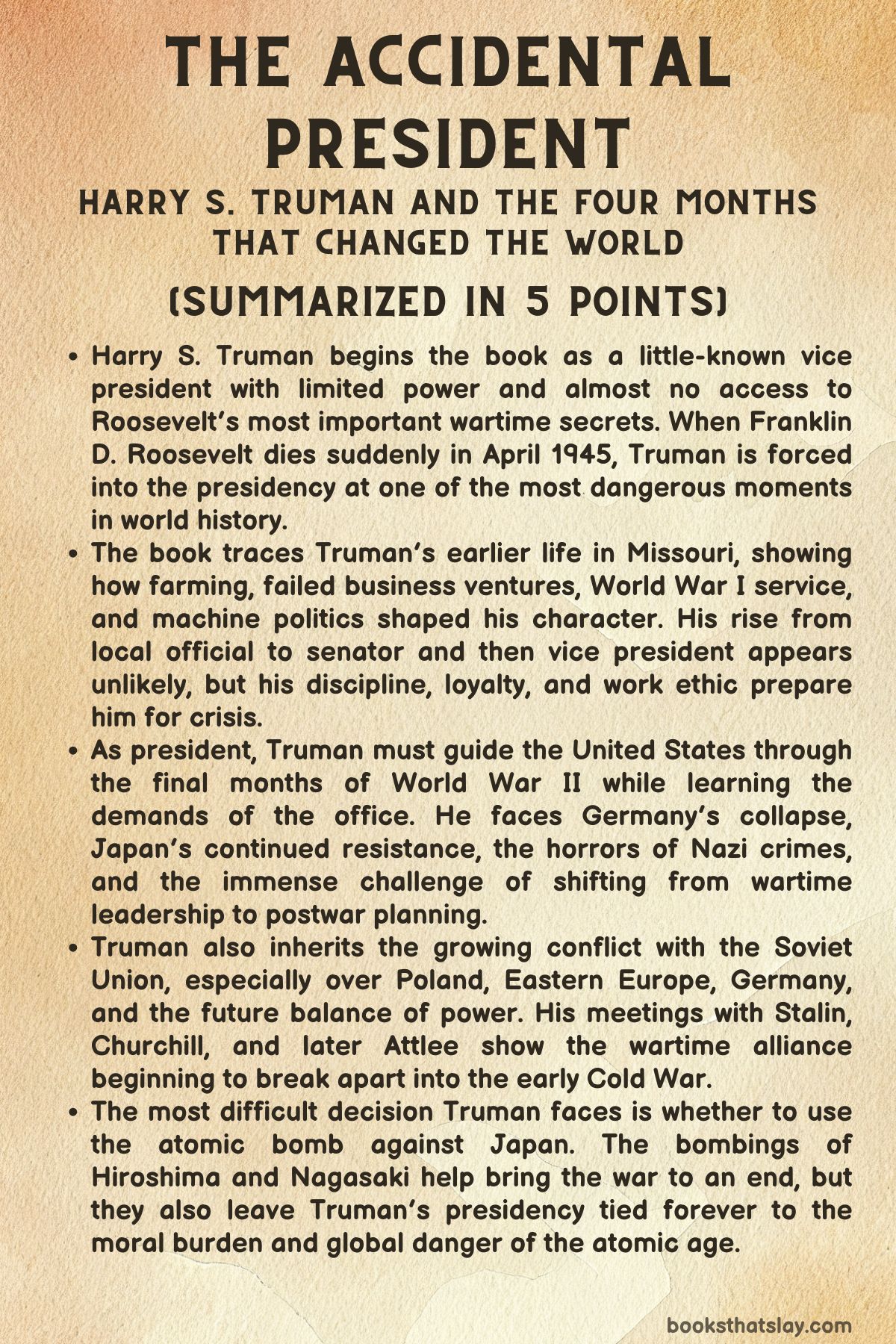
The Accidental President: Harry S. Truman and the Four Months That Changed the World by A. J. Baime is a historical account of Harry S. Truman’s sudden rise to the presidency after Franklin D. Roosevelt’s death in April 1945. The book follows an ordinary-seeming Missouri politician who inherits extraordinary power at one of the most dangerous moments in modern history.
Truman must face the end of World War II, the atomic bomb, the birth of the United Nations, and the first signs of the Cold War while still learning the machinery of the presidency. It is a study of leadership under pressure, political formation, moral burden, and global consequence.
Summary
The Accidental President begins on April 12, 1945, with Harry S. Truman living a modest vice-presidential life in Washington, DC. He wakes early, eats breakfast with his family, and goes to his office in the Senate Office Building.
His official duties are light, and he expects an ordinary day of Senate business, friendly conversation, and an evening of poker. Yet the world around him is nearing a historic breaking point.
Allied forces are closing in on Berlin, the Nazi death camps are being exposed, American bombers are destroying Japanese cities, and fierce combat continues in the Pacific.
At Warm Springs, Georgia, President Franklin D. Roosevelt is resting after years of leading the United States through economic depression and global war. His health is failing, though many details of his condition remain hidden from the public and even from Truman.
Roosevelt is also wrestling with growing problems in the alliance with the Soviet Union. Joseph Stalin has broken promises about free elections in Eastern Europe, especially in Poland, and American officials are beginning to fear that Soviet power may replace Nazi Germany as the next great threat to peace.
Roosevelt still hopes that careful diplomacy can preserve cooperation, but his confidence is fading.
That afternoon, Roosevelt suddenly complains of a terrible headache and collapses. Doctors soon realize that he has suffered a fatal cerebral hemorrhage.
Eleanor Roosevelt receives the news with controlled sorrow, thinking first of the country and the world. Truman is summoned to the White House, where Eleanor tells him that the president is dead.
His first instinct is to ask whether there is anything he can do for her, but she reminds him that he is now the one facing the greatest trouble. Within hours, Truman takes the oath of office.
He is stunned, frightened, and aware that he knows very little about the most secret matters of government, including a mysterious military project that even he has not yet been told about.
The book then looks back at Truman’s life to explain how such an unlikely man reached the presidency. Born in Missouri in 1884, he grows up in a rural world shaped by family loyalty, hard work, party politics, and memories of the Civil War.
As a child, he suffers illness and poor eyesight, which keeps him from many sports and pushes him toward reading, history, music, and self-discipline. He falls in love with Bess Wallace at a young age, though their relationship develops slowly because of his shyness and uncertain prospects.
After high school, Truman works to support his family after financial troubles. He farms, tries business ventures, and struggles to find a stable future.
When the United States enters World War I, he joins the army and becomes an artillery officer. Military service changes him.
He proves that he can lead difficult men under hard conditions, wins the loyalty of Battery D, and returns home with greater confidence. He marries Bess in 1919 and tries to succeed in business, opening a haberdashery with Eddie Jacobson.
The business fails, leaving Truman with heavy debts, but politics offers a new path.
Through the support of the Pendergast political machine in Kansas City, Truman becomes a county judge, an administrative position tied to public works and local government. He is associated with a corrupt machine but tries to maintain personal honesty.
He builds roads, backs courthouse projects, and learns how power works in practical terms. His connection to Tom Pendergast shadows his later career, but it also launches him into state and national politics.
In 1934, Truman is elected to the United States Senate, where he first feels like an outsider. Many senators look down on him because of his machine background, but he studies procedure, works hard, supports Roosevelt’s New Deal, and earns respect.
During World War II, Truman becomes nationally known through his Senate committee investigating waste and inefficiency in defense spending. The committee saves money, exposes mismanagement, and gives Truman a reputation for diligence and independence.
In 1944, Democratic leaders search for a new running mate for Roosevelt. Roosevelt’s health is clearly weak, though the public does not know the full truth.
Several candidates divide the party, but Truman seems acceptable to many factions. He does not want the vice presidency and especially does not want to risk becoming president, but he is eventually chosen.
After Roosevelt wins a fourth term, Truman enters the vice presidency with little influence and almost no access to major wartime secrets.
Once he becomes president, Truman must adapt immediately. The office changes his relationships, his family life, and his sense of self.
People who once treated him casually now defer to him. The White House still feels like Roosevelt’s house, and the nation is mourning a leader who had dominated American politics for twelve years.
Truman decides to continue Roosevelt’s major policies, keep key advisors temporarily, and reassure Congress and the public. His plain manner helps him connect with reporters and legislators, but doubts remain about whether he can manage the burden.
The military situation gives him no time to ease into power. In Europe, Nazi Germany is collapsing, but the humanitarian crisis is immense.
Millions are displaced, cities are ruined, and the horrors of the concentration camps reveal the scale of Nazi crimes. In the Pacific, the battle for Okinawa and the firebombing of Japanese cities show that the war against Japan may continue at terrible cost.
American planners fear that an invasion of Japan could kill huge numbers of soldiers and civilians.
Truman also faces growing tension with the Soviet Union. The dispute over Poland becomes an early test of his foreign policy.
Some advisors urge firmness, while others warn that a rough approach could damage cooperation. Truman meets Soviet Foreign Minister Molotov and speaks bluntly about Soviet behavior.
This direct style pleases some officials and worries others. The United States, Britain, and the Soviet Union are still allies, but the alliance is already cracking.
The most serious secret Truman inherits is the atomic bomb. He learns that the Manhattan Project has spent vast sums to build a weapon capable of destroying an entire city.
The project began from fear that Nazi Germany might build such a weapon first, but by the time Truman understands its scope, Germany is nearly defeated and Japan is the likely target. Scientists, soldiers, and officials debate how to use the bomb, whether to warn Japan, whether to involve the Soviets, and whether the weapon might shape the postwar world.
Truman recognizes that this decision could affect civilization itself.
Germany surrenders in May 1945, giving Truman a moment of public triumph on his birthday. Yet victory in Europe only shifts attention to Japan and the future of global order.
Truman supports the creation of the United Nations, hoping that a new international body can prevent another world war. At the same time, he must plan for economic transition at home, manage labor concerns, reduce wartime spending, and prepare for a summit with Stalin and Winston Churchill.
At Potsdam, Truman meets Churchill and Stalin while awaiting news of the atomic bomb test. He finds Churchill impressive but burdened by Britain’s declining power, and he finds Stalin shrewd, controlled, and difficult.
The successful atomic test in New Mexico changes Truman’s position. The bomb appears to offer a way to force Japan’s surrender without an invasion, but it also opens a new age of danger.
Truman informs Stalin only vaguely about the new weapon, though Stalin likely already knows through espionage. The Potsdam Declaration warns Japan to surrender or face destruction, but Japan does not accept the terms.
On the journey home, Truman learns that the atomic bomb has been dropped on Hiroshima. He reacts with relief and excitement because he believes it may end the war and save American lives.
Soon after, the Soviet Union enters the war against Japan, and a second atomic bomb is dropped on Nagasaki. Japan then signals its willingness to surrender, provided the emperor’s position is addressed under Allied authority.
On August 14, 1945, Japan accepts the surrender terms, and crowds celebrate outside the White House.
The book closes by showing that Truman’s victory brings little lasting ease. The postwar world quickly becomes defined by conflict with the Soviet Union, the division of Germany, the fall of China to communism, and the Korean War.
Truman wins reelection in 1948 despite political difficulties, but his legacy remains tied to the atomic bomb. The book presents him as a man who never expected the presidency yet became one of the most consequential leaders of the twentieth century, forced to make decisions whose effects continue long after his death.
Key Figures
Harry S. Truman
Harry S. Truman stands at the center of The Accidental President as a man shaped by modest origins, hard labor, military service, local politics, and sudden global responsibility. He begins the book as a vice president with little influence, limited knowledge of Roosevelt’s inner circle, and no expectation that power will fall to him so quickly.
His rise is not presented as the result of glamour or natural grandeur, but as the outcome of persistence, loyalty, practicality, and political survival. Truman’s childhood in Missouri gives him habits of discipline and plain speech, while his years as a failed businessman and county official teach him humility and the cost of compromise.
His service in World War I gives him a sharper sense of command, especially through his leadership of Battery D. As president, he is anxious and often lonely, yet he works with enormous energy. His greatest strength is his willingness to decide, even when information is incomplete and the stakes are frightening.
His greatest burden is that his decisions, especially on the atomic bomb and Soviet relations, carry moral weight beyond anything he had imagined.
Bess Truman
Bess Truman is one of the book’s clearest reminders that the presidency affects private lives as much as public history. She is not eager for fame, ceremony, or the harsh attention that comes with the White House.
Her discomfort is visible from the moment Truman becomes president, when she stands beside him during the oath looking overwhelmed by the change in their lives. Bess has known Truman since youth, and their long marriage is rooted in devotion, habit, and shared Missouri identity.
Yet she does not respond to public life with Eleanor Roosevelt’s confidence or activism. Instead, she prefers privacy, family, and distance from the political stage.
Her reaction to the White House, including her dislike of its furnishings and her unease under public scrutiny, makes her deeply human. She also becomes a measure of Truman’s emotional loneliness.
When she and Margaret are away, Truman feels the isolation of power more sharply. In The Accidental President, Bess represents the personal cost of history pressing itself upon a family that never sought royal treatment.
Margaret Truman
Margaret Truman appears as both daughter and symbol of the family’s adjustment to power. She is a college student when her father becomes president, and her ordinary life is suddenly invaded by reporters and public curiosity.
Her presence shows how Truman’s new role changes not only official routines but also the daily movements of those closest to him. Margaret’s later reflection on the White House captures the strange unreality of living inside a national monument while also trying to remain a normal family member.
She is not a political actor in the same way as her father’s advisors, but her role is important because she helps reveal the emotional atmosphere around Truman. Through Margaret, the book shows that the presidency is not simply an office one enters; it is a space that surrounds and reshapes the people who live near it.
She reflects the wonder, pressure, and disorientation of a family suddenly placed at the center of world attention.
Franklin D. Roosevelt
Franklin D. Roosevelt dominates the opening of the book even though he dies early. His long presidency forms the world Truman inherits.
Roosevelt is shown as exhausted after years of leading the nation through depression and war, yet still engaged with massive questions of diplomacy, especially the failing relationship with Stalin. He is confident in his ability to manage people and alliances, sometimes too confident, and his secrecy leaves Truman dangerously unprepared.
Roosevelt’s death creates the central shock of the book. He is remembered with deep public grief, and his immense stature makes Truman’s task seem almost impossible.
The White House, the cabinet, the military structure, and global strategy all still carry Roosevelt’s imprint. His strengths are political imagination, public connection, and wartime leadership.
His weaknesses, at least as they affect Truman, include secrecy, poor preparation of his successor, and perhaps excessive faith that personal diplomacy could control Stalin’s ambitions.
Eleanor Roosevelt
Eleanor Roosevelt appears briefly but powerfully as a figure of strength, dignity, and public purpose. Her response to Roosevelt’s death is controlled and selfless; she thinks not only of her family but also of the people and the world.
Her words to Truman, reminding him that he is now the one in trouble, show her clear understanding of the presidency’s burden. She also casts a long shadow over Bess Truman.
Eleanor had been an unusually active and influential First Lady, and the contrast makes Bess’s discomfort with public life more visible. Eleanor’s role in the book is not large in terms of action, but she represents continuity, seriousness, and the moral gravity of the moment.
She helps transfer the emotional reality of power from Roosevelt to Truman.
Joseph Stalin
Joseph Stalin is one of the central forces pressing against Truman’s presidency. In the book, Stalin is not simply a wartime ally but a ruler whose ambitions and methods create the first shape of the Cold War.
He breaks promises about Poland and Eastern Europe, supports puppet governments, and treats Soviet sacrifice in the war as justification for expansion. To Roosevelt, Stalin had been a difficult partner who might still be managed.
To Truman, he becomes a test of firmness and judgment. Stalin’s personality is controlled, calculating, and hard to read.
He can express sympathy over Roosevelt’s death and pledge cooperation, but his actions suggest deeper strategic aims. At Potsdam, his calm reaction to Truman’s hint about the atomic bomb suggests either remarkable self-control or prior knowledge through spies.
In The Accidental President, Stalin embodies the shift from wartime alliance to ideological confrontation.
Winston Churchill
Winston Churchill is presented as a grand, forceful, and historically aware leader who understands the danger of Soviet power earlier and more openly than many others. He mourns Roosevelt’s death because he knows the war has reached a decisive moment and because he relied on Roosevelt’s partnership.
Churchill presses for a strong Anglo-American position in Europe and warns about Soviet domination before the phrase “iron curtain” becomes famous. He can be dramatic, stubborn, and aristocratic, but he is also perceptive about Truman.
After meeting him, Churchill recognizes Truman’s character, directness, and resolve. His role changes when British voters remove him from office during the Potsdam period, a moment that shows how even towering wartime leaders are subject to democratic change.
Churchill’s presence gives the book a sense of old-world authority meeting Truman’s plain American style.
Clement Attlee
Clement Attlee enters the book as Churchill’s political opponent and then, unexpectedly, as Britain’s new prime minister during the Potsdam meetings. His arrival marks a major transition in British politics and in the wartime alliance.
Unlike Churchill, who seems almost inseparable from Britain’s wartime identity, Attlee is quieter and less theatrical. Yet he is prepared, serious, and ready to continue the partnership with the United States.
His role is important because it shows that the postwar world will not be shaped only by the personalities who won the war. New leaders will inherit unfinished business, just as Truman inherited Roosevelt’s burdens.
Attlee’s presence also reinforces one of the book’s key political facts: democratic systems can change leadership suddenly even while global negotiations continue.
Henry Stimson
Henry Stimson, the secretary of war, is one of the book’s most important advisors because he connects Truman to the atomic bomb and to the military decisions surrounding Japan. He is experienced, grave, and aware that the new weapon could change human history.
Stimson thinks deeply about the bomb’s moral and strategic implications, including whether Japan should receive a warning before its use. He also understands the possible value of Germany as a future barrier against Soviet expansion, which places him among those thinking beyond immediate victory toward postwar balance.
Stimson’s strength is his seriousness. He does not treat the bomb as only a technical achievement but as a historical force.
His weakness, or limitation, is that even his caution operates within a government where use of the bomb is widely assumed.
William Leahy
William Leahy serves as Truman’s chief of staff and a senior military advisor, helping provide continuity from Roosevelt’s administration. His importance lies in his closeness to the machinery of wartime command.
Truman keeps him because stability is essential in the first days after Roosevelt’s death. Leahy represents the experienced military establishment that Truman must rely on while still learning the presidency.
He briefs Truman, helps structure the daily flow of information, and offers a link to ongoing operations in Europe and the Pacific. Although he is not as dramatically drawn as some other figures, his presence matters because Truman cannot govern alone.
Leahy shows how presidential leadership depends on systems of advice, habit, and trusted channels of information.
James Byrnes
James Byrnes is ambitious, experienced, and politically significant. He believes he had a strong claim to the vice presidency and later becomes Truman’s choice for secretary of state.
Byrnes brings knowledge and confidence, but also raises doubts among some observers who see him as self-interested and overly eager for power. His role in showing Truman the secret Yalta protocols gives him immediate importance in the new administration.
He accompanies Truman to Potsdam and helps shape foreign policy at a moment when relations with the Soviet Union are hardening. Byrnes is useful to Truman because he knows Washington and international affairs, but his ambition makes him a complicated ally.
He represents the kind of seasoned insider Truman needs, even if trust is not simple.
Edward Stettinius
Edward Stettinius is Roosevelt’s secretary of state and an important figure in the creation of the United Nations. Truman decides to replace him with Byrnes but allows him to complete his work at the San Francisco conference, which shows Truman’s practical sense of timing and respect for continuity.
Stettinius is associated with international cooperation and the hope that a new global organization can prevent future wars. He is not portrayed as a dominant personality, but his role is historically important.
He helps carry forward Roosevelt’s internationalist project into Truman’s presidency. His later appointment as the first American ambassador to the United Nations gives him a dignified transition and links him permanently to the postwar order.
Averell Harriman
Averell Harriman is one of the key American experts on Stalin and the Soviet Union. As ambassador to Moscow, he has direct experience with Soviet leadership and becomes an important guide for Truman.
He warns that Stalin seeks cooperation only on terms that preserve Soviet expansion and influence. Harriman’s heated exchanges with Stalin over Poland reveal how badly relations are deteriorating.
His advice generally pushes Truman toward firmness, and he becomes part of the group that believes a harder line is necessary. Harriman is valuable because his views come from experience rather than theory.
He understands both the possibility and the danger of negotiation with the Soviet regime.
Charles Bohlen
Charles Bohlen appears as a skilled diplomat and Soviet specialist who helps interpret the communications between Roosevelt and Stalin. His role is that of an informed analyst at a moment when Truman badly needs context.
Bohlen’s knowledge gives Truman access to the history behind the present crisis, especially the arguments over Poland and Soviet conduct after Yalta. He represents the professional diplomatic corps: people who may not make final decisions but shape how leaders understand events.
Bohlen’s importance lies in translation, not only of language but of intention, pattern, and diplomatic meaning.
Vyacheslav Molotov
Vyacheslav Molotov, the Soviet foreign minister, functions as Stalin’s hard-edged representative in direct dealings with Truman. His meetings with American officials reveal the rigidity of Soviet demands, especially on Poland, reparations, and postwar influence.
Truman’s blunt conversation with Molotov becomes an early sign that the new president will not simply continue Roosevelt’s softer tone. Molotov is disciplined, forceful, and unyielding.
He is not shown as an independent moral presence so much as an instrument of Soviet policy. His anger over not being consulted on the Potsdam Declaration also shows Soviet sensitivity to exclusion from decisions affecting Asia and the postwar balance.
Dwight D. Eisenhower
Dwight D. Eisenhower appears as both military commander and future political possibility. In Europe, he makes the significant decision not to race to Berlin, judging that American lives should not be spent taking territory already assigned to the Soviet occupation zone.
He also witnesses and exposes the horror of Nazi camps, understanding the importance of documenting what Allied forces have found. When he returns to Washington, he receives a hero’s welcome, and Truman respects him deeply enough to say privately that he would hand the presidency to him if he could.
Eisenhower represents competence, restraint, and national trust. His refusal to run in 1948, at least as presented to Truman, also eases one of Truman’s political anxieties.
J. Robert Oppenheimer
J. Robert Oppenheimer is the scientific mind most closely associated with the atomic bomb in the book. As leader of the Los Alamos laboratory, he carries both intellectual brilliance and moral unease.
He understands the weapon’s power and believes that Soviet-American cooperation on atomic matters may be necessary to prevent future catastrophe. Yet he also sees that the bomb’s use may already be assumed by policymakers.
His reaction to the successful test, marked by awe and dread, captures the terrible gap between scientific achievement and human consequence. Oppenheimer is not a conventional political figure, but his work gives Truman the most consequential option of his presidency.
Leslie Groves
General Leslie Groves is the military organizer behind the Manhattan Project. He briefs Truman on the atomic bomb and represents the administrative force that turned scientific possibility into a usable weapon.
Groves is practical, secretive, and focused on results. He pushes the project forward under enormous pressure and insists on testing the weapon before Truman’s major diplomatic meetings.
His role shows that the atomic bomb is not only a scientific creation but also a military and bureaucratic achievement. Groves helps embody the scale, secrecy, and momentum of the project, which by 1945 has become almost impossible for political leaders to ignore.
Curtis LeMay
Curtis LeMay commands the bombing campaign against Japan and represents the ruthless logic of total war. His incendiary attacks on Japanese cities kill vast numbers of civilians, yet he justifies them through the memory of Pearl Harbor and the goal of forcing surrender.
LeMay’s attitude reveals how moral limits shift during prolonged war. By the time the atomic bomb is ready, Japan has already suffered devastating aerial destruction, and LeMay’s campaign forms part of the background that makes the bomb seem to some officials like a continuation of existing strategy rather than a complete break.
He is efficient, harsh, and unsentimental, a figure shaped by a war in which civilian and military targets have become dangerously close.
George Marshall
General George Marshall appears as one of the most respected military advisors in the American government. He briefs Truman on the possible invasion of Japan, including the grim expectation of heavy casualties.
Marshall’s importance lies in the seriousness of his advice. He is not reckless; he considers alternatives, including warnings and other methods of forcing surrender.
His presence gives weight to the military side of Truman’s decision-making. When Truman thinks about the bomb or invasion, Marshall’s assessments help define what is at stake.
He represents disciplined military judgment rather than political ambition.
John J. McCloy
John J. McCloy, the assistant secretary of war, appears in the discussions over Japan and the atomic bomb. His mention of the bomb in a high-level meeting is striking because it breaks the almost taboo-like silence surrounding the subject.
McCloy’s role is brief but meaningful. He helps show that even inside the government, the atomic bomb is treated as something secret, strange, and difficult to discuss openly.
His presence also points to the range of officials involved in the decision. The choice is not made in isolation; it emerges from a room full of military, diplomatic, and civilian voices, each carrying different assumptions.
Harry Hopkins
Harry Hopkins is Roosevelt’s trusted advisor and one of the last important bridges between Roosevelt’s diplomacy and Truman’s presidency. Though gravely ill, he travels to Moscow to meet Stalin and assess whether cooperation remains possible.
His report gives Truman some encouragement, especially regarding Soviet entry into the war against Japan, but it also raises concerns about Soviet ambitions in Asia. Hopkins’s role is marked by loyalty, exhaustion, and historical transition.
He belongs to Roosevelt’s world, yet his final diplomatic service helps Truman navigate the early weeks of his own administration. His decline and death symbolize the passing of the Roosevelt era.
Tom Pendergast
Tom Pendergast is the Kansas City political boss whose machine helps make Truman’s career possible. He is associated with corruption, favors, votes, and machine discipline, but the book also shows that Truman’s connection to him is more complicated than simple guilt by association.
Pendergast recognizes Truman’s usefulness and backs his rise, including his Senate campaign. For Truman, the Pendergast connection is both opportunity and burden.
It gives him a path into politics but also marks him as suspect among reformers and Washington elites. Pendergast represents the rough local politics that trained Truman in loyalty, negotiation, and compromise, even while threatening his reputation.
Mike Pendergast
Mike Pendergast is important as the person who helps pull Truman from failed business into politics. As the father of one of Truman’s army friends, he provides the personal connection that leads to Truman’s first county position.
Mike’s role shows how Truman’s political career grows out of relationships formed through military service and local trust. He is less powerful than Tom Pendergast, but he is crucial as the link between Truman’s private struggles and public career.
Through him, the book shows how politics often begins not with ideology but with personal recommendation, obligation, and timing.
Eddie Jacobson
Eddie Jacobson is Truman’s business partner in the failed haberdashery and one of the figures connecting Truman’s postwar hopes to later disappointments. Their clothing store represents Truman’s attempt to build a respectable civilian life after World War I and marriage.
The business fails during a recession, leaving Truman in debt, but Jacobson remains part of Truman’s story as a friend from an earlier life. When Truman later sees him running a men’s clothing store in Missouri, the moment reminds readers of the ordinary path Truman might have followed.
Jacobson represents loyalty, modest ambition, and the business failure that indirectly pushes Truman toward politics.
Eddie McKim
Eddie McKim is one of Truman’s old friends, and his reaction to Truman’s presidency shows how the office changes personal relationships. When McKim becomes intimidated around him, Truman recognizes that things will never be the same.
This small moment is important because it reveals the loneliness built into high office. Truman does not simply gain power; he loses a degree of ordinary companionship.
McKim’s role is minor in political terms but significant emotionally. He shows that becoming president creates distance even from people who knew the man before the title.
Dennis Ross
Dennis Ross, Truman’s high-school classmate and later press secretary, represents Truman’s reliance on familiar, trusted people. Choosing Ross reflects Truman’s habit of drawing from his Missouri circle rather than only from the elite networks that surrounded Roosevelt.
Ross helps manage the president’s public relationship with the press at a time when reporters are eager to understand the unknown new leader. His presence also shows Truman’s preference for loyalty and personal history.
In a presidency filled with generals, diplomats, and global figures, Ross anchors Truman to an earlier, more local identity.
Henry Morgenthau
Henry Morgenthau, Roosevelt’s treasury secretary, appears as a figure whose ideas Truman resists, especially regarding the future of Germany. Morgenthau’s plan to de-industrialize Germany after the war seems dangerous to Truman and others who fear that a ruined Germany could destabilize Europe or strengthen Soviet influence.
Truman’s acceptance of Morgenthau’s resignation marks a move away from certain Roosevelt-era policies. Morgenthau represents both continuity and conflict: he is part of the inherited administration, but his vision does not fit Truman’s developing approach to postwar reconstruction.
His role helps show Truman beginning to assert his own judgment.
Robert Jackson
Robert Jackson is selected to lead the prosecution of major Nazi officials, placing him at the center of the legal response to wartime atrocity. His role matters because the book is not only about military victory but also about justice after victory.
By appointing Jackson, Truman supports the idea that Nazi crimes should be answered through law rather than simple revenge. Jackson represents the attempt to create a moral and legal record of what happened in Europe.
His work points toward the Nuremberg trials and the broader question of how civilization should respond when governments commit mass crimes.
Charles de Gaulle
Charles de Gaulle appears as proud, difficult, and determined to restore French prestige after the humiliation of 1940. His demands and suspicions frustrate American officials, who believe France’s requests exceed its postwar strength.
Truman’s handling of de Gaulle over French movements near Italy gives the new president a diplomatic success. By threatening aid while allowing de Gaulle to save face, Truman shows firmness without needless humiliation.
De Gaulle represents national pride wounded by defeat and eager to reassert itself. His role also shows that postwar diplomacy is not only about the United States and Soviet Union; even allies bring competing ambitions.
Josip Broz Tito
Josip Broz Tito appears as the communist leader of Yugoslavia and a source of tension in northern Italy. His territorial claims create a dangerous dispute at a moment when Truman wants to avoid any new European conflict that could interfere with the war against Japan.
Tito represents the spread of communist power beyond direct Soviet occupation and shows how local disputes could become part of a larger ideological struggle. His role is not large, but it points toward the instability of postwar Europe, where resistance leaders, national borders, and ideological loyalties all collide.
George Kennan
George Kennan appears as a sharp analyst of Soviet behavior. His warning that joint control of Germany with the Russians is unrealistic anticipates the logic of containment and the division of Europe.
Kennan’s importance lies in his ability to see patterns before they become official policy. He understands that Soviet and American goals are not easily compatible and that hopes for a smooth, cooperative withdrawal from Germany are naïve.
His role gives intellectual shape to the emerging Cold War. Kennan represents clear-eyed analysis at a time when many officials are still trying to preserve wartime assumptions.
Joseph Davies
Joseph Davies offers a more conciliatory view of the Soviet Union and serves as a counterweight to harder-line advisors such as Harriman. His conversations with Truman and Churchill show that American policy is not yet settled.
Some officials still believe Stalin can be handled through reassurance and understanding, while others think only firmness will work. Davies is important because he prevents the book from presenting Truman’s choices as simple or unanimous.
He represents the argument for caution, patience, and continued engagement, even as events make that position harder to defend.
Herbert Hoover
Herbert Hoover appears as a former president warning about starvation in Europe. His role is brief but significant because it brings attention to the humanitarian disaster following the war.
Hoover’s warning reminds readers that victory does not immediately bring stability. Food shortages, displacement, and economic collapse threaten millions.
His presence also links Truman’s moment to earlier American leadership and to the practical challenges of relief. Hoover represents the moral urgency of reconstruction and the need to prevent social collapse from feeding political extremism.
Harlan Stone
Chief Justice Harlan Stone administers the oath of office to Truman after Roosevelt’s death. His role is formal but historically important.
The oath transforms Truman from shocked vice president into president of the United States. Stone’s mistaken expansion of Truman’s middle initial into a name adds a human imperfection to an otherwise solemn constitutional moment.
He represents the law’s continuity during crisis. Roosevelt has died, the nation is stunned, and the world is at war, but the constitutional transfer of power proceeds.
Sam Rayburn
Sam Rayburn is with Truman shortly before the summons to the White House changes everything. As Speaker of the House, he represents Truman’s congressional world, the environment where Truman feels known and comfortable.
Rayburn’s presence at the moment before history turns underscores how ordinary Truman’s day had been. He is also part of the legislative culture that expects better relations with Truman than it had with Roosevelt.
Rayburn represents the congressional friendships and political networks that Truman brings into the presidency.
Truman’s Mother
Truman’s mother, often called Mamma Truman, is a vivid family presence. Her advice to “be good” and “be game” captures the plain moral language of Truman’s upbringing.
Her dislike of Abraham Lincoln because of old Civil War loyalties adds historical and regional texture to Truman’s family background. She is humorous, stubborn, and deeply connected to Missouri memory.
Her role helps humanize Truman at moments when the presidency threatens to turn him into a symbol. She reminds readers that the president remains a son shaped by family stories, inherited loyalties, and old sectional feelings.
Truman’s Father
Truman’s father shapes him through hardship, politics, and financial instability. His failures force young Truman into work and responsibility, and his political interests help introduce Truman to the rough judgments of public life.
Truman is not especially close to him, but their bond over politics matters. His death leaves Truman responsible for the family farm and deepens Truman’s desire to find financial security.
He represents the burdens of family duty and the unstable economic world that formed Truman before public office.
Bess Wallace’s Father
Bess Wallace’s father is a tragic background figure whose suicide affects the Wallace family and the emotional setting of Truman and Bess’s courtship. His death, tied to financial trouble and alcohol, leaves a mark on Bess’s family status and grief.
Though he does not act directly in the main events, his story helps explain the atmosphere around Bess and the seriousness of Truman’s long pursuit of her. He represents the private sorrows that sit behind public biographies.
Lloyd Stark
Lloyd Stark, the governor of Missouri, becomes Truman’s major opponent during the difficult Senate reelection fight of 1940. His challenge forces Truman to defend his record while carrying the stain of the Pendergast association.
Stark represents the reformist and anti-machine pressure Truman must survive. The contest tests Truman’s political skill, stamina, and ability to appeal beyond the machine that first lifted him.
Defeating Stark helps secure Truman’s national future, because without that victory there would be no later vice presidency.
Henry Wallace
Henry Wallace is Roosevelt’s sitting vice president before Truman replaces him on the Democratic ticket. He has passionate supporters and nearly holds onto the nomination during the convention.
Wallace represents a different possible future for the Democratic Party and the country. His supporters see him as a progressive and visionary figure, while party leaders fear he may be too divisive or risky.
His defeat clears the path for Truman, making Wallace one of the most important “almost” figures in the book. The drama around his candidacy shows how contingent Truman’s rise really was.
William Douglas
William Douglas, the Supreme Court justice, appears as one of the possible vice-presidential choices in 1944. His name is part of the confusion over Roosevelt’s preference and the party’s attempt to balance competing factions.
Douglas’s role is limited, but it matters because it shows that Truman’s selection was not inevitable. The presidency might have passed to someone entirely different.
Douglas represents the uncertainty and backroom maneuvering behind a decision that later becomes world-changing.
Albert Einstein
Albert Einstein appears indirectly through the origins of the atomic bomb. His warning that uranium could be used for a powerful weapon helps set the Manhattan Project in motion.
Einstein is not a policymaker in the events Truman faces, but his scientific authority contributes to the chain of decisions that leads to Los Alamos, the test in New Mexico, and the bombing of Japan. His role represents the connection between theoretical science and state power, a relationship that becomes one of the defining realities of the atomic age.
Georgy Zhukov
Georgy Zhukov appears as the Soviet military leader who later reports Stalin’s reaction to Truman’s hint about the atomic bomb. His role is brief but revealing.
Through Zhukov, the reader sees that Stalin’s calm public response does not mean indifference. The Soviet leadership understands the strategic meaning of the bomb and moves to accelerate its own atomic program.
Zhukov therefore helps expose the hidden consequence of Truman’s disclosure: the atomic age will not remain an American monopoly for long.
King George VI
King George VI appears near the end when Truman stops in Plymouth and tells him about the atomic bomb. The meeting reflects the close connection between the United States and Britain, even as Britain’s global power is changing.
The king is not a strategic decision-maker like Churchill or Attlee, but his presence gives ceremonial weight to the alliance. He represents continuity, monarchy, and Britain’s wartime dignity at a moment when political leadership has shifted and the world order is changing.
The Regent of Iraq
The regent of Iraq appears during Truman’s early efforts to engage with the Middle East. His visit introduces issues that will become increasingly important after the war: oil, regional influence, Arab opposition to Zionism, and the place of Middle Eastern states in international security.
The awkward gift of a silver coffee set with handleless cups adds a small cultural note to the encounter. The regent’s role is minor in the plot but important in scope, showing that Truman’s presidency is immediately global, reaching far beyond Europe and Japan.
Adolf Hitler
Adolf Hitler appears near the end of his power, hidden in his bunker and misreading Roosevelt’s death as a possible miracle for Germany. His reaction shows the delusion and desperation of the collapsing Nazi regime.
Hitler’s suicide soon after confirms the end of the war in Europe, but the destruction he caused remains everywhere: ruined cities, death camps, displaced people, and the political vacuum into which the Allies and Soviets move. He is less a living actor in the book than the source of the catastrophe Truman inherits.
Woodrow Wilson
Woodrow Wilson appears as a historical comparison through the failure of the League of Nations. His inability to bring the United States into that earlier international organization haunts the creation of the United Nations.
Wilson represents an earlier hope for collective security that failed, helping explain why Truman and others treat the UN Charter as so important. His presence in the book is historical rather than active, but it gives context to the fear that victory without lasting institutions may lead to another war.
Robert Oppenheimer’s Scientists
The scientists at Los Alamos function as a collective character marked by brilliance, secrecy, and moral strain. Some begin to question the implications of what they are building, even as Oppenheimer argues that ending the war is the overriding goal.
Their work changes the nature of military power and places science inside the machinery of national survival. They represent the uneasy partnership between knowledge and destruction.
Their achievement is technical, but its meaning is political, ethical, and human.
The Crew of the Enola Gay
The crew of the Enola Gay appears at the moment when the atomic bomb moves from policy and science into action. Their mission over Hiroshima turns secret planning into irreversible fact.
The copilot’s later reflection shows shock at the scale of destruction and the psychological burden carried by those who delivered the bomb. The crew members are soldiers following orders, but they also become witnesses to something beyond ordinary combat.
They represent the human agents inside a vast military system whose consequences they can feel but not fully control.
The Crew of the Bockscar
The crew of the Bockscar carries the second atomic bomb, initially toward Kokura and then to Nagasaki because of weather. Their role shows how chance and circumstance can determine the fate of cities.
The change of target is one of the book’s stark reminders that history is shaped not only by leaders and policies but also by clouds, fuel, timing, and field decisions. Like the Enola Gay crew, they are military professionals inside a mission of enormous consequence.
Their action helps bring Japan closer to surrender, while deepening the moral questions surrounding atomic warfare.
Themes
Leadership Under Sudden Pressure
Leadership in The Accidental President is defined by shock, speed, and incomplete preparation. Truman does not enter the presidency after years of grooming or deep involvement in Roosevelt’s wartime strategy.
He inherits power in a single evening, after spending most of his vice presidency outside the center of decision-making. This makes his leadership especially revealing because it is built in real time.
He must learn who to trust, what secrets matter, how to speak to Congress, how to handle the press, and how to command a global military while the war is still being fought. The book treats leadership not as a heroic pose but as a sequence of decisions made under pressure.
Truman’s plain speech and working habits become assets because they give him steadiness when ceremony and grief threaten to overwhelm the government. Yet the same directness can also create diplomatic risks, as seen in his early handling of the Soviets.
His leadership grows from local politics, military command, and personal discipline, but the presidency forces those qualities onto a global stage. The theme matters because Truman’s example suggests that history often turns not on perfect preparation, but on a person’s ability to accept responsibility when refusal is impossible.
The Moral Burden of the Atomic Bomb
The atomic bomb gives the book its deepest moral tension because it is both a weapon and a turning point in human history. Truman learns about it only after becoming president, and he must absorb its scientific, military, diplomatic, and ethical meaning almost at once.
For military planners, the bomb offers a possible way to avoid an invasion of Japan and save American lives. For scientists such as Oppenheimer, it is a terrifying achievement that may end one war while making future wars far more dangerous.
For diplomats, it becomes a possible source of leverage over the Soviet Union. These different meanings make the decision difficult to judge in simple terms.
The book shows that many officials regarded use of the bomb as likely, even natural, because Japan had not surrendered and total war had already normalized mass bombing of cities. Yet the destruction of Hiroshima and Nagasaki opens questions that cannot be closed by military logic alone.
The bomb changes victory into a source of dread. Truman celebrates the possibility of ending the war, but the reader also sees the birth of an age in which civilization can destroy itself.
The theme rests on that painful contradiction: a decision made to end war also creates a permanent fear about the future.
The Collapse of Wartime Alliance
The alliance between the United States, Britain, and the Soviet Union begins the book as a military necessity but ends as a fragile arrangement giving way to suspicion. Germany’s defeat removes the common enemy that had held the powers together, and the deeper conflict over political systems, borders, and influence becomes harder to hide.
Poland is the clearest early test. The Soviet Union promises free elections but supports a government under its control, while American and British leaders struggle to decide how firmly to respond.
Truman inherits Roosevelt’s hope for cooperation but also the evidence that Stalin is breaking agreements. Advisors divide between those who still favor conciliation and those who believe only firmness will work.
The Potsdam meetings confirm how much the relationship has changed. The leaders can still sit at the same table, but their goals are moving apart.
The United Nations is born at the same time as the Cold War’s first outlines, which gives the period a strange double character: hope for international order and fear of ideological division. This theme shows that peace after a great war is not automatic.
Victory creates new questions about power, territory, memory, and trust, and those questions can quickly harden into a new conflict.
Ordinary Identity and Extraordinary Power
Truman’s ordinary identity is not treated as a weakness; it is one of the book’s main ways of understanding his presidency. He comes from farms, small towns, failed businesses, local machines, Senate procedure, poker games, family letters, and old friendships.
He is not polished like Roosevelt, grand like Churchill, or icy like Stalin. His habits are plain, sometimes awkward, and deeply tied to Missouri.
Yet this ordinary background becomes extraordinary because of the office he suddenly holds. The contrast is visible everywhere: the modest apartment giving way to the White House, old friends becoming nervous around him, Bess resisting public life, and Truman walking through Washington while carrying decisions that affect millions.
The book uses this contrast to show how democratic power can place a seemingly common man in a position once occupied by giants. It also shows the loneliness of that transformation.
Truman’s old forms of comfort, including family routines and casual friendships, become harder to preserve. At the same time, his ordinariness helps him connect with citizens who see him as one of their own.
The theme asks what happens when a person formed by local duty and personal loyalty must act as the central figure in a world crisis.