The Accidental Tourist Summary, Characters and Themes
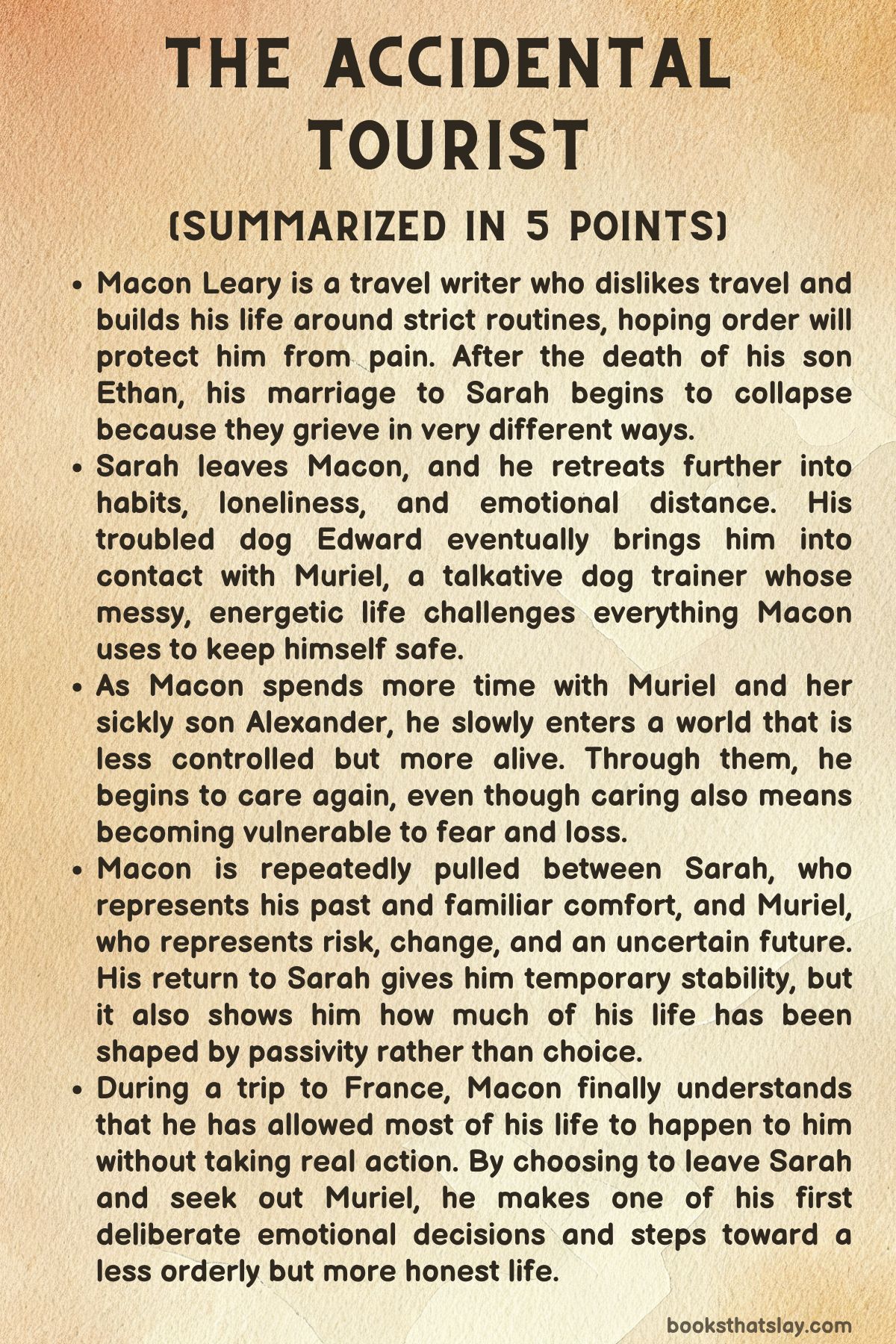
The Accidental Tourist by Anne Tyler is a quiet, emotionally observant novel about grief, habit, marriage, and the frightening work of choosing a life instead of merely enduring one. The book follows Macon Leary, a travel writer who hates travel and depends on rigid routines to keep pain at a distance after the death of his son and the collapse of his marriage.
Through Macon’s relationships with Sarah, Muriel, his siblings, and a troubled dog named Edward, the novel studies how people protect themselves from loss, and how connection can arrive in awkward, messy, inconvenient ways.
Summary
Macon Leary and his wife Sarah are driving home from a failed beach vacation when the strain between them finally breaks into the open. Their young son, Ethan, has recently been killed, and neither of them knows how to live inside the loss.
Rain begins falling hard, and Sarah grows frightened as Macon keeps driving. What appears to be a disagreement about road safety soon reveals a deeper conflict: Sarah feels that Macon is too detached, too ruled by routine, and too unwilling to show the kind of fear or grief she needs from him.
Macon insists that he is trying to cope in his own way, but his calmness only makes Sarah feel more alone. During the argument, she tells him she wants a divorce.
After Sarah leaves, Macon remains in their house with the cat, Helen, and Ethan’s dog, Edward. The house feels altered by Sarah’s absence.
Her missing presence is visible in the furniture she used, the things she took, and the traces she left behind. Ethan’s room stays painfully clean, almost impersonal.
Macon begins reshaping his daily life into a set of strict systems. He changes how he washes dishes, launders clothes, sleeps, eats, and moves through the house.
These systems are meant to save effort and preserve order, but they also show how much he is trying to avoid emotional disorder.
Macon writes travel guides for business travelers who dislike travel as much as he does. His series is designed for people who want to pass through unfamiliar cities with as little discomfort as possible.
Macon’s work reflects his personality: he classifies, organizes, and reduces unpredictability wherever he can. Yet beneath this controlled exterior, he cannot sleep well and often thinks about Ethan’s death.
Ethan had slipped away from summer camp and was killed during a robbery at a burger place. The randomness of the crime has left both Macon and Sarah damaged in different ways.
When Macon has to travel to England for work, he tries to board Edward at his usual vet, only to learn that the dog has been blacklisted for biting someone. At another clinic, he meets Muriel, a talkative, forceful woman who works there and seems instantly interested in both Macon and Edward.
She offers to help train the dog. Macon finds her strange and intrusive, but she stays in his mind.
His trip to England is lonely and mechanical. He checks hotels and restaurants, records practical details, and fights the urge to come home early.
When he returns, he finds that Sarah has removed a rug from the house, making his home feel even less like his own.
Macon’s life continues to narrow. He ignores work, becomes less careful about his appearance, and relies more heavily on his systems.
After a household accident involving Edward and Helen, he falls down the stairs and badly injures his leg. Unable to care for himself, he moves in with his sister Rose and his brothers Porter and Charles.
The Leary siblings are all attached to habit and order, and their household feels sealed off from the wider world. Rose takes care of the men, Porter and Charles follow their own routines, and Macon finds comfort in being looked after without being forced to explain himself.
While Macon stays with his siblings, his publisher, Julian, visits and discovers the extent of Macon’s troubles. Edward’s behavior worsens, and the family urges Macon to get rid of him.
Macon cannot do that because Edward belonged to Ethan. The dog is one of the living ties to his son.
Under pressure, Macon calls Muriel. She begins training Edward, but her methods and personality unsettle Macon.
She talks constantly about her life, her jobs, her past, and eventually her son Alexander. Edward responds well to her, which frustrates Macon, because she seems able to reach what he cannot control.
Muriel and Macon clash when she handles Edward too harshly, and Macon dismisses her. Yet she has already disturbed the boundaries of his life.
Meanwhile, Sarah asks to meet him for dinner. Macon hopes for reconciliation and tells her that living without her has been terrible.
He even suggests they try to have another child. Sarah refuses.
She believes Macon and his family are closed off, fixed in their ways, and unable to face pain in a way that includes her. She tells him that his practical treatment of Ethan’s belongings after the death made her feel even more isolated.
Macon’s loneliness deepens during a work trip to New York. In a restaurant high above the city, he is overcome by panic and a sense of distance from everyone he loves.
He calls home for help, but Charles is trapped in the pantry by Edward, Rose is out with Julian, and Porter is unavailable. Unable to reach Sarah, Macon calls Muriel.
She agrees to rescue Edward and calms Macon down. This moment changes their relationship.
Muriel becomes someone who can act when Macon is helpless.
As Macon spends more time with Muriel, he learns about her difficult life. She married young after becoming pregnant with Alexander, whose premature birth left him with medical problems.
Her husband Norman rejected both her and the child. Muriel has built a scrappy, unstable, energetic life around survival.
During Thanksgiving and its aftermath, Macon begins to feel drawn to her. He also spends time with his niece Susan, who misses Ethan and worries that the family is beginning to forget him.
Through Susan, Macon realizes that Ethan’s death has affected more people than he allowed himself to see.
Macon tries to avoid dinner with Muriel and Alexander because being around another child hurts him. When he goes to her house to leave a note, he ends up telling her about Ethan.
Muriel responds with physical tenderness rather than formal sympathy. She gives him a place to rest, and Macon senses that she, too, carries scars.
Their relationship becomes intimate. Macon begins spending more nights at her house, and eventually his life shifts toward hers.
Muriel’s home is disorderly, crowded, and alive. Macon gets to know Alexander, the neighbors, Muriel’s friend Bernice, her sister Claire, and the rhythms of Singleton Street.
He starts fixing things, making meals, helping Alexander, and taking Edward into this new household. He feels less responsible with Alexander than he did with Ethan, and that makes the relationship easier at first.
Yet when he sees Alexander being bullied and sends Edward to protect him, he realizes that caring for a child means becoming vulnerable again.
Rose and Julian marry, bringing Macon and Sarah back into each other’s orbit. Sarah remains familiar to him in a way Muriel is not.
Macon starts thinking of her during ordinary moments. At the same time, Muriel pushes toward a future with him.
She talks about living together, traveling with him, Alexander’s schooling, and marriage. Macon resists giving clear answers.
He enjoys Muriel’s world but hesitates to fully commit to it.
When Sarah moves back into the repaired house, Macon returns to her. Their old habits resume with surprising ease.
Sarah admits she had been seeing another man but found herself longing for Macon’s familiar ways. Macon, however, misses Muriel’s oddities.
He calls Muriel about Alexander’s health and learns that Dominick, a neighborhood boy connected to Muriel’s life, has died in a car crash. The news reminds him again of how sudden loss can be and how deeply he has hurt Muriel by leaving.
On a trip to France, Muriel appears on Macon’s flight, having arranged to follow him. She is awkward but resourceful, and she has read his guidebook carefully enough to manage the city.
Macon is torn between irritation, affection, and duty. When he injures his back, Sarah arrives to care for him after Rose sends her.
Sarah suggests that the trip could become a second honeymoon, but her presence forces Macon to see something essential about himself. He has let life happen to him.
His marriage, his work, fatherhood, and even Muriel have come to him without his active choice.
At last, Macon decides to act. He packs to leave Sarah and return to Muriel.
Sarah tries to stop him by appealing to comfort, appearance, and the long history of their marriage. Macon understands that he cannot choose only what looks orderly or proper.
He leaves behind his luggage when it becomes too painful to carry and takes a cab. As the cab circles past the hotel, he sees Muriel waiting for her own ride.
Macon asks the driver to stop, choosing the unpredictable life that has called him back.
Characters
Macon Leary
Macon Leary is the central figure of The Accidental Tourist, and his personality is built around control, restraint, and avoidance. He is a travel writer who dislikes travel, which immediately shows the contradiction at the heart of his life.
His profession requires movement, but his temperament longs for sameness. After Ethan’s death, Macon’s dependence on routines becomes more than a quirk; it becomes a defense against unbearable pain.
He designs systems for laundry, meals, sleeping, packing, and travel because systems let him believe that life can be managed. Yet the book gradually shows that his order is fragile.
He is not cold because he feels nothing; he is cold because he feels too much and does not know how to express it. Macon’s growth lies in learning that safety is not the same as living.
His final choice of Muriel is important because, for once, he takes an active step rather than allowing life to decide for him.
Sarah Leary
Sarah Leary is Macon’s estranged wife and Ethan’s mother. Her grief is raw, angry, and searching, while Macon’s grief is quiet and controlled.
Sarah needs signs of emotional response from Macon, but his way of surviving makes her feel abandoned. Her request for divorce is not simply a rejection of Macon; it is also an attempt to escape a house and marriage that seem unable to hold her pain.
Sarah is not portrayed as cruel, even when she wounds Macon. She is a woman trying to understand how evil, chance, and loss can exist in the world.
Her later return to Macon comes from familiarity and exhaustion, but the book also suggests that comfort alone cannot repair what has broken. Sarah represents the pull of the past: real, tender, and powerful, but not necessarily enough for renewal.
Ethan Leary
Ethan is dead before the main action begins, but his presence shapes nearly every relationship in the story. He is Macon and Sarah’s twelve-year-old son, killed in a random act of violence after leaving summer camp.
Because he is gone, the reader knows him through memory: his bond with Edward, his irritation at Macon’s systems, his cousins’ recollections, and his parents’ grief. Ethan functions as the emotional center that has been removed from the family.
Macon’s inability to part with Edward, Sarah’s rage toward the killer, and Susan’s fear that the family is forgetting him all show how a child can remain deeply present after death. Ethan is not only a lost son; he is the measure of what Macon and Sarah cannot recover.
Muriel
Muriel is the disruptive force who pulls Macon out of his sealed life in The Accidental Tourist. She is talkative, pushy, practical, needy, funny, and resilient.
At first, Macon sees her as an intrusion because she ignores the boundaries he depends on. She calls him, visits him, offers help, tells stories, and refuses to disappear politely.
Yet Muriel’s lack of polish is tied to survival. She has raised Alexander through illness and abandonment, worked different jobs, and learned to handle danger directly.
Unlike Sarah, Muriel does not require Macon to explain grief in refined language. She responds to his pain by making room for him.
Muriel’s flaws are real: she can be manipulative, impulsive, and demanding. Still, she gives Macon access to an active, imperfect, living world.
Edward
Edward is Ethan’s dog, and his behavior reflects the emotional disorder around him. He bites, threatens people, chases family members, and resists control, but he is not merely a comic problem.
For Macon, Edward is a living connection to Ethan, which is why giving him away feels impossible. Edward’s aggression also expresses the household’s unspoken fear and grief.
When Muriel trains him, the process becomes part of Macon’s own re-entry into human contact. Edward’s eventual adjustment to Muriel’s home shows that change is possible, even for a creature defined by anxiety and habit.
His protection of Alexander during the bullying scene is especially meaningful because he moves from being a source of danger to a guardian.
Rose Leary
Rose is Macon’s sister, and her identity is centered on caretaking. She runs the Leary household, feeds her brothers, manages domestic order, and quietly makes herself necessary.
Her systems resemble Macon’s, but hers are tied to service. Rose’s marriage to Julian briefly suggests that she might build a life beyond caring for her brothers, yet she returns to help Porter and Charles when they fall apart without her.
This does not make her weak; it shows how deeply she has been trained by family patterns. Rose wants love, but she also wants to be needed.
Her eventual work for Julian gives her organizational gifts a more public and balanced form.
Porter Leary
Porter is one of Macon’s brothers, divorced and living in the family home with Rose and Charles. He shares the Leary tendency toward routine and emotional awkwardness.
His struggles with custody and his uncertainty about how to spend meaningful time with his children reveal that he is not uncaring, only limited in expression. Porter’s presence helps build the portrait of the Leary family as intelligent, self-contained, and socially uneasy.
He depends on Rose more than he fully admits. Through Porter, the book shows how habit can become a family culture passed among adults who never quite learned ordinary intimacy.
Charles Leary
Charles is Macon’s other brother, also divorced and living in the Leary home. He is practical, blunt, and protective of family boundaries.
His criticism of Muriel exposes the class prejudice and emotional caution of the Learys. Charles sees Muriel as a symptom of Macon’s instability rather than as a person Macon loves.
Yet Charles is not simply judgmental. His panic when trapped by Edward and his concern over Macon’s altered life show vulnerability beneath his sternness.
He represents the part of Macon’s old world that wants him restored to familiar form, even if that familiar form is emotionally stunted.
Julian
Julian is Macon’s publisher and later Rose’s husband. He is more open, sociable, and emotionally direct than the Learys, which makes his attraction to Rose significant.
He values Macon’s unusual travel-writing voice and recognizes that Macon’s discomfort with travel can be turned into a literary strength. Julian also provides an outside view of the Leary family.
He sees their oddness but is not repelled by it. His marriage to Rose is one of the book’s quieter signs that love can cross differences in temperament.
When he tells Macon that Muriel is good for him, he becomes one of the few characters able to see Macon’s new life without immediate suspicion.
Alexander
Alexander is Muriel’s son, a medically fragile child with allergies, sensitivities, and a history of premature birth. He is quiet, watchful, and used to adult anxiety surrounding his body.
For Macon, Alexander is both a comfort and a danger. He allows Macon to experience a form of fatherly care again, but he also reawakens fear.
Macon initially finds helping Alexander easier than helping Ethan because he feels less responsible for the outcome. Over time, however, Alexander becomes emotionally important to him.
The bullying scene marks a turning point: Macon realizes that caring for Alexander means worrying again about the future. Alexander represents life after loss, not as replacement, but as renewed attachment.
Helen
Helen, the cat, is a small but revealing presence. Macon builds a system that allows her to come and go through the dryer hose outlet, showing both his inventiveness and absurd commitment to convenience.
Her accident in the hose contributes to Macon’s fall, making her part of the collapse of his supposedly efficient household. Helen’s role is minor, but she helps show that Macon’s systems do not truly protect him.
Even the smallest living creature resists perfect management.
Garner
Garner is Macon’s neighbor, and his role is to speak from the perspective of the community outside Macon’s private world. He brings Macon’s mail and comments on how difficult Macon is to read.
Garner’s remarks about Ethan’s belongings and Sarah’s feelings challenge Macon’s belief that practical action is neutral. He suggests that other people may have seen Macon’s behavior as cold or confusing.
Garner is important because he gives voice to what Macon’s neighbors have noticed but not fully said: Macon’s grief has made him strange to others.
Grandfather Leary
Grandfather Leary is mostly present through memory and dreams. His decline after Grandmother Leary’s death parallels Macon’s own danger after losing Sarah and Ethan.
In Macon’s dream, Grandfather warns him about losing the center of his life. Macon first thinks this refers to Ethan, but the warning also points toward Sarah.
Grandfather represents an older pattern of dependence and emotional collapse. His portrait of the Leary children also reminds Macon that family identity can harden early and remain unchanged unless challenged.
Grandmother Leary
Grandmother Leary is not active in the main action, but her absence matters. After her death, Grandfather Leary begins to lose his mental stability, making her the unseen center of his life.
She also belongs to the family history that shaped Macon and his siblings after their mother sent them to live with their grandparents. Her importance lies in the structure she provided.
Like Sarah, Rose, and Muriel in different ways, she shows how much the Leary men rely on women to hold life together.
Alicia
Alicia is Macon’s mother, and her brief appearance at Rose and Julian’s wedding reveals much about the Leary children. She is energetic, changeable, and socially blunt.
In Macon’s memory, she moved rapidly through interests and relationships and eventually sent her children to live with their grandparents. Her instability helps explain why Macon and his siblings became so attached to order.
At the wedding, Macon wonders whether Muriel’s liveliness partly reminds him of Alicia. Alicia therefore complicates Muriel’s role: Macon may be drawn not only to difference, but also to a familiar kind of disorder from childhood.
Norman
Norman is Muriel’s ex-husband and Alexander’s father. Though he does not appear directly, his abandonment has shaped Muriel’s life.
He married Muriel because she became pregnant, then withdrew when Alexander’s health problems became severe. His accusation that Alexander might not be his reveals his weakness and cruelty.
Norman matters because he helps explain Muriel’s hunger for commitment and her fear of being used. Macon’s uncertainty hurts her partly because Norman has already taught her what abandonment feels like.
Mrs. Dugan
Mrs. Dugan, Muriel’s mother, is critical, dismissive, and emotionally ungenerous toward Muriel. At Christmas, she minimizes Muriel’s gifts, embarrasses her by discussing Dr. Kane, and shows limited warmth toward Alexander.
Her behavior helps explain Muriel’s insecurity and need to prove that she matters. The photo album, where Muriel disappears after Claire is born, becomes a visual sign of this emotional neglect.
Mrs. Dugan is not simply a difficult mother; she is part of the reason Muriel fights so hard to be seen.
Mr. Dugan
Mr. Dugan is quieter than his wife and less socially forceful. He becomes more open when drinking and talking about cars.
His connection with Macon is limited but less hostile than Mrs. Dugan’s treatment of Muriel. He represents a household in which affection is present only in partial, indirect forms.
His relative mildness does not undo the family’s damage, but it gives Muriel’s background a more realistic texture: neglect and criticism can exist alongside ordinary domestic conversation.
Claire
Claire is Muriel’s younger sister. She is still in her teens and later moves in with Muriel after conflict with their parents.
Claire’s closeness with Alexander shows that she can be affectionate and loyal, but her own instability adds to the busy, crowded life around Muriel. Her parents’ suspicion of her behavior suggests that the Dugan household polices appearance and reputation harshly, especially with daughters.
Claire also helps show Muriel as a caretaker beyond motherhood; Muriel’s home becomes a refuge for people who do not fit easily elsewhere.
Bernice
Bernice is Muriel’s best friend and a regular presence in her home. She belongs to the social world of Singleton Street, where neighbors and friends move in and out of one another’s lives with ease.
Bernice’s comments are sharp and casual, and she helps define the atmosphere that contrasts so strongly with the Leary household. She is also part of Muriel’s support network.
Through Bernice, the book presents community as noisy, imperfect, and necessary.
Dominick
Dominick is a young man connected to Muriel’s neighborhood who works on her car in exchange for using it. His death in a crash late in the book is a harsh reminder that loss is not confined to Macon’s past.
Dominick’s recklessness and his mother’s worry place him within the everyday risks of Singleton Street. His death also affects Muriel deeply and exposes the cost of Macon’s attempt to separate himself from her world.
When Muriel tells Macon about Dominick, she is not only reporting a tragedy; she is showing him that life continued painfully after he left.
Dominick’s Mother
Dominick’s mother appears briefly but memorably as a worried parent searching for her son. Her concern about his staying out and driving unsafely becomes tragic after his death.
She reflects one of the book’s recurring concerns: parents can love, warn, and fear, but they cannot fully protect their children. Her role mirrors Sarah and Macon’s helplessness after Ethan’s death in a smaller but painful way.
Susan
Susan is Porter’s daughter and one of Ethan’s cousins. Her trip with Macon to Philadelphia reveals that the younger generation has also been carrying grief.
When she talks about Ethan, Macon realizes that his son mattered beyond the immediate parent-child bond. Susan’s worries about being forgotten by her own expanding family also echo the fear of emotional replacement.
She is observant, vulnerable, and more emotionally direct than the adults around her. Her question about whether Ethan would be angry that they are beginning to forget him is one of the book’s clearest expressions of mourning.
Danny
Danny is one of Porter’s children. His role is smaller than Susan’s, but he helps show Porter’s obligations as a father and the wider family structure around Macon.
The presence of Porter’s children reveals the gap between adult routines and children’s needs. Danny contributes to the sense that the Leary family continues to function around practical arrangements, custody schedules, and domestic care even while deeper emotional issues remain unresolved.
Liberty
Liberty is another of Porter’s children. Like Danny, she is part of the family background that surrounds Macon’s grief.
Her presence at family gatherings reminds the reader that childhood has not vanished from the Leary world, even after Ethan’s death. For Macon, being around children can be painful because it recalls what he lost.
Liberty’s role helps create that emotional atmosphere without needing a large individual arc.
Porter’s Ex-Wives
Porter’s ex-wives appear at Rose and Julian’s wedding, adding to the sense of complicated family history. They are minor figures, but their presence shows that the Leary family is not neat or conventionally stable despite its obsession with order.
The failed marriages of Porter and Charles also make Macon and Sarah’s separation feel part of a larger family pattern of emotional difficulty.
Sarah’s Mother
Sarah’s mother appears during Macon’s shopping trip with Alexander. Her questions force Macon to confront how his new life looks from the perspective of his old one.
When she asks about the “friend” whose son he is helping, Macon is caught between concealment and acknowledgment. Her role is brief, but she represents Sarah’s social and family world pressing back into Macon’s life.
Dr. Kane
Dr. Kane is the unmarried veterinarian whom Mrs. Dugan once imagined as a good match for Muriel. He does not play an active role, but the story about him reveals Mrs. Dugan’s hopes for Muriel and her disappointment in how Muriel’s life turned out.
Dr. Kane functions as a symbol of the respectable alternative Muriel did not secure. His mention also embarrasses Muriel in front of Macon, deepening the reader’s understanding of her insecurity.
The Camp Director
The camp director is the person who comes to tell Macon and Sarah that Ethan has died. His role is brief but devastating.
He stands at the border between ordinary life and catastrophe, bringing news that permanently alters the family. Because he delivers the message in person, he becomes part of Macon’s memory of the moment when life split into before and after.
The Neighbor Girls
The twin neighbor girls who help watch Alexander belong to the informal support system around Muriel. They show how Muriel’s life depends on practical neighborhood arrangements rather than formal stability.
Their presence also helps create the open, communal feeling of Singleton Street, where people know one another’s business and help in casual ways.
The Large Plane Passenger
The large man seated beside Macon on a flight is a minor character who helps Macon see the meaning of his own work. As a reader of Macon’s guides, he appreciates the comfort and protection they provide.
His description of the guides as creating a kind of cocoon allows Macon to understand that his habits, however limiting, have also served others. This encounter briefly validates Macon’s profession and shows that even his avoidance has practical value.
The Frightened Woman on the Plane
The frightened woman on the flight to Edmonton allows Macon to perform calmness for someone else. While reassuring her, he wonders whether he may actually be becoming the relaxed person he pretends to be.
Her role is small but important because she shows Macon changing in practice before he fully understands the change internally.
The Chambermaid
The chambermaid in France helps Macon when his back goes out. Her practical assistance leads him to contact Julian’s office and indirectly brings Sarah to France.
She is a minor figure, but her role matters structurally because Macon’s helplessness in the hotel room creates the final confrontation among Macon, Sarah, and Muriel. She also underscores how dependent Macon becomes when his body fails and his systems no longer work.
Themes
Grief and the Different Languages of Loss
Grief in The Accidental Tourist is not treated as a single shared emotion but as a force that separates people who have suffered the same event. Macon and Sarah both lose Ethan, but they cannot recognize each other’s ways of mourning.
Sarah wants visible anguish, anger, fear, and moral outrage. She wants Macon to acknowledge that the world has become terrifying and that their son’s death cannot be reduced to practical arrangements.
Macon responds by organizing, discarding, simplifying, and withdrawing. His grief is not smaller than Sarah’s, but it is harder to see.
This mismatch destroys their marriage because each interprets the other’s coping method as a failure of love. The book also shows how grief spreads beyond parents.
Susan misses Ethan, Edward remains tied to him, and even ordinary objects become charged with absence. Forgetting becomes frightening, yet remembering is painful.
The story’s emotional power comes from showing that loss does not end; it changes shape. It becomes routine, silence, anger, tenderness, guilt, and sometimes the fear of loving again.
Habit as Protection and Prison
Macon’s routines begin as forms of comfort, but they gradually reveal themselves as barriers against life. His systems for laundry, travel, food, packing, and housework are clever in one sense, yet they also shrink his world.
He treats unpredictability as an enemy because unpredictability has already taken Ethan from him. If he can control small things, perhaps he can keep larger terror away.
The problem is that these routines do not heal him; they only help him avoid exposure. The Leary family as a whole shares this pattern.
Rose has systems for serving others, Porter and Charles retreat into domestic oddity, and the siblings create a private culture that outsiders find hard to enter. Muriel disrupts this order because her life cannot be managed by Macon’s rules.
Her house is noisy, crowded, financially unstable, and emotionally demanding. Yet it is also alive.
The book does not reject habit completely; some routines provide care and continuity. Instead, it asks whether habit serves life or replaces it.
Macon’s journey is a movement from hiding inside order to choosing a form of disorder that includes love.
Love as Choice Rather Than Accident
A central question in the story is whether Macon has ever truly chosen anything. His marriage to Sarah began almost by drift, his career came from Julian’s recognition of his odd travel writing, fatherhood happened within the flow of marriage, and Muriel entered his life through Edward’s bad behavior.
For much of the book, Macon treats life as something that happens to him. This passivity protects him from responsibility but also keeps him emotionally immature.
Sarah belongs to his past and offers the comfort of deep familiarity. Muriel offers a future that is uncertain, socially awkward, and full of demands.
The final decision matters because Macon acts with intention. He does not choose Muriel because she is easier.
In many ways, she is harder. He chooses her because their relationship asks him to be present rather than preserved.
Love here is not idealized as perfect compatibility. Sarah and Macon know each other deeply, and Muriel and Macon are mismatched in many visible ways.
The book suggests that love becomes meaningful when a person takes a step toward it with awareness, risk, and responsibility.
Class, Respectability, and the Fear of Disorder
The contrast between the Leary world and Muriel’s world brings class and respectability into quiet but persistent focus. Macon’s family values control, privacy, restraint, and a certain middle-class neatness.
Muriel’s Singleton Street life is crowded, informal, loud, and economically fragile. Her neighbors help with childcare, young people borrow cars, family members move in after conflict, and problems are handled directly rather than politely hidden.
Charles’s criticism of Muriel exposes how easily concern can mix with snobbery. He sees her clothes, neighborhood, child, and manner as signs that Macon has lost himself.
Yet the book does not romanticize poverty or instability. Muriel’s life contains real danger, illness, insecurity, and grief.
Dominick’s death, Alexander’s health, and Muriel’s financial choices all show the costs of disorder. Still, this world offers Macon something his respectable life has not: immediacy, contact, and participation.
Respectability in the story can become another kind of emotional hiding place. By moving toward Muriel, Macon does not simply reject his class background; he accepts that a less polished life may contain forms of truth and care that his ordered world has failed to provide.