Chain of Thorns by Cassandra Clare Summary, Characters and Themes
Chain of Thorns by Cassandra Clare is the concluding volume of The Last Hours trilogy, a Shadowhunter Chronicle set in Edwardian London. It follows the children of beloved characters from earlier series as they face demonic threats, tangled romances, and the burden of their families’ legacies.
This installment explores loyalty, sacrifice, and the consequences of secrets as James Herondale, Cordelia Carstairs, Lucie Herondale, Matthew Fairchild, and their circle of friends confront Belial, a Prince of Hell, whose schemes threaten their world. The novel blends action, mystery, and romance into a tale about courage, resilience, and the enduring bonds of friendship and love.
Summary
The story opens with James Herondale suffering from nightmares in which his demon grandfather, Belial, whispers of armies stirring. Troubled by these visions, James journeys with his father Will and the warlock Magnus Bane to Cornwall to track his missing sister, Lucie.
She has fled with Malcolm Fade, a warlock driven by grief, and Jesse Blackthorn’s preserved body. James hides the depth of Belial’s influence from Will, fearing his father’s reaction.
Along the way, Magnus suspects that Malcolm has taken Lucie to a house near Polperro, setting the stage for confrontation.
In Paris, Cordelia Carstairs tries to escape her pain after her marriage to James collapsed. She travels with Matthew Fairchild, who is committed to staying sober for her sake.
They wander the city together, shopping, dining, and visiting cabarets. At one such place, a warlock medium channels the spirit of Cordelia’s father, who delivers a cryptic warning that “they wake,” leaving her shaken.
Cordelia wrestles with her loyalty to James and her growing reliance on Matthew, sensing that both affection and tragedy wait ahead.
Meanwhile, Lucie awakens in Malcolm’s coastal hideout after exhausting herself reviving Jesse. For the first time, Jesse breathes and moves freely, no longer a ghost.
Their reunion is joyous but shadowed by Malcolm’s obsession with resurrecting Annabel Blackthorn, his long-lost love. He presses Lucie to summon Annabel’s spirit, revealing the depth of his dangerous fixation.
Lucie agrees only to limited help, wary of his desperation. Jesse, meanwhile, feels guilt for the runes etched into his skin—marks taken from Shadowhunters Belial had killed—yet Lucie comforts him, and their bond grows closer.
Elsewhere, Ariadne Bridgestock discovers disturbing records left by her father, the Inquisitor. Among them are accusations against Herondales and Lightwoods, hinting at corruption and betrayal.
At the same time, Thomas Lightwood grapples with unspoken feelings for Alastair Carstairs, while helping Christopher Lightwood with experiments in magical communication. Grace Blackthorn, imprisoned in the Silent City, finally confesses her mother Tatiana’s manipulations and her own misuse of demonic power, admitting to ensnaring James against his will.
Brother Zachariah offers her compassion, insisting she was a victim of Tatiana’s cruelty, though Grace remains uncertain about her future.
James eventually admits to Will and Magnus that Belial has haunted him through visions and the cursed bracelet Grace once gave him. Magnus realizes Belial’s schemes are coming to fruition.
Will is heartbroken by his son’s secrecy but vows to protect him. Meanwhile, Cordelia and Matthew’s Parisian escape offers moments of levity, but her heart remains tied to James, whose absence gnaws at her.
The threads converge when James, Will, and Magnus track Lucie to Cornwall. There, Will mistakes Jesse for a revenant and attacks, but Jesse proves his humanity.
Lucie explains how she used her necromantic power to restore him. Though uneasy, Will accepts Jesse after Magnus confirms his life is genuine, not dark magic.
Malcolm proposes Jesse could re-enter Shadowhunter society under a false identity, while Lucie and James share a sibling’s confession—he admits he no longer loves Grace and longs for Cordelia, though he has yet to reveal the truth to her.
Back in London, Anna Lightwood hosts a party that draws her estranged lover Ariadne, who seeks shelter after her mother’s rejection and the weight of her father’s secrets. Their complicated relationship rekindles.
At the same time, Tatiana Blackthorn resurfaces, crashing a Christmas celebration by holding Alexander Lightwood hostage. She exposes Tessa Gray’s half-demon parentage, igniting suspicion against the Herondales.
Though the group rescues Alexander and captures Tatiana, her surrender feels staged, hinting at a deeper plot. At the Enclave meeting that follows, the Inquisitor and Charles Fairchild accuse the Herondales of deceit, leaving James and Lucie to defend their family’s honor.
Meanwhile, Matthew, reeling from Charles’s betrayal, nearly relapses into drink. Supported by Thomas and Alastair, he destroys his liquor and reveals that Charles has been blackmailed by Bridgestock, complicating his betrayal.
The friends rally around him, vowing to stand together despite the mounting distrust within the Clave. Lucie and Jesse’s relationship deepens, though her attempts to use her powers to track Belial leave her shaken by terrifying visions of towers and gates guarded by demons.
Events build toward a decisive battle when Belial finally makes his move, unleashing his forces at Westminster Abbey. As chaos erupts, Lucie uses her necromantic gift to free souls bound to Belial, crippling his army.
Jesse and Bridget fight alongside the others, while Cordelia witnesses James stab himself with Cortana in a desperate attempt to sever Belial’s hold. At that moment, divine light strikes Belial, destroying him.
James survives, though barely, and Cordelia’s paladin powers help heal him. Lilith herself appears to reclaim Cordelia as her servant, but Cordelia reveals the vow binding her ended when Belial fell.
Furious, Lilith flees, leaving the Shadowhunters victorious at last.
In the aftermath, London returns to a fragile peace, its citizens remembering the battle as nothing more than a snowstorm. Families mourn their losses while others rejoice in new beginnings.
Cordelia learns of her baby brother’s birth, while James and Cordelia reconcile, their love strengthened by survival. Thomas and Alastair commit to a future together, as do Anna and Ariadne.
Matthew, though planning a journey abroad, renews his bonds with his friends. Grace and Jesse cautiously rebuild their lives free of Tatiana’s shadow.
The younger generation gathers at Chiswick House to bury tokens of their struggles, each leaving behind a piece of their past—symbols of growth and healing. Finally, Cordelia and Lucie undergo their parabatai ceremony in the Silent City.
Surrounded by the spirits of Shadowhunters, they vow eternal loyalty. Their bond is blessed by generations before them, closing the story with a sense of unity, renewal, and hope for the challenges yet to come.
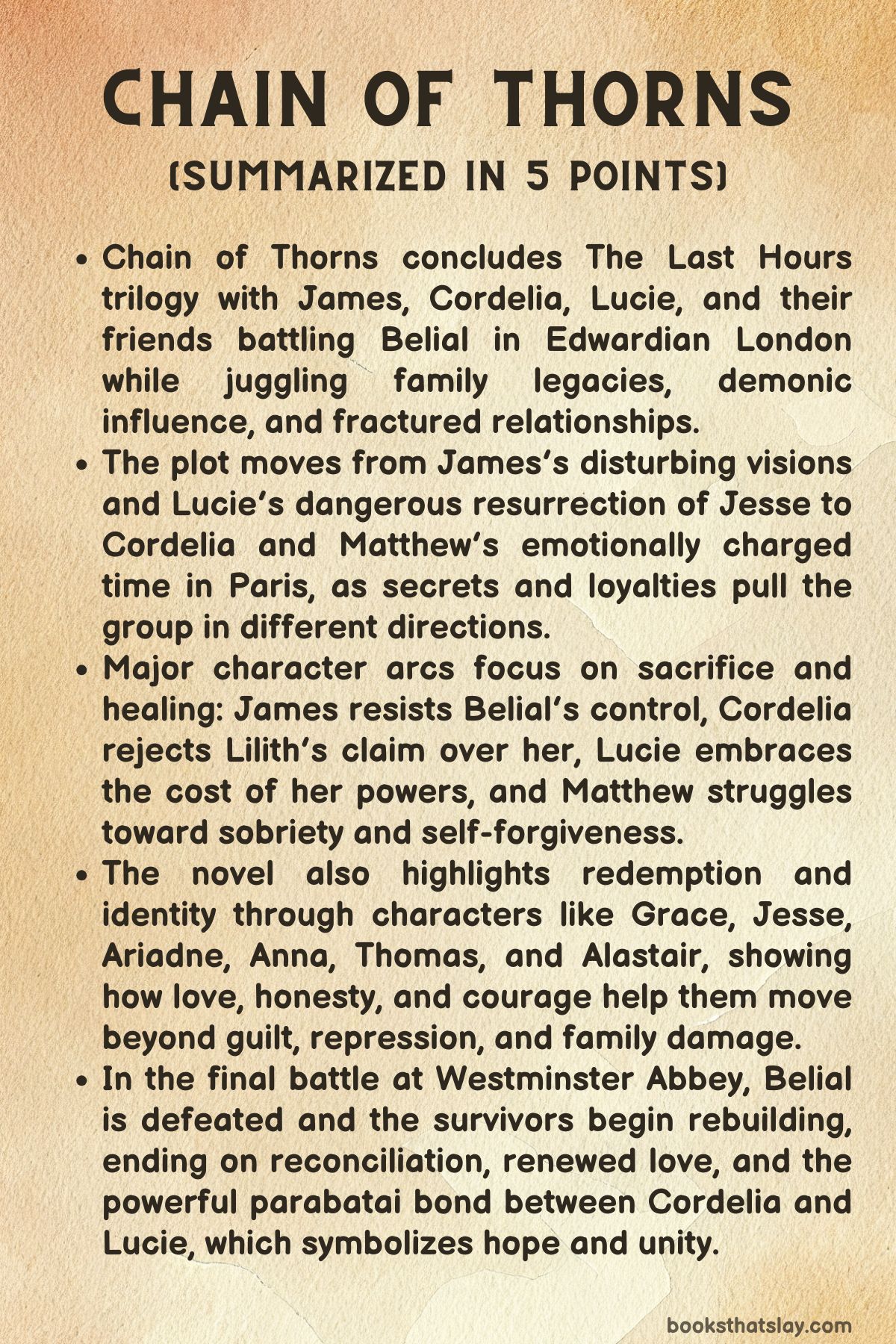
Characters
James Herondale
James is central to Chain of Thorns, carrying both the weight of his lineage and the burden of Belial’s influence. His nightmares and visions reveal the ongoing pull of his demonic heritage, and though he is terrified of losing himself to darkness, he continuously chooses loyalty and love over corruption.
His relationships are layered with guilt—toward Cordelia for the collapse of their marriage, toward Grace for the manipulation she subjected him to, and toward Matthew as his parabatai. Despite these struggles, James embodies resilience, ultimately finding the strength to resist Belial, even at the cost of his own body and soul.
His bravery at Westminster Abbey, where he nearly sacrifices himself, underscores his enduring devotion to protecting those he loves and securing a future free from his grandfather’s shadow.
Cordelia Carstairs
Cordelia emerges as one of the most complex and conflicted figures in the novel. Torn between her love for James and her escape to Paris with Matthew, she embodies both vulnerability and immense inner strength.
As Lilith’s paladin, her struggle is not only romantic but also spiritual, for she must decide whether she will yield to demonic command or forge her own destiny. Cordelia’s bravery, from confronting Tatiana to healing James with Cortana, demonstrates her evolution from a girl clinging to memories into a woman forging her own power.
Her final parabatai bond with Lucie affirms her loyalty and ability to balance love, duty, and friendship, cementing her role as a protector and anchor for the group.
Lucie Herondale
Lucie’s journey is deeply tied to her necromantic gift and her love for Jesse Blackthorn. She begins as a girl entranced by romantic notions of bringing Jesse back and grows into someone who must wield immense power to fight Belial’s army of the dead.
Her strength is tempered by compassion—she defies Malcolm’s obsession and prioritizes Jesse’s humanity above all. Her visions, as well as her near-collapse during the battle, highlight both the danger of her abilities and her willingness to embrace sacrifice.
Lucie’s bond with Jesse adds emotional depth to her arc, while her parabatai vow with Cordelia reinforces her growth into a young Shadowhunter capable of great love and responsibility.
Jesse Blackthorn
Jesse’s resurrection gives him both a second chance at life and a heavy burden to carry. The runes taken from murdered Shadowhunters weigh on his conscience, filling him with guilt and doubt about whether he deserves happiness.
Yet his romance with Lucie becomes a source of strength, allowing him to redefine his existence not as a revenant but as a man capable of love and courage. His confrontation with Tatiana illustrates his resolve to reject her madness and stand against the darkness that once defined his family.
Jesse’s quiet strength and devotion balance Lucie’s fiery determination, making their partnership one of the novel’s most poignant emotional cores.
Matthew Fairchild
Matthew is a character marked by tragedy and self-reinvention. His vow of sobriety in Paris demonstrates his determination to grow, yet his lingering self-loathing makes him vulnerable to both temptation and despair.
His devotion to Cordelia is tender and protective, contrasting sharply with James’s tortured love. At the same time, his fractured bond with his brother Charles and his complicated friendship with James reveal his insecurities and deep yearning for acceptance.
By the end, Matthew accepts his own imperfections while recommitting to those who love him, and though he chooses to travel, his reconciliation with James and Cordelia signifies a quiet triumph over his inner demons.
Grace Blackthorn
Grace undergoes one of the most dramatic transformations. Once an instrument of her mother Tatiana’s cruelty, she is forced to confront the truth of her actions and the manipulations she inflicted upon others.
Her testimony in the Silent City reveals both her guilt and her longing for redemption. Brother Zachariah’s compassion offers her the first chance to see herself as more than her mother’s tool, while her lingering hope for Jesse underscores her humanity.
Grace’s journey is one of atonement, as she attempts to break free from the chains of her past and imagine a future not defined by betrayal or coercion.
Tatiana Blackthorn
Tatiana embodies the destructive force of obsession and paranoia. Her hatred of the Herondales and her desperate clinging to twisted notions of revenge consume her, driving her to commit atrocities—including kidnapping Alexander and manipulating her daughter.
Her exposure of Tessa’s heritage destabilizes the Enclave and reflects her desire to poison the community from within. Yet even in her madness, Tatiana is not entirely devoid of tragic resonance, as her obsession with Annabel mirrors Malcolm’s destructive grief.
Ultimately, Tatiana serves as both a warning and an antagonist, her surrender feeling less like defeat and more like another cruel step in Belial’s broader plan.
Ariadne Bridgestock
Ariadne’s arc explores themes of identity, love, and courage. She wrestles with the rejection of her mother after revealing her sexuality, a rejection that forces her to seek solace in Anna’s arms.
Though burdened by the shame instilled by her upbringing, Ariadne chooses truth over silence, defying her father’s cruelty and prejudice. Her romance with Anna is both tender and defiant, culminating in declarations of love during the climactic battle.
Ariadne transforms from a young woman trapped by her family’s expectations into one who claims her independence and embraces the possibility of love without fear.
Anna Lightwood
Anna is the embodiment of freedom and defiance against societal norms, yet beneath her confidence lies vulnerability, particularly in her feelings for Ariadne. She relishes her independence, hosting flamboyant parties and living on her own terms, but Ariadne’s return forces her to confront her fear of intimacy and loss.
The two balance each other: Anna’s boldness inspires Ariadne, while Ariadne’s sincerity grounds Anna. In the end, Anna chooses love without relinquishing her independence, showing that true strength lies in embracing both freedom and connection.
Thomas Lightwood
Thomas is gentle yet burdened by insecurity. His secret affection for Alastair reveals his longing for love, even as he fears rejection.
His loyalty to his friends and his quiet bravery in battle demonstrate his steady strength, though he often doubts his worth. His note to Alastair, though initially unspoken, becomes a catalyst for honesty, pushing both of them toward vulnerability.
By the conclusion, Thomas’s relationship with Alastair blossoms into mutual support, symbolizing his triumph over silence and fear.
Alastair Carstairs
Alastair is a character defined by sharp edges and hidden wounds. His harshness often masks insecurity, born from prejudice he endured and mistakes he made in the past.
Guarding Cortana reflects his determination to atone, even as he struggles with isolation. His relationship with Thomas softens him, drawing out his capacity for tenderness and honesty.
Alastair’s insistence on helping Matthew confront his addiction shows his uncompromising love, even when it takes the form of tough truth. By embracing his feelings for Thomas and standing firmly against his past demons, Alastair achieves a balance between pride and vulnerability.
Malcolm Fade
Malcolm is tragic in his obsession with Annabel, embodying the dangers of grief unchecked. Though he aids Lucie and Jesse, his help is tainted by self-interest and his unwillingness to release the past.
His scheme to conceal Jesse’s existence is born partly of compassion, yet it also underscores his manipulative tendencies. Malcolm’s story serves as a dark mirror to the other romances in the book, showing what love becomes when twisted into obsession.
By the end, his bitterness toward Shadowhunters remains, leaving his fate unresolved but marked by sorrow.
Themes
Love and Sacrifice
In Chain of Thorns, love consistently demands sacrifice, and this tension defines many of the characters’ arcs. James’s love for Cordelia is complicated by the lingering shadow of his bond with Grace, which was manipulated through demonic influence.
His struggle illustrates how love can be both a source of strength and unbearable guilt, requiring him to risk everything—including his own body and soul—to free himself from Belial’s grip. Cordelia, too, embodies this theme in the sacrifices she makes, whether it is her attempt to build a future with Matthew despite her heart’s pull toward James, or her ultimate defiance of Lilith when she risks losing the power of the paladin bond to protect her own agency.
Lucie’s love for Jesse is another example: she brings him back from death despite the dangerous consequences, knowing her gift could doom her. These sacrifices, whether large or small, are not without cost, yet they demonstrate that true love in this story is defined by willingness to endure pain, judgment, and even death.
By the novel’s end, love is shown not as a simple romantic force but as a burden that reshapes destinies, requiring courage to hold on even when the world brands such choices as reckless or forbidden.
Family and Legacy
Family lies at the heart of the conflicts, secrets, and revelations in Chain of Thorns, and the novel uses lineage both as a source of identity and as a potential curse. Tessa’s revealed heritage as Belial’s daughter casts suspicion on the Herondales, showing how one’s bloodline can become a weapon wielded by others.
Characters like Ariadne and Grace also face the heavy burden of family: Ariadne suffers under the bigotry and schemes of her father, while Grace grapples with Tatiana’s corruption and cruelty, learning to accept that her mother’s sins do not erase her own chance at redemption. For Jesse, family legacy is paradoxical—he carries runes stolen from the dead, making his very life a reminder of others’ suffering, yet his resurrection offers hope to Lucie and proves that love can redefine what inheritance means.
Even Cordelia and Alastair’s struggles highlight the weight of legacy: their father’s failures cast long shadows, yet their choices mark a conscious effort to move beyond his mistakes. The story ultimately portrays legacy not as a fixed burden but as something characters can resist, reshape, or embrace on their own terms.
The Corrupting Force of Power
Power in Chain of Thorns is rarely neutral—it consumes those who seek to control it. Malcolm’s obsession with resurrecting Annabel illustrates how love twisted by power becomes destructive.
Belial represents the ultimate corruption, using his influence over James’s dreams and visions to bend him toward despair, while Lilith’s manipulation of Cordelia as her paladin reveals how divine or infernal forces exploit human vulnerability for their own ends. Even within the Clave, power breeds corruption, as seen in Bridgestock’s scheming and the political exploitation of Tessa’s heritage.
What the book shows most sharply is that unchecked power, whether demonic, institutional, or personal, threatens to erode love, loyalty, and morality. The characters who survive are those who recognize the danger of surrendering fully to such power, choosing instead to resist its temptation, even if resistance brings immense suffering.
Cordelia’s rejection of Lilith is one of the clearest demonstrations of this theme—by refusing the allure of authority and control, she embraces her humanity over dominion, showing that real strength lies not in wielding power but in refusing to let it define her.
Redemption and Forgiveness
One of the most compelling themes in Chain of Thorns is the possibility of redemption. Grace’s arc reflects this most poignantly, as she confesses to her manipulation of James and Charles under Tatiana’s influence, finally admitting her role in her mother’s schemes.
The kindness she receives from Brother Zachariah and Christopher demonstrates that forgiveness can exist even for those deeply complicit in wrongdoing, provided they take accountability and show a desire to change. Matthew’s journey toward sobriety also reflects this theme—his companionship with Cordelia in Paris underscores that healing is neither linear nor easy, but it is possible when supported by friendship and honesty.
Even Jesse, who feels haunted by the runes etched from murdered Shadowhunters, finds redemption in proving his humanity and fighting for those he loves. The novel insists that forgiveness is not about erasing guilt but about recognizing growth and resilience.
It challenges its characters to move beyond shame and self-condemnation, showing that redemption, while never simple, is always worth striving for.
Unity Against Darkness
Despite betrayal, loss, and political divisions, the younger generation in Chain of Thorns repeatedly demonstrates that unity is the strongest defense against overwhelming evil. The parabatai bond between Cordelia and Lucie crystallizes this idea at the end of the novel, when they pledge to stand together until death, supported by blessings from generations of Shadowhunters.
Throughout the story, moments of unity emerge in the collective fight against Tatiana, in James’s friends rallying to rescue Alexander, and in the climactic battle where diverse characters—parabatai, lovers, and friends—stand shoulder to shoulder against Belial’s legions. This theme contrasts sharply with the divisions among the Clave, which falls into infighting and suspicion, showing that corruption festers where unity fails.
The burial of symbolic objects in Jesse’s coffin during the epilogue embodies this idea: the group lays down remnants of their struggles not only as individuals but as a collective act of moving forward. Their ability to stand together, despite differences and past wounds, reaffirms that survival and victory are possible only through solidarity, trust, and the choice to put love above fear.