Carnage by Shantel Tessier Summary, Characters and Themes
Carnage by Shantel Tessier is a dark revenge romance and the fifth book in the interconnected L.O.R.D.S. series. It can be read as a standalone, though prior books add context to the secret society.
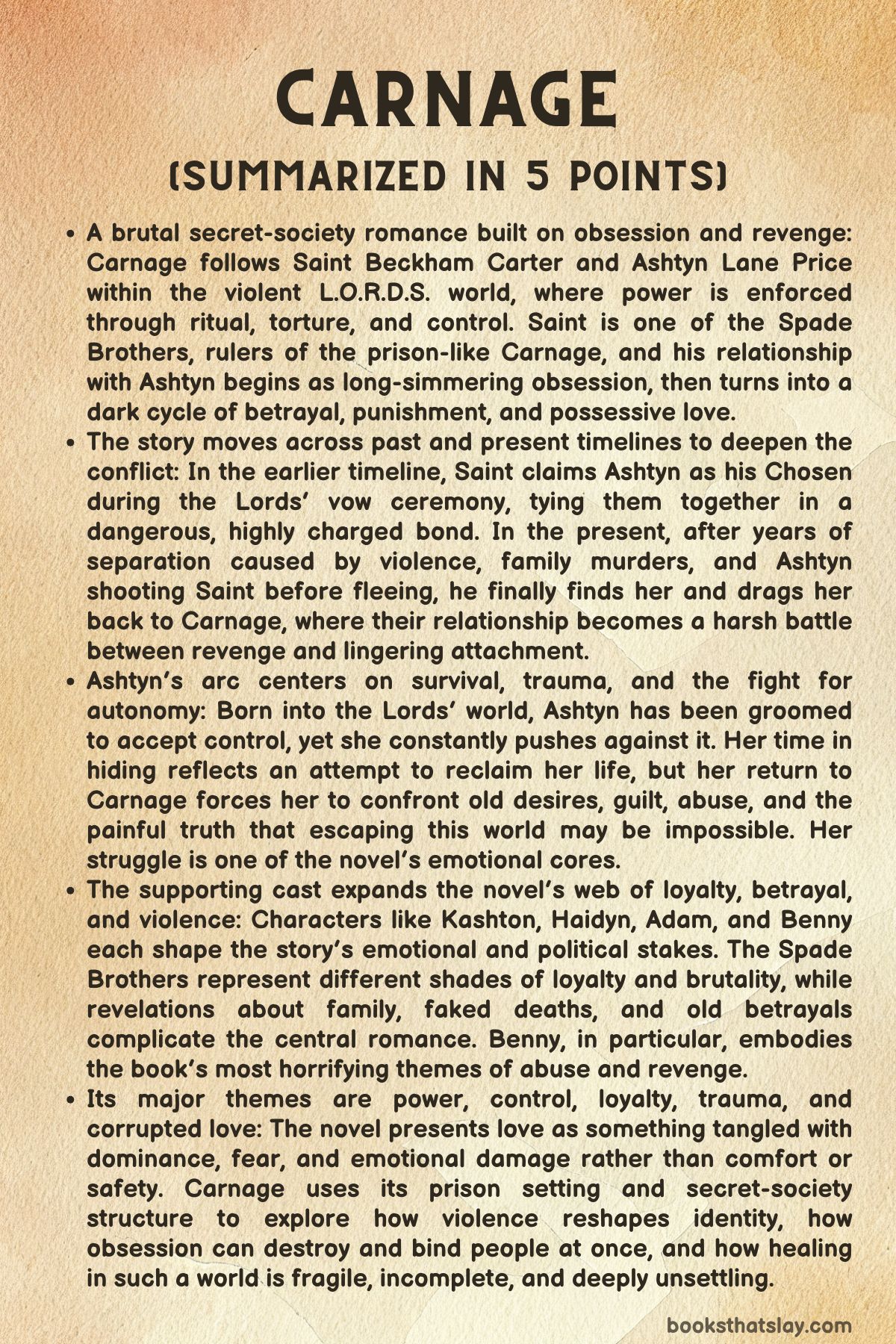
The story unfolds in dual timelines and centers on Saint Beckham Carter, one of the Spade Brothers who run Carnage — a hidden, hellish prison where Lords who betray their oaths are sent to be broken, tortured, and imprisoned for life, often losing their sanity. The Spade Brothers (Saint, Kashton, Haidyn, and Adam) are not blood relatives but a designated group of elite Lords tasked with enforcing this brutal system, taking over from their predecessors.
Summary
The novel opens during the final stages of the Lords’ initiation process at Barrington University. Saint and his fellow Spade Brothers have endured the society’s ruthless trials and are preparing for their vow ceremony, where they officially claim power and select their “Chosen” — women who vow to belong to them. Saint has long been obsessed with Ashtyn Lane Price (sometimes referred to as Ashtyn Lake Price in discussions).
Ashtyn is Adam’s twin sister and the daughter of a former Spade (Altus Price). Born into the Lords world, she has been groomed for this life and shares a deep, mutual (though complicated) attraction with Saint. They have secretly wanted each other for years.
During the vow ceremony, Saint claims Ashtyn as his Chosen. She belongs to him — and, in the Spade Brothers’ dynamic, often to the group in shared, intense, and dark ways that blur lines of possession and loyalty. Their relationship ignites with raw passion, dominance, obsession, and moments of twisted tenderness. Ashtyn navigates the expectations placed on her as a Chosen while grappling with her desires and the dangerous world around her.
The Spade Brothers solidify their control over Carnage, which was previously run by their fathers under even harsher rules.
Political tensions and betrayals within the Lords escalate. Ashtyn’s parents (Altus and Brenda) are murdered amid power struggles and secrets involving the society. Adam, her twin and a Spade Brother, faces trouble with the Lords and goes on the run, making Ashtyn a target as leverage.
Chaos erupts on a bloody, violent night filled with death, manipulation, and revelations. Feeling trapped by the control, violence, and impossible choices — including threats to her life and the weight of her vows — Ashtyn shoots Saint and flees, disappearing into hiding. This act shatters the group and sets the stage for years of searching and simmering rage. Saint survives but is left with physical and emotional scars from the betrayal.
Saint has never stopped hunting for Ashtyn. The Spade Brothers now fully run Carnage, operating it with their own (still extremely dark) methods, distinct from their fathers’ era. Using leads — including information extracted from Whitney, a character tied to prior events in the series — Saint finally locates Ashtyn. She has been living off the grid, working in a strip club, engaging in casual relationships, and attempting to build a life free from the Lords’ grasp. Her time away includes trauma, attempts at normalcy, and internal conflict over her past desires and the suffocating expectations she escaped.
Saint kidnaps her and brings her back to Carnage. What follows is a brutal revenge arc. No longer her devoted (if possessive) lover, Saint treats her as a betrayer who must be punished and broken. He locks her in the facility, subjecting her to psychological manipulation, physical dominance, isolation, and the horrors of Carnage’s environment. The dynamic becomes a intense power struggle: Saint is determined to reclaim her completely, forcing submission and reasserting control, while Ashtyn fights for autonomy even as her lingering attraction, shared history, and complex feelings toward him (and the other Spade Brothers) complicate her resistance.
The story delves deeply into their toxic yet magnetic bond. Flashbacks and present events reveal more about the night she fled, the murders of her parents, Adam’s disappearance and role, and hidden betrayals within the Lords.
Other antagonists emerge, including figures from Ashtyn’s past like Benny, whose abusive actions add layers of trauma and trigger revenge plots. The Spade Brothers — Kashton and Haidyn in particular — play significant supporting roles, with group dynamics, loyalty tests, and shared history influencing events.
External threats from the broader Lords society and internal power struggles create constant danger.
Ashtyn endures extreme circumstances inside Carnage, including branding (used to mark her for protection/hiding or as punishment, tying into prisoner protocols), confinement, and confrontations that push her mental and physical limits. Saint’s obsession drives him to extreme lengths to keep her, even if it means she hates him. Their interactions mix violence, dark passion, manipulation, moments of raw vulnerability, and twisted care. Ashtyn grapples with her trauma, guilt, desires, and the realization that escaping the Lords world may be impossible.
Tensions build toward a climactic confrontation involving betrayals, rescues, and reckonings. Secrets about Adam, Haidyn, and other connections (including ties to events or characters from the broader series) surface. The story explores how far Saint will go to possess Ashtyn and whether their bond can survive the carnage — both literal and metaphorical — they have inflicted on each other.
The novel reaches a dark, intense resolution where Saint and Ashtyn confront the full weight of their past and present. Through violence, psychological warfare, and forced proximity, they navigate a path back to each other, though forever altered by trauma, revenge, and the unyielding rules of their world. The Spade Brothers handle lingering threats, including antagonists like Benny, whose fate ties into justice and protection.
The book includes epilogues that provide glimpses into their future. Saint and Ashtyn move toward a committed, possessive relationship within the Lords framework.
One epilogue highlights their evolving dynamic, with Saint reflecting on his role as a husband and eventual father, noting the challenges of raising a strong-willed daughter (Tinsley is referenced in a humorous, foreshadowing way). They find a fragile stability amid the ever-present dangers of their society, with Saint determined to protect what is his while acknowledging the darkness that defines them. Lingering threats suggest their struggles are not entirely over, but they face the future together on their own dark terms.
The narrative emphasizes themes of obsession, betrayal, loyalty, control, trauma, and the corrupting influence of power within the Lords’ secret society. Carnage itself serves as both a literal prison and a symbol of the inescapable hell the characters inhabit. The story is known for its heavy triggers, including non/dub-con elements, violence, torture, branding, sharing dynamics (in the past timeline), and intense psychological manipulation.
Characters
Saint Beckham Carter
Saint Beckham Carter is the central character in Carnage, embodying the intense and ruthless nature of the Lords. A member of the prestigious Spade brothers, Saint is thrust into a world of power, control, and brutal initiation rites that challenge both his body and mind.
From the very beginning, Saint is defined by his resilience and unyielding commitment to the Lords. He faces harrowing trials that push him beyond his physical limits, enduring pain and isolation, which molds him into a man willing to sacrifice everything for power.
Despite this, his inner turmoil grows as his obsession with Ashtyn Lane Price intensifies. She becomes both a symbol of his dominance and a person he cannot control fully, making his relationship with her one of complex power dynamics.
As Saint rises to full power within the Lords, he becomes colder and more manipulative, using fear and control to secure his position. His journey from a naive freshman to a sadistic Lord marks his transformation into a man who sees power as both a means of survival and a way to dominate those around him, especially Ashtyn.
Saint’s character is defined by contradictions: his affection for Ashtyn is twisted by his need to control, and his desire for strength often blinds him to the emotional cost of his actions. His final initiation, involving pain and the Lord’s branding, cements his place within this dark and brutal society, where power is everything and loyalty comes at a cost.
Ashtyn Lane Price
Ashtyn Lane Price is the female protagonist in Carnage, a character caught between the oppressive world of the Lords and her own desires. Born into a family tied to the Lords, Ashtyn is groomed to serve a Lord, specifically one of the Spade brothers, and struggles with the weight of her family’s expectations.
Throughout the story, Ashtyn’s character is marked by her internal conflict—on one hand, she desires independence and freedom from the control exerted by her family and the Lords, and on the other hand, she is deeply attracted to Saint and the power dynamics he represents. This tension is amplified as she navigates her relationship with him, especially as Saint manipulates and controls her under the guise of love.
Ashtyn’s journey is also shaped by her past trauma, including a history of abuse and manipulation, which makes her both a victim and a player in the dangerous game of power. Her relationships, particularly with Saint, are fraught with emotional complexity, as she oscillates between resistance and submission.
Despite her traumatic past, she longs for emotional connection and sexual freedom, but these desires are consistently overshadowed by the societal expectations placed upon her and her role within the Lords’ world. Her transformation from a victim of her circumstances to someone who understands her place in the violent and controlling world around her is a central arc in the novel.
Ashtyn’s character represents the struggle for autonomy in a world that seeks to strip her of her agency.
Kashton
Kashton is a significant figure in Carnage, who plays a crucial role in Saint’s world of power and manipulation. While not as prominently featured as Saint, Kashton’s character provides a necessary contrast to Saint’s more dominant and obsessive traits.
He is initially presented as a more complex and mysterious figure, someone who is entangled in the power struggles of the Lords but often acts with a more calculated demeanor. Kashton’s interactions with Saint and the others reveal a man who understands the cost of loyalty to the Lords, yet he sometimes shows signs of internal conflict.
While Kashton may not display the same level of obsession with Ashtyn as Saint, his role in the story highlights the various layers of loyalty, control, and ambition that define the Lords. He represents a character who is willing to bend to the Lords’ demands but also harbors a sense of personal morality that occasionally comes into conflict with the brutal world around him.
As the story unfolds, Kashton’s motivations become more evident, showing that even within this ruthless environment, there are characters who navigate the system with more restraint and thoughtfulness.
Haidyn
Haidyn’s return from presumed death in Carnage adds a pivotal twist to the story, reintroducing a character who has been absent for a significant portion of the narrative. Haidyn’s past and his relationship with the Lords, particularly with Saint and Ashtyn, are steeped in mystery.
His survival after being thought dead shocks those around him, especially Ashtyn, who had believed her brother was lost forever. Haidyn is a complex character driven by his own set of morals, which often conflict with the harsh realities of the Lords’ world.
Unlike Saint, who embraces the system to its core, Haidyn seeks to protect Ashtyn from it, even at great personal risk. His actions, especially his attempts to give Ashtyn a chance at a better life, contrast sharply with Saint’s more ruthless approach to control.
Haidyn’s return to the story is not just about reuniting with Ashtyn, but also about confronting the dark forces at play within the Lords, and his presence provides a glimmer of hope for characters who wish to break free from the cycle of abuse and manipulation. Despite his own flaws and the challenges he faces, Haidyn represents the possibility of redemption in a world dominated by power and dominance.
Adam
Adam’s character in Carnage serves as a pivotal figure in the unfolding drama, especially in the context of his interactions with Haidyn and the Lords. Initially appearing as a mysterious ally to Haidyn, Adam is revealed to have played a crucial role in faking Haidyn’s death, which adds a layer of intrigue and complexity to his character.
Adam’s motivations are tied to his loyalty to Haidyn, and his protective instincts toward Ashtyn are evident, despite his previous abandonment of her. As the story progresses, Adam becomes an essential player in the effort to confront the dangers posed by the Lords and their manipulative, violent world.
His presence in the narrative helps shed light on the familial bonds that transcend the cruel rituals and power struggles within the Lords. Adam’s ability to navigate the darker corners of this world without fully succumbing to its rules offers a nuanced view of loyalty, trust, and personal sacrifice.
Benny
Benny serves as one of the antagonists in Carnage, representing the darkest elements of abuse, manipulation, and violence that permeate the world Saint and Ashtyn inhabit. Ashtyn’s traumatic experiences with Benny, who tortured and raped her, reveal the extreme lengths to which some characters go to maintain power and control over others.
Benny’s character, though not central for much of the story, plays a pivotal role in Ashtyn’s emotional journey. His abusive actions serve as a reminder of the true horrors that lurk beneath the surface of the Lords’ society.
His reappearance in the story triggers a major emotional reaction in Ashtyn, and his fate becomes a central point in the narrative as Saint seeks to exact revenge and restore some semblance of justice for the pain he caused. Benny’s character is integral to the exploration of trauma, abuse, and the need for redemption in a world where those who are supposed to protect are often the ones who inflict the most harm.
Themes
Power and Control
In Carnage, power and control are pivotal forces driving the characters’ actions and shaping the world they inhabit. The structure of the secret society, the Lords, is based on dominance and manipulation, where each member’s worth is determined by their ability to maintain control over others.
From Saint’s ruthless pursuit of Ashtyn to the strict trials and rituals of the Lords, the quest for power is central. Saint’s journey from a fresh initiate to a senior member of the Lords reflects the brutal transformation that takes place in those who seek power within this system.
Throughout the novel, the ability to dominate, both physically and psychologically, is the ultimate measure of success. Saint’s obsession with Ashtyn is not just about desire, but about possessing her as a symbol of his dominance over the world he inhabits.
His manipulative behavior and his treatment of her as a conquest highlight the extent to which power can corrupt, turning love into a twisted expression of control. This theme is also explored through the Lords’ societal expectations, where women like Ashtyn are seen as prizes, tools to be used for the satisfaction of men in power.
The controlling nature of this world is not just physical but emotional, as it suffocates personal desires and forces characters to confront their roles within this rigid power structure.
Loyalty and Sacrifice
Loyalty plays a crucial role in Carnage, particularly as it pertains to the Lords and the trials that initiates must undergo to prove their worth. The brutal tests that Saint faces are designed to test his loyalty, not only to the society but also to the men who rule it.
The sacrifices he makes, from enduring excruciating pain to abandoning his previous beliefs and relationships, are all in the name of loyalty. This theme is highlighted through Saint’s transformation—he begins the journey as someone searching for meaning but ultimately sacrifices his own identity to align with the Lords’ brutal code.
The loyalty demanded by the society extends beyond personal values, as Saint’s devotion to the Lords becomes his driving force, overriding his emotional connections with others, especially Ashtyn. This loyalty is demanded not only through actions but also through submission, as seen when Saint claims Ashtyn as part of his ritual, cementing his commitment to both the Lords and his position of power.
Loyalty becomes an inescapable trap, forcing characters to choose between their own morals and the obligations to the people who control their destiny. Ashtyn’s struggle to reconcile her desire for independence with the loyalty expected of her is another layer of sacrifice, as she finds herself trapped in a system that strips her of her autonomy in the name of loyalty.
Obsession and Desire
The theme of obsession is explored through Saint’s growing fixation on Ashtyn. His desire is not simply romantic but almost pathological in nature, as he becomes consumed with the idea of possessing her.
This obsession drives much of his behavior, from the secret surveillance of her to his determination to make her submit to him. His fixation becomes an all-encompassing force, overshadowing all else, including the deeper emotional and moral implications of his actions.
Ashtyn’s own desires are complicated by her upbringing and the expectations placed upon her by her family and society. Her curiosity about her sexuality and her fantasies about Saint clash with her disapproval of the system that controls her.
The sexual tension between them, magnified by the Lords’ traditions, turns into a dangerous game of power dynamics where desire is both a weapon and a means of control. Ashtyn’s conflicting emotions—her attraction to Saint and her desire for autonomy—highlight the way desire can both empower and entrap individuals, making it difficult for them to break free from the expectations that dictate their lives.
The destructive nature of obsession is evident throughout the story, as it forces both characters into a world of manipulation, control, and ultimately, betrayal.
Identity and Transformation
Identity and personal transformation are key themes in Carnage, particularly as characters navigate the pressures of the Lords and their own inner conflicts. Saint’s evolution is a testament to how the Lords mold their members, stripping away individuality and replacing it with a new persona based on loyalty to the society.
His transformation from an innocent young man to a hardened Lord reflects the power of the organization to redefine a person’s identity, pushing them to adopt values and behaviors that serve the interests of the group. This process of forced transformation is central to the plot, as Saint is no longer the person he was when he entered Barrington University, having sacrificed his former self to fit into the world of the Lords.
Ashtyn’s own journey is marked by her struggle to maintain her sense of self while being pushed into the role of a “gift” to a Lord. Her transformation is not one she chooses but one that is thrust upon her by her family and the society she is bound to.
Her attempts to assert her own identity, particularly through her sexual exploration and desire for independence, are constantly at odds with the rigid expectations placed on her. Ashtyn’s conflict is a direct result of the oppressive societal forces that shape her, forcing her to question her value and purpose in a world that does not allow her to define herself.
Trauma and Healing
The exploration of trauma and the possibility of healing is an underlying current in Carnage, as both Saint and Ashtyn are marked by their experiences within the violent world of the Lords. Saint’s past is filled with brutal experiences that have shaped his view of power and control.
His initiation trials, which involve extreme physical and mental torture, leave deep emotional scars that he represses in order to survive within the system. This repression manifests in his relationships, particularly with Ashtyn, where his past trauma makes him view intimacy as a means of domination rather than connection.
Ashtyn’s trauma, however, is more explicitly addressed throughout the narrative. She grapples with the emotional and physical scars of her past, particularly her relationship with Saint and the abuse she endured.
Her escape from Saint’s control and her subsequent life in Las Vegas are attempts at healing, yet her past continues to haunt her, manifesting in her relationships and her desire to numb herself through drugs and detached sexual encounters. Despite her attempts to move forward, her past keeps pulling her back, particularly when Saint reappears in her life.
The possibility of healing is explored in their relationship, as they both must confront their shared history and the damage they have caused each other. However, the cycle of trauma is difficult to break, and the novel presents a bleak view of healing in a world dominated by violence and control.
Ashtyn’s path to healing is uncertain, as she must choose between embracing the love and power Saint offers or continuing to fight for her independence in a world that keeps pulling her back into its grasp.