The Acorn People Summary and Analysis
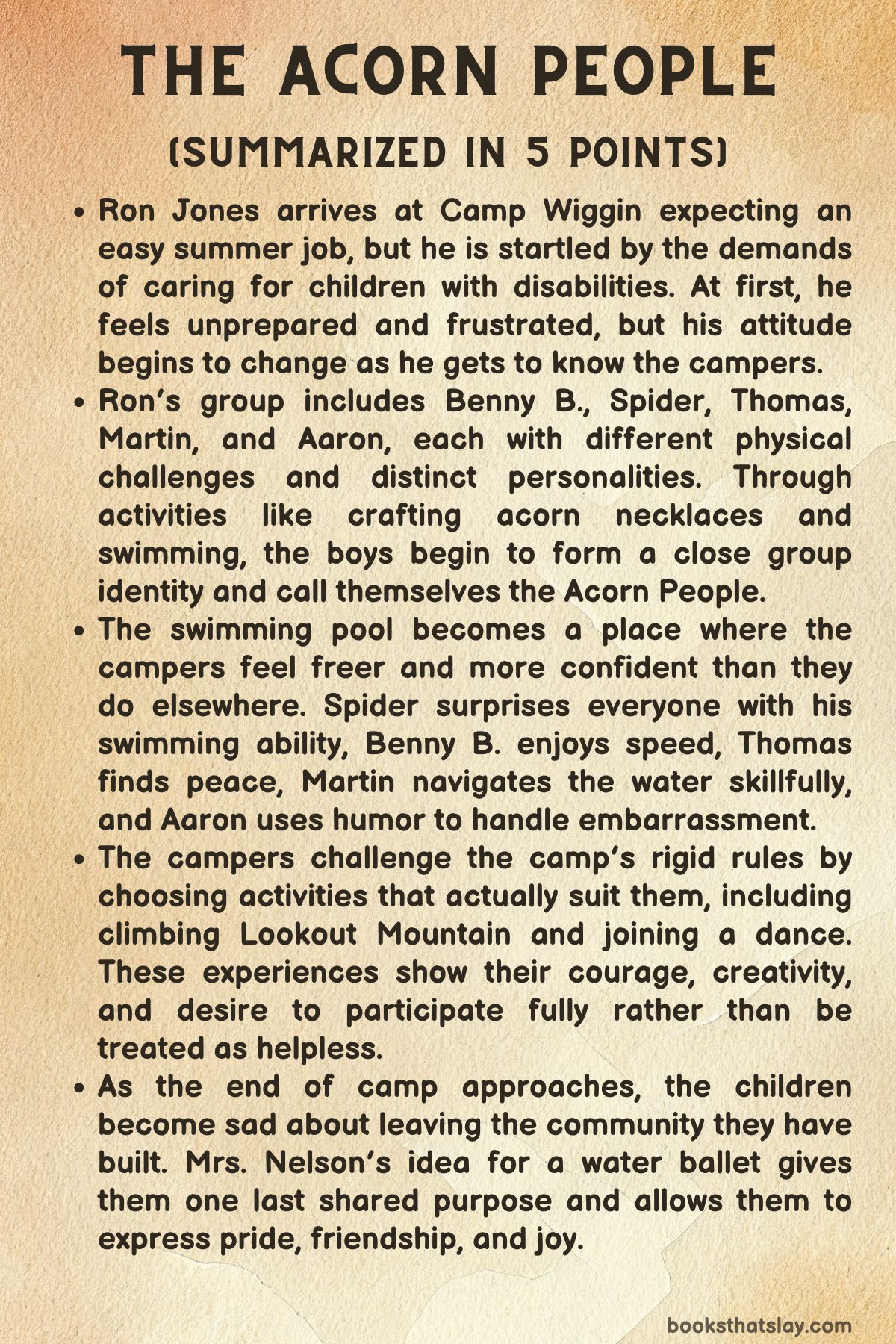
The Acorn People by Ron Jones is a short fiction book about a young counselor’s experience at a summer camp for children with disabilities. At first, Ron arrives with shallow expectations and little understanding of what his campers need, but his time with them changes him.
The book follows his growing respect for Benny B., Spider, Thomas, Martin, Aaron, and the wider camp community as they challenge rules, create friendships, and claim joy in a place not designed for them. It is a book about dignity, exclusion, friendship, and the difference between pitying people and truly seeing them.
Summary
Ron Jones begins his work as a summer camp counselor with the wrong expectations. He has accepted the job thinking it will involve ordinary camp pleasures, decent pay, and a relaxed summer atmosphere.
Instead, he quickly realizes that the camp is meant for children with disabilities, many of whom need constant physical help and emotional support. The camp itself is rugged, inconvenient, and poorly suited to the children who are arriving.
As parents bring their children in and try to settle them, Ron feels uncomfortable, unprepared, and increasingly resentful. Rather than seeing the campers as individuals, he first sees only the difficulty of caring for them.
By the end of his first exhausting experience with them, his frustration turns into anger, and even sleep gives him no comfort because his mind is crowded with disturbing images of disability and dependence.
The next morning begins with more practical challenges. Ron has to help children who have wet their beds, and this forces him into the intimate realities of care before he has learned patience or compassion.
He then gets to know the five boys assigned to him. Benny B. is lively, quick, and fascinated by speed, despite the effects of polio.
Spider has no arms or legs, but he is talkative, alert, and full of personality. Thomas Stewart is withdrawn and weighed down by muscular sclerosis, often seeming trapped in sadness.
Martin is blind, energetic, and more adventurous than Ron expects. Aaron, nicknamed “Arid,” has no bladder and uses urostomy bags, which make him the target of discomfort and judgment from others.
At first, Ron does not know how to bring them together. During a craft activity, he begins stringing acorns into a necklace as a way of joking about how strange and overwhelmed he feels.
The boys connect with the joke because they also feel out of place. The acorn necklace becomes more than a craft project.
It becomes a sign of shared identity. The boys begin calling themselves the Acorn People, turning a moment of awkwardness into a small but powerful act of belonging.
They even make a necklace for another counselor, showing that the symbol is not just personal but communal.
The swimming pool becomes one of the first places where Ron’s assumptions begin to change. In the water, the children are freed from many of the limits placed on their bodies by wheelchairs, braces, and harnesses.
Benny B. becomes the fastest swimmer in the pool. Aaron turns his urostomy bag, usually a source of embarrassment, into a comic weapon during games.
Thomas, who often seems closed off, looks peaceful while floating. Martin uses the movement of the water to orient himself, proving that blindness does not make him helpless.
Spider surprises everyone most of all. Though Ron has not imagined him as a swimmer, Spider moves across the pool with skill and speed, using his body in a way that draws cheers from the group.
The pool changes the atmosphere. Ron starts to feel happiness instead of dread, and the boys begin bonding through stories and shared pride.
As the days continue, Ron grows more aware of how badly the camp’s official rules fit the children. Mr. Bradshaw, the camp administrator, appears from time to time with stern instructions and moral sayings, but his approach is based on a narrow idea of what camp should be.
He expects order, schedules, and activities designed for children without disabilities. Ron sees that these expectations do not serve his campers.
The boys prefer the pool, where they feel capable and free, so they begin ignoring the prescribed routines. When they meet a group of girls there, the boys become shy, self-conscious, and excited.
The interaction is awkward but normal, and that normality matters. They flirt, laugh, and form crushes like any other children at camp.
Aaron gives his acorn necklace to Mary, a blind girl, and then has to make himself another while the others tease him. Soon the necklaces spread beyond Ron’s group, becoming a camp-wide sign of connection.
The group’s strongest test comes when the camp announces that campers can earn merit badges by climbing Lookout Mountain. The task is physically difficult and poorly suited to children using wheelchairs or living with serious physical disabilities.
Ron’s group is unsure whether to attempt it, but Martin pushes them to try. The climb becomes exhausting almost immediately.
The paths are narrow, the undergrowth tangles in wheelchair spokes, and every incline requires careful pushing and braking. The journey demands cooperation from everyone.
When the boys grow tired, Spider lifts their spirits by pretending they are explorers on a grand expedition. His imagination helps them see their struggle not as failure but as adventure.
The final part of the mountain path is too steep for wheelchairs. Martin refuses to stop.
He leaves his wheelchair and moves upward backward on his bottom, using his arms to push himself along. His determination changes the group’s sense of what is possible.
Others follow his example, and they eventually reach the top. The climb gives the boys a sense of achievement that no ordinary camp rule could have produced.
Yet when they return, they learn that Mr. Bradshaw is displeased by the camp’s disorder. He objects not only to Ron’s group but to many activities that have allowed children to enjoy themselves, including cooking, archery, music, and makeup lessons.
His idea of discipline threatens the campers’ freedom.
When parents visit, Ron’s group is assigned to make name tags. Aaron turns the task into a comic labeling spree, placing labels on people and objects all around camp.
Later, Mr. Bradshaw shows the campers and parents a water-safety film, disappointing everyone who had expected entertainment. Ron notices the water ballet shown near the end of the film, a detail that becomes important later.
That night, he feels frustrated because both parents and administrators seem to reinforce limiting ideas about the children. The campers are constantly being watched, corrected, protected, or categorized instead of being allowed to enjoy camp on their own terms.
Mrs. Nelson, the camp nurse, becomes a surprising ally. After Aaron labels everything, she removes the labels while wandering around camp drunk, and the children later treat her as a hero.
Ron sees meaning in her action because the campers themselves have been burdened by labels. They are not just “disabled children,” not problems, not medical cases, not burdens.
Mrs. Nelson’s removal of the labels becomes a comic but meaningful rejection of the way others define them. The children gather around her afterward, sensing that she sees them with warmth rather than judgment.
The camp dance becomes another moment of transformation. At first, many children are unsure how to participate.
Dancing seems like an activity that might exclude them, but a counselor begins a square dance and gives clear instructions so everyone can join, including blind campers. Soon the dance opens into many forms of movement.
The children participate in their own ways, flirting, laughing, and enjoying attention. Aaron and Mrs. Nelson are named King and Queen of Camp Wiggin.
Aaron is overwhelmed by the praise and begins to cry because he has rarely experienced such open affection. The moment shows how starved he has been for acceptance and how deeply kindness can affect a child who has often been treated as unpleasant or strange.
As the end of camp approaches, the mood darkens. Ron notices that the children grow anxious and withdrawn, almost returning to the guarded state in which they arrived.
The thought of leaving their temporary community weighs on them. Mr. Bradshaw focuses on cleanliness and order before the parents return, but Ron worries more about the children’s emotional state.
He asks that the pool remain open until the end, and Mr. Bradshaw allows it as long as it is cleaned before the parents arrive. The pool remains the central place where the campers feel most alive.
Mrs. Nelson then offers a plan that gives the campers new purpose. Remembering the water ballet from the film, she suggests that they create their own performance, complete with a story and reporters to record it.
The idea breaks through the sadness of departure. The campers become excited and begin planning together.
Instead of ending camp as passive children waiting to be collected, they prepare to present themselves proudly. The plan for the water ballet represents everything Ron has learned: these children do not need pity or narrow protection.
They need space, imagination, respect, and the chance to show who they are.
Key Figures
Ron Jones
Ron Jones is the narrator and central adult figure in the book. At the beginning, he is inexperienced, uncomfortable, and deeply shaped by common ableist assumptions.
He accepts the counselor job expecting easy summer work, and when he discovers the reality of caring for children with disabilities, he reacts with resentment rather than generosity. This makes him flawed but important as a narrator because his change becomes one of the book’s main movements.
His early anger exposes how disability is often treated as an inconvenience by people who have not learned to see disabled children as full human beings. As he spends time with the campers, his perspective changes through direct experience rather than abstract lessons.
The pool, the mountain climb, the dance, and the acorn necklaces teach him that his campers are creative, funny, romantic, stubborn, sensitive, and capable of joy. In The Acorn People, Ron’s growth is not presented as instant goodness.
He has to move from discomfort to responsibility, from pity to respect, and from control to partnership. By the later parts, he is no longer simply managing the boys.
He is protecting their right to enjoy camp, questioning Mr. Bradshaw’s rules, and recognizing that the children’s emotional lives matter as much as their physical care.
Benny B.
Benny B. is one of Ron’s campers and is described as a lively child with polio who loves the idea of speed. His fascination with being a high-speed racer reveals a powerful contrast between how others might view him and how he imagines himself.
People may see his body first and assume limitation, but Benny’s inner life is full of motion, excitement, and competition. In the pool, he becomes the fastest child, and this moment is central to understanding him.
Water gives him a space where he can experience speed in a real, physical way, not merely as fantasy. Benny’s energy helps challenge Ron’s early assumptions about what the campers can enjoy.
He is not passive or tragic; he wants to win, play, flirt, and be noticed. His character also adds brightness to the group dynamic because his desire for speed reflects the larger desire of the campers to move beyond the slow, careful, restricted roles imposed on them.
Spider
Spider is one of the most memorable figures in the book because his physical condition is described in stark terms, yet his personality quickly exceeds any narrow definition based on his body. He has no arms or legs, but he loves to talk and has a strong presence among the boys.
His swimming scene is especially important because it overturns expectations, including Ron’s. Spider moves through the pool with surprising grace and speed, showing that ability can take forms outsiders do not predict.
He also has a strong imagination, as seen during the mountain climb when he pretends the group is an expedition party. This act is more than childish play.
It helps the boys endure exhaustion and fear by turning hardship into shared adventure. Spider’s role in the story is emotional and social as much as physical.
He helps the group laugh, keep going, and see themselves as brave rather than helpless.
Thomas Stewart
Thomas Stewart is a teenager with muscular sclerosis and is presented as despondent, which gives him a quieter and heavier presence than some of the other campers. His sadness suggests the emotional cost of living in a body that others may misunderstand, pity, or treat as a problem.
Thomas does not immediately fill the space with humor like Spider or energy like Benny B.; instead, he often appears withdrawn. Yet the pool reveals another side of him.
When he floats in the water, he seems peaceful, and this image matters because it shows that relief is possible for him. His character reminds the reader that not every camper responds to difficulty with loud resilience.
Some carry pain inwardly. Thomas’s importance lies in the book’s refusal to make every disabled child cheerful in the same way.
He represents the quieter need for gentleness, patience, and spaces where a burdened child can simply rest.
Martin
Martin is a blind fourteen-year-old whose energy and determination make him one of the strongest forces in the group. He challenges assumptions about blindness by showing confidence, initiative, and physical courage.
In the pool, he uses waves and ripples to guide himself, proving that he understands his environment through senses and strategies that Ron has not considered. His most important moment comes during the climb up Lookout Mountain.
When the trail becomes too steep for wheelchairs, Martin refuses to accept defeat. He leaves his wheelchair and moves upward using his arms, inspiring others to continue.
This action is not merely about proving toughness. It shows leadership.
Martin pushes the group beyond the limits set by fear, terrain, and expectation. In The Acorn People, Martin stands for self-directed courage, but he is not reduced to a lesson.
He remains a boy who wants achievement, recognition, and participation on his own terms.
Aaron, also called Arid
Aaron, nicknamed “Arid,” is one of the most emotionally complex children in the story. He has no bladder and uses urostomy bags, which smell unpleasant and make others uncomfortable.
Because of this, he is especially vulnerable to rejection, teasing, and social distance. Yet Aaron is also funny, mischievous, affectionate, and eager for connection.
In the pool, he turns his urine bag into a comic advantage, threatening to spray others and using humor to control what might otherwise be a source of shame. His habit of labeling everything with leftover name tags also reveals his playful intelligence.
At a deeper level, Aaron’s story is about the pain of being treated as repulsive and the healing power of acceptance. When he gives his acorn necklace to Mary, he shows tenderness and romantic innocence.
When he is named King of Camp Wiggin and receives praise, he cries because kindness is so unfamiliar to him. Aaron’s tears show how deeply he wants to be loved without disgust or embarrassment.
Mr. Bradshaw
Mr. Bradshaw is the camp administrator and functions as a representative of rigid authority. He is stern, distant, and attached to order, schedules, and official standards.
His problem is not simply that he likes discipline; it is that his rules do not account for the actual children in front of him. He expects campers with disabilities to fit a camp structure designed around children without those needs.
This makes his leadership ineffective and often harmful. He sees creative activities and flexible routines as “unruly,” even when they allow campers to experience joy, confidence, and community.
In The Acorn People, Mr. Bradshaw represents the institutional mindset that values appearance, control, and parental approval over the lived needs of children. He is not shown as openly cruel in every action, but his narrowness limits the campers.
His eventual agreement to keep the pool open suggests he can bend slightly, but he remains a figure whose authority must be questioned.
Mrs. Nelson
Mrs. Nelson, the camp nurse, is one of the adult characters who best understands the emotional needs of the children. She is unconventional and imperfect, especially in the scene where she wanders around camp drunk while removing Aaron’s labels.
Yet that scene becomes meaningful because her action symbolically rejects the labeling of the campers themselves. The children admire her afterward because they sense that she is on their side.
She does not treat them only as medical responsibilities. She allows humor, warmth, and freedom into the camp environment.
Her suggestion that the campers create a water ballet shows her imagination and her respect for their desire to perform, create, and be seen. Mrs. Nelson’s role is important because she offers a different kind of adult care from Mr. Bradshaw’s.
She cares not by controlling the children but by giving them chances to express themselves.
Mary
Mary is a blind girl who becomes important through her connection with Aaron. Although she appears briefly, her role matters because she helps show the campers as children with ordinary emotional and social desires.
Aaron gives her his acorn necklace, a gesture that suggests affection, admiration, or a young crush. This moment allows Aaron to be seen not as a medical problem but as a boy capable of tenderness.
Mary also helps widen the social world of the story beyond Ron’s cabin group. Through her, the acorn necklace becomes part of a larger camp culture, linking different children together through shared recognition and affection.
The Parents and Visitors
The parents and visitors are not deeply individualized, but they shape the emotional pressure surrounding the camp. At the beginning, parents struggle to settle their children into an environment that is not well designed for them.
Their presence highlights how difficult care can be, but later their visit also reinforces unfair standards. Ron senses that the parents, along with Mr. Bradshaw, contribute to rules and expectations that prevent the children from doing what they truly want.
The parents are not presented simply as villains; many are likely anxious, protective, and tired. Still, their presence reminds the reader that disabled children are often watched and managed by adults who may love them but still limit them.
The Other Counselor
The other counselor appears through the acorn necklace gift and represents the wider staff community that Ron’s group begins to affect. Although this character is not individually developed, the gift matters because it shows that the boys want to include others in their new identity.
The necklace is not kept as a private joke. It becomes something they share, and the other counselor’s presence helps mark the spread of the Acorn People idea beyond Ron’s immediate cabin.
This minor character therefore helps show how a small act of creativity can become a symbol for a larger group.
The Girls at the Pool
The girls at the pool are minor characters, but they are important because they bring out the boys’ self-consciousness, flirtation, and desire to be socially accepted. Their presence changes the pool from a private zone of freedom into a social space where the boys must face feelings of attraction, embarrassment, and confidence.
The girls help reveal that Ron’s campers are not defined only by disability. They have crushes, awkward moments, hopes, and teasing friendships.
Through these interactions, the book insists on their ordinary adolescence and childhood.
The African Staff Member
The African staff member is mentioned in connection with singing, one of the activities Mr. Bradshaw considers disorderly. Though this character receives little detail, the reference is still meaningful.
The singing suggests a camp environment becoming more expressive, communal, and culturally open than Mr. Bradshaw wants it to be. This staff member represents the kind of adult presence that helps the campers experience joy outside strict routines.
Even as a minor figure, the character belongs to the broader contrast between creative freedom and institutional control.
The Counselor Who Leads the Square Dance
The counselor who begins the square dance plays a key role in making the camp dance inclusive. At first, the children hesitate because dancing can seem impossible or embarrassing for campers with different physical abilities.
This counselor breaks the activity down beat by beat, making it accessible even to blind children. The character’s importance lies in practical inclusion.
Instead of excluding children from an activity because they cannot participate in a conventional way, the counselor changes the method so that everyone can join. This moment shows that accessibility often depends on imagination and instruction, not on lowering expectations.
Themes
Disability, Dignity, and the Failure of Pity
The children in the story are often first seen through the conditions of their bodies, but the book steadily challenges that narrow way of seeing. Ron’s early reaction is shaped by discomfort and pity, and this prevents him from recognizing the campers as full people.
He notices their needs before he notices their humor, wishes, courage, and intelligence. As the camp continues, the children show that dignity does not come from appearing independent in a conventional way.
It comes from being treated as people whose feelings and choices matter. The pool scenes are especially important because they show the campers experiencing freedom in forms suited to them.
Spider swims, Benny B. races, Thomas rests, Martin navigates, and Aaron turns embarrassment into comedy. None of these moments erase disability, but they refuse to let disability become the whole identity of a child.
The Acorn People argues that pity can be another form of distance. Respect requires attention, adjustment, and the willingness to let disabled children define themselves beyond adult assumptions.
Labels and the Need to Be Seen Fully
Labels appear in the story both literally and socially. Aaron’s playful habit of placing name tags on people and objects becomes funny at first, but Mrs. Nelson’s removal of those labels gives the action deeper meaning.
The campers themselves live under labels placed on them by adults, institutions, medical language, and social discomfort. They are often treated as disabled before they are treated as children.
A label may help identify a need, but it can also shrink a person into a category. Aaron knows this pain more sharply than many others because his urostomy bag makes people react to him with disgust or unease.
When he is named King of Camp Wiggin, the praise overwhelms him because it replaces the cruel label with public affection. The acorn necklaces also work against harmful labeling.
They create an identity chosen by the children themselves, not imposed by doctors, parents, or administrators. The book shows that being named with love is very different from being labeled with fear.
Freedom Through Adaptation
The camp’s official structure often fails because it expects children with disabilities to fit activities and schedules that were not made for them. Mr. Bradshaw’s rules value order over experience, and this creates unnecessary exclusion.
The most successful moments happen when activities are adapted, reimagined, or claimed by the campers in their own way. Swimming allows bodies to move differently.
The mountain climb becomes possible through teamwork, patience, and Martin’s determination to leave his wheelchair behind when the trail demands another method. The dance becomes inclusive when a counselor gives clear beat-by-beat instructions.
Mrs. Nelson’s water ballet idea offers another example: instead of assuming the children cannot perform, she asks what kind of performance they can create. These moments show that freedom is not created by pretending limitations do not exist.
It is created by changing the environment, the rules, and the expectations so that participation becomes possible. The story treats adaptation as a form of respect.
Community as a Source of Courage
The campers become braver when they stop feeling alone. The acorn necklaces begin as a small craft joke, but they quickly become a symbol of belonging.
Ron’s five boys are very different from one another, yet the shared name gives them a group identity that helps them face embarrassment, exhaustion, and sadness. On the mountain, no single camper succeeds alone; progress depends on pushing wheelchairs, stopping together, joking together, and following Martin’s example.
At the dance, the children gain confidence because the group makes participation feel possible. Even Aaron’s emotional reaction to being crowned King shows the power of community.
Praise from others gives him a sense of worth he has rarely known. As the end of camp approaches, the children’s sadness also proves how meaningful this community has become.
They fear losing the one place where they have been allowed to laugh, flirt, compete, perform, and belong. The book presents community not as simple togetherness, but as the condition that allows courage to appear.