The Acts of King Arthur and His Noble Knights Summary, Characters and Themes
The Acts of King Arthur and His Noble Knights is John Steinbeck’s retelling of Arthurian legend, drawn from the world of medieval chivalry but written with a modern storyteller’s clarity. The book follows Arthur from his secret birth and rise to kingship through the founding of Camelot’s moral code, the quests of his knights, the betrayal of magical figures, and the first signs of the tragedy that will later destroy the Round Table.
Steinbeck keeps the old heroic world alive while giving its people recognizable fears, pride, desire, guilt, and weakness.
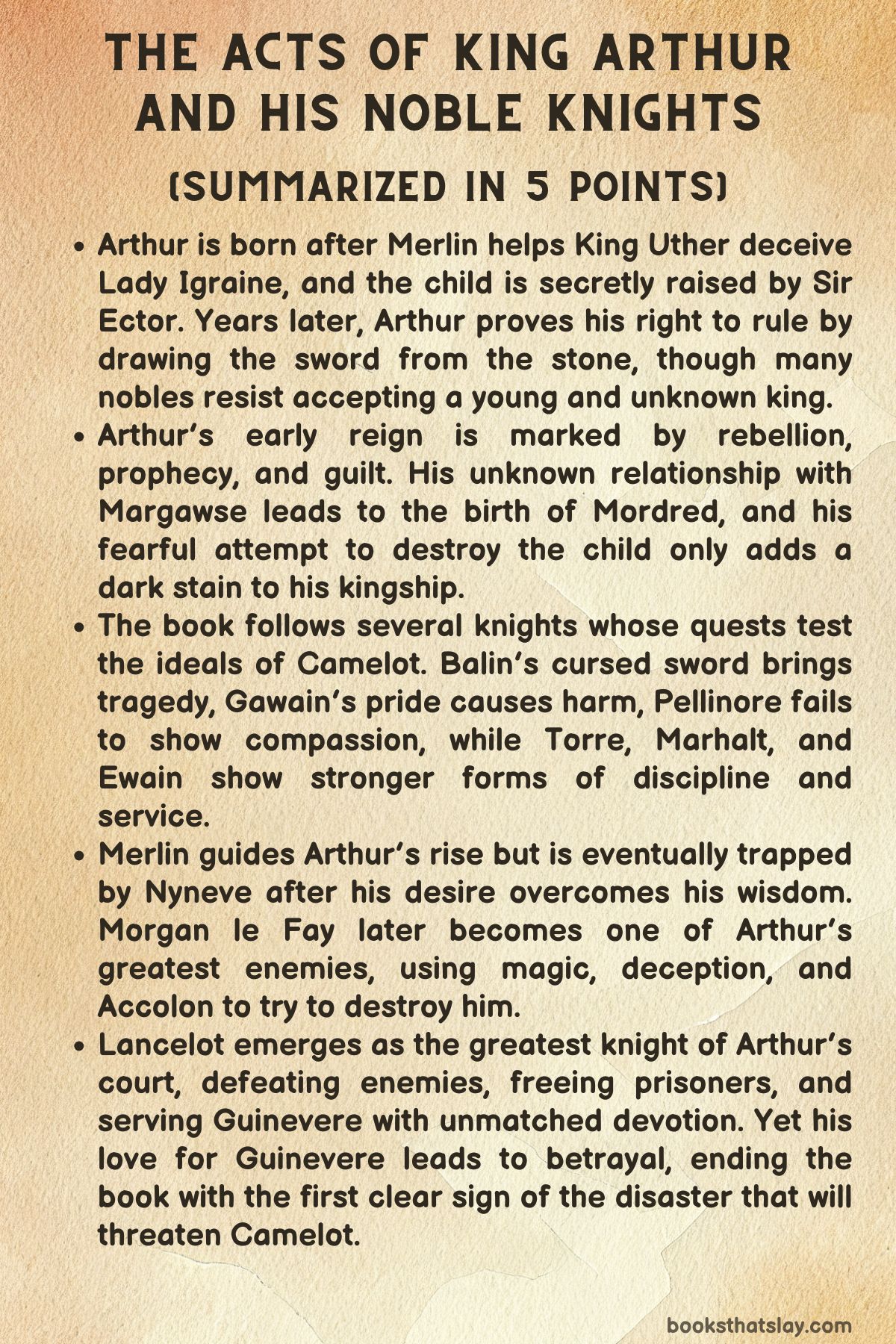
Summary
The Acts of King Arthur and His Noble Knights begins with the strange and morally troubled events surrounding Arthur’s birth. King Uther of Britain becomes obsessed with Lady Igraine, the wife of the Duke of Cornwall.
Merlin, the great wizard, helps Uther satisfy his desire by disguising him as Igraine’s husband. The duke is killed during a siege, but Igraine does not yet know this, and Uther comes to her in the duke’s shape.
From this union, Arthur is conceived. Uther later marries Igraine, but Merlin takes the child away and arranges for him to be raised in secrecy by Sir Ector.
Arthur grows up not knowing that he is the son of a king.
After Uther’s death, Britain falls into disorder. Rival nobles gather armed followers and try to seize power for themselves.
Law weakens, violence spreads, and the country waits for a ruler who can restore order. Merlin creates a test by placing a sword in a stone and declaring that whoever draws it out is the rightful king.
Arthur, still a young squire, removes the sword while trying to find a weapon for his foster brother Kay. At first, many lords refuse to accept him because he is young and seems to lack royal blood.
Yet Arthur draws the sword again and again, proving the sign cannot be dismissed. After long resistance, the nobles accept him, though several northern lords rebel against his rule.
Arthur faces war almost immediately. Merlin advises him to ally with Kings Bors and Ban of France, who agree to support him in exchange for future help against their enemy Claudas.
Their combined armies fight the rebellious lords, but the struggle does not end with a clear victory. The rebels withdraw because their own territories are threatened, giving Arthur time to grow into his kingship.
During this early period, Arthur unknowingly has a relationship with Margawse, the wife of King Lot and his own half-sister. Merlin later reveals that this sin will produce Mordred, the son who will eventually destroy Arthur.
Arthur’s right to rule becomes clearer when Queen Igraine publicly admits that he is her son. This revelation settles doubts about his lineage and gives emotional weight to his reunion with the mother who lost him as an infant.
Yet Arthur’s peace remains uneasy. He fights Sir Pellinore and nearly dies before Merlin intervenes.
Since Arthur’s sword is broken in that combat, Merlin takes him to the Lady of the Lake, who gives him Excalibur and its enchanted scabbard. The sword is powerful, but the scabbard is more valuable because it protects its wearer from wounds.
Even so, Arthur cannot escape fear of Merlin’s prophecy. When he learns that Margawse has borne a son on May Day, he orders all infants born that day to be set adrift at sea.
The act stains his reign. The babies drown, except Mordred, who survives and is raised in obscurity.
The next major tale concerns Sir Balin. A maiden arrives at Arthur’s court with a sword that only a pure and worthy knight can draw.
Many fail, but Balin, a poor and recently imprisoned knight, succeeds. The maiden asks for the sword back, warning that it will bring destruction, but Balin keeps it.
When the Lady of the Lake appears and demands the heads of Balin and the maiden, Balin kills her, claiming she murdered his mother. Arthur is horrified that Balin has killed a woman under royal protection and banishes him.
Merlin explains that the sword is cursed and that Balin will eventually kill his own brother.
Trying to regain honor, Balin joins with his brother Balan to defeat Arthur’s enemy Lord Royns. They succeed, and Balin briefly returns to favor.
Arthur then sends him to help a knight troubled by an unseen enemy. Balin’s journey becomes a chain of disasters.
He tries to help others, but his actions repeatedly end in death. At last, he fights an unknown knight in single combat and kills him, only to discover that the man is Balan.
The brothers die because of fate, misunderstanding, and the curse attached to Balin’s sword.
Arthur later decides to marry Guinevere, hoping to strengthen his reign and secure an heir. Merlin warns him against the marriage, saying Guinevere will betray him with his closest friend, but Arthur refuses to listen.
As part of the marriage gift, Guinevere’s father gives Arthur the Round Table, which becomes the center of Camelot’s fellowship. During the wedding feast, a white stag, a white hound, black dogs, a lady, and a violent knight create a chain of quests.
Merlin reminds Arthur that great adventures often begin in small and strange ways, so Arthur sends Gawain after the stag, Torre after the hound, and Pellinore after the abducted lady.
Gawain’s quest ends badly. He kills a knight and accidentally kills a lady who tries to protect him.
His failure leads Guinevere to impose a lifelong obligation on him: he must defend women and show mercy when mercy is asked. Torre performs better.
He retrieves the stolen hound, defeats opponents, and shows promise as a noble knight. Pellinore succeeds in rescuing the abducted lady, Nyneve, but he ignores a suffering damsel and a wounded knight on the way.
He later learns that the damsel was his own daughter and that her curse will one day be fulfilled. These quests lead to the oath of the Round Table: its knights must be merciful, defend women’s honor, and avoid unjust causes.
Merlin’s own end comes through Nyneve. He falls helplessly in love with her even though he knows she will destroy him.
Nyneve learns his magic little by little, including spells that cannot be broken. She persuades him to create a hidden chamber beneath a rock and then traps him inside it forever.
Merlin’s wisdom cannot save him from desire. Soon after, Arthur faces five foreign kings who raid his country.
Through a night attack, escape, and a dawn ambush, Arthur and his companions kill the kings, causing their leaderless armies to flee.
Morgan le Fay then becomes one of Arthur’s greatest threats. Jealous of her half-brother, she plots to kill him through her lover Accolon.
She steals Excalibur and its scabbard by replacing them with false copies. During a hunt, Arthur, Accolon, and Uryens fall under enchantment.
Arthur awakens in prison and agrees to fight as champion for Sir Damas. Accolon receives the real Excalibur and is told to kill Arthur.
In the duel, Arthur is confused by the failure of his weapon until he realizes the deception. He defeats Accolon, who confesses Morgan’s scheme before dying.
Morgan later steals Excalibur’s scabbard and escapes by turning herself and her companions into stones. Her rebellion remains unresolved, and she retreats in fear while still threatening vengeance.
The story then follows Gawain, Ewain, and Marhalt on separate quests. Gawain travels with a young maiden who dislikes his vanity.
He meets Sir Pelleas, who loves Ettarde so desperately that he allows himself to be humiliated just to be near her. Gawain promises to help but instead seduces Ettarde.
Pelleas nearly kills them both but leaves in despair. Nyneve helps him by causing Ettarde to suffer the same rejected love she inflicted on him.
Pelleas turns away from Ettarde and finds happiness with Nyneve.
Marhalt’s quest is far more balanced. He travels with a capable woman of thirty who proves practical, intelligent, and good company.
He defeats enemies, wins honor in a tournament, kills a giant troubling Earl Fergus’s lands, and spends a season in domestic comfort before restlessness returns. Ewain travels with Lady Lyne, an elderly woman who trains young knights.
She teaches him discipline, tactics, and skill, turning him into a far stronger warrior. With her guidance, he wins a tournament and restores stolen lands to the lady of the Castle of the Rock.
The final major section centers on Lancelot. Arthur’s kingdom has become peaceful, but peace leaves warriors restless.
Guinevere proposes that knights travel the land enforcing the King’s Justice. Lancelot, the greatest knight, goes on a quest with his lazy nephew Lyonel.
While Lancelot sleeps, Lyonel is captured by Sir Tarquin, who hates Camelot’s knights. Lancelot, meanwhile, is abducted by four magical queens, including Morgan le Fay.
They try to make him choose one of them, offering lust, variety, motherly affection, and power. Lancelot refuses them all.
A young damsel helps Lancelot escape in exchange for his promise to aid her father in a tournament. He fulfills the promise, then searches for Lyonel.
He finds Tarquin, kills him, and frees the imprisoned knights. Lancelot continues his travels, defeating villains and sending them to Guinevere as signs of devotion.
He later meets Kay, who feels crushed by his administrative duties as seneschal. Lancelot exchanges armor with him to protect his reputation and raise his spirits.
Near the end, a young enchantress gives Lancelot a vision of Guinevere condemned for treason, but he rejects it as nonsense. Back at Camelot, the court celebrates his deeds.
After the feast, Guinevere pulls Lancelot into her chamber, and they kiss. Lancelot leaves in grief, knowing he has betrayed Arthur and crossed into the future Merlin warned about.
Characters
King Arthur
Arthur is the central figure of the book and is presented as both a chosen king and a deeply fallible man. His rise begins in innocence, since he does not know his true parentage and draws the sword from the stone almost by accident while trying to serve Kay.
This humility is one reason he seems worthy of kingship. Yet his rule is marked by the burden of prophecy, sin, and fear.
His relationship with Margawse, though committed in ignorance, creates Mordred, and his attempt to kill the May Day infants shows how terror can corrupt even a noble ruler. Arthur’s greatness lies in his desire to create justice out of chaos.
He establishes alliances, accepts the Round Table, supports the knightly oath, and tries to turn violence into moral service. Still, The Acts of King Arthur and His Noble Knights does not make him perfect.
He is brave, generous, and sincere, but he can also be stubborn, frightened, and morally compromised.
Merlin
Merlin is the architect of Arthur’s destiny and one of the most complex figures in the story. He arranges Arthur’s birth, protects him in childhood, creates the sword test, advises him in war, warns him about Guinevere, and explains the meanings behind many strange events.
His knowledge is immense, yet his wisdom often comes with helplessness. He can foresee disaster but cannot always prevent it.
This is clearest in his relationship with Nyneve. He knows she will be his undoing, but desire defeats caution.
Merlin’s tragedy is that knowledge does not free him from human weakness. He is manipulative in the beginning, especially in helping Uther deceive Igraine, but he also serves the larger dream of order in Britain.
His imprisonment marks the loss of Arthur’s greatest guide.
King Uther
Uther is important because his desire sets the whole Arthurian story in motion. He is a king driven less by justice than by possession.
His longing for Igraine leads him to accept Merlin’s deception, and Arthur’s birth begins with an act that is morally shadowed. Uther later marries Igraine, but the damage has already been done.
He represents the older, unstable world from which Arthur must emerge: a world where kings take what they want and power excuses wrongdoing. At the same time, without Uther, Arthur would not exist, so the book places Arthur’s noble future on a troubled foundation.
Lady Igraine
Igraine is both victim and mother. She is deceived by Merlin’s spell and Uther’s desire, then loses her child without understanding why.
Her later declaration that Arthur is her son becomes crucial because it confirms his royal identity and helps quiet the doubts surrounding his rule. Igraine’s role carries emotional weight because she links private suffering with public legitimacy.
She does not control the events around her, but her truth finally restores part of what was taken from her. Her reunion with Arthur also softens the political story with a personal wound that has lasted for years.
The Duke of Cornwall
The Duke of Cornwall is Igraine’s first husband and the man whose death allows Uther’s deception to succeed. Though he appears briefly, his presence matters because his murder and impersonation create the moral stain at the beginning of Arthur’s lineage.
He represents the human cost hidden beneath royal desire and magical planning. His death is not merely a plot device; it reminds the reader that the creation of a legendary king begins with betrayal, siege, and loss.
Sir Ector
Sir Ector is Arthur’s foster father and the guardian of his hidden childhood. His importance lies in the quiet stability he gives Arthur before the boy becomes king.
By raising Arthur away from court, Ector allows him to grow without royal pride. The book does not dwell heavily on his inner life, but his household shapes Arthur’s early humility.
Ector stands for ordinary loyalty, the kind that supports greatness without demanding glory.
Sir Kay
Kay begins as Arthur’s foster brother and later becomes seneschal of Camelot. Early in the story, Arthur serves him as a squire, which highlights Arthur’s modest position before his identity is revealed.
Later, Kay’s character becomes more practical and weary. As seneschal, he is buried in accounts, supplies, food, and organization.
He feels that administration has drained the heroic part of him. Lancelot’s exchange of armor with Kay is a generous act because it protects Kay’s dignity.
Kay shows that Camelot depends not only on glamorous quests but also on exhausting labor that others overlook.
King Bors
King Bors is one of the French rulers who supports Arthur during the rebellion of the northern lords. His alliance helps Arthur survive the early challenge to his authority.
Bors is practical and political, agreeing to help Arthur because Arthur will later help him against Claudas. He represents the importance of mutual obligation in kingship.
Arthur’s reign cannot be built by destiny alone; it also requires negotiation, military partnership, and trust between rulers.
King Ban
King Ban, like Bors, strengthens Arthur’s position during his early wars. He is a foreign ally whose aid gives Arthur the force needed to face internal rebellion.
Ban’s role shows that Arthur’s kingdom is connected to a larger world of rulers, rivalries, and debts. His support also reflects Merlin’s political wisdom: Arthur must survive first, and ideals can only grow once his throne is secure.
King Claudas
Claudas does not dominate the action, but he matters as the enemy of Bors and Ban. His existence explains why the French kings are willing to help Arthur in exchange for future support.
He represents the wider field of conflict beyond Britain. Even as Arthur tries to unite his own land, the book reminds readers that power is always linked to other wars and obligations.
The Eleven Rebel Lords
The eleven lords who resist Arthur’s rule embody the disorder Britain faces after Uther’s death. They are jealous, ambitious, and unwilling to accept a young king whose royal blood is not yet publicly known.
Their rebellion gives Arthur his first major test as ruler. They are not individualized in detail, but as a group they represent aristocratic pride and the danger of private ambition overpowering public order.
King Lot
King Lot matters mainly through his connection to Margawse and the northern opposition to Arthur. As a ruler, he belongs to the world of rival kings and unstable loyalties.
As Margawse’s husband, he is also tied to the hidden sin that produces Mordred. His presence strengthens the sense that Arthur’s personal and political worlds cannot be separated.
Margawse
Margawse is Arthur’s half-sister and the mother of Mordred. Her relationship with Arthur is tragic because neither understands their blood connection at the time.
She becomes the means through which prophecy enters Arthur’s family line. Margawse is not treated only as a villain; she is part of a world where kinship secrets, desire, and political marriage create disaster.
Her motherhood gives Mordred both royal blood and a cursed place in Arthur’s future.
Mordred
Mordred is more a shadow of the future than an active figure, yet his importance is enormous. Conceived through Arthur’s unknown incest with Margawse, he becomes the child Arthur fears most.
Arthur’s attempt to destroy him by sending the May Day infants to sea only deepens the moral darkness around the prophecy. Mordred survives, rescued by peasants, which makes fate seem stronger than royal command.
In the book, he represents the return of hidden sin and the failure of violence to erase guilt.
Sir Pellinore
Pellinore is a powerful knight whose actions reveal both courage and moral blindness. He nearly defeats Arthur in combat, proving his strength before becoming part of Camelot’s wider world.
During the wedding quests, he successfully rescues Nyneve, but he refuses to stop for a suffering damsel and a wounded knight. This failure becomes devastating when he learns the damsel was his own daughter.
Pellinore’s story shows that chivalry is not only about completing assigned quests; it also requires attention to suffering along the way. His remorse makes him human, but it cannot undo the harm caused by his single-mindedness.
The Lady of the Lake
The Lady of the Lake is a magical figure connected to power, bargains, and danger. She gives Arthur Excalibur and its scabbard, transforming his ability to survive in battle.
Yet she also demands a future gift, reminding readers that magical help often carries a price. In Balin’s story, another side of her reputation emerges when Balin accuses her of killing his mother and beheads her.
Her role is therefore uncertain and unsettling. She is a giver of sacred kingship symbols, but she is also linked to vengeance, fear, and supernatural debt.
Lady Lyle of Avalon
Lady Lyle of Avalon is connected to the sword carried by the maiden who comes to Arthur’s court. Though she does not take center stage, her presence suggests a wider magical world beyond Camelot.
The test she sends exposes hidden worth in Balin and begins the tragic movement of his fate. She represents the mysterious forces that enter Arthur’s court and challenge its knights in ways ordinary judgment cannot predict.
The Maiden with the Sword
The maiden who carries the sword is an agent of testing. She arrives at court with a weapon that only a pure and worthy knight can draw, and her expectations are overturned when the ragged Balin succeeds.
Her initial doubt about Balin’s appearance shows how easily nobility can be mistaken for outward polish. Yet she also understands the danger of the sword and asks for it back.
Her warnings go unheeded, making her a figure of knowledge ignored.
Sir Balin
Balin is one of the book’s most tragic knights. He is worthy enough to draw the enchanted sword, yet that same act binds him to disaster.
He is brave, wronged, eager to regain honor, and often motivated by justice, but his choices repeatedly bring death. His killing of the Lady of the Lake may come from vengeance, but it violates Arthur’s courtly protection and leads to banishment.
Balin’s tragedy is that good intention cannot protect him from cursed consequence. His final combat with Balan is devastating because it turns brotherhood into mutual destruction.
In The Acts of King Arthur and His Noble Knights, Balin shows how fate can twist courage into ruin.
Sir Balan
Balan is Balin’s brother and companion in the attempt to regain honor. He helps Balin defeat Lord Royns, proving his loyalty and martial strength.
His death at Balin’s hands gives the cursed sword’s prophecy its cruelest form. Balan is not only a victim of fate but also a mirror of Balin: both are noble, both are brave, and both are destroyed by misrecognition.
Their shared tomb becomes a warning to later knights.
Lord Royns
Lord Royns is Arthur’s enemy and a target through whom Balin seeks restoration. His defeat allows Balin and Balan to return briefly to Arthur’s favor.
Royns represents the kind of external enemy chivalric action can defeat. Yet his role also contrasts with Balin’s deeper problem: military success cannot free Balin from the curse that governs his path.
Guinevere
Guinevere is queen, political partner, moral lawgiver, and future source of betrayal. Arthur marries her despite Merlin’s warning, showing both his love and his refusal to accept counsel he dislikes.
Guinevere’s gift of the Round Table through her father helps shape Camelot’s identity. She is not passive; she corrects Gawain after his failure and helps define the ethical duties of knighthood.
Later, she suggests the King’s Justice as a way to give idle knights meaningful work in peacetime. Her relationship with Lancelot begins with desire that both fulfills prophecy and threatens everything Camelot stands for.
She is intelligent and commanding, but also caught between public duty and private passion.
Sir Gawain
Gawain is brave and talented, but deeply flawed by pride, vanity, and poor judgment. His wedding quest reveals his lack of mercy when he kills a knight and accidentally kills a lady.
Guinevere’s punishment forces him to devote his life to defending women, which turns failure into obligation. Later, his conduct with Pelleas and Ettarde exposes his selfishness more sharply.
He promises to help a suffering knight but seduces the woman Pelleas loves, then excuses himself with absurd self-righteousness. Gawain’s character shows that knightly courage without humility can become destructive.
Sir Torre
Torre is one of the more promising young knights. Sent to recover the stolen white hound, he faces challenges without complaint and completes his task with independence.
He shows firmness when dealing with the knight who stole the brachet and responds to the damsel’s demand for justice. Merlin’s praise suggests that Torre has the makings of a noble knight.
His story contrasts with Gawain’s because Torre’s quest is marked by steadiness rather than vanity.
The Knight Who Steals the Brachet
The knight who steals the white hound disrupts Arthur’s wedding feast and becomes the focus of Torre’s quest. He is not explored deeply, but he functions as a test of courtly response.
His theft is not a harmless prank; it draws Camelot into the world of obligation, pursuit, and justice. His later attempt to escape leads to his death, making him an example of wrongdoing that must answer to knightly law.
The Damsel Who Demands Her Brother’s Death Be Avenged
This damsel appears in Torre’s quest and demands the head of the knight who killed her brother. Her role is brief but morally important.
She insists that justice must include accountability for private grief. Through her, the book shows that quests are not only displays of knightly skill; they involve the pain of people harmed by violence.
Her demand forces Torre to confront justice as something personal and costly.
Nyneve
Nyneve begins as the lady Pellinore rescues and later becomes the woman who traps Merlin. She learns magic from Merlin while using his desire for her against him.
Her imprisonment of Merlin can seem cruel, but the book later presents her as reformed, using her powers for good. She helps Pelleas escape his humiliating devotion to Ettarde and eventually becomes his beloved.
Nyneve’s character changes from dangerous apprentice to active healer. She is one of the few magical figures who grows morally over time.
Pellinore’s Daughter
Pellinore’s daughter is the suffering damsel he refuses to help during his quest. Her death gives the episode its terrible irony.
Pellinore is so focused on completing Arthur’s command that he fails his own child without recognizing her. She represents the human cost of rigid questing and becomes the voice of a curse that later returns.
Her brief presence leaves a lasting mark on Pellinore’s character.
The Wounded Knight
The wounded knight who dies beside Pellinore’s daughter is another victim of neglected compassion. His role emphasizes that need can appear outside the official boundaries of a quest.
Pellinore’s refusal to stop for him reveals a failure not of courage but of moral attention. The knight’s death turns Pellinore’s success into something stained by omission.
The Hermit
The hermit who is asked to bury the dead bodies in Pellinore’s story represents spiritual witness and quiet service. He does not alter the plot dramatically, but his presence gives the aftermath a moral frame.
Burial becomes an act of recognition after neglect. Through him, the story acknowledges that even when knights fail, someone must tend to the dead.
The Five Foreign Kings
The five foreign kings are raiders who threaten Arthur’s realm after Merlin’s disappearance. As a group, they represent external violence testing the stability of Arthur’s rule.
Their deaths in Arthur’s ambush show his tactical courage and the strength of his companions. They also appear at a time when Arthur has lost Merlin’s active guidance, forcing him to rely more heavily on his own leadership.
Morgan le Fay
Morgan le Fay is one of the most dangerous characters in the book. She is Arthur’s half-sister, but kinship does not soften her jealousy or ambition.
She uses beauty, enchantment, treason, and murder to bend events toward her will. Her plot with Accolon shows her desire to kill Arthur and rule indirectly through Uryens.
By stealing Excalibur’s scabbard, she removes the protection that could preserve Arthur in future battles. Morgan’s power lies not only in magic but in patience and resentment.
In The Acts of King Arthur and His Noble Knights, she is a major force of internal betrayal, a threat born from within Arthur’s own family.
Sir Accolon
Accolon is Morgan’s lover and the instrument of her plot against Arthur. Under her influence, he accepts the real Excalibur and fights Arthur without fully grasping the moral weight of what he is doing.
His confession after defeat reveals the scheme, and Arthur grants him mercy, though he dies from his wounds. Accolon is guilty, but he is also used.
His character shows how enchantment and desire can turn a knight into a weapon for someone else’s ambition.
Sir Uryens
Uryens is Morgan’s husband and part of her political design. She intends to make him king after Arthur’s death, but only as a puppet she can control.
Uryens himself is less active than Morgan or Accolon, but his role shows the cold structure of Morgan’s ambition. Marriage, in her plan, is not partnership but a tool for power.
Sir Damas
Damas is the unjust lord who imprisons knights and forces them to fight for him. Arthur, trapped in his prison, agrees to serve as his champion rather than remain captive.
Damas represents corruption within local lordship: weak honor supported by coercion. His conflict with his brother Outlake gives Arthur a chance to confront injustice even while unknowingly facing Morgan’s larger trap.
Sir Outlake
Outlake is Damas’s brother and the rightful party in their dispute. Because he is wounded, Accolon fights as his champion.
Outlake’s role helps set the stage for Arthur and Accolon’s duel. He stands on the more legitimate side of the quarrel, but the situation is manipulated by Morgan so that justice becomes entangled with treason.
The Dwarf
The dwarf who delivers Excalibur to Accolon is a servant of Morgan’s plan. He acts as a messenger and facilitator, helping place the true sword in the wrong hands.
Though minor, he shows how plots depend on small agents who move objects, instructions, and secrets at the right moment.
Sir Ewain
Ewain is Morgan’s son, but he refuses to be defined by her treachery. After Arthur banishes him from court, he sets out to prove his loyalty.
His quest with Lady Lyne becomes a story of training and growth. Unlike Gawain, who often assumes his own excellence, Ewain submits to discipline.
Lyne’s instruction turns him into a stronger and more thoughtful knight. His refusal to abandon his quest for marriage also shows commitment.
Ewain represents the possibility that a person can choose honor even when family ties are stained.
Sir Marhalt
Marhalt is mature, capable, and refreshingly balanced. He joins Gawain and Ewain after testing them in combat and then travels with the practical woman of thirty.
His adventures show strength without arrogance. He defeats enemies, wins a tournament, kills a giant, and accepts domestic peace for a time.
Yet he also learns that comfort can become confinement. Marhalt’s relationship with his guide is one of the healthiest partnerships in the book because it includes respect, humor, and mutual competence.
The Young Maiden Guide
The young maiden who guides Gawain quickly sees through his conceit. Her dislike of him is justified by his behavior, and she becomes a sharp judge of false courtliness.
She is not impressed by reputation or masculine confidence. Her decision to leave with another knight exposes Gawain’s inability to command genuine respect.
She represents youthful clarity and the refusal to flatter vanity.
Sir Pelleas
Pelleas is a knight destroyed by humiliating love until Nyneve saves him. His devotion to Ettarde is so extreme that he allows himself to be captured and abused just to come near her.
He is noble but emotionally enslaved. Gawain’s betrayal nearly breaks him completely, yet Pelleas refuses to murder the sleeping pair.
That restraint keeps him from becoming monstrous in pain. With Nyneve, he finds a healthier love, making his arc one of release from degrading obsession.
Ettarde
Ettarde is proud, cruel, and careless with Pelleas’s devotion. She enjoys the power his love gives her and allows him to be humiliated.
Her later enchantment makes her suffer the longing she once exploited. Ettarde’s role is a moral reversal: she is forced to experience the pain she dismissed.
She is not simply a romantic obstacle; she represents emotional vanity and the abuse of another person’s loyalty.
The Woman of Thirty
Marhalt’s guide, the woman of thirty, is capable, practical, and emotionally intelligent. She can manage the demands of travel, offer sound advice, and share companionship without pretending helplessness.
Her bond with Marhalt grows because both recognize competence in the other. She is one of the book’s strongest examples of balanced partnership.
Her presence challenges narrow ideas of courtly femininity by showing that grace and usefulness can exist together.
Lady de Vawse
Lady de Vawse hosts the tournament in which Marhalt wins honor and a golden circlet for his damsel. Her role places her within the social world of knightly recognition.
Tournaments are not only contests of strength but public stages where reputation is shaped. Lady de Vawse helps provide that stage.
Earl Fergus
Earl Fergus is the young ruler whose land is troubled by a giant. His gratitude after Marhalt kills the giant creates a period of rest and domestic comfort for Marhalt and his companion.
Fergus represents the local communities that benefit from knightly action. Through him, heroic violence becomes connected to protection and relief rather than mere glory.
The Giant
The giant in Marhalt’s adventure is a direct figure of threat. Unlike the more psychologically complex villains, he represents brute danger pressing on a vulnerable land.
Marhalt’s defeat of him confirms the knight’s usefulness in a world where physical menace still matters.
Lady Lyne
Lady Lyne is one of the most memorable mentors in the book. Elderly, sharp, and highly skilled, she chooses Ewain because she trains young knights into champions.
Her reflections on gender and warfare are striking: she believes women’s abilities are limited by social accident rather than natural inferiority. Her training is severe, strategic, and effective.
She teaches Ewain not only how to fight but how to think. Lyne challenges the assumptions of the knightly world from within it, proving that wisdom, discipline, and tactical intelligence may matter more than youthful confidence.
The Lady of the Castle of the Rock
The lady of the Castle of the Rock has been wronged by Sir Edward and Sir Hugh, who have stolen her holdings. Her situation gives Ewain a chance to use Lyne’s training in a just cause.
After Ewain restores her position, she proposes marriage, but he refuses because his quest is unfinished. She represents the rightful order that good knighthood should protect.
Sir Edward
Sir Edward is one of the two brothers who steal land from the lady of the Castle of the Rock. He represents predatory knighthood, the use of arms for theft rather than justice.
His defeat by Ewain is a sign that training and moral purpose can overcome lawless strength.
Sir Hugh
Sir Hugh shares Edward’s guilt in dispossessing the lady of the Castle of the Rock. Together, the brothers show how knighthood can become criminal when separated from honor.
Hugh’s surrender after Ewain kills his brother reinforces the collapse of unjust force when properly challenged.
Sir Lancelot
Lancelot is the greatest knight in Arthur’s world, but his greatness is shadowed by inner conflict. He is unmatched in battle, generous to those in need, loyal to Guinevere, and capable of humility after victory.
He rejects the four queens, rescues imprisoned knights, defeats Tarquin, helps Kay, and repeatedly proves his courage. Yet his devotion to Guinevere becomes dangerous because she is Arthur’s wife.
His first kiss with her fills him with grief because he understands that he has betrayed the king he loves. Lancelot’s tragedy is that his finest qualities do not prevent moral failure.
His love, loyalty, and excellence collide with one another.
Sir Lyonel
Lyonel is Lancelot’s nephew and is introduced as lazy and irresponsible. His journey with Lancelot is meant to improve him, but he is quickly captured after trying to rescue other knights from Tarquin.
Lyonel has courage, since he refuses to yield when Tarquin threatens him, but he lacks his uncle’s discipline and experience. His capture becomes the reason Lancelot eventually confronts Tarquin.
Sir Tarquin
Tarquin is a brutal knight who captures and imprisons Camelot’s knights because he hates Lancelot for killing his brother. He is strong, relentless, and personally motivated by revenge.
His castle full of prisoners makes him a direct enemy of Arthur’s fellowship. His death at Lancelot’s hands restores many knights to freedom and confirms Lancelot’s role as Camelot’s greatest defender.
The Queen of the Outer Isles
The Queen of the Outer Isles is one of the four magical queens who abduct Lancelot. She offers him an endless variety of experiences, trying to tempt him away from loyalty through novelty.
Her role reveals one kind of temptation: the desire never to be fixed, faithful, or satisfied. Lancelot’s refusal proves his resistance to distraction.
The Queen of North Galys
The Queen of North Galys tempts Lancelot through lust. She is direct in appealing to bodily desire, and her offer tests whether Lancelot’s self-control can withstand enchantment and seduction.
His refusal shows strength, though the later scene with Guinevere proves that resisting one temptation does not make him safe from another.
The Queen of Eastland
The Queen of Eastland offers Lancelot motherly affection. Her temptation is different from lust or power because it appeals to comfort, care, and emotional rest.
Through her, the book suggests that even tenderness can become a trap if it is used to possess another person. Lancelot refuses her as well.
Morgan le Fay, Queen of Gore
As one of the four queens who imprison Lancelot, Morgan offers power over all things. This temptation matches her own nature, since she seeks control through magic and manipulation.
Her presence in Lancelot’s episode connects his personal testing with the broader threat she poses to Arthur’s kingdom. She understands desire and uses it as a weapon.
The Young Damsel Who Frees Lancelot
The young damsel who releases Lancelot from Maiden’s Castle is clever, brave, and practical. She does not free him for nothing; she asks him to help her father in a tournament.
Her bargain is fair, and Lancelot honors it. She represents the positive side of request and obligation in the knightly world.
Unlike the queens, she does not try to possess Lancelot but asks him to use his strength justly.
The Damsel’s Father
The damsel’s father depends on Lancelot’s aid in a tournament against his enemies. He is important because his need gives Lancelot a chance to repay rescue with service.
His role shows the reciprocal nature of honor: help received must become help given.
Sir Gaheris
Gaheris appears as one of Tarquin’s captives, brought in just as Lancelot arrives. His capture emphasizes the scale of Tarquin’s violence against Camelot.
Once Lancelot defeats Tarquin, Gaheris is told to free the prisoners and send them home. He functions as a trusted knight who can carry restoration back to Arthur’s court.
The Young Enchantress
The young enchantress who meets Lancelot near the end offers a disturbing vision of Guinevere condemned for treason. Her role is prophetic, but Lancelot dismisses what he sees.
She represents warning ignored. Unlike Merlin’s direct counsel, her message comes through unsettling enchantment, and Lancelot is not ready to accept its truth.
Themes
Kingship, Legitimacy, and Moral Burden
Arthur’s rise asks what truly makes a king legitimate: blood, divine sign, public recognition, personal virtue, or the ability to create order. The sword in the stone gives Arthur a sacred claim, but the nobles do not accept it immediately because politics is governed by pride and self-interest as much as by signs.
Igraine’s public statement strengthens Arthur’s claim through lineage, while his military alliances prove he can survive as a ruler. Yet the book refuses to treat kingship as pure glory.
Arthur’s crown is tied to hidden sin, difficult choices, and fear of future ruin. His order to kill the May Day infants is especially important because it shows a king trying to defeat prophecy through an immoral act.
The act does not save him; Mordred survives. This theme makes kingship a burden rather than a reward.
Arthur must build justice while carrying guilt, and his authority is strongest when he turns from private fear toward public responsibility.
Chivalry as Discipline, Not Decoration
Knighthood in the story is never just shining armor, tournaments, or brave combat. The Round Table oath defines chivalry as mercy, justice, defense of women, and refusal to fight for wrongful causes.
Many knights fail because they mistake action for virtue. Gawain can fight, but he lacks humility and mercy.
Pellinore completes his assigned quest but ignores suffering beside the road. Balin wants to act honorably, yet violence follows him wherever he goes.
Torre, Marhalt, Ewain, and Lancelot show better versions of knighthood when they protect others, accept discipline, or use strength for service rather than pride. Lady Lyne’s training of Ewain is especially revealing because she treats knighthood as craft, strategy, patience, and self-mastery.
The book suggests that courage is only the beginning. A knight must also know when to stop, whom to protect, how to judge a cause, and how to master the ego that turns heroism into harm.
Fate, Prophecy, and the Limits of Knowledge
Prophecy shapes the lives of Arthur, Merlin, Balin, Mordred, and Lancelot, but knowledge of the future does not give them control over it. Merlin knows Arthur’s sin will produce Mordred, knows Guinevere will betray Arthur with his closest friend, and knows Nyneve will imprison him.
Yet he cannot prevent these events. Arthur’s attempt to destroy Mordred only adds guilt and fails to change the outcome.
Balin is warned that the sword will bring disaster, but he keeps it and walks toward the fate attached to it. Lancelot receives a vision of Guinevere’s future danger, yet he dismisses it.
These examples do not make characters powerless machines. Instead, The Acts of King Arthur and His Noble Knights presents fate as something that works through human weakness: desire, fear, pride, denial, and impatience.
The tragedy is not only that prophecies come true, but that people often help fulfill them while trying to escape them.
Desire, Betrayal, and Human Weakness
Desire drives some of the book’s most important acts of betrayal. Uther’s desire for Igraine leads to deception and Arthur’s troubled birth.
Arthur’s desire for Margawse creates Mordred and stains his conscience. Merlin’s desire for Nyneve defeats his wisdom and leads to his imprisonment.
Morgan’s desire for power turns her against her brother and makes her willing to use Accolon as a weapon. Lancelot and Guinevere’s desire is the most dangerous because it threatens the emotional and political center of Camelot.
The book does not present desire as simple evil. Love, longing, admiration, and need are part of being human.
The danger comes when desire overrules loyalty, justice, and truth. Characters often know better and still fail.
This makes betrayal more painful because it rarely comes from strangers alone; it comes from family, lovers, friends, and trusted companions. The fall of Camelot begins not outside its walls but inside human hearts that cannot fully govern themselves.