The Adding Machine Summary, Characters and Themes
The Adding Machine by Elmer Rice is an expressionist play about a clerk named Zero, whose life has been reduced to routine, obedience, social prejudice, and mechanical labor. After twenty-five years of adding figures for a department store, he is fired because an adding machine can replace him.
His violent response sends him through trial, execution, the afterlife, and finally toward another cycle of work. The play uses exaggeration, repetition, dark humor, and strange afterlife scenes to criticize capitalism, conformity, moral hypocrisy, and the way human beings can become as automatic as the machines that replace them.
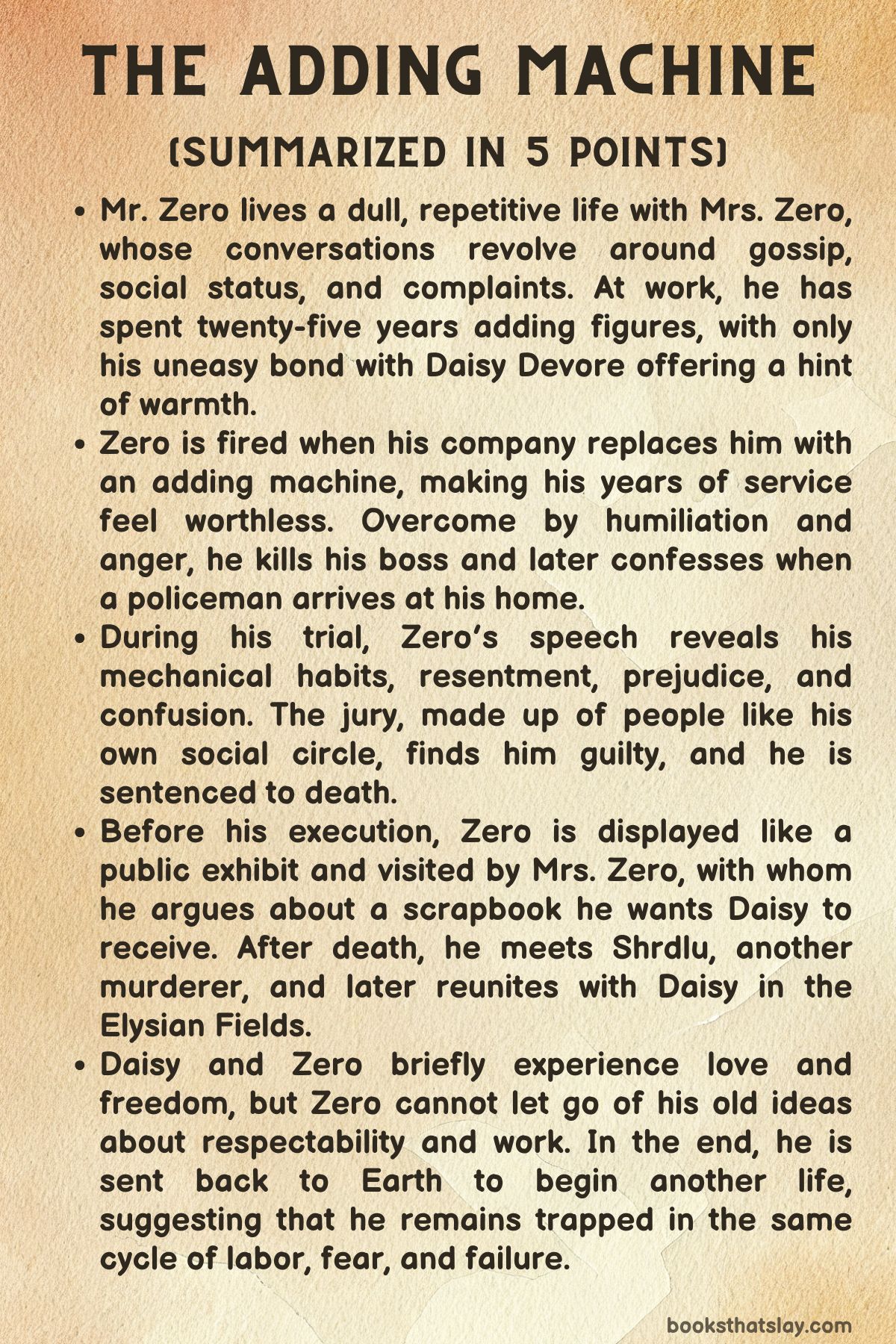
Summary
The Adding Machine opens in the bedroom of Mr. and Mrs. Zero, a married couple whose life is cramped, repetitive, and emotionally barren. Mrs. Zero speaks almost without pause while Zero remains silent.
Her talk moves from gossip to household complaints to moral judgments about neighbors and acquaintances. She measures people by status, respectability, manners, and small social signs.
She wants herself and her husband to rise in the eyes of others, even in ordinary habits such as where they go to the movies. Her sense of value is shaped by imitation: she wants to behave like those she sees as better placed in society.
Zero, meanwhile, is presented less as an active husband than as a tired presence in the room. Mrs. Zero compares her work as a homemaker with his work as a clerk who adds figures.
Her complaints circle back repeatedly, creating a sense of domestic imprisonment. The scene establishes the emptiness of their marriage and the narrow social world they inhabit.
Their home life is not built on intimacy or real understanding. It is built on habit, complaint, appearance, and endurance.
The next scene moves to Zero’s workplace, where he sits in an office inside a department store. His assistant, Daisy Diana Dorothea Devore, reads numbers to him while he adds them.
Their work is mechanical, repetitive, and emotionally deadening, yet their relationship contains a strange tenderness beneath their irritability. They snap at each other over small mistakes, but their long years together have made them familiar with each other’s moods and habits.
Each remembers a store picnic from years earlier, when Mrs. Zero was absent and Zero and Daisy shared a rare moment of closeness. That memory has remained alive because it represents something their daily lives have denied them: romance, choice, and pleasure.
When the workday ends, Daisy leaves. Zero’s boss enters and calls him into the office.
Zero expects recognition after twenty-five years of service, but instead he is told that he is being dismissed. The company has purchased an adding machine, so Zero’s labor is no longer needed.
The cruelty of the moment is sharpened by the boss’s indifference. He barely knows Zero and does not even remember his name properly.
Zero’s identity, loyalty, and years of service mean nothing against efficiency and cost. The scene ends in noise and rising tension, suggesting that Zero physically attacks and kills his employer.
Zero then returns home late for supper. Mrs. Zero is upset because guests are expected: the Ones, Twos, Threes, Fours, Fives, and Sixes.
She criticizes him for being late and continues to complain about his lack of ambition and failure to get promoted. Zero says little.
Mrs. Zero notices what she calls red ink on his collar and tells him to change. The detail points to the murder, though she does not understand it.
The guests arrive, all resembling the Zeros in their rigid social behavior. They separate by gender, with the men sitting together and the women gossiping together.
Their conversation exposes their narrowness, cruelty, sexism, class anxiety, and prejudice. The men criticize women’s suffrage and speak with smug certainty.
The women criticize the men, comment on fashion, repeat rumors, and judge the behavior of others. The Sevens’ rumored divorce becomes one of the subjects of gossip.
The group’s respectability is shown to be shallow. They claim moral superiority while displaying ignorance and hostility.
The social evening is interrupted by the arrival of a policeman. Zero, suddenly unable or unwilling to maintain the lie, gives him the bloody collar and confesses to murdering his boss.
This confession turns the domestic comedy into public judgment.
The trial that follows is strange and stylized. Zero stands before a jury made up of the same social types who filled his parlor: One through Six and their wives.
He begins by complaining about his lawyers, but his speech soon breaks apart into numbers, memories, resentments, and confessions. His mind has been shaped so fully by the act of adding figures that even in court he cannot escape calculation.
He tries to explain the murder by saying that his boss would not stop talking. He also expresses regret after learning that his employer had a family and was known for charity.
Yet the trial also exposes Zero’s uglier moral nature. He confesses to other violent impulses, including racist violence, and assumes the jurors would share those impulses.
The jurors, offended not by his morality but by his open recognition of their own hidden instincts, immediately find him guilty. Zero is condemned, not because the court represents true justice, but because society protects its own image of decency.
Zero is later shown in a cage, dressed in prison clothes and eating ham and eggs. He is displayed like an exhibit to schoolchildren, who are brought to see him as the “North American murderer.” The scene turns execution into spectacle.
Zero’s humanity is reduced once again, this time not by an office machine but by public curiosity. He has ordered repeated servings of ham and eggs for his final meal, clinging to appetite and routine even on the day of death.
Mrs. Zero visits him in mourning clothes. Their conversation is practical and oddly unemotional.
They discuss expenses, arrangements, and memories of married life. She brings him another plate of ham and eggs, and he eats eagerly.
For a moment, they agree that they had a good life together, though the audience has already seen how limited that life was. Zero asks about a scrapbook containing newspaper reports about him.
He wants it given to Daisy after his death. Mrs. Zero refuses, wanting it to go to her sister’s child instead.
The argument reveals her jealousy and Zero’s buried feeling for Daisy. Their last meeting ends in anger when Mrs. Zero breaks his plate and leaves.
A strange figure called the Fixer appears, wearing silk pajamas and winged shoes. He speaks to Zero about death and calls the guards.
A man with an axe gives the signal, and the Fixer locks the cage before leaving. Zero’s execution is treated with ritual, absurdity, and cold efficiency.
After death, the play shifts to a graveyard. A young couple, Judy and her partner, stand on Zero’s fresh grave.
Judy explains that she spent six months in jail because Zero had reported her for indecent exposure. Their casual presence over his grave gives his death no dignity.
After they leave, Zero rises from the grave, confused and disoriented.
He meets another dead man named Shrdlu, a dirty, sleepless figure who is also a murderer. The two talk, smoke, and compare crimes.
Shrdlu reveals that he killed his mother, whom he describes as saintly. He believes himself to be sinful and desperately wants punishment.
His life was shaped by religion, repression, and guilt. After reading Treasure Island, he once tried to run away but was brought back.
He became a proofreader and lived under the influence of his devout mother. One evening, while a minister named Dr. Amaranth was dining with them, Shrdlu cut the leg of lamb and suddenly slit his mother’s throat.
Unlike Zero, who wants comfort and justification, Shrdlu longs for damnation because punishment would confirm the moral order he believes in. Their conversation is interrupted by another dead person, a head rising from a grave and telling them to be quiet.
The next afterlife scene places Zero and Shrdlu in the Elysian Fields, a peaceful landscape beside a river and meadow. Zero enjoys the beauty at first, and Shrdlu explains that they are among the favored.
Shrdlu, however, is miserable because he has not received the punishment he expected. He cannot find his mother and cannot hear the heavenly music others describe.
His suffering comes from the absence of the judgment he craves.
Daisy then appears. She has killed herself after Zero’s execution and has been searching for him.
Zero is first afraid the voice may belong to Mrs. Zero, but he is relieved to see Daisy. Shrdlu leaves them alone.
Daisy and Zero confess the feelings they never acted upon in life. They remember the picnic, the drive home, and the kiss they both wanted but never shared.
At last they kiss, and suddenly they can hear music. They dance freely, and for a brief time they imagine a happy life together.
The happiness does not last. When Shrdlu returns, Zero becomes embarrassed and judgmental.
He worries about respectability, marriage, and the kind of people allowed in the Elysian Fields. He cannot accept a world without ordinary social rules, labor discipline, and class distinctions.
Daisy wants to stay, but Zero rejects the place. He puts his shoes back on and leaves, choosing familiar restriction over freedom.
The final scene returns to an office-like space. Zero is seated at an adding machine, absorbed in work.
Lieutenant Charles and Joe try to pull him away. Charles explains that Zero is going back to Earth.
Souls are recycled again and again until they wear out. Some improve, but many, including Zero, grow worse through repeated lives.
Zero has gone through tens of thousands of cycles.
Charles tells him that he will be born again with no memory. His next life will involve a different kind of adding: work in a mine where he will make a tiny movement with his right toe.
Zero resists, wanting to remain where he is, but Charles tricks him by using ventriloquism to create a woman’s voice. Zero runs after it.
Joe laughs and is reprimanded. The play ends with Charles complaining about his own job, suggesting that even cosmic systems are bureaucratic, repetitive, and wearying.
Characters
Mr. Zero
Mr. Zero is the central figure of the play and one of the clearest examples of a person whose identity has been flattened by routine. He has spent twenty-five years adding figures for a department store, and that work has shaped not only his habits but also his mind.
When he speaks in court, his thoughts keep sliding into numbers, showing that his labor has become part of his consciousness. Zero is not innocent, though the story invites sympathy for his humiliation.
He is a victim of an economic system that treats a worker as disposable once a machine can do the job more cheaply, but he also carries cruelty, prejudice, cowardice, and moral emptiness within him. His murder of his boss grows out of rage, injury, and the collapse of his small expectation that loyalty will be rewarded.
In the afterlife, Zero briefly has a chance to accept love and freedom with Daisy, but he cannot sustain it. He returns to respectability, suspicion, and narrow social rules because those are the only structures he understands.
His tragedy in The Adding Machine is not only that he is replaced by a machine, but that he has already learned to live like one.
Mrs. Zero
Mrs. Zero represents domestic routine, social anxiety, and the shallow moral codes of the world Zero inhabits. Her speech at the beginning of the play is almost relentless, and Zero’s silence makes their marriage feel less like a relationship than a pattern repeated every night.
She is not written simply as a nagging wife; she is also a product of her environment. She measures life through gossip, appearance, reputation, and comparison with people she considers socially superior.
Her desire to change where she and Zero go to the movies reveals how deeply she wants to climb even a small step in status. She also values conventional respectability more than emotional truth.
When Zero is about to die, she visits him and speaks in practical terms about money, arrangements, and the scrapbook. Her refusal to let the scrapbook go to Daisy exposes jealousy, possessiveness, and wounded pride.
She and Zero may agree that they had a good life, but the play makes that claim sound hollow. Their marriage has been built on habit rather than love.
Daisy Diana Dorothea Devore
Daisy is Zero’s assistant and the character most closely connected to his unrealized emotional life. At work, she reads numbers to him while he adds them, and their exchanges are often sharp, petty, and irritated.
Yet beneath this surface is a tenderness neither has known how to express. Their shared memory of the store picnic becomes the emotional center of what might have been.
Daisy’s full name, Daisy Diana Dorothea Devore, gives her a theatrical quality, but her life is painfully ordinary: she is another worker trapped in a mechanical routine. Her affection for Zero shows that even in a dehumanizing workplace, human longing persists.
Her suicide after his execution suggests the depth of her attachment and the emptiness of her life without him. In the Elysian Fields, Daisy is more open to freedom than Zero is.
She wants to stay, love, dance, and accept happiness without the old rules. Her sadness at Zero’s departure marks her as one of the play’s most quietly tragic figures because she is ready for liberation, while Zero cannot receive it.
Zero’s Boss
Zero’s boss is a brief but crucial presence. He represents impersonal corporate power rather than individual villainy.
His cruelty lies not in dramatic hatred but in casual indifference. He fires Zero after twenty-five years of service because the company has bought an adding machine, and he barely knows or remembers the man whose life he is changing.
This indifference is central to the play’s criticism of modern labor. The boss treats Zero’s years of work as a practical fact that has lost value.
He also speaks too much, at least from Zero’s perspective, and this becomes Zero’s stated reason for the murder. After the killing, Zero learns that the boss was charitable and had a family, which complicates him slightly.
He is not only a symbol; he was also a person. Still, the story uses him mainly to show how a system can make human beings invisible to one another.
His death is shocking, but the conditions leading to it are cold, ordinary, and socially accepted.
Mrs. One
Mrs. One is part of the social circle that visits the Zeros, and she helps create the atmosphere of judgment, gossip, and conformity. Like the other numbered women, she is less individualized than symbolic, but that is part of the play’s design.
Her identity is tied to a social type rather than private depth. She participates in the gendered division of the gathering, joining the women as they discuss clothing, behavior, scandal, and the perceived failures of others.
Through Mrs. One, the play shows how social life can become a system of surveillance. She is not merely chatting; she is helping enforce the standards by which people are ranked and shamed.
Her presence matters because she reflects the same respectability Mrs. Zero wants to maintain. In the trial scene, the numbered couples become jurors, suggesting that ordinary social judgment and legal judgment come from the same narrow moral community.
Mr. One
Mr. One belongs to the group of male guests who gather separately from the women and discuss social and political matters with smug certainty. He participates in a masculine circle that criticizes women and resists social change, including women’s suffrage.
Like the other numbered men, he is a type rather than a deeply personal figure. His function is to show the emptiness of middle-class male respectability.
He believes in order, hierarchy, and masculine authority, but his views reveal insecurity and prejudice rather than wisdom. As a juror, he becomes part of the collective force that condemns Zero.
His judgment is not shown as morally elevated. Instead, it grows from the same social attitudes displayed at the dinner gathering.
Mr. One helps the play connect private conversation, public prejudice, and official punishment.
Mrs. Two
Mrs. Two reflects the world of comparison and gossip that shapes Mrs. Zero’s social life. She is one of the women who gather apart from the men, and her role lies in reinforcing the group’s shared standards.
The women judge other people’s clothing, behavior, marriages, and public conduct. Mrs. Two is part of that social chorus, which reveals how respectability depends on constant criticism of others.
Her character may not receive individual psychological development, but she contributes to the pressure that surrounds Zero and Mrs. Zero. The numbered naming also strips her of personal uniqueness.
She is a social unit, almost as replaceable as Zero is in the office. In that sense, Mrs. Two supports one of the play’s major ideas: people in this world are reduced to roles, numbers, habits, and opinions they repeat without much self-awareness.
Mr. Two
Mr. Two is one of the male guests whose conversation exposes the ignorance and prejudice of the social group. He sits with the men and participates in their talk about women, work, and society.
His views are not presented as thoughtful positions but as rehearsed attitudes. He helps form the masculine counterpart to the women’s gossip circle.
Together, these groups show a community built on complaint rather than connection. Mr. Two’s later place among the jurors strengthens the sense that Zero is judged by people very much like himself.
They are not moral opposites to him; they are extensions of his own world. His character demonstrates how ordinary prejudice can become institutional power once placed inside a court.
Mrs. Three
Mrs. Three is especially connected to the gossip about behavior at the movie theater, making her part of the play’s concern with public respectability. The women’s discussion of her conduct shows how quickly social groups turn private habits into evidence of character.
Whether Mrs. Three has truly done anything wrong matters less than the fact that she becomes material for talk. Her character reveals the pettiness of the group’s moral scale.
Small acts, appearances, and social gestures carry exaggerated importance. Mrs. Three also shows how women in this world police one another, even while being dismissed by men.
Her place in the jury later suggests that those who are judged in one setting can become judges in another.
Mr. Three
Mr. Three is another figure in the male social circle, defined by conformity and group opinion. He helps create the sense that the Zeros’ guests are variations of the same personality rather than distinct individuals.
This is important because the play’s expressionist method exaggerates sameness. Mr. Three’s presence shows how people can surrender individuality to shared attitudes.
He is part of a male world that complains about women while depending on rigid gender roles to maintain its own authority. As a juror, he helps condemn Zero, but the condemnation feels hypocritical because the group has already revealed its own moral ugliness.
Mr. Three therefore represents ordinary social judgment without genuine self-knowledge.
Mrs. Four
Mrs. Four is part of the women’s gossiping group and contributes to the collective portrait of social respectability as shallow performance. Her individuality is less important than her participation in a pattern.
She helps create the environment where people are constantly measured, compared, and criticized. The women speak about style, marriage, manners, and scandal, and Mrs. Four belongs to this network of judgment.
Her presence also helps mirror Mrs. Zero, showing that Mrs. Zero’s values are not isolated personal flaws but shared social habits. In the court, Mrs. Four’s place among the jurors suggests that the same people who trade rumors in private can claim moral authority in public.
This makes her a small but important part of the play’s satire.
Mr. Four
Mr. Four represents the interchangeable respectability of the male guests. He is part of a group that speaks with confidence while revealing a limited and prejudiced worldview.
The men’s conversation about women’s suffrage and gender roles shows fear of change disguised as common sense. Mr. Four’s function is to strengthen the group dynamic: the men validate one another’s assumptions, making ignorance feel like truth.
His presence in the jury box later makes the legal system seem like an extension of parlor opinion. Mr. Four is not a developed individual because the story wants him to feel like a social mechanism.
He is one more voice in a society that condemns what it does not want to recognize in itself.
Mrs. Five
Mrs. Five belongs to the circle of women whose talk reveals social anxiety and moral narrowness. She helps form the background against which Mrs. Zero’s own desires become clearer.
The women’s comments about clothing, conduct, and divorce show their fear of social disorder and their fascination with other people’s failures. Mrs. Five participates in that culture of observation.
She may seem minor, but her importance lies in the way she helps create a crowd mentality. In this play, crowds matter because they erase individual responsibility.
When judgment is shared by everyone, no one feels personally cruel. Mrs. Five contributes to that pattern in both the social gathering and the trial.
Mr. Five
Mr. Five is one of the male guests and jurors who embody conventional opinion. His attitudes are part of a collective masculine voice that mocks women, resists equality, and treats prejudice as normal.
He is not asked to be thoughtful; he is asked to belong. That belonging is the point of his character.
Mr. Five shows how social identity can depend on repeating the accepted opinions of one’s group. In the trial, he helps turn that group identity into judgment against Zero.
The play uses him to show that official condemnation may come from people who are morally compromised themselves. Mr. Five is ordinary, and that ordinariness is what makes him disturbing.
Mrs. Six
Mrs. Six completes the numbered set of women invited to the Zeros’ home and later associated with the jury. Like the others, she represents the social pressure of respectability.
She helps fill the room with talk that is petty, judgmental, and anxious about reputation. Her presence reinforces the idea that Mrs. Zero’s world is not private but communal.
Everyone watches everyone else, and everyone fears being watched. Mrs. Six’s role is also structural: she helps create the repeated pattern of numbers that surrounds Zero’s life.
Names become numbers, people become types, and society itself begins to resemble an adding machine. Her minor status does not make her unimportant; she is one part of the system that shapes and condemns Zero.
Mr. Six
Mr. Six is part of the male circle and the jury, and his character continues the pattern of numbered conformity. He stands for the ordinary man who accepts the opinions of his group without examining them.
His involvement in misogynistic and prejudiced conversation shows that public respectability can coexist with private ugliness. As one of Zero’s judges, he reveals the hypocrisy of a society that punishes crime while ignoring the violent ideas it quietly tolerates.
Mr. Six matters because he helps complete the social machine around Zero. The story does not need to give him a long personal history; his anonymity is his meaning.
The Sevens
The Sevens are not present in the same way as the other numbered couples, but they enter the play through gossip about their plan to divorce. Their absence is meaningful because they become an object of judgment without defending themselves.
The other guests use them as material for moral talk, which shows how the community treats private pain as entertainment. The Sevens represent the fear of social breakdown.
Divorce threatens the image of stable respectability that the group wants to preserve, even though the marriages shown directly are empty or unhappy. Through the Sevens, the story shows that social order often depends on appearances rather than genuine human connection.
The Policeman
The policeman who arrives at the Zeros’ home represents the sudden entry of public authority into private life. Until his arrival, the guests are absorbed in gossip, gendered chatter, and social performance.
His presence cuts through that ordinary scene and exposes the hidden violence beneath it. Zero’s confession and the handing over of the bloody collar transform him from a silent, late husband into a murderer.
The policeman does not need much psychological depth because he functions as an agent of the legal system. He marks the moment when Zero’s crime can no longer be contained within domestic denial.
His arrival also reveals how quickly social respectability collapses when confronted with blood and guilt.
The Officers
The officers in the court and prison scenes belong to the machinery of law and punishment. They help move Zero through the stages of judgment, confinement, and execution.
Like many minor figures in the play, they are less individual personalities than functions within a system. Their presence makes punishment feel procedural and impersonal.
Zero’s life has already been controlled by office routines, whistles, and workplace hierarchy; after his crime, he is controlled by another set of routines: trial, imprisonment, display, and death. The officers help connect the world of labor to the world of punishment.
Both reduce the person to a role and move him along a fixed path.
The Jury
The jury is made up of the same numbered couples who appear in Zero’s social world, which is one of the play’s sharpest satirical choices. They are not distant representatives of justice; they are his neighbors, guests, and social equals.
This makes their judgment feel hypocritical and familiar. During Zero’s confession, he exposes violent and racist impulses and suggests that the jurors might share them.
Their quick decision to convict him reflects not only horror at the murder but also anger at being morally implicated. The jury represents society’s desire to punish openly committed violence while hiding the uglier beliefs that exist beneath its polite surface.
In The Adding Machine, legal judgment is inseparable from social judgment, and the jury shows how both can protect appearances rather than truth.
The Schoolchildren
The schoolchildren who visit Zero in his cage show how violence and punishment are turned into education and spectacle. They are brought to observe him as the “North American murderer,” taking notes as though he were an exhibit rather than a person awaiting death.
Their presence makes the scene both absurd and disturbing. They are young, but they are already being trained to see crime, punishment, and human suffering through institutional categories.
The children also show how society reproduces its values. They learn not compassion or reflection, but classification.
Zero is not presented to them as a failed worker, husband, lover, or human being; he is presented as a type. In this way, the children become part of the same dehumanizing culture that has shaped the adults.
The Guide
The guide who presents Zero to the schoolchildren acts like a museum lecturer or showman. His description of Zero as a murderer turns a living man into a public object.
He controls the children’s attention and frames what they are supposed to see. The guide’s calm manner makes the scene colder because he treats execution-day imprisonment as ordinary instruction.
His role reveals how institutions can make cruelty seem civilized. By giving Zero a label and placing him before observers, the guide participates in the same reduction that has followed Zero throughout the play.
Zero was a worker, then a criminal, then an exhibit. The guide helps enforce that final label before death.
The Caretakers
The caretakers who accompany the schoolchildren are minor figures, but they help normalize the prison visit. Their conversation with the guide suggests that the spectacle of Zero’s confinement is socially accepted.
They do not appear shocked that children are being brought to see a condemned man in a cage. Their presence shows how adults transmit indifference to the young.
They support the scene’s criticism of public morality: a society that claims to punish violence can still treat a condemned person’s suffering as a lesson, attraction, or outing. The caretakers are important because they show that this cruelty is not limited to officials.
Ordinary guardians also participate in it.
The Fixer
The Fixer is one of the strangest figures in the play, appearing before Zero’s execution in silk pajamas and winged shoes. His costume suggests a supernatural or symbolic role rather than a realistic prison official.
He speaks to Zero about mortality and then calls the guards, acting as a messenger or manager of death. His name is ironic because he does not repair Zero’s life or offer redemption.
Instead, he helps arrange the final step in the process that will destroy Zero’s body and send him into the next stage of existence. The Fixer belongs to the play’s larger vision of existence as bureaucracy.
Even death has functionaries, procedures, and signals. He makes execution feel both theatrical and administrative.
The Guards
The guards who respond to the Fixer are agents of confinement and death. They do not need to explain themselves because their authority comes from the system they serve.
Their role is to carry out the sentence, not to understand Zero. Like the officers, they belong to the machinery of punishment.
Their presence at the cage reinforces Zero’s helplessness. He is locked in, watched, fed, visited, displayed, and finally taken toward death.
The guards help create the sense that once society has classified a person as guilty, the rest becomes process. They are not personally cruel in any elaborate way; their obedience is enough.
The Man with the Axe
The man with the axe is a brief but powerful figure because he gives the signal that Zero’s execution is ready. He embodies death as action rather than speech.
In a play filled with talking, gossiping, confessing, and explaining, his simple nod is chilling. The axe also gives the execution an archaic and brutal quality, contrasting with the modern office and the adding machine.
This contrast matters because the play suggests that modern society is not truly civilized; it simply organizes violence in official forms. The man with the axe is the physical endpoint of that organization.
Judy
Judy appears in the graveyard scene with her partner, standing on Zero’s fresh grave. She says she spent six months in jail because Zero reported an act of indecent exposure.
Her brief appearance adds a sharp detail to Zero’s character: he was not only a victim of social judgment, but also someone who judged and punished others. Judy’s resentment shows that Zero’s respectability had real consequences for people around him.
She is casual, loud, and disrespectful over his grave, which strips Zero’s death of solemnity. Judy’s role is minor, but she widens the moral picture.
Zero suffered under society’s rules, but he also helped enforce them when he had the chance.
Judy’s Partner
Judy’s partner is another brief graveyard figure whose main role is to accompany her and help establish the irreverent tone of the scene. Together, they treat Zero’s grave as a place for talk rather than mourning.
His presence makes the scene feel socially ordinary rather than isolated: Zero’s death has already become part of the world’s background. The partner also helps contrast the living and the dead.
For the living couple, the grave is just a location. For Zero, it is the threshold into confusion and afterlife.
This contrast supports the play’s dark comedy, where death does not bring dignity or clarity.
Shrdlu
Shrdlu is Zero’s afterlife companion and one of the most revealing characters in the play. He is a murderer like Zero, but his inner life is very different.
He killed his mother, whom he regards as saintly, and he is consumed by guilt and religious fear. Unlike Zero, who wants comfort, routine, and justification, Shrdlu wants punishment.
He believes in sin so intensely that the absence of damnation becomes torture for him. His past suggests repression and obedience: he lived with his devout mother, attended church repeatedly, became a proofreader, and carried a divided mind full of religious pressure and violent impulse.
His murder of his mother while serving dinner to Dr. Amaranth is shocking because it erupts from a life built on restraint. In the Elysian Fields, Shrdlu’s misery becomes almost comic because paradise denies him the hell he expects.
He helps expose the absurdity of moral systems based on punishment. He also acts as a contrast to Zero, showing that guilt can imprison a person as much as routine can.
Shrdlu’s Mother
Shrdlu’s mother appears through his memory, but she is central to understanding him. He describes her as a saintly woman, deeply religious and closely tied to church life.
Whether she is truly saintly or whether Shrdlu has turned her into an impossible moral figure is uncertain. What matters is how she exists in his mind: pure, demanding, and spiritually overwhelming.
Her influence helps explain his guilt and self-hatred. She represents a form of morality that may seem holy on the surface but creates intense psychological pressure.
Shrdlu’s murder of her is not treated as rational or justified; it is the violent breaking point of a man who sees himself as sinful before he has even acted. Her absence in the afterlife torments him because he wants reunion, judgment, or confirmation.
Instead, he receives uncertainty.
Dr. Amaranth
Dr. Amaranth, the minister who comes to dinner at Shrdlu’s home, is a minor but symbolically important character. He represents the religious world that shapes Shrdlu’s imagination.
His presence at the dinner where Shrdlu kills his mother makes the act feel like a rebellion against the entire moral order surrounding Shrdlu, not only against his mother as an individual. The minister’s role is mostly indirect, but he contributes to the atmosphere of piety, repression, and judgment.
He is part of the world that teaches Shrdlu to think in terms of sin, damnation, and eternal punishment. Because Shrdlu longs for flames after death, Dr. Amaranth’s influence can be felt even when he is not physically present.
The Head in the Grave
The head that rises from another grave to tell Zero and Shrdlu to be quiet adds absurd humor to the afterlife. This figure reminds the audience that death has not created peace, wisdom, or grandeur.
Even the dead are irritable and bothered by noise. The head’s complaint punctures the seriousness of Zero and Shrdlu’s discussion, turning the graveyard into a strange continuation of ordinary life.
The character also suggests that the afterlife is crowded, mundane, and socially awkward. Death does not free people from annoyance.
This small role supports the play’s larger refusal to treat death as a noble solution.
Lieutenant Charles
Lieutenant Charles appears in the final scene as an official of the soul-recycling system. He explains that Zero is being sent back to Earth and that souls are used over and over until they wear out.
Charles is calm, practical, and somewhat weary, making cosmic reincarnation sound like office administration. His role is central to the ending of The Adding Machine because he reveals that Zero’s life is not a single tragedy but part of a repeated pattern.
Zero has had tens of thousands of chances, and rather than improving, he has grown worse. Charles also manipulates Zero by using a woman’s voice to lure him away, showing that he understands Zero’s weaknesses.
He is not a comforting guide. He is a bureaucrat of existence, doing a tiring job in a universe that resembles the workplace Zero never escaped.
Joe
Joe is Lieutenant Charles’s assistant or subordinate in the final scene. His main action is laughter when Charles tricks Zero with ventriloquism.
That laughter is quickly reprimanded, which shows the discipline even within the afterlife’s bureaucracy. Joe’s minor role helps make the final scene feel like another workplace.
There are superiors, subordinates, tasks, mistakes, and complaints. He also provides a reaction to Zero’s gullibility, making the ending darkly comic.
Joe’s laughter reminds the audience that Zero’s fate is both pathetic and absurd. Like many figures in the play, Joe is part of a system rather than a fully private individual, and that is exactly why he fits the play’s vision.
Themes
Mechanization and the Loss of Human Value
Zero’s replacement by an adding machine is the clearest expression of the play’s concern with mechanization, but the issue begins before the machine arrives. Zero has already been trained to act mechanically.
His days are governed by repetition, numbers, whistles, and obedience. His speech breaks into calculations because the work has colonized his mind.
The company’s decision to fire him after twenty-five years shows that modern labor values function over personhood. Zero’s loyalty, age, habits, and dependence mean nothing once a device can perform the task.
The tragedy is not only unemployment; it is the discovery that the system never saw him as fully human in the first place. This theme continues after death.
The final office-like space and the explanation of recycled souls suggest that even existence itself has become mechanical. Human beings are processed, reused, assigned, and worn out.
The Adding Machine therefore presents mechanization as both economic and spiritual. It is a way of organizing work, but also a way of shrinking imagination, emotion, and moral growth.
Conformity, Respectability, and Social Judgment
Respectability in the story is shown as a narrow code built from gossip, appearances, prejudice, and fear of difference. Mrs. Zero wants to imitate people she considers socially superior, while the guests at the Zeros’ home constantly judge others for clothing, manners, divorce, and public behavior.
This society does not encourage reflection or kindness. It encourages comparison.
The numbered names of the guests make them feel interchangeable, as though social life has stripped them of individuality. Their conversations show that conventional morality can hide cruelty, sexism, xenophobia, and hypocrisy.
The trial deepens this theme by turning the same social group into a jury. The people who gossip in private become the people who condemn in public.
Zero is guilty of murder, but the court scene also exposes the moral cowardice of those judging him. They are disturbed not only by his crime but by his suggestion that they share some of his violent impulses.
Respectability survives by denying what it contains. The story criticizes a society more concerned with looking decent than becoming humane.
Failed Love and Emotional Cowardice
The relationship between Zero and Daisy shows how love can be lost through fear, habit, and social obedience. Their daily interactions are full of irritation, but their memories of the picnic reveal a deeper longing.
Both wanted tenderness, and both imagined a life together, yet neither acted. This failure is not simply personal shyness.
It comes from a world that has trained them to suppress desire and stay within assigned roles. Zero remains in a dead marriage; Daisy remains beside him at work, close enough to dream but not close enough to change anything.
In the Elysian Fields, they finally kiss and hear music, suggesting that love can open a freedom neither found in life. Yet Zero cannot accept it for long.
He becomes embarrassed when Shrdlu appears, worries about respectability, and rejects the looseness of paradise. Daisy is ready to choose feeling over convention, but Zero retreats into the rules that have already ruined him.
The sadness of their relationship lies in the fact that happiness appears, briefly and clearly, and Zero still walks away from it.
Punishment, Guilt, and the Failure of Moral Systems
The play repeatedly questions whether punishment produces justice, understanding, or transformation. Zero is tried, convicted, caged, displayed, and executed, yet none of these actions truly explains him or repairs the harm he has done.
The prison scene turns punishment into spectacle, with children brought to observe him as an exhibit. The court scene exposes the hypocrisy of judgment, since the jurors condemn Zero while refusing to face their own moral ugliness.
Shrdlu’s story approaches the theme from another direction. He desperately wants punishment because he believes his sin requires eternal flames.
When he reaches the Elysian Fields instead, he is tormented by the absence of the hell he expected. His misery shows how deeply a punitive moral system can shape the mind.
He cannot accept mercy, uncertainty, or peace because he has built his identity around guilt. Zero, by contrast, wants comfort and avoidance rather than moral reckoning.
Between them, the story suggests that punishment alone cannot create wisdom. A system may condemn, execute, or recycle a soul, but still fail to produce genuine change.