The Address by Fiona Davis Summary, Characters and Themes
The Address by Fiona Davis is a historical mystery that moves between 1880s New York and 1980s New York, using the Dakota apartment building as its central setting. The novel follows Sara Smythe, an English hotel worker whose life changes after she meets architect Theodore Camden, and Bailey Camden, a recovering addict nearly a century later who uncovers buried family secrets.
The book combines romance, class conflict, betrayal, mental health abuse, inheritance, and architectural history. Its emotional force comes from the way private lives are shaped by public reputations, hidden parentage, and the unequal power given to men, wealth, and social status.
Summary
Sara Smythe is a capable thirty-year-old woman working as head housekeeper at London’s Langham Hotel. She is unmarried, but her professional position allows her to use the title “Mrs.” One day, while handling the demands of her role, she notices a young girl in danger across the courtyard.
The child is climbing near a window ledge, and Sara rushes to the apartment, pulls her back, and saves her from falling. The child’s mother is Minnie Camden, wife of Theodore Camden, an American architect.
Theodore is impressed by Sara’s courage and composure, and he later offers her a position in New York as head housekeeper at the Dakota, a luxury apartment building he is helping to create.
Sara hesitates at first. Her life in England is difficult, but familiar.
She visits her mother in Fishbourne and reflects on the limits placed on women like them. Her mother once worked on an aristocratic estate and was dismissed after becoming pregnant by the Earl of Chichester.
Sara has grown up with the shame and bitterness of illegitimacy. Her mother discourages her from going to America, but Sara sees that England offers her few real chances.
Theodore’s offer becomes a symbol of possible reinvention, so she decides to cross the Atlantic.
When Sara arrives in New York, the Dakota does not look like the grand opportunity she imagined. The area around it is rough, unfinished, and far from the city’s fashionable center.
Still, she soon proves herself. Theodore and the building’s management realize that the man hired to manage the Dakota has backed out, and Sara is offered the larger role.
She will oversee the building’s staff, operations, and domestic order. Although the promotion is intimidating, Sara handles her duties with intelligence and confidence.
She earns Theodore’s admiration, and their connection grows.
In 1985, Bailey Camden is trying to rebuild her life after rehab. She once worked in interior design, but her addiction damaged her career.
Her former boss Tristan refuses to take her back. Bailey then meets Melinda Camden, a wealthy friend and distant family connection who lives in the Dakota.
Melinda offers Bailey a job renovating her apartment, though her taste horrifies Bailey. Melinda wants to strip away the old character of the apartment and turn it into something bright, shallow, and fashionable.
Bailey needs the work, so she accepts, staying in the maid’s room while handling the renovation.
Bailey’s connection to the Camdens is complicated. She is not considered a blood descendant of the family.
Her grandfather Christopher was raised as a Camden ward, but he later left the family and carried resentment about being treated as both included and excluded. Bailey’s father Jack has inherited some of that bitterness.
Bailey, meanwhile, feels drawn to the Dakota, especially as she begins to sense that her family’s past may be more important than she has been told.
In Sara’s timeline, Theodore treats her with unusual respect. He takes her into town, discusses architecture and class with her, and draws a cottage like the home she dreams of owning one day.
Sara is cautious because she has been harmed before by Mr. Ainsworth, the husband of a seamstress to whom she was once apprenticed. When Ainsworth tried to assault her, she defended herself with scissors.
Since then, she has been wary of men with power over women. Yet Theodore seems different to her.
He appears kind, ambitious, and attentive.
Their bond turns romantic after Theodore invites Sara to a masked ball. There, they witness the arrogance of New York’s wealthy elite, and Theodore’s anger at their cruelty toward poor children makes Sara feel that he understands injustice.
After returning to the Dakota, they confess their attraction and sleep together. The next day, Minnie Camden and the children arrive.
Sara realizes the danger of the affair, but Theodore insists that he loves her. Sara tries to end the relationship, knowing that she is his employee and that he is married, but her feelings remain strong.
Soon Sara becomes ill and realizes she is pregnant. Daisy Cavanaugh, a young maid Sara likes and trusts, guesses the truth.
Daisy suggests someone who could end the pregnancy, but Sara hesitates because the procedure is illegal and dangerous. Meanwhile, Minnie reports that her emerald necklace has been stolen.
The jewels are found in Sara’s desk, and Sara is accused. Because she is weak, confused, and unable to defend herself clearly, others describe her behavior as unstable.
She asks for Theodore, calling him her friend, and this is treated as evidence that she is delusional. She is sent to the asylum on Blackwell’s Island.
The asylum is brutal. Sara is stripped, scrubbed, deprived of comfort, and subjected to cruelty.
She meets Natalia, another inmate, who teaches her how to survive by not angering the nurses. Sara also witnesses the abuse of Marianne, an older woman forced to dance until she collapses.
When Sara tries to defend her, she is kicked in the stomach by a nurse. She fears for her baby but survives.
Later, she goes into labor and is told afterward that the baby died and was malformed. Broken by grief, Sara loses hope.
Her escape comes through Nellie Bly, the journalist who enters the asylum undercover to expose its conditions. Nellie recognizes that Sara is sane and helps secure her release.
Sara learns that Daisy later confessed to stealing Minnie’s necklace and planting it in Sara’s desk. Mr. Douglas, the Dakota manager, had allowed Sara to remain in the asylum even after the truth became known.
Theodore claims he was told Sara had returned to England, which is why he did not search for her. He offers her work at his new architectural office and arranges for her to live at the Dakota again.
In 1985, Bailey finds old trunks in the Dakota’s storage area. One belongs to Sara Jane Smythe, another to Theodore, and another to Minnie.
In Sara’s trunk, Bailey finds a travel booklet and a photograph of Sara with children, including a baby. The building superintendent, Renzo, tells Bailey that Sara was convicted of murdering Theodore Camden.
Bailey also notices that she resembles Sara. Later, at her father’s house, she sees a drawing of a cottage signed by Theodore and addressed to Sara.
These clues lead Bailey to suspect that Christopher, her grandfather, may have been the child of Sara and Theodore.
Bailey investigates with Renzo’s help. In Theodore’s trunk, they find architectural plans, a metal sheath connected to an old knife, and what appears to be Theodore’s finger bone.
In Minnie’s trunk, Bailey finds a note addressed to Christopher from a woman claiming to be his mother and stating that Theodore Camden is his father. The signature begins with an “S.” Bailey believes this proves that Christopher was Sara and Theodore’s son, making her a true Camden descendant.
Melinda reacts with hostility because Bailey’s discovery threatens her inheritance.
Back in the 1880s, Sara’s renewed life with Theodore becomes increasingly complicated. She learns that Christopher, the baby Minnie has adopted, may not be an orphan from a dying woman as Theodore claims.
Sara also notices troubling signs in Theodore’s behavior. His son Luther recoils from him, and Sara later sees bruises on the boy’s arm.
Theodore also grips Sara hard enough to bruise her. These moments force Sara to reconsider the man she loves.
The charm and ambition she admired begin to look like control.
Sara visits Daisy at Blackwell’s Island and learns the full truth. Daisy had told Theodore that Sara was pregnant and tried to get money from him.
When Sara delayed ending the pregnancy, Daisy secretly gave her something meant to induce an abortion. After Sara’s arrest, Theodore refused to pay Daisy, and Daisy began stealing to support her family.
Sara then goes to the hospital and discovers that her baby did not die. Theodore signed the forms, and the Camdens took the child in.
Christopher is Sara’s son.
Sara confronts Minnie, and the confrontation exposes the whole household’s misery. Minnie reveals that Theodore forced her to raise Christopher and that Luther and Lula are not Theodore’s children.
Minnie had an affair while Theodore was away, and Theodore punished her emotionally for it. Luther enters with a stolen knife, the same knife taken from the Rutherfords’ house.
Theodore appears, and Minnie, overwhelmed by years of control and fear, stabs him repeatedly. Theodore dies.
Sara protects Minnie and the children. She attempts to make the murder look like an intruder’s crime, hiding the knife in the park and concealing the sheath and severed finger in Theodore’s belongings.
Sara is convicted of the murder and sent to prison. Minnie visits her, ashamed that Sara has taken the blame.
Sara insists that Minnie can give Christopher a better life than she ever could. She writes a letter for Christopher to receive when he turns twenty-one, though she knows she may not live that long.
In 1985, Bailey’s investigation leads to DNA testing. Melinda and Manvel are not Theodore’s descendants, but Bailey and Jack are.
Jack had secretly provided a blood sample after learning that Minnie once intended to set up an annuity for Christopher. Bailey and Jack inherit the Camden trust, while Melinda and Manvel receive only the apartment.
Melinda is furious, but Manvel accepts the result. Jack apologizes to Bailey for avoiding the past, and Bailey begins to accept both her family history and her own need for recovery.
A year later, Bailey is sober. She and Jack have bought the Dakota apartment from Melinda, and Bailey is restoring it with Renzo.
Her design business is doing well, and she has stopped running from her history. Sara died of cancer a few years after Theodore’s murder, and Minnie died of the flu in 1900.
Not every question from the past can be answered, but Bailey finds strength in knowing the truth. The Dakota, once a place of secrets, becomes a home she can claim honestly.
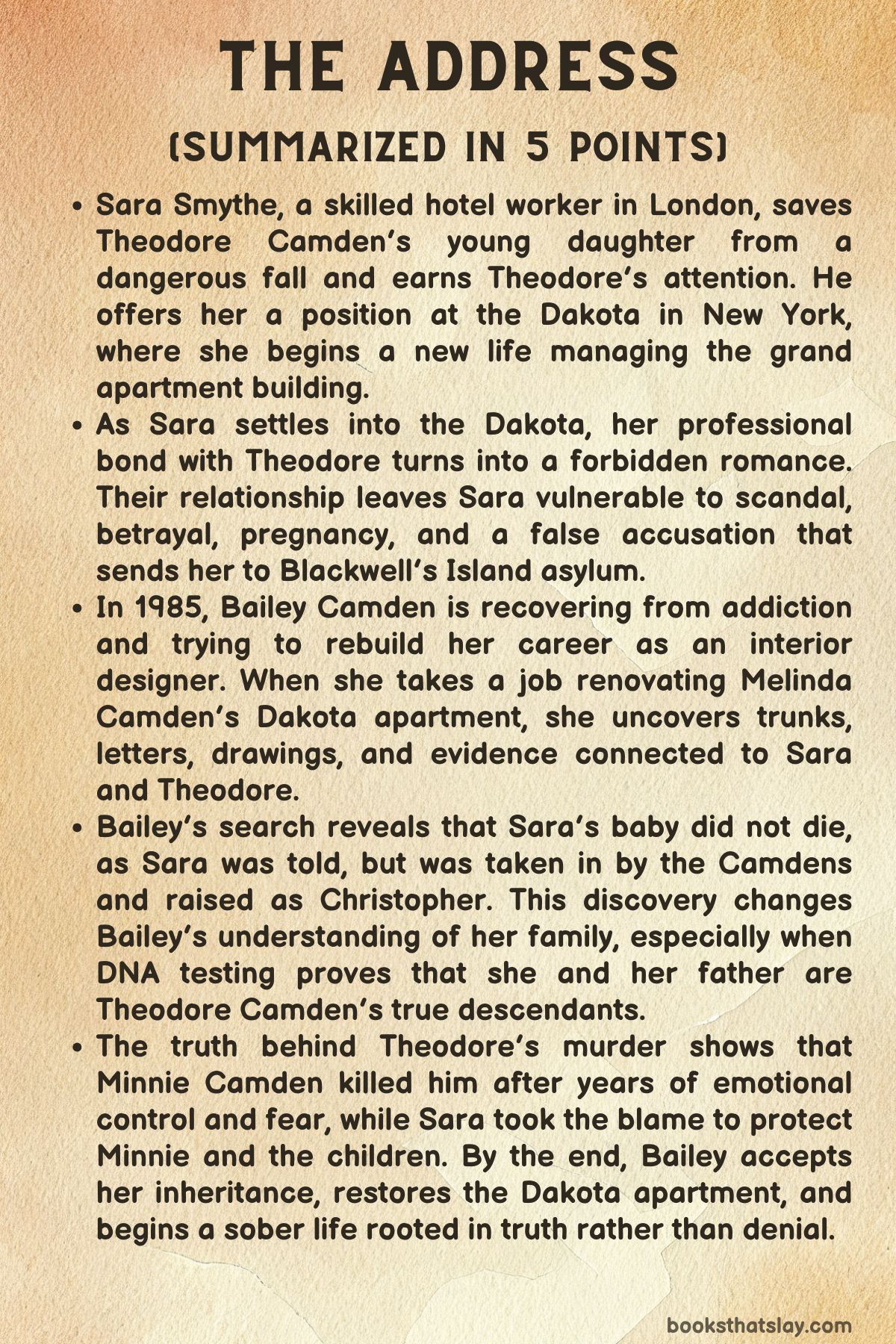
Characters
Sara Smythe
Sara Smythe is the emotional center of the historical side of the book and one of its most fully developed characters. In The Address, she begins as a disciplined, observant, and ambitious hotel worker whose professionalism hides deep private wounds.
Born outside marriage after her mother was exploited by an aristocrat, Sara grows up aware of how class and gender can decide a woman’s fate before she has a chance to shape it herself. Her move to New York represents courage, but also vulnerability.
She wants opportunity, respect, and a life not defined by shame. Her relationship with Theodore reveals both her longing for love and her tendency to trust the image of goodness she wants to see.
Sara is intelligent, resilient, and morally serious, but she is not immune to self-deception. Her final decision to protect Minnie and Christopher shows sacrifice, but it also reflects how few choices women like her truly have.
Bailey Camden
Bailey Camden carries the modern half of the story, and her personal recovery mirrors her investigation into the Camden past. Through The Address, Bailey is shown as talented, wounded, and searching for a stable identity.
Her addiction has cost her work, credibility, and self-respect, yet she still has a sharp eye for design and a genuine reverence for the Dakota’s history. Her connection to the building is emotional before it becomes legal or biological.
Bailey wants to belong somewhere, and the possibility that Sara and Theodore are her ancestors gives her a reason to face truths her family avoided. Her growth is not only about inheritance; it is about sobriety, accountability, and learning to stop depending on people like Melinda for approval.
By the end, Bailey earns a future by accepting the past without letting it consume her.
Theodore Camden
Theodore Camden is one of the book’s most deceptive figures because his charm initially appears inseparable from kindness. Within The Address, he is presented first as a visionary architect, a self-made American, and a man willing to recognize Sara’s talent when others might dismiss her.
He speaks of opportunity, social mobility, and the future of New York, which makes him seem progressive. Yet his private behavior reveals a darker hunger for control.
He manipulates Sara, hides the truth about her child, mistreats Minnie, and frightens Luther. Theodore wants to be admired as a builder of beautiful spaces, but he damages the lives inside those spaces.
His tragedy is not that he loves too much, but that he confuses possession with love. His death exposes the violence already present beneath his polished exterior.
Minnie Camden
Minnie Camden is initially easy to misread as a cold, privileged wife who stands in Sara’s way, but the book gradually reveals her as another trapped woman. She has status, wealth, and a respected name, but these do not give her freedom.
Her marriage to Theodore is emotionally punishing, especially after her affair and the births of children who are not his. Minnie’s decision to raise Christopher is not simple generosity; it is shaped by Theodore’s pressure and her own limited power.
She can be guarded and resentful, but her fear is understandable once Theodore’s cruelty becomes clearer. Her killing of Theodore is an act of desperation after years of humiliation and control.
Sara’s decision to protect her shows that Minnie is not merely a rival, but a fellow victim of the same social system.
Daisy Cavanaugh
Daisy Cavanaugh is a painful example of how poverty can twist loyalty into betrayal. At first, she appears warm, lively, and hardworking.
Sara likes her and sees in her a younger woman with dreams of improving her life. Daisy’s friendliness makes her later actions especially damaging.
She plants the stolen necklace, helps send Sara toward ruin, and secretly doses Sara in an attempt to end the pregnancy. Yet Daisy is not written as simply evil.
Her family’s poverty, her mother’s death, and her desperation for money place her under unbearable pressure. She becomes involved in Theodore’s scheme because she sees no safe path for herself.
Daisy’s betrayal hurts because it comes from someone who also lacks power. Her fate on Blackwell’s Island shows that the poor are easily used and then discarded.
Renzo
Renzo is the Dakota superintendent in Bailey’s timeline and one of the few people who treats the building’s past with care rather than greed. At first, he seems unfriendly, but his reserve comes from caution and protectiveness.
He respects the Dakota as a living historical space, not merely a property to be altered or exploited. His help with the trunks, the sheath, and the old evidence makes him essential to Bailey’s search.
More importantly, he challenges Bailey when she tolerates Melinda and Tony’s selfishness. Renzo sees Bailey’s talent and vulnerability, but he does not flatter her.
His relationship with her develops slowly because it is based on honesty. By the end, he represents a healthier future: one built on restoration, patience, and mutual respect.
Melinda Camden
Melinda Camden is privileged, stylish, careless, and deeply threatened by any challenge to her status. She treats Bailey as a cousin when it suits her, but her affection has limits.
Melinda offers Bailey work, yet the offer also keeps Bailey dependent and close enough to control. Her desire to remake the Dakota apartment in a flashy beach-house style shows her disregard for history and inherited responsibility.
When Bailey uncovers evidence that she may be a true Camden descendant, Melinda’s insecurity turns hostile. She is less interested in truth than in money, ownership, and social position.
Her cruelty is sharpened by entitlement. She assumes the past belongs to her because wealth has taught her that everything does.
Jack Camden
Jack Camden, Bailey’s father, is shaped by inherited resentment. He knows that his father Christopher was raised among the Camdens but never fully accepted by them, and he has built part of his identity around rejecting the family’s world.
His reluctance to help Bailey with DNA testing comes from fear as much as stubbornness. He does not want old wounds reopened because he suspects they will confirm how much his family was denied.
Yet Jack is not static. Once he learns about Minnie’s intended annuity and understands what the truth could mean, he provides the blood sample and pays for the test.
His apology to Bailey matters because it breaks a pattern of avoidance. He learns that rejecting the past is not the same as being free from it.
Christopher Camden
Christopher is central to the plot even though he is mostly seen through other people’s memories and records. As Sara’s lost son, he represents stolen motherhood, hidden inheritance, and the cruelty of secrets.
Raised by Minnie as part of the Camden household, he receives shelter and status but not the full truth of his origin. His later bitterness suggests that he sensed the emotional imbalance in his place within the family.
He was close enough to privilege to know what exclusion felt like sharply. Christopher’s life becomes the bridge between Sara’s suffering and Bailey’s discovery.
The truth about him changes the legal future of Bailey and Jack, but more importantly, it restores a broken maternal line.
Mrs. Haines
Mrs. Haines is a disciplined and watchful member of the Dakota staff. She is less warm than Daisy and more formal in her conduct, which makes her seem distant.
Yet her role is important because she observes details others miss, including the suspicious man connected to Daisy. Mrs. Haines represents the professional servant who survives by caution.
She does not have Sara’s openness or Daisy’s charm, but she understands the importance of order in a household where disorder can destroy reputations. Her reports help Sara later reconsider what really happened around Daisy and the thefts.
She is a minor character, but her careful attention adds weight to the hidden mechanics of the plot.
Fitzroy
Fitzroy, the head porter at the Dakota, helps establish the building as a place with its own internal hierarchy. He is one of the first people Sara meets after arriving in New York, and his presence reinforces how isolated she is at the start.
As a staff member, he understands the building from below rather than from the glamorous view of its residents. Theodore’s idealistic talk about American opportunity is tested by people like Fitzroy, whose social mobility remains limited despite the promises of the new world.
Fitzroy’s character helps expose the difference between rhetoric and reality. He is part of the labor force that makes luxury possible but does not fully share in its rewards.
Mr. Douglas
Mr. Douglas is one of the book’s clearest examples of institutional cowardice. As Sara’s superior at the Dakota, he has the authority to protect her or at least investigate fairly when she is accused.
Instead, he allows prejudice and convenience to guide his actions. His description of Sara’s behavior helps send her to Blackwell’s Island, and when Daisy’s confession later clears Sara, he still lets the lie continue.
Mr. Douglas is not as theatrically cruel as the asylum nurses or as personally manipulative as Theodore, but his failure is severe. He shows how ordinary officials can destroy lives by choosing reputation, order, and self-protection over justice.
Henry Hardenbergh
Henry Hardenbergh is important as the professional force behind the Dakota and as Theodore’s architectural superior. He represents established credibility in the world Theodore wants to enter fully.
His presence reminds the reader that architecture is not only art but also business, reputation, and patronage. Theodore sees the Dakota as a trial run and hopes Hardenbergh’s support will help him build his own firm.
Hardenbergh’s role is not deeply emotional, but he helps define Theodore’s ambition. Around him, Theodore is not just a romantic figure in Sara’s life; he is a man trying to rise professionally and eager to control how others see him.
Mrs. Putnam
Mrs. Putnam is a demanding future tenant of the Dakota whose complaints reveal the expectations of wealthy residents. She criticizes design choices, wants more gold leaf, and treats luxury as something that must constantly announce itself.
Sara’s handling of Mrs. Putnam proves Sara’s tact and skill. Rather than becoming defensive, Sara offers practical suggestions and wins her over.
Mrs. Putnam’s role is brief but useful because she shows the kind of social world Sara must manage: people with money, opinions, and little awareness of the labor required to satisfy them. She also gives Sara an early chance to impress Theodore.
Kenneth Worley
Kenneth Worley is an older Dakota resident in Bailey’s timeline who connects the building’s present to its layered past. Having worked there in the 1930s and later inherited an apartment from a man he loved, Kenneth embodies another kind of hidden history.
His life suggests that the Dakota has always held private stories beneath its public grandeur. Kenneth is kind to Bailey and supports her art by buying her drawing and introducing her to others who value her work.
He helps Bailey see that her talent can sustain her. His warmth contrasts with Melinda’s selfishness and gives Bailey a healthier community within the building.
Tony
Tony is Melinda’s boyfriend and functions largely as an extension of her greed and superficiality. He drinks heavily, encourages Bailey into unsafe situations, and shows interest in the historical objects only when they might be valuable.
His reaction to the sheath and bone is crass, focused on ownership and profit rather than human meaning. Tony also intensifies the toxic atmosphere around Melinda.
He is not emotionally invested in Bailey’s search, Sara’s tragedy, or the Camden truth. His purpose in the story is to show how easily history can be turned into an object for gain when people lack empathy.
Manvel Camden
Manvel Camden, Melinda’s twin brother, is less aggressive and less entitled than his sister. His importance grows near the inheritance reveal.
Because the Camden trust depends on male-line DNA testing, his sample becomes part of the process that exposes the truth. Unlike Melinda, Manvel does not respond with rage when Bailey and Jack are confirmed as Theodore’s descendants.
His happiness for Bailey suggests that he is not consumed by the same possessiveness that defines Melinda. Though he remains a secondary figure, his reaction helps distinguish individual character from family privilege.
He benefits from the Camden name but is not ruled by it in the same way.
Fred Osborn
Fred Osborn, the family financial advisor, represents legal memory and institutional recordkeeping. Bailey turns to him when her suspicions about Christopher and Theodore become serious.
Fred explains the DNA requirements tied to the trust and later finds Minnie’s letter about creating an annuity for Christopher. His work transforms Bailey’s personal theory into a legal reality.
Fred is not emotionally central, but he is structurally important because he connects family history to material consequences. Through him, the hidden past becomes something that can alter inheritance, ownership, and recognition.
Natalia
Natalia is Sara’s friend inside Blackwell’s Island and one of the few sources of practical kindness during Sara’s confinement. She understands the asylum’s rules and warns Sara not to resist in ways that will bring harsher punishment.
Natalia’s advice is born from experience, not weakness. She helps Sara endure by teaching her how to survive a place designed to break women.
Her concern for Sara’s pregnancy also shows compassion in an environment where compassion is rare. Natalia represents the many women trapped in institutions because they are poor, inconvenient, foreign, unsupported, or misunderstood.
Her presence broadens the book’s concern beyond Sara alone.
Marianne
Marianne is an older inmate at Blackwell’s Island whose suffering exposes the sadism of the asylum staff. Once a dancer, she still possesses grace, but that grace becomes a weapon used against her when a cruel nurse forces her to dance until she collapses.
Marianne’s scene is brief but devastating because it shows how the institution strips women of dignity and turns their identities into sources of humiliation. She is not given a large personal history, yet her presence makes the asylum’s cruelty concrete.
Through Marianne, the book shows that abuse is not only physical; it is also the deliberate destruction of personhood.
Nellie Bly
Nellie Bly is the real historical journalist whose undercover investigation changes Sara’s fate. In the book, she enters the asylum under the name Nellie Brown and quickly recognizes that Sara does not belong there.
Nellie’s intelligence, courage, and commitment to exposing abuse make her a force of justice in a system built to silence women. She does not merely rescue Sara; she brings public attention to conditions that many people prefer to ignore.
Nellie’s role also shows the power of writing and journalism. Her work proves that truth, when documented and published, can challenge institutions that depend on secrecy.
Luther Camden
Luther Camden is one of Minnie’s children and an important indicator of Theodore’s hidden cruelty. Early scenes may present the Camden household as privileged and orderly, but Luther’s fear of Theodore reveals another reality.
His bruises and recoil show that Theodore’s control extends to children. Luther’s discovery with the stolen knife also places him near the final crisis, though he is more victim than agent.
He is a child shaped by adult secrets, violence, and fear. Through Luther, the book shows how domestic tyranny leaves marks that observant people can read, even when a family tries to preserve a polished public image.
Lula Camden
Lula Camden is one of Minnie’s children and appears most memorably when Sara finds her crying because Minnie is ill. Her distress draws Sara into the Camden apartment, where Sara cares for the children and baby Christopher.
Lula’s role highlights Sara’s maternal instincts and the emotional neglect within the Camden household. Like the other children, Lula lives inside a family governed by secrecy and strained appearances.
She is not responsible for the adult conflicts around her, but she is affected by them. Her vulnerability helps explain why Sara becomes attached not only to Theodore but also to the children.
Emily Camden
Emily Camden, another of Minnie’s children, helps reveal the pattern of Theodore’s behavior through her comments about Luther. When she explains that Theodore dislikes the children being near his things, she gives Sara a clue that the household’s fear is not accidental.
Emily’s presence also helps create the image of the Camden children as a small group trying to function within an unstable home. She is less individually developed than Luther, but her observations matter.
Children in the book often see more than adults realize, and Emily’s casual explanation helps Sara understand the danger she has been overlooking.
Sara’s Mother
Sara’s mother is bitter, damaged, and emotionally harsh, but her life explains much about Sara’s fears and ambitions. Seduced or exploited by an aristocrat and dismissed from service after becoming pregnant, she has lived with disgrace and disappointment for decades.
Her warnings to Sara come from pain, even when they sound cruel. She understands that powerful men can ruin women and continue with their lives untouched.
Sara resists becoming like her mother, yet her own story repeats parts of that earlier wound. The mother’s role is important because she shows how gendered injustice passes from one generation to another, shaping daughters even when they try to escape it.
Mr. Ainsworth
Mr. Ainsworth is a predatory figure from Sara’s past. As the husband of the seamstress to whom Sara was apprenticed, he used his position to intimidate and threaten her.
Sara’s memory of him colors her later interactions with men, especially when Theodore comes too close or when male power feels unsafe. Sara defended herself by stabbing his hand with scissors, an act that reveals both her fear and her will to survive.
Mr. Ainsworth does not occupy much space in the present action, but psychologically he is significant. He is the first clear example of the danger Sara faces when men mistake access for entitlement.
Mrs. Ainsworth
Mrs. Ainsworth is connected to Sara’s lost apprenticeship and the life Sara might have had as a seamstress. She is not as strongly developed as her husband, but her household represents another place where Sara was unsafe.
Sara’s departure from the apprenticeship pushed her into service, shaping the path that eventually leads her to the Langham and then the Dakota. Mrs. Ainsworth’s presence in the backstory also reminds the reader that women’s workplaces were not automatically safe for women.
A male predator inside the household could destroy an apprenticeship, a reputation, and a future.
Tristan O’Reilly
Tristan O’Reilly is Bailey’s former boss and a symbol of the professional consequences of her addiction. He refuses to give her back her design job after her public drunken behavior damaged her reputation.
His anger later increases when Bailey accepts the Dakota renovation that had belonged to his firm. Tristan is not presented as nurturing or forgiving, but he does represent a reality Bailey must face: talent alone cannot erase harm caused by addiction.
His rejection pushes Bailey toward Melinda’s offer, which is risky but necessary for the plot. He belongs to the world Bailey is trying to re-enter, but on new terms.
Peggy Camden
Peggy Camden, Bailey’s mother, is dead before the main modern action, but her absence has shaped Bailey’s life. Bailey’s drinking and drug use worsened after Peggy’s death, and Jack was unable to guide her through that loss.
Peggy also cared about the unresolved tension between Christopher and the Camdens, sensing that there must have been more to the story. Her curiosity lives on in Bailey, who continues the search for answers.
Peggy’s role is therefore emotional and inherited. She represents the love Bailey lost and the family questions that remained unanswered after her death.
Sophia Camden
Sophia Camden is part of Bailey’s childhood connection to the wealthy Camden branch. Bailey’s family visited Sophia and her twins, Melinda and Manvel, around Christmas.
Sophia’s presence establishes the social distance between Bailey’s family and the more privileged Camdens. Though she is not central to the active mystery, she helps explain how Bailey grew up close enough to the family to feel connected, but not close enough to feel equal.
That uneasy closeness becomes one of Bailey’s deepest wounds and one of the reasons the Dakota has such power over her imagination.
The Camden Nanny
The Camden nanny appears in both the London rescue incident and later around the children’s care. Her role reflects the dependence of wealthy families on paid women whose labor often remains invisible until something goes wrong.
When the little girl nearly falls, the nanny’s absence becomes part of the explanation, though the larger responsibility belongs to the household that leaves children emotionally and physically vulnerable. Later, gaps in childcare bring Sara closer to the Camden children.
The nanny is a minor figure, but she helps show how domestic service structures the lives of both employers and servants.
The Asylum Nurse
The cruel nurse at Blackwell’s Island embodies institutional abuse. She controls the women through humiliation, physical violence, sleep deprivation, and fear.
Her treatment of Marianne and Sara shows that the asylum is not a place of healing but a place where powerless women can be punished without consequence. She enjoys domination, making her one of the book’s most openly vicious figures.
Unlike Theodore, who hides control behind charm, the nurse exercises cruelty directly. Her character gives human form to a system that labels women unstable and then makes their suffering worse.
The Doctor at Blackwell’s Island
The doctor who tells Sara that her baby died participates in one of the most devastating lies in the book. Whether he acts out of ignorance, pressure, or complicity, his authority gives the falsehood power.
Sara believes him because he occupies a position that society teaches patients to trust. His role shows how medical authority can be used against vulnerable women, especially when they are institutionalized and denied outside advocates.
The doctor’s words rob Sara of hope and help conceal Theodore’s actions. He is a reminder that harm can come not only from open cruelty but also from professional authority used without accountability.
The Later Doctor Who Tries to Help Sara
The later doctor who appears after Sara gives birth seems more humane than many figures at Blackwell’s Island, promising to do what he can for her. Even so, Sara remains trapped within a system where doctors, nurses, and administrators control every fact she receives.
His presence creates brief hope, but that hope is overwhelmed by the lie about the baby’s death. The character shows the limits of individual kindness inside a corrupt institution.
A decent manner is not enough when the structure itself denies women truth and freedom.
Themes
Class, Status, and the Illusion of Opportunity
Class shapes nearly every life in the story, even when characters claim that America offers a fresh start. Sara leaves England partly because she wants to escape a rigid society where illegitimacy and gender limit her future.
New York appears more open, and Theodore speaks proudly about the possibility of rising through talent and effort. Yet the Dakota itself reveals contradiction.
It is a palace of modern living built through the labor of servants, porters, maids, and managers who will never enjoy the comfort they maintain. Sara rises professionally, but her position remains fragile because her respectability can be destroyed by accusation.
Bailey’s timeline shows a different version of class power: inheritance, trust funds, apartment ownership, and family names determine who is believed and who is dismissed. Melinda assumes that wealth gives her the right to control objects, spaces, and people.
The Address suggests that opportunity exists, but it is never equally distributed. Those with money can call their advantages natural, while those without it must fight to be seen at all.
Women, Power, and Social Control
Women in the story are repeatedly punished for desire, pregnancy, poverty, addiction, or disobedience. Sara’s mother is cast out after becoming pregnant by a powerful man, while the man’s status remains intact.
Sara is endangered by Mr. Ainsworth, then later by Theodore, whose charm hides his need to control her body, work, child, and future. Minnie has wealth and rank, but marriage traps her inside Theodore’s authority.
Daisy betrays Sara, yet her choices come from poverty and the fear of losing her family’s survival. Blackwell’s Island makes this theme most visible: women can be declared unstable, confined, silenced, and abused with little evidence and little recourse.
Even in 1985, Bailey faces another kind of control through Melinda, addiction, professional judgment, and family exclusion. The book does not present women as uniformly noble or innocent; instead, it shows how restricted choices can lead them to harm themselves and each other.
Their conflicts are real, but the larger force pressing on them is a society that gives men, institutions, and money the power to define female truth.
Architecture, Memory, and Hidden History
The Dakota is more than a setting; it is a storehouse of memory. Its rooms, trunks, drawings, plans, and architectural details hold evidence that official family stories tried to erase.
Sara sees the building first as a professional opportunity and later as the place where her love, betrayal, child, and downfall converge. Bailey sees it as a design challenge, then as a personal archive.
Her instinct to preserve the apartment’s original character reflects her deeper need to preserve truth rather than cover it with fashionable surfaces. Melinda’s renovation plans are important because they show the danger of treating history as an inconvenience.
She wants to remove the dark wood, old moldings, and inherited atmosphere because she does not value what they contain. Bailey, by contrast, learns to read space carefully.
The storage room becomes as important as any official record because it holds the physical remains of secrets: Sara’s belongings, Theodore’s plans, the sheath, the bone, and the letter. The building’s beauty is inseparable from the suffering hidden inside it, and restoration becomes an ethical act.
Addiction, Recovery, and Facing the Past
Bailey’s recovery is not separate from the historical mystery; it is the modern form of the same struggle to face buried pain. At the beginning, Bailey wants work, money, and acceptance, but she is still vulnerable to shame and avoidance.
Her relapse after the confrontation with Tristan shows how easily old patterns return when she feels rejected. Melinda’s influence is especially dangerous because Melinda understands weakness and uses it to maintain power.
Bailey’s search for Sara and Christopher could have become another escape from her own life, and she recognizes that risk. Yet the investigation also teaches her how to face reality without drinking over it.
Each discovery forces her to ask what kind of person she wants to become: someone who hides from truth like Jack once did, someone who exploits it like Melinda, or someone who restores it with care. Sobriety in the book is not presented as a single victory but as a daily practice of honesty.
By accepting her lineage, her losses, her talent, and her responsibility, Bailey begins to build a life that is not ruled by denial.