The Address Book Summary and Analysis
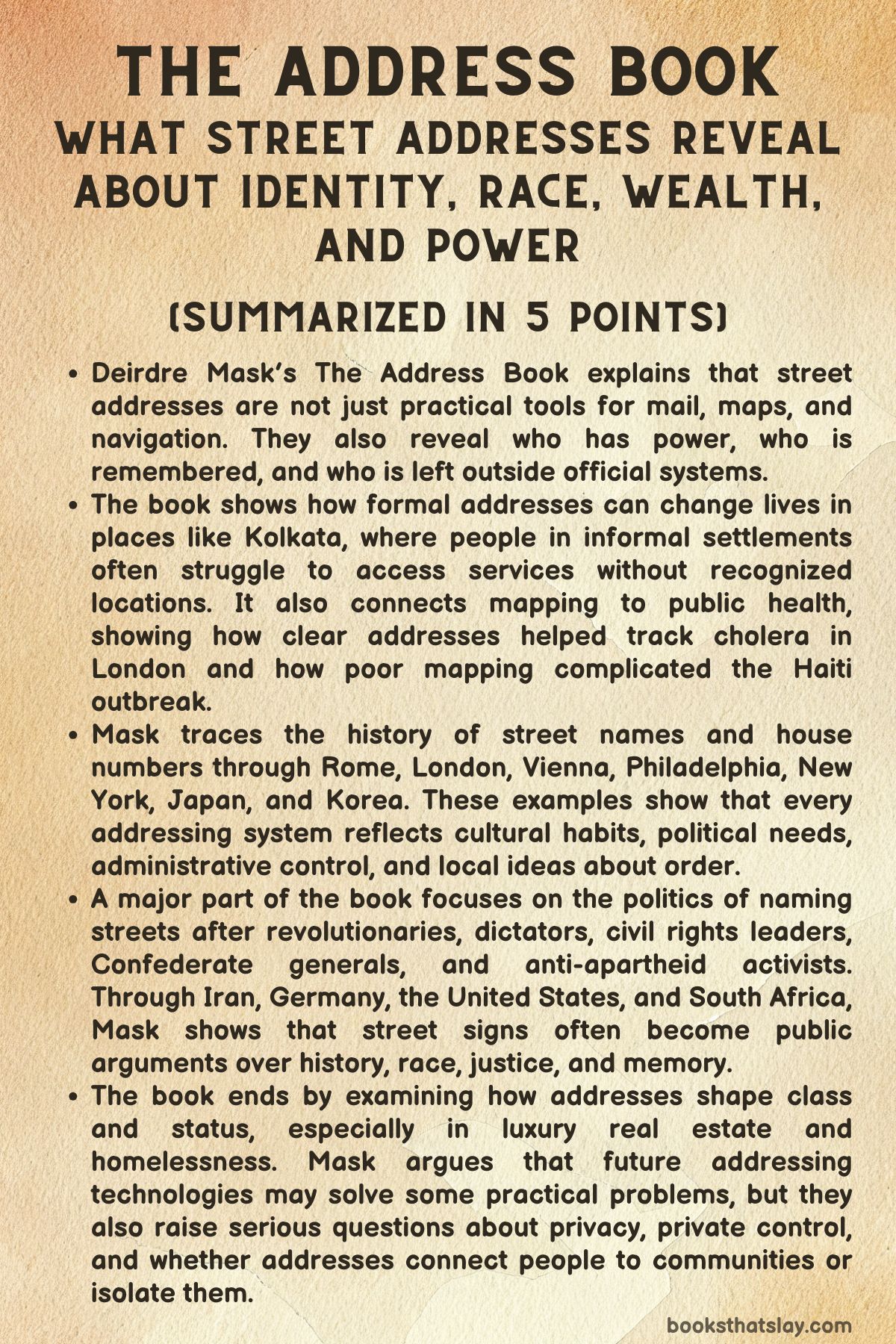
The Address Book: What Street Addresses Reveal About Identity, Race, Wealth, and Power by Deirdre Mask is a nonfiction study of something most people treat as ordinary: the street address. The book shows that addresses are not just practical tools for mail, maps, and emergency services; they also reveal how societies organize power, memory, race, class, and citizenship.
Mask moves through cities and countries including Kolkata, Haiti, Rome, London, Vienna, New York, Iran, Germany, South Africa, and the United States to show how naming and numbering places can include people, exclude them, honor them, police them, or erase them.
Summary
The Address Book begins with the idea that street names and addresses matter far more than most people assume. Deirdre Mask opens by showing how even apparently simple street renamings can create public anger, pride, and debate.
In New York City, many local laws have involved street names, often because communities want to honor people whose lives carry political or emotional meaning. The dispute over a proposed street name for Black activist Sonny Carson becomes an early example of the book’s central argument: addresses are never neutral.
They show who has power, who is remembered, and whose history becomes part of public life.
Mask’s interest in addresses grows from both research and personal experience. In rural West Virginia, she finds communities where formal street names are missing or inconsistent.
Local residents may know how to find one another by landmarks and personal memory, but outsiders, including emergency workers, often struggle. Some residents welcome formal street naming because it can make life safer and easier.
Others resist it because they see it as government intrusion. Mask also connects the subject to her own life as a Black woman living in Britain.
When she encounters a street named Black Boy Lane, she reflects on Britain’s unresolved relationship with slavery and racism. Her family eventually chooses a home on Wilberforce Road, named for abolitionist William Wilberforce, reinforcing the idea that street names carry moral and historical weight.
The book then moves to Kolkata, where Mask studies how formal addresses can transform life in informal settlements. Her guide is Subhashis Nath, a social worker with Addressing the Unaddressed, an organization that assigns location codes to homes in slum communities.
In places where streets are narrow, irregular, and difficult for outsiders to understand, residents receive unique codes tied to GPS locations. These codes help them prove where they live and gain access to government identification, healthcare, schools, banking, and social benefits.
Mask places this modern problem within Kolkata’s colonial history. British rulers divided the city by race and failed to understand Indian domestic arrangements, which made it easier to ignore slum residents.
The modern lack of addresses continues that pattern of invisibility. When Mask herself forgets the name of her hotel and is quickly helped by police because official records identify where she is staying, she sees clearly how different her situation is from that of people who remain unmapped.
In Haiti, Mask considers how addresses and maps can save lives during epidemics. She first revisits Victorian London and the work of John Snow, who mapped cholera deaths and traced them to a contaminated water pump on Broad Street.
Snow’s success depended on house numbers, death records, and the ability to connect illness to location. Mask then compares this to the 2010 cholera outbreak in Haiti, where weak mapping systems made it difficult for researchers to track the disease.
French researcher Renaud Piarroux, working with Haitian epidemiologists, traced the outbreak to a sewage leak from a UN base into a river system. The UN denied responsibility for years before admitting the connection.
Through this example, Mask shows that addresses and maps are not just administrative conveniences; they can determine whether disease is understood, contained, and publicly acknowledged.
The book also looks backward to ask how people navigated before modern addressing systems. In ancient Rome, formal street names were not central to everyday navigation.
Romans relied heavily on landmarks, public spaces, smells, sounds, and mental maps. Mask connects this to the work of urban planner Kevin Lynch, who argued that cities become easier to understand when they have clear paths, landmarks, edges, districts, and nodes.
She also discusses neuroscience, especially the work of John O’Keefe and James D. Ranck, to explain how the brain forms internal maps through place neurons and grid neurons. Ancient memory techniques, such as Cicero’s method of imagining ideas inside a building, show that people have long connected place and memory.
London gives Mask a way to explain where street names come from. Some early names were bluntly descriptive, tied to trades, markets, churches, mills, or local families.
Others were rude, odd, or misleading. As London grew, repeated names became a major problem for postal workers and residents.
The expansion of the mail system, especially through Rowland Hill’s penny post, made accurate addressing more important. Cheap postage allowed ordinary people to send letters, but confusing addresses led to the rise of “letter detectives” who tried to decode incomplete or strange directions.
Postal codes eventually helped organize the growing city. Mask also notes that communities often rename streets informally, especially immigrant communities that use unofficial names to reflect their own sense of belonging.
In Vienna, Mask studies house numbers as tools of state power. With historian Anton Tantner, she looks at the history of numbering homes and connects it to the rise of modern government.
Empress Maria Theresa ordered residences across Habsburg lands to be numbered so the state could identify citizens and find soldiers. Similar systems later appeared elsewhere, including the United States, where the Philadelphia model placed odd numbers on one side of a street and even numbers on the other.
Mask shows that numbering houses made cities easier to navigate, but also easier to monitor. Jacques François Guillauté’s plan for Paris imagined a city where police could connect every citizen to a residence and record their lives in detail.
The address, in this sense, becomes both a convenience and a method of control.
The American love of grids and numbered streets appears through New York and Philadelphia. Manhattan’s grid, created by John Rutherford, Simeon De Witt, and Gouverneur Morris, turned land into an orderly market and helped make the city easier to buy, sell, and develop.
Philadelphia’s grid reflects William Penn’s Quaker ideals of order and rationality. Numbered streets suited a culture that rejected certain traditional names and preferred plainness.
Mask contrasts this with London after the Great Fire, where plans for a rational grid were rejected in favor of rebuilding along older lines. The contrast shows that street systems express cultural values as much as planning choices.
The book challenges Western assumptions through Japan and Korea. Tokyo shows that a major modern city can function without naming most streets.
Japanese addressing traditionally focuses on blocks rather than roads, and houses may be numbered by the order in which they were built. Mask uses Roland Barthes’s confusion in Tokyo to show how strange this can seem to Western visitors.
Urban designer Barrie Shelton connects Japanese block-based addressing to the spatial nature of kanji writing, while Korean addressing reflects a mixture of block-based and line-based thinking. Korea’s shift toward Western-style street names is also tied to colonial history and globalization, making address reform a matter of identity.
In its political sections, the book examines revolutions and memory. In Iran, Pedram Moallemian and his friends rename Winston Churchill Street after Bobby Sands, an Irish Republican Army hunger striker.
For them, Sands symbolizes resistance to British power, especially given Britain’s role in Iranian history. The name becomes official, and the British embassy adjusts its entrance to avoid using it.
Mask compares this to revolutionary Paris, where Henri Grégoire wanted street signs to teach republican values, and to other countries where streets honor figures like Emiliano Zapata, Lenin, or Frida Kahlo. Street names become public lessons in who deserves admiration.
Germany shows how street names can help a society confront its past. Susan Hiller’s project documents German streets containing variations of the word “Jew,” showing how names record where Jewish life once existed.
During the Nazi period, many Jewish street names disappeared and were replaced by names honoring Hitler and Nazi figures. After the war, those names were removed, and in East Berlin many were replaced with names honoring communist figures.
Reunification created further debate because communist names became reminders of division. Mask connects this to the German idea of working through the past, suggesting that street names become public arguments over memory, guilt, and repair.
In the United States, Mask studies Confederate street names and Martin Luther King Jr. streets to show how race shapes public space. In Hollywood, Florida, Benjamin Israel campaigns against streets named for Robert E. Lee, Nathan Bedford Forrest, and John Bell Hood, especially because they pass through a Black neighborhood.
Mask traces the city’s history to segregation, the failed Black community of Liberia, and later Confederate renamings. She also reflects on her own school experience with the Confederate flag, showing how Black Americans often feel pressured into silence.
In St. Louis, Melvin White tries to revive MLK Drive, once part of a strong Black business community but later weakened by disinvestment. Mask argues that many MLK streets are underfunded not because of King’s name, but because segregation placed them in Black neighborhoods denied resources.
South Africa extends the question of racial memory. After apartheid, officials in Pretoria proposed replacing streets named for Afrikaners with names honoring anti-apartheid activists.
AfriForum opposed the changes, arguing that Afrikaners were being erased. Mask explains the history of Afrikaner power, British conflict, apartheid, and the difficult transition after Nelson Mandela’s election.
Mandela initially avoided aggressive renaming to preserve peace, while later leaders changed many names. The debate shows that public memory after oppression is never simple: one group’s justice may feel to another group like loss.
The final sections examine class and homelessness. In Manhattan, Mask shows that addresses can create wealth.
Donald Trump’s shift from 15 Columbus Circle to One Central Park West shows how prestige can be bought. Earlier developers renamed streets like West End Avenue and Central Park West to raise property values.
Henry Mandel’s creation of One Park Avenue similarly shows how addresses can reshape real estate status. Research from several countries confirms that names affect home prices.
The book ends by considering people without addresses and technologies that may replace traditional systems. Sarah Golabek-Goldman argues that unhoused people need stable addresses to get jobs and services, and she supports banning employers from asking for addresses too early in hiring.
Chris Hildrey proposes assigning unhoused people addresses linked to vacant luxury properties, exposing the unfairness of cities where empty homes exist beside people without homes. In the conclusion, Mask contrasts Daniel Burnham, the celebrated planner of Chicago, with Edward Brennan, the lesser-known worker who reorganized the city’s chaotic streets.
She then considers what3words, Chris Sheldrick’s system that assigns three-word codes to every small square on Earth. Mask sees its usefulness but worries about private companies controlling addresses.
The book closes by insisting that addresses shape belonging, memory, power, and justice.
Key Figures
Deirdre Mask
Deirdre Mask is the central guiding presence of The Address Book, not as a fictional protagonist but as a researcher, narrator, and moral observer. She approaches addresses as practical tools, historical records, and political statements.
Her personal identity as a Black woman matters because she does not treat street names as abstract labels. When she reacts to Black Boy Lane in London or recalls her own experience with the Confederate flag during a school trip, she shows how public symbols can affect people privately.
Mask’s strength in the book is her ability to connect small details to large systems. A street sign, a house number, or a missing address becomes evidence of power, exclusion, class ambition, racial memory, or government control.
She is curious, but she is not neutral in the sense of being detached. Her narration makes clear that addresses can protect, harm, honor, erase, and define people.
Sonny Carson
Sonny Carson appears as a figure whose proposed memorialization exposes the politics behind street naming. The debate over whether a Brooklyn street should honor him shows that public memory is selective and contested.
Carson’s critics see him as too controversial to be honored, while his supporters argue that many already-honored historical figures also had serious moral flaws. His role in the book is not simply about his own life but about the standards communities use when deciding who belongs on a street sign.
Through Carson, the book raises a difficult question: whether public honor requires moral purity, political usefulness, community attachment, or historical importance.
Michael Bloomberg
Michael Bloomberg appears through his rejection of the proposal to honor Sonny Carson. His role represents institutional power in the naming process.
As mayor, Bloomberg’s judgment carries official weight, and his dismissal of Carson helps trigger public protest. In the book, he becomes an example of how government officials can decide which histories are acceptable in public space.
His presence also shows the tension between top-down authority and community desire. Residents may see a name as meaningful because it reflects their local memory, while officials may treat it as a matter of public reputation and political risk.
Thomas Jefferson
Thomas Jefferson appears as a comparison point in the Sonny Carson debate. Protestors use Jefferson to show the inconsistency of public honor: if streets can honor a man connected to slavery, why should Carson’s flaws disqualify him automatically?
Jefferson’s role in the book is symbolic. He represents the way powerful societies normalize the flaws of famous men while holding other figures, especially Black radicals or activists, to harsher standards.
His appearance forces readers to see street names not as innocent tributes but as signs of which contradictions a society is willing to overlook.
William Wilberforce
William Wilberforce appears through Wilberforce Road, where Mask and her family choose to live. His role is tied to the moral comfort and historical association his name provides.
As an abolitionist, Wilberforce stands in contrast to names that carry racist or colonial meanings. For Mask, his name on a street sign becomes part of the emotional landscape of choosing a home.
He represents the possibility that public names can honor justice rather than domination. At the same time, his presence reminds readers that even a street name connected to moral reform exists within a larger society still marked by slavery’s afterlife.
Subhashis Nath
Subhashis Nath is one of the most important practical reformers in the book. As a social worker with Addressing the Unaddressed, he helps assign formal location codes to people living in Kolkata’s informal settlements.
His work shows that an address can be a gateway to citizenship. Nath does not treat the residents of slums as invisible, temporary, or unworthy of recognition.
Instead, he helps create a system that allows them to claim services, identification, and social standing. In The Address Book, Nath represents the humane side of mapping: the belief that recording a place can make life safer, more dignified, and more politically visible.
John Snow
John Snow is presented as a key figure in the history of public health. His investigation of cholera in Victorian London shows the power of linking disease to location.
Snow’s intelligence lies in his refusal to accept vague explanations. By mapping deaths and connecting them to the Broad Street pump, he demonstrates that addresses and house numbers can become tools of scientific discovery.
His role in the book is to show that a city’s ability to identify where people live can be a matter of life and death. Snow also represents the kind of thinker whose work becomes fully valued only after later generations understand its importance.
Renaud Piarroux
Renaud Piarroux plays a role similar to John Snow, but in the modern context of Haiti’s cholera outbreak. He gathers evidence, works with local epidemiologists, and traces the disease to a sewage leak connected to a UN base.
His character is defined by persistence against institutional denial. Piarroux’s work shows that mapping is not merely technical; it can challenge powerful organizations and force responsibility into public view.
His struggle to publish and gain recognition for his findings reveals that evidence alone is not always enough when institutions have reasons to avoid blame.
Kevin Lynch
Kevin Lynch gives the book a theoretical language for understanding how people experience cities. His idea of the imageable city helps explain how paths, landmarks, districts, nodes, and edges shape mental maps.
Lynch’s role is important because he broadens the discussion beyond official street signs. He shows that people navigate through memory, sensory experience, and urban form.
In the book, Lynch represents the human side of city planning: the desire to understand not just how cities are built, but how they are felt and remembered by the people who move through them.
John O’Keefe
John O’Keefe appears through his neuroscience research on the brain’s relationship to place. His work on place neurons gives scientific support to the idea that navigation is deeply connected to memory and identity.
O’Keefe’s role in the book is to show that addresses and maps are not only social systems; they connect to how the brain understands the world. By helping explain the internal mapping process, he strengthens Mask’s argument that place is fundamental to human experience.
James D. Ranck
James D. Ranck appears alongside O’Keefe in the discussion of how the brain forms location-based knowledge. His work on grid neurons helps explain how people and animals create internal coordinate systems.
Ranck’s role in the book is scientific rather than narrative, but it is still important. He helps show that humans are not dependent only on official maps or street signs.
The brain itself produces a kind of private geography, which makes the formal address system both powerful and incomplete.
Cicero
Cicero appears as evidence that ancient thinkers understood the connection between memory and place long before modern neuroscience. His method of imagining a speech as a building, with ideas placed in different rooms, shows that spatial thinking has long been used to organize knowledge.
In the book, Cicero links ancient rhetoric to modern brain science. His role suggests that place is not merely where life happens; it is also one of the main structures through which people remember, argue, and think.
Rowland Hill
Rowland Hill is important because his postal reforms changed the social meaning of communication. By advocating for the penny post, he helped make mail affordable to ordinary people.
His role in the book connects addresses to democracy and social mobility. A cheaper postal system required clearer addressing, and clearer addressing allowed more people to participate in written communication.
Hill represents reform that appears administrative on the surface but has deep social consequences. He helps show that an address can connect people across class boundaries.
Anton Tantner
Anton Tantner acts as Mask’s guide into the history of house numbering. As a historian, he helps reveal that house numbers are not dull details but signs of political change.
His role is to make visible what most people ignore. Through his interest in old numbers and archival traces, Tantner helps the book connect urban order to state power.
He is a figure of historical attention, someone who notices that a number on a wall can carry the history of taxation, conscription, policing, and bureaucracy.
Empress Maria Theresa
Empress Maria Theresa represents the state’s desire to count, organize, and command its subjects. Her order to number residences across Habsburg territories was driven partly by the need to find soldiers.
In the book, she is a powerful example of how addressing systems can serve government control. Her project helped identify millions of people through their homes, turning residences into points in a state system.
She is not shown simply as an efficient administrator; she represents the moment when house numbering becomes tied to military and bureaucratic power.
Clement Biddle
Clement Biddle appears as a practical organizer of American house numbering. His Philadelphia system, with odd numbers on one side and even numbers on the other, becomes a model for later urban order.
Biddle’s role in the book is quieter than that of rulers or activists, but his influence is lasting. He represents the practical intelligence behind systems that later seem natural.
Once a numbering method becomes common, people forget that someone had to design it. Biddle’s work shows how administrative choices can shape daily life for centuries.
George Washington
George Washington appears through his connection to Clement Biddle and the early American systems of order. His role is not central, but his presence places house numbering within the larger project of building a new nation.
In the book, Washington helps frame the address as part of state formation. The young United States needed ways to count, classify, tax, communicate with, and govern its people.
Washington’s connection to Biddle suggests that even small urban systems can be part of national organization.
Jacques François Guillauté
Jacques François Guillauté is one of the book’s most revealing figures because his plan for Paris makes the connection between addresses and surveillance explicit. As a policeman, he imagines a city divided, named, numbered, and recorded in detail.
His vision shows that the address can be a tool for finding people, tracking them, and linking them to official records. What makes him striking is that his manuscript does not appear outwardly sinister, even though its ideas suggest deep state control.
He represents the ordinary appearance of bureaucratic power.
John Rutherford
John Rutherford is one of the men responsible for Manhattan’s grid plan. His role in the book is tied to the transformation of land into an orderly, saleable, and expandable urban system.
Rutherford helps represent the rational planning impulse that reshaped New York. The grid may seem simple, but it changed how the island could grow, how property could be divided, and how the city could become a center of finance.
His importance lies in helping impose abstract order on a complex physical landscape.
Simeon De Witt
Simeon De Witt, as one of Manhattan’s grid planners, represents the surveying and technical side of urban transformation. His work helps turn a crowded and uneven city into a numbered structure that supports development.
In the book, De Witt is part of a larger argument about how maps and plans can remake reality. The grid does not simply describe Manhattan; it helps create the modern city.
De Witt’s role shows how planners can shape not only streets but markets, movement, and future growth.
Gouverneur Morris
Gouverneur Morris appears as another key figure in the creation of Manhattan’s grid. His role carries political and economic meaning because the grid helped make New York easier to develop and monetize.
Morris represents the confidence of planners who believed that rational order could improve a city. At the same time, the book suggests that such order often serves property and commerce as much as public life.
Through Morris, the grid becomes a symbol of American ambition, efficiency, and market logic.
William Penn
William Penn is one of the book’s most important historical planners. His design for Philadelphia reflects Quaker values of order, simplicity, and rational life.
Penn’s grid is not merely practical; it expresses a moral vision. His experience of London’s Great Fire may have strengthened his desire for a city with wider, straighter, safer streets.
In the book, Penn represents the hope that urban design can produce a better society. His numbered streets also connect religious practice, language, and city form in a distinctly American way.
Roland Barthes
Roland Barthes appears as a Western intellectual encountering Tokyo’s unfamiliar addressing system. His confusion helps the book show that what feels natural in one culture may be deeply strange in another.
Barthes’s role is useful because he gives readers a way to experience disorientation. He does not stand as an authority on Japanese life so much as a witness to the limits of Western assumptions.
Through him, the book questions the belief that named streets are the obvious or superior way to organize a city.
Barrie Shelton
Barrie Shelton provides one of the book’s most interesting cultural explanations for addressing systems. By connecting Japanese block-based addressing to the spatial character of kanji writing, he suggests that writing habits and urban habits may reflect similar ways of thinking.
Shelton’s role is analytical. He helps explain why Japanese cities may focus on areas rather than lines, while English-speaking cities focus on streets.
His argument makes addressing feel less like a technical system and more like an expression of perception, language, and culture.
Pedram Moallemian
Pedram Moallemian appears as a young Iranian who participates in renaming Winston Churchill Street after Bobby Sands. His action begins as a political prank but becomes part of public memory.
Moallemian’s importance lies in showing that street naming can come from below as well as above. Ordinary people, especially young people shaped by revolutionary politics, can challenge official memory through public space.
In the book, his act captures the emotional force of anti-colonial feeling and the way a name can embarrass a powerful foreign government.
Bobby Sands
Bobby Sands is presented as a revolutionary symbol whose meaning changes depending on place. In Iran, he becomes a figure of resistance to British power.
His death during a hunger strike gives his name moral force for people who see Britain as an imperial actor. Yet the book notes that streets honoring him are absent in Ireland itself, where his memory remains too politically sensitive.
Sands’s role shows that street names are not only about the person named; they are about the needs, wounds, and conflicts of the society doing the naming.
Henri Grégoire
Henri Grégoire represents the revolutionary belief that street names can educate citizens. After the French Revolution, he wanted Parisian street signs to reflect new republican values rather than monarchy and church authority.
His role in the book is that of a moral planner. He sees naming as a way to reshape public consciousness.
Grégoire’s approach shows that revolutions do not only change governments; they also try to change memory, language, and daily surroundings. A street sign becomes a small public lesson in political identity.
Emiliano Zapata
Emiliano Zapata appears as an example of how revolutionary figures can dominate public naming long after their deaths. The many streets named for him in Mexico show how revolutionary memory becomes part of ordinary geography.
Zapata’s role in the book is symbolic rather than personal. He represents the way nations turn political struggle into civic honor.
His name on streets suggests that revolution is not confined to history books; it becomes part of addresses, directions, and daily speech.
Lenin
Lenin appears as another example of revolutionary memorialization on a massive scale. Thousands of streets named after him show how political regimes use public space to normalize ideology.
His role in the book is to represent the scale at which states can enforce memory. A Lenin street does not merely honor one man; it signals the reach of a political order and its preferred version of history.
His example also implies that when regimes change, street names often become unstable because the values they display are no longer secure.
Frida Kahlo
Frida Kahlo appears in the discussion of Spain replacing fascist street names with names honoring women. Her role is tied to corrective memory.
Naming streets after figures like Kahlo challenges older public landscapes dominated by men, militarism, and authoritarian politics. In the book, she represents a shift in public honor toward artists, women, and anti-fascist cultural symbols.
Her presence shows that renaming is not only about removing shameful names; it is also about creating a more inclusive public memory.
Susan Hiller
Susan Hiller is a conceptual artist whose J Street Project reveals how street names can preserve traces of Jewish life in Germany. Her work is important because it treats names as evidence.
By documenting streets containing variations of the word “Jew,” she shows that public geography can record both presence and exclusion. Hiller’s role in The Address Book is that of an artist-archivist.
She makes visible the relationship between naming, anti-Semitism, memory, and survival. Her project also shows that art can help societies notice histories they pass every day without seeing.
Adolf Hitler
Adolf Hitler appears through the Nazi practice of renaming streets to honor him and other Nazi figures. His role in the book is a stark example of how authoritarian power uses public naming as propaganda.
Streets named for Hitler were meant to make loyalty to the regime part of ordinary life. His presence also shows how names can participate in violence: as Jewish names disappeared from signs, Jewish people were being removed from public life and then murdered.
Hitler’s role makes clear that street naming can become a tool of ideological domination.
Hans Scholl
Hans Scholl appears as one of the anti-Nazi siblings honored in East Berlin street naming. His role is connected to resistance, martyrdom, and the politics of postwar memory.
By naming streets after him, authorities could replace Nazi symbols with anti-fascist ones. Yet because East Berlin was under Soviet influence, even anti-Nazi memorials could later become tangled in communist state identity.
Hans represents the moral clarity of resistance but also the complexity of how later governments use that resistance for their own narratives.
Sophie Scholl
Sophie Scholl, like her brother Hans, represents youthful courage against Nazi power. Her name on a street carries the memory of protest and sacrifice.
In the book, she helps show how naming can be an act of repair after atrocity. Honoring her replaces the names of perpetrators with the names of those who resisted them.
At the same time, the later debates over communist-era names show that even righteous memorials can become politically complicated depending on who installs them and what larger system they serve.
Benjamin Israel
Benjamin Israel is a central figure in the discussion of Confederate street names in Hollywood, Florida. As an African American Orthodox Jew, he brings a strong moral and historical awareness to the fight against honoring Confederate generals in a Black neighborhood.
His character is defined by persistence and refusal to accept inherited insult as normal. Israel’s activism shows how street names can burden residents with a daily reminder of racial violence.
He represents local resistance to public symbols that many officials and residents have learned to ignore or defend as tradition.
Robert E. Lee
Robert E. Lee appears as one of the Confederate generals honored by street names in Hollywood. His role in the book is not primarily military but symbolic.
A street named for Lee normalizes the Confederacy within civic space and asks residents, including Black residents, to live under a sign connected to a war for slavery. Lee represents the broader American struggle over whether Confederate figures should be treated as heritage, shame, or warning.
His name becomes part of the argument over how honestly the United States remembers racism.
Nathan Bedford Forrest
Nathan Bedford Forrest is one of the most disturbing figures discussed in the book’s section on Confederate memorials. As a slave trader and Confederate general associated with the massacre of Black Union soldiers, he represents the violence behind supposedly traditional public honor.
Benjamin Israel finds his street especially offensive, and the book makes clear why. Forrest’s presence on signs and monuments shows how white supremacy can be preserved through ordinary civic language.
His name turns a street into a daily reminder of terror, domination, and historical denial.
John Bell Hood
John Bell Hood appears with Lee and Forrest as another Confederate general honored by a street name in Hollywood. His role is part of the broader pattern of Confederate commemoration placed within or near Black communities.
Hood’s individual biography matters less in the supplied material than the public meaning of his name. He represents how Confederate memory often appears as a set of names repeated across public landscapes.
In the book, his presence helps show that the problem is not one isolated sign but a system of commemoration built around racial power.
Joseph Young
Joseph Young, the founder of Hollywood, Florida, is presented as a developer shaped by the racial conditions of his time. He creates the city during a period of growth and intense racism, and because of segregation he establishes Liberia as a separate Black community.
Young’s role is complex. He seems to imagine Liberia as a place of Black self-determination, yet the very need for a separate town reflects Jim Crow injustice.
His work shows how city-building can contain both ambition and segregation. Later renamings of Liberia’s streets reveal how fragile Black civic identity can be when absorbed into larger white-controlled systems.
Forrest Gump
Forrest Gump appears as a cultural reference rather than a real political actor. His name matters because the character is named after Nathan Bedford Forrest, bringing Confederate memory into popular entertainment.
In the book, this reference shows how deeply historical names can enter everyday culture, even in forms that seem harmless or sentimental. Forrest Gump’s role is to reveal normalization.
A name tied to racial violence can become familiar through film, humor, and nostalgia, making its origins easier to overlook.
Martin Luther King Jr.
Martin Luther King Jr. is one of the book’s most important figures of public honor. Streets named after him are meant to commemorate civil rights, justice, and moral leadership, yet the book shows that many MLK streets are located in underfunded Black neighborhoods.
King’s role is therefore double. He is honored as a national hero, but the condition of many streets bearing his name reveals the country’s failure to fulfill his vision.
His name becomes a test of American sincerity: public admiration means little if the communities associated with him remain neglected.
Melvin White
Melvin White is a local activist who tries to restore the dignity of streets named after Martin Luther King Jr. in St. Louis and beyond. Having grown up on MLK Drive when it was part of a strong Black community, he understands both what has been lost and what might be rebuilt.
His organization, Beloved Streets of America, reflects his belief that these streets should not be treated as symbols of decline. White’s role is hopeful but realistic.
He shows that names alone cannot repair disinvestment; communities need resources, care, and sustained work.
Nelson Mandela
Nelson Mandela appears in the South African section as the leader who helped guide the country out of apartheid. His approach to street names is marked by restraint.
Rather than immediately removing Afrikaner names, he avoids aggressive renaming in order to preserve a fragile peace. Mandela’s role in the book shows the political difficulty of memory after oppression.
He represents reconciliation, but not forgetfulness. His choices suggest that public naming must sometimes balance justice with the risk of renewed conflict.
Thabo Mbeki
Thabo Mbeki appears as Mandela’s successor, more willing to change street names connected to apartheid and racial insult. His role contrasts with Mandela’s caution.
Mbeki’s renamings reflect a stronger push to remake public space after white minority rule. In the book, he represents a later stage of post-apartheid politics, when patience with old symbols begins to give way to demands for visible change.
His actions show that delaying symbolic justice may preserve peace for a time, but unresolved memory eventually returns to public debate.
Andrew Zondo
Andrew Zondo appears as a controversial anti-apartheid figure honored through street naming. His case shows that replacing oppressive names does not always produce simple moral clarity.
Because he detonated a bomb that killed five people, his commemoration raises painful questions about violence, resistance, and legitimacy. In the book, Zondo represents the difficulty of honoring freedom struggles that included morally troubling acts.
His name on a street forces society to ask whether liberation movements should be remembered only through heroes without stains, or whether public memory must face the full complexity of political violence.
Donald Trump
Donald Trump appears as a real estate developer who understands the financial value of a prestigious address. By changing a building’s address from 15 Columbus Circle to One Central Park West, he shows how an address can become a luxury brand.
His role in the book is tied to class, marketing, and urban inequality. Trump does not merely use the city; he uses the symbolic power of its names.
His example shows that addresses can be bought, polished, and sold to the wealthy as status objects.
Henry Mandel
Henry Mandel is another developer who uses address prestige to reshape real estate value. By securing One Park Avenue for his apartment complex, he demonstrates how naming and numbering can serve ambition and profit.
Mandel’s role is especially revealing because his success displaces Martha Bacon’s prior claim to the address. He represents the modernizing force of real estate development, where history, residence, and personal attachment can be pushed aside by market power.
His story shows that addresses are not only about location; they are assets.
Martha Bacon
Martha Bacon appears as the person displaced from the original 1 Park Avenue address. Her role is small but meaningful.
She represents older New York, personal continuity, and the human cost of real estate ambition. While developers like Mandel think in terms of prestige and market value, Bacon’s connection to the address is residential and historical.
In the book, she helps show that address changes can erase not just numbers but lives attached to places. Her displacement gives emotional weight to what might otherwise seem like a technical adjustment.
Sarah Golabek-Goldman
Sarah Golabek-Goldman is one of the book’s most socially urgent reformers. As a law student researching homelessness, she learns that many unhoused people want a permanent address more than almost anything else because it can affect employment, banking, services, and dignity.
Her proposal to stop employers from asking for addresses too early in the hiring process targets discrimination directly. She represents legal imagination applied to a practical injustice.
Her work shows that the absence of an address can trap people in homelessness by making stability harder to regain.
Chris Hildrey
Chris Hildrey appears as an architect and advocate responding to London’s housing inequality. His proposal to assign unhoused people addresses connected to vacant luxury properties is both practical and symbolic.
It would help people receive mail and access services while exposing the moral absurdity of empty homes existing beside homelessness. Hildrey’s role in the book is imaginative and confrontational.
He uses the address system to challenge property inequality, suggesting that civic tools can be redesigned to serve those excluded by wealth.
Daniel Burnham
Daniel Burnham represents celebrated, elite city planning. His Plan of Chicago and association with the City Beautiful movement make him a famous figure in urban history.
In the book, however, his reputation is contrasted with Edward Brennan’s lesser-known work. Burnham’s role is to show how society often honors grand visions more than practical systems that make everyday life function.
He is not dismissed, but the book places his prestige beside questions of class and recognition.
Edward Brennan
Edward Brennan is one of the book’s quiet heroes. A grocery deliveryman and bill collector, he reorganizes Chicago’s chaotic street system without the fame given to elite planners.
His work matters because confusing street names and broken-link streets made ordinary labor harder. Brennan’s role is deeply democratic.
He improves the city from the perspective of people who must move through it daily. His lack of fame reveals class bias in public memory: the polished planner is celebrated, while the worker who solves practical problems is nearly forgotten.
Chris Sheldrick
Chris Sheldrick is the creator of what3words, a system that assigns three-word codes to small squares across the globe. His work responds to the real problem of places without usable formal addresses.
In The Address Book, Sheldrick represents the future of addressing: digital, private, precise, and global. His system can help emergency services, deliveries, and people living outside formal maps.
Yet it also raises concerns because it shifts addressing power from public communities to private technology. Sheldrick’s role is therefore both innovative and unsettling.
Themes
Addresses as Power
Addresses in the book are never just neutral labels attached to buildings. They are tools used by governments, communities, businesses, and activists to organize life.
When a state numbers houses, it can deliver mail and emergency services, but it can also tax, conscript, police, and monitor people more effectively. Vienna’s numbering under Maria Theresa makes this especially clear because the project is tied to the need for soldiers.
Guillauté’s imagined Paris pushes the same logic further by linking every residence to records of the people inside. Yet power does not belong only to governments.
Communities also claim power when they fight to rename streets after activists, revolutionaries, or civil rights leaders. Developers claim power when they buy prestigious addresses to raise property value.
Even the lack of an address is a form of power acting against someone, as seen in the lives of unhoused people and slum residents. The Address Book shows that to assign, deny, change, or sell an address is to shape who can be found, helped, honored, watched, ignored, or priced out.
Visibility, Citizenship, and Belonging
A person without an address can become socially invisible even while living in plain sight. This theme appears strongly in Kolkata, where residents of informal settlements need formal location codes to access identification, healthcare, schooling, banking, and benefits.
Their lack of addresses is not simply a logistical problem; it affects whether the state can recognize them as citizens with claims and rights. The same issue appears in the discussion of homelessness.
Without a stable address, unhoused people face barriers to jobs and services, and employers may judge them before considering their abilities. Addressing becomes a form of belonging because it says that a person exists in a place that society is willing to record.
Mask also shows the emotional side of belonging through communities that resist names imposed from outside or fight for names that reflect their histories. To be addressed is to be placed within a civic system, but the quality of that placement matters.
A harmful name can wound belonging, while a meaningful one can affirm community identity.
Public Memory and Historical Conflict
Street names act as public memory made permanent, or at least made to look permanent. The book repeatedly shows that names become battlegrounds when societies disagree about the past.
Confederate streets in the United States honor men connected to slavery and racial violence, often in places where Black residents must live with those names every day. German street renamings before, during, and after Nazi rule reveal how regimes try to erase, replace, or repair memory through signs.
In South Africa, post-apartheid renaming raises painful questions about whether old Afrikaner names preserve heritage or protect the memory of oppression. Revolutionary names in Iran, France, Mexico, Russia, and Spain show another side of the same theme: new political orders often try to teach new values through public space.
These examples show that history is not settled simply because a name appears on a sign. A street name can honor, accuse, provoke, comfort, or reopen old wounds.
Public memory remains active because people continue to live inside it.
Class, Property, and the Price of Place
An address can carry economic value far beyond its practical function. Manhattan’s luxury real estate market shows that a prestigious address can make a building more desirable and more expensive.
Donald Trump’s use of One Central Park West and Henry Mandel’s pursuit of One Park Avenue reveal how developers turn location names into brands. This theme also appears in research showing that street names can influence property prices, with elegant, royal, or fashionable names increasing value while silly or undesirable names can reduce it.
Yet the book does not treat this as harmless marketing. When addresses become status goods, cities become more unequal.
The wealthy can buy symbolic belonging in admired places, while poorer residents may be pushed aside, ignored, or denied stable addresses altogether. The contrast between luxury buildings, vacant investment properties, and homelessness in London makes the theme especially sharp.
A city may contain empty homes with valuable addresses while people nearby cannot claim any address at all. Place, under these conditions, becomes a marker of wealth rather than a shared civic right.