The Adoration of Jenna Fox Summary, Characters and Themes
The Adoration of Jenna Fox by Mary E. Pearson is a young adult science fiction novel about identity, memory, medical ethics, and the limits of parental love. Set in a near-future America shaped by biotechnology and strict medical regulation, the book follows seventeen-year-old Jenna Fox as she wakes from a coma with no memory of who she is.
As she relearns language, movement, family, and emotion, she slowly discovers that her survival is far more complicated than anyone has told her. The story asks what makes a person human: the body, the mind, memory, choice, love, or something harder to define. This is the first book in the Jenna Fox Chronicles series.
Summary
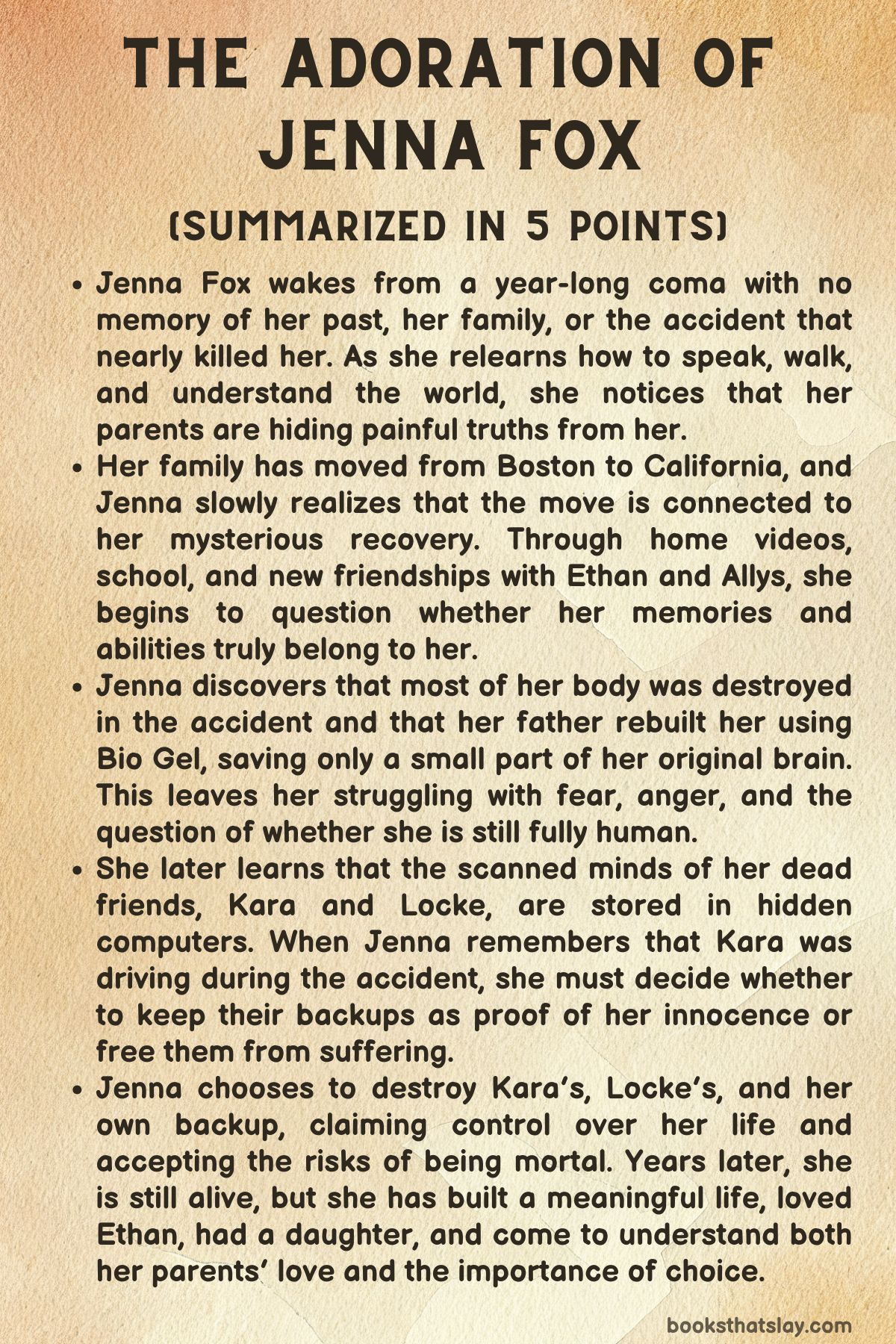
Jenna Fox wakes after a year-long coma in a world that feels both familiar and completely strange. She is seventeen, but she has no memory of her life, her parents, her grandmother Lily, or the accident that nearly killed her.
She cannot walk properly, she forgets ordinary words, and even her own body seems distant from her. Her mother, Claire, watches her with intense devotion, while her father is often away in Boston for work.
Lily, her grandmother, behaves differently. She does not openly reject Jenna, but she keeps a cool distance that Jenna cannot understand.
Jenna’s parents encourage her to watch old home videos in order to recover her memories. These videos show a girl who danced, laughed, argued, and grew up under the gaze of parents who seemed to adore her.
Yet the room Jenna now lives in is bare, with no real signs of the person she used to be. She begins to wonder whether her life had meaning before the accident.
She wonders why her family moved from Boston to California, why her old friends have not contacted her, and why her mother avoids certain questions.
As Jenna regains strength, she becomes restless. She sneaks out of the house and meets Mr. Bender, a neighbor who is an environmental artist.
He is private and unusual, but he treats Jenna with curiosity rather than fear. He notices her sharp intelligence and her strange ability to recall large amounts of historical information.
Jenna also discovers that birds refuse to land on her hands, a small detail that unsettles her more than she expects. When she falls into a creek, the sensation of drowning brings back an impossible memory from toddlerhood, something she should not be able to remember clearly.
Jenna’s relationship with Lily grows more complicated when they visit a Catholic mission. Lily reveals that the family has only been in California for two weeks, which means they moved shortly after Jenna woke up.
Jenna begins to suspect that her parents are hiding something about her recovery. At the mission, Jenna sees Ethan, a quiet boy who will later become important to her.
She also learns more about Lily’s religious beliefs and the world around her. In this future, medicine and bioengineering have saved lives but also caused disaster.
Antibiotic resistance has killed millions, and engineered organisms have reshaped nature. The government now controls medical treatment through the Federal Science Ethics Board, which assigns “points” to procedures and limits how much medical intervention any person may receive.
Jenna wants to return to school. Claire resists, but Lily argues that Jenna needs a life outside the house.
Eventually, Jenna is allowed to attend a small school focused on ecosystem studies. There she meets Ethan again, as well as Allys, a brilliant and outspoken girl who lost all four limbs to infection and now uses artificial limbs.
Allys strongly supports medical regulation because she blames past scientific recklessness for what happened to her. Jenna also encounters Dane, a cold and unsettling boy who enjoys provoking people and seems to lack ordinary empathy.
At school, Jenna realizes that she knows things she does not remember learning. She can recite whole texts from memory, including Walden.
This frightens her because it feels less like education and more like something planted inside her. She is drawn to Ethan, who treats her as normal and does not press her too hard.
He has his own painful history: he spent time in juvenile hall after violently attacking a man connected to his brother’s drug addiction. Ethan’s honesty helps Jenna trust him, and their bond deepens.
The mystery of Jenna’s body grows harder to ignore. She cannot dance the way the girl in the videos danced.
Her fingers do not interlace properly. She cannot taste hot chocolate, even though she remembers loving it.
When she secretly enters a locked closet in her parents’ room, she finds three computers, one labeled with her name. In the struggle to remove it, she cuts her hand and sees blue Bio Gel beneath her skin.
The truth finally comes out: most of Jenna’s original body was destroyed in the accident. Only a small amount of her brain and some skin were saved.
Her father, a scientist whose company created Bio Gel, built her a new body and uploaded her scanned mind into it.
Jenna is horrified. She learns that she is illegal under current medical law.
Her parents secretly saved her and moved to California to hide her. Her father sees her survival as a breakthrough and a miracle, while Jenna experiences it as a violation.
She asks how much of her is truly herself. Lily believes there may be things worse than death, and Jenna begins to understand why Lily has struggled to accept the new Jenna.
Her parents insist they acted out of love, but Jenna feels robbed of choice. Even worse, she remembers the time between body and rebirth as a suffocating darkness, a state in which she wanted release but could not escape.
Jenna soon learns that her mind has been altered in other ways. Her parents installed subliminal commands meant to protect her, including a command that can force her to go to her room.
They also uploaded academic material into her brain, explaining why she can recite texts she never remembers studying. Jenna feels that neither her body nor her mind belongs fully to her.
She eventually tells Ethan the truth, and he accepts her without hesitation. This acceptance gives her comfort, though he warns her not to tell Allys, whose beliefs about science and regulation may make her dangerous to Jenna.
Jenna’s guilt about the accident becomes sharper when she searches online at Mr. Bender’s house. She finds reports claiming that she was driving without a license when the car went over a ledge, killing her two best friends, Kara and Locke.
Jenna is devastated. She remembers them slowly, especially Kara’s boldness and Locke’s presence in her life, but she cannot fully accept that she caused their deaths.
She later discovers that the two other computers in the locked closet are labeled Kara and Locke. Her father scanned their brains too.
Unlike Jenna, they were never given bodies. Their minds remain trapped in the same dark state Jenna remembers.
This discovery changes everything. Jenna realizes that the voices she has sensed are Kara and Locke calling for help.
Her father argues that their backups might be useful if Jenna is ever prosecuted, since they may contain evidence about who was really driving. He also sees death as something science may eventually overcome.
Jenna sees suffering. She remembers the darkness too clearly to treat the backups as files or evidence.
She must decide whether to preserve them for her own safety or destroy them to free her friends.
At school, Allys begins to connect Jenna to Fox BioSystems and the famous accident. She realizes that Jenna should not have survived and concludes that Jenna was reconstructed illegally.
Allys is shaken and angry because Jenna’s existence opposes everything she believes about medical ethics. Soon after, Allys stops coming to school.
Jenna and Ethan visit her and discover that she is dying from renewed infection. Under the FSEB point system, she has no treatment options left except pain relief.
Allys has told her parents about Jenna and urged them to report her, but her own condition exposes the cruelty of the system she defended.
Jenna finally remembers the accident. She, Kara, and Locke went to a party using Jenna’s father’s car.
Jenna had stolen the keys, but Kara was the one driving. The party turned unpleasant, and they fled.
Kara drove too fast, lost control, and the car went over a cliff. Jenna remembers the fall, the wreck, and the sounds of her friends dying.
Kara and Locke are the only ones who could prove Jenna was not the driver, but keeping them as witnesses means leaving them trapped.
Jenna begins to claim her own needs. At the beach, Lily asks what she truly wants.
Jenna says she needs a red skirt, space, freedom from being her mother’s miracle, and the destruction of the backups. Claire agrees to some things but refuses to release the computers.
Lily, however, chooses to help Jenna. Early one morning, Jenna creates a distraction, locks her parents in her room, opens the hidden closet, removes the computers, and throws them into the pond.
She destroys Kara’s backup, Locke’s backup, and her own. By doing so, she chooses risk, mortality, and personhood over endless preservation.
Her parents are furious and terrified, but Jenna asks them to respect her decision. The family reaches a fragile moment of acceptance.
Soon after, Allys’s parents come to the house. They do not come to expose Jenna.
They come to beg Jenna’s father to save their daughter as he saved Jenna. The moral lines that seemed clear begin to blur.
Lily takes Jenna to church and blesses her with holy water, offering a kind of spiritual recognition. Jenna begins to believe in the life she now has, not because every question has been answered, but because she has chosen it.
The story ends more than two hundred years later. Jenna is still alive, as is Allys, whom her father managed to save.
Their survival led to a new medical standard based on the minimum percentage of brain activity required for reconstruction, known as the Jenna Standard. Jenna and Allys have spent long lives advocating for people like themselves.
Ethan lived with Jenna for seventy good years before his death. Much later, Jenna had a daughter, Kayla, using genetic material from herself and Ethan.
As Jenna watches Kayla in Mr. Bender’s old garden, she understands her parents more deeply, especially the terrible love that made them refuse to let her die. Yet she also knows that no parent should outlive a child, and she plans to choose death when the time is right.
The novel closes with Jenna and Kayla feeding sparrows, a quiet image of continuity, choice, and acceptance.
Characters
Jenna Fox
Jenna Fox is the central figure of The Adoration of Jenna Fox, and her character is built around the question of what makes someone real. At the beginning of the book, she is almost a stranger to herself.
She knows her name because others tell it to her, but she does not yet possess the memories, habits, or emotional certainty that usually make identity feel stable. Her journey is not just about recovering the past; it is about deciding whether the life given back to her is one she can claim.
Jenna’s horror after discovering her Bio Gel body is not simple fear of being artificial. It is the shock of realizing that her body, memories, education, and even certain responses have been shaped by other people’s choices.
Her deepest growth comes when she begins making choices that belong to her alone. Destroying the backups is an act of moral courage, but it is also an act of self-definition.
She refuses to be stored, repeated, controlled, or preserved against her will. By the end, Jenna is not searching for proof that she is the old Jenna.
She has accepted that she is changed, but she insists that change does not erase her humanity.
Claire Fox
Claire Fox, Jenna’s mother, is defined by fierce love, fear, and control. She cannot bear the thought of losing her daughter, and that love leads her to make choices that are both understandable and deeply troubling.
Claire sees Jenna’s survival as a miracle, but she also treats Jenna as something fragile that must be protected from knowledge, danger, and even independence. Her secrecy comes from trauma, but it becomes a form of imprisonment.
Claire’s need to preserve Jenna is tied to her earlier image of Jenna as a perfect daughter, a dancer, and a child whose life had to follow a carefully guarded shape. After the reconstruction, this protective impulse becomes even stronger because Jenna’s existence is illegal and vulnerable.
Claire is not a villain; the book gives her pain real weight. Still, her love often fails to respect Jenna’s right to decide what kind of life she wants.
Her struggle is the struggle of a parent who saved a child’s life but cannot accept that saving someone does not mean owning them.
Jenna’s Father
Jenna’s father is a scientist, inventor, and parent whose belief in medical possibility drives much of the story’s conflict. He helped create Bio Gel, and his scientific confidence allows Jenna’s reconstruction to happen.
He sees the procedure as a triumph, proof that death can be challenged and that the boundaries of medicine can move forward. As a father, his actions come from love, but as a scientist, he often speaks about Jenna in technical terms that make her feel less like a daughter and more like a project.
His explanations are calm and rational, yet they reveal the dangerous side of brilliance when it is not restrained by consent or humility. He believes he did what any parent would do, but the book forces readers to question whether love excuses every act.
His decision to keep Kara and Locke’s backups also shows how easily human lives can become tools when science treats consciousness as data. He is one of the most morally complex figures in The Adoration of Jenna Fox, because he is both savior and violator, loving father and reckless innovator.
Lily
Lily, Jenna’s grandmother, brings moral and spiritual tension into the story. A former doctor and a religious woman, she understands both medicine and its limits.
Her distance from Jenna is painful, but it does not come from cruelty. Lily is struggling with the idea that the girl before her may not be the same child she once knew.
She also carries guilt from her own past, including her inability to save her husband and her role in helping Claire bring Jenna to California. Lily believes that some boundaries matter, and that survival at any cost may not always be mercy.
At the same time, she loves Jenna enough to change. Her support in destroying the backups shows that she has come to recognize Jenna’s right to choose.
Lily’s informal baptism of Jenna is one of the book’s most important gestures because it does not solve the scientific questions. Instead, it offers recognition through belief.
Lily comes to accept Jenna not because every doubt disappears, but because she sees Jenna’s moral agency, suffering, and need for dignity.
Ethan
Ethan is Jenna’s first real connection outside her family after she wakes. He is important because he treats her neither as a miracle nor as a medical problem.
His acceptance gives Jenna a space where she can speak honestly and feel seen. Ethan has a troubled past of his own, having violently attacked a man connected to his brother’s drug addiction.
This history makes him more than a simple romantic interest. He understands guilt, anger, and the way one action can mark a life.
His willingness to tell Jenna the truth about himself builds trust between them, and his reaction to Jenna’s secret shows the depth of his loyalty. He does not reduce her to her artificial body.
Instead, he responds to her fear with steadiness. Ethan represents human connection based on choice rather than history.
He did not know the old Jenna, so his love is not tied to nostalgia. He cares for the person in front of him, which helps Jenna believe that her present self has value.
Allys
Allys is one of the strongest moral counterweights in the story. She is intelligent, outspoken, and politically committed, especially in her support for the Federal Science Ethics Board.
Her beliefs are rooted in personal suffering. She lost her limbs because of infection in a world damaged by irresponsible medical practices, so her support for strict regulation is not abstract.
It is tied to her body, her pain, and her anger. When she learns what Jenna is, her reaction is severe because Jenna represents the kind of illegal science Allys fears.
Yet Allys’s own decline exposes the weakness of the system she defends. The point system denies her lifesaving treatment, reducing her life to a calculation.
Her parents’ decision to ask Jenna’s father for help creates a painful reversal. Allys is not hypocritical in a simple sense; she is trapped between principle and survival.
Her later life with Jenna, after being saved through similar methods, suggests that her understanding of ethics expands. In the book, Allys shows that moral certainty often becomes more complicated when the body is the one paying the price.
Dane
Dane is a disturbing presence because he exposes the difference between intelligence and conscience. He is observant, direct, and often able to identify truths others avoid, but his honesty is mixed with cruelty.
He enjoys making others uncomfortable and seems to lack empathy. His classmates distrust him, and the book presents him as someone who has been rejected by many institutions because of his behavior.
His attempt to physically drag Jenna away confirms the danger hinted at earlier. Dane’s role is not only to threaten Jenna but also to sharpen the book’s question about humanity.
Jenna worries that her artificial body makes her less human, yet Dane, fully biological, behaves with far less moral awareness than she does. Through him, the story suggests that humanity cannot be measured only by natural birth, flesh, or genetic origin.
Compassion, restraint, and ethical feeling matter more.
Mr. Bender / Edward
Mr. Bender, later revealed as Edward, is a guide figure for Jenna. He lives apart from others, creates environmental art, and notices things that many people ignore.
His false identity reflects one of the book’s central concerns: people can remake themselves, but the reasons behind reinvention matter. He took on the identity of his mentor to escape a painful past, and this gives him a special understanding of Jenna’s confusion about selfhood.
His connection to Jenna’s father and his role in the family’s escape plan show that he is not just a neighbor but part of the secret structure protecting her. Yet he offers Jenna something her parents often cannot: calm acceptance.
He does not demand that she be the old Jenna, nor does he treat her as a scientific wonder. The scene in which birds finally land on Jenna while she wears his jacket carries symbolic force.
Mr. Bender helps Jenna move from feeling rejected by nature to feeling that she still belongs in the living world.
Kara
Kara is mostly present through Jenna’s memories, but her influence is powerful. She was one of Jenna’s closest friends and appears to have been bold, persuasive, and willing to push boundaries.
She convinces Jenna to buy the red skirt and later drives the car on the night of the accident. Kara’s role is complicated because she is both beloved friend and the one whose reckless driving causes the crash.
Yet the book does not reduce her to blame. Her trapped backup becomes a moral crisis for Jenna.
Kara is no longer physically alive, but her stored consciousness forces Jenna to confront whether a mind without a body can still suffer and still deserve mercy. Jenna’s decision to destroy Kara’s backup is not an act of rejection.
It is an act of release. Kara represents friendship, guilt, lost youth, and the ethical horror of preserving consciousness without freedom.
Locke
Locke, like Kara, exists mainly through memory and through the hidden backup that contains his scanned mind. He was Jenna’s close friend and one of the two people who died in the accident.
His suffering after death is part of what makes Jenna reject her father’s view of the backups as useful or protective. Locke’s stored mind might be able to prove Jenna’s innocence, but Jenna knows that keeping him trapped for her benefit would be morally wrong.
His character highlights the cost of treating people as evidence, insurance, or data. Although he has fewer direct details than Kara, Locke’s presence matters because he strengthens Jenna’s final decision.
She does not free only the friend with the stronger remembered personality. She frees both of them because both are people to her.
Father Rio
Father Rio is a minor but meaningful character connected to Lily and the Catholic mission. He represents a quieter form of faith within a world dominated by scientific debate and legal control.
His work with Lily around non-bioengineered plants connects spiritual life with care for the natural world. Though he does not shape the plot as strongly as Lily or Ethan, his presence helps create the mission as a place where Jenna encounters questions that science alone cannot answer.
The church setting becomes important for Jenna because it gives form to ideas of soul, belief, forgiveness, and mystery. Father Rio’s role supports that atmosphere.
Allys’s Parents
Allys’s parents appear most powerfully near the end, when they come to Jenna’s family in desperation. Before that, they exist mainly through Allys’s life and illness, but their final action changes the moral balance of the story.
They know Jenna’s existence may be illegal, and Allys has urged them to report her. Yet when their daughter is dying, they ask Jenna’s father to do for Allys what he did for Jenna.
Their decision shows how quickly public principles can become private anguish when a child’s life is at stake. They mirror Claire and Jenna’s father in an important way.
Like Jenna’s parents, they face the terror of losing a daughter and become willing to cross lines they might once have condemned.
The Security Man
The security man is a small but revealing figure. He watches Jenna and Ethan at the mission and later appears with Jenna’s father, advising that the backups be moved to a safer place.
He represents the hidden machinery around Jenna’s life: surveillance, secrecy, risk, and escape planning. His presence reminds readers that Jenna is not simply recovering at home.
She is living under threat because her body is evidence of a major crime. Though he is not emotionally developed, he helps show the scale of what Jenna’s parents have done and the danger that surrounds their family.
Kayla
Kayla appears at the end of The Adoration of Jenna Fox, but her role is deeply significant. She is Jenna’s daughter, created long after Ethan’s death from both Jenna’s and Ethan’s genetic material.
Kayla represents the future Jenna chooses after centuries of life, grief, advocacy, and survival. Through Kayla, Jenna finally understands her parents in a more intimate way.
Motherhood helps her grasp why Claire and her father fought so hard to keep her alive, even while she still recognizes the dangers of their choices. Kayla also gives Jenna a reason to think carefully about death.
Jenna decides that no parent should outlive a child, which shows how far she has come from being someone preserved against her will to someone who plans to choose the shape and end of her own life.
Jenna’s Grandfather
Jenna’s grandfather is not active in the main action, but his death from resistant bacteria is important to the background of the book. His death explains part of Lily’s grief and guilt, and it also reflects the larger medical crisis of the world.
Through him, the story shows that scientific progress has not been clean or harmless. The same culture that creates lifesaving technology has also created disasters through overuse, carelessness, and arrogance.
His absence shapes Lily’s worldview and strengthens her belief that medicine cannot solve everything.
Ethan’s Brother
Ethan’s brother is another background figure whose suffering explains a major character’s past. His addiction led Ethan to attack the drug dealer responsible, which resulted in Ethan’s time in juvenile hall.
Although he does not appear directly, he helps explain Ethan’s anger and his distrust of official systems. His story gives Ethan emotional depth and makes him more able to understand Jenna’s fear of being judged by one terrible event.
The Drug Dealer
The drug dealer is a minor figure, but he matters because he is tied to Ethan’s guilt and reputation. Ethan’s attack on him causes others to see Ethan as dangerous, yet the context complicates that judgment.
The drug dealer represents harm that spreads through families and pushes people into desperate actions. Through this figure, the book shows that a person’s worst act may have a story behind it, even if that story does not erase responsibility.
Themes
Identity and the Meaning of Being Human
Jenna’s central conflict is not only whether she survived, but whether survival has preserved the person she was. Her body has been rebuilt, her brain has been supported by Bio Gel, and parts of her knowledge have been uploaded rather than learned through ordinary experience.
These facts make her fear that she is an imitation. Yet the book gradually moves the question away from biology alone.
Jenna’s humanity is shown through fear, anger, guilt, desire, love, memory, and moral choice. Dane, who is biologically ordinary but emotionally cruel, becomes an important contrast.
Allys, too, complicates the idea of bodily wholeness because her artificial limbs do not make her less human. The Adoration of Jenna Fox suggests that identity is not located in a single place.
It is not only the brain, body, memory, or soul. It is also the ability to choose, to care about others, to suffer ethically, and to claim responsibility.
Jenna becomes most fully herself not when she proves she is the same girl from the videos, but when she acts according to her own conscience.
Parental Love, Control, and Consent
Claire and Jenna’s father save Jenna because they love her, but the book asks whether love can become dangerous when it refuses limits. Their decision is emotionally understandable.
Watching a child die is unbearable, and they have the knowledge and resources to prevent it. Yet Jenna never consented to being reconstructed, programmed, hidden, and preserved through backups.
Her parents’ love gives her life, but it also takes away her control over that life. Claire’s need to protect Jenna becomes a refusal to let her grow beyond the role of miracle daughter.
Jenna’s father’s scientific certainty makes him believe that because he can save her, he should. The story does not treat the parents as monsters, which makes the theme stronger.
Their actions come from grief, devotion, and terror. Still, the book insists that love without respect can become possession.
Jenna’s destruction of the backups is therefore not only rebellion. It is a demand that her parents recognize her as a person with authority over her own existence.
Medical Ethics and the Cost of Progress
The future world of the novel is shaped by the consequences of earlier scientific excess. Antibiotic resistance, engineered plants, illegal procedures, and the rise of the Federal Science Ethics Board all show a society trying to recover from the damage caused by unchecked innovation.
Yet regulation creates its own cruelty. The point system is meant to distribute medical treatment fairly and prevent abuse, but it leaves Allys to die when she has used up her allotted care.
Jenna’s father represents the opposite danger: genius that bypasses law and consent because it believes the result justifies the risk. Neither side is presented as fully right.
Strict regulation can become inhuman when it values rules over lives, while unregulated science can become monstrous when it treats bodies and minds as experiments. The book’s ethical power comes from refusing an easy answer.
Jenna’s life is illegal, but she is real. Allys supports regulation, but regulation abandons her.
The question is not whether science is good or bad, but whether human dignity can survive both ambition and fear.
Memory, Guilt, and Freedom
Jenna’s recovery of memory is painful because memory does not simply restore her; it burdens her. At first, she wants to remember because memory seems like the path back to identity.
But each return of the past brings new distress: her strained relationship with her mother, her lost friends, the accident, and the truth of Kara driving the car. Memory becomes tied to guilt, especially when Jenna believes she caused Kara and Locke’s deaths.
Later, when she learns that their backups may prove her innocence, she faces a terrible moral test. Keeping them would protect her, but it would also leave them trapped in the dark state she remembers as agony.
Freedom in the novel requires more than knowing the truth. It requires acting on it.
Jenna’s choice to destroy the backups shows that she values mercy over self-protection. It also frees her from living as a repeatable object.
By giving up the possibility of another backup life, she accepts risk, mortality, and responsibility as parts of being truly alive.