The Advantage by Patrick M. Lencioni Summary and Analysis
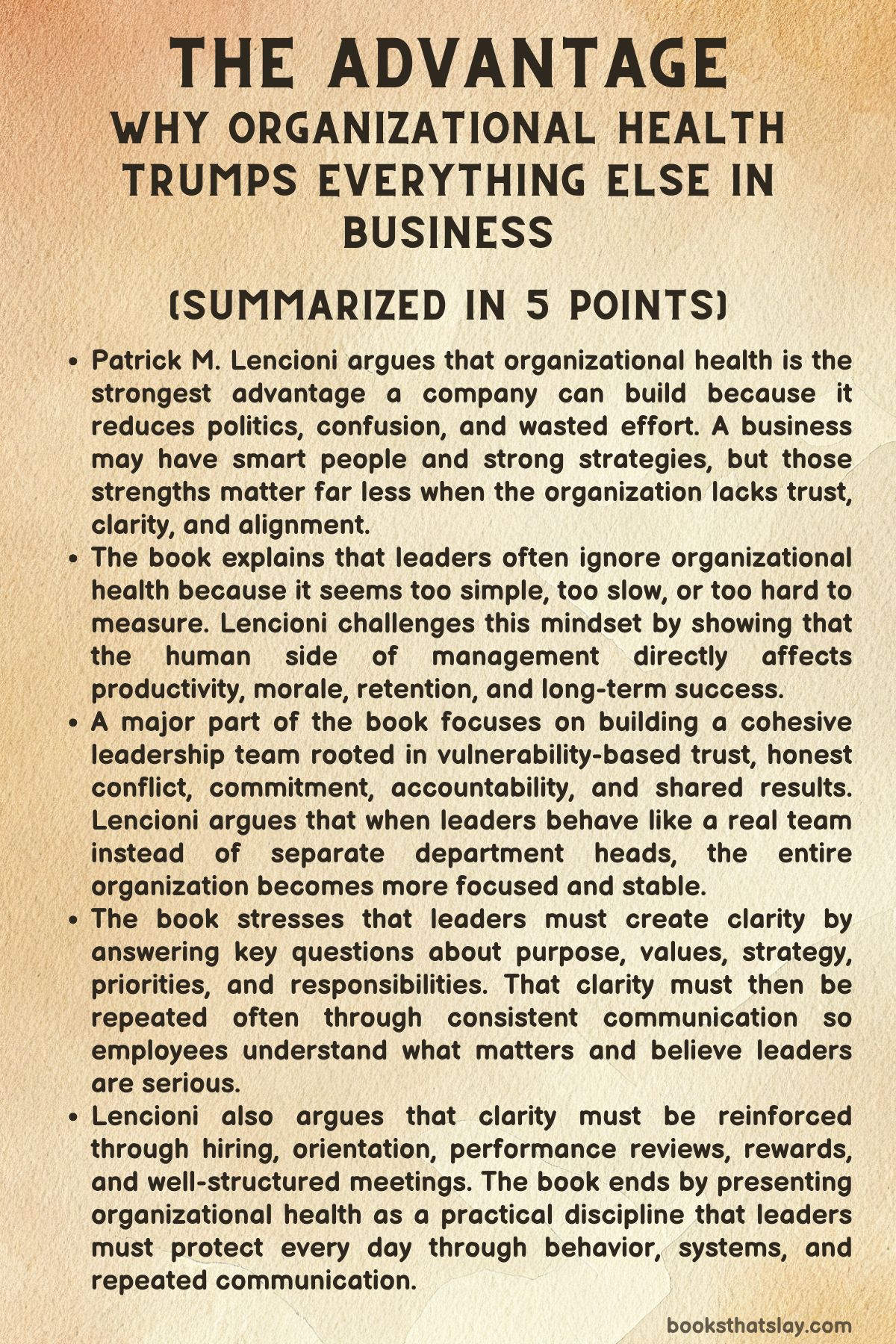
The Advantage by Patrick M. Lencioni is a business and leadership book about why organizational health matters more than strategy, finance, marketing, or technical intelligence alone. Lencioni argues that companies often already have enough talent and expertise, but they fail because politics, confusion, weak communication, and poor leadership habits prevent that knowledge from turning into results.
The book presents a practical model for building healthier organizations through cohesive leadership, clarity, repeated communication, and systems that support shared values. It is less about abstract theory and more about how leaders behave, decide, meet, hire, reward, and communicate every day.
Summary
Patrick M. Lencioni’s The Advantage argues that organizational health is the most powerful and underused source of success in business. The book begins with Lencioni explaining how his view of management developed through personal experience, consulting work, and years of observing why workplaces either succeed or become frustrating places for employees.
He describes how his father’s difficult work experiences, his own early jobs, and later professional roles helped him see that management decisions shape not only business outcomes but also people’s daily lives. Although leaders often focus on strategy, finance, marketing, and technology, Lencioni concludes that the deeper difference between successful and struggling organizations lies in how well they function as human systems.
The central argument is that healthy organizations outperform unhealthy ones because they reduce politics, confusion, employee disengagement, and wasted effort. Lencioni does not deny the value of intelligence, planning, or technical skill.
Instead, he argues that most organizations already have enough knowledge to succeed, but they fail to use it well because their leaders are divided, unclear, inconsistent, or unwilling to confront difficult people and issues. A company may have strong market analysis, clever products, and capable employees, but if leadership is fractured, priorities are unclear, and people do not trust one another, that intelligence loses much of its force.
Lencioni identifies three common biases that prevent leaders from prioritizing organizational health. The first is the sophistication bias, which makes leaders dismiss simple ideas because they seem too obvious to be valuable.
The second is the adrenaline bias, which causes leaders to chase urgent tasks while ignoring deeper work that feels slower and less dramatic. The third is the quantification bias, which makes leaders distrust anything that cannot be measured precisely.
Because organizational health involves trust, clarity, behavior, and culture, many executives avoid it even when they know dysfunction is hurting performance. They prefer data-heavy analysis because it feels safer and more objective.
To define organizational health, Lencioni presents it as a state of alignment. A healthy organization has management, strategy, operations, and culture working together.
Its leaders speak with one voice, its employees understand what matters, and its systems reinforce the right behaviors. In contrast, an unhealthy organization may look intelligent from the outside but internally suffers from politics, silos, mixed messages, low morale, and confusion.
Lencioni insists that these problems are not soft or secondary. They directly affect productivity, retention, customer satisfaction, and the emotional lives of employees.
The book then presents four disciplines that create organizational health. The first discipline is building a cohesive leadership team.
Lencioni argues that no organization can be healthy if the people at the top are not unified. A leadership team must be more than a group of executives who each manage their own department.
It must function as a real team whose members trust one another, engage in honest debate, commit to decisions, hold one another accountable, and focus on shared results. Lencioni compares true teams to basketball teams, where players depend on one another constantly, rather than golf teams, where individuals mainly perform side by side.
Trust is the foundation of this leadership cohesion. Lencioni means vulnerability-based trust, where leaders can admit mistakes, weaknesses, uncertainty, and failures without fear of being punished.
When that kind of trust exists, leaders can engage in productive conflict. They can argue over ideas without turning disagreement into personal attacks.
This conflict is necessary because artificial harmony leads to weak decisions and hidden resentment. Once leaders have debated honestly, they must commit to decisions even when they did not initially agree.
They must also hold one another accountable rather than relying only on the chief executive to police behavior. Finally, they must care more about collective results than departmental success or personal status.
The second discipline is creating clarity. Once leaders become cohesive, they must answer the most important questions about the organization.
Lencioni argues that many companies suffer because employees receive vague mission statements, generic values, and constantly shifting priorities. Leaders may believe they are aligned, but even small differences at the top create large confusion below.
Employees then make decisions based on guesswork, departmental loyalty, or personal interpretation. To prevent this, leaders must clearly define why the organization exists, how it behaves, what it does, how it will succeed, what matters most right now, and who is responsible for what.
Lencioni is especially critical of empty corporate language. He argues that values should not be slogans designed for posters or marketing material.
They must be real behavioral standards that leaders are willing to enforce. If an organization claims a value but tolerates people who violate it, the value becomes meaningless and employees grow cynical.
Similarly, strategy does not have to be perfect or complex to be useful. A good plan that leaders understand, accept, and repeat is more powerful than a sophisticated plan that no one truly owns.
Clarity gives people confidence because they know what matters and how their work connects to the larger purpose.
The third discipline is overcommunicating clarity. Lencioni stresses that leaders often underestimate how much repetition employees need before a message becomes believable.
Executives may get bored with a message after discussing it many times among themselves, but employees may be hearing it clearly for the first time. For that reason, leaders must repeat the organization’s purpose, values, strategy, priorities, and responsibilities through many channels and occasions.
Communication should not be a one-time announcement, a polished presentation, or an occasional email. It must be constant, direct, and consistent.
A major practice in this discipline is cascading communication. After leadership meetings, leaders should quickly share the same key messages with their teams.
This prevents different departments from receiving different interpretations of decisions. It also builds credibility because employees can see that leaders are aligned.
Lencioni argues that leaders are not only decision-makers but also reminders. Their job is to keep saying what matters until the organization absorbs it.
Repetition may feel inefficient to executives, but to employees it signals seriousness and commitment.
The fourth discipline is reinforcing clarity. Lencioni argues that communication alone cannot sustain organizational health.
The organization’s systems must support the same values and priorities that leaders claim to believe. Hiring, orientation, performance management, compensation, recognition, and dismissal decisions must all reflect the organization’s clarity.
If leaders say culture matters but hire only for technical skill, their actions contradict their words. If they reward people who achieve results while damaging trust or violating values, they teach employees that values are optional.
Hiring should include cultural fit as well as competence. Orientation should introduce new employees to the organization’s purpose and values, not just policies and paperwork.
Performance management should be simple, clear, and focused on ongoing feedback rather than bloated forms designed mainly for legal protection. Recognition should highlight behavior that supports the culture.
Compensation should also reinforce what the organization values. Most importantly, leaders must be willing to remove people, even high performers, who damage the culture.
Keeping talented employees who undermine values sends a destructive message to everyone else.
The book also gives special attention to meetings. Lencioni argues that meetings are not a distraction from leadership work; they are where leadership work happens.
He criticizes unfocused meetings that mix tactical updates, strategic discussions, administrative issues, and broad reflection into one confusing session. Instead, he recommends different meeting types for different purposes.
Brief daily check-ins help leaders stay connected. Weekly tactical meetings allow teams to review immediate priorities and solve current problems.
Separate strategic conversations give leaders time to address major issues deeply. Periodic off-site meetings allow reflection on strategy, team behavior, and long-term direction.
For Lencioni, better meetings create better organizations because they provide regular spaces for trust, conflict, clarity, accountability, and decision-making. When meetings are badly designed, problems are either ignored or discussed at the wrong level.
When they are well structured, leaders can address issues faster and communicate decisions more consistently. This view challenges the common belief that organizations need fewer meetings.
Lencioni argues that they often need better meetings, and sometimes more of the right kind.
Near the end, Lencioni presents organizational health as a durable competitive advantage. Competitors can copy products, strategies, technologies, and processes more easily than they can copy a culture built on trust, clarity, communication, and reinforcement.
However, this advantage requires the direct involvement of the chief executive or primary leader. It cannot simply be delegated to human resources or consultants.
The leader at the top must model vulnerability, demand honest debate, insist on clarity, repeat key messages, and make difficult decisions that protect the culture.
Lencioni recommends that leadership teams begin with focused time away from daily distractions, where they can build trust and answer the most important questions about the organization. From there, they can create a short playbook that records their agreed purpose, values, strategy, priorities, roles, and behavioral commitments.
This playbook should not become bureaucracy. It should be a practical guide that leaders use to communicate and reinforce clarity across the organization.
The book closes by turning its ideas into a checklist for organizational health. This checklist allows leaders to assess whether their team has trust, productive conflict, commitment, accountability, and shared results.
It also asks whether the organization is clear about its purpose, values, business, strategy, current priority, and responsibilities. It checks whether leaders communicate consistently and whether systems reinforce what they say matters.
The checklist transforms the book’s argument into a practical tool.
Overall, The Advantage presents a simple but demanding view of leadership. Healthy organizations do not become healthy through slogans, retreats, or isolated programs.
They become healthy when leaders repeatedly practice trust, clarity, communication, and discipline. Lencioni’s message is that organizational health is not separate from business performance.
It is the condition that allows strategy, intelligence, and talent to produce real results.
Key Figures
Patrick M. Lencioni
Patrick M. Lencioni is the central voice and guiding figure of The Advantage. Since the book is nonfiction, he is not a fictional character but the author, observer, consultant, and teacher whose experiences shape the entire argument.
He presents himself as someone who arrived at his conclusions through years of practice rather than formal statistical research. His authority comes from watching organizations struggle with politics, confusion, weak meetings, poor communication, and leadership breakdowns.
Lencioni’s personality in the book is practical, direct, and impatient with unnecessary complexity. He distrusts management jargon and prefers simple ideas that leaders can actually use.
At the same time, he asks a great deal from leaders, especially emotional honesty, consistency, and the courage to confront cultural problems. His role is not merely to explain organizational health but to convince leaders that it deserves the same seriousness they usually reserve for strategy or finance.
Lencioni’s Father
Lencioni’s father appears as an important personal influence rather than as a developed figure in a traditional narrative. His workplace frustrations help the author understand that management is not an abstract business concern; it affects real human beings and the quality of their daily lives.
Through his father, the book shows that unhealthy organizations do not only lose money or efficiency. They also drain morale, weaken hope, and send people home carrying the emotional weight of workplace dysfunction.
His presence gives the author’s argument a human foundation. He represents the many employees whose lives are shaped by decisions made far above them.
In The Advantage, this figure helps explain why Lencioni treats organizational health as both a business issue and a human issue.
The Primary Leader or CEO
The primary leader or CEO is one of the most important roles in the book because Lencioni places ultimate responsibility for organizational health at the top. This figure cannot simply approve a culture program and hand it to someone else.
The leader must personally model vulnerability, insist on honest debate, create clarity, repeat key messages, and protect the values of the organization. The CEO is shown as the person whose behavior either gives permission for health or allows dysfunction to continue.
If the leader avoids conflict, accepts vague priorities, tolerates cultural misfits, or delegates the hard emotional work of leadership, the organization will follow that pattern. This role is demanding because it requires both authority and humility.
The leader must be strong enough to make difficult decisions and humble enough to admit weakness, listen to others, and build trust.
The Leadership Team
The leadership team functions almost like the central collective character of the book. Lencioni treats this group as the engine of organizational health because every major cultural signal begins with how leaders behave together.
In The Advantage, the leadership team must become a real team rather than a collection of department heads. Its members must trust one another, argue honestly, commit to shared decisions, hold one another accountable, and focus on collective results.
When this team is cohesive, the rest of the organization receives clearer direction and stronger examples of behavior. When it is divided, even small gaps between leaders create major confusion below.
The leadership team is also where many of the book’s hardest lessons appear, because talented executives often struggle to give up ego, departmental loyalty, or artificial harmony for the sake of the whole organization.
Executives and Senior Managers
Executives and senior managers appear as the people most likely to understand the importance of organizational health while still failing to practice it. They often know that trust, clarity, and communication matter, yet they avoid the work because it feels too simple, too slow, or too difficult to measure.
They may prefer technical tasks, strategic planning, financial analysis, or urgent operational work because these activities feel safer and more respectable. In the book, executives are not portrayed as unintelligent.
In fact, Lencioni repeatedly suggests that most organizations already possess enough intelligence. The issue is that executives often allow politics, pride, fear, or habit to block that intelligence from being used well.
Their analysis reveals a central tension in leadership: knowing the right thing is easier than building the discipline to do it repeatedly.
Employees
Employees represent the people most affected by leadership clarity or confusion. They are the ones who must live with vague priorities, mixed messages, weak values, and inconsistent management systems.
When leaders are unclear, employees are forced to guess what matters. They may follow departmental loyalties, copy the behavior of powerful people, or become cynical when stated values are not enforced.
When leaders are aligned and communication is repeated, employees gain confidence and direction. They understand why the organization exists, how they are expected to behave, what matters most, and how their work contributes.
The book treats employees not as passive recipients of orders but as people whose motivation and performance depend heavily on the environment leaders create. Their morale becomes a test of whether leadership clarity is real.
Clients
Clients in the book mainly appear through Lencioni’s consulting experiences. They are organizations that reveal the patterns he has seen across industries: leadership teams that avoid conflict, companies with bloated executive groups, businesses that communicate poorly, and organizations whose systems contradict their values.
These clients give the book its practical texture. They are not usually presented as fully named individuals, but they function as examples of common organizational struggles.
Through them, Lencioni demonstrates that dysfunction is often ordinary rather than dramatic. A company does not need a scandal to be unhealthy; it can slowly weaken through unclear priorities, bad meetings, and tolerated misbehavior.
The clients also show that health can improve when leaders are willing to face uncomfortable truths and change their habits.
Competitors
Competitors appear as a contrast that helps explain why organizational health is such a strong advantage. In Lencioni’s view, competitors can often copy visible business practices, products, strategies, or technologies.
What they cannot easily copy is a healthy internal culture built through trust, clarity, communication, and reinforcement. The competitors in the book are also used to show how leaders sometimes ignore simple but powerful practices because they seem beneath them.
This makes them important symbolic figures. They represent organizations that may be smart but remain limited by pride, complexity, or blind spots.
Their weakness is not always a lack of talent. It is the failure to recognize that disciplined, consistent, human-centered management can be more powerful than cleverness alone.
Human Resources and Legal Departments
Human resources and legal departments are not treated as villains, but Lencioni warns against allowing them to design people systems without strong leadership involvement. In the book, these departments can become symbols of bureaucracy when hiring, performance reviews, orientation, and compensation systems are copied from other organizations or designed mainly to reduce legal risk.
Lencioni’s concern is that such systems often become generic, complicated, and disconnected from the actual culture of the organization. Their proper role is supportive, not controlling.
They should help leaders reinforce clarity, not replace leadership judgment. This analysis shows the book’s preference for simple, culture-specific systems over administrative procedures that look professional but fail to guide behavior.
New Employees
New employees are important because they reveal whether an organization truly knows how to communicate its identity. Lencioni argues that orientation should be more than paperwork, policies, and procedural training.
It should be a person’s first serious introduction to the organization’s purpose, values, priorities, and expected behaviors. New employees are vulnerable to the signals they receive early.
If they hear strong values but observe contradictory behavior, they learn cynicism quickly. If they see consistency between words, systems, and leadership conduct, they begin to understand how to belong and contribute.
In this sense, new employees function as a test of cultural clarity. Their experience shows whether the organization can transfer its values to people who were not present when those values were first defined.
High Performers Who Undermine Values
High performers who undermine values are among the most revealing figures in the book. They create a difficult leadership test because they may deliver strong short-term results while damaging trust, morale, and culture.
Lencioni argues that keeping such people sends a powerful message that performance matters more than values. Other employees then conclude that the organization’s stated principles are negotiable.
These figures expose the difference between declared culture and enforced culture. Leaders who tolerate them may believe they are being practical, but the book suggests they are slowly weakening the organization.
Removing them, even when painful, protects credibility and strengthens the trust of people who do live by the values. Their role shows that health requires sacrifice, not just enthusiasm.
Customers
Customers appear as indirect but important beneficiaries or victims of organizational health. When a company is unhealthy, customers may experience confusion, poor service, inconsistency, or loss of trust.
Internal politics and unclear priorities eventually reach the outside world because employees cannot serve customers well when they are distracted by dysfunction. When the organization is healthy, customers benefit from alignment, faster decisions, stronger morale, and consistent behavior.
The book does not focus on customers as individual personalities, but it treats customer experience as one of the consequences of leadership behavior. They matter because they show that culture is not trapped inside office walls.
The way leaders manage themselves ultimately affects the people the organization exists to serve.
Families and Communities
Families and communities appear near the moral edge of Lencioni’s argument. The book suggests that workplace dysfunction does not remain at work.
Employees who experience confusion, politics, distrust, and discouragement often carry that stress into their homes and social lives. Families therefore become quiet witnesses to the health or illness of organizations.
This broadens the book’s concern beyond profit and productivity. Lencioni wants readers to see that better management can improve human lives beyond the workplace.
Communities also benefit when organizations give people more dignity, clarity, and hope. These figures are not active participants in the business framework, but they deepen the stakes of the argument by showing that leadership behavior has social consequences.
Management Thinkers Referenced by Context
The broader world of management thinkers appears in the book’s context through comparisons with figures and works associated with strategy, leadership, communication, and organizational performance. These figures are not characters in a narrative sense, but they help define Lencioni’s position.
Where some management approaches emphasize research, metrics, competitive positioning, innovation, or time management, Lencioni emphasizes behavior, cohesion, and clarity. Their presence highlights what makes his argument distinct.
He is not trying to replace strategy or measurement, but he argues that these tools lose power without health. This wider intellectual setting helps readers understand the book as part of a larger conversation about why organizations succeed and why many intelligent companies still fail to function well.
Themes
Organizational Health as Competitive Advantage
In The Advantage, organizational health is treated as a stronger and more lasting advantage than intelligence, strategy, finance, marketing, or technology alone. Lencioni’s reasoning is that most organizations have access to similar information, similar tools, and similarly capable people, yet their results differ sharply because some organizations are better at using what they already know.
Health allows intelligence to become action. It reduces politics, clears confusion, improves morale, and helps people move in the same direction.
This idea challenges leaders who assume that success comes mainly from better plans or sharper technical expertise. Lencioni does not dismiss those things, but he argues that they cannot compensate for a fractured culture.
A brilliant strategy becomes weak when leaders disagree privately, communicate inconsistently, or fail to hold people accountable. Organizational health is also difficult for competitors to copy because it is built through repeated behavior rather than purchased systems.
It grows from trust, clarity, discipline, and courage. The theme matters because it redefines business strength as something rooted in human habits, not only intellectual advantage.
Leadership Cohesion and Trust
Leadership cohesion is presented as the foundation on which every other part of organizational health depends. If leaders do not trust one another, they avoid honest conversations, protect their own departments, and create confusion for everyone beneath them.
Lencioni’s idea of trust is not politeness or personal warmth. It is the willingness to be vulnerable, admit mistakes, acknowledge weaknesses, and ask for help.
This kind of trust makes productive conflict possible. Without it, leaders either attack one another politically or hide behind artificial agreement.
The theme shows that unity is not the same as constant harmony. A strong leadership team argues about important issues, but does so with the shared goal of reaching the best decision for the organization.
Once the debate is over, members commit fully and communicate consistently. This cohesion is demanding because it requires leaders to give up ego, defensiveness, and narrow loyalty to their own departments.
The organization takes its emotional and behavioral cues from the top, so a divided leadership team creates a divided workplace. Trust among leaders is therefore not private chemistry; it is a public condition that shapes the entire culture.
Clarity, Communication, and Repetition
Clarity in the book is not treated as a slogan or a polished statement. It is the practical condition in which people understand why the organization exists, how it behaves, what it does, how it succeeds, what matters now, and who is responsible for what.
Lencioni argues that many organizations create confusion because leaders assume that vague agreement is enough. In reality, small differences in leadership interpretation become large problems for employees.
Clear answers must be simple, honest, and repeated often. The communication part of this theme is especially important because Lencioni believes leaders usually stop repeating messages long before employees have fully absorbed them.
Repetition may feel boring to executives, but it builds belief among employees. When leaders communicate the same priorities through meetings, conversations, decisions, and systems, people begin to trust that the message is real.
This theme also criticizes overreliance on polished corporate communication. Employees are more persuaded by consistency than by presentation quality.
Clarity becomes powerful only when it is repeated until it shapes daily choices.
Systems, Meetings, and Daily Reinforcement
Organizational health survives only when it is built into ordinary routines. Lencioni argues that values and priorities cannot depend on speeches or occasional retreats.
They must be reinforced through hiring, orientation, performance management, compensation, recognition, dismissal decisions, and meetings. This theme shows the practical side of culture.
If leaders claim that teamwork matters but reward individual stars who damage trust, the system teaches the opposite of the message. If they say values are important but hire only for technical ability, employees notice the contradiction.
Meetings are especially important because they are where leaders practice or violate the culture in real time. Poor meetings create confusion and avoidance, while well-designed meetings separate tactical issues, strategic questions, and long-term reflection.
The theme insists that culture is not maintained by intention alone. It is maintained by repeated structures that make the desired behavior easier and the wrong behavior harder to ignore.
This gives the book its disciplined quality. Healthy organizations are not built through inspiration alone; they are built through habits that make clarity visible every day.