The Adventures of Robin Hood Summary, Characters and Themes | Roger Lancelyn Green
The Adventures of Robin Hood by Roger Lancelyn Green is a retelling of the Robin Hood legend, shaped as a grand adventure about justice, loyalty, resistance, and sacrifice. Set in medieval England during the conflict between Saxons and Normans, the book follows Robert Fitzooth as he becomes Robin Hood, the outlaw leader of Sherwood Forest.
With Maid Marian, Little John, Friar Tuck, Will Scarlet, and other companions beside him, Robin fights corrupt rulers, greedy churchmen, cruel sheriffs, and false nobles. The story presents Robin not simply as a thief, but as a defender of the poor and a loyal servant of the rightful king.
Summary
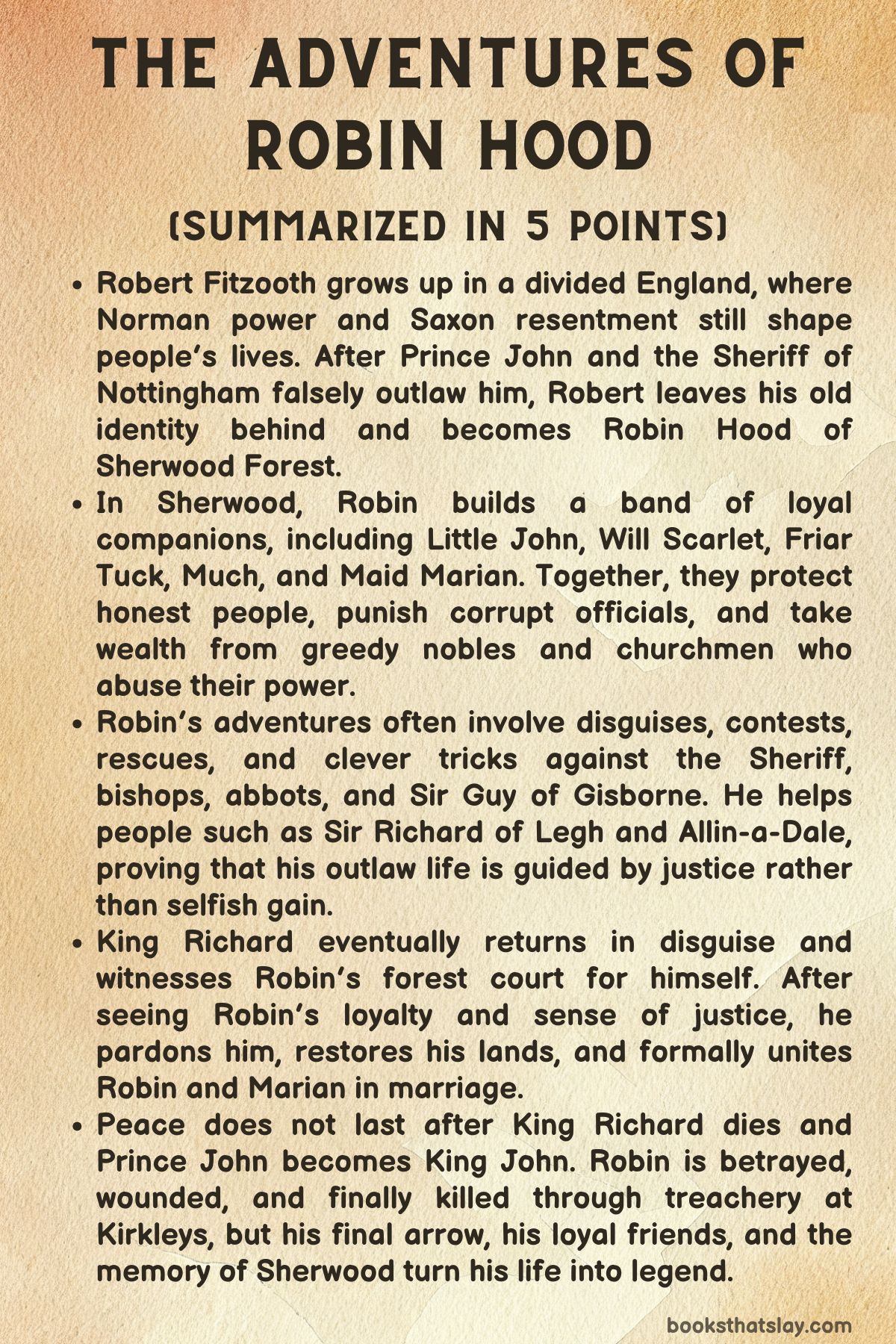
The Adventures of Robin Hood begins in a divided England after the Norman Conquest, when old Saxon families and newer Norman powers still distrust one another. William Fitzooth, a man of mixed Saxon and Norman blood, loves Joanna Gamwell, but her father, Sir George, rejects him because of his lineage.
William and Joanna marry secretly and flee to Sherwood Forest when Joanna is expecting a child. Sir George pursues them in anger, but the sight of the newborn child softens him.
He forgives the couple, names the child Robin from Robert Fitzooth, and charges him to remain true to England and help those in need.
Years later, King Richard is away on crusade, and his brother Prince John abuses the kingdom in his absence. John, the Sheriff of Nottingham, corrupt churchmen, and ambitious nobles use the law as a weapon to seize property and punish the weak.
Robert Fitzooth, known by many as Robin Hood, is still living as a nobleman, but he is loyal to King Richard and sympathetic to the oppressed. When Much the Miller is killed after taking a deer to feed his family, Robin’s household becomes tied to open resistance.
Worman, Robin’s treacherous steward, helps Prince John and the Sheriff build a case against him.
During Robin’s wedding to Marian Fitzwalter, Prince John’s men interrupt the ceremony and declare him an outlaw. Robin accepts the end of his old identity and embraces the name Robin Hood completely.
He escapes with his followers into Sherwood Forest, while Marian is sent back to her father. In the forest, Robin gives his men freedom to leave, but many stay.
He declares that they will fight extortioners, tyrants, false priests, and men who abuse power. They will not harm honest folk, but they will take from those who gained wealth through cruelty and corruption.
Robin’s band grows into a community with its own rules, loyalty, and sense of justice. Will Scarlet is rescued from hanging after being captured while recovering Robin’s hidden treasure.
Little John joins after defeating Robin in a staff fight on a narrow bridge, proving both his strength and his good spirit. Friar Tuck enters the band after matching Robin in wit and physical courage.
Marian, refusing to remain confined by her father or threatened by Sir Guy of Gisborne, escapes in disguise and reaches Sherwood, where she becomes the Maiden Queen of the forest.
Many of Robin’s adventures show his unusual code of justice. Sir Richard of Legh, an honest knight, has lost his wealth because he ransomed his son from the crusades and borrowed money from the greedy Abbot of St. Mary’s.
Prince John’s tax collectors have taken the money Sir Richard saved, and the Abbot hopes to seize his lands. Robin lends Sir Richard the money he needs, trusting his honor.
Later, when Robin captures corrupt monks carrying treasure for Prince John, he takes their money and considers Sir Richard’s debt paid by the very churchman who tried to ruin him.
Robin repeatedly outwits the Sheriff of Nottingham, bishops, abbots, and Prince John’s agents. He attends an archery contest arranged by Prince John and wins the silver arrow, though his presence leads to a dangerous chase in which Little John is wounded.
Sir Richard shelters Robin and his men, honoring the laws of hospitality despite pressure from Sir Guy. When Sir Richard is later imprisoned unfairly, Robin and his allies secure his release.
Robin also disguises himself as a butcher, tricks the Sheriff into entering Sherwood, and robs him of the money he intended to spend on cattle.
The adventures are often humorous as well as dangerous. Robin and Little John disguise themselves as beggars to see who can return with greater spoils.
Robin saves three yeomen from execution, while Little John wins gold from false beggars. Robin meets Arthur-a-Bland, a tanner who hopes to capture him, but after tricks, drinking, and a long fight, Arthur joins the forest band.
Robin also helps Allin-a-Dale marry the woman he loves after the Bishop of Peterborough tries to force her into marriage with an old wealthy knight. Robin interrupts the wedding, replaces the bridegroom, and compels the Bishop to perform the proper ceremony.
As Robin’s fame spreads, his cause becomes more openly political. Rumors arise that King Richard has been captured and needs ransom money.
Robin begins gathering wealth for the rightful king, not for himself. He meets George-a-Greene, the strong Pinner of Wakefield, who proves powerful enough to defeat several of Robin’s men before joining him.
Marian forms a friendship with George’s wife, Bettris, and the band continues to grow through courage, loyalty, and shared opposition to John’s rule.
The story also contains episodes of magic and folklore. Mother Maudlin, the Witch of Paplewick, tricks and enchants people, creating confusion around Marian and the lost woman Earine.
Robin uncovers Maudlin’s deception, finds Earine alive, and restores happiness by bringing separated lovers together. This part of the story adds a strange, legendary atmosphere to Sherwood, where ordinary justice, old belief, forest mystery, and romance all exist side by side.
Darker events follow when Sir Guy of Gisborne becomes more dangerous. Robin dreams of danger and soon faces disaster.
Will Scarlet is killed, Little John is captured, and Sir Guy reveals himself while pretending to be a forester. Robin defeats and kills Sir Guy in single combat, then disguises himself to free Little John and other prisoners.
His grief over Will Scarlet’s death leads him to severe vengeance against the verderers who helped the Sheriff. This moment shows how the violence of the age hardens even a heroic figure.
King Richard eventually returns in disguise as a tall palmer. He encounters Robin, observes his forest court, and listens as Robin explains his life as an outlaw.
Robin insists that his men do not prey on the honest but oppose the powerful who use law as theft. During the same episode, Prince John enters Sherwood and tries to seize Marian, but Robin wounds and captures him.
The palmer reveals himself as King Richard, pardons Robin, restores his lands and titles, and finally completes Robin and Marian’s marriage in Sherwood Forest.
For a time, Robin and Marian live peacefully. Many of the merry men follow King Richard into later wars, while Robin trusts that his royal pardon protects him.
But Richard dies, and Prince John becomes King John. John tricks Robin into coming to Nottingham Castle and has him sealed inside a tower.
Robin sounds his silver bugle-horn, and Little John rescues him with a rope shot by arrow, but Robin falls and suffers a lasting internal injury. He escapes with Marian and his friends, kills the Sheriff during the chase, and sends Marian to the Nunnery of Kirkleys for safety.
Robin flees alone and reaches the coast, where he disguises himself as a poor fisherman named Simon Lee. Though he is poor at fishing, he proves his courage when French pirates attack the boat.
He rallies the fishermen, defeats the pirates, and helps divide their treasure fairly. Yet he remains hunted and weakened, unable to return openly to his old life.
In the final stage of the story, Robin reaches Kirkleys, where Marian has taken refuge. The Prioress, desiring Marian’s property for the nunnery, lies to Robin and says Marian has gone.
Pretending to treat him, she opens his vein and leaves him to bleed. Robin realizes too late that he is dying.
He sounds his horn one last time, and Little John and Marian come to him. Robin asks for his bow and says he should be buried where his final arrow lands.
He dies in their arms.
Marian remains at the nunnery and later becomes a respected Prioress named Matilda. Little John disappears into legend.
Years later, King Henry III becomes lost in Sherwood Forest and meets two hermits who share food and display extraordinary archery skill. The king realizes afterward that he has dined with Little John and Friar Tuck, though he can never find them again.
The story ends with Robin’s world passing into memory, where Sherwood remains a place of justice, loyalty, friendship, and enduring legend.
Characters
Robin Hood
Robin Hood begins life as Robert Fitzooth, a child born out of private love and public division. His mixed Saxon and Norman heritage places him between two worlds, and this background helps explain why he is not driven by narrow tribal pride.
He is raised with a larger ideal of England, and that ideal becomes the moral center of his life. In The Adventures of Robin Hood, he is not merely a rebel against authority; he is a rebel against corrupted authority.
His outlawry begins when Prince John and the Sheriff use the law falsely, turning loyalty to King Richard and sympathy for the poor into crimes. Once Robin becomes an outlaw, he does not collapse into bitterness.
He creates a new order in Sherwood, with rules, loyalty, shared meals, religious devotion, and a fierce distinction between honest people and oppressors.
Robin’s courage is physical, but it is also moral. He fights armed men, competes in contests under threat of capture, rescues prisoners, and faces Sir Guy of Gisborne in deadly combat.
Yet he also trusts people when trust seems risky, as shown in his treatment of Sir Richard of Legh. He understands honor and recognizes it in others.
His generosity is not sentimental; it is practical, daring, and often dangerous. At the same time, the book does not make him flawless.
He loves contests, disguises, wagers, and bold tricks, and his taste for danger sometimes puts others at risk. After Will Scarlet’s death, his vengeance against the verderers shows the darker edge of grief and war.
Robin’s greatness lies in the fact that he remains committed to justice even while living outside the law, and his tragedy lies in the fact that a man so alive in the forest is finally destroyed by treachery, injury, and a ruler’s revenge.
Maid Marian
Maid Marian is one of the strongest figures in the book because she refuses to be treated as a passive reward in Robin’s story. Her love for Robin is constant, but she is not defined only by romance.
When her father tries to separate her from Robin, she resists with clear will and sharp intelligence. She understands the danger of Prince John’s world and chooses the freedom of Sherwood over the safety and status of noble confinement.
Her escape in disguise shows that she has courage, skill, and independence. When Robin meets her without recognizing her, their fight proves that she can stand beside him in action, not only in affection.
Marian also brings dignity and balance to the forest community. As Maiden Queen of Sherwood, she is a symbolic partner to Robin’s leadership.
She softens some of the rougher edges of the outlaw world without weakening it. She is capable of friendship, as seen with Bettris, and capable of direct defiance, as seen when Prince John tries to seize her.
Her strike against John and her refusal to submit to him show her political courage as well as personal bravery. Marian’s final arc is deeply sad because she survives Robin but remains tied to him in memory.
Her later life as Matilda at Kirkleys suggests discipline, endurance, and sorrow transformed into spiritual authority. She is not just Robin’s beloved; she is one of the moral pillars of the story.
Little John
Little John enters the book through strength, humor, and equality. His first meeting with Robin is important because he defeats him honestly.
This establishes a relationship based not on blind obedience, but on mutual respect. Robin can laugh at his own defeat and welcome the man who bested him, while Little John can recognize leadership without surrendering his own pride.
Their friendship becomes one of the emotional foundations of The Adventures of Robin Hood. Little John is physically powerful, but his loyalty matters even more than his strength.
He stands by Robin through danger, injury, exile, and the final moments of Robin’s life.
Little John also provides a lively contrast to Robin. He enjoys tricks, contests, and arguments, and his rivalry with Robin during the beggar episode shows his competitive nature.
Yet he is never merely comic. When wounded, he urges Robin to leave him behind, showing courage and selflessness.
When Robin is trapped by King John, Little John answers the horn and saves him. At Robin’s death, he is present not as a servant, but as the truest companion of a lifetime.
His later disappearance into legend suits him. He belongs to Sherwood so completely that he seems less like a man who dies in ordinary fashion and more like a living remnant of Robin’s age.
Friar Tuck
Friar Tuck, first known as Brother Michael, represents the difference between true religion and corrupt church power. The book contains many churchmen who are greedy, cowardly, or politically compromised, but Friar Tuck stands apart from them.
He is rough, funny, strong, hungry, and sometimes absurd, yet he has moral clarity. His early defense of Robin and Marian shows that he values justice over obedience to powerful men.
When he is cast out, his loss becomes Sherwood’s gain. His later meeting with Robin at the river is comic and physical, but beneath the joke is a test of spirit.
Tuck proves he is no weak or false holy man.
His presence in the forest gives Robin’s band a spiritual dimension. He blesses, eats, fights, drinks, jokes, and rebukes in equal measure.
He is not a polished court priest; he is a man of the people, and that makes him suitable for Robin’s world. When he takes money from frightened priests for King Richard’s ransom, the scene exposes the hypocrisy of church wealth while allowing Tuck to act as a corrective force.
He is one of the book’s great comic figures, but his comedy does not reduce him. Instead, it makes him warmer, earthier, and more human.
By the end, when King Henry unknowingly meets him as a hermit, Tuck has become part of the lingering spirit of Sherwood.
Will Scarlet
Will Scarlet is brave, loyal, and sharp-eyed, and his role is especially important early in the story. He senses danger when Much the Miller is killed and brings Much’s son back to Robin’s manor.
His actions help connect Robin’s private life to the larger injustice spreading under Prince John. Will is also bold enough to return to Locksley Hall after Robin’s outlawry and recover hidden treasure.
His capture and rescue show both his courage and his value to the band. He refuses to accept Worman’s betrayal quietly and calls treachery by its proper name even when facing death.
Will’s death later in the book marks one of the story’s major shifts from adventurous resistance to lasting cost. Until that point, many dangers are escaped through wit, disguise, archery, or sudden rescue.
Will’s killing reminds the reader that Robin’s war against corrupt power is not a game. His death wounds the fellowship and changes Robin’s mood.
Robin’s harsh revenge after losing Will shows how deeply the bond among the merry men runs. Will Scarlet’s life in the book is shorter than Robin’s or Little John’s, but his courage, loyalty, and death leave a deep mark on the moral and emotional direction of the story.
Prince John and King John
Prince John is the central political villain of the book. While King Richard is away, John turns absence into opportunity.
He uses law, taxation, accusation, and fear to enrich himself and weaken those loyal to Richard. His cruelty is not impulsive alone; it is organized.
He works through sheriffs, bishops, abbots, knights, stewards, and armed men. This makes him dangerous because he turns institutions into tools of theft.
His hatred of Robin grows because Robin exposes him repeatedly. Robin does not merely rob John’s allies; he humiliates the system John depends on.
As King John, his villainy becomes even more direct and personal. Once he has the crown, he uses royal authority to take revenge.
His imprisonment of Robin in the tower is one of his coldest acts because it is secretive, cowardly, and designed to erase Robin without fair combat. John’s weakness is also clear.
He is vindictive, insecure, and often dependent on agents who fail him. He can threaten Marian, pursue Robin, and command soldiers, but he cannot command love, loyalty, or legend.
In The Adventures of Robin Hood, John represents power without honor, and his failure is measured not only in lost battles, but in his inability to destroy what Robin means to the people.
The Sheriff of Nottingham
The Sheriff of Nottingham is one of the most persistent enemies in the story. He represents local authority corrupted by greed and fear.
Unlike Prince John, who stands at the center of national ambition, the Sheriff is the everyday face of oppression. He enforces cruel punishments, helps declare Robin an outlaw, pursues prisoners, and repeatedly tries to capture the men of Sherwood.
His authority depends on intimidation, but Robin turns that intimidation into ridicule again and again. The butcher episode is especially humiliating for him, as Robin tricks him into entering the forest and robs him under the cover of hospitality.
The Sheriff is not presented as grand or noble in evil. He is smaller than that: spiteful, greedy, and often foolish.
Yet his foolishness does not make him harmless. He is involved in executions, arrests, pursuits, and the machinery that punishes the poor while protecting the powerful.
His final death during Robin’s escape from King John brings an end to a long conflict. It also feels fitting because the Sheriff has spent the book hunting Robin through unjust means, only to fall when Robin is himself wounded, hunted, and desperate.
He is a reminder that corrupt systems survive not only through princes, but through officials willing to carry out their will.
Sir Guy of Gisborne
Sir Guy of Gisborne is a darker and more martial enemy than the Sheriff. He is dangerous because he combines personal hatred, skill in arms, and a willingness to use Marian as bait.
From the moment Robin is outlawed, Sir Guy becomes one of the chief figures of pursuit. He is not content with legal condemnation; he wants capture, humiliation, and death.
His interest in Marian also gives his villainy a personal and threatening quality. He tries to enter Robin’s life through its most vulnerable emotional bond.
Sir Guy’s oath to Marian after she defeats him could have marked a turning point, but he remains tied to violence and pursuit. His final confrontation with Robin is shaped by disguise and dishonor, as he appears as a forester while seeking Robin’s death.
Robin appeals to knightly honor and forces the fight into open sword combat, which reveals a central contrast between the two men. Robin, though an outlaw, insists on fair combat; Sir Guy, though a knight, is willing to rely on deception.
His death closes one of the book’s fiercest rivalries. He stands for corrupted chivalry, the kind that keeps the appearance of nobility while abandoning its moral duties.
Sir Richard of Legh
Sir Richard of Legh is one of the clearest examples of honor under pressure. He is poor not because he has been foolish or wicked, but because he has acted as a father and a Christian knight by ransoming his son.
His vulnerability exposes the cruelty of the Abbot of St. Mary’s and Prince John’s tax collectors. When Robin meets him, Sir Richard has almost nothing, but he still has truth.
Robin recognizes this and responds with trust. The loan Robin gives him is more than financial help; it is an act of moral recognition.
Sir Richard later proves worthy of that trust. He tries to repay Robin and shelters him after the archery contest, even when doing so could bring danger.
His defense of hospitality against Sir Guy shows that he takes chivalric duty seriously. He is an important contrast to false nobles and corrupt churchmen.
He does not have Robin’s daring or outlaw freedom, but he has steadiness, gratitude, and courage. Through Sir Richard, the book shows that justice requires alliances between the wronged, the honorable, and the brave.
Worman
Worman is a traitor whose actions help push Robin from nobleman to outlaw. As Robert Fitzooth’s steward, he should owe loyalty to his lord, but he chooses self-interest and alliance with Prince John.
His betrayal is especially ugly because it comes from within Robin’s own household. He does not simply stand on the opposing side; he sells knowledge, twists events, and helps the powerful destroy a man he served.
His killing of Much the Miller also links him directly to the suffering of the poor.
Worman’s importance lies in the kind of villainy he represents. He is not a prince, bishop, sheriff, or knight.
He is a servant who tries to rise by betraying trust. In a book built around fellowship, loyalty, and chosen bonds, Worman is the opposite of the merry men.
He uses nearness as a weapon. His death by hanging under Robin’s command is harsh, but within the story’s moral order, it answers his treachery.
Worman shows that oppression needs informers and betrayers as much as it needs rulers.
The Abbot of St. Mary’s and Corrupt Churchmen
The Abbot of St. Mary’s represents greed disguised as holiness. His treatment of Sir Richard of Legh reveals a complete failure of charity.
Instead of helping a struggling knight who borrowed money for a noble cause, he hopes to seize his lands. His conduct is made worse by the fact that he hides behind religious authority.
The High Cellarer and other church officials tied to Prince John continue this pattern, carrying money, messages, and influence in support of unjust power.
The book does not attack faith itself. Friar Tuck and Brother Michael show that true religious life can be brave, generous, and joyful.
The corrupt churchmen are condemned because they betray the values they claim to represent. They use sacred office for wealth, fear, and political advantage.
Robin’s treatment of them often has a comic edge, especially when he forces them to dine, pay, sing, or dance, but the humor carries a serious judgment. Their corruption makes Robin’s outlaw justice appear more righteous than official respectability.
King Richard
King Richard is the rightful king whose absence creates the disorder of the story and whose return briefly restores justice. For much of the book, he is more ideal than active presence.
Robin’s loyalty to him gives political meaning to the outlaw cause. The money taken from corrupt men is often justified as service to Richard, especially when rumors spread of his capture and ransom.
Richard represents a vision of kingship tied to courage, legitimacy, and honor.
When Richard appears disguised as a tall palmer, he tests Robin’s world before revealing himself. This is important because he does not simply pardon Robin out of distant royal grace; he sees the forest order for himself.
He hears Robin explain his principles, watches the fellowship, and understands the difference between criminal greed and resistance to tyranny. His pardon, restoration of Robin’s lands, and marriage of Robin and Marian bring the story to its highest moment of public justice.
Yet Richard’s later death also exposes the fragility of that justice. Without a good king, Robin’s safety vanishes.
Much the Miller’s Son
Much the Miller’s son begins as a figure shaped by loss. His father is killed after taking a deer to feed his family, and that event reveals the cruelty of Forest Law under Prince John’s agents.
Much’s son is brought into Robin’s orbit through tragedy, and his presence helps make Robin’s resistance personal. The injustice is not abstract; it has a child’s face, a dead father, and a family harmed by power.
As he becomes part of the merry men, Much’s son proves useful, loyal, and brave. He helps carry information, assists in rescue plans, and takes part in the life of Sherwood.
His character shows how Robin’s band gathers not only strong fighters and comic companions, but also people wounded by the system they oppose. He is part of the social meaning of the book: the forest becomes a refuge for those whom official law has failed or harmed.
Allin-a-Dale
Allin-a-Dale brings music, romance, and storytelling into Robin’s world. His personal sorrow over being denied marriage to the woman he loves gives Robin another chance to correct an injustice.
The Bishop’s attempt to force the young woman into marriage with an old rich knight is an abuse of guardianship and church authority. Robin’s intervention turns a cruel ceremony into a rightful union.
Allin’s happiness is restored not through private luck, but through communal action.
After his wedding, Allin becomes the singer of Robin’s deeds. This role is important because legends survive through voices like his.
He turns action into memory, and memory into song. In a story so concerned with fame, reputation, and the passing of Robin’s world into legend, Allin helps explain how Robin becomes more than a man.
He is not one of the strongest fighters, but he carries the emotional and cultural life of Sherwood.
Themes
Justice Outside the Law
Justice in The Adventures of Robin Hood often stands apart from official law because the law has been captured by selfish rulers and their servants. Prince John, the Sheriff, corrupt bishops, abbots, and armed officers use legal language to excuse theft, imprisonment, forced marriage, and execution.
Against this, Robin builds a rough but principled justice in Sherwood. His men take from those who gained wealth dishonestly, protect the poor, rescue the condemned, and honor those who act truthfully.
This creates a central tension: Robin is legally an outlaw, yet morally he often behaves more justly than those who hold office. The book asks readers to consider whether obedience remains virtuous when authority itself becomes corrupt.
Robin’s forest court is imperfect and sometimes violent, but it is guided by recognizable ethical rules. Honest travelers are respected, poor people are helped, and greedy officials are punished.
The theme becomes especially powerful because Robin does not reject order altogether. He remains loyal to King Richard and wants rightful authority restored.
His rebellion is not against justice, but against the misuse of justice’s name.
Loyalty, Fellowship, and Chosen Community
Sherwood Forest becomes more than a hiding place; it becomes a chosen community built on loyalty. Robin’s followers are not held by rank, salary, or fear.
In fact, when Robin first becomes an outlaw, he releases his men from obligation and allows them to leave. Those who stay do so freely, and that choice gives the fellowship its emotional strength.
Little John, Will Scarlet, Friar Tuck, Much, Marian, Allin-a-Dale, George-a-Greene, and others join through tests of courage, gratitude, friendship, or shared injustice. The group is held together by meals, oaths, songs, jokes, contests, rescues, and mourning.
This loyalty is active, not decorative. Robin carries Little John when he is wounded; Little John rescues Robin from King John’s tower; Marian leaves noble safety for the forest; Friar Tuck stands with the outlaws against corrupt churchmen.
The fellowship also has a cost. Will Scarlet’s death shows that love within a band makes loss sharper.
Still, the community endures because its bonds are stronger than fear. Sherwood becomes a model of belonging based on trust rather than inheritance.
Power, Corruption, and False Respectability
Many of the book’s villains appear respectable on the surface. Prince John is royal, the Sheriff represents law, Sir Guy is a knight, and the abbots and bishops hold religious office.
Yet their actions reveal greed, cowardice, cruelty, and ambition. This contrast between appearance and reality is one of the story’s sharpest criticisms.
The people who should protect England instead prey upon it. They declare men outlaws to steal estates, punish hungry families for taking deer, force marriages for money, and use church wealth for political schemes.
Robin’s disguises often expose their false respectability. When he becomes a butcher, beggar, palmer, or minstrel, he uses lowly appearances to reveal the moral poverty of those above him.
The book repeatedly shows that title and virtue are not the same thing. A poor knight may be honorable, a friar may be truer than an abbot, a forest outlaw may serve England better than a prince.
This theme gives the story lasting force because it challenges the reader to judge people by conduct rather than costume, office, or social rank.
Legend, Memory, and the Passing of Heroic Time
The story gradually moves from lively adventure into elegy, showing how heroic lives become legend. Early episodes are full of contests, tricks, disguises, rescues, and feasts, but later events grow darker.
Will Scarlet dies, King Richard’s protection disappears, King John takes revenge, and Robin is wounded in a way he never truly recovers from. The forest world that once seemed free and permanent begins to fade.
Robin’s final arrow turns his death into a symbolic act, choosing his resting place by the same skill that defined his life. Marian’s later life at Kirkleys, Little John’s disappearance, and the strange meeting between King Henry and the two hermits all show that Sherwood has moved from present reality into story.
The king can hear of Robin, dine with those who knew him, and sense the old magic of the greenwood, but he cannot fully recover it. Memory preserves what history cannot hold in ordinary form.
Robin’s life ends, but the values attached to him — courage, generosity, resistance, friendship, and love of freedom — remain alive through song, tale, and rumor.