A Good Animal Summary, Characters and Themes
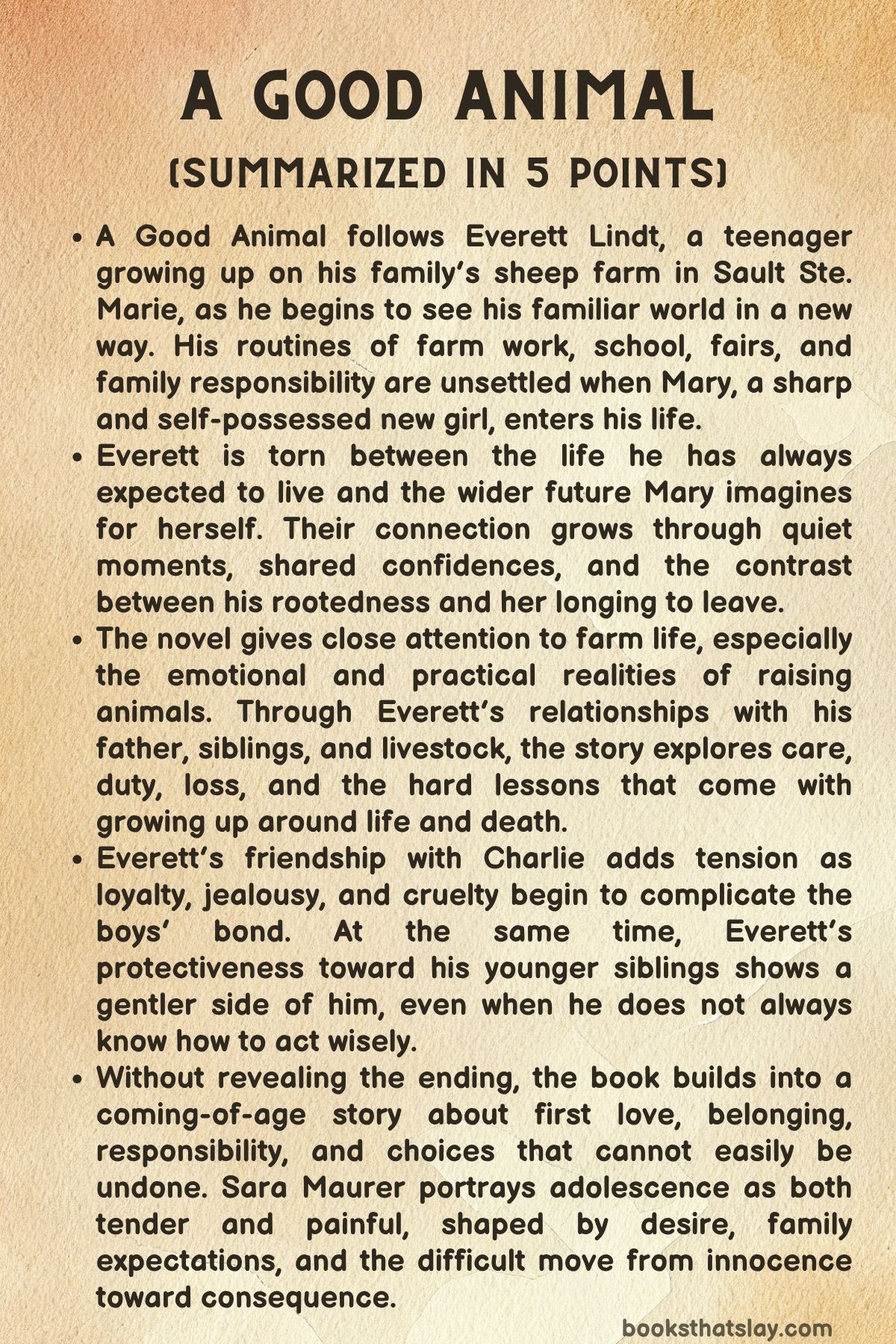
A Good Animal by Sara Maurer is a coming-of-age rural novel about love, responsibility, family, and the hard lessons of growing up on a farm. Set in Sault Ste.
Marie in the mid-1990s, the story follows Everett Lindt, a teenage sheep farmer whose life is shaped by land, livestock, and duty. When he meets Mary, a restless new girl with dreams beyond town, he is pulled between the future he expects and the life she wants to escape. The book explores first love without sentimentality, showing how tenderness, pride, fear, and poor choices can change a life forever.
Summary
Everett Lindt looks back on his youth from a later point in life, remembering his family’s sheep farm in Sault Ste. Marie and the people who shaped him there.
The land has belonged to the Lindts for generations, and Everett has always felt tied to it. Among all his memories, one person remains strongest: Mary, a girl he loved when he was seventeen.
He especially remembers one cold May night near the St. Marys River, a night that marked him permanently.
In the summer of 1995, Everett lives with his parents, his younger brother Jay, and his little sister Katie. His life is built around farm work, chores, sheep, hay, and the county fair.
When Roy Mason calls to say his hay is ready, Everett needs extra help and convinces his mother to let Jay rake hay for the first time. Everett and his best friend Charlie King work the fields while Jay handles the rake.
Charlie comes from a hog-farming family and is charming, loud, and often cruel without thinking much about it.
During lunch, Mason’s daughter Kylie arrives with food and brings Mary, a new girl staying in the Masons’ modular house while her Coast Guard father is stationed nearby. Everett is immediately attracted to her.
Mary has a calm confidence that sets her apart from the girls he knows. Charlie tries to impress her, but she does not respond the way he expects.
She mocks his hat and sees through his performance. Everett is fascinated.
Later, Charlie embarrasses Everett by exposing his farmer’s tan, and Mary notices the meanness beneath Charlie’s joking. Everett defends Charlie out of loyalty, but her comment stays with him.
Charlie later apologizes and even gets Mary’s phone number for Everett.
Everett works up the courage to call Mary, but she turns him down politely. She says she wants to focus on school and on getting out of town.
Everett is embarrassed, though he keeps hoping she may change her mind. As fair season arrives, Everett, Jay, and Katie prepare their 4-H lambs.
Katie loves her bottle lamb, Fluffernutter, deeply, while Everett worries she does not understand that market lambs are sold for slaughter. At the fair, Katie does well, but Everett has a disappointing show.
He sees that other families are using better breeding stock and realizes his father’s flock may be behind. He argues with his father and eventually gets permission to buy a ram of his own.
On sale day, Katie cannot bear to lose Fluffernutter. Everett first repeats a comforting lie that maybe someone will buy her as a pet, but when Katie is forced into the sale ring, he impulsively bids on the lamb himself.
He spends nearly all his savings to bring Fluff home. His father is angry, saying the lamb is poor breeding stock, but Katie is thrilled.
That same day, fair queen Stacy Harris notices Everett’s kindness and invites him to a livestock lock-in. Everett goes after drinking with Charlie.
Stacy flirts with him, and when Mary appears with Kylie, Everett drunkenly tries to make Mary jealous. He kisses Stacy later, but the encounter falls apart when he asks her to use his real name instead of a teasing nickname.
Afterward, he finds Mary stranded because Kylie has left with Charlie. Everett drives Mary home, and her gratitude renews his hope.
When school starts, Everett’s truck is broken, so he rides the bus and begins sitting with Mary every day. Their conversations grow personal.
Mary talks about her mother in Florida, her Coast Guard father, and her dream of leaving town for art school. Everett talks about farming, staying on the land, and building a show-lamb herd.
Once his truck is fixed, Mary agrees to ride with him and visit his farm.
Everett and Charlie travel south to a ram sale, where Everett buys a young Hampshire ram named Roman. His father criticizes the purchase because Roman is too young to breed that season, but Everett believes the ram can improve his future flock.
When Mary visits the farm, Everett shows her Roman, the old Lindt foundation stones, the ewes, and the creek where he and Katie find clay formations they call claybabies. Mary finds one shaped like a singing bird and treasures it.
Katie becomes jealous because Everett has shared their private place with Mary.
Everett and Mary grow closer. He takes her to Lake Superior, where they kiss and wade into the water.
Their relationship begins quietly, with both of them unsure but drawn to each other. Soon after, coyotes attack the flock.
Everett and his father find Fluffernutter badly injured but alive. Everett realizes he had noticed her limping earlier and forgotten to mention it.
His father makes him shoot her. They take the body to the farm’s dead-animal place.
Everett’s father lies to Katie, saying Fluff ran away, but Everett tells her the truth when she presses him. Katie demands to see the body, then screams when she sees the damage.
She accuses Everett of caring only about lambs and breeding while she truly loved Fluff. That night, Everett uses Fluff’s body as bait, waits with a rifle, and kills one of the coyotes.
Charlie learns about Everett and Mary from Kylie and feels betrayed that Everett kept it from him. Everett insists they are not officially dating, but Mary has already begun to change how he sees himself.
Their bond strengthens through autumn. Mary dislikes Charlie’s arrogance and is disturbed by the hogs at his family’s farm.
Everett keeps defending Charlie, though he increasingly wants his relationship with Mary to exist apart from everyone else.
As winter nears, Everett and Mary spend long hours driving together. Mary dreams of California and art school, while Everett wants to remain on the farm.
At an abandoned barn, they exchange spoken love notes and have sex for the first time. The experience makes Everett feel even more attached to her.
Mary’s father later warns him crudely, and Everett’s own father also cautions him, revealing that Everett was born because his parents were careless when they were young.
A December snowstorm keeps Everett home, where he unexpectedly enjoys time with his family. When he sees Mary again, she speaks more about her mother, Florida, and her memories of trying to hold her parents together.
Everett introduces her to his mother, but Mary feels uneasy with the warmth and questions. At Christmas, Everett gives her a Queen CD, and she gives him a drawing of Roman.
Before she leaves for Florida, they have sex again, and Everett asks to remove the condom briefly. This becomes a repeated risk.
On New Year’s Eve, Mary calls from Florida, and they say “I love you” for the first time.
After Mary returns, tension begins to build. Lambing season starts, and Mary sees Everett save a lamb during a difficult birth.
She admires his competence, but soon afterward he is late picking her up because he was helping revive frozen lambs. Mary snaps at him, and Everett misunderstands the deeper cause of her fear and frustration.
By March, Mary tells Everett she is three weeks late. They panic and agree to tell no one.
Everett imagines a future where they marry, work, raise the baby, and stay together on the farm. He buys her a cheap ring and presents this plan as if it can solve everything.
Mary agrees reluctantly, but Everett soon learns from Charlie that she has been accepted to art schools in California. During an argument at school, Everett lashes out at Charlie, exposing things Charlie said about Kylie.
Kylie breaks up with Charlie, and the two boys fight violently.
During a storm, Everett confronts Mary about California and their future. Mary admits she never wanted the life Everett planned.
She shows bruises on her belly and reveals she has been trying to end the pregnancy herself. She wants an abortion in Buffalo but does not have the money.
Everett promises to sell Roman, but Roman is killed when another ram gets loose. Desperate, Everett visits a veterinarian and learns about a drug used to stop pregnancies in sheep.
He realizes it might cause Mary to miscarry.
Everett tells Mary about the drug. At Rotary Island, she injects herself, then takes a second dose when nothing happens quickly.
She becomes sick, but refuses to go to the hospital. Everett takes her home and leaves a love note in her room.
Later that night, Mary comes to his farm carrying the remains of the miscarriage wrapped in his coat. Together, they bury it in the gully along with the engagement ring.
Mary tells Everett she liked him because he belonged somewhere, and she wanted to know what it felt like to be known. They hold each other one last time.
At dawn, Mary drives away, and Everett understands that their relationship, and the version of himself he had imagined with her, is over.
Characters
Everett Lindt
Everett Lindt is the central character of A Good Animal, and his emotional journey shapes the entire book. At seventeen, he stands between boyhood and adulthood, still rooted in the rhythms of his family’s sheep farm but beginning to face choices that are far heavier than the daily responsibilities he has grown up with.
Everett is hardworking, observant, and deeply attached to the land, yet he is also inexperienced in understanding people’s pain, especially when that pain does not fit into the practical farm logic he knows. His love for Mary becomes the force that unsettles his ordinary life.
At first, he sees her as mysterious and different, someone who seems to belong to a wider world beyond Sault Ste. Marie.
As their relationship deepens, his desire for her becomes mixed with a desire to hold onto her, to make her part of the life he has always imagined for himself.
Everett’s character is morally complicated because he is capable of tenderness and cruelty, honesty and avoidance, responsibility and dangerous immaturity. His love for Katie leads him to spend nearly all his savings to save Fluffernutter, showing his instinct to protect those he loves.
Yet he also forgets to report Fluff’s injury, lies before telling the truth, and later participates in choices that bring severe emotional and physical consequences for Mary. His farming background makes him practical and competent around animals, but that same practicality becomes dangerous when he applies animal medicine and farm solutions to a human crisis.
Everett is not written as a villain; instead, he is a young person whose limited understanding, fear, and desperation lead him into decisions he cannot undo. By the end of the book, he is marked by memory, guilt, and the knowledge that love without true understanding can become possessive and harmful.
Mary
Mary is one of the most emotionally significant and complex figures in the book. She enters Everett’s world as an outsider, someone who has moved into the area because of her father’s Coast Guard posting, but she never fully belongs there.
Her dark hair, confidence, and sharp intelligence immediately attract Everett, yet what makes her memorable is not simply her beauty or mystery. Mary is restless, guarded, and determined to escape the limitations of the town.
Her dream of art school and California reveals her hunger for a life shaped by self-expression rather than obligation. Unlike Everett, who feels anchored by land, family, and farm inheritance, Mary is defined by movement, instability, and the need to leave.
Mary’s relationship with Everett is tender but also deeply fragile. She is drawn to him because he seems steady, present, and rooted in a way her own parents have not been.
Everett’s farm life offers her a glimpse of belonging, and for a time she seems to find comfort in his reliability. However, Mary never truly wants the future Everett imagines for them.
When she becomes pregnant, the difference between their desires becomes impossible to ignore. Everett imagines marriage, work, and staying; Mary sees that future as a trap that would destroy the life she has been trying to reach.
Her attempt to end the pregnancy shows her desperation, fear, and isolation. Mary’s tragedy comes from being young, unsupported, and forced into an impossible situation where every choice seems to cost her something.
By the end, she understands Everett more clearly than he understands her, and her departure is both an escape and a wound.
Charlie King
Charlie King is Everett’s best friend, but he also functions as a test of Everett’s loyalty, insecurity, and moral awareness. Charlie is confident, loud, charming, and often cruel in casual ways.
He knows how to dominate social situations, flirt with girls, and make Everett feel small without always seeming to recognize the damage he causes. His humiliation of Everett in front of Mary exposes the imbalance in their friendship.
Everett often excuses Charlie’s behavior because they have grown up together and because Charlie’s boldness fills a space Everett cannot easily occupy himself. Yet Mary sees Charlie’s cruelty quickly, and her reaction forces Everett to question what he has accepted as normal.
Charlie is not simply a bully; he is also insecure, jealous, and emotionally careless. His anger when he learns about Everett and Mary shows that he expects access to Everett’s private life and feels betrayed when he is excluded.
His relationship with Kylie reveals his selfishness, especially when Everett exposes the way Charlie has spoken about her. The fight between Everett and Charlie marks the collapse of a boyhood friendship that could not survive the pressures of love, secrecy, and pride.
Charlie represents the rough social world Everett comes from, a world where boys prove themselves through mockery, toughness, and competition. His presence helps show how difficult it is for Everett to separate loyalty from habit and friendship from harm.
Katie Lindt
Katie Lindt is Everett’s little sister, and she brings innocence, emotional honesty, and moral clarity into the book. Her attachment to Fluffernutter is one of the clearest signs that she does not yet fully understand the brutal realities of farm life.
To Everett and his father, animals can be loved and cared for while still being part of a system of breeding, selling, slaughter, and death. To Katie, Fluff is not livestock in that practical sense; Fluff is a beloved companion.
This difference gives Katie’s character much of her emotional power. She sees love as something that should protect completely, while the adults and older boys around her live in a world where love often coexists with loss.
Katie’s grief over Fluff’s sale and later death exposes the emotional cost of the farm’s hard logic. Everett’s decision to buy Fluff back is one of his most loving actions, but Katie later recognizes that even this kindness is not pure in the way she wants it to be.
When she accuses Everett of wanting Fluff for lambs while she truly loved her, she forces him to confront the mixed motives behind his actions. Katie may be young, but she is not simple.
Her pain reveals truths that older characters try to soften, hide, or rationalize. Through Katie, the book shows how childhood innocence is not weakness; it can be a form of moral perception that sees through adult compromise.
Jay Lindt
Jay Lindt, Everett’s younger brother, represents the stage of boyhood just before deeper responsibility fully arrives. At twelve, he is eager to be useful on the farm and proud to take on work such as raking hay for the first time.
His role shows how farm children are gradually trained into adult labor, often before they fully understand the weight of that labor. Jay wants recognition, and his presence reminds readers that Everett was once like him: younger, eager, and still learning how the family’s world operates.
Jay also plays the role of an observer inside the Lindt household. He notices Everett’s relationship with Mary and exposes it to their father, not necessarily out of malice but out of the bluntness and mischief of a younger sibling.
His character adds realism to the family dynamic. He is not central to the romantic tragedy, but he helps show the environment Everett comes from: a home where privacy is limited, work is shared, and growing up means being folded into the farm’s responsibilities.
Jay’s importance lies in the way he reflects Everett’s past and hints at the next generation being shaped by the same land, habits, and expectations.
Katie and Jay’s Mother
Everett’s mother is a quieter presence in the book, but she represents warmth, domestic stability, and the emotional center of the Lindt family. She is the parent who can be persuaded to let Jay help with haying, and she is also the figure whose kindness unsettles Mary when Mary visits the house.
Her warmth stands in contrast to Mary’s fractured family life. For Everett, his mother’s care is ordinary enough that he may not fully recognize its value.
For Mary, that same warmth feels strange and uncomfortable because it highlights what she has lacked.
The mother’s role is important because she helps define the world Everett assumes is permanent. The Lindt household is not perfect, but it has continuity, shared meals, family labor, and a sense of belonging.
Mary’s discomfort around Everett’s mother reveals the emotional distance between Mary’s life and Everett’s. The mother does not need dramatic scenes to matter; her presence shows what Everett takes for granted and what Mary both longs for and resists.
She is part of the rooted family structure that makes Everett feel secure, but that same structure can feel suffocating to someone who wants escape.
Everett’s Father
Everett’s father is practical, stern, and deeply shaped by the demands of farming. He loves his family, but his love often appears through correction, warning, labor, and hard lessons rather than open tenderness.
He criticizes Everett’s choices, especially the decision to buy Fluff back and the purchase of Roman, because he views animals through the lens of breeding value, productivity, and survival. His anger is not random; it comes from the pressure of keeping a farm alive and from knowing that sentiment can be costly.
Yet his harshness also creates distance between him and Everett, who wants his father’s respect but often receives judgment instead.
As a character, Everett’s father embodies the farm’s unforgiving wisdom. He understands death, breeding, weather, animal weakness, and human carelessness as part of one continuous reality.
When he makes Everett shoot Fluff, he forces his son to perform a brutal act of responsibility. When he warns Everett about Mary, sex, and consequences, he speaks from experience rather than abstract morality.
His revelation that Everett himself was the result of youthful carelessness complicates him, showing that he too once made impulsive choices that shaped the rest of his life. He is not merely strict; he is a man who has lived long enough to fear the consequences his son cannot yet fully imagine.
Roy Mason
Roy Mason is a practical farm neighbor whose hayfield brings Everett, Charlie, Kylie, and Mary together. His role in the book is brief but important because he helps create the first setting in which Everett sees Mary.
Roy belongs to the same rural network as the Lindts and the Kings, a world where labor, favors, and seasonal farm work connect families. His call about the hay sets the social and emotional plot into motion.
Roy also represents the ordinary adult structure around the younger characters. While the teenagers experience attraction, embarrassment, rivalry, and possibility, Roy’s world is one of work that needs doing.
This contrast matters because the book often places intense adolescent emotion against the plain background of farm labor. Roy is not a deeply explored emotional figure, but his presence helps establish the community Everett lives in: practical, interdependent, and shaped by weather, animals, and timing.
Kylie Mason
Kylie Mason is socially confident, flirtatious, and connected to both Mary and Charlie. She helps bring Mary into Everett’s orbit, and her interest in Charlie creates one of the book’s important secondary relationships.
Kylie’s character initially seems lighter than Mary’s, but she becomes significant because of the way Charlie treats her. Through Kylie, the book reveals Charlie’s carelessness and the emotional damage hidden beneath teenage flirtation and bravado.
Kylie also serves as a contrast to Mary. While Mary resists Charlie’s charm and sees through his arrogance, Kylie is more willing to be drawn into his attention.
This does not make Kylie foolish; rather, it shows how powerful Charlie’s confidence can be in their social world. When Everett exposes Charlie’s disrespectful comments about her, Kylie’s breakup with Charlie becomes a moment of self-respect.
Her character helps reveal that the boys’ private talk has real consequences for the girls around them. Kylie may not dominate the central plot, but she matters because she shows how casual cruelty can fracture relationships.
Stacy Harris
Stacy Harris, the fair queen, represents a possible but shallow alternative to Everett’s longing for Mary. She notices Everett after his act of kindness toward Katie, and for a moment she gives him the attention and validation he wants.
At the livestock lock-in, Everett uses Stacy partly to make Mary jealous, showing that his interest in Stacy is tangled with pride rather than genuine affection. Stacy becomes part of Everett’s attempt to perform confidence after Mary’s rejection.
Stacy is also important because she exposes Everett’s insecurity. When she calls him “Sheep Boy,” the nickname breaks the fantasy of the moment.
Everett wants to be desired as himself, not as a joke or novelty. His discomfort reveals how sensitive he is to being seen as lesser, rural, awkward, or unsophisticated.
Stacy is not portrayed as cruel in the same way Charlie can be, but her casual nickname reminds Everett of the social labels he cannot escape. Her role is brief, yet she helps show how badly Everett wants recognition and how much Mary’s opinion matters to him.
Ms. Weltzer
Ms. Weltzer, Everett’s English teacher, has a small but symbolically meaningful role. Her lesson about how a single word can alter a sentence becomes a way for Everett to understand Mary’s effect on his life.
In that moment, school language and emotional experience come together. Mary becomes, in Everett’s mind, the word that changes everything around her.
Ms. Weltzer’s importance lies less in her personal development and more in what her classroom moment reveals about Everett. He is not simply a farm boy without inner life; he thinks metaphorically, feels deeply, and tries to make sense of experience through language even if he often lacks the maturity to act wisely.
Ms. Weltzer’s lesson gives shape to Everett’s private realization that love has reordered his world. Her role shows how ordinary moments can become emotionally charged when a character is changing inside.
Mary’s Father
Mary’s father is a harsh and emotionally limited figure whose presence helps explain Mary’s guardedness. His Coast Guard assignment brings Mary into Everett’s town, but he does not provide the emotional steadiness she needs.
His crude warning to Everett reveals his suspicion, bluntness, and inability to speak with care. He sees danger in Everett’s relationship with Mary, but his way of addressing it is coarse rather than protective in a meaningful emotional sense.
Mary’s father contributes to Mary’s sense of instability. He is physically present in her life, unlike her mother, but presence alone is not the same as support.
His character helps explain why Mary is drawn to Everett’s reliability while also fearing the confinement of another life shaped by someone else’s expectations. He represents a form of authority that does not truly understand Mary.
Because of that, Mary moves through her crisis largely alone, unable to turn to the adults who should protect her.
Mary’s Mother
Mary’s mother is mostly absent, but that absence strongly shapes Mary’s character. Living in Florida and associated with Mary’s memories of family fracture, she represents abandonment, longing, and the unstable emotional history Mary carries with her.
Mary’s stories about her mother reveal a child who once tried to hold her parents together and failed. That failure becomes part of Mary’s deeper wound: she has learned that love does not guarantee staying.
The mother’s absence also helps explain Mary’s complicated reaction to Everett’s family. The warmth of the Lindt home is not simply comforting to her; it is painful because it reminds her of what she did not have.
Mary’s desire to leave for art school and California is not only ambition. It is also an attempt to create a life that is not defined by her parents’ brokenness.
Though Mary’s mother appears from a distance, she is central to the emotional background of Mary’s choices.
Fluffernutter
Fluffernutter is not human, but she is one of the most emotionally important presences in the story. As Katie’s bottle lamb, Fluff represents innocence, attachment, and the painful gap between loving an animal and raising livestock.
To Katie, Fluff is a companion. To Everett’s father, she is poor breeding stock.
To Everett, she becomes both a symbol of tenderness and a source of guilt. His decision to buy her back is loving, impulsive, and impractical all at once.
Fluff’s death after the coyote attack becomes one of the book’s most painful turning points. Everett’s failure to mention her earlier injury, his forced act of shooting her, and Katie’s devastated reaction all deepen the story’s concern with responsibility.
Fluff’s body also connects animal death to later human loss, especially through the repeated image of burial and the earth taking everything. Fluff is important because she makes the cost of love visible.
She shows that care does not always save what is loved, and that practical decisions can still leave emotional wounds.
Roman
Roman, Everett’s young Hampshire ram, represents Everett’s ambition and belief in his future as a farmer. Everett buys him because he wants to improve his flock and prove that he understands modern breeding better than his father thinks.
Roman is tied to Everett’s dream of building his own show-lamb herd and creating a place for himself within the family farm’s future. In that sense, Roman is more than livestock; he is Everett’s investment in adulthood.
Roman’s death is devastating because it destroys Everett’s plan at the exact moment when he most needs money to help Mary. The loss pushes Everett further into desperation and indirectly leads him toward the dangerous idea of using Lutalyse.
Roman’s fate shows how quickly Everett’s sense of control collapses. The animal that once represented his future becomes another reminder that plans can be ruined by accident, violence, and forces beyond human control.
Curly
Curly, the older ram, represents the established order of the Lindt farm. Unlike Roman, who carries Everett’s hope for improvement and independence, Curly belongs to the existing system controlled by Everett’s father.
When Curly is released to breed the ewes, he reflects the farm’s traditional cycle of reproduction, labor, and lambing. He is part of the predictable rhythm Everett has always known.
Curly becomes more symbolically important when he gets loose and Roman is killed. That event can be read as a collision between the old order and Everett’s attempted future.
Whether or not Curly is understood as blameworthy in any human sense, his role in Roman’s death intensifies the book’s pattern of animal violence shaping human choices. Curly’s presence reminds readers that farm life is not sentimental.
Animals are living forces with instincts, power, and consequences.
The Coyote
The coyote that attacks the flock is a figure of wildness, violence, and intrusion. It enters the farm world from outside and destroys the illusion that Everett can protect what matters to him.
The attack on Fluff is especially painful because Fluff has already been rescued once from the market system, only to be lost to a different kind of death. The coyote therefore becomes a symbol of the uncontrollable forces that break through human plans.
Everett’s decision to use Fluff’s body as bait and kill the returning coyote shows his grief turning into vengeance. Yet the act does not truly heal anything.
Burying Fluff, the coyote, and the blanket together creates one of the story’s strongest images of death and consequence. The coyote matters because it teaches Everett that violence answered with violence still leaves emptiness behind.
It prepares the emotional ground for the later burial in the gully, where love, loss, secrecy, and guilt come together.
Themes
Belonging and the Pull of Home
Everett’s life is shaped by the farm long before he can fully question it. The land is not just a place where his family works; it is the source of his identity, pride, duties, and future plans.
He understands sheep, weather, breeding, mud, loss, and exhaustion because these things have formed his sense of self. Mary, by contrast, has no stable home in the same way.
Her father’s Coast Guard life keeps her moving, and her mother’s absence leaves her emotionally unsettled. This contrast makes Everett attractive to her because he seems rooted, known, and claimed by a place.
In A Good Animal, belonging is shown as both comfort and trap. Everett’s attachment to the farm gives him purpose, but it also limits his imagination when Mary becomes pregnant.
He assumes that staying, marrying, and working harder can solve everything because that is the world he understands. Mary’s need to leave is not selfishness; it is survival.
Their love fails partly because they are pulled toward opposite ideas of safety.
Innocence, Responsibility, and Moral Growth
Everett begins with a young person’s confidence that he can manage the adult world around him. He thinks he can handle sheep, desire, friendship, family duty, and love through loyalty and effort.
Yet again and again, he is forced to see that responsibility is more painful than simply doing work. Buying Fluff back for Katie feels noble, but Fluff’s later death exposes how love cannot always protect what is fragile.
Telling Katie the truth shows Everett’s honesty, but it also hurts her deeply. His relationship with Mary pushes this pattern further.
He wants to be dependable, but his choices become dangerous when fear replaces judgment. The pregnancy forces him into decisions for which he has no maturity, money, or guidance.
His attempt to “fix” the situation with farm knowledge becomes tragic because animal care and human life are not the same. By the end, responsibility is no longer romantic or heroic.
It is the heavy knowledge that good intentions can still cause harm.
Love, Desire, and Misunderstanding
Everett’s love for Mary is sincere, but it is also shaped by longing, pride, and inexperience. From the beginning, he sees her as someone who changes the meaning of his ordinary life.
Their time together gives him confidence and tenderness, but it also makes him imagine a future before he truly understands what Mary wants. Mary cares for him because he keeps showing up for her, listens to her, and offers a steadiness she has rarely received from her parents.
Still, being loved by Everett does not erase her fear of being trapped. Their physical relationship deepens their bond, but it also increases the pressure between them.
Everett reads pregnancy as a crisis that can become marriage, work, and family. Mary reads it as the end of the future she has fought to imagine.
The tragedy of A Good Animal comes from this emotional gap. They love each other, but love does not give them the same dream, the same choices, or the same freedom.
The Harshness of Farm Life and the Reality of Loss
The farm teaches Everett that life and death exist side by side. Lambs are born in difficult conditions, animals are bred for value, market lambs are sold for slaughter, and weak creatures often do not survive.
These facts are ordinary to Everett, but the story shows how “ordinary” loss still leaves wounds. Katie’s attachment to Fluff exposes the emotional cost hidden beneath farm routines.
For adults, livestock may be practical property; for a child, one animal can become a loved companion. The coyote attack makes this conflict impossible to avoid.
Everett must shoot Fluff, face Katie’s grief, and carry the knowledge that his own forgetfulness may have contributed to the suffering. Later, Roman’s death destroys Everett’s hope of solving Mary’s problem by selling him.
The repeated deaths on the farm prepare the reader for the final burial in the gully, where private grief is treated with the same bleak finality as animal death. The land receives everything, but it does not comfort everyone equally.