Agnes Aubert’s Mystical Cat Shelter Summary, Characters and Themes
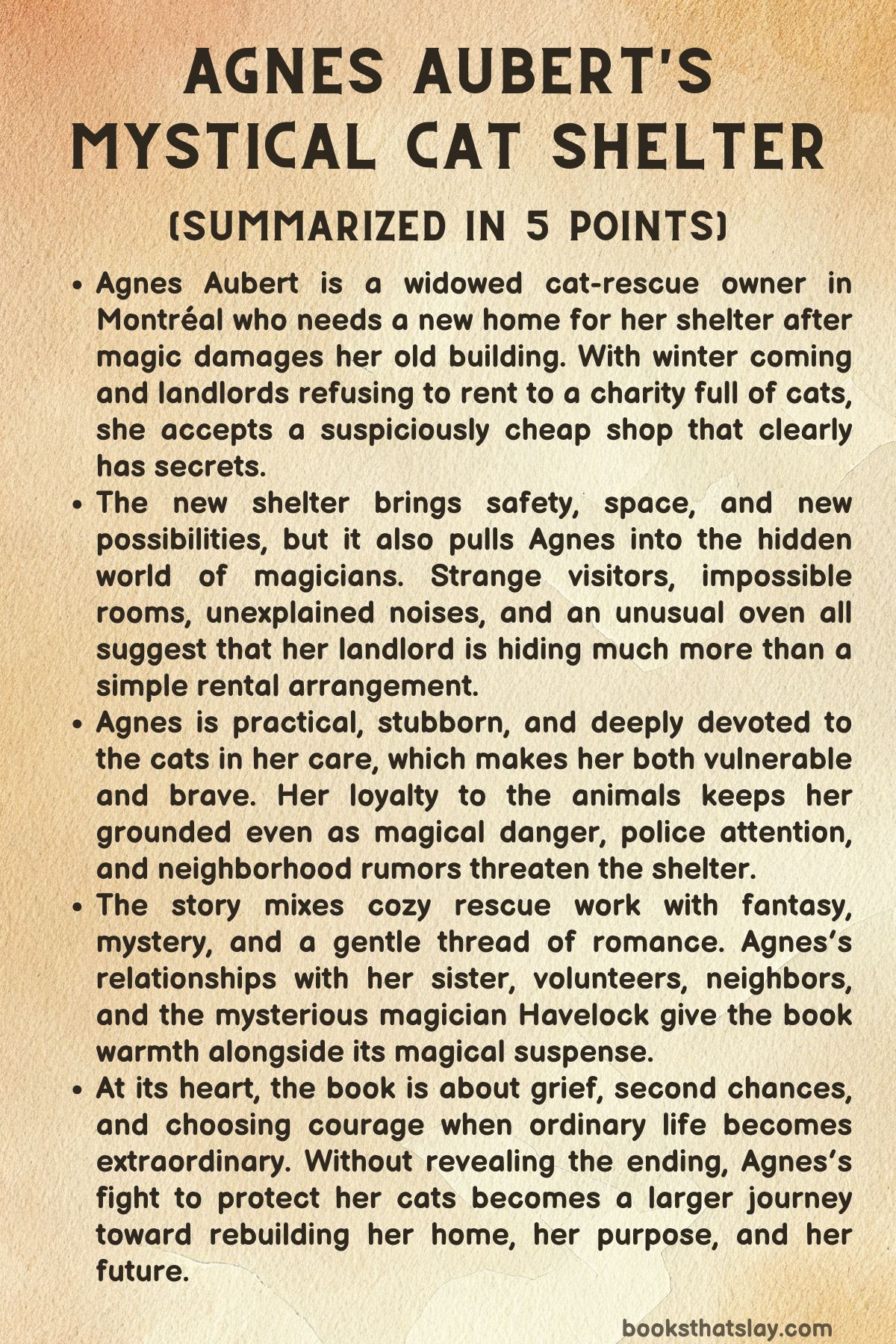
Agnes Aubert’s Mystical Cat Shelter by Heather Fawcett is a cozy fantasy novel about rescue work, loss, second chances, and the chaos that follows when ordinary kindness collides with dangerous magic. The story follows Agnes, a widowed cat-shelter owner in Montréal, as she tries to keep her animals safe after her shelter is damaged.
Her search for a new home leads her into the path of Havelock Renard, a feared magician hiding from his powerful sister. What begins as a practical fight for survival becomes a strange, funny, and tender adventure about courage, loyalty, and learning to risk love again.
Summary
Agnes Aubert is a widow who runs Les Amis des Chats, a small cat-rescue charity in Montréal. The shelter is more than a business to her; it is the work she built with her late husband, Robin, and it gives shape to her life after his death.
When a magical duel breaks out on Rue Sainte-Roseline, her shelter is badly damaged. A wall is blasted open, the heating is ruined, and winter is close.
Agnes urgently needs a new shop and living space, but finding a landlord willing to rent to a cat shelter proves almost impossible.
Her first serious hope is M. Levasseur, who owns a shabby shop with an apartment above it. He seems sympathetic when Agnes explains that magicians destroyed her old premises, but the moment she admits she houses cats, he refuses.
Agnes returns to the broken shelter, where she cares for her difficult but beloved animals, especially His Majesty, a bossy black cat who had been Robin’s favorite, and Banshee, a quiet tabby with strange habits. Agnes’s sister, Élise, tries to help.
Together they attempt a small lie with another landlord, Mathieu, pretending Agnes runs a typing business. The plan nearly works until Mathieu says he will check with someone who knows Agnes’s true business.
Agnes cannot keep lying and walks away.
Soon after, Agnes finds herself on Rue des Hirondelles, a street several people have mentioned with unease. There she meets Oksana, the wary owner of a neighboring bookshop, and discovers that the suspicious empty property is actually a former scarf shop.
Inside, she meets Yannick Abrams, an anxious young man acting for the landlord. The shop is large, oddly old-fashioned, and much grander than Agnes expects.
It has a mysterious oven, a sitting room, a trapdoor beneath a rug, and a beautiful apartment upstairs. The rent is unbelievably low, and Yannick admits previous tenants left suddenly.
Agnes senses that something is wrong, but she has no better choice. On her way home she finds two abandoned kittens, which settles the matter for her.
She accepts the shop because the cats need a place to live.
Agnes, Élise, and the shelter volunteer Mina move into Rue des Hirondelles. The new shelter is eerie, but it is warm and spacious.
Yannick helps with cleaning, and Agnes uses the leftover luxury scarves as bedding for the cats. At first, the move seems like a blessing.
Families begin adopting kittens, and the shelter can function again. Detective Laurent Rouzet visits, claiming he wants to know the local businesses, though Agnes senses he is curious about the property’s mysterious owner.
Strange things soon happen. The oven smells of fresh baking every morning though no one uses it.
Noises come from the basement. Elegant and unsettling visitors pass through the shop and vanish through the trapdoor.
Oksana warns Agnes that magicians are involved and that the neighborhood has learned to tolerate the situation quietly.
One night, Banshee wakes Agnes. Downstairs, Agnes finds Valérie, a glamorous and dangerous magician, holding one of the cats and looking for “Lock,” meaning Havelock Renard, the feared Witch King.
Valérie reveals that Havelock is hiding in the building with his Artefacts. She uses magic to tear the shop apart, smashing windows, cracking ceilings, and sending cages crashing down.
Agnes crawls through the chaos to free the cats. Then a monstrous shadow rises from the basement and becomes Havelock himself, barefoot and in pyjamas.
He and Valérie, who is his twin sister, battle with terrifying spells. Havelock defeats her for the moment, but he knows she will return.
To protect himself and the shelter, he uses a rushed spell to move the entire interior of the shop to a new location.
Agnes and the cats arrive violently on Rue Sainte-Sophie. The spell has stretched the shelter into a larger space, but it has left Agnes dizzy, the cats terrified, and everything in confusion.
Agnes is furious. Havelock has hidden his identity, brought danger to her door, and put the animals at risk.
He explains that Valérie believes he has a legendary Artefact: a book created by Alice Vortigern that allows travel into the past. If the book exists, a magician could recover spells from Vortigern’s lost library before it burned, gaining enormous power.
Havelock insists he does not have it.
The police arrive after neighbors report the strange noise of the relocation spell. Laurent is among them, which worries Agnes because he has seen her old shelter and some of the cats before.
Havelock disguises the animals and hides the magical evidence. Agnes lies, claiming this is a second branch of her charity.
The officers nearly notice the truth but eventually leave.
Havelock then goes into the Rivenwood, the dangerous forest world from which magic comes, to gather enough power to return the shelter to Rue des Hirondelles. Agnes sees his human form dissolve into something shadowy and fiery as he enters that world, and she faints.
When she wakes, she tells Élise what happened. Élise urges her to leave, reminding Agnes that Havelock is believed to have nearly caused an apocalypse years earlier.
Agnes refuses to abandon the cats. She also realizes that the new location, near wealthy businesses, could help the shelter grow.
The shelter begins operating in both locations, and the new shop becomes unexpectedly useful. Wealthy adopters arrive, including a man who adopts a difficult older cat and pays more than asked.
Agnes, Élise, Mina, and Yannick manage the growing work while Agnes tries to understand Havelock and his secrets. Yannick reveals he is Havelock’s apprentice.
Agnes searches Havelock’s chaotic basement workshop, finding stacks of magical objects, books, enchanted spiders, and strange Artefacts. She hopes to find Vortigern’s book, perhaps to give it to Valérie and end the danger.
Instead, Agnes finds Havelock wounded after a trip to the Rivenwood. Part of his leg has transformed into his shadow form.
She bandages him, and he explains that spectres are former magicians consumed by Rivenwood magic. He also reveals that Valérie was able to find him because a tracking spell is attached to Agnes and the cats.
They realize the book may be hidden somewhere among Havelock’s disorganized collection.
Agnes makes a bargain with Havelock. She will help him catalogue his Artefacts if he enchants shelter cats with harmless temporary charms.
Rumors have spread that the shelter sells magical cats, and Agnes sees a chance to turn that rumor into help for the animals. Havelock is skeptical, but Yannick believes simple charms can work: comfort, good sleep, pain relief, or household harmony.
Havelock agrees. As Agnes organizes the workshop, she becomes more involved in his world and more aware of her attraction to him.
The enchanted-cat plan succeeds wildly. Adopters come in large numbers.
One cat eases aches, another brings pleasant dreams, another encourages peace in a household. Donations rise, and even difficult cats find homes.
Yet the attention also draws danger. Laurent asks Agnes to attend the winter festival with him, and Agnes accepts, partly because he seems safer than Havelock.
Meanwhile, she learns the truth about Havelock’s past. He created the apocalypse spell as a young magician, but Valérie stole and unleashed it.
Havelock stopped the disaster by going deep into the Rivenwood and creating a spell to undo his own work.
Agnes and Havelock grow closer. One night they share éclairs produced by the mysterious oven, and she tells him about Robin’s sudden death.
Havelock admits he has been fighting Valérie’s apprentices across the city and repairing their damage. When he quietly heals the cats and removes their fleas, Agnes is overcome and kisses him, then runs away.
Soon, a newspaper claims the shelter is under investigation for trafficking enchanted cats. Rather than destroying the charity, the article makes the public even more eager to adopt.
But Valérie attacks again while Havelock is trapped in the Rivenwood. She puts Yannick to sleep, breaks through the wards, and brings apprentices.
Havelock escapes and fights them, but Valérie captures His Majesty and disappears. Agnes is devastated.
The city considers new police powers to search for magical Artefacts, putting the shelter in danger. Agnes learns that Laurent is also a magician and may have access to Vortigern’s lantern, an Artefact that can absorb magic.
Then Valérie finds a secret route into Havelock’s basement with help from His Majesty. She steals dangerous Artefacts and uses Agnes’s own notes to identify them.
Valérie seeks the time-travel book, and Agnes realizes the compass Valérie uses is not pointing downward into the workshop but upward toward the bakery oven. The book has been hidden in the soot, and its magic has been producing midnight pastries by turning the oven back to an earlier time.
Agnes uses the book in desperation and sends herself and Élise three years into the past, to the night of Havelock’s apocalypse. There, Agnes understands that future Havelock needs Vortigern’s lantern to defeat Valérie.
She and Élise go to Mount Royal, rescue a disabled black kitten, and encounter the younger Havelock while he is being hunted by other magicians. Agnes convinces him that the lantern will not stop the apocalypse and tells him he must enter the Fourth Fathom of the Rivenwood and create a twelve-layer partition spell.
Believing she is connected to Vortigern because she carries the book’s magic, he gives her the lantern and leaves.
On the way back, Agnes sees Robin alive in the past. The moment nearly breaks her, but she lets him go, choosing the life and responsibilities waiting for her in the future.
With help from the rescued kitten, Agnes and Élise find the tiny opening back to their own time and return.
Agnes brings the lantern to Havelock, who is cornered in his ruined workshop. He unleashes it, and the lantern absorbs magic from Valérie, her apprentices, the Artefacts, and the surrounding chaos.
Valérie survives but loses her power and later escapes with His Majesty. The arrests Agnes feared never happen.
Public opinion shifts after people learn Havelock defended the neighborhood. The bylaw is delayed and quietly dropped.
Donations and adoptions pour into the shelter, allowing Agnes to expand her work. Laurent apologizes and adopts Ambulance, the loud orange tabby.
Two weeks later, the shelter is thriving. Agnes keeps Thoreau and the rescued black kitten, now named Cataclysm.
Havelock, awkward but changed, makes an illusion of birds for the cats and reveals that he has connected the shelter attic to Paris. Agnes realizes he is trying to apologize and ask her out.
She suggests coffee. Havelock offers a magician’s café in Montmartre, and Agnes chooses to follow him through the attic window, leaving her chores for a while and stepping toward a new beginning.
Characters
Agnes Aubert
Agnes is the emotional and moral center of Agnes Aubert’s Mystical Cat Shelter. She is a widowed woman whose life is built around rescue, care, and stubborn endurance.
Her shelter is not simply a workplace for her; it is the continuation of a life she once shared with Robin and a mission that gives shape to her grief. At the beginning of the story, Agnes is defined by crisis.
Her old shelter has been damaged, winter is coming, landlords reject her, and she is forced to make practical decisions under emotional pressure. Yet even when frightened, exhausted, or humiliated, she remains guided by responsibility.
Her refusal to abandon the cats shows that her compassion is not sentimental softness but a fierce, daily discipline.
Agnes’s greatest strength is also the source of much of her vulnerability. She cares so deeply that others can use her concern against her.
Havelock’s enemies threaten the shelter because they know she will not leave the cats behind, and Valérie’s tracking spell attaches danger to Agnes and the animals. Even so, Agnes is never passive.
She lies to the police when necessary, confronts magical danger, investigates Havelock’s basement, organizes his Artefacts, and eventually uses Vortigern’s book to travel into the past. Her courage grows from ordinary devotion rather than a desire for power.
She does extraordinary things because ordinary lives, cats, friends, and shelters are worth protecting.
Agnes also has a complex emotional arc. Her memories of Robin reveal that love and loss still shape her, and her brief encounter with him in the past tests her ability to accept grief without undoing it.
She could be overwhelmed by the chance to see him alive again, but she chooses the future, the shelter, and the people depending on her. Her growing feelings for Havelock are equally complicated because he represents danger, mystery, and moral ambiguity.
Agnes is drawn to his woundedness and hidden kindness, but she also challenges him, distrusts him, and refuses to excuse the chaos around him. By the end of the book, she has not abandoned caution, but she has opened herself to a new life beyond grief.
Havelock Renard
Havelock Renard is one of the most powerful and morally complicated figures in the book. Known as the feared Witch King, he first appears as a frightening and almost mythical presence hidden beneath the shelter.
His shadow-creature form, strange Artefacts, secret workshop, and connection to the Rivenwood make him seem dangerous before he is fully understood. At first, his behavior appears selfish because he has hidden himself in a building that Agnes rents without telling her the truth, thereby placing her and the cats in the middle of his conflict with Valérie.
His secrecy makes him difficult to trust, and Agnes’s anger toward him is justified.
As the story develops, Havelock becomes more sympathetic without becoming simple. He created the spell that caused the apocalypse, but the book reveals that Valérie stole and unleashed it.
His guilt is still real because his ambition and magical brilliance helped make such destruction possible. His later actions show a man trying to repair harm while accepting that he may never be fully forgiven.
He repeatedly enters the Rivenwood, exhausts himself undoing destructive enchantments, protects the shelter, heals the cats, and ultimately helps stop Valérie. He is not innocent, but he is repentant, and that distinction is central to his character.
Havelock’s personality combines awkwardness, arrogance, loneliness, and tenderness. He can be careless with danger and impatient with ordinary concerns, yet he is also moved by Agnes’s practical compassion.
His attempts to manage the cats are comically disastrous, but they reveal that he is trying to enter Agnes’s world rather than only pulling her into his. His relationship with Agnes brings out his humanity.
He begins as a hidden magician surrounded by Artefacts and fear, but by the end he is someone capable of apology, gentleness, and hope. His magical connection of the shelter attic to Paris becomes more than a spectacle; it is his shy way of offering Agnes possibility.
Valérie Renard
Valérie is the major antagonist of the story and one of its most destructive characters. She is Havelock’s twin sister, and her connection to him makes her more than a simple villain.
She shares his magical background and his access to dangerous knowledge, but she lacks his remorse. Her hunger for power drives much of the conflict.
She wants Vortigern’s time-travel book because it could give her access to lost spells and make her nearly unstoppable. Her pursuit of this Artefact leads her to attack the shelter, threaten the cats, manipulate apprentices, and endanger an entire city.
Valérie’s cruelty is especially clear in the way she treats others as tools. She uses magical violence without concern for ordinary people, animals, or neighborhoods.
Her attack on the shelter is not only a battle against Havelock; it is an invasion of Agnes’s fragile refuge. She holds cats hostage, steals Artefacts, puts Yannick to sleep, and uses Agnes’s notebook for her own purposes.
Her actions show intelligence and resourcefulness, but those qualities are corrupted by ambition. She is dangerous because she combines charm, beauty, magical skill, and complete self-interest.
Her relationship with Havelock gives her character tragic weight. The story suggests that the twins were once close, but jealousy, ambition, and the Rivenwood changed her.
Valérie’s fall shows what magic can do when it magnifies resentment and desire. She is not merely seeking survival; she seeks superiority.
Her loss of magical power at the end is fitting because her identity has become so dependent on domination. Yet her escape with His Majesty also leaves her with a strange, diminished continuation.
She survives, but stripped of the force that once made her terrifying.
Élise
Élise is Agnes’s sister, protector, and clearest voice of practical caution. She often sees danger faster than Agnes does and is willing to say what Agnes does not want to hear.
When Havelock’s presence places the shelter at risk, Élise urges Agnes to leave. Her advice is not cowardice; it comes from love and a realistic understanding of how badly things could go wrong.
She is protective, sharp, and emotionally perceptive, especially when she notices Agnes’s growing feelings for Havelock.
Élise also provides balance to Agnes’s self-sacrificing nature. Agnes is willing to endure almost anything for the cats, but Élise reminds her that her own safety matters too.
Their bond is one of the strongest human relationships in the story. Élise does not always agree with Agnes, yet she repeatedly shows up to help her.
She assists with moving the shelter, helps manage crises, covers for strange magical events, and supports Agnes through fear and confusion. Her loyalty is active rather than merely affectionate.
During the time-travel sequence, Élise becomes part of the book’s emotional and magical turning point. Her presence gives Agnes someone to protect while also grounding the impossible experience in sisterly urgency.
Even when affected by Havelock’s sleep spell, she remains tied to Agnes’s deepest responsibilities. Élise represents family, common sense, and the ordinary human world that Agnes is trying to preserve amid magical chaos.
Yannick Abrams
Yannick begins as an anxious and suspiciously eager young man who presents himself as the landlord’s representative. His nervousness hints from the beginning that he knows more than he says.
Later, when he is revealed as Havelock’s apprentice, his earlier behavior makes more sense. He is caught between loyalty to Havelock, fear of Valérie, and concern for the shelter.
His awkwardness gives him a gentler presence than many of the other magical characters.
As Havelock’s apprentice, Yannick helps explain the magical world without becoming arrogant about it. He understands enchantments, Artefacts, and the dangers of Valérie, but he is also alarmed by Havelock’s recklessness.
When Havelock recreates the apocalypse through illusion, Yannick’s horrified reaction shows that he is not blindly devoted. He respects Havelock, but he also recognizes when his master goes too far.
This makes Yannick morally important because he represents a younger magician who still has the capacity for humility.
Yannick’s work with Agnes in cataloguing the Artefacts also shows his usefulness and decency. He helps turn Havelock’s chaotic hoard into something understandable, and he supports the plan to enchant cats with temporary helpful charms.
He is not a grand heroic figure, but he is essential to the story’s practical progress. His character bridges the magical and domestic sides of the book, helping Agnes navigate a world she never asked to enter.
Detective Laurent Rouzet
Laurent initially appears as a polite detective interested in local businesses, but his role becomes more complicated as the story progresses. His attention to Agnes’s shelter may seem friendly or even romantic, yet it also carries the threat of investigation.
This uncertainty makes him an important source of tension. Agnes is never fully sure whether his interest in her is personal, professional, or magical, and that ambiguity affects her decisions.
Laurent’s character is especially interesting because he represents official authority in a story where authority is not always trustworthy. The police are suspicious of magic, and new laws threaten the shelter and Havelock.
Laurent’s connection to the police makes him potentially dangerous, even when he behaves courteously. The revelation that he is a magician adds another layer to his character.
He is not simply an outsider judging magic; he is part of the magical world while also serving an institution that may punish it.
By the end, Laurent becomes less threatening and more human. His apology and adoption of Ambulance suggest that he is capable of humility and change.
He does not become Agnes’s romantic future, but he does become part of the shelter’s wider circle of support. His arc moves from suspicion to reconciliation, showing that not every authority figure must remain an enemy.
Robin
Robin is dead before the main events unfold, but his presence deeply influences Agnes. He helped her found the shelter, and his memory is tied to her sense of purpose.
The shelter is partly an act of mourning, a way for Agnes to continue a shared dream after losing him. His relationship with His Majesty also adds emotional weight, since the cat’s attachment to Robin makes His Majesty’s later betrayal feel even more complicated.
Robin represents Agnes’s past, especially the life she had before grief reshaped her. His sudden death from a heart condition explains why Agnes is both lonely and cautious about new love.
She is not simply avoiding romance; she is carrying the shock of having lost someone without warning. This makes her feelings for Havelock frightening, because loving again means accepting the possibility of pain.
The moment when Agnes sees Robin alive in the past is one of the most emotionally powerful parts of the story. She is given the impossible experience of seeing what she has lost, but she does not try to change his fate or remain with him.
This choice shows her growth. Robin remains beloved, but Agnes’s future cannot be built by returning to him.
His role in the book is therefore both tender and necessary: he is the love that shaped Agnes, but not the life she must choose forever.
His Majesty
His Majesty is one of the most memorable cats in the book because he has such a strong personality. He is tyrannical, possessive, proud, and emotionally significant to Agnes because of his bond with Robin.
He is not treated as a decorative pet; he behaves like a character with motives, preferences, and loyalties of his own. His early presence gives the shelter humor and personality, but his later actions make him more morally ambiguous.
His attack on Valérie initially seems heroic, and it reflects his fierce nature. Yet his later betrayal, when he shows Valérie the secret passage, complicates the reader’s understanding of him.
His Majesty is not simply good or bad. He is independent, self-serving, and perhaps drawn to power in the same imperious way that his name suggests.
His final departure with Valérie feels strangely appropriate because both characters possess pride, danger, and a taste for dominance.
Despite this betrayal, His Majesty remains emotionally important. Agnes’s devastation when Valérie takes him shows that love for an animal does not depend on perfect behavior.
His Majesty’s character adds humor, pain, and unpredictability to the story. He reminds the reader that the cats are not symbolic props but living beings with their own strange wills.
Banshee
Banshee is quiet, mysterious, and crucial to the plot. As a strange, silent tabby, she carries an air of hidden knowledge from the beginning.
She wakes Agnes on the night Valérie first appears, which makes her seem almost like a guardian figure. Unlike His Majesty, who dominates through personality, Banshee matters through watchfulness and mystery.
Her habit of sleeping near the bakery oven becomes extremely important because it helps point Agnes toward Vortigern’s hidden book. Banshee’s presence near the oven suggests that she senses something others overlook.
She is not explained in ordinary terms, and that makes her fit naturally into the magical atmosphere of the shelter. She seems to belong equally to the world of cats and the world of enchantment.
Banshee’s role shows how the animals often perceive danger before humans understand it. She does not need dialogue to affect the story.
Her silence becomes part of her power, making her one of the most quietly significant cats in the book.
Mina
Mina is one of Agnes’s volunteers and represents the everyday support system that allows the shelter to survive. She helps with the move, manages shelter work, and later learns the truth about Havelock.
Her presence shows that Agnes’s rescue work is not a solitary fantasy; it depends on practical labor, trust, and community.
Mina’s importance lies in her steadiness. While larger magical conflicts unfold, someone still has to clean cages, care for animals, organize supplies, and keep the shelter functioning.
Mina helps preserve that ordinary rhythm. Her willingness to continue after learning the truth shows courage, though hers is quieter than Agnes’s.
She also helps reveal Agnes’s leadership. Agnes inspires loyalty because people can see the sincerity of her work.
Mina’s continued involvement confirms that the shelter is more than Agnes’s personal mission; it is a shared refuge built by people who believe in what she is doing.
Oksana
Oksana, the neighboring bookshop owner, is suspicious, sharp, and knowledgeable about the strange nature of Rue des Hirondelles. She functions as a warning figure early in the story.
Her guarded behavior tells Agnes that the new shop is not merely cheap and eccentric but dangerous. She understands that magicians are involved and that the neighborhood has learned to tolerate what it cannot control.
Oksana’s caution makes her feel realistic. She is not eager to become a heroine or expose secrets.
Instead, she survives by knowing when to speak and when to stay quiet. This gives the magical neighborhood a sense of lived-in history.
People like Oksana have adapted to danger through suspicion and silence.
Although she is a minor character, Oksana helps establish the atmosphere of the story. Through her, the reader sees that Agnes is entering a place with its own rules.
Oksana’s warnings make the shop feel unsettling even before Havelock is revealed.
Rémy
Rémy, the local baker, is a practical and helpful community figure. He spreads rumors about the enchanted cats in a way that helps the shelter attract adopters, and he also brings Agnes news about Valérie’s followers and the destruction they cause.
His role connects the shelter to the neighborhood beyond its walls.
Rémy’s usefulness is not magical power but social influence. He understands how talk moves through a community.
By helping the rumors grow, he contributes to the shelter’s success, even if the situation becomes more chaotic than Agnes expects. His support shows that ordinary people can shape events just as much as magicians can.
He also adds warmth to the world of the story. Amid duels, Artefacts, and danger, Rémy represents the local relationships that make the neighborhood feel alive.
His bakery becomes indirectly important through the oven and the hidden book, tying domestic comfort to magical mystery.
Oliver
Oliver is connected to the bakery and helps spread the reputation of the enchanted cats. Though he is a smaller character, he contributes to the growing public fascination with Agnes’s shelter.
His role supports the idea that the shelter’s success depends not only on magic but also on word of mouth, curiosity, and community enthusiasm.
Oliver’s character is important because he participates in the social chain that changes public perception. The enchanted cats could have remained a strange secret, but people like Oliver help turn them into a phenomenon.
This attention is risky, but it also saves many cats by increasing adoptions.
He represents one of the many minor figures whose actions collectively transform Agnes’s work. The book uses characters like Oliver to show that a community is made through small contributions, not only dramatic heroics.
Roger Fairwood
Roger Fairwood is a wealthy shipping magnate and newspaper owner whose adoption of an enchanted cat has major consequences. His cat cures his insomnia, making him a powerful example of how Havelock’s charms can genuinely help people.
Because of his social position, his experience gives the shelter publicity and credibility.
Roger’s importance lies in how he connects wealth, media, and public opinion. His involvement helps the second shelter become successful and brings donations and attention.
At the same time, his presence shows the double-edged nature of publicity. Attention can help the cats, but it can also attract suspicion and danger.
He is not one of the central emotional characters, but he plays a meaningful structural role. Through him, the shelter’s private mission becomes a public story.
His influence helps shift the shelter from desperate survival toward expansion.
Gabriel
Gabriel is connected to Élise and functions as a voice of warning when the danger around the shelter grows. He alerts Agnes that the shelter may be at risk because of the city’s move toward stronger police powers over magical Artefacts.
His role is brief but important because he helps clarify the political and legal threat surrounding the magical conflict.
Gabriel’s presence broadens the stakes. The danger is not only Valérie’s violence or Havelock’s secrets; institutions may also threaten Agnes’s work.
Gabriel helps bring that larger pressure into focus. He is part of the ordinary social world that becomes entangled with magic.
As a character, Gabriel is less emotionally central than Élise, but he contributes to the story’s sense of urgency. His warning reminds Agnes that survival requires more than bravery in magical battles.
She must also navigate public opinion, law, and reputation.
M. Levasseur
M. Levasseur is one of the landlords Agnes approaches when she desperately needs a new home for the shelter. At first, he appears sympathetic because her old premises were damaged by magicians, but his sympathy ends the moment he learns she houses cats.
His rejection reflects the practical prejudice Agnes faces as someone trying to run an animal-rescue charity.
He is not villainous in the grand magical sense, but he represents a mundane obstacle that is just as real as enchantment. Agnes’s work is difficult not only because of spells and duels but because ordinary people do not want the inconvenience of cats, noise, smells, or responsibility.
M. Levasseur’s refusal pushes Agnes toward Rue des Hirondelles, making him indirectly important to the plot.
His role also reveals Agnes’s vulnerability. She depends on landlords, money, and public tolerance.
Before the magical danger begins, the book shows that Agnes is already fighting a difficult social and economic battle.
Mathieu
Mathieu is another landlord Agnes and Élise try to persuade. Their attempt to disguise the shelter as a typing business shows how desperate they have become.
Mathieu nearly accepts the lie, but his intention to check with Hamad forces Agnes to abandon the deception. This moment reveals Agnes’s conscience and discomfort with dishonesty.
Mathieu’s role is small, but he helps expose Agnes’s limits. She can bend the truth under pressure, but she cannot fully build her future on a lie.
His presence also deepens the sense that Agnes has few options. The world does not easily make room for her work, even though that work is compassionate and necessary.
Through Mathieu, the story shows that Agnes’s eventual acceptance of the strange Rue des Hirondelles shop is not reckless whim but desperation. She chooses danger because ordinary respectability has already failed her.
Hamad
Hamad is a former neighbor from Rue Sainte-Roseline who knows the truth about Agnes’s shelter. Though he does not play an active role in the main magical plot, his existence affects Agnes’s decision when Mathieu plans to verify her reliability.
Hamad represents the truth Agnes cannot permanently hide.
His role is important because he quietly forces moral honesty. Agnes and Élise’s typing-business lie might have secured a place, but Hamad’s knowledge makes that impossible.
This pushes Agnes back toward uncertainty and eventually toward the strange shop that changes her life.
Hamad also reminds the reader that Agnes has a history in the community. She is not anonymous; people know what she does.
That public identity can be inconvenient, but it also means her work has roots.
Thoreau
Thoreau is one of the shelter cats and becomes especially important when he falls ill. His sickness reminds Agnes that rescue work is full of constant, immediate needs.
Even while magical danger grows, cats still require food, medicine, warmth, and attention. Thoreau’s condition keeps the story grounded in the daily reality of animal care.
Havelock’s healing of Thoreau’s irritated skin is emotionally significant because it shows Agnes a gentler use of magic. Until then, much of the magic around her has been destructive, secretive, or frightening.
Seeing it used to relieve suffering moves her deeply and helps trigger her kiss with Havelock. Thoreau therefore becomes part of the emotional bridge between Agnes’s compassion and Havelock’s capacity for kindness.
By the end, Agnes keeps Thoreau, which shows his personal importance to her. He is not just one rescued cat among many; he becomes part of the smaller chosen family Agnes carries forward.
Fantôme
Fantôme is one of the cats who escapes into the snow after Valérie’s attack and Havelock’s preparations to move the shop. Agnes’s insistence on rescuing Fantôme, despite Havelock’s warning, reveals the depth of her commitment.
She will not accept magical convenience if it means leaving vulnerable animals behind.
Fantôme’s role is brief but meaningful. The cat becomes a test of Agnes’s values during a moment of extreme danger.
Havelock is focused on survival and magical urgency, while Agnes refuses to let survival become selective. Her return with Fantôme and Lynx proves that her compassion does not disappear under pressure.
Through Fantôme, the book shows that Agnes’s heroism is specific and concrete. She does not save “the cats” as an abstract group; she saves individual lives, each with a name.
Lynx
Lynx, like Fantôme, is one of the cats Agnes rescues from the snow. The moment matters because Agnes risks herself to retrieve both cats before Havelock completes the relocation spell.
Lynx helps demonstrate that Agnes’s bond with the shelter animals is personal, not symbolic.
Lynx’s presence also affects Havelock. He waits for Agnes, even though he has warned her of the danger, which suggests that he is beginning to understand the seriousness of her values.
Agnes’s rescue of Lynx and Fantôme becomes one of the early moments where Havelock sees that her courage is not theatrical but absolute.
Although Lynx does not have a large individual arc, the cat’s role reinforces the book’s central idea that small lives matter. In a story full of apocalyptic magic, saving one freezing cat remains important.
Juliette
Juliette is an older and difficult cat whose adoption by a wealthy man marks a hopeful turning point for the shelter. Older or difficult animals are often harder to place, so Juliette’s adoption matters emotionally and practically.
It shows that the new location can do more than merely keep the shelter alive; it can help cats who might otherwise be overlooked.
Her adoption also gives Agnes encouragement when she is trying to justify remaining in a dangerous situation. The Sainte-Sophie location is absurd and risky, but Juliette’s adoption proves that visibility can save lives.
For Agnes, that success strengthens her belief that expansion is possible.
Juliette’s role highlights the shelter’s mission. Agnes is not only rescuing charming kittens; she is trying to find homes for animals with age, difficulty, and history.
Juliette represents those harder cases and the joy of seeing them chosen.
Ambulance
Ambulance is a loud orange tabby whose personality makes him memorable from the moment he appears. His name suggests noise, urgency, and comic disruption.
He adds humor to the story while also becoming part of the shelter’s emotional world.
Ambulance’s adoption by Laurent at the end is significant because it softens Laurent’s role and completes a small arc of reconciliation. The detective who once seemed suspicious of Agnes’s work becomes someone who takes in one of her cats.
This adoption turns an uneasy relationship into a gesture of trust.
Ambulance also represents the practical success of Agnes’s mission. Every adoption is a small victory against cold, hunger, and abandonment.
His movement from rescue to home captures the shelter’s purpose in a simple but satisfying way.
Cataclysm
Cataclysm is the disabled black kitten Agnes rescues while traveling in the past. The kitten’s name connects humorously and dramatically to the apocalypse surrounding that moment.
Agnes’s decision to save the kitten during such a dangerous mission perfectly expresses her character. Even while trying to change the outcome of a magical disaster, she notices a vulnerable animal and acts.
Cataclysm becomes unexpectedly important when Agnes throws the kitten at Havelock to stop him from attacking Élise. This strange, almost comic action helps shift the course of events.
Havelock mistakes Agnes for Vortigern because of the magic she carries, and the encounter leads him toward the actions necessary to stop the apocalypse. Cataclysm is therefore both a rescued animal and part of the story’s turning point.
By keeping Cataclysm at the end, Agnes symbolically brings the past into her future in a healthy way. Unlike Robin, whom she must let go, Cataclysm is a life she can save and carry forward.
The kitten represents survival, absurdity, and the unexpected importance of compassion.
Themes
Love as Care, Not Escape
Agnes’s love is shown through work, patience, and repeated acts of protection rather than grand speeches. Her grief for Robin still shapes her life, but it does not make her passive.
Instead, it becomes part of the reason she keeps rescuing cats, repairing damage, and refusing to abandon those who depend on her. In Agnes Aubert’s Mystical Cat Shelter, love is practical: it means feeding frightened animals, cleaning cages, risking danger, and making difficult choices when safer options exist.
Her growing bond with Havelock also follows this pattern. She is not simply drawn to his power or mystery; she responds to moments when he heals the cats, accepts responsibility, or shows kindness beneath his frightening reputation.
At the same time, the story does not erase Robin. Agnes’s past love remains meaningful, and her new feelings do not replace it.
The theme suggests that love can survive loss by changing form, allowing Agnes to care for the living while still honoring the dead.
Responsibility and the Use of Power
Magic in the story is never treated as harmless spectacle. It can shelter, heal, transport, disguise, and comfort, but it can also destroy buildings, endanger animals, and tempt people toward control.
Havelock’s past shows how talent without judgment can lead to disaster, even when the original intention is not evil. Valérie represents the darker side of ambition: she sees magical objects and lost spells as tools for dominance, not as forces that demand restraint.
Agnes, who has little interest in magic at first, becomes a moral counterweight because she measures every plan by its effect on vulnerable lives. Her idea of enchanting cats for adoption could easily become exploitative, yet she frames it around rescue and survival.
This theme asks what powerful people owe to those without power. The answer is not simply to avoid using power, but to use it carefully, openly, and with responsibility.
Havelock’s growth depends on learning that power must serve protection rather than pride.
Home, Safety, and Belonging
The search for a new shelter gives the story its emotional foundation. Agnes is not merely looking for a building; she is trying to preserve a fragile community made up of abandoned cats, volunteers, family, neighbours, and eventually even magicians.
Each damaged or strange location tests what “home” really means. A shelter with broken walls is unsafe, a suspicious magical shop is dangerous, and the second location is absurdly placed, yet Agnes keeps turning unstable spaces into places of care.
The cats make this theme especially clear because they need warmth, food, routine, and trust before they can belong anywhere. Agnes herself is also searching for belonging after widowhood.
Her life has narrowed around duty, but the new shelter gradually expands her world, bringing in Élise, Mina, Yannick, Havelock, adopters, and even the wider city. The theme shows that home is not guaranteed by walls or respectability.
It is created through loyalty, protection, and the choice to stay when leaving would be easier.
Grief, Courage, and Beginning Again
Agnes’s courage is quiet, stubborn, and deeply human. She is not fearless; she is often exhausted, frightened, embarrassed, or overwhelmed.
What makes her brave is that she keeps acting despite those feelings. Her grief for Robin could have trapped her in memory, but instead it becomes part of her strength.
The moment when she meets him in the past is especially powerful because it offers an emotional temptation: she could cling to what she lost. Yet she chooses the future, even though that choice hurts.
This gives the book a hopeful view of renewal. Beginning again does not mean forgetting the past or pretending pain has vanished.
It means carrying sorrow while still accepting new work, new love, and new risks. Agnes’s final movement toward Paris with Havelock suggests that her life has opened again.
She does not abandon responsibility, but she allows herself joy, proving that survival can grow into possibility.