Dead First Summary, Characters and Themes
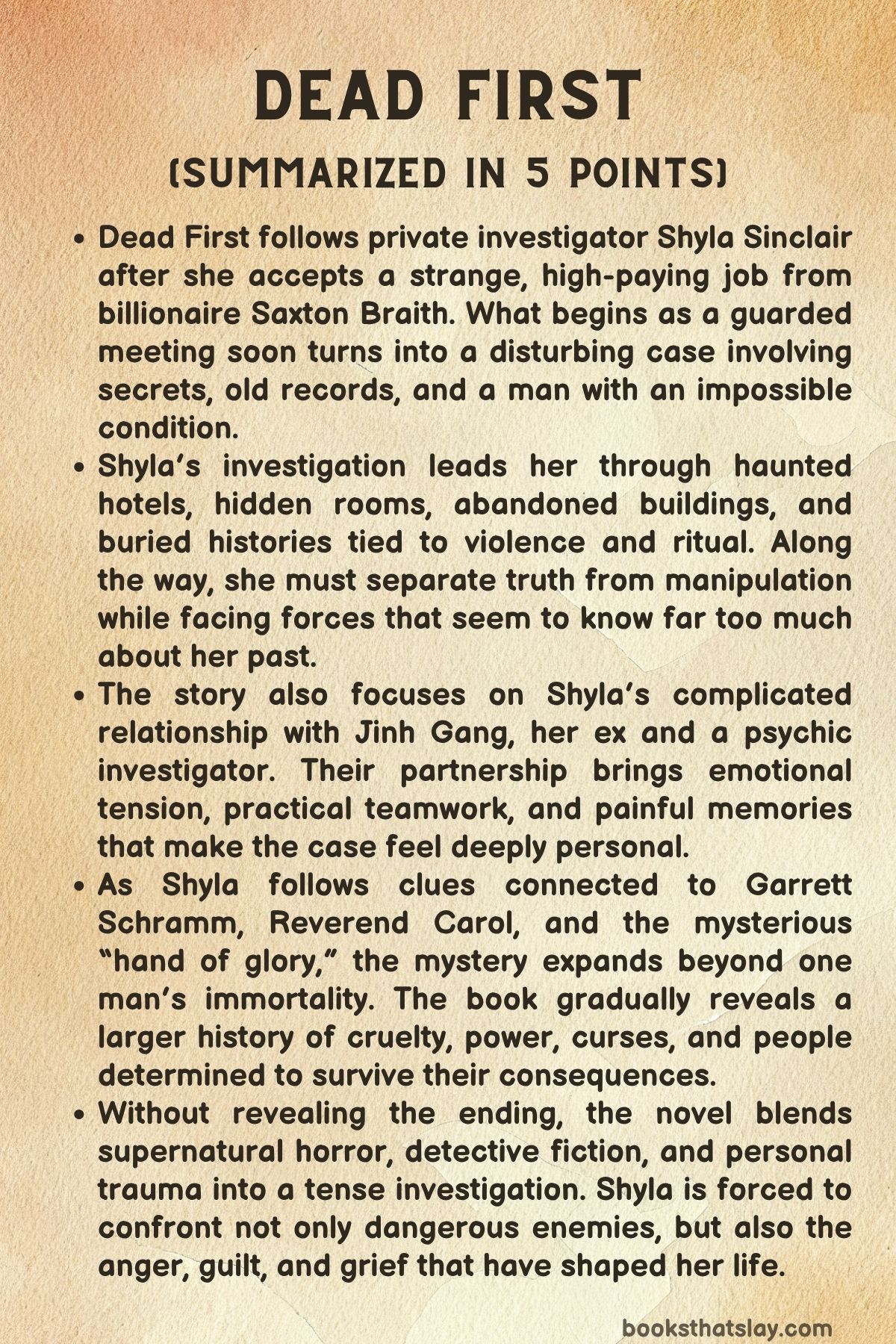
Dead First by Johnny Compton is a supernatural horror mystery about a private investigator drawn into the secret life of an immortal billionaire. The book follows Shyla Sinclair, a woman with a violent past and a sharp instinct for danger, as she is hired to uncover why Saxton Braith cannot die.
What begins as a strange assignment becomes a confrontation with ghosts, witches, cursed body parts, hidden crimes, and old rituals. The story blends detective fiction with occult horror, using Shyla’s investigation to explore survival, guilt, revenge, and the heavy cost of refusing to face the past.
Summary
Shyla Sinclair is a private investigator used to dangerous clients and strange requests, but the invitation from billionaire Saxton Braith feels wrong from the beginning. It is hand-delivered to her home, offering enough money to make refusal difficult.
Against her better judgment, she goes to Braith’s isolated manor, where she meets the wealthy, controlled, unsettling man and his severe assistant, Remy. Braith questions Shyla about one of her old cases involving Massimo Dante, but she refuses to reveal anything protected by client confidentiality.
He tries to tempt her with increasing sums of money, then admits he has had her watched for some time.
The meeting turns terrifying when Remy suddenly drives a fireplace poker through Braith’s head. Shyla expects him to die, but he does not.
Braith remains upright, pulls the weapon free, and heals before her eyes. Shyla tries to escape and draws her gun, but Braith calmly explains that he cannot die.
He claims he does not know the source of his immortality and wants Shyla to discover it. He also reveals that she was recommended by Jinh Gang, Shyla’s ex and a psychic investigator.
Shyla is angry and frightened, but the evidence Braith provides keeps her from walking away. Among his documents is an old report about a 1958 plane crash in Galveston involving a dead pilot named Garrett Schramm and an unidentified survivor who looks like Braith.
Shyla confronts Jinh for sending her into the situation without warning. Jinh admits she believed Shyla might refuse the job if she knew the truth in advance.
Shyla begins researching Schramm, whose trail leads to San Antonio and a hotel called the Inspiration Sweet. She goes there alone, hoping to reach the famous top-floor Inspiration Suite, which is rumored to hold historical records.
When she knocks on the door, something inside answers in an inhuman voice, telling her it knows who sent her. The lights fail, strange footsteps and voices surround her, and she runs downstairs.
Jinh appears at the hotel, claiming they are checking in together, and explains that a vision warned her Shyla was in danger.
The two women continue investigating and discover that a hidden sub-basement lies beneath the hotel bar. After bribing the bartender, they enter the underground space after hours.
Jinh immediately senses spirits and identifies the area as a place where people were killed. Garrett Schramm’s ghost appears and forces his way into Shyla’s mind.
He tries to connect with her through her buried history of violence, sensing that she has killed before. Schramm wants Shyla to see herself as someone like him, but she refuses.
Instead of giving in, she mocks his weakness and rejects his control. Jinh helps pull Shyla out of the trance, and they flee.
Their research suggests that Schramm once ran cruel torture games in Korea after World War II, then brought similar practices back to Texas. Another lead points them to Reverend Germain Carol, a man who once condemned the Inspiration Sweet but later seemed to come under Schramm’s influence.
Shyla and Jinh visit Carol’s granddaughter, Luisa, who has already been warned by two mysterious people not to speak with them. Luisa eventually calls them back and says her grandfather claimed he had known the devil, learned terrible knife tortures, and later ended up in an old hospital in Yorktown.
Luisa’s mother had also become obsessed with a “hand of glory,” believed to be hidden in the hospital.
Braith, worried about Shyla’s progress and her trouble with the police, sends Remy to assist and watch her. Shyla dislikes being monitored but accepts the extra help.
Around this time, Jinh psychically witnesses Shyla’s memory of killing Rodney Hewitt, one of the people who abducted and raised her. Shyla confesses that she shot Rodney after learning that he and Linda Montgomery, the woman who raised her, planned to kill her once she discovered the truth about her kidnapping and her real mother.
Shyla, Jinh, and Remy travel to Yorktown to find the old hospital. They learn the town’s hospital history is confused because there were actually two hospitals, and the older structure may still partly exist underground.
Near its former site, they find strange blocked grates and suspect lower floors remain buried. An abandoned bar nearby may connect to the hidden remains.
When they investigate the bar, Jinh senses something opening inside. Deputy Neal Bell arrives and questions them, but Remy exposes a secret from his past involving the death of a young man named Anthony Richard.
Terrified, Neal admits local officers are told to keep people away because those who enter often return changed, if they return at all.
Inside the abandoned bar, the place appears frozen in the moment it was deserted. Jinh finds a trapdoor beneath a pool table.
Neal is forced to go down first, but unnatural darkness swallows him. Remy shuts the door, and they soon hear him scream and fall.
When the door is opened again, the ladder is visible and the darkness is gone, but Neal has vanished. Shyla, Jinh, and Remy descend anyway.
Once they are below, the trapdoor shuts and becomes blocked from above.
The underground corridors behave like a living nightmare. Doors appear and disappear, hallways shift, and Jinh vanishes, leaving her knife behind.
Shyla sees a Black woman in white and later spots Jinh being led away by that woman and a Black man. She realizes they are witches and likely the same people who have been watching her.
When Shyla tries to reach them, a wall blocks her path. The place attacks her mind with guilt, making her feel she is always too late to save anyone.
A sheet-covered body on a gurney crawls toward her on twisted, lengthened arms. It is Neal, dead and changed by the underground place.
Shyla falls while escaping and loses consciousness.
She wakes in a psychic vision where the woman appears as Linda Montgomery. The disguise drops, and the witch and her brother question Shyla about Braith.
They identify themselves as Ava and Alan Tarver. They claim Braith is not only a murderer but an impostor and a weaker kind of witch who used sacrifice to make himself nearly immortal.
They know his true story and how to kill him. In the real world, Shyla finds Remy restrained and Jinh mentally broken by what she has endured.
The Tarvers take Jinh hostage and tell Shyla to bring them Braith if she wants her back alive.
Shyla and Remy escape and find Braith waiting outside with deputies under his influence. At the Yorktown Police Museum, Braith uses a magical truth serum to force Shyla to confess that she killed Rodney and hid his body.
He then reveals his past. After World War I, Braith searched for immortality through ritual sacrifice.
In Galveston, he murdered members of Enoch Tarver’s family until Enoch cursed him: Braith would either die by Enoch’s hand or never die at all. Braith cut off Enoch’s hands, but one was lost in the Gulf and later became sacred to Enoch’s descendants.
Braith offers Shyla immortality if she helps him kill the Tarvers.
Remy turns against Braith after realizing he never cared whether she lived. She and Shyla attack him, blind him, and escape.
Remy later explains that Braith keeps his old mentor Weldon imprisoned with Enoch’s other hand. Gloves made from cursed hands can wound Braith, but may not kill him unless used correctly.
Shyla refuses to abandon Jinh and continues alone to Galveston after leaving Remy behind.
In Galveston, Shyla prays to Linda’s spirit, offering forgiveness in exchange for help. She contacts the spirit of Enoch’s surviving daughter, who confirms that Enoch’s hand must be the thing that kills Braith.
Braith captures Jinh and the Tarvers, kills Remy, and draws Shyla to an old fort. There, he kills Alan, wounds Jinh and Shyla, and tries to force Shyla into cursing him as Enoch once did, which would make him even harder to destroy.
Shyla calls on Linda, whose spirit briefly possesses and weakens Braith. Shyla shoots him again and again, then removes the hand-of-glory glove from him and forces it down his throat as his face regenerates around it.
With Jinh’s help, she holds him in place until Enoch’s hand finally kills him by choking him to death.
After Braith’s death, his control over people and institutions begins to collapse. Shyla, Jinh, and Ava are treated as victims of the events surrounding him.
Shyla survives, but the victory costs her emotionally. By forgiving Linda in order to defeat Braith, she gives up the hatred that had shaped much of her life.
Jinh stays with her as they recover. When Shyla dreams of her real mother trapped beneath the water, she asks Jinh to help find her remains and bring her home.
Characters
Shyla Sinclair
Shyla Sinclair is the central figure of the book and the character through whom most of the mystery, horror, and emotional weight unfolds. As a private investigator, she is intelligent, guarded, and professionally disciplined, especially when Saxton Braith tries to pressure her into revealing information about a former client.
Her refusal to betray confidentiality shows that she has a strong personal code, even though her life has been shaped by violence and moral compromise. Shyla is not presented as innocent or untouched by darkness.
She has killed before, and her past with Rodney Hewitt and Linda Montgomery reveals that she carries deep trauma from being abducted, raised under falsehoods, and forced to survive people who meant to destroy her.
What makes Shyla compelling is that she is both wounded and fiercely resistant. Garrett Schramm’s ghost tries to reach her by appealing to the violence inside her, suggesting that they are alike because she has killed.
Shyla’s rejection of him is important because it shows that the book does not define her only by what she has done. She may have blood in her past, but she refuses to surrender her identity to cruelty.
Her laughter at Schramm’s weakness is an act of defiance, proving that she understands darkness without worshipping it.
Shyla’s emotional journey is also tied to guilt and loss. The supernatural attacks beneath Yorktown exploit her fear that she is always too late to save people, which shows how much responsibility she secretly carries.
Her determination to save Jinh, even when Remy suggests abandoning her, proves that loyalty matters more to Shyla than self-preservation. By the end of the story, Shyla’s victory over Braith is not only physical but spiritual.
She defeats him by using the cursed hand, but she also sacrifices her hatred of Linda in order to call on Linda’s spirit for help. This choice complicates her healing because forgiveness does not erase pain.
Instead, it leaves Shyla grieving in a new way, no longer protected by anger. Her final desire to find her real mother’s remains shows that she is moving from survival toward restoration.
Saxton Braith
Saxton Braith is the main villain of the book and one of its most disturbing characters because he hides monstrous ambition behind wealth, control, and charm. At first, he appears to be an eccentric billionaire who wants Shyla to solve the mystery of his immortality.
The shocking moment when Remy drives a fireplace poker through his skull and he calmly survives reveals that he is not simply powerful in a social sense but physically unnatural. His immortality gives him an almost godlike confidence, yet the story gradually reveals that this power is rooted in murder, ritual sacrifice, and cowardice.
Braith’s character is defined by his desire to escape death without accepting moral consequence. He seeks immortality after World War I, and his method is not noble or tragic but predatory.
He sacrifices others so that he can continue existing, making him a figure of selfish survival taken to its most horrifying extreme. His murder of Enoch Tarver’s family and his mutilation of Enoch show that Braith’s cruelty is not accidental.
He is willing to destroy entire lives and bloodlines to protect himself.
Braith is also manipulative. He studies Shyla before hiring her, tests her loyalty with money, uses magical truth serum to force a confession from her, and tries to tempt her with immortality.
His offer to Shyla is especially revealing because he assumes that everyone ultimately wants what he wants: power, permanence, and escape from human limits. He fails to understand that Shyla’s suffering has not made her hunger for domination.
His inability to understand love, loyalty, grief, and sacrifice is part of what makes him vulnerable.
By the end, Braith’s immortality becomes a trap rather than a triumph. His body heals, but his soul and humanity have long since decayed.
His death by Enoch’s hand is symbolically fitting because the violence he tried to erase returns through the descendants and relics of the people he harmed. Braith represents the horror of refusing mortality so completely that one becomes less human than the dead.
Jinh Gang
Jinh Gang is Shyla’s ex and a psychic investigator whose role in the story is both practical and emotional. She connects Shyla to Braith’s case by recommending her, but she also withholds enough information that Shyla feels betrayed.
This makes Jinh a complicated figure from the beginning. She cares about Shyla and wants her involved because she believes Shyla is capable, yet her decision not to fully warn her shows that Jinh can be secretive and controlling when she thinks the outcome justifies it.
Jinh’s psychic abilities make her essential to the investigation. She senses danger at the hotel, sees spirits in the hidden killing floor, understands the supernatural nature of Yorktown, and helps interpret forces that Shyla cannot perceive on her own.
However, her gift is not treated as simple power. It also makes her vulnerable.
She is exposed to visions, spirits, psychic attacks, and overwhelming mental pressure. In many ways, Jinh’s sensitivity is both her strength and her wound.
Her relationship with Shyla is one of the emotional anchors of the story. They are no longer together, but their bond remains intimate and powerful.
Jinh knows parts of Shyla that others do not, including her pain and violence. When she witnesses Shyla’s memory of killing Rodney, the moment deepens the emotional trust and tension between them.
Jinh does not merely function as a helper in the mystery; she forces Shyla’s hidden past into the open.
Jinh’s kidnapping by the Tarvers raises the stakes because it reveals how important she is to Shyla. Shyla’s refusal to abandon her shows that their relationship is still defined by loyalty, even if it is complicated by past hurt.
In the final confrontation, Jinh helps Shyla hold Braith down long enough for Enoch’s hand to kill him. This makes her not just a victim to be rescued but an active participant in Braith’s defeat.
By staying with Shyla afterward, Jinh becomes a source of care and continuity as Shyla faces grief, recovery, and the unfinished mystery of her real mother.
Remy
Remy begins as Saxton Braith’s stern assistant, but she develops into one of the most morally interesting characters in the story. Her first major act is horrifying: she drives a fireplace poker through Braith’s skull.
At first, this makes her seem brutal and possibly loyal to his strange methods, especially because the act is part of demonstrating Braith’s immortality to Shyla. Remy initially appears to be an extension of Braith’s power, someone who monitors, assists, and intimidates on his behalf.
As the story progresses, however, Remy becomes more complex. She is practical, frighteningly composed, and capable of violence, but she is not empty.
Her confrontation with Deputy Neal Bell shows that she has access to hidden knowledge and knows how to weaponize fear. She exposes Neal’s secret with precision, suggesting that she understands human guilt and weakness.
Her willingness to force Neal into the hidden underground space also shows that she can be ruthless, especially when survival or information is at stake.
Remy’s turning point comes when she realizes that Braith does not truly care whether she lives. This revelation breaks the illusion of loyalty or purpose that may have tied her to him.
Her betrayal of Braith is significant because it shows that even someone hardened by proximity to evil can still recognize when she has been used. She helps Shyla fight him and later gives her important information about Weldon, Enoch’s hand, and the limitations of the cursed gloves.
Remy’s death in Galveston gives her arc a tragic shape. She does not become purely heroic, and the story does not erase her earlier cruelty, but she does choose to resist Braith once she understands the truth of her place in his world.
Her character shows how people can become trapped in the service of monsters, and how difficult but meaningful it is to turn against them, even too late.
Garrett Schramm
Garrett Schramm is a dead pilot whose history leads Shyla deeper into the mystery of Braith’s immortality. His connection to the 1958 Galveston plane crash and the unidentified survivor who resembles Braith makes him an important clue in the investigation.
However, Schramm becomes more than a piece of history when his ghost appears in the hidden killing floor beneath the Inspiration Sweet.
Schramm is a figure of sadism, violence, and corruption. The investigation suggests that he ran torture games in Korea after World War II and later brought similar horrors to San Antonio.
This makes him part of the wider pattern of hidden evil in the book: atrocities do not remain buried, and places can become infected by the suffering committed inside them. Schramm’s ghost is not remorseful.
Instead, he tries to connect with Shyla through violence, sensing that she has killed and attempting to convince her that this makes them alike.
His failure to possess or morally seduce Shyla is important. Schramm represents the kind of predator who believes that trauma and violence inevitably create monsters.
Shyla proves him wrong. Her resistance exposes his weakness because he needs others to validate his worldview.
If Shyla accepts that killing makes her the same as him, then Schramm’s cruelty gains a kind of justification. Her refusal denies him that comfort.
Schramm’s role is also atmospheric and thematic. He helps reveal the book’s interest in haunted places, buried crimes, and the way violence echoes across time.
Even after death, he remains tied to the suffering he caused. He is not simply a ghost but a remnant of human cruelty that continues trying to reproduce itself.
Enoch Tarver
Enoch Tarver is one of the most important figures in the hidden history of the story, even though his influence is felt largely through the past, his curse, and his severed hands. He is the man whose family Braith murders during his pursuit of immortality.
In response, Enoch curses Braith so that Braith will die by Enoch’s hand or never die at all. This curse becomes the central supernatural mechanism behind Braith’s near-immortality and eventual destruction.
Enoch is a victim of terrible violence, but he is also a figure of power. His curse shows that he possesses spiritual or magical force strong enough to bind Braith across generations.
The severing of his hands is one of the story’s most grotesque and symbolic acts. Braith tries to remove the means of his own death by cutting off Enoch’s hands, but he cannot fully control the consequences of his violence.
One hand is lost and eventually becomes sacred to Enoch’s descendants, while the other is kept with Weldon. Enoch’s body is mutilated, but his justice survives.
As a character, Enoch represents ancestral grief and righteous vengeance. His curse is born from suffering, but it also traps Braith in the very immortality he desired.
Enoch’s power outlasts Braith’s wealth, manipulation, and violence. The final death of Braith through Enoch’s hand restores moral balance, not because it undoes the murders, but because it allows the past to finally reach the man who tried to escape it.
Enoch’s presence also deepens the role of Ava and Alan Tarver. They are not random enemies or supernatural obstacles; they are descendants carrying the burden of a family wound that began with Braith’s crimes.
Through Enoch, the story turns revenge into inheritance, asking what descendants owe to the dead and what justice looks like when evil survives for generations.
Ava Tarver
Ava Tarver is one of Enoch Tarver’s descendants and one of the witch twins who stalk Shyla during the investigation. At first, Ava appears threatening, secretive, and possibly villainous.
She and Alan manipulate the environment beneath Yorktown, take Jinh hostage, and force Shyla into a dangerous bargain. Their methods are frightening, and their treatment of Shyla and Jinh shows that they are willing to cause fear and pain in pursuit of their goal.
However, Ava’s role becomes more sympathetic once Braith’s true history is revealed. She is not hunting him out of simple malice.
She is part of a family line scarred by Braith’s murders, and she possesses knowledge about who he really is and how he can be killed. Ava understands that Braith is not merely immortal but an impostor and murderer whose life has been extended through sacrifice.
Her hostility toward Shyla comes from suspicion: Shyla has been working for Braith, and Ava cannot know whether she is an ally, pawn, or future threat.
Ava’s survival at the end is significant. Alan dies during the final confrontation, but Ava lives to see Braith defeated.
This gives her character a painful mixture of victory and loss. The family mission succeeds, but it does not spare her from grief.
She is treated as a victim afterward, which suggests that the public version of events cannot fully contain the supernatural and ancestral truth of what happened.
Ava represents the cost of inherited justice. She carries knowledge and power, but those gifts isolate her and place her in danger.
Her character complicates the idea of heroism because she does necessary things in frightening ways. In the world of the book, justice is rarely clean, and Ava embodies that harsh truth.
Alan Tarver
Alan Tarver, Ava’s twin brother, is the other descendant of Enoch Tarver involved in the mission to destroy Braith. Like Ava, Alan initially appears mysterious and threatening.
He participates in abducting Jinh and confronting Shyla, and he helps reveal the truth about Braith’s past. His actions show that he is deeply committed to ending Braith’s unnatural life, even if that means using coercion and fear.
Alan’s bond with Ava is central to his identity. The twins operate as a pair, and their shared purpose makes them feel almost like extensions of the same ancestral force.
They are not simply individual witches; they are heirs to a curse, a history, and a responsibility. Their power and knowledge come from a lineage shaped by Braith’s violence, and Alan’s willingness to risk himself suggests that he sees the fight against Braith as something larger than personal survival.
His death at the old fort is one of the story’s major losses. Braith kills him during the final confrontation, proving again how dangerous and ruthless Braith remains even when cornered.
Alan’s death also raises the emotional cost of victory. The defeat of Braith does not come without sacrifice, and Alan becomes one of the people consumed by the long struggle that began with Enoch’s family.
Alan’s character shows how revenge and justice can demand everything from those who inherit them. He does not live to see the full aftermath of Braith’s collapse, but his role helps make that collapse possible.
His death also leaves Ava as the surviving bearer of their family’s burden.
Linda Montgomery
Linda Montgomery is one of the most emotionally complicated figures in Shyla’s life. She is one of the people who abducted and raised Shyla, meaning she is tied directly to the lies, trauma, and danger that shaped Shyla’s childhood.
For much of the story, Linda represents betrayal and stolen identity. Shyla’s memory of discovering that Linda and Rodney planned to kill her reveals just how unsafe and false her upbringing was.
Yet Linda’s role becomes more complicated near the end. Shyla prays to Linda’s spirit and offers forgiveness in exchange for help.
This does not make Linda innocent, nor does it erase the harm she caused. Instead, it shows how Shyla’s relationship to her past is changing.
Hatred has protected Shyla for a long time, giving shape to her pain and keeping Linda fixed as a monster in her mind. By offering forgiveness, Shyla sacrifices that protection for the chance to save others and defeat Braith.
Linda’s spirit briefly possessing and weakening Braith gives her a final role in the story’s justice. She becomes part of the force that helps Shyla survive and win.
This moment does not fully redeem Linda, but it complicates her. She was an abductor and a source of trauma, yet in death she becomes someone Shyla can call upon in a desperate act of spiritual negotiation.
Linda’s importance lies in what she represents for Shyla. She is not only a person from Shyla’s past but also a symbol of the emotional prison Shyla has lived inside.
Forgiving Linda costs Shyla deeply because it changes the meaning of her own pain. That grief continues after Braith’s defeat, showing that forgiveness in the story is not simple peace but another form of loss.
Rodney Hewitt
Rodney Hewitt is one of the people who abducted and raised Shyla, and his importance comes through Shyla’s memory of killing him. He is a dark presence in her past, representing the immediate threat she faced when she learned the truth about her kidnapping and discovered that he and Linda Montgomery planned to kill her.
Rodney’s death is one of the defining secrets Shyla carries.
Rodney functions as a measure of Shyla’s moral complexity. She killed him, hid his body, and has lived with that knowledge.
The book does not present this act as simple murder or simple self-defense without emotional consequence. Instead, it becomes part of the burden that makes Shyla vulnerable to supernatural manipulation.
Garrett Schramm tries to use her history of killing to claim kinship with her, and Braith later forces her to confess the truth through magical means.
Rodney’s role is therefore less about who he is as a fully present character and more about what his death reveals in Shyla. He is tied to her survival, rage, fear, and secrecy.
His presence in the story shows that escaping abuse does not automatically free a person from the moral and emotional aftermath of what survival required.
Through Rodney, the book explores the difference between violence used to dominate and violence used to survive. Shyla’s killing of Rodney marks her, but it does not make her like Braith or Schramm.
That distinction is central to understanding her character.
Reverend Germain Carol
Reverend Germain Carol is an important link between the Inspiration Sweet, Garrett Schramm, the hand of glory, and the old hospital in Yorktown. He once condemned the Inspiration Sweet, suggesting that he recognized something evil or corrupt about the place.
However, he later appears to have fallen under Schramm’s influence, which makes him a tragic example of moral resistance being overcome by darkness.
Carol’s story is disturbing because he seems to have encountered evil, named it, and then become entangled with it. His claim that he had known the devil and learned horrific knife tortures suggests that his spiritual authority was damaged or inverted.
As a reverend, he should represent faith, guidance, and protection, but his connection to torture and obsession shows how thoroughly the supernatural evil in the story can corrupt people.
His later presence in an old hospital in Yorktown helps direct Shyla’s investigation toward the underground horrors beneath the town. Through Luisa’s account, Carol becomes a voice from the past warning of forces that are not fully understood.
His connection to the hand of glory also links religious language, folk magic, violence, and family obsession.
Reverend Carol represents failed spiritual defense. He recognized evil but could not escape its pull.
His life becomes evidence that the forces surrounding Schramm, Braith, and the hidden hospital do not merely kill people; they change them, seduce them, and leave obsessions behind for later generations.
Luisa
Luisa is Reverend Germain Carol’s granddaughter and a key source of information for Shyla and Jinh. At first, she is cautious because she has already been warned by two mysterious people not to speak to Shyla.
Her fear shows that the Tarvers are actively controlling access to the truth and that anyone connected to Carol’s history may be in danger. Despite this, Luisa eventually chooses to call Shyla back and share what she knows.
Luisa’s role is important because she bridges personal family history and the larger supernatural mystery. Through her, Shyla learns about Carol’s claims of knowing the devil, the knife tortures, the Yorktown hospital, and her mother’s obsession with the hand of glory.
These details help move the investigation from scattered historical clues toward a clearer understanding of Braith’s enemies and the object that can destroy him.
Luisa is not a fighter or investigator in the same way Shyla, Jinh, Remy, Ava, or Alan are, but her courage matters. She speaks despite being warned not to, and her information helps expose the buried history that powerful and supernatural forces want hidden.
Her character shows how ordinary people become connected to extraordinary horror through family memory, inherited fear, and fragments of testimony.
Luisa also reflects the lingering damage caused by the past. Her grandfather’s experiences and her mother’s obsession have shaped her family, even if she does not fully understand the supernatural forces involved.
She represents the way trauma and mystery can pass down through generations as rumor, fear, and unfinished knowledge.
Deputy Neal Bell
Deputy Neal Bell is a local authority figure in Yorktown who appears when Shyla, Jinh, and Remy investigate the abandoned bar. At first, he seems to represent ordinary law enforcement interference, someone who might stop the investigation or force the characters away from the site.
However, Remy quickly exposes that Neal has a horrific secret involving Anthony Richard, a young man whose death Neal and his brother apparently caused.
Neal’s character reveals the corruption and fear surrounding the hidden underground space. He admits that officers are told to keep people away because those who enter return changed, if they return at all.
This confession shows that local authority is not truly in control. The police know something is wrong, but instead of confronting it, they manage the boundary around it.
Neal’s fear makes him both complicit and pathetic.
His forced descent through the trapdoor is one of the book’s most frightening moments. The unnatural darkness swallows him, and he vanishes before returning as a grotesque dead thing.
His transformation into the crawling body on the gurney shows the power of the underground place to punish, distort, and use the dead as instruments of terror.
Neal is not innocent, but his fate is still horrifying. He represents hidden guilt made physical.
The secret he helped bury is dragged into the open, and then the supernatural world consumes him. His character adds to the book’s theme that buried crimes never remain buried forever.
Anthony Richard
Anthony Richard does not appear as an active character, but his death is crucial to understanding Deputy Neal Bell. He is the young man connected to the horrific secret involving Neal and Neal’s brother.
Although the details are limited, Anthony’s role is that of a victim whose death continues to haunt the guilty.
Anthony’s importance lies in how his memory exposes Neal. Remy uses the truth about him as a weapon, showing that the past still has power over those who try to hide it.
Anthony becomes one of several dead figures in the story whose suffering continues to shape the living. Like Enoch’s murdered family and Shyla’s real mother, he represents a life cut off by violence and then buried beneath silence.
Through Anthony, the book reinforces its concern with accountability. The people who cause harm may continue living for years, but the truth remains present, waiting for the right pressure to bring it out.
Anthony’s death helps reveal Neal’s moral weakness and the broader rot surrounding Yorktown’s hidden places.
Massimo Dante
Massimo Dante is connected to Shyla through a previous case, and Braith uses his name to test her professionalism. Although Massimo does not play a large active role in the events described, he is important because he helps establish Shyla’s character.
When Braith questions her about that case, Shyla refuses to break client confidentiality. Her refusal shows that she is not easily bought, even when Braith tempts her with large sums of money.
Massimo’s role also helps Braith reveal his own methods. By bringing up Shyla’s former client, Braith demonstrates that he has investigated her, watched her, and gathered information before inviting her to the manor.
This makes the meeting feel less like a job offer and more like a controlled test. Massimo is therefore part of the power game Braith plays in the opening movement of the story.
As a character in the wider world of the book, Massimo suggests that Shyla has a professional history beyond this case. She is not a random person pulled into supernatural events but an investigator with a reputation strong enough to attract dangerous attention.
His presence helps define the boundaries of Shyla’s ethics before those ethics are tested by immortality, ghosts, curses, and violence.
Weldon
Weldon is Braith’s mentor and a hidden figure in the background of the immortality plot. Remy reveals that Braith keeps him imprisoned with Enoch’s other hand, making Weldon part of the secret machinery behind Braith’s long survival and magical knowledge.
Although he is not as active in the visible events as Braith or the Tarvers, his existence deepens the sense that Braith’s power has roots in older occult instruction.
Weldon’s role as mentor suggests that Braith did not discover immortality alone. He was guided into ritual sacrifice, cursed hands, and the supernatural logic that governs his condition.
This makes Weldon partly responsible for shaping Braith into the monster he becomes, though Braith’s own choices remain central. Mentorship in this context is corrupted: instead of passing down wisdom, Weldon appears connected to the transmission of violent, forbidden knowledge.
His imprisonment also reveals Braith’s nature. Braith does not honor even those who helped him.
He uses, confines, and discards people according to his own needs. If Weldon once had power over Braith as a mentor, that relationship has been inverted into captivity.
This shows that Braith’s loyalty extends to no one but himself.
Weldon represents the hidden origins of evil knowledge in the story. He is part of the background structure that makes Braith’s immortality possible, and his connection to Enoch’s other hand shows how bodies, relics, and power are bound together in the book’s supernatural world.
Themes
The Burden of a Violent Past
Shyla’s investigation is shaped by the fact that violence is not just something she studies from a distance; it is something she has survived, committed, and carried inside herself. Her history of being abducted and raised by dangerous people gives her a deep understanding of cruelty, manipulation, and survival, but it also leaves her vulnerable to guilt and self-doubt.
In Dead First, the supernatural forces repeatedly try to use her past against her, especially by suggesting that her own killing makes her similar to the monsters she is hunting. Shyla’s strength comes from refusing that false comparison.
She has killed, but not for pleasure, power, or control. Her violence came from a desperate attempt to free herself from people who had destroyed her life.
The theme becomes powerful because the story does not present trauma as something easily overcome. Shyla survives by facing what happened, naming the difference between survival and evil, and choosing not to let her worst memories define her entire identity.
Immortality as Corruption
Saxton Braith’s immortality is not shown as a gift, but as a curse built on selfishness, murder, and fear. His long life has not made him wiser, kinder, or more human.
Instead, it has allowed his cruelty to harden over time. Because he cannot die easily, he begins to treat other people as temporary objects, useful only when they serve his needs.
His wealth and power make this corruption even worse, because they allow him to hide his crimes, control others, and turn survival into domination. The search for eternal life becomes a moral failure because Braith wants to escape the natural limits that bind everyone else while forcing others to pay the price.
His immortality also isolates him. He must keep secrets, manipulate servants, and depend on rituals and curses.
The story suggests that living forever without conscience is not true life at all. It is a long decay, where the body keeps healing but the soul becomes increasingly empty.
Trust, Betrayal, and Chosen Loyalty
The relationships around Shyla are marked by suspicion, hidden motives, and painful tests of trust. Jinh sends her toward Braith without fully warning her, Braith manipulates her from the beginning, Remy watches her for her employer, and the Tarvers withhold truth until they need her help.
In this world, trust is never simple because almost everyone has a secret or an agenda. Yet the story also shows that loyalty can grow through action rather than perfect honesty.
Jinh risks herself again and again because she cares for Shyla. Remy begins as Braith’s servant, but when she realizes how little he values her life, she chooses to stand against him.
Shyla’s own loyalty is clearest when she refuses to abandon Jinh, even when doing so would be safer. The theme matters because the horror depends not only on ghosts and curses, but on whether people can rely on one another when fear makes selfishness tempting.
True loyalty is shown through sacrifice, not promises.
Forgiveness, Justice, and Release
Shyla’s final victory depends on more than defeating Braith; it also requires a painful act of emotional release. Her hatred of Linda Montgomery is understandable, because Linda helped steal her childhood and shaped much of her suffering.
Yet Shyla’s decision to offer forgiveness is not a simple excuse for Linda’s actions. Instead, it becomes a strategic and spiritual turning point.
She gives up the power that hatred has over her, and that sacrifice allows Linda’s spirit to help weaken Braith. In Dead First, justice is not presented as clean revenge.
Braith must be stopped, but Shyla also has to decide what kind of person she will become after facing him. The ending shows that release does not erase grief.
Shyla still carries loss, especially when she dreams of her real mother. However, the desire to recover her mother’s remains suggests movement toward healing.
Justice means ending the monster’s power, while release means refusing to remain trapped by the damage he and others caused.