Dawn of the North Summary, Characters and Themes
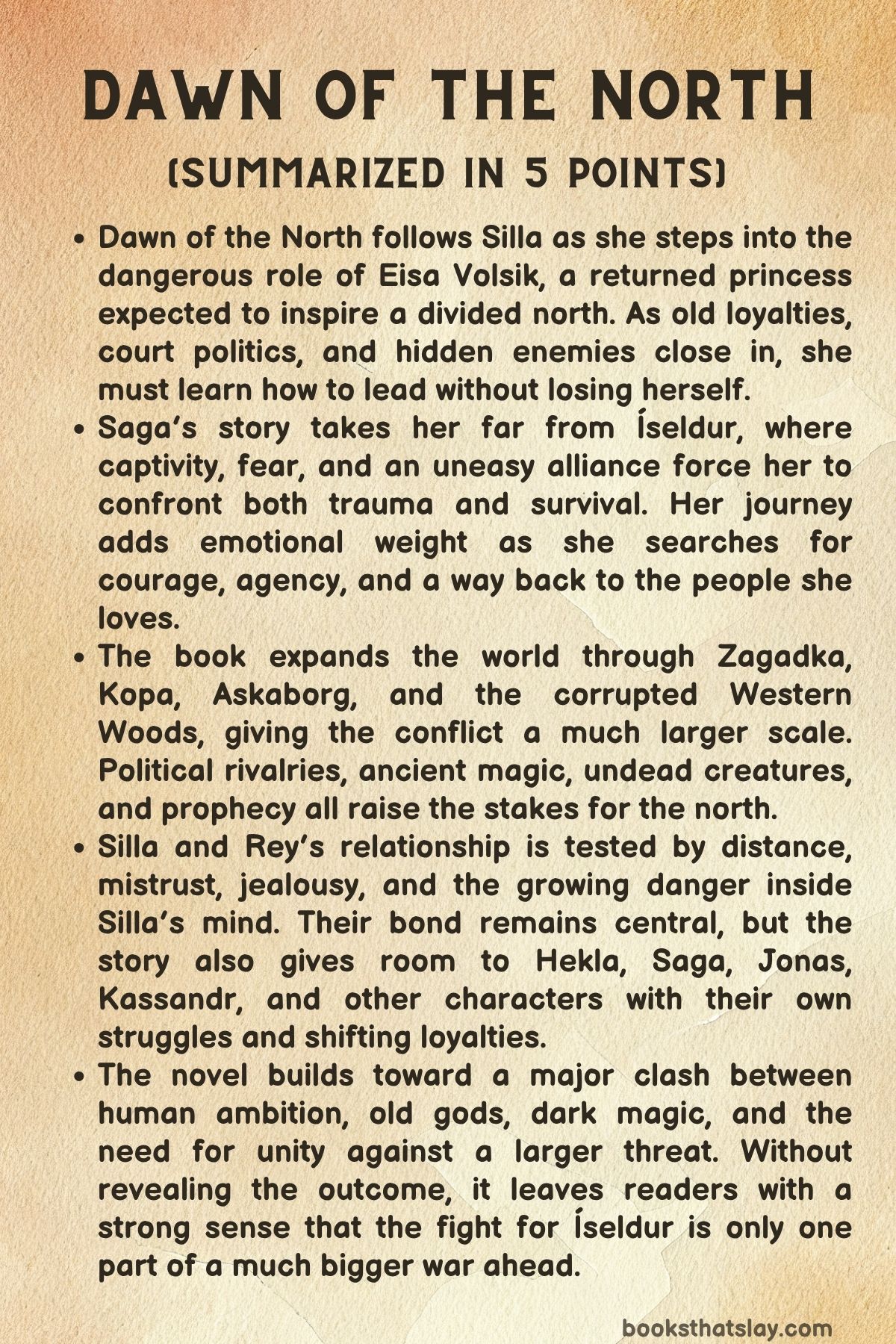
Dawn of the North by Demi Winters is a dark Nordic fantasy about grief, power, prophecy, and two sisters caught between kingdoms, gods, and war. The story follows Silla, who must live as Princess Eisa Volsik while hiding dangerous truths, and Saga, who is trapped in Zagadka after being blamed for a deadly magical attack.
Around them, the north faces famine, political fracture, undead creatures, a spreading mist, and the threat of Rökkur. The book blends court tension, battle, romance, and mythic danger as its characters fight for survival, loyalty, and the future of Íseldur. It’s the 3rd book of the Ashen series.
Summary
After the black-flame explosion in Askaborg’s great hall, Queen Signe is left shattered by the death of her daughter, Yrsa. The funeral is cruel and ceremonial, with five thrall girls sacrificed and laid beside the princess before the funeral ship burns.
Signe is overcome with grief, but King Ivar’s mind turns quickly to revenge. He believes Zagadka caused the attack and prepares to sail against it before his father’s fleet can arrive.
Signe cannot stop him, but she demands that Saga Volsik be brought back alive so she can kill her herself.
In Kopa, Silla now appears publicly as Princess Eisa Volsik. She attends an Uppreisna council beneath Ashfall Fortress, uncertain in her new identity but forced to perform as a royal figure before the northern households.
Jarl Hakon uses her return to call for unity, the restoration of old traditions, and resistance against Urkan rule. He also reveals that Saga caused the explosion at Askaborg and has vanished.
Silla understands that Saga must have given Myrkur access to her magic, which makes finding her urgent.
The council is interrupted by survivors from Istré, including Hekla, Sigrún, Gunnar, and Eyvind. Hekla explains that Istré has fallen and burned after the cursed mist from the Western Woods escaped.
The mist Turns humans and animals into draugur and had grown stronger during the double black moon. Its source must be found and destroyed before it spreads farther.
Jarl Hakon refuses to send many warriors, so Rey is ordered to continue the mission he was originally given.
Far away in Zagadka, Saga is imprisoned in Kovograd Fortress by Kassandr Rurik. Her rooms are comfortable, but she has no freedom, no Sense, and no way to reach Eisa.
Kassandr insists he brought her there to protect her, but Saga sees only captivity. He wants her to meet Zagadka’s high prince and suggests that marriage to him could protect her.
Furious, Saga attacks Kassandr, but he barely responds and tells her to come to him when she is ready to accept.
Silla and Hekla later reunite and exchange the truths they have been carrying. Hekla tells Silla about Istré, Eyvind, and Gunnar’s proposal, while Silla reveals the avalanche, Kalasgarde, Myrkur’s presence inside her, and the need to hide who she really is.
Rey gathers the warriors and explains that Rökkur, the twilight of days, may be starting. They connect Harpa’s prophecy to recent events: the serpent in Kalasgarde, the sleeping dragon Kraugeir, the corrupted forest, and the need to find Rökksgarde.
In Zagadka, Kassandr is punished by his father, the high prince, for bringing Saga to Kovograd. Oleg, Kassandr’s half brother, argues that Saga should be returned or killed to appease Ivar.
When Oleg threatens her, Kassandr partially shifts into his beast form and attacks him. The high prince orders Kassandr to make an offering at the golden oak, removing him from Kovograd for several days, while Saga is forced to write a letter to Ivar taking responsibility for the explosion.
Back in Kopa, Silla’s public role grows more difficult. Rey prepares to leave for Istré, while Kaeja, his former lover, challenges Silla to spar.
Kaeja uses magical speed to embarrass her, but Silla refuses to quit and eventually defeats her with unexpected power. Silla then kisses Rey in front of the warriors, openly claiming him.
Yet Myrkur’s influence continues to disturb her, and Rey worries that the god inside her is not as quiet as she believes.
Silla and Rey part reluctantly. She must remain in Kopa to act as queen and search for a way to break Myrkur’s bargain, while Rey must return to Istré.
Before leaving, he gives her a dagger and warns her to be careful about whom she trusts. Soon after, Silla sees a black hawk at her window, and Myrkur awakens to warn her that death is coming.
Meanwhile, Jonas survives the ruin of Svangormr Pass but loses toes and much of the use of one leg. In Sunnavík, he sees famine spreading while Ivar’s fleet loads huge supplies for war.
He finally reaches Queen Signe and tries to tell her about what happened at the pass, but she blames him for the deaths of her Chosen. Rather than kill him at once, she sends him to Volund.
Jonas is forced into the pits, where he fights undead creatures and survives. Volund then welcomes him into the Corpse Bringers.
In Kovograd, Saga slowly begins to reclaim herself. Kassandr’s sister Elisava visits her, shares food and stories, and introduces her to Havoc, a chained white winged stallion that killed Kassandr’s older brother.
Saga sees her own captivity reflected in the creature. Inspired, she forces herself onto the balcony despite memories of Magnus’s torture.
Feeling sunlight and seeing the city below becomes a turning point in her recovery. When Kassandr returns, he begins teaching her Zagadkian in exchange for meals.
Their bond remains tense, but he helps her move through fear step by step.
Rey, Hekla, Gunnar, Eyvind, and the warriors travel toward Istré and find villages destroyed by the mist. One chained draugur repeats the word Rökksgarde before Rey kills it, strengthening the sense that the prophecy and the mist are connected.
In Kopa, Silla dreams of Myrkur’s memories and later survives an assassination attempt when another woman drinks from her poisoned cup and dies. Someone near her court wants Eisa Volsik dead.
Political pressure rises in Kopa. At a feast, Atli confronts Silla and denies stealing letters meant for Agnar.
He also reveals his history with Rey and Kaeja, claiming Rey took Kaeja from him. Rey later confronts Atli and, after being provoked, punches him before the jarls, embarrassing Silla.
In the courtyard afterward, Rey admits that Kaeja betrayed him with Atli while they were together. Silla comforts him, and they reconcile, but trust between them is tested again when Rey secretly investigates her missing letters.
In Zagadka, Ivar’s siege begins. Firepots rain down on Kovograd, and Saga organizes a fire brigade.
When the stables burn, she frees Havoc, who escapes through the roof. Later, Kassandr is trapped in his beast form, and Saga calms him by entering his room, speaking firmly, tapping his shoulder, and humming until he sleeps.
Kassandr realizes she understands him in a way no one else has. But the siege worsens, and when an iron-plated tower threatens the fortress, Saga decides to act.
She slips out with a fire flask, intending to surrender and kill Ivar. Before she can, Havoc returns, attacks Ivar’s men, and carries Saga into the sky.
At the same time, Silla’s power changes. During sparring, she accidentally pulls Rey’s galdur into herself and discovers she can draw magic from other Galdra.
Refugees then arrive at Kopa, fleeing the mist with a beating heart, but Jarl Hakon refuses them entry despite having full stores. Silla’s anger grows, and Myrkur pushes at her mind, feeding her ambition and rage.
The final battle moves into the Western Woods. Silla, Rey, Atli’s warriors, and the queensguard enter the corrupted forest, planning to destroy the infected hjarta tree at the heart of the mist.
The leech knows they are coming. Turned ravens appear, then a hidden army of undead beasts erupts from the snow.
The warriors push toward the heartwood while Silla reaches the central grove and finds the infected tree. A huge Turned wolfspider attacks, and Silla tries every form of power she can access, but nothing damages the tree.
Myrkur tells her that Sunnvald’s magic cannot destroy the tree because the hjarta trees came from Sunnvald’s ashes. Only Myrkur’s darkness can defeat the leech.
Refusing to surrender all her magic to Him, Silla makes a dangerous bargain and challenges Him to single combat. Myrkur chooses a Turned bear as His body.
Silla fights while Rey holds back the mist with smoke, but she cannot siphon divine darkness as she can siphon galdur. Myrkur overwhelms her and begins consuming her mind.
Hekla arrives with the Forest Maiden, beasts, and allies, helping turn the battle. She kills the monstrous spider Gjalla and frees Kritka, though she is badly hurt and loses her prosthetic arm.
Eyvind helps Rey hold back the mist with flame. Across the sea, Saga senses Silla’s danger and flies to Íseldur on Havoc with Kassandr.
She reaches Silla and uses their sisterly bond, love, and shared memories to strengthen her. When Myrkur attacks Saga, Silla rises again.
Using Runný’s Shadow Hound power, she creates a reflective shield that turns Myrkur’s black flames back on the bear. The bear is destroyed, the infected tree splits, the leech dies, and Myrkur’s bargain is broken.
After the battle, Silla and Saga reunite with joy. The Forest Maiden begins healing the dead tree with mushrooms.
Saga introduces Kassandr as her husband and the heir to Zagadka. Back in Kopa, Silla and Rey confess their love.
At a feast, Saga announces that Zagadka has sent warriors, winged horses, and grain. The sisters declare their plan to reclaim Íseldur, prepare for Rökkur, find Rökksgarde, and unite the jarls against the Urkans.
Their victory is interrupted when Kraki arrives with a warning: Kiv has fallen, and a dragon has awakened.
The story closes with Ivar wounded after his failed attack on Zagadka. His concubine Eldrún, revealed as a Harefoot Galdra assassin, ambushes him.
Ivar kills her, but Signe enters and reveals Eldrún served her. She removes a dagger from Ivar’s body and lets him bleed to death, ending his rule with cold revenge.
Characters
Silla / Eisa Volsik
Silla is the emotional and political center of the book, a young woman forced to live inside a royal identity before she feels ready for the burden it carries. Publicly presented as Princess Eisa Volsik, she must perform confidence, authority, and sacred legitimacy in front of northern jarls while privately fearing that she is an impostor, a sister in danger, and a vessel for Myrkur’s growing influence.
Her arc is built around the tension between performance and truth. At first, she plays the role of queen because others need her to, but as the story develops, she begins to understand that leadership is not only inherited through blood or titles; it is proven through protection, courage, mercy, and the willingness to stand between vulnerable people and powerful men.
Her relationship with Myrkur makes her one of the most psychologically complex figures in the story. Myrkur does not simply threaten her from outside; He presses against her thoughts, sharpens her anger, tempts her ambition, and tries to turn her pain into cruelty.
This internal struggle makes Silla’s leadership dangerous as well as inspiring, because the same force that gives her access to terrifying power also risks corrupting the moral instincts that make her worth following. Her violent speech before the jarls shows how easily righteous anger can become bloodthirsty vengeance when manipulated by a divine darkness.
Yet Silla’s strength lies in the fact that she recognizes the danger inside herself and continues resisting it.
Silla’s love for Rey reveals a softer but equally important side of her character. With him, she is not merely Eisa, queen, weapon, or symbol; she is someone frightened, jealous, wounded, passionate, and deeply human.
Their conflicts are not shallow romantic misunderstandings but clashes between trust, trauma, secrecy, and political survival. When Rey hides things or acts on assumptions, Silla feels the sting of being managed rather than trusted.
Yet she also sees his pain and helps him understand that betrayal by Kaeja and humiliation by Atli do not define his worth. Through this relationship, Silla learns that love cannot replace leadership, but it can steady her when the demands of power threaten to swallow her.
Her defining act comes when she refuses to surrender her bloodline gift to Myrkur and instead challenges Him directly. This moment shows the full shape of her courage: she is strategic, sacrificial, stubborn, and unwilling to win by becoming the thing she hates.
She does not defeat darkness through brute force alone, but through love, sisterhood, borrowed strength, and moral refusal. By the end of Dawn of the North, Silla has changed from a woman trying to survive a role into a queen who can claim it.
She remains vulnerable, but that vulnerability no longer makes her weak; it makes her capable of ruling with both fire and compassion.
Saga Volsik
Saga is one of the most tragic and resilient figures in the book, shaped by captivity, guilt, terror, and a desperate love for her sister. Her imprisonment in Kovograd begins with fury and helplessness.
Kassandr claims he has brought her there for safety, but Saga experiences it as another form of control after everything she has already endured. Her inability to use her Sense, her separation from Silla, and her fear of going outside show how deeply trauma has confined her body and mind.
Even when she is given comfort, food, and guarded rooms instead of a dungeon, she understands that comfort without freedom is still captivity.
Her guilt over the black-flame explosion weighs heavily on her. By writing to Ivar and taking responsibility for Yrsa’s death, Saga tries to turn herself into the solution to a political crisis.
This reflects both her bravery and her self-punishing nature. She believes that if she accepts blame, perhaps others can be spared.
Yet the book gradually shows that Saga’s worth is not measured by how much suffering she can absorb. Her growing bond with Elisava, her interest in Zagadkian language, and her connection to Havoc begin to pull her back into life.
The balcony scene is especially important because it marks a quiet victory: Saga does not suddenly become fearless, but she chooses to step toward the world again.
Havoc mirrors Saga’s own condition. The chained winged horse is dangerous, traumatized, feared, and trapped because others do not know how to reach him.
Saga recognizes herself in him, and when she later frees him from the burning stable, she is also symbolically freeing the part of herself that has been caged by fear. Her escape on Havoc’s back transforms her from a prisoner into an active force in the story.
She does not wait to be rescued; she acts, risks herself, and chooses movement over paralysis.
Saga’s ability to calm Kassandr’s beast reveals her compassion and emotional intelligence. She sees the person inside the monstrous form and reaches him through rhythm, gentleness, and trust rather than domination.
This is central to her character: Saga has been harmed by violence, but she refuses to let violence become her only language. Her greatest strength appears when she senses Silla’s danger and crosses the sea to help her.
In the final battle, it is Saga’s love and memories that help anchor Silla against Myrkur. She becomes not only a survivor, but a savior, proving that tenderness can be as decisive as fire, steel, or magic.
Rey
Rey is a warrior defined by duty, loyalty, guilt, and a fierce need to protect those he loves. He begins the book carrying the weight of unfinished missions and hard knowledge, especially his belief that Rökkur may be beginning.
He is practical, disciplined, and often grim, but his severity comes from experience rather than cruelty. Rey understands that the threat spreading through the Western Woods is not a simple military problem; it is a sign that the world’s old powers are awakening, and this makes him one of the few characters willing to face the full scale of the danger before others are ready to accept it.
His relationship with Silla brings out both his nobility and his flaws. He loves her deeply and tries to keep her safe, but his protectiveness sometimes turns into secrecy.
By sending men to investigate the missing letters without telling her, he acts from concern but creates the feeling that he does not fully trust her judgment. This makes Rey’s arc partly about learning that love cannot be built on guarding someone from the truth.
Silla needs partnership, not management. Rey’s best moments come when he recognizes her strength rather than trying to stand in front of it.
Rey’s past with Kaeja and Atli adds emotional vulnerability to his character. The betrayal he suffered left him humiliated and defensive, and Kaeja’s attempts to manipulate him show that old wounds still have power over him.
His public violence against Atli exposes how quickly pain can override discipline. This moment damages Silla politically and forces Rey to confront the fact that personal rage can have public consequences.
Yet his later honesty with Silla allows him to reclaim dignity from shame. He is not simply the stoic warrior; he is a man still learning how to be open without feeling weak.
In the battle against the leech, Rey’s role is both martial and emotional. His smoke magic holds back the mist, protecting Silla while she risks everything against Myrkur.
He cannot win the fight for her, and that limitation is important. Rey’s love is powerful, but it cannot replace Silla’s own agency or Saga’s sisterly bond.
His strength lies in endurance, devotion, and the willingness to stand beside Silla even when he cannot save her alone. By the end, Rey remains a protector, but he is also becoming a partner who understands that Silla’s destiny must be shared, not controlled.
Hekla
Hekla is one of the book’s clearest examples of courage without illusion. She enters the story bearing witness to the horror of Istré’s fall, and her account of the mist, the draugur, and Loftur’s failed attempt to hide the victims gives her the role of truth-teller.
She does not soften what happened to make others comfortable. Her trauma makes her urgent, but it does not make her reckless.
When others want to charge at every visible threat in the Western Woods, Hekla understands that the enemy may be manipulating them and that survival depends on discipline as much as bravery.
Her physical condition, including her prosthetic arm and later injury, never reduces her to a symbol of weakness. Instead, Hekla’s body becomes part of her realism.
She knows pain, limitation, and adaptation. Her heroism does not come from being untouched by suffering; it comes from continuing despite it.
When she fights Gjalla, loses her prosthetic arm, and still kills the spider to free Kritka, the moment captures the essence of her character. She is breakable, but she is not easily defeated.
Hekla’s emotional life is equally complicated. Her connection with Eyvind is strained by deception, especially his failure to explain his betrothal to Liv.
Hekla is not portrayed as someone easily won back by charm or regret. She has enough self-respect to recognize that affection cannot erase dishonesty.
This makes her romantic conflict meaningful because it is rooted in trust, not simple attraction. Eyvind may care for her, but Hekla demands truth before tenderness.
As a friend to Silla, Hekla is grounding and perceptive. She exchanges painful truths with Silla, listens to what has happened, and notices the inhuman strangeness behind Silla’s eyes when Myrkur’s influence surfaces.
Her loyalty is therefore not blind. She loves her friends, but she also sees danger clearly.
Hekla’s importance lies in her steadiness: she is a survivor, a fighter, and a witness who refuses to let fear distort her judgment.
Kassandr Rurik
Kassandr is one of the most morally conflicted characters in the book. He abducts Saga and confines her in Kovograd, insisting that he has saved her from Ivar, yet his protection still denies her freedom.
This contradiction defines him. Kassandr is not a simple villain, because his motives are tied to political calculation, fear of war, and genuine concern for Saga’s survival.
But he is also not innocent, because he repeatedly assumes that his judgment gives him the right to decide another person’s fate. His arc depends on slowly recognizing the harm hidden inside his idea of rescue.
His relationship with his father, the high prince, and his half brother Oleg reveals the brutal environment that shaped him. Kassandr is punished, controlled, and expected to serve the kingdom’s interests even when those interests clash with his own instincts.
His beast form makes his internal conflict visible. The beast is rage, protectiveness, shame, and inherited violence made physical.
When Oleg threatens Saga and Kassandr partially shifts, the scene shows that his control is fragile when someone he cares about is endangered.
Saga changes Kassandr because she reaches the part of him that others manage only through fear or discipline. Her ability to soothe his beast does not romanticize his earlier actions, but it does expose his loneliness and the tragedy of being treated as a weapon or danger rather than a whole person.
Through Saga, he begins to understand that safety without consent is another kind of imprisonment. His regret after she calms him is important because it marks the beginning of moral self-awareness.
By the end, Kassandr stands as a bridge between Zagadka and the Volsik sisters. His status as heir, his marriage to Saga, and his kingdom’s support make him politically significant, but his personal transformation matters just as much.
He is a man trying to become better than the systems that shaped him. The book does not erase his mistakes, but it allows him growth through humility, loyalty, and the painful recognition that love cannot be built through control.
Jonas
Jonas is a bitter, damaged, and dangerous survivor whose suffering twists into hatred. He wakes in Sunnavík haunted by the losses of his brother Ilías, the Bloodaxe Crew, his toes, and the use of much of his frostbitten leg.
His body carries the memory of catastrophe, and his mind clings to blame as a way to survive grief. Rather than becoming wiser through suffering, Jonas becomes more resentful, especially toward Eisa.
His pain is real, but the book shows how real pain can still lead a person into cruelty when it becomes fused with vengeance.
His encounter with Queen Signe is a turning point. Jonas tries to speak of Svangormr Pass, perhaps hoping to be heard or understood, but Signe sees him through the lens of her own losses and blames him for the deaths of her Chosen.
Being sent to Volund instead of immediately executed drags him into a darker world. In the pits, he proves his brutality and survival instinct by killing undead creatures with desperate violence.
This earns him a place among the Corpse Bringers, binding him to death, punishment, and militarized horror.
Jonas’s hatred of Eisa becomes useful to Signe, and that makes him more dangerous. When Signe asks for information that could help destroy her enemy, Jonas gives her everything he knows.
This act shows how far he has fallen. His grief has made him vulnerable to manipulation, and his desire to hurt Eisa matters more to him than the larger consequences of empowering Signe.
He becomes a man whose wounds are turned into weapons by people more powerful than himself.
Yet Jonas is not merely a monster. His losses, disability, hunger, and fear make him pitiable as well as threatening.
The tragedy of his character is that he might have become something else if his pain had been met with compassion instead of exploitation. Instead, he moves deeper into darkness, becoming part of a deathly order that reflects what he has allowed himself to become inside: a survivor animated by resentment.
Queen Signe
Queen Signe is one of the coldest and most calculating figures in the book, but her cruelty is rooted in grief. The death of Yrsa devastates her, and the funeral scene reveals both her personal anguish and the brutality of the royal world she inhabits.
The sacrifice of thrall girls beside her daughter’s burned body shows that Signe’s society transforms mourning into spectacle, hierarchy, and violence. Her grief is sincere, but it does not soften her; it hardens her into vengeance.
Her marriage to Ivar is marked by power, resentment, and betrayal. Finding him with his concubine confirms the emotional emptiness between them, yet Signe does not simply collapse under humiliation.
She watches, waits, and plots. Her request that Ivar bring Saga back alive so she can kill her herself reveals the intensity of her hatred.
Signe does not want justice in any balanced sense; she wants personal revenge shaped by maternal loss and royal pride.
Signe’s intelligence makes her especially dangerous. She has a spy near Eisa in Kopa, extracts useful information from Jonas, and uses Eldrún as an assassin close to Ivar.
Unlike Ivar, who often acts through open aggression, Signe works through patience, secrets, and hidden knives. She understands that power is not only held by armies and crowns, but also by information, placement, and timing.
Her murder of Ivar in the epilogue is the culmination of her character’s quiet ruthlessness. She lets him bleed to death after revealing that his concubine served her, transforming his private betrayal into the instrument of his downfall.
In that moment, Signe becomes more than a grieving queen; she becomes an active claimant of power. She is terrifying because she can turn pain into strategy and humiliation into revenge.
King Ivar
King Ivar is a violent ruler driven by pride, suspicion, and the need to answer humiliation with war. After the explosion at Askaborg, he immediately frames the disaster as Zagadkian aggression and prepares to sail against Zagadka before his father’s fleet can arrive.
This haste shows his defining weakness: he mistakes speed and brutality for strength. Rather than carefully seeking truth, he chooses retaliation because war protects his image of dominance.
His treatment of those around him reveals a man who values possession and obedience more than loyalty. His relationship with Signe is politically bound but emotionally poisoned, and his affair with Eldrún exposes both arrogance and carelessness.
His response to Saga is similarly brutal. When she tries to surrender and take responsibility, he strikes her and vows destruction rather than using the moment for diplomacy.
Ivar is not interested in peace unless it confirms his superiority.
Militarily, Ivar is formidable. His fleet, siege tactics, supplies, and iron-plated tower make him a genuine threat.
The siege of Kovograd shows the destructive reach of his ambition. Yet his power is undermined by his inability to understand the people closest to him.
He does not see Signe’s plotting, Eldrún’s true allegiance, or the consequences of ruling through fear. His world is full of enemies partly because he creates them.
His death is fitting because it comes not on a glorious battlefield but through intimate betrayal. Injured after failure, ambushed by his concubine, and then finished by his wife, Ivar is destroyed by the very household he believed he controlled.
His end exposes the hollowness of tyrannical power: a king may command armies and still be blind to the dagger beside his bed.
Myrkur
Myrkur is the book’s embodiment of divine darkness, temptation, and predatory bargain-making. He is terrifying not only because of His power, but because He understands human weakness.
Inside Silla, He does not simply command; He insinuates. He feeds anger, amplifies ambition, and offers violent certainty in moments when leadership feels impossible.
His danger lies in making corruption feel like strength.
His connection to the Volsik bloodline and Silla’s mother’s bargain gives Him a deeply personal hold over the sisters. He is not a distant evil but an inherited threat, tied to family, magic, and survival.
This makes Silla’s struggle against Him more intimate than a normal battle. To defeat Myrkur, she must resist not only an outside godlike force but also the temptation to surrender her own identity for power.
Myrkur’s confrontation with Silla in the heartwood reveals His arrogance. He believes that divine darkness cannot be outmaneuvered by human love, sisterhood, or tactical creativity.
When Silla challenges Him to single combat, He accepts because He assumes His superiority is absolute. Yet this confidence becomes His weakness.
He understands power, but he underestimates relationship.
His defeat through Silla and Saga’s bond is thematically important. Myrkur cannot be siphoned like ordinary galdur, and He cannot be beaten by Sunnvald’s magic in the usual way.
He is overcome when Silla refuses to yield and Saga’s love restores her mind. The reflective shield that turns His black flames back against Him makes His destruction poetic: the darkness He unleashes becomes the force that breaks His own hold.
Myrkur is defeated because the sisters prove that love can be more enduring than divine hunger.
Kaeja
Kaeja is a sharp, manipulative, and disruptive presence whose power lies as much in emotional provocation as in her Harefoot speed. Her sparring match with Silla is not merely physical competition; it is an attempt to humiliate her and establish dominance in front of others.
By cheating with her speed and pressing Silla publicly, Kaeja reveals her willingness to use advantage unfairly while still hiding behind the appearance of skill.
Her history with Rey and Atli makes her a figure of betrayal. She wounded Rey by sleeping with Atli while still with him, and the fact that others knew before Rey did deepened his humiliation.
Kaeja’s later attempt to stir Rey’s insecurities shows that she still knows where to strike. She suggests that Eisa belongs among jarls while Rey will fade into the shadows, trying to make him feel unworthy and abandoned.
As one of Silla’s ladies-in-waiting, Kaeja becomes a political and emotional threat inside the court. Her presence forces Silla to practice restraint.
Silla cannot simply treat her as a romantic rival; she must deal with her as part of queenly life, where enemies may stand close, smile politely, and wait for weakness. Kaeja therefore helps expose the difference between battlefield danger and court danger.
Kaeja is not portrayed as a grand villain, but she is dangerous because she thrives in intimate spaces. She knows how to embarrass, unsettle, and divide.
Her role is to test the trust between Silla and Rey and to remind both of them that past betrayals can continue shaping present choices unless confronted honestly.
Atli
Atli is proud, resentful, and politically useful, which makes him a complicated antagonist rather than a simple obstacle. His conflict with Rey is rooted in old humiliation and rivalry, especially the painful history involving Kaeja.
Atli sees Rey not just as a rival in love but as someone who took something from him, and this bitterness colors every interaction between them. His version of the past is self-serving, but it also reveals that he has spent years nursing grievance.
With Silla, Atli presents himself as reasonable and wronged. He denies stealing the missing letters and insists his father would never endanger Eyvind, creating doubt in Silla’s mind about Rey’s certainty.
This makes him effective because he does not rely only on aggression; he uses plausible arguments, emotional history, and political positioning. He understands that uncertainty can be as damaging as open accusation.
His demand that Rey kneel and beg for help shows his cruelty and vanity. Atli has the ability to assist in mustering warriors for a major threat, but he turns the moment into a personal power play.
He wants Rey’s humiliation more than he wants unity. This pettiness has public consequences, because Rey’s violent reaction embarrasses Silla before the jarls and weakens the image she is trying to build.
Yet Atli’s men and scouts later become part of the dangerous mission into the Western Woods, which shows that he is not irrelevant to the larger conflict. His household’s abilities matter, even if his pride makes him difficult to trust.
Atli represents one of the central political problems of the story: the north needs unity, but many of its powerful people are still trapped inside private grudges.
Eyvind
Eyvind is a character caught between charm, desire, duty, and dishonesty. His interest in Hekla seems genuine, but his failure to explain his betrothal to Liv damages the trust between them.
This makes him frustrating because he is not without feeling; rather, he lacks the courage or clarity to speak honestly before the truth wounds someone else. His flaw is avoidance.
His conversations with Rey show that Eyvind knows he has mishandled things. He wants Hekla back, but wanting forgiveness is not the same as earning it.
The book treats Hekla’s resistance seriously, making Eyvind’s romantic arc depend on whether he can become more honest and accountable. His affection must mature into responsibility.
In the Western Woods, Eyvind becomes important as a warrior and Galdra. His flames help Rey hold back the mist during the battle, proving that despite his personal failings, he can be brave and useful when the danger is clear.
This contrast gives him depth. He may be emotionally clumsy, but he is not cowardly in battle.
Eyvind’s significance lies in the difference between public courage and private honesty. He can face monsters, mist, and death, yet struggles with the vulnerability of telling the truth to someone he cares for.
His growth depends on learning that emotional bravery is also a form of honor.
Gunnar
Gunnar brings steadiness, loyalty, and emotional complication to Hekla’s side of the story. His unexpected proposal to Hekla suggests deep feeling, but it also places pressure on a woman already carrying trauma, responsibility, and unresolved emotions about Eyvind.
Gunnar’s role is not as loud or politically central as some others, but he matters because he represents another possible form of safety and devotion.
His presence in the journey toward Istré and the Western Woods shows that he is dependable under pressure. He is part of the group that faces the spreading horror of the mist and the draugur, and his willingness to continue into danger marks him as courageous.
He is not merely a romantic alternative; he is a warrior involved in the larger fight for survival.
Gunnar’s character also helps reveal Hekla’s emotional state. Her response to his proposal and her continuing conflict over Eyvind show that her heart is not easily directed by convenience.
Gunnar may offer loyalty, but Hekla’s choices remain her own. Through him, the story explores how affection can be sincere without being simple.
Runný
Runný is one of Silla’s most loyal and practical allies. She serves close to Silla in Kopa, often appearing at moments when the demands of court, danger, and magic collide.
Her role is grounded in service, vigilance, and quick action. She is not merely a background attendant; she is someone who notices threats and helps keep Silla alive in a hostile political environment.
Her recognition that Silla’s cup was poisoned is crucial. When Ástrid drinks from the cup and dies, Runný understands the meaning of the event quickly, proving her sharpness under pressure.
This moment confirms that Silla’s enemies are not only on battlefields or across the sea; they are close enough to reach her cup. Runný’s alertness helps expose the assassination attempt before it can be hidden or misunderstood.
In the final battle, Runný’s Shadow Hound power becomes essential when Silla uses it to create a reflective shield. This contribution gives Runný significance beyond courtly support.
Her power becomes part of the solution that destroys Myrkur’s bear and breaks the infected tree. She is therefore woven directly into the victory.
Runný represents loyal service at its strongest: intelligent, brave, and quietly indispensable. She does not seek the center of attention, but without her, Silla would be far more vulnerable.
Her presence shows that queens do not survive through personal power alone; they survive through the trusted people who stand close enough to see danger coming.
Jarl Hakon
Jarl Hakon is a political force who understands symbolism and uses it effectively. By presenting Eisa’s return before the northern households, he turns Silla’s identity into a rallying point for restoring the old ways, resisting Urkan rule, and uniting the north.
He recognizes that people need more than strategy; they need a figure who can embody hope, legitimacy, and rebellion.
Yet Hakon is also pragmatic to the point of harshness. When Hekla warns about the mist and the fall of Istré, he refuses to spare many warriors and instead orders Rey to continue the mission.
Later, when refugees gather at Kopa’s gates, he refuses them entry despite having full stores. This reveals the darker side of political calculation.
Hakon may speak of unity, but his mercy has limits when resources, control, or strategy are at stake.
His treatment of Silla shows both support and manipulation. He needs her as Eisa, but that need places her under constant pressure to perform the role correctly.
He is willing to use her return for political momentum, yet he does not always align with her moral instincts. Their conflict over the refugees exposes a major difference between them: Hakon thinks like a power broker, while Silla increasingly thinks like a queen responsible for the suffering people outside the gates.
Hakon is not purely villainous, because his goals include resistance to Urkan domination and northern unity. However, he embodies the danger of leadership without compassion.
His presence forces Silla to define what kind of ruler she wants to become, not merely what cause she wants to win.
Lady Tala
Lady Tala is a mentor figure who trains Silla in the behavior expected of a queen. Her lessons may appear formal, but they carry real political weight.
When she tells Silla not to apologize for lateness and reminds her that a queen must inspire respect, Tala is teaching her that power is partly performed. In court, small gestures can shape how others judge legitimacy.
Tala’s worldview is practical and traditional. Her suggestion of a political marriage upsets Silla because of Rey, but from Tala’s perspective, marriage is a tool of rule, alliance, and stability.
This creates tension between personal love and royal expectation. Tala does not necessarily mean to be cruel; she is speaking from a system in which queens are rarely allowed to belong fully to themselves.
Her importance lies in showing that Silla’s transformation into Eisa is not only magical or emotional. It is also social.
Silla must learn posture, speech, restraint, and the invisible rules of court. Tala helps make that transformation believable.
She represents the discipline behind monarchy, where authority must be practiced until it appears natural.
Elisava
Elisava brings warmth, curiosity, and cultural connection into Saga’s life in Zagadka. Her visits with food, sbiten, and conversation give Saga one of her first gentle human connections after captivity.
Because Rov interprets between them at first, their friendship develops across language, showing how care can begin even before perfect understanding exists.
Through Elisava, Saga learns about Zagadkian seasonal gods, customs, and the winged horses from clans beyond the river. This makes Elisava an important bridge between Saga and the world of Kovograd.
She helps Zagadka become more than the place where Saga is imprisoned; it becomes a living culture with stories, rituals, and people capable of kindness.
Elisava also plays a practical role during the siege. She helps with the fire brigade and later provides the fire flask that Saga takes when she decides to slip out and confront Ivar.
Her support is quiet but consequential. She does not dominate the action, but her presence helps Saga regain courage and agency.
Elisava’s kindness matters because it complicates Saga’s view of Zagadka. Kassandr may have taken her freedom, but Elisava shows her that not everyone around her is an enemy or jailer.
She represents the possibility of trust in a place Saga initially experiences only as another cage.
Rov
Rov is a stabilizing presence in Kovograd, especially around Kassandr and Saga. As interpreter, he makes communication possible between Saga and Elisava, allowing a friendship to form despite language barriers.
This practical role gives him quiet importance, because without him, Saga’s isolation would be much deeper.
He also understands the danger of Kassandr’s beast form and warns Saga against entering the ruined room alone. His caution is not cowardice; it comes from knowledge of what Kassandr can become.
Rov represents the people who have lived with the consequences of Kassandr’s condition and know how quickly tenderness can turn into danger.
When he brings news of the Urkan siege tower, Rov also functions as a messenger of hard reality. He cuts through the intimate emotional moment between Saga and Kassandr with the fact that Kovograd may fall.
This keeps the Zagadka storyline balanced between personal healing and political catastrophe.
Rov’s character is defined by service, loyalty, and realism. He is not as emotionally central as Saga or Kassandr, but he helps hold their world together by translating, warning, and delivering truths others need to hear.
Signe’s Daughter Yrsa
Yrsa is dead before she can act in the main events described, yet her death shapes the entire political and emotional direction of the story. As the burned princess mourned in Askaborg, she becomes the symbol around which Signe’s grief and Ivar’s revenge gather.
Her funeral is not only a personal tragedy but a royal and cultural event marked by sacrifice, fire, and public mourning.
Yrsa’s importance lies in what her death awakens in others. For Signe, it becomes a wound that transforms grief into vengeance.
For Ivar, it becomes justification for war against Zagadka. For Saga, it becomes a source of guilt so intense that she writes to Ivar taking responsibility.
Yrsa therefore continues to influence the living even in absence.
Because the funeral includes the sacrifice of five thrall girls, Yrsa’s death also exposes the brutal hierarchy of the world around her. A princess’s death is honored with ceremony, while enslaved girls are killed to accompany her.
This contrast reveals the violence embedded in royal tradition. Yrsa is mourned, but the system mourning her creates more victims.
Eldrún
Eldrún appears at first as Ivar’s concubine, but the epilogue reveals her true significance as a Harefoot Galdra assassin serving Signe. This twist redefines her role completely.
She is not merely a sign of Ivar’s infidelity or Signe’s humiliation; she is Signe’s hidden weapon placed close to the king’s body and trust.
Her attack on Ivar shows courage and deadly purpose, even though she does not survive. As a Harefoot, she carries a power associated with speed and assassination, making her especially suited to intimate violence.
Her presence proves that Signe’s revenge has been planned with patience and precision.
Eldrún’s role also exposes Ivar’s arrogance. He believes he possesses her, but she has been serving his wife.
This reversal is thematically sharp because it turns his private betrayal into the method of his downfall. Eldrún’s death is brief but consequential, clearing the way for Signe to finish what she began.
Volund
Volund is associated with punishment, death, and the terrifying world of the Corpse Bringers. When Jonas is dragged into the pits and forced to fight undead creatures, Volund watches the test and then welcomes him into the order.
This makes him a gatekeeper to a brutal form of belonging, one earned through violence and survival.
His role suggests a society where death is organized, trained, and weaponized. The Corpse Bringers are not just warriors; they are tied to horror, undead creatures, and the transformation of broken people into instruments of violence.
Volund recognizes something useful in Jonas’s brutality and desperation.
Volund’s importance is atmospheric as well as practical. He expands the darker side of Askaborg and Signe’s world, showing that beneath royal politics lies an even harsher machinery of blood and death.
Through him, Jonas’s suffering is redirected into a dangerous new identity.
Hekla’s Forest Maiden
The Forest Maiden is a mystical figure connected to the corrupted woods and the divided consciousness threatened by the leech. Her presence deepens the spiritual and ecological stakes of the story.
The Western Woods are not merely a setting but a living system under attack, and the Forest Maiden embodies that wounded life.
Her guidance through Kritka helps Hekla’s group understand that the mission is not simply to kill every visible draugur or monster. The true danger lies deeper, at the source of corruption.
This makes the Forest Maiden a figure of wisdom, patience, and natural order struggling against infection.
When she arrives with beasts and allies during the final battle, she helps turn the tide. Her power is not like the human politics of Kopa or the royal violence of Askaborg.
It is older, wilder, and bound to the land itself. After the leech dies, her act of covering the dead tree in mushrooms begins the process of healing, showing that victory is not only destruction of evil but restoration of balance.
Kritka
Kritka is closely tied to the Forest Maiden and serves as a guide into the corrupted truth of the Western Woods. Through Kritka, Hekla receives direction that keeps the group focused on the deeper mission rather than being distracted by the horde of draugur.
This guidance is crucial because the enemy seems to rely on fear, bait, and misdirection.
Kritka’s capture by the wolfspider Gjalla raises the emotional stakes of the forest battle for Hekla. Seeing Kritka wrapped in silk forces Hekla into a brutal personal fight, and Hekla’s determination to save her shows the bond between them.
Kritka’s survival makes Hekla’s sacrifice and pain meaningful rather than futile.
As a character, Kritka represents communication between human warriors and the wounded forest power they are trying to save. She is not politically powerful, but she is spiritually and strategically important.
Her role reminds the reader that listening to the land and its guardians matters as much as swords and armies.
Havoc
Havoc, the chained white winged stallion, is one of the most symbolic nonhuman characters in the book. Feared because he killed Kassandr’s older brother Radomir, he is treated as a dangerous creature that must be restrained.
Yet Saga sees something more than violence in him. She recognizes captivity, fear, and misunderstood rage, which makes Havoc a mirror of her own trauma.
His name suggests destruction, but his arc moves toward liberation. When Saga frees him from the burning stable, she breaks more than physical chains.
She acts on empathy and refuses to let another trapped being die because others fear him. Havoc’s later return to save Saga from Ivar transforms that compassion into rescue.
He remembers freedom, and he answers it.
Havoc also becomes the means by which Saga crosses impossible distances to reach Silla. His wings turn sisterly love into action.
Without him, Saga might not arrive in time to help Silla survive Myrkur’s attack. This makes Havoc essential to the final victory, not as a simple magical animal but as a being whose bond with Saga changes the course of events.
Oleg
Oleg is Kassandr’s half brother and a sharp contrast to him. Where Kassandr is conflicted, Oleg is colder and more openly pragmatic.
His suggestion that Saga should be returned or killed to appease Ivar reveals a political mind stripped of compassion. To him, Saga is not a traumatized person or potential ally but a problem to be solved.
His threat toward Saga triggers Kassandr’s loss of control, showing Oleg’s role as a catalyst. He exposes the violence simmering beneath family politics in Zagadka and forces Kassandr’s beast into the open.
Oleg’s presence also reveals how unstable the succession and royal household are after Radomir’s death.
Oleg is dangerous because his logic can sound politically reasonable in a crisis. Appeasing Ivar may seem practical, but the cost is moral surrender.
Through Oleg, the book explores how kingdoms under threat may be tempted to sacrifice vulnerable people in the name of survival.
The High Prince of Zagadka
The high prince is a stern ruler balancing family discipline, political survival, and the threat of Ivar’s aggression. His whipping of Kassandr shows that he rules through punishment and expects obedience even from his heir.
He is not sentimental, and his first concern is the kingdom’s safety.
His questioning of Saga reveals a leader trying to assess danger quickly. Once Saga confirms that Ivar will seek revenge if he believes Zagadka was involved, the high prince understands the scale of the crisis.
Yet his response remains controlling: he orders Saga to write a letter and sends Kassandr away to make an offering at the golden oak. Like many rulers in the story, he treats individuals as pieces in a larger strategy.
He is not as openly cruel as Ivar, but his authority is hard and hierarchical. He values order, ritual, and political consequence.
His role helps define Zagadka as a kingdom under pressure, where even those trying to prevent war may commit harsh acts in the name of stability.
Elisava’s Brother Radomir
Radomir is dead before the main Zagadka events unfold, but his absence shapes Kassandr, Havoc, and the politics of succession. As the original heir killed by Havoc, he represents the future Zagadka lost before Saga arrived.
His death explains both Havoc’s chaining and Kassandr’s burden as heir.
Radomir’s fate also reveals the failed alliance with the river clans and the dangers surrounding the winged horses. Through him, the book hints at older political wounds beyond the immediate Urkan-Zagadkian conflict.
His death is not only a family tragedy but a diplomatic rupture.
For Kassandr, Radomir’s absence likely intensifies pressure and guilt. Becoming heir after a brother’s death is not simple advancement; it is inheritance through loss.
Radomir therefore remains an unseen force shaping the expectations placed on Kassandr.
Bjorn
Bjorn is significant mainly through Signe’s fear for him. Her concern when Ivar prepares to sail against Zagadka shows that not all of her emotional life is consumed by Yrsa’s death, though grief and vengeance dominate her actions.
Bjorn represents what Signe still has to lose.
His presence in the story, though limited, adds stakes to Ivar’s reckless military plans. Signe cannot stop the attack, but her fear for Bjorn reveals that Ivar’s decisions endanger his own family as well as his enemies.
Bjorn’s importance lies in the vulnerability he creates within the royal household.
Ástrid
Ástrid is a brief but important figure because her death exposes the assassination attempt against Silla. When she drinks from Silla’s cup, convulses, and dies, she becomes the unintended victim of a murder meant for Eisa Volsik.
Her death transforms courtly suspicion into undeniable danger.
Ástrid’s role highlights the cost of political violence on ordinary people. She is not the intended target, yet she dies because someone close enough to poison a cup is willing to risk collateral death.
Through Ástrid, the book reminds the reader that plots against rulers often consume the innocent first.
Fallgerd
Fallgerd is important because of his connection to Silla’s mother and Myrkur’s past plans. As the man who once saved her mother, he represents an older layer of the story that Silla does not fully control or understand.
His appearance in the public audience pulls the past into the present.
Myrkur’s violent reaction to him reveals that Fallgerd once interfered with something significant. This makes him more than a grateful citizen or personal link to Silla’s family.
He is a reminder that the bargain haunting Silla and Saga has a history filled with choices, interruptions, and consequences.
Fallgerd’s value lies in what he awakens. Through him, Silla sees that Myrkur’s plans are not abstract divine schemes; they have been shaped by human resistance before.
His presence suggests that the past still holds keys to understanding the present danger.
Loftur
Loftur, the chieftain of Istré, is a tragic example of secrecy turning disaster into catastrophe. Faced with people and animals being Turned by the mist, he hides the victims in a barn while trying to reverse the curse.
His motive may include protection, denial, or desperate hope, but the result is disastrous. By concealing the truth, he allows the horror to gather strength.
His failure shows that some evils cannot be managed quietly. The mist manipulates him, grows stronger during the double black moon, and escapes the Western Woods.
Loftur’s choices therefore help turn a local crisis into a spreading threat. He is not evil in the same way as Myrkur or Ivar, but his fear and secrecy become destructive.
Loftur’s role warns against leadership that prioritizes control over honesty. By trying to contain panic, he enables a greater terror.
His tragedy lies in the possibility that he wanted to save his people but lacked the clarity or courage to face what was happening openly.
Kraki
Kraki appears near the end as a half-mad messenger bearing a terrifying warning: Kiv has fallen and a dragon has awakened. His role is brief but powerful because he interrupts celebration with the reminder that one victory does not end the larger crisis.
The north may have survived the leech and broken Myrkur’s bargain, but Rökkur is still unfolding.
His condition matters as much as his words. Being half-mad suggests that what he has seen is overwhelming, perhaps beyond ordinary human endurance.
Kraki functions as an omen made human, staggering into the feast with news that expands the danger beyond Kopa and the Western Woods.
Through Kraki, the ending turns from reunion and triumph toward future dread. He ensures that the book closes not with safety, but with escalation.
Ivar’s Father
Ivar’s father is mostly important as an absent pressure. Ivar’s decision to attack Zagadka before his father’s fleet can arrive shows impatience, ambition, and perhaps insecurity.
The father’s larger fleet represents established authority and military power that Ivar refuses to wait for.
This absence helps define Ivar. A more cautious ruler might coordinate with such a force, but Ivar acts early to claim revenge on his own terms.
His father therefore functions as a measure of the authority Ivar both relies on and resists. Even without appearing directly in the major events, he shapes the political urgency around the attack.
Thorir
Thorir is one of Ivar’s men and becomes significant when he finds Saga during her attempt to surrender and kill Ivar. By carrying her to the king, he prevents her plan from unfolding as she intended and places her directly in Ivar’s power.
His action turns Saga’s desperate strategy into a moment of extreme danger.
Thorir’s role is brief, but he represents the machinery of Ivar’s army: loyal, forceful, and efficient in delivering vulnerable people to royal violence. He does not need deep characterization to matter; his function is to show how quickly individual courage can be swallowed by military power.
Thrand
Thrand appears among the warriors in the Western Woods and represents the instinct for direct martial action. When the group sees a large horde of human draugur, Thrand and others want to attack.
This reaction is understandable because warriors are trained to meet visible enemies with force.
Hekla’s refusal to divert from the quest contrasts with Thrand’s impulse, showing the difference between courage and strategy. Thrand is not cowardly or foolish in a simple sense; he reflects the warrior mindset that has value in battle but can be exploited by an enemy using traps and misdirection.
His role helps emphasize why the fight against the leech requires restraint as well as strength.
Jarl Agnar
Jarl Agnar is important because of his absence from the northern alliance. The uncertainty over whether Silla’s letters reached him creates political tension and contributes to conflict between Silla and Rey.
If Agnar has not joined them because the letters were intercepted, then someone is sabotaging unity; if he received them and stayed away, then the alliance is weaker than hoped.
Agnar therefore represents the fragility of northern politics. His missing support shows that Silla’s claim alone cannot automatically unite the jarls.
Messages can be stolen, loyalties can hesitate, and every absent ally becomes a potential crack in the rebellion.
Princess Yrsa’s Thrall Girls
The five thrall girls sacrificed at Yrsa’s funeral are not individually named, but they are deeply important to the moral atmosphere of the book. Their deaths show the cruelty of a society that treats enslaved girls as objects to accompany a princess into death.
They are victims of ritual, hierarchy, and royal grief.
Their presence in the funeral scene complicates sympathy for Signe and her world. Signe’s mourning is real, but the ceremony surrounding that mourning produces further injustice.
The girls remind the reader that powerful families often turn private loss into public violence, and those with the least power pay the price.
The Leech
The leech is the corrupting force at the heart of the Western Woods, a parasitic presence that infects the hjarta tree, spreads mist, and Turns humans and animals into draugur-like horrors. It is frightening because it does not merely kill; it transforms life into a weapon against itself.
Forest creatures, villagers, ravens, bears, spiders, and wolves become extensions of its hunger.
Its intelligence makes it especially dangerous. The hidden army beneath the snow, the Turned ravens, and the use of bodies and fear show that the leech can anticipate, lure, and overwhelm.
It is not just disease or rot; it is strategy inside corruption. This makes the Western Woods battle feel like a confrontation with a thinking infection.
The leech’s defeat restores more than military safety. When the infected tree splits and the Turned creatures flee, the forest begins to heal.
The leech represents unnatural consumption, and its death allows natural cycles, symbolized by mushrooms covering the dead tree, to begin again.
Gjalla
Gjalla, the monstrous Turned wolfspider, is one of the most terrifying physical embodiments of the leech’s corruption. By dropping the corpses of Atli’s missing scouts, she announces the enemy’s cruelty and power.
She is not simply a beast; she is a horror designed to break morale.
Her fight with Hekla is one of the book’s most intense personal battles. Gjalla’s capture of Kritka makes the conflict emotionally specific, turning a large war against corruption into a desperate rescue.
Hekla’s injuries and loss of her prosthetic arm during the fight show how costly the victory is.
Gjalla represents the nightmare version of nature under the leech’s control. Her defeat by Hekla is therefore both a personal triumph and a symbolic rejection of the forest’s corruption.
Kraugeir
Kraugeir, the sleeping dragon, is part of the larger prophetic structure surrounding Rökkur. Although not central in direct action here, the dragon’s existence expands the scale of the story beyond court politics and regional war.
Alongside the serpent, tree, and queen, Kraugeir suggests that ancient powers are moving into alignment.
The later warning that a dragon has awakened makes Kraugeir’s significance more ominous. Dragons in this world are not decorative myths; they are signs of world-changing danger.
Kraugeir represents the sleeping catastrophe that the characters can no longer ignore.
Harpa
Harpa matters through prophecy. Her vision of a serpent, dragon, tree, and queen helps Rey and the others interpret the strange events unfolding around them.
The serpent in Kalasgarde, the sleeping dragon Kraugeir, the Western Woods, and Silla’s role all become connected through this prophetic framework.
Because of Harpa, the characters begin to understand that their separate crises may be parts of one larger pattern. Her importance is therefore interpretive.
She gives language to the shape of Rökkur before everyone can fully see it.
Magnus
Magnus is significant through the trauma he inflicted on Saga. Her memories of his torture nearly overwhelm her when she tries to step onto the balcony in Kovograd.
Even in absence, he remains a force inside her fear, shaping how her body reacts to open air, confinement, and vulnerability.
His role is to show that trauma does not end when the immediate danger ends. Saga may be physically away from Magnus, but the memory of him still imprisons her.
Her movement onto the balcony is therefore a victory over his lingering power.
Ilías
Ilías, Jonas’s dead brother, is central to Jonas’s grief and hatred. His loss haunts Jonas and becomes one of the emotional foundations for Jonas’s resentment toward Eisa.
Ilías represents the personal cost of the disasters that have shaped the Bloodaxe Crew storyline.
Through Ilías, Jonas’s bitterness becomes more understandable, though not excusable. The death of a brother can create unbearable pain, and Jonas chooses to turn that pain outward.
Ilías’s absence therefore helps explain Jonas’s descent without justifying the harm he later causes.
Sigrún
Sigrún is part of the group that arrives from Istré and helps bring news of the disaster. Though not individually central in the provided events, her presence strengthens the sense that Hekla did not escape alone and that Istré’s fall has created a scattered group of witnesses and survivors.
Her role contributes to the credibility and urgency of Hekla’s warning. The arrival of multiple survivors makes the threat harder for the council to dismiss, even if Hakon still refuses to spare many warriors.
Themes
Grief, Revenge, and the Cost of Power
Grief in Dawn of the North often becomes dangerous because it is tied to rank, pride, and public expectation. Signe’s mourning for Yrsa is not given space to remain private; it is immediately surrounded by ritual sacrifice, political tension, and Ivar’s need to answer loss with war.
Her pain hardens into a wish for personal revenge against Saga, showing how sorrow can be twisted into cruelty when power gives it permission to act without restraint. Ivar responds to tragedy not with reflection but with military ambition, using the explosion as justification for attacking Zagadka.
This turns grief into a tool of rule, where mourning becomes a public excuse for violence. Jonas also carries loss, but his grief is mixed with humiliation, physical ruin, and hatred, making him vulnerable to Signe’s manipulation.
The theme shows that suffering does not automatically make people noble; it can deepen compassion, but it can also sharpen brutality when characters choose vengeance over truth.
Identity, Performance, and the Burden of Leadership
Silla’s role as Eisa Volsik places identity under constant pressure. She is not simply pretending to be royal; she is being forced to grow into a symbol that others need for survival, rebellion, and unity.
Her uncertainty in council meetings, public audiences, court training, and political negotiations shows how leadership is not only about bloodline but about control, endurance, and the ability to inspire trust. Lady Tala’s lessons make clear that a queen is judged by posture, timing, silence, and confidence as much as by decisions.
Yet Silla’s performance becomes more complicated because Myrkur feeds on her anger and ambition, making it difficult to know where her true authority ends and His influence begins. Her public image demands strength, but her private self remains full of fear, love, guilt, and doubt.
The theme gains depth because Silla’s leadership is not presented as natural perfection; it is a painful process of learning when to command, when to listen, and when to resist the power inside her.
Freedom, Captivity, and Reclaiming the Self
Saga’s imprisonment in Zagadka explores captivity beyond locked doors. Kassandr gives her comfort, food, protection, and language lessons, but none of these erase the fact that he has taken away her choice.
Her anger at him is justified because safety without freedom still becomes another form of control. At the same time, Saga’s fear of open spaces, her memories of torture, and her loss of magical connection reveal an inner captivity created by trauma.
Her movement onto the balcony, her growing bond with Havoc, and her decision to act during the siege mark stages in reclaiming herself. Havoc’s chained violence mirrors Saga’s own trapped power: both are feared, contained, and misunderstood until the moment they break free.
In Dawn of the North, freedom is not shown as a single escape but as a gradual return of courage, agency, and self-trust. Saga’s flight on Havoc becomes powerful because it is not only rescue from danger; it is a visible rejection of fear.
Love, Loyalty, and Trust in Times of War
Relationships in the story are tested not by simple misunderstandings but by secrecy, divided duties, and the pressure of coming war. Silla and Rey love each other deeply, yet their bond is strained whenever protection turns into control or secrecy.
Rey’s hidden investigation into the letters and his past with Kaeja and Atli show how old wounds can damage present trust if left unspoken. Their conflict matters because love alone is not enough; they must also learn honesty, respect, and faith in each other’s judgment.
The sisterly bond between Silla and Saga carries even greater force, becoming strong enough to reach across distance and help Silla resist Myrkur when she is nearly lost. Hekla’s guarded feelings toward Eyvind also show that loyalty requires truth, not just affection or heroic gestures.
Across these relationships, the story suggests that love becomes strongest when it is active: choosing rescue, confession, forgiveness, and solidarity even when fear makes isolation easier.