Cruelty Free Summary, Characters and Themes
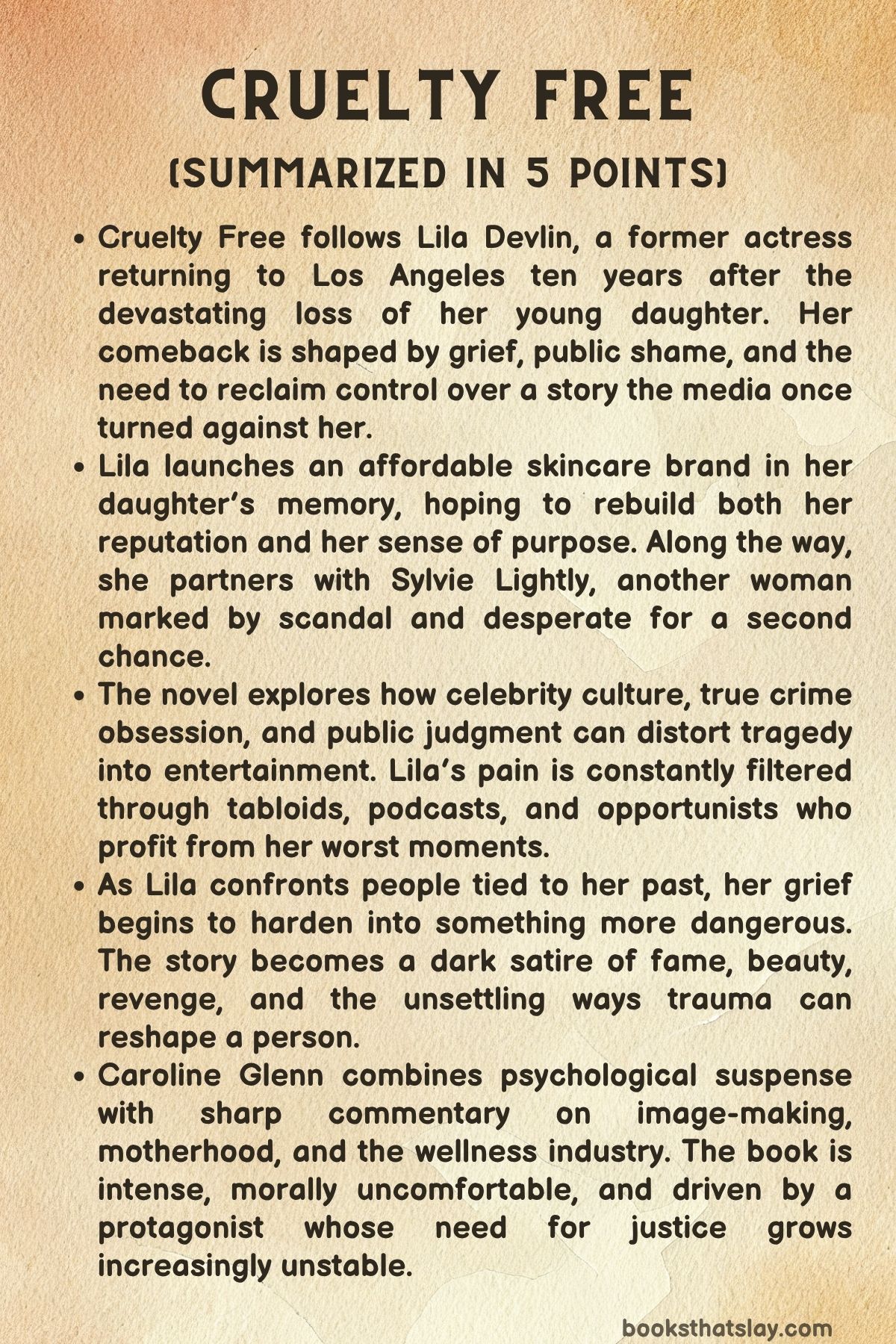
Cruelty Free by Caroline Glenn is a dark satirical thriller about grief, celebrity culture, public shame, revenge, and the beauty industry’s obsession with perfection. The novel follows Lila Devlin, a former actress whose life was destroyed after the kidnapping and presumed murder of her daughter, Josie.
Years later, Lila returns to Los Angeles with plans to rebuild herself through a skincare brand created in Josie’s memory. Instead, her pain hardens into violence. The book mixes crime, horror, and sharp social commentary, showing how trauma, fame, and moral decay can turn a victim into something monstrous.
Summary
Ten years after her daughter Josie was kidnapped and presumed murdered, Lila Devlin returns to Los Angeles. She has spent years living quietly outside the public eye, trying to escape the scandal that consumed her life.
Before the tragedy, Lila had been a famous actress. She was discovered young by director Susan Friedland, became a star, married actor Aidan Reynolds, and eventually had Josie after a difficult pregnancy.
Josie’s birth brought Lila severe postpartum depression, but over time she recovered and became fiercely attached to her daughter.
The night everything changed, Lila was out at a bachelorette party. She drank heavily and used cocaine, while Aidan came home early, dismissed the nanny, and failed to arm the alarm.
By morning, Josie had vanished from her nursery. An open window, ladder marks outside, and a ransom note made it look like a kidnapping.
But the investigation was mishandled from the start. Police errors contaminated the scene, and paparazzi swarmed the house.
The media focused less on Josie and more on Lila’s drug use, strange behavior, and anger. Public sympathy quickly turned into suspicion.
Further ransom demands followed. Lila wanted to make an exchange herself, but the police became involved.
During the attempted handoff, an officer fired at a van he believed was part of the crime, and the van escaped. Lila was furious, convinced the police had destroyed her best chance to save Josie.
Investigators later turned their attention to Arthur Allen, a gardener who had worked at the house and had a criminal record, but they never found proof. A final message claimed Josie was dead.
When a burned toddler’s body was later found near Lake Gregory, everyone believed it was Josie. Lila’s marriage collapsed.
Aidan remarried a model named Sonnet and had another daughter, Talia, while Lila vanished.
Back in Los Angeles, Lila plans to launch a budget skincare brand called glob in Josie’s memory. She first asks her former publicist, Cara Donaldson, for help, but Cara refuses and sends her to Sylvie Lightly, a disgraced PR professional whose own career was ruined after she drove into a crowd outside a nightclub.
Lila is wary of Sylvie at first, but Sylvie understands public condemnation and uses that shared experience to gain Lila’s trust. The two women become partners.
Lila also reconnects with Aidan and meets Sonnet and Talia. Seeing the life Aidan has built without her wounds her deeply.
She tries to confront the people connected to Josie’s case, hoping some kind of closure will follow. Detective Nick Fox remains arrogant and still hints that Lila may have been involved.
Then Lila meets Nico DeLuca, a gossip publisher who profited from the scandal around Josie’s disappearance. Nico gives a selfish apology and then asks Lila to appear on a podcast about mothers without children.
Lila snaps and kills him with a box cutter.
Sylvie discovers what Lila has done and, instead of reporting her, helps cover it up. She deletes recordings, stages phone activity, and disposes of the body.
Lila feels a disturbing calm after Nico’s death. It does not restore Josie, but it gives her a sense of power she has not felt in years.
The two women keep building glob and hire Maya, a young chemistry student from Cape Cod. Maya’s youth, intelligence, and slight resemblance to Josie make Lila feel protective of her.
Meanwhile, Lila becomes focused on John Carmichael, the retired lead detective whose mistakes shaped the case. She tracks him to Lake Arrowhead, intending to kill him.
Carmichael admits the investigation failed Josie and tells Lila he has found Arthur Allen living under a new name in Slab City. Lila shoots Carmichael, and with Sylvie’s help, disposes of his body.
Lila and Sylvie then travel to Slab City in disguise. Lila attacks Arthur Allen and demands that he confess to kidnapping Josie.
Arthur insists he was framed and had nothing to do with it. Lila tortures him, but he still refuses to confess.
Finally, she kills him. Instead of peace, Lila feels empty.
The deaths of Nico, Carmichael, and Arthur have not satisfied her need for punishment.
Afterward, Lila decides that everyone who profited from Josie’s death deserves to suffer. Sylvie shows her an oral history book about the case, and Lila tears out the list of people involved, treating it like a kill list.
While preparing to dispose of Arthur’s body, Sylvie suggests using his collagen for glob’s products. They process his body into collagen powder, and this horrifying ingredient becomes the secret behind glob’s success.
Glob soon becomes a viral sensation after influencers praise it online. Lila grows rich and famous again, appearing on television and presenting the brand as a loving tribute to Josie.
She and Sylvie travel to New York for publicity, where Lila targets Greer Houser, a true-crime podcaster who built her career on Josie’s case. Lila and Sylvie visit Greer’s home, knock her unconscious, drown her, pack her body into a chest, and bring her back to Los Angeles to turn into more collagen.
As the company expands, Maya becomes more important to Lila. Maya admires her and works in the lab without knowing the truth about the collagen.
Sylvie grows jealous of Lila’s attention toward Maya. The women continue killing people from the oral history list, including Cara Donaldson, Tommy Olsen, and others.
They also begin targeting people connected to Sylvie’s past. Their relationship becomes increasingly unstable, possessive, and violent, but murder and the business keep them tied together.
Lila also starts believing that she and Aidan still belong together. At his birthday party, she meets Talia again and later kisses Aidan.
He pulls away, saying he cannot betray his family. Lila begins to notice inconsistencies in Aidan’s story about the night Josie disappeared.
She remembers details suggesting he had been drinking, wearing shoes inside, and may have hidden the truth. After sleeping with him again, she confronts him and convinces herself that he accidentally killed Josie, staged the kidnapping, and allowed Lila to be blamed.
To punish him, she decides to kidnap and kill Talia.
At the same time, Maya decides to leave glob and move to New York with Peter. Lila sees Peter as a threat because he is taking Maya away.
She and Sylvie run him over, kidnap him, and Lila beats him to death. Maya is devastated by Peter’s disappearance and turns to Lila for comfort, unaware that Lila murdered him.
Lila and Sylvie abduct Talia from Aidan’s home and take her to Lila’s house. Before Lila can kill her, Maya arrives unexpectedly.
She senses danger, and Sylvie threatens her with a gun. Maya and Talia are locked in the basement, where Maya finds jars of human collagen labeled with victims’ names, including Peter’s.
Then Sylvie reveals the truth. Josie was not killed by Arthur or Aidan.
Sylvie kidnapped her years earlier for ransom money, hoping to save her husband and his mother. When the plan fell apart, she abandoned Josie alive at a fire station.
Josie may have grown up somewhere else, not knowing Lila at all. Lila is destroyed by the revelation that Sylvie knew Josie had lived and kept it from her.
Lila shoots Sylvie, and the two women fight as a fire starts in the house. Sylvie stabs Lila, and Lila slits Sylvie’s throat.
Both are fatally wounded. In the basement, Maya helps Talia escape through a small window and brings help.
She later finds Lila dying, seemingly after Lila has opened the basement door. Maya refuses to forgive her and escapes.
As Lila dies, she imagines seeing Josie as a teenage girl in a grocery store. Josie does not recognize her.
Lila begs not to be forgotten and ends with the bitter wish that she will haunt her daughter.
Characters
In Cruelty Free, Caroline Glenn builds the story around grief, celebrity, public judgment, revenge, and the terrifying ways unresolved trauma can mutate into violence. The characters are not just connected by Josie’s disappearance; they are shaped by the way that tragedy is consumed, exploited, misunderstood, or hidden.
Each important figure reflects a different side of the book’s central darkness: fame, guilt, motherhood, ambition, cruelty, and the hunger to turn pain into power.
Lila Devlin
Lila Devlin is the emotional and moral center of the book, though she becomes increasingly horrifying as the story progresses. At the beginning of her journey, she is defined by unbearable loss.
The kidnapping and presumed murder of her daughter Josie destroys her marriage, her public image, and her sense of identity. Lila’s grief is complicated by guilt, because on the night Josie disappeared she was drinking, using drugs, and away from home.
The public uses this against her, reducing her to a careless celebrity mother rather than recognizing the depth of her suffering. This judgment scars her almost as deeply as Josie’s disappearance itself, and her later violence grows from the belief that the world not only failed her daughter but also enjoyed watching her suffer.
Lila is a deeply wounded mother, but the book never allows her pain to remain purely sympathetic. Her grief hardens into entitlement, rage, and eventually murder.
She begins by wanting answers and accountability, but after killing Nico DeLuca, she discovers that violence gives her a temporary sense of release. This is the turning point in her character: revenge stops being a desperate act and becomes a need.
Every person connected to Josie’s case becomes, in Lila’s mind, part of a larger system of cruelty. She convinces herself that she is punishing people who deserve it, but her moral reasoning becomes more unstable with each killing.
By the time she begins turning victims into collagen for glob, she has transformed grief into consumption, making the bodies of the dead into a product that restores her fame.
Lila’s relationship with motherhood is one of the most disturbing and tragic parts of her character. Her love for Josie is real, but it becomes possessive and destructive.
She cannot accept a world in which Josie is gone, nor can she accept that other people have continued living. Her fixation on Maya and Talia shows that her maternal instincts have become distorted.
Maya becomes a replacement daughter figure, someone Lila wants to protect and control. Talia becomes a target because she represents Aidan’s new family and the life Lila believes was stolen from her.
Lila’s final vision of Josie as a living teenage girl is devastating because it reveals the emptiness beneath all her violence. She wanted justice, then revenge, then recognition, but what she truly wanted was impossible: to recover the life with Josie that was taken from her.
Sylvie Lightly
Sylvie Lightly is one of the most dangerous characters in the book because she understands damage and knows how to turn it into strategy. When she first enters Lila’s life, she presents herself as another woman ruined by public judgment.
Her disgraced past as a PR professional gives her a point of connection with Lila, and she uses that shared shame to gain Lila’s trust. Sylvie is clever, persuasive, and practical.
Where Lila is emotional and impulsive, Sylvie often thinks in terms of cleanup, optics, and opportunity. This makes her the perfect accomplice, because she can translate Lila’s rage into action and cover stories.
Sylvie’s loyalty to Lila is intense but never simple. She helps hide Nico’s murder, assists with disposing of bodies, and eventually encourages the use of human collagen in glob’s products.
Her relationship with Lila is part friendship, part romance, part obsession, and part business partnership. She wants to be needed by Lila, and this need becomes more obvious when Maya enters their lives.
Sylvie’s jealousy reveals how possessive she is. She does not merely want to help Lila; she wants to be the one person who truly understands her, enables her, and survives beside her.
The revelation that Sylvie kidnapped Josie changes the entire meaning of her character. She is not simply Lila’s accomplice after the fact; she is the original source of Lila’s destruction.
Her earlier sympathy, her partnership, and her intimacy with Lila become horrifying because they are built on a secret betrayal. Sylvie’s decision to abandon Josie alive at a fire station shows that she is not without some line of conscience, but her choice to hide the truth for years makes her unforgivable within the moral world of the story.
In Cruelty Free, Sylvie represents the cruelty of concealment: the way one hidden act can ruin countless lives, and the way guilt can disguise itself as devotion.
Josie Devlin Reynolds
Josie Devlin Reynolds is physically absent from most of the story, yet she shapes nearly every major action in the book. As Lila and Aidan’s daughter, she represents innocence, loss, and the life that might have been.
Her disappearance turns her into a symbol long before she can become a fully known person. To Lila, Josie is the beloved child whose loss justifies everything.
To the media, she becomes the center of a sensational crime. To investigators, she becomes a case.
To exploiters like Nico and Greer, she becomes content. This is part of the tragedy: Josie’s humanity is repeatedly replaced by what others need her to mean.
Josie’s importance lies in the contrast between the real child and the imagined child. Lila remembers her as a daughter, but over time Josie becomes almost mythic in Lila’s mind.
She is the wound that never closes. The final imagined encounter with Josie as a teenager is powerful because it restores, for a moment, the possibility that Josie had a life beyond the crime.
The fact that Josie does not know Lila makes the scene even more painful. Lila has lived entirely inside the tragedy, while Josie, if alive, may have existed outside Lila’s memory and obsession.
Josie is therefore not only the lost child of the book but also a reminder that grief can become selfish when it refuses to imagine the lost person as separate from the mourner.
Aidan Reynolds
Aidan Reynolds is a character marked by weakness, guilt, and emotional escape. As Lila’s former husband and Josie’s father, he is central to the original tragedy.
His actions on the night Josie vanished are careless and suspicious: he returns home, sends the nanny away, fails to arm the alarm, and later gives accounts that do not fully satisfy Lila. Even before Lila believes he may have caused Josie’s death, Aidan appears as someone who avoids responsibility.
He survives the catastrophe by moving forward, remarrying, and building a new family, while Lila remains trapped in the ruins of the old one.
Aidan’s remarriage to Sonnet and his fatherhood to Talia make him especially painful to Lila. He seems to have achieved what she cannot: a second life.
This does not necessarily make him cruel, but it does make him emotionally limited. He wants distance from the past without fully confronting what the past did to Lila.
His kiss with Lila shows that he is still vulnerable to nostalgia and desire, yet his retreat afterward shows that he lacks the courage to truly face the consequences of reopening that bond. Lila’s suspicion that he killed Josie reveals more about her desperate need for a target than about confirmed truth, but Aidan’s evasiveness makes him easy for her to condemn.
Aidan functions as a symbol of survival without accountability. He may not be the villain Lila imagines, but he is not innocent in the emotional sense.
His failures on the night of Josie’s disappearance haunt the book, and his new family becomes an unbearable reminder of the future Lila lost. Through Aidan, the story examines how differently two parents can respond to the same tragedy: one by fleeing into replacement, the other by turning grief into revenge.
Maya
Maya is one of the clearest moral contrasts to Lila and Sylvie. She enters the story as a young chemistry student whose intelligence and ambition make her valuable to glob.
She admires Lila and is drawn into the promise of the brand, seeing it as an opportunity for professional growth and perhaps emotional belonging. Her resemblance to what Josie might have become causes Lila to project maternal feelings onto her, but Maya herself is not merely a replacement figure.
She is capable, observant, and eventually brave enough to recognize that something is deeply wrong.
Maya’s role becomes increasingly important because she exposes the difference between genuine care and possessive control. Lila believes she loves Maya in a protective way, but her actions prove otherwise.
When Maya decides to leave and build a future with Peter, Lila experiences this as abandonment and betrayal. This reaction reveals that Lila’s affection is conditional.
She wants Maya near her, dependent on her, and emotionally available to her. Maya’s independence threatens the fantasy Lila has created, so Lila destroys Peter and then allows Maya to grieve in her arms.
This is one of Lila’s cruelest acts because it corrupts comfort itself.
By the end, Maya becomes a survivor and a witness. In the basement, when she discovers the jars of collagen labeled with victims’ names, she finally sees the full horror behind glob’s success.
Her protection of Talia shows her courage and moral clarity. Her refusal to forgive Lila is equally important.
The book does not ask Maya to redeem Lila through compassion. Instead, Maya survives her and rejects her, which makes Maya one of the few characters able to break free from Lila’s emotional gravity.
Talia Reynolds
Talia Reynolds represents innocence endangered by adult guilt, jealousy, and revenge. As Aidan and Sonnet’s daughter, she is not responsible for the past, but she becomes trapped inside it because Lila sees her as a living symbol of Aidan’s second chance.
Talia’s existence wounds Lila because she embodies the family Aidan still has while Josie remains absent. This makes Lila’s plan to abduct and kill Talia especially horrifying.
Talia is not targeted for anything she has done; she is targeted for what she represents.
Talia also functions as a mirror to Josie. Both are young daughters placed in danger because of adult choices.
The difference is that Talia’s danger occurs after Lila has become the kind of threat she once feared. This reversal is central to the book’s moral collapse.
Lila, who once suffered the loss of a child, becomes willing to inflict that same devastation on another mother and father. Talia’s escape with Maya’s help prevents Lila from completing this final act of revenge, but her presence still reveals how far Lila has fallen.
Sonnet
Sonnet is important because she represents the life that continued after Lila’s world ended. As Aidan’s new wife and Talia’s mother, she occupies the place Lila once held, though not in a simple or malicious way.
Her presence intensifies Lila’s grief because she is proof that Aidan has rebuilt his domestic life. Sonnet does not need to be cruel to hurt Lila; her ordinary happiness is painful enough.
In the book, Sonnet’s main function is to show how grief distorts perception. To Lila, Sonnet is not just a woman married to her ex-husband.
She becomes an intruder into a life Lila believes should still belong to her. Yet Sonnet is also vulnerable, because Lila’s rage eventually reaches toward Talia.
Through Sonnet, the story shows that revenge does not remain fixed on the guilty or even the possibly guilty. Once Lila’s violence expands, innocent people connected to her pain become targets too.
Nico DeLuca
Nico DeLuca represents media exploitation at its most cynical and self-serving. As a gossip publisher who profited from the Devlin baby scandal, he helped turn Josie’s disappearance into public spectacle.
His apology to Lila is shallow because he centers his own guilt and career rather than truly acknowledging the damage he caused. When he asks Lila to appear on a podcast episode about mothers who “don’t have any children,” he reveals that he still sees her pain as material.
Nico’s murder is the first major sign that Lila’s anger has crossed into irreversible violence. He is not innocent in the emotional ecosystem of the story; he fed the public appetite that dehumanized Lila and Josie.
However, his death also shows that Lila’s idea of justice is already unstable. Killing Nico does not heal her.
It only teaches her that violence can briefly quiet her pain. As the first victim, Nico becomes the doorway through which Lila enters her new identity as avenger, murderer, and eventually monster.
Detective Nick Fox
Detective Nick Fox represents institutional arrogance and the failure of authority. During the original investigation, police errors help contaminate the crime scene and damage the chances of finding Josie.
Fox’s later attitude toward Lila is smug and unapologetic, and he continues to imply that she may be guilty. His character matters because he shows how official power can worsen trauma when it refuses humility.
Fox is not portrayed as a source of comfort or justice. Instead, he is part of the machinery that leaves Lila feeling abandoned and blamed.
His suspicion of Lila may have procedural logic, given the circumstances of the case, but his lack of compassion makes him morally ugly. In Lila’s mind, people like Fox did not simply fail Josie; they helped turn Lila into a public suspect and private ruin.
He therefore contributes to the book’s larger portrait of a world where institutions, media, and individuals all feed the same cruelty.
John Carmichael
John Carmichael is the retired lead detective whose failures continue to haunt the case. Unlike Nick Fox, Carmichael eventually admits that the police failed Josie, which gives him a more complicated role.
He is not purely defensive or smug. His admission suggests some awareness of guilt, and his discovery that Arthur Allen is living under another name gives Lila a new direction for her revenge.
Yet this does not save him, because Lila no longer wants only information. She wants blood.
Carmichael’s death shows that confession and regret are not enough to satisfy Lila. He gives her something she has wanted for years: acknowledgment that Josie was failed.
But by that point, acknowledgment cannot restore her daughter or undo the public destruction of her life. Carmichael becomes another body in Lila and Sylvie’s expanding system of punishment.
His character therefore marks the point where Lila’s revenge detaches from even the appearance of justice.
Arthur Allen
Arthur Allen is one of the most unsettling figures because he is both suspicious and, ultimately, falsely blamed. As a convicted sex offender who worked at the Reynolds home and showed interest in Josie’s room, he becomes an easy suspect.
The police and Lila both see him as someone who fits the shape of the crime. His later life under another name deepens the atmosphere of guilt around him, even though he insists that he did not kidnap Josie.
Arthur’s torture and death are crucial because they expose the emptiness of Lila’s revenge. She believes that forcing a confession from him will bring closure, but he refuses to confess even under extreme violence.
When she kills him, she feels no peace. This moment matters because it proves that her hunger is no longer about one guilty person.
Arthur’s death should end the quest if her quest were truly about Josie’s kidnapper, but instead it expands it. He becomes the proof that revenge cannot satisfy grief when grief has become identity.
Cara Donaldson
Cara Donaldson is Lila’s former publicist and one of the people connected to her old celebrity life. Her refusal to help Lila launch glob shows a practical desire to distance herself from scandal and instability.
Cara’s decision to refer Lila to Sylvie indirectly sets the central partnership of the book in motion, making her more important than she first appears.
Cara represents professional self-preservation. She knows Lila’s history, understands the danger of public association, and chooses not to risk herself.
In a less violent story, this might simply be a business decision. In Lila’s world, however, refusal becomes betrayal.
Cara’s later place among the victims shows how Lila’s sense of grievance expands to include not only those who actively exploited Josie’s death but also those who failed to support Lila in the way she demanded.
Greer Houser
Greer Houser is the true-crime podcaster who built a career out of Josie’s case. She represents a more modern form of exploitation than Nico: not tabloid gossip, but polished, serialized tragedy packaged for listeners.
Her success depends on turning another family’s suffering into narrative entertainment. For Lila, Greer is not merely a commentator; she is a parasite feeding on Josie’s memory.
Greer’s murder in New York shows how far Lila and Sylvie’s operation has evolved. By this point, killing is no longer only emotional release.
It is also connected to glob’s production. Greer’s body becomes raw material, collapsing the distance between media consumption and literal consumption.
Her character is important because she shows that the story’s critique is not limited to old paparazzi culture. It also attacks the audience-friendly industries that transform real pain into content.
Peter
Peter is Maya’s boyfriend and a victim of Lila’s possessive attachment. He is important less because of his own flaws than because of what he represents to Lila: Maya’s future beyond glob and beyond Lila’s control.
Maya’s plan to move to New York with him threatens the emotional role Lila has assigned to her. Peter becomes, in Lila’s mind, the person stealing Maya away.
His murder is one of the clearest examples of Lila’s selfish cruelty. Unlike some of the other victims, Peter is not connected to Josie’s case or to Sylvie’s past.
He is killed because he stands between Lila and the fantasy of keeping Maya close. The aftermath is even more disturbing because Maya turns to Lila for comfort, unaware that Lila caused her grief.
Peter’s character reveals that by this stage, Lila is no longer punishing the people who consumed her tragedy. She is creating new tragedies to protect her own desires.
Tommy Olsen
Tommy Olsen appears as one of the people targeted from the oral history list, making him part of the wider network of individuals who participated in, profited from, or remained attached to the public story of Josie’s disappearance. Even with limited detail, his role matters because he helps show how Lila’s revenge becomes systematic.
The torn-out “Cast of Characters” page becomes a hit list, and Tommy is absorbed into Lila and Sylvie’s machinery of punishment.
As a character, Tommy represents the expansion of blame. Lila no longer needs a direct personal confrontation with each person to justify killing them.
Their inclusion in the narrative of Josie’s case is enough. This makes Tommy important to the book’s structure because he shows how revenge becomes bureaucratic and impersonal.
Lila treats the list almost like evidence, but it is really a permission slip for further violence.
Lydia
Lydia, the nanny, is a quieter but significant figure in the original tragedy. Aidan sends her away before Josie vanishes, which makes her absence part of the chain of failures that allow the kidnapping to happen.
Later, when Lila wants to handle the ransom exchange herself, Lydia alerts Detective Nick Fox. This action may come from concern, but it also contributes to the police intervention that Lila believes ruins her chance to recover Josie.
Lydia’s role shows how even well-intentioned decisions can become unbearable in the aftermath of trauma. From one perspective, contacting the police is responsible.
From Lila’s perspective, it is another betrayal and another moment when someone else takes control of her daughter’s fate. Lydia is not presented as villainous, but she belongs to the group of people whose choices Lila cannot stop revisiting.
Her character adds to the book’s sense that tragedy is built from many small decisions, not only one monstrous act.
Susan Friedland
Susan Friedland is the director who discovers Lila during an open casting call, making her indirectly responsible for Lila’s entrance into fame. Her role is part of Lila’s origin story as a celebrated actress whose life becomes public property.
Susan represents the beginning of the celebrity machine that later devours Lila during Josie’s disappearance.
Although Susan is not central to the revenge plot, she matters because she helps explain how Lila became visible enough to be destroyed publicly. Fame gives Lila wealth, attention, and opportunity, but it also ensures that her worst trauma becomes a spectacle.
Susan’s discovery of Lila is therefore not negative in itself, but it begins the path toward a life in which private suffering can never remain private.
Themes
Grief as a Force That Distorts Identity
Lila’s grief does not remain a private sorrow; it gradually becomes the center of her entire identity. After Josie’s disappearance, she is no longer seen as a mother in pain but as a public symbol of scandal, suspicion, and failure.
Years later, her return to Los Angeles shows that she has not healed from the loss but has built her life around it. Her skincare brand is presented as a tribute to Josie, yet it also becomes a way for Lila to reclaim attention, power, and control.
In Cruelty Free, grief is shown as something that can turn sacred memory into obsession when it is never allowed to rest. Lila’s love for Josie is real, but it becomes mixed with rage, humiliation, and revenge until she can no longer separate justice from punishment.
Her grief makes her vulnerable to manipulation, especially by Sylvie, because both women understand what it means to be publicly condemned. By the end, Lila’s longing for Josie remains painfully human, but it has been corrupted into violence, possession, and self-destruction.
Public Judgment and the Violence of Media Consumption
The public does not simply watch Lila’s tragedy; it feeds on it. From the moment Josie vanishes, reporters, gossip outlets, true-crime figures, and casual spectators reduce a child’s disappearance to entertainment.
Lila’s drug use, appearance, anger, and mental health are treated as evidence against her, while the deeper failures of the investigation are pushed aside. This theme exposes how media attention can become a second crime, turning victims into characters and grief into content.
Nico and Greer represent different forms of exploitation: one profits through gossip, while the other builds authority through true-crime storytelling. Both treat Josie’s death as material to package and sell.
Lila’s later killings are monstrous, but they grow from her belief that these people consumed her pain without consequence. The novel criticizes a culture that claims sympathy while rewarding spectacle.
It shows how public judgment can trap a person inside one frozen version of themselves, especially when that judgment is repeated by headlines, podcasts, books, and viewers who feel entitled to another person’s suffering.
Revenge, Justice, and Moral Collapse
Lila begins by seeking answers, but her search quickly changes into revenge. At first, her anger seems directed at people who failed Josie: the police who mishandled the case, the media figures who profited from it, and the suspect who may have harmed her child.
However, each act of violence proves that revenge cannot give her what she truly wants. Killing Nico brings relief only briefly.
Killing Carmichael gives her no real closure. Killing Arthur Allen leaves her feeling empty rather than healed.
This pattern reveals the central moral collapse of Cruelty Free: Lila mistakes destruction for justice until murder becomes easier to justify. Once she decides that everyone who benefited from Josie’s tragedy deserves punishment, her rage expands beyond guilt or innocence.
The “hit list” becomes less about truth and more about appetite. Her revenge also becomes practical, feeding glob’s success through the horrific use of victims’ bodies.
The novel shows that revenge may begin with pain, but when it is separated from truth, restraint, and accountability, it becomes another form of cruelty.
Possession, Motherhood, and the Need to Be Remembered
Motherhood in the story is shaped by love, guilt, fear, and possession. Lila’s attachment to Josie is intense because the child represents both her deepest love and her greatest wound.
After losing Josie, she begins seeking substitutes for the daughter she cannot recover. Maya’s resemblance to Josie makes Lila protective, but that protection soon becomes controlling.
When Maya tries to leave, Lila treats her independence as betrayal. Talia becomes another distorted reflection of motherhood: she is innocent, yet Lila sees her as a way to punish Aidan and reclaim power over the life he built without her.
These relationships show that Lila’s longing to mother has become inseparable from her need to own and control. Sylvie’s confession makes the tragedy even sharper because Josie may have lived beyond Lila’s grief, outside Lila’s memory and influence.
Lila’s final imagined encounter with Josie reveals her deepest fear: not only that she lost her daughter, but that her daughter might not remember her. Her last wish to haunt Josie is both heartbreaking and terrifying, turning love into a demand that cannot be escaped.