A Reliable Wife Summary, Characters and Themes
A Reliable Wife by Robert Goolrick is a dark psychological novel about loneliness, desire, deception, and the cost of trying to escape the past. Set in rural Wisconsin in 1907, it begins with a wealthy businessman waiting for a mail-order bride, only to discover that the woman who arrives is not who she claimed to be.
From that first lie, the story moves into a world of secrets, old wounds, betrayal, and uneasy forgiveness. The novel is less a simple love story than a study of damaged people who want money, revenge, comfort, and redemption, often all at once.
Summary
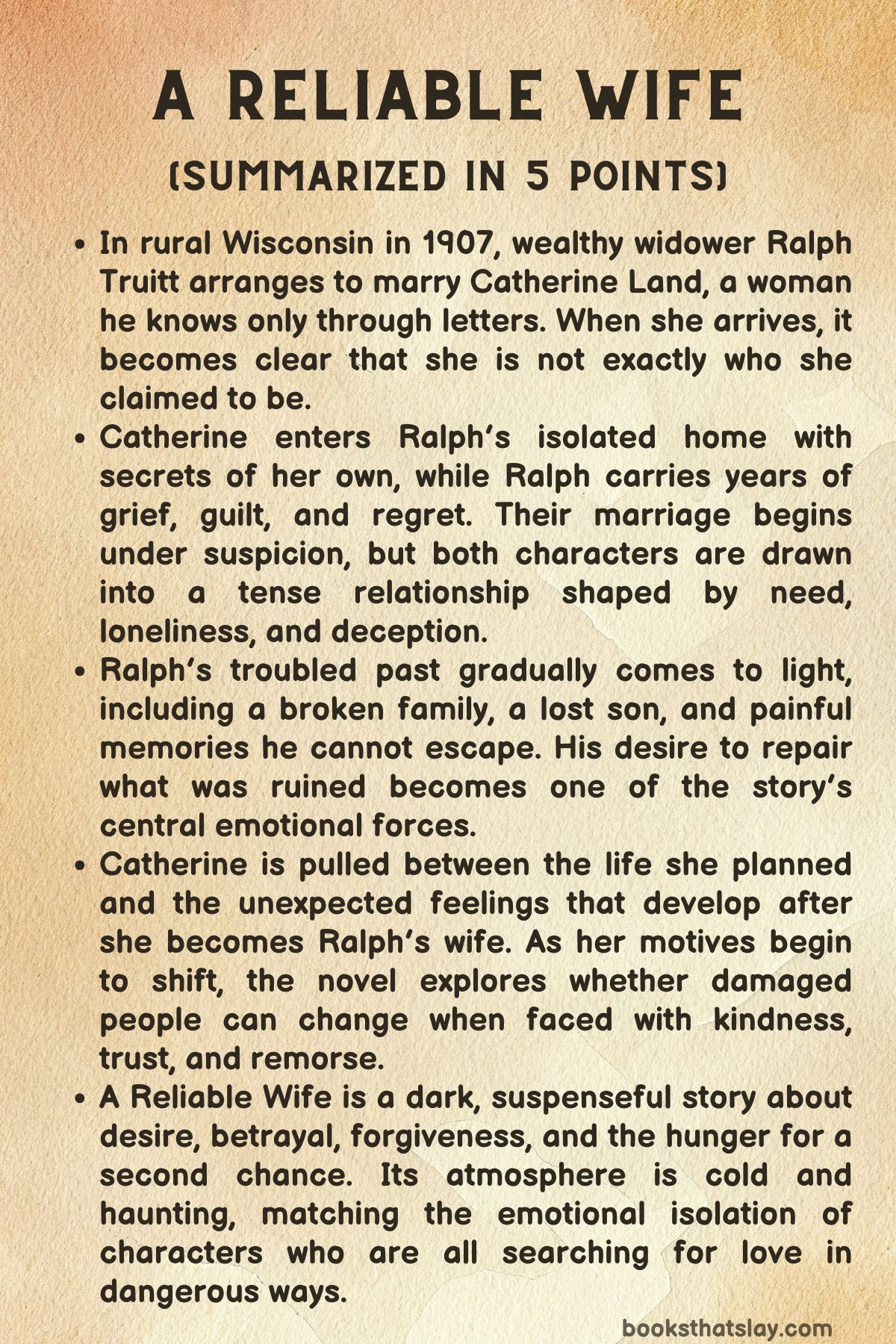
In A Reliable Wife, Ralph Truitt is a rich, powerful businessman living in a small Wisconsin town in the early twentieth century. Although he owns a large house and has great influence, his life is empty.
His wealth has not protected him from loneliness, regret, or the memory of his ruined family. In October 1907, he stands at the train station waiting for Catherine Land, a woman he has arranged to marry after exchanging letters with her.
The people of the town watch him closely, curious and judgmental, because everyone knows he has advertised for a wife and is now expecting a stranger to step into his life.
Ralph expects a plain, modest woman, the kind of reliable companion Catherine has presented herself to be in her letters. She has sent a photograph, and he has built an idea of her from that image and from her careful words.
But when Catherine arrives, Ralph immediately sees that she is not the woman in the picture. She is beautiful, composed, and clearly hiding something.
Catherine admits that the photograph was not hers but her cousin’s. Ralph understands at once that their marriage has begun with deception.
Still, he does not send her away. The weather is dangerous, the town is watching, and some part of him is too tired or too hopeful to abandon the arrangement so quickly.
On the way to Ralph’s home, disaster strikes. A deer startles the horses, the carriage crashes, and Ralph is badly hurt.
Catherine, however, proves herself calm and capable. She controls the frightened horses, gets Ralph home, and helps care for him.
At the house, she stitches his head wound and assists Mrs. Larsen as Ralph suffers through a severe fever. During this time, Catherine studies the house, its rooms, its valuable objects, and the life Ralph’s money can provide.
She has not come only to be a wife. Hidden beneath her manner is a plan: she carries poison in a blue bottle and intends to marry Ralph, kill him slowly, inherit his fortune, and leave with the man she truly wants.
As Ralph recovers, he begins to tell Catherine about his past. His story explains much of the bitterness and sorrow that have shaped him.
He grew up under the power of a cruel mother and later sought pleasure and escape in Chicago and Europe. He married Emilia, a woman whose beauty and passion once enchanted him, but the marriage collapsed after she betrayed him with her piano teacher, Moretti.
Ralph responded with rage and violence, driving Emilia and Moretti away. His daughter Franny later died, and his son Antonio ran from him after Ralph treated him with anger and cruelty.
Ralph has spent years searching for Antonio, the son he lost through his own brutality. Now he believes he has found him in Saint Louis.
Ralph and Catherine marry, though trust between them is thin. Ralph gives her expensive clothes and jewelry, placing her into the role of a wealthy man’s wife.
Then he sends her to Saint Louis to bring Antonio home. Catherine obeys, but the journey reveals the true shape of her scheme.
The man Ralph believes may be his lost son is actually Tony Moretti, Catherine’s lover. Tony is connected to Ralph’s painful past through Emilia and Moretti, and he carries deep resentment toward Ralph.
Catherine and Tony have planned everything together. She is supposed to marry Ralph, poison him, take his money, and then live with Tony in comfort.
In Saint Louis, Catherine falls back into Tony’s world. Their relationship is passionate but destructive, full of need, control, and shared corruption.
Catherine still feels the force of her old attachment to him, yet her time with Ralph has begun to change her in ways she does not fully understand. Ralph’s loneliness, his guilt, and his strange willingness to accept pain disturb her.
She also encounters her sister Alice, whose life has fallen into poverty, sickness, and misery. This meeting deeply shakes Catherine.
Alice’s suffering reminds her of the life Catherine has tried to escape and of the damage left behind by years of desperation and selfish choices.
Catherine returns to Wisconsin with Tony, who now presents himself as Antonio. Ralph receives him as his lost son, though the situation is filled with lies and uneasy knowledge.
Catherine begins carrying out the plan. She poisons Ralph slowly with arsenic, placing it in his food, water, and personal belongings.
Ralph grows weaker and sicker, but he is not as blind as Catherine thinks. He realizes what is happening.
Instead of stopping her, he allows it to continue. He is exhausted by disappointment and believes that Antonio’s return may be false in every meaningful way.
Death, to him, begins to look almost like release.
But Catherine changes. Living with Ralph, seeing his suffering, and recognizing the depth of his need awaken feelings she did not expect.
Her plan, once cold and practical, becomes unbearable to her. She begins to love Ralph, or at least to care for him with a seriousness she has never known before.
As his illness worsens, she stops poisoning him. She nurses him with the same determination she once used to destroy him.
Eventually, she confesses what she has done. Ralph, instead of rejecting her, forgives her.
His forgiveness is not simple or clean; it comes from sorrow, self-punishment, longing, and a desperate wish to keep what remains of his life from collapsing again. Catherine is pregnant and believes the child is Ralph’s.
Tony cannot accept this change. He has come to Ralph’s house expecting money, power, and Catherine’s loyalty.
Instead, he finds Catherine pulling away from him and urging him to accept Ralph’s love. She wants him to stop living through hatred and to take the chance Ralph is offering, even if that chance is built on falsehood.
Tony refuses. His anger and desire are stronger than any wish for peace.
He spends Ralph’s money recklessly, behaves with arrogance, and remains obsessed with Catherine. To him, Ralph is still an enemy, and Catherine is still something he believes belongs to him.
The tension inside the house grows until it breaks. Tony attacks and rapes Catherine in the conservatory.
Catherine fights back and stabs him with sewing scissors. Ralph finds them and understands the full betrayal: Catherine and Tony’s plan, their affair, and the false identity Tony has used.
Rage overtakes him. Ralph attacks Tony, and the two men fight through the house and out onto the grounds.
Tony runs onto the frozen pond. The ice gives way beneath him, and he falls into the freezing water.
Ralph tries to save him, but Tony drowns under the ice.
After Tony’s death, he is buried near Ralph’s family, becoming part of the household’s long history of grief. Ralph and Catherine remain together, but their future is not free from the past.
Their marriage has been shaped by lies, attempted murder, violence, forgiveness, and loss. Catherine gives birth to a child, bringing new life into a house marked by death and regret.
In the end, A Reliable Wife leaves Ralph and Catherine alive, not innocent or fully healed, but bound together by what they have survived. Their life continues in the shadow of what they did, what they endured, and what they chose not to abandon.
Characters
Ralph Truitt
Ralph Truitt is the emotional center of A Reliable Wife, a man whose wealth has not protected him from loneliness, regret, or spiritual exhaustion. He is powerful in his town, respected because of his money and business success, but his private life is almost completely hollow.
His decision to send for a wife through letters shows both his desperation and his desire to rebuild something human in his life. Ralph is not simply a victim, however.
His past reveals cruelty, rage, possessiveness, and violence, especially in his treatment of Emilia and Antonio. He has suffered deeply, but he has also caused suffering, and this makes him a morally complicated figure in the book.
His longing for Antonio’s return is not only the longing of a father for his son, but also the longing of a guilty man who wants punishment, forgiveness, and redemption all at once.
Ralph’s relationship with Catherine reveals his capacity for both blindness and grace. He knows from the beginning that she has lied to him, yet he accepts her anyway because he wants companionship more than certainty.
Later, when he realizes she is poisoning him, his refusal to stop her shows how weary he has become of life. He almost treats death as something deserved.
Yet Ralph’s forgiveness of Catherine is one of the most important signs of his transformation. He does not excuse betrayal because he is foolish; rather, he understands betrayal because his own life has been built around it.
By the end of the story, Ralph remains wounded and burdened, but he is also capable of tenderness. His survival is not a clean triumph, but it suggests that even a damaged man can choose mercy over vengeance.
Catherine Land
Catherine Land is one of the most layered characters in the book because she enters Ralph’s life as a deceiver but gradually becomes capable of genuine feeling. At first, she presents herself as a practical and calculating woman who has come to Wisconsin with a clear plan: marry Ralph, poison him, inherit his fortune, and return to Antonio.
Her false photograph and hidden poison immediately establish her as someone skilled in disguise. Yet Catherine is not portrayed as simply greedy or heartless.
Her past, her relationship with Antonio, and her encounter with Alice reveal a woman shaped by poverty, survival, shame, and emotional damage. She has learned to use beauty and deception as tools because the world has given her few safe ways to live.
Catherine’s transformation comes through her unexpected emotional attachment to Ralph. As she poisons him, she begins to see him not merely as a target but as a lonely, suffering human being.
Her guilt grows into care, and her care grows into love. This change does not erase her crimes, but it makes her one of the most morally complex figures in A Reliable Wife.
Catherine’s pregnancy also deepens her role in the story because it connects her to the possibility of renewal, even though that renewal is surrounded by death and betrayal. Her final life with Ralph is not a simple happy ending.
It is a life built from damaged choices, forgiveness, and the painful hope that people can become different from what they once were.
Antonio Truitt / Tony Moretti
Antonio Truitt, also known as Tony Moretti, is Ralph’s lost son and Catherine’s lover, making him the character who connects the deepest betrayals in the story. He carries the wounds of his childhood, especially Ralph’s hatred and violence after Emilia’s betrayal.
His resentment toward Ralph is understandable, but the way he allows that resentment to consume him makes him destructive. Antonio does not merely want money; he wants revenge, power, and emotional victory over his father.
His plan with Catherine is built around humiliating and replacing Ralph, not just robbing him. In this sense, Antonio becomes a figure of unresolved pain that has turned poisonous.
Antonio’s tragedy lies in his inability to accept love when it is finally offered to him. Ralph is willing to accept him, even under false and painful circumstances, but Antonio cannot step out of the identity he has built around anger.
His obsession with Catherine also shows his need to possess rather than love. When Catherine begins to change, Antonio experiences her transformation as a betrayal.
His attack on her in the conservatory exposes the brutality beneath his charm and woundedness. His death on the frozen pond is symbolically fitting because he is swallowed by the coldness he has carried within himself.
Antonio could have become the center of Ralph’s redemption, but instead he becomes the final consequence of the family’s long history of violence and betrayal.
Emilia Truitt
Emilia Truitt is physically absent from most of the story, but her influence remains powerful. She represents the first great betrayal in Ralph’s adult life and the beginning of the family’s collapse.
Her affair with Moretti destroys Ralph’s marriage and leads to a chain of consequences that affects Franny, Antonio, and eventually Catherine. Emilia is important not simply because she betrays Ralph, but because Ralph’s reaction to her betrayal reveals the violence and possessiveness within him.
Through Emilia, the story shows how love can become control and how humiliation can turn into cruelty.
Although Emilia is often seen through Ralph’s memory, she should not be reduced only to a faithless wife. She also represents a life of passion and desire that stood in opposition to Ralph’s cold, controlled world.
Her choices are destructive, but they expose the emotional emptiness inside the Truitt household. Emilia’s betrayal becomes the wound Ralph never stops touching.
Even after her departure, she remains present through Antonio’s pain, Ralph’s guilt, and the repeated pattern of desire leading to ruin. She is a ghostlike figure in the book, shaping events long after she is gone.
Franny Truitt
Franny Truitt is Ralph and Emilia’s daughter, and her role in the story is defined by innocence lost through the failures of adults. Her death is one of the great sorrows in Ralph’s past and contributes to the emotional deadness that surrounds him when Catherine arrives.
Franny represents what was pure and vulnerable in Ralph’s family before betrayal, rage, and grief destroyed it. Because she does not live long enough to shape the present action directly, her importance is symbolic rather than active.
Franny’s death deepens Ralph’s sense that his life has been punished or cursed. She becomes part of the burden he carries, another reminder that his home was once full of possibility but became a place of absence.
Her memory also helps explain why Ralph is so desperate for Antonio’s return. Antonio is not only the son he lost emotionally; he is also the last surviving link to the family Ralph destroyed.
Franny’s place in the story is quiet, but her absence helps create the atmosphere of grief that defines Ralph’s household.
Alice
Alice, Catherine’s sister, is a painful reminder of the world Catherine comes from and the suffering she has tried to escape. Her life in illness and misery forces Catherine to confront the human cost of poverty, abandonment, and desperation.
Alice’s condition devastates Catherine because it shows her what might have happened to her as well. She is not just a minor family figure; she is a mirror held up to Catherine’s past.
Alice also helps explain why Catherine is so divided. Catherine wants wealth and safety, but she is haunted by the people and experiences she has left behind.
Seeing Alice weakens Catherine’s confidence in the cold plan she has made with Antonio. It reminds her that survival without compassion can become another form of death.
Through Alice, the story gives Catherine a deeper emotional history and shows that her deception is connected to fear, shame, and grief as much as ambition.
Mrs. Larsen
Mrs. Larsen is a steady domestic presence in Ralph’s house and represents order, duty, and practical care. She helps nurse Ralph after the carriage accident and becomes part of the household world Catherine enters.
Unlike Ralph, Catherine, and Antonio, Mrs. Larsen is not driven by consuming desire or revenge. Her role is quieter, but she helps ground the story in ordinary routines of illness, recovery, and service.
Mrs. Larsen also functions as a contrast to Catherine. While Catherine enters the house with hidden motives, Mrs. Larsen belongs to the visible, respectable structure of Ralph’s life.
Her presence emphasizes the gap between appearance and truth in the household. On the surface, Ralph’s home contains wealth, servants, and order; underneath, it contains poison, guilt, and emotional ruin.
Mrs. Larsen’s steadiness makes that hidden disorder stand out more sharply.
Moretti
Moretti, Emilia’s piano teacher and Antonio’s father figure by association, is important because he represents the original intrusion of passion and betrayal into Ralph’s marriage. His affair with Emilia destroys Ralph’s trust and helps create the hatred that Ralph later directs toward Antonio.
Moretti is not as developed as Ralph or Catherine, but his influence is enormous because his actions begin the chain of family destruction that shapes the book’s present.
Moretti also represents the danger Ralph associates with desire. To Ralph, he becomes the man who stole his wife, corrupted his home, and shattered his authority.
Whether this view is completely fair matters less than the effect it has on Ralph. Moretti becomes a symbol of humiliation, and Ralph’s inability to recover from that humiliation leads him into violence and emotional cruelty.
His presence in the past helps explain why Ralph responds to betrayal with such intensity and why Antonio’s later return is so painful.
Themes
Loneliness and the Hunger for Connection
Ralph’s wealth cannot protect him from emotional emptiness. His large house, public status, and business success only make his isolation more visible, because he has everything except warmth, trust, and family.
His decision to send for a wife shows how desperate he has become for human closeness, even if that closeness begins as an arrangement rather than love. Catherine also carries loneliness, though hers comes from a history of survival, poverty, shame, and emotional damage.
She arrives with a criminal plan, but her actions gradually reveal that she is not only chasing money; she is also searching for safety and belonging. Antonio’s loneliness is darker and more destructive because he cannot accept love when it is offered.
He turns pain into revenge and desire into control. In A Reliable Wife, loneliness pushes people toward lies, danger, and betrayal, but it also explains why they keep reaching for one another despite fear.
The characters are damaged by isolation, yet they still long to be seen, forgiven, and chosen.
Deception, Performance, and Hidden Identity
Nearly every important relationship begins with some form of deception. Catherine first appears as a false version of herself, sending another woman’s photograph and pretending to be a plain, dependable wife.
Her identity is a performance designed to gain Ralph’s trust while hiding her plan to poison him. Antonio also performs a role, returning as the lost son while carrying the identity of Catherine’s lover and Ralph’s enemy.
Even Ralph participates in forms of self-deception. He knows Catherine has lied from the beginning, and later he understands that something is terribly wrong, yet he allows the illusion to continue because hope matters more to him than truth.
The theme shows how people use lies not only to harm others but also to protect themselves from unbearable reality. False identities become a way to survive, gain power, or delay grief.
Yet the novel also suggests that deception cannot remain stable forever. Hidden motives eventually surface, and when they do, the emotional cost is severe.
Guilt, Punishment, and the Need for Forgiveness
The characters are trapped by past actions that continue to shape the present. Ralph carries guilt for the violence and cruelty that helped destroy his family.
His treatment of Emilia, Antonio, and the memory of Franny leaves him with a sense that suffering is deserved. This explains why he almost accepts death when Catherine poisons him; he sees punishment as something he has earned.
Catherine’s guilt develops more slowly. At first, she treats Ralph as a target, but as she witnesses his pain and receives his kindness, her plan becomes morally unbearable.
Her decision to stop poisoning him marks a major shift from greed toward remorse. Ralph’s forgiveness is central because it does not erase the crime, but it allows both characters to keep living after it.
Antonio, by contrast, refuses forgiveness. He holds onto rage until it destroys him.
A Reliable Wife presents guilt as a force that can either lead to confession and repair or harden into hatred when forgiveness is rejected.
Love as Damage, Need, and Redemption
Love in the story is rarely simple or gentle. It is mixed with obsession, possession, memory, and grief.
Ralph’s love for his family was once corrupted by pride and violence, leaving him with years of regret. His later love for Catherine is unusual because it grows even while he knows she is dangerous.
He wants not an innocent woman, but someone who might remain with him despite the truth. Catherine’s feelings also change from calculation into care.
Her love becomes visible through action: stopping the poison, nursing Ralph, confessing, and choosing a life with him over Antonio’s destructive plan. Antonio represents love at its most damaged.
His desire for Catherine is controlling, resentful, and violent, proving that passion without compassion becomes cruelty. The theme shows that love does not always save people cleanly, but it can create the possibility of change.
Ralph and Catherine’s final life together is not free from sorrow, yet it is built on survival, forgiveness, and the difficult choice to remain.