For Human Use Summary, Characters and Themes
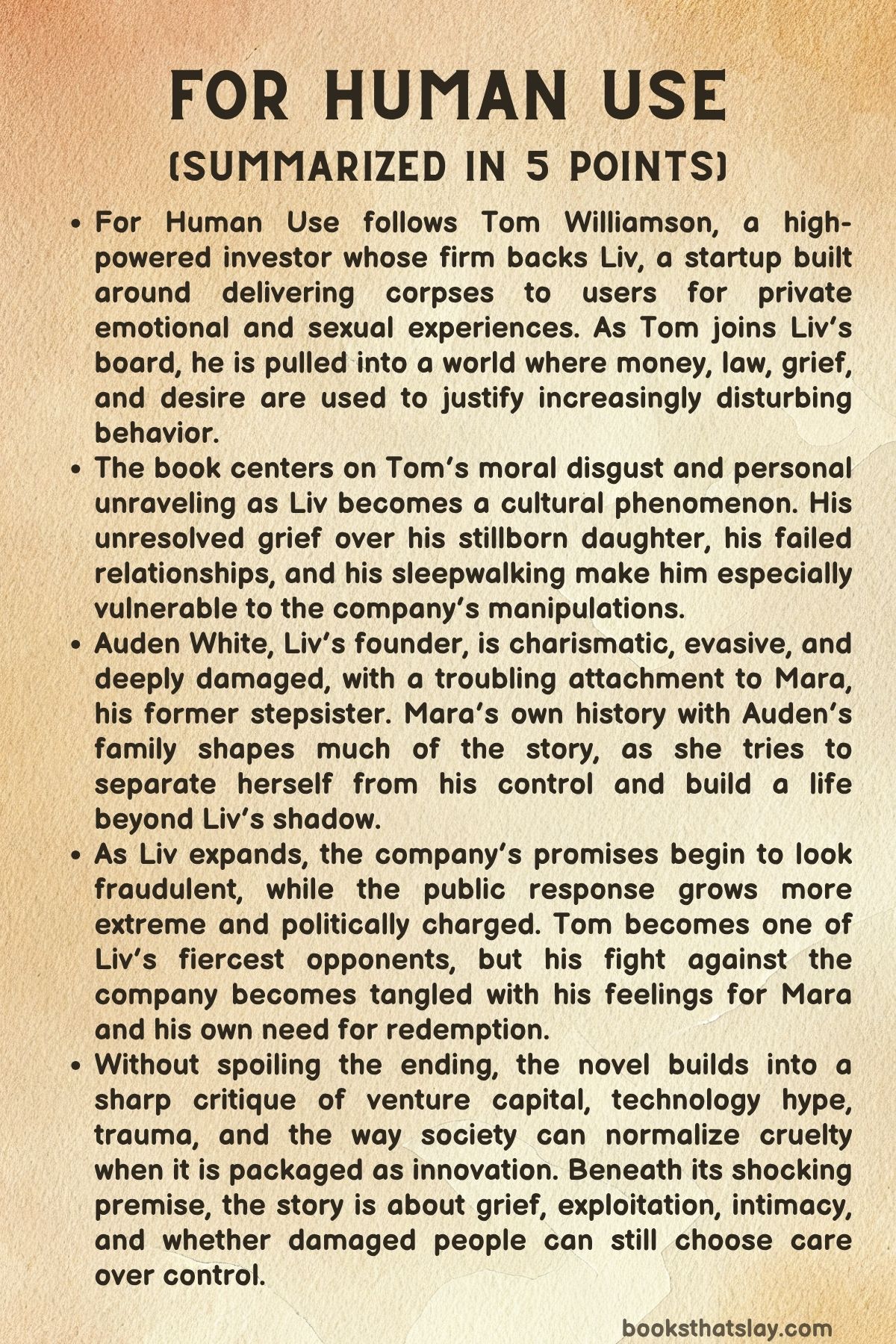
For Human Use by Sarah G. Pierce is a dark satirical novel about grief, desire, capitalism, and the ways technology can turn human damage into a market. The story follows Tom Williamson, a venture capitalist forced onto the board of Liv, a startup that delivers corpses to users seeking private encounters with the dead.
What begins as a shocking investment opportunity becomes a moral and personal crisis, pulling Tom into old trauma, corporate fraud, public scandal, and an uneasy romance with Mara, a young woman tied to Liv’s founder. The book uses grotesque ideas to question intimacy, consent, loneliness, and profit.
Summary
Tom Williamson is a senior partner at Kane Capital whose personal life is already falling apart when the story begins. His ex-fiancée, Elizabeth, is moving out of his apartment after their broken engagement, and while he tries to manage the awkward goodbye, he receives messages from Lorraine, another partner at the firm.
She tells him he has missed an unusual pitch from a startup called Liv. The company, founded by Auden White, allows living users to choose dead bodies through an app and have the corpses delivered to their homes.
Tom assumes the idea must be fake or illegal, but Lorraine says the lawyers have reviewed it.
Tom returns to Kane Capital and joins Robert Kane’s meeting with Auden. Kane is disgusted by Liv but also fascinated by its business potential.
Auden speaks about the company in abstract terms, claiming it offers privacy, emotional intensity, and freedom from social judgment. Tom asks practical and moral questions about legality, consent, transport, liability, and user behavior, but Auden avoids clear answers.
Despite Tom’s concern, Kane decides to invest $150 million and puts Tom on Liv’s board. Auden also manipulates Kane into lending him a set of valuable Bauhaus chairs, adding another strange layer to the partnership.
Auden’s past and private life reveal a more disturbing side of him. Before Liv’s public success, he brought his stepsister Mara into the anatomical lab beneath his brownstone and showed her a corpse, frightening her.
Later, after Liv becomes a major company, he reconnects with Mara and invites her back into his life. He apologizes, offers to pay for her education, and suggests she live in his brownstone.
Auden believes Mara needs saving, but his attachment to her is possessive and unsettling. He is drawn to her body, her vulnerability, and their shared history in ways that blur family, obsession, and control.
Tom’s distress over Liv grows alongside his own unresolved grief. He talks to his psychiatrist, Dr. Thornton, about sleepwalking, drinking, and his fear that he may do something terrible without knowing it.
Thornton suggests that Liv may disturb Tom because it touches buried trauma. Tom avoids discussing Amelia, his ex-wife, and their stillborn daughter.
After the baby died before birth, Amelia held her while Tom could not, and the marriage collapsed. Amelia later met Nikola in a grief support group, and Tom never fully recovered from the loss.
As Tom investigates Liv, he attends a focus group where young male users explain why they prefer corpses to living partners. They see Liv as a way to explore desire without rejection, guilt, judgment, or the emotional needs of women.
Tom is horrified by how easily the users frame their behavior as progressive and harmless. His consultant, Peter McNeil, is also disturbed, but he recognizes the company’s massive growth potential.
Liv becomes a cultural force. Its board normalizes debates about corpse access, legal protections, and teenage users.
Tom is further shaken when he discovers that Amelia now works at Liv as COO and is helping Auden sell the company as a moral movement. Auden expands his public influence while hiding deception inside the company.
Tom later tours Liv’s warehouse and learns that the polished embalming lab shown to investors is fake. The real processing happens at a grim second site, exposing the gap between Liv’s image and its operations.
At a Liv retreat in Costa Rica, Tom is forced to spend time with Auden, Mara, Amelia, Nikola, Lorraine, and Liv executives. Auden announces a wildly inflated valuation before Tom approves it and frames Liv as a company brave enough to reveal truths society denies.
Mara seems uneasy with the performance, and Tom notices her discomfort. That night, drunk and medicated, Tom returns to his villa and finds a corpse Auden has placed there as a welcome gift.
When Tom wakes, he realizes he has spent the night spooning the dead woman on the couch. He is horrified.
Auden uses the incident to intimidate Tom, implying he could expose him. Tom realizes he has been set up and leaves the retreat early.
Mara impulsively books the same flight back to New York. Their connection grows during the trip.
After dropping her at Auden’s brownstone, Tom returns and asks her to dinner. Inside the entryway, he tries to kiss her, but Mara freezes because she knows Auden and Elliot can see through the security cameras.
Tom misreads her reaction and leaves humiliated.
Tom’s professional conflict with Liv worsens. He consults his lawyer friend Dev, who advises him to focus on fraud, especially the false investor demonstrations and fake Department of Defense contracts Amelia has been implying.
At Liv headquarters, a social media scandal erupts after Caroline, an employee, accidentally engages with a teenager’s suicide video. Amelia fires Caroline, but Tom protects her from a harsher exit and keeps her from signing a new nondisclosure agreement.
Tom then confronts Amelia and sees that Auden has drawn her into securities fraud.
In a Kane Capital meeting, Tom refuses to approve Liv’s valuation and accuses Auden of lying about demonstrations, formulas, and government contracts. Auden responds by using Tom’s dead child and failed marriage against him, suggesting he is emotionally unstable.
Tom snaps and attacks Auden. Kane removes Tom from the firm, and Tom gives up his Liv stock.
Months later, Tom runs Cleara, an anti-Liv investment and political operation funded by Lawrence Ross. Cleara supports research, campaigns, and market strategies meant to weaken Liv.
Meanwhile, Mara has left Auden, moved to Brooklyn, returned to school, and started doing painting and design work. She learns from Caroline that Tom and Caroline were never involved, despite Auden’s lie.
When Tom and Mara match on a dating app, they finally have dinner. Mara explains the cameras, reveals that Auden was her stepbrother, and opens up about her life.
Tom tells her about Amelia, the lost baby, and his broken engagement. They kiss and begin a relationship.
Their romance is intense but fragile. Tom becomes anxious and possessive, while Mara worries she may matter to him only because of Auden.
During one date, Tom learns that Dr. Thornton has died and suffers a severe panic attack. Mara calmly helps him, finds his medication, distracts him with stories, and stays with him.
Tom gives her a key and calls her his girlfriend, though the relationship still lacks stability.
At Barbara Kane’s lavish birthday party, Mara appears with Tom, shocking Auden. Tom introduces her proudly as his girlfriend, but Auden later texts Mara and asks to speak privately.
She meets him in a hallway, where he breaks down over Liv, Cleara’s attacks, and the loss of his old life. Tom sees them embracing and feels betrayed.
Around the same time, Cleara’s risky corpse-market trade becomes dangerously exposed because Kane is helping Liv. Tom and Mara fight, and his sleepwalking worsens.
After a fire damages Tom’s building, Mara and Tom stay at a hotel. There she tells him the truth about John, Auden’s father, who sexually exploited her when she was a teenager, took intimate pictures, and later hanged himself after the photos vanished.
Tom responds awkwardly, unsure how to comfort her. Later, Mara discovers a confidential report Tom had arranged about John’s death, including autopsy photos.
Feeling violated and exposed, she withdraws from him.
As AntiLiv protests spread, corpses are burned and warehouses are attacked. Tom tries to protect Christine, a Cleara colleague targeted by Kane Capital, and forces Kane to indemnify her.
Then AntiLiv hacks Liv and releases internal documents proving that the company lied about its embalming formula, misused investor money, and paid tuition for an unnamed young woman. Helena Royce, Liv’s crisis publicist, considers using Mara’s abuse as a public relations story, but Auden refuses.
The situation grows more violent. A hit piece makes Tom look like he assaulted Mara, and he receives threats.
Corpse shortages lead some Liv users to kill living people to create new bodies. Christine’s trade becomes extremely profitable as the market collapses.
Worried about Mara and Auden, Tom goes to Auden’s beach house and finds him overdosed on morphine. Tom saves him and takes him to a hospital.
Auden admits he is being blackmailed over the photos of Mara. Tom learns Auden had stolen and kept the photos years earlier, claiming he used them as leverage against John.
Back at Auden’s house, Nikola appears unstable, and Mara arrives with the truth: she leaked Liv’s documents and gave AntiLiv warehouse locations after Auden helped smear Tom. Lorraine and Elliot arrive, trying to force Tom into a deal by threatening to release Mara’s photos.
Before they can act, armed corpse influencers enter from next door. Their leader shoots Lorraine and Elliot, retrieves Mara’s photos, and returns them to her, but then turns the violence into content.
Auden is forced to pose the bodies, and when he resists, he is shot. Tom is also wounded.
Mara stays calm, helps Tom, and distracts the attackers until a quiet girl knocks the leader unconscious with a fire poker.
In the aftermath, Liv collapses, killings decline, and society begins trying to recover. Auden survives but faces lawsuits and likely prison.
Mara faces felony hacking charges for leaking Liv’s documents. Tom remains committed to her, and they attend couples counseling while considering marriage.
His poker friends provide false testimony to give Mara an alibi for the night she accessed Auden’s computer. The story ends with Tom and Mara damaged but still trying to build a life together after the collapse of Liv and the world it briefly created.
Characters
Tom Williamson
Tom Williamson is the central moral and emotional lens of For Human Use. He begins as a polished, wealthy, highly controlled senior partner at Kane Capital, but the story steadily exposes how fragile that control really is.
His first response to Liv is disgust, disbelief, and legal suspicion, which immediately separates him from characters who are willing to treat the company as merely another strange market opportunity. Yet Tom is not purely heroic or morally simple.
He remains attached to the world that funds Liv, sits on its board, profits from proximity to it, and often waits until damage has already spread before acting decisively. This tension makes him one of the most psychologically complex figures in the book: he sees the horror clearly, but he is also compromised by class, ambition, grief, and cowardice.
Tom’s deepest wound is the death of his stillborn daughter and the collapse of his marriage to Amelia afterward. His refusal to hold the baby becomes a defining image of his emotional paralysis.
He is a man who reacts to unbearable feeling by withdrawing, intellectualizing, drinking, or losing control in private. His sleepwalking is especially important because it turns his inner life into physical action.
The messes he makes while asleep show that his repressed fear, guilt, and desire cannot stay contained. His terrifying night with the corpse in Costa Rica is not presented as a simple act of corruption; it is a grotesque manifestation of his grief, exhaustion, medication, loneliness, and the moral contamination of Liv’s world.
His relationship with Mara gives him a chance at tenderness, but it also reveals his possessiveness and insecurity. Tom wants to protect Mara, but he often struggles to understand her autonomy.
He becomes anxious when she is unavailable, misreads her connection to Auden, and responds awkwardly when she finally tells him about John’s abuse. Still, he grows in meaningful ways.
He tries to protect Christine from Kane’s intimidation, fights the media machinery that might expose Mara, rescues Auden despite hating him, and eventually chooses love over reputation. By the end, Tom has not become clean or innocent, but he has become more honest.
He learns that care is not the same as control, and that moral courage requires acting even when the situation is humiliating, legally dangerous, or emotionally painful.
Mara
Mara is one of the most quietly powerful characters in the story. At first, she seems to exist in the orbit of Auden: his stepsister, his girlfriend, his emotional fixation, and the person he believes he must rescue.
But as the book develops, Mara becomes far more than an object of another person’s obsession. She is observant, guarded, practical, and deeply wounded, yet she is also capable of warmth, humor, courage, and independent judgment.
Her stillness is often mistaken for passivity, but her silence is usually a form of self-protection. She has learned to survive around people who project their needs onto her.
Mara’s past with John is central to understanding her. As a teenager, she was sexually exploited by Auden’s father, and the trauma of that relationship leaves her caught between confusion, shame, attachment, and loss.
Auden wants her to accept a simple version of herself as a victim who must be saved by him, but Mara resists being forced into someone else’s narrative. Her refusal to speak about John in the way Auden demands does not mean she denies the harm; it shows how complicated abuse can become when affection, dependence, manipulation, and grief are tangled together.
Mara’s strength lies partly in her refusal to let others turn her pain into a symbol.
Her bond with Tom gives her another path, but it is not uncomplicated. Tom offers tenderness and stability, yet he also brings panic, suspicion, and a desire to fix what cannot simply be fixed.
Mara repeatedly shows emotional intelligence that Tom lacks: she recognizes his panic attack, comforts him without judgment, and stays calm under extreme pressure at Auden’s beach house. Her decision to leak Liv’s documents and warehouse locations reveals her moral agency.
She is not merely rescued from Liv; she helps destroy it. By the end, Mara remains legally vulnerable and emotionally scarred, but she has claimed authorship over her life.
She moves from being watched, managed, and interpreted by men to becoming someone who acts, chooses, loves, and survives.
Auden White
Auden White is the founder of Liv and one of the most disturbing figures in the novel. He is visionary, charismatic, manipulative, wounded, and morally evasive.
His public language turns corpses into “experiences,” “privacy,” and “attraction,” allowing him to disguise exploitation as innovation. He understands the power of lofty language in a culture eager to confuse disruption with progress.
Auden does not simply sell a service; he sells permission. He gives users a way to transform desire, loneliness, and domination into something that sounds modern and liberating.
Auden’s relationship with Mara is the key to his inner life. He is attached to her with a mixture of love, guilt, erotic fixation, and savior fantasy.
Because John abused Mara, Auden sees himself as the person who understands the truth and must force her to acknowledge it. Yet his need to save her becomes another form of control.
He watches her through cameras, lies to her about Tom, tries to manage her education and housing, and treats her body and history as things he has special rights over. His possession of the photos of Mara, even if he claims he kept them as leverage against John, reveals the darkness at the center of his protectiveness.
He hates what was done to her, but he also cannot fully separate protection from possession.
Auden is not a simple villain because he is also damaged by the abuse and corruption around him. His father’s actions, his motherless or unstable family structure, and his unresolved guilt shape his obsession with bodies, fear, and control.
Still, the book does not excuse him. He lies to investors, manipulates Tom, builds a company on the commodification of the dead, and repeatedly uses other people’s trauma to shield himself.
His collapse is fitting because Liv’s entire promise depends on denying limits: legal limits, bodily limits, moral limits, and emotional limits. Auden survives, but survival leaves him facing litigation, prison, and the wreckage of the world he helped create.
Amelia
Amelia is Tom’s ex-wife and later Liv’s COO, making her both a figure from Tom’s private grief and a major force in the company’s public expansion. Her history with Tom is defined by the stillbirth of their daughter.
Unlike Tom, Amelia held the baby, and that difference becomes symbolic of the emotional divide that destroyed their marriage. She faced the loss directly, while Tom turned away.
Her later relationship with Nikola, whom she met in a grief support setting, deepens Tom’s sense of abandonment, but it also shows that Amelia sought connection where Tom could not provide it.
At Liv, Amelia becomes a persuasive and dangerous executive because she can frame the company as a moral cause rather than a grotesque business. She gives Liv emotional legitimacy.
Her speeches suggest that the company reveals hidden truths about human desire, grief, and repression, but her rhetoric also helps conceal fraud. She hints at fake Department of Defense contracts and allows herself to be pulled into Auden’s inflated claims.
Amelia is intelligent enough to know better, which makes her complicity especially troubling. She is not merely fooled; she chooses to participate in the story Liv tells about itself.
Amelia’s role remains emotionally complicated because she is not presented as heartless. She still has a connection to Tom, and when Helena’s media strategy threatens to expose Mara’s trauma, Amelia warns him.
That moment shows that beneath her corporate allegiance, she retains some moral boundary. Amelia represents one of the book’s central questions: how grief can make people vulnerable to grand narratives that promise meaning.
Liv gives her a cause, a language, and a position of power, but it also traps her inside a machine that feeds on damaged people.
Lorraine
Lorraine is a Kane Capital partner whose pragmatism shades into ruthlessness. She is one of the first people to alert Tom to Liv, and her reaction is not moral horror so much as sharp curiosity.
Throughout the story, she represents the investment world’s ability to normalize almost anything once it appears profitable. Lorraine does not need to be a true believer in Liv’s philosophy; she only needs to recognize its financial possibilities.
That makes her frightening in a different way from Auden. Auden creates the ideology, while Lorraine helps convert it into institutional power.
Her later actions reveal how aggressively she protects money and status. When Christine’s corpse-market trade threatens Kane Capital, Lorraine helps turn Christine into a scapegoat.
She uses legal threats, intimidation, and strategic blame to protect the firm’s interests. Near the end, she attempts to blackmail Tom into having Cleara acquire Liv by threatening to release Mara’s photos.
This moment strips away any remaining professional polish. Lorraine is willing to weaponize sexual exploitation material involving a teenage Mara in order to force a financial outcome.
Lorraine’s death at the beach house is brutal, but it also fits the moral world she helped build. She participates in a system that treats bodies, secrets, and trauma as assets, and she is finally consumed by people even more openly predatory than herself.
Her character shows that the horror of Liv is not confined to its founder or users. It requires lawyers, investors, publicists, executives, and partners who are willing to turn disgust into valuation.
Robert Kane
Robert Kane is the founder of Kane Capital and one of the most important symbols of elite financial power in the book. He is initially horrified by Liv, but his horror quickly becomes fascination.
His decision to invest $150 million shows how easily moral revulsion can be overridden by the thrill of being early to something huge. Kane is not naïve.
He understands that Liv is dangerous, grotesque, and potentially catastrophic, but he also sees that danger itself can become profitable.
Kane’s relationship with Tom is paternal, strategic, and manipulative. He forces Tom onto Liv’s board, uses him as a stabilizing adult in the room, and later removes him from Kane Capital when Tom becomes inconvenient.
Yet Kane also respects power and leverage. When Tom confronts him about Christine, Kane recognizes the seriousness of the situation and writes the indemnification letter.
He is not incapable of doing the right thing, but he usually does it only when pressured by self-interest, embarrassment, or force.
His marriage to Barbara and the subplot involving the Bauhaus chairs expose his vanity and entitlement. He loans Auden something that belongs emotionally, if not practically, to Barbara, treating even intimate objects as bargaining pieces.
When Barbara smashes his rare whiskey collection, the scene punctures his aura of control. Kane represents the old-money or old-finance version of the same hunger that drives Liv: the belief that everything can be valued, traded, loaned, leveraged, or recovered.
His late retreat from corpse futures suggests he can recognize disaster, but only after helping unleash it.
Elizabeth
Elizabeth is Tom’s ex-fiancée, and although she appears early and briefly, she helps establish Tom’s emotional pattern. Her moving out of his apartment while he is distracted by Liv’s pitch deck shows how deeply Tom compartmentalizes.
Elizabeth is crying over the end of their engagement, but Tom’s attention drifts toward images of cadavers and the bizarre business opportunity unfolding at work. This is not because he feels nothing; rather, he is unable to remain present inside emotional intimacy when discomfort becomes too intense.
Elizabeth also reveals that Tom’s romantic life before Mara is marked by avoidance rather than healing. He has tried to rebuild after Amelia, but the engagement fails because he has not truly confronted his grief or his fear of attachment.
Elizabeth’s role is therefore less about her individual development and more about what her departure exposes in Tom. She is part of the ordinary life he is failing to maintain just as Liv pulls him into an extraordinary moral crisis.
Dr. Thornton
Dr. Thornton, Tom’s psychiatrist, serves as one of the few characters who tries to interpret Tom’s symptoms rather than exploit them. He sees that Tom’s reaction to Liv is connected to buried grief, especially the unresolved trauma of Amelia and their daughter.
His conversations with Tom suggest that disgust at Liv is not only moral; it is also personal. Liv forces Tom to confront dead bodies, intimacy, and grief in ways he has spent years avoiding.
Thornton’s death from a stroke has a powerful effect on Tom because it removes one of his stabilizing structures. The news triggers a severe panic attack just as Mara arrives for what Tom hoped would be a perfect evening.
This timing matters because it forces Tom to be vulnerable in front of Mara rather than perform control. Thornton’s role continues even after his death: he represents the unfinished work of self-knowledge.
Tom’s later growth depends partly on moving from clinical insight into lived honesty.
Peter McNeil
Peter McNeil is the due diligence consultant who helps Tom investigate Liv. He functions as a witness to the company’s early user culture and its financial potential.
At the focus group, Peter sees what Tom sees: young men describing corpse intimacy as emotionally safer, less demanding, and more progressive than relationships with living women. He is disturbed by the implications, but he also recognizes that the company has massive market potential.
That divided response makes him important.
Peter represents a professional class trained to observe moral danger and market opportunity at the same time. Unlike Tom, he is not as emotionally entangled in Liv, so his disturbance is cooler and more analytical.
Yet his conclusion that the company could be huge shows how capitalism can absorb disgust without resolving it. Peter helps make clear that Liv’s success is not an accident.
It answers a real appetite, and people around it are willing to study that appetite rather than condemn it.
Nikola
Nikola is Amelia’s new husband and one of the more unsettling secondary characters. His connection to Amelia begins in grief, since he meets her through a support group after Tom and Amelia’s loss.
For Tom, Nikola is a living reminder that Amelia found comfort elsewhere. This makes Nikola emotionally significant even before his deeper involvement with Liv becomes clear.
He embodies Tom’s sense of replacement.
As the story progresses, Nikola becomes associated with Liv’s inner circle and eventually with corpse dependency. His instability during the corpse shortage shows how Liv’s users can become addicted not just to a product, but to a whole emotional and sexual structure built around death.
When he appears with a gun at Auden’s house, he represents the violent endpoint of the culture Liv has created. Nikola’s grief may have made him vulnerable, but Liv turns vulnerability into appetite, and appetite into danger.
Helena Royce
Helena Royce is the crisis publicist hired to manage Liv’s scandals. She is intelligent, polished, and morally chilling because she sees trauma primarily as narrative material.
Her instinct is to convert catastrophe into messaging. When Liv is threatened by public outrage, teenage suicides, fraud revelations, and Auden’s personal history, Helena searches for a story that will preserve the company or at least protect its founder.
Her proposed strategy involving Auden witnessing abuse shows her willingness to use Mara’s suffering as a public-relations shield.
Helena is not driven by the same desires as Liv’s users or the same visionary obsession as Auden. Her power lies in framing.
She understands that in a media-saturated world, survival often depends less on truth than on which story reaches the public first. This makes her one of the book’s sharpest portraits of professional amorality.
She does not need to believe in Liv. She only needs to know how to sell the next version of it.
Elliot
Elliot is Liv’s “corpse experience” curator, a title that captures the grotesque elegance of the company’s language. His job is to shape encounters with dead bodies into curated, emotionally charged experiences.
He helps transform corpses from human remains into premium content. Elliot’s presence shows how Liv requires not only technology and logistics, but also aesthetic management.
Death has to be staged, softened, and packaged.
He also participates in surveillance and control. He catches Tom touching a corpse’s foot through security footage, and the cameras in Auden’s brownstone connect him to the larger machinery of watching Mara and managing risk.
Elliot is part of the intimate authoritarianism around Liv: the company sells privacy to users while secretly observing, recording, and manipulating the people within its orbit. His death at the beach house is another example of the world of content turning on its makers.
The bodies he once curated become part of a violent scene curated by others.
Caroline
Caroline begins as a Liv employee managing social media, but she later becomes a more sympathetic and politically active figure. Her accidental interaction with a suicide video reveals how fragile Liv’s public image is and how eager the company is to sacrifice lower-level workers to protect itself.
Amelia fires her quickly, but Tom intervenes to improve her severance and prevent her from signing away further rights. Caroline’s firing shows the hierarchy inside Liv: executives build the dangerous system, while employees lower down absorb the blame when the system produces scandal.
After leaving Liv, Caroline becomes connected to Mara and AntiLiv activism. Her friendship with Mara matters because it gives Mara a relationship outside Auden’s control and Tom’s anxieties.
Caroline reassures Mara about Tom and helps her think about attraction without turning it into a puzzle of worthiness. She also appears at the corpse-burning protest, showing that she has moved from managing Liv’s image to resisting what it represents.
Caroline’s arc is one of moral repositioning. She begins inside the machine, is discarded by it, and then helps oppose it.
Zach Meyer
Zach Meyer is the journalist profiling Auden and threatening reputational damage. He represents media exposure in a world where scandal, ideology, and spectacle are inseparable.
For Auden, Zach is dangerous because he can puncture the founder myth. For Tom, he is irritating and threatening because he can reduce complex moral horror into a public image or nickname.
Tom later mocks him during Cleara’s press call, which helps create Tom’s new public identity as “Body Buzzsaw Tom.”
Zach’s role is important because Liv is not only a business but a cultural phenomenon. It grows through attention, outrage, fascination, and commentary.
Journalists like Zach can challenge powerful figures, but they also participate in the same attention economy that makes Liv famous. He is a reminder that exposure is not always the same as justice, though it can still destabilize lies.
Dev
Dev is Tom’s lawyer friend and a voice of practical clarity during Tom’s spiral. When Tom is panicked about the Costa Rica corpse incident, the aborted kiss with Mara, and Liv’s fraud, Dev helps him sort the legal issues from the emotional ones.
He advises Tom to focus on valuation, fake demonstrations, and the false Department of Defense claims rather than losing himself in shame and romantic confusion.
Dev’s importance lies in his steadiness. He does not solve Tom’s problems, but he gives him a framework for action.
In a story full of people who manipulate language to hide wrongdoing, Dev uses legal reasoning to identify what actually matters. He helps Tom move from disgust and panic toward evidence, fraud, and accountability.
Lawrence Ross
Lawrence Ross is the force behind Cleara, the anti-Liv investment and political operation that Tom eventually runs. He represents opposition to Liv, but not necessarily pure moral innocence.
Cleara fights Liv through research, campaigns, market strategies, and political pressure, yet it also operates inside the same financial and strategic world that empowered Liv in the first place. Lawrence’s operation shows that even resistance can become institutional, tactical, and profit-aware.
For Tom, Lawrence provides a second professional life after Kane Capital. Cleara allows Tom to transform his disgust into action and public identity.
However, Cleara’s corpse-market trades and political maneuvers raise their own ethical questions. Lawrence’s presence complicates the idea of clean opposition.
The fight against Liv may be necessary, but the tools used against it can still be morally compromised.
Zoey
Zoey is a smaller but revealing character in Tom’s post-Kane life. By changing his dating filters, she indirectly reconnects him with Mara.
This detail is significant because the dating world has been warped by Liv and corpse preferences, turning intimacy into another algorithmic marketplace. Zoey’s intervention suggests that Tom, despite his public confidence at Cleara, remains awkward and somewhat helpless in private life.
She also functions as part of Tom’s new environment, where politics, dating, media, and anti-Liv work overlap. Her role is not large, but she helps move Tom from obsessive isolation toward renewed contact with Mara.
In a story where technology often distorts desire, Zoey uses a technological system in a way that unexpectedly restores a living human connection.
Christine
Christine is one of Cleara’s most important figures and a sharp contrast to the executives at Liv and Kane Capital. She is financially aggressive, especially through the corpse-futures trade, but she also becomes a target of institutional intimidation.
When Kane Capital tries to blame her personally and threatens her with legal action, Tom recognizes that she is being used as a scapegoat. His defense of her marks one of his clearer moments of loyalty and courage.
Christine’s trade is morally complicated. It positions Cleara to profit from Liv’s collapse and from the chaos in corpse markets.
When the Matthew 8:22s attack her position and the trade becomes enormously profitable during the corpse shortage, the story forces readers to question whether opposing a monstrous system through market mechanisms can ever be clean. Christine is not depicted as sentimental, but she is competent, exposed, and more vulnerable than the powerful institutions attacking her.
Her character shows how financial war creates its own ethical casualties.
Barbara Kane
Barbara Kane is Robert Kane’s wife and the owner, emotionally if not formally, of the prized Wassily chairs that become part of Kane’s strange bargain with Auden. Her presence initially seems connected to wealth, taste, and social performance, especially through her lavish birthday party.
Yet she becomes more than a decorative figure when she discovers that Kane loaned Auden her chairs. Her fury exposes the arrogance with which Kane treats shared or intimate possessions as financial instruments.
Barbara’s destruction of Kane’s rare whiskey collection is one of the book’s most satisfying reversals of elite control. In a world where powerful men value objects, companies, corpses, and people according to their own private systems, Barbara answers with direct, physical rage.
Her action does not undo Liv, but it punctures Kane’s authority and reveals that his domestic world is not as controlled as his financial one.
John
John, Auden’s father and Mara’s abuser, is one of the darkest presences in the story despite being dead before the main action unfolds. His sexual exploitation of Mara as a teenager shapes both Mara’s trauma and Auden’s obsession.
John’s abuse is not only an individual crime; it becomes the hidden wound that distorts the lives of the next generation. Mara’s confusion, Auden’s fixation, the missing photos, John’s suicide, and Auden’s later blackmail crisis all trace back to him.
John’s relationship with Mara is presented as emotionally complicated from Mara’s perspective, which makes it more disturbing rather than less. She cared for him and misses him, even though he exploited her.
This complexity is crucial because it resists a simplistic portrayal of abuse. John’s suicide after Auden confronts him leaves behind no accountability, only evidence, grief, secrecy, and competing interpretations.
In many ways, John is the buried corpse beneath the living plot: hidden, unresolved, and still poisoning everyone around him.
Dr. Brant
Dr. Brant has a brief but important role because he informs Tom of Dr. Thornton’s death. This news arrives at a moment when Tom is trying to perform romantic competence with Mara, and it instantly breaks that performance.
Dr. Brant therefore functions as a messenger of mortality and instability. His call brings death back into Tom’s private life in a way that is not abstract, corporate, or ideological.
Although he is not deeply developed, Dr. Brant’s role matters structurally. He triggers one of the most intimate scenes between Tom and Mara, where Tom’s panic becomes visible and Mara responds with patience rather than judgment.
Through him, the story shifts from Tom discussing mental health in therapy to Tom having to live through crisis in front of someone he loves.
Themes
The Commodification of the Human Body
For Human Use presents a world where death is no longer treated as sacred, private, or final, but as a market category that can be packaged, delivered, branded, and scaled. Liv turns corpses into consumer products, and the language of investment helps make this horror sound ordinary.
Tom’s due diligence, board meetings, valuation debates, and warehouse visits show how capitalism can soften moral shock by turning it into risk management. The company’s fake glamour also exposes the gap between public image and hidden labor: the polished pitch depends on grim, physical work done out of sight.
Users claim they are seeking intimacy, freedom, or emotional safety, but their desire is built on the total silence of the dead. The dead body becomes the perfect product because it cannot refuse, judge, demand, or speak back.
Through Liv, the novel shows how easily human remains can be stripped of dignity when profit, loneliness, and technological convenience are allowed to define value.
Grief, Trauma, and Avoidance
Tom’s horror at Liv is not only moral; it is personal. His disgust is tied to grief he has never fully faced, especially the death of his daughter and the collapse of his marriage to Amelia.
His sleepwalking, panic attacks, drinking, and physical sickness show that buried pain does not stay buried; it returns through the body when the mind refuses to name it. Amelia’s presence at Liv makes this wound even sharper, because she seems to have moved toward the very world Tom finds unbearable.
Mara’s trauma works differently but just as powerfully. Her past with John has left her with confusion, shame, anger, and a longing to control the story of what happened to her.
Auden tries to force meaning onto her pain, while Tom often fails to respond with the care she needs. The novel treats trauma as something that cannot be solved by explanation alone.
It has to be faced with patience, honesty, and trust.
Power, Control, and Exploitation
Relationships throughout the story are shaped by uneven power. Auden’s attachment to Mara is presented as care, but it often becomes control.
He wants to save her, define her past, manage her future, and decide what she should feel. His fixation is tied to guilt, desire, and ownership, which makes his protection feel dangerous.
Kane Capital operates with similar patterns on a corporate level. Kane, Lorraine, Auden, and Amelia use money, legal pressure, reputation, and private information to control outcomes.
Even Tom, though more morally aware, sometimes tries to protect Mara in ways that ignore her independence. The leaked photos, hidden reports, security footage, NDAs, lawsuits, and blackmail all show how information becomes a weapon.
People are harmed not only by violence, but by being turned into evidence, leverage, or narrative material. For Human Use suggests that exploitation often hides behind protection, ambition, love, or crisis management, making it harder to recognize until damage has already been done.
Intimacy in a Dehumanized World
The rise of Liv reveals a society terrified of real intimacy. Users prefer corpses because the dead make no demands and offer no emotional risk.
This desire exposes a deeper failure among the living: people want closeness without vulnerability, desire without responsibility, and companionship without another person’s freedom. Against this, Tom and Mara’s relationship becomes fragile but meaningful because it is difficult.
They misunderstand each other, hurt each other, panic, withdraw, and return. Their bond is not clean or ideal, but it requires presence, listening, and risk.
Mara calming Tom during his panic attack contrasts sharply with Liv’s cold fantasy of controlled intimacy. Tom’s willingness to stay after learning painful truths about her past also matters, even when he often responds imperfectly.
The novel finally argues that human connection cannot be replaced by frictionless access to bodies. Real intimacy depends on consent, uncertainty, memory, and emotional responsibility.
It is painful because the other person is alive, separate, and free.