Crown of War and Shadow Summary, Characters and Themes
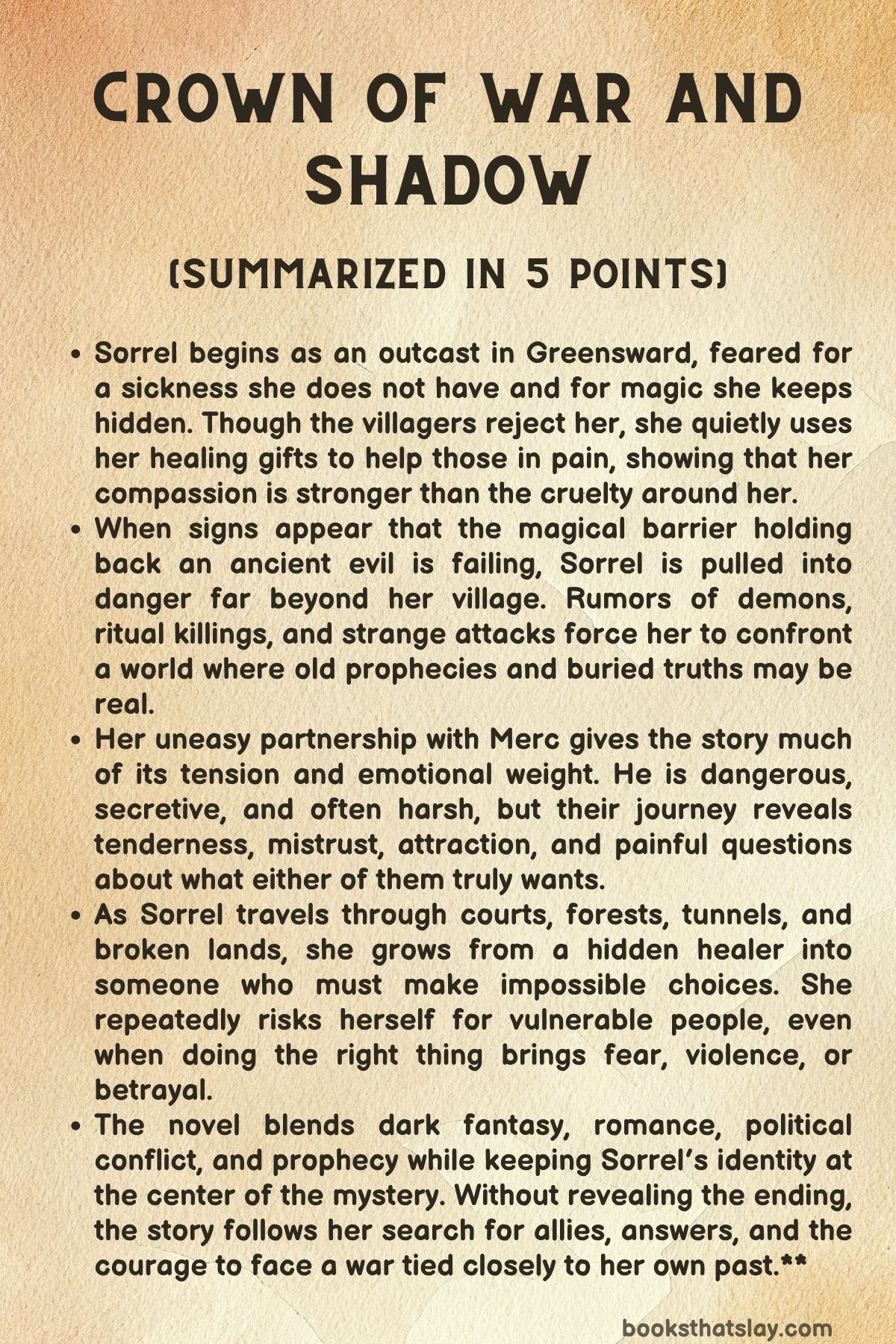
Crown of War and Shadow by J R Ward is a dark fantasy about Sorrel, an outcast healer whose life in a fearful village hides a far older truth. Treated as diseased and dangerous, she survives by serving others in secret, using magic she barely understands.
When the magical prison holding back the Dark King begins to fail, Sorrel is forced from hiding and drawn into a journey of prophecy, violence, desire, betrayal, and self-discovery. The story follows her struggle to understand her power, her past, and her place in a war that may decide the fate of every kingdom. It’s the 1st book of the Kingdoms of the Compass series.
Summary
Sorrel begins as a shunned barmaid at the Gauntlet Public House in Greensward, a village surrounded by walls near Prosperitus. She wears a Pox cloak, not because she is sick, but because people already fear and reject her.
She lives under the stairs, works for the cruel Mr. Lewis, and quietly makes medicines for villagers who would never openly thank her. Though she is despised, she still risks herself to help the sick and dying, using forbidden gifts that make her both useful and dangerous.
One night, while trying to leave the pub to take herbs to Mare, an elderly woman she loves, Sorrel is stopped by Mr. Lewis and forced to keep working. The evening turns strange when Mr. Cavenish bursts into the pub carrying bloody remains and claiming demons are escaping because the Fulcrum is failing.
The Fulcrum is the magical barrier that keeps the Dark King and his demons imprisoned. He says cattle have been slaughtered at compass points and warns that the Dark King is rising.
Sorrel later sneaks into the rainy village streets, only to be taken by the farrier, who begs her to save his newborn son. At his home, she finds the baby already dead and the mother, Elly, dying after childbirth.
Sorrel cannot save them, but she eases Elly’s suffering and promises to protect the children left behind. As often happens when Sorrel looks into someone’s eyes, she sees the farrier’s future death by fire.
Her power gives her knowledge, but not always the ability to change what is coming.
Back at the pub, Sorrel meets a mercenary who calls himself Merc. He is dangerous, watchful, and unlike the villagers, he does not treat her as filth.
He notices her scent, speaks of wild horses near the ocean, and seems to know things that match her secret dreams. He first mistakes her for one of the women who sell their bodies at the pub, but his interest in her soon becomes more complicated.
Sorrel is drawn to him, though she distrusts his motives.
The next morning, Sorrel visits Mare, a banished former noblewoman who is dying in an abandoned shop. Mare urges Sorrel to leave Greensward and gives her royal gold coins for protection, but Sorrel refuses to abandon the woman who has become like family to her.
Soon after, Sorrel goes beyond the village wall to gather medicine and finds another slaughtered cow, confirming the pattern Mr. Cavenish warned about. Near the Fulcrum, she sees black corruption spreading through the magical barrier.
When Sorrel hears screams, she discovers boys torturing a wounded dragon. She threatens them, but black tendrils from the Fulcrum seize two of the boys and drag them away.
Sorrel tries to save the third, Fergus, but cannot hold him. The darkness then grabs her and calls her by name.
A golden knight, Julion Wyse of Prosperitus, arrives and drives the darkness back. Sorrel refuses to leave until she helps the dragon.
She enters its life force, seals its fatal wound, and brings it back from death. Julion realizes she is the person he has been searching for.
When Julion takes Sorrel back toward Greensward, they find the village in chaos. The surviving boy has blamed Sorrel for the deaths, and the villagers gather around a bonfire demanding her blood.
They believe her magic weakened the Fulcrum. Julion uses his authority to get inside the village, but Sorrel escapes him because she does not want to become a tool of the court.
She wants only to reach Mare.
While hiding from armed men, Sorrel encounters Merc. He shields her from discovery and tells her she must leave.
Knowing she cannot survive alone, she asks what it would cost to hire him. He first names an impossible price, then agrees to take her to the Badlands because he is already going there.
Instead of money, he demands a sexual bargain. Sorrel accepts reluctantly, setting her own terms.
Before leaving, she insists on checking on Mare. They find Mare murdered in a ritual killing, her body mutilated and a bloody crescent painted on the wall.
Sorrel realizes men killed Mare while searching for her. Overcome with guilt, she wants to stay, but Merc forces her to leave because the mob is still hunting her.
Sorrel takes Mare’s hidden pouch of royal coins before they go.
Sorrel also returns to the Gauntlet, where Mr. Lewis reveals that her life has been built on a lie. She is not an ordinary orphan.
A prophecy says she is the daughter of the Savior, the woman who created the Fulcrum and defeated the Dark King. Mr. Lewis’s family was entrusted with her care.
He gives her a satchel and a box, saying they contain a compass and the object of her quest. He tells her to travel with the knight of swords and seek the warrior queen who sees no one.
Sorrel rejects the prophecy but cannot deny that her memories are uncertain.
Mr. Lewis sends Sorrel and Merc through a hidden tunnel. The passage is dark, wet, and full of danger.
Sorrel panics, and Merc forces her onward. When they reach a flooded section, a vicious moat creature attacks.
Sorrel sees the creature’s death and uses her knife to help Merc kill it. Injured, she passes out.
When she wakes, Merc has cooked the creature’s meat and makes her eat to regain strength. Their bond deepens, and he kisses her, but when he realizes her innocence, he releases her from their original bargain.
They escape through the flooded tunnel, and Sorrel discovers she can move naturally through water, as if remembering another life. Outside, Merc vanishes beneath the moat while creatures circle her.
Julion rescues her, then asks for her help because his beloved is dying. He saw Sorrel revive the dragon and wants her power.
Sorrel refuses, afraid that using magic openly will bring another mob. Julion leaves, but his desperation unsettles her.
Sorrel and Merc continue toward the Badlands. Along the way, Sorrel helps a woman named Lena survive a dangerous childbirth after the bleeding does not stop.
With Merc’s help, she prepares herbs and medicines, revives Lena, and saves her life. Lena and her husband Ronl thank Sorrel with kindness she is not used to receiving.
Lena later calls her “sister,” which deeply affects Sorrel, who has lived almost entirely without family.
At an outpost lodging house, Sorrel sees another vulnerable young maid being abused by a brutal cook. Unable to ignore the danger, she asks Merc to kill the man.
She also bargains with Thale, the powerful man who controls the establishment, offering to reveal his death in exchange for protection for the maid and her twin sister. Thale doubts her until Sorrel sees his murder clearly: his own lieutenant will kill him with a crystal blade.
He accepts her power and agrees to protect the girls.
This creates a painful rift between Sorrel and Merc. He returns after killing the cook and finds Thale in her room, wrongly believing she traded her body.
Angry and hurt, Merc demands the payment he once wanted from her. Sorrel wants him despite the bitterness between them, and they sleep together.
Afterward, Merc leaves, saying their bargain is settled. Sorrel is left alone, wounded by his abandonment.
Later, Sorrel reaches the southern court with Lavante and the recovered sacred ruby. She presents the ruby publicly so no advisor can hide what she has done.
Before the hidden warrior queen, she places the ruby on the throne and offers the black crystal crown, urging the queen to rise against the Dark King. Sorrel explains how she retrieved the ruby from beyond the Crystal Gate and warns that demons are already spreading.
The queen believes her but refuses to join the war, saying her people must come first. She also says the crown is not hers and orders Sorrel and Merc to leave.
Sorrel reunites with Merc, who has been healed. She tells him they must go to Prosperitus next and seek help from Julion.
During the journey north, they pass dead cattle, abandoned homes, and signs that the Dark King’s power is spreading. Near the Fulcrum, Sorrel sees a face rise from the blackened sand and understands the truth: the Dark King is her father, and the voice that has warned her all her life belongs to her mother.
When Sorrel returns to Greensward, she finds it burned and filled with bodies. At first, she thinks Prosperitus purifiers killed everyone, but the Sooths reveal that the symbol carved into the victims marks them as claimed by the Dark King.
Demons harvested their souls to strengthen him. The Sooths tell Sorrel the warrior queen must rise and that Julion is already marching with an army.
They give her a small gray pebble for later.
Sorrel then sees the same symbol scarred into Merc’s back and realizes he is a demon sent by the Dark King to bring her to him. Merc admits the truth but says he has come to love her and is letting her go.
He also tells her she is dead and cursed. Sorrel looks into water and understands why she has never seen her own death: it has already happened.
Sorrel releases the glamour hiding her true form and gives its protection to Lavante. Her real appearance is revealed, marked by dark hair, darker skin, and the Dark King’s symbols on her wrists.
She commands nearby demons to kneel and enters the Fulcrum alone. Inside, the Dark King tries to tempt her, claim her, and drain her power.
The Sooth’s pebble distracts him long enough for Sorrel to fight back. She nearly forces him into prison again, but he tortures Merc to break her focus.
Sorrel protects Merc, and just when she is close to destruction, the souls she helped across many lives gather around her. Their strength shields her.
The Dark King’s own power turns against him and tears him apart, allowing the Fulcrum to reform. Sorrel and Merc escape.
When Julion arrives with his army, Sorrel finally understands the truth of the crown. It was never meant for the hidden queen.
It belongs to her. She places it on her head, declares herself the warrior queen, and prepares to unite the kingdoms against the Dark King.
Characters
Sorrel
Sorrel is the central character of Crown of War and Shadow, and her journey is built around rejection, hidden power, sacrifice, and the painful discovery of identity. At the beginning of the book, she appears to be a powerless outcast: a shunned barmaid forced to live under the stairs, wear a Pox cloak, and endure contempt from people who still depend on her secret healing.
Her life in Greensward shows how deeply society fears what it does not understand. Even though villagers mock, avoid, and suspect her, Sorrel continues to help them with medicines, herbs, and forbidden magic.
This makes her morally strong from the start, because her goodness is not dependent on gratitude. She helps people who would never openly protect her.
Sorrel’s most defining quality is compassion, but the book never presents that compassion as simple softness. Her kindness repeatedly places her in danger.
She helps Elly during childbirth, tries to save the farrier’s family, eases Mare’s suffering, rescues the wounded dragon, saves Lena from dying after childbirth, and risks herself for the abused maid at the lodging house. These actions reveal that Sorrel cannot ignore pain when she sees it.
She is almost painfully aware of suffering, especially the suffering of women, children, animals, and the powerless. Her healing is not only magical or medicinal; it is emotional and moral.
She restores dignity to those who have been abandoned.
At the same time, Sorrel is not naïve. She is frightened, suspicious, angry, and often overwhelmed.
Her ability to see deaths gives her a terrifying relationship with the future, and her forbidden powers isolate her even further. She knows that using magic can save lives, but she also knows it can make her a target.
This creates one of her strongest inner conflicts: she wants to help, but every act of help exposes her to violence. The mob’s accusation that she weakened the Fulcrum shows how easily fear turns goodness into guilt.
Sorrel becomes the village’s scapegoat because people would rather blame a visible outsider than face a deeper evil.
Her relationship with Merc exposes another side of her character. With him, Sorrel experiences desire, distrust, dependence, anger, tenderness, and betrayal.
She is drawn to him because he sees her in ways others do not, yet she is also afraid of being used by him. Their bond is complicated because it begins with bargaining and survival rather than trust.
Over time, however, Sorrel’s emotional strength becomes clearer. She does not simply become attached to Merc; she challenges him, judges him, needs him, rejects him, forgives him, and ultimately protects him even after learning the devastating truth about what he is.
Sorrel’s final transformation is both personal and mythic. She learns that she is not merely a cursed orphan or a village healer but the daughter of the Dark King and the rightful warrior queen.
This revelation could have destroyed her sense of self, but instead it clarifies who she has always been. Her bloodline connects her to darkness, yet her choices connect her to mercy, courage, and protection.
The fact that the souls she helped over centuries rise to defend her proves that her real identity was shaped less by origin than by action. By claiming the crown, Sorrel accepts power not as privilege, but as responsibility.
She becomes a ruler because she has spent the whole story serving those who had no one else.
Merc
Merc is one of the most complex characters in the book because he moves between danger, desire, deception, and unexpected devotion. When he first appears, he seems like a hardened mercenary: physically intimidating, emotionally guarded, practical, and morally ambiguous.
His initial bargain with Sorrel is disturbing because it frames protection as something transactional and exploitative. Yet even early on, there are signs that he is not simply cruel.
He notices Sorrel, responds to her scent, speaks to her with a strange intensity, and seems drawn to the secret parts of her imagination, especially when he describes the sorrel-colored horses by the sea.
Merc’s harshness often functions as armor. He pushes Sorrel through fear, darkness, tunnels, danger, and physical exhaustion, but he also protects her repeatedly.
He fights the balas, guides her through the escape passage, feeds her when she is weak, comforts her after nightmares, and helps her during Lena’s childbirth crisis. His care is frequently rough, unsentimental, and imperfect, but it is real.
One of the most revealing moments in his characterization comes when he releases Sorrel from their sexual bargain after realizing her innocence and uncertainty. This does not erase his earlier behavior, but it shows that he is capable of restraint and moral recognition.
His tenderness is often most visible when he is not trying to appear tender. The image of him holding Lena’s newborn and letting the child suck on his finger reveals a hidden gentleness beneath his violent exterior.
His jealousy, however, also exposes his possessiveness and insecurity. When he assumes Sorrel has traded herself to Thale, he reacts with anger and hurt rather than trust.
Merc’s emotional life is intense but poorly governed; he feels deeply, yet often expresses that feeling through accusation, withdrawal, or physicality.
The major revelation that Merc is a demon sent by the Dark King radically reframes his role. His scars, secrecy, supernatural qualities, and mysterious connection to Sorrel all become signs of a hidden mission.
Yet the revelation does not reduce him to a villain. Instead, it makes his inner conflict sharper.
He was sent to bring Sorrel to the Dark King, but he comes to love her and chooses to let her go. That choice is crucial because it proves he is not merely the creature his master created or controlled.
Like Sorrel, he is defined by the battle between origin and choice.
Merc’s love for Sorrel is flawed, possessive, and sometimes damaging, but it becomes redemptive because he ultimately sacrifices his mission for her freedom. His presence in the book deepens the theme that darkness is not always the same as evil.
He carries corruption, violence, and deception, but he also becomes capable of loyalty, protection, and love. His final survival with Sorrel suggests that redemption in the story is not clean or easy; it is earned through pain, truth, and the willingness to break from the power that made him.
Julion Wyse
Julion Wyse first appears as a heroic golden knight, a figure of courtly authority and rescue. His arrival at the Fulcrum, where he fights back the darkness and saves Sorrel, makes him seem like the traditional noble protector of the story.
He rides a white stallion, wears golden armor, and represents Prosperitus, law, order, and royal power. In contrast to the mob’s fear and Merc’s dangerous ambiguity, Julion initially appears civilized and righteous.
However, Julion’s character becomes more complicated as the story develops. He recognizes Sorrel’s power after seeing her revive the dragon, and his interest in her is tied not only to justice but also to need.
He wants her help because someone he loves is dying. This desperation makes him sympathetic, but it also makes him dangerous.
When Sorrel refuses to use her power, Julion becomes threatening, showing that noble status does not necessarily equal moral purity. He may be more polished than Merc, but he is also capable of pressure and control when grief drives him.
Julion’s hidden identity as the heir to Prosperitus adds political importance to his character. Sorrel’s discovery of his face on the coin changes the reader’s understanding of him.
He is not simply a knight seeking help; he is a prince connected to the future of the kingdom. His march toward the Fulcrum with an army shows that he is willing to confront the Dark King directly, but it also suggests that he operates through institutions, armies, and royal authority, while Sorrel operates through sacrifice, instinct, and direct magical confrontation.
Julion functions as a contrast to both Merc and Sorrel. Unlike Merc, he seems publicly honorable, but his desperation exposes entitlement.
Unlike Sorrel, he belongs to power from the beginning, but he does not fully understand the deeper truth of the crown until Sorrel claims it. His role is important because he represents the kind of official hero people expect, while Sorrel becomes the true heroic force the world actually needs.
Mare
Mare is one of the emotional anchors of Crown of War and Shadow, even though her time in the story is limited. She is a former noblewoman banished from Prosperitus and reduced to dying in an abandoned shoe shop.
Her fall from status gives her a tragic dignity. She understands both privilege and exile, which allows her to see Sorrel more clearly than most people do.
Unlike the villagers who fear Sorrel, Mare loves her and treats her as family.
Mare’s relationship with Sorrel is maternal. When she calls Sorrel the only daughter she has left, she gives Sorrel something she has been denied for most of her life: belonging.
She urges Sorrel to leave Greensward, not because she is selfish or afraid, but because she understands that Sorrel’s compassion will eventually get her killed. Mare’s hidden pouch of royal gold coins symbolizes her final act of protection.
She wants Sorrel to buy safety, protection, and escape, even though Sorrel refuses to abandon her.
Mare’s murder is one of the most brutal turning points in the book. Her ritualized death shows the cruelty of the forces hunting Sorrel and the danger of superstition.
The fact that she is killed because others believe she may be hiding Sorrel intensifies Sorrel’s guilt and grief. Mare becomes a victim of the same hatred and fear that have surrounded Sorrel all her life.
Her death also marks the end of Sorrel’s last emotional shelter in Greensward.
Even after death, Mare continues to shape Sorrel’s choices. The coins she leaves behind help Sorrel survive, and the memory of her love strengthens Sorrel’s sense of responsibility.
Mare represents the rare person who sees Sorrel not as a curse, witch, servant, or tool, but as a daughter. That recognition helps prepare Sorrel to later accept a far greater identity.
Mr. Lewis
Mr. Lewis is initially presented as a harsh and exploitative employer. He keeps Sorrel under the stairs, controls her labor, stops her from helping Mare, and treats her with little visible kindness.
In the early parts of the story, he appears to be another figure in the pattern of people who use Sorrel while refusing to value her. His public role at the Gauntlet Public House is tied to discipline, survival, and secrecy.
The later revelation about Mr. Lewis complicates him significantly. He has not merely been an ordinary cruel employer; he has been the keeper of a prophecy passed down through his family.
He knows that Sorrel is connected to the Savior, the Fulcrum, the Dark King, and a great quest. This does not make his harshness harmless, but it gives his behavior a hidden context.
He has guarded Sorrel’s secret, perhaps believing that concealment mattered more than comfort.
Mr. Lewis represents the morally uncomfortable side of duty. He protects Sorrel’s destiny without nurturing Sorrel herself.
His guardianship is practical rather than loving. When he gives her the satchel, the compass, and the mysterious box, he becomes the messenger of her larger purpose.
Yet his failure is also clear: Sorrel has been kept ignorant of herself for so long that the truth feels more like another betrayal than a gift.
His character shows how prophecy can damage the person it is meant to protect. Mr. Lewis preserves the mission, but not Sorrel’s emotional wellbeing.
He is important because he connects her ordinary suffering to a much older and larger struggle, but he also embodies the cost of secrets kept in the name of destiny.
The Dark King
The Dark King is the central force of corruption, fear, and domination in the story. For much of the book, he exists as a terrifying presence behind signs and symbols: the failing Fulcrum, slaughtered animals, black contamination, demons, ritual murders, and the SP mark.
His power spreads through decay and fear before he fully appears. This makes him feel less like a single enemy at first and more like a disease infecting the world.
His connection to Sorrel is one of the most important revelations in the book. The discovery that he is her father transforms the conflict from external battle into a confrontation with inheritance.
Sorrel is not merely fighting a distant evil; she is fighting the darkness that claims a blood relationship with her. The Dark King tries to use that connection to seduce, control, and drain her.
His power is not only physical or magical, but psychological. He wants Sorrel to believe that origin determines destiny.
The Dark King’s cruelty is based on possession. He harvests souls, commands demons, marks victims, corrupts the Fulcrum, and tries to reclaim Sorrel as his own.
His relationship with power is parasitic. He does not rule in order to protect; he consumes in order to expand himself.
His attempt to torture Merc in order to break Sorrel’s focus shows that he understands love only as a weakness to exploit.
His defeat is meaningful because Sorrel does not overcome him by becoming like him. She defeats him through the accumulated force of compassion.
The souls she helped rise to defend her, proving that his hunger for souls is answered by her history of saving them. The Dark King represents inherited darkness, but his failure proves that Sorrel’s choices are stronger than his claim over her.
The Savior
The Savior is a powerful background figure whose actions shape the entire world of the story. She created the Fulcrum, subdued the Dark King, and entrusted Sorrel to Mr. Lewis’s bloodline.
Although she is not present in the same immediate way as Sorrel, Merc, or Julion, her legacy defines the book’s central conflict. She represents the previous generation’s victory and its unfinished consequences.
As Sorrel’s mother, the Savior becomes more than a legendary figure. Her voice has been warning Sorrel to hide from the Dark King, suggesting that her protection continued even after separation or death.
This gives her a haunting maternal presence. She is associated with sacrifice, foresight, and the desperate attempt to keep Sorrel out of the Dark King’s reach.
The Savior also represents the burden inherited by daughters from mothers. Sorrel does not simply repeat her mother’s work; she completes and transforms it.
The Savior imprisoned the Dark King and built the barrier, while Sorrel ultimately claims the crown and prepares to unite kingdoms for war. In this sense, the Savior’s legacy is both protective and incomplete.
She gives Sorrel survival, but Sorrel must create the future.
The Warrior Queen
The hidden warrior queen is a figure of authority, trauma, and refusal. She is the person Sorrel is told to seek, the queen who “sees no one,” and her court is surrounded by secrecy, ritual, and political tension.
When Sorrel brings back the sacred ruby and presents the black crystal crown, the queen appears to be the one destined to rise and fight the Dark King. Yet she refuses the role Sorrel expects her to take.
Her refusal is not portrayed as simple cowardice. She believes her first duty is to her own people, and this makes her a ruler shaped by responsibility rather than grand prophecy.
However, her inability or unwillingness to join the larger war also reveals the limitation of isolated leadership. She can recognize the truth of Sorrel’s warning and still choose not to act beyond her borders.
This makes her a complex political figure: wise enough to understand danger, but constrained by duty, fear, or pragmatism.
The queen’s interaction with Sorrel also helps reveal Sorrel’s true role. By saying the crown is not hers, the queen unknowingly points Sorrel toward the real answer.
The crown belongs not to the hidden ruler Sorrel has sought, but to Sorrel herself. The queen therefore functions as a false destination in the quest.
Sorrel believes she is delivering power to someone else, only to learn that she must claim it personally.
Thale
Thale is a dangerous and calculating power figure at the lodging house. With his top hat, control over the establishment, and aura of menace, he represents a different kind of authority from kings, knights, and village mobs.
His power is local, criminal, and personal. People fear him because he controls their immediate world, and his presence makes the lodging house feel like a place ruled by hidden violence.
Sorrel’s interaction with Thale is one of the clearest examples of her courage and intelligence. She does not have the strength to protect the abused maid directly, so she bargains with the man who has power.
Thale initially sees Sorrel through a predatory lens, assuming that her body is the currency she offers. But Sorrel turns the encounter by revealing her ability to see death.
In that moment, she transforms from vulnerable woman to someone with knowledge even Thale cannot ignore.
Thale’s fear of his own predicted death makes him more human without making him good. He is ruthless, but not fearless.
Once Sorrel proves her power, he becomes practical and cooperative, promising protection for the maid and her sister. His character shows how Sorrel learns to use not only healing and magic, but also information, negotiation, and psychological leverage.
Thale is morally dark, yet he becomes useful because Sorrel understands what he values most: survival.
The Bearded Lieutenant
The bearded lieutenant is important less because of his personal depth and more because of what he represents. He is the man Sorrel sees in Thale’s death vision, the one who will slit Thale’s throat with a crystal blade and steal his diamond pin.
His presence reveals betrayal within Thale’s own circle. The danger to Thale does not come from an obvious external enemy, but from someone close enough to strike.
The crystal blade associated with him connects ordinary violence to the larger magical world. His future crime is not just a murder; it is tied to the Crystal Gate and the dangerous forces surrounding Sorrel’s quest.
In the story’s moral pattern, he represents ambition, treachery, and hidden violence waiting for opportunity. Through him, Sorrel’s death-sight becomes a tool that can alter power relationships.
The Abused Maid
The abused maid is one of the most vulnerable characters in the book, and her situation reveals Sorrel’s fierce concern for women trapped under male violence. She is bruised, controlled, and terrorized by the cook, yet she cannot simply flee because her twin sister would be endangered.
Her fear is not passive weakness; it is the fear of someone who understands exactly how power is being used against her.
Her character matters because she gives Sorrel another moral test. Sorrel is already exhausted, injured, and emotionally hurt, but she cannot ignore the maid’s suffering.
The maid’s helplessness exposes a world where women are often trapped not only by direct abuse but by threats against those they love. Sorrel’s decision to involve both Merc and Thale shows how seriously she takes the danger.
The maid also helps show the limits of simple rescue. Killing the cook may remove the immediate abuser, but Sorrel realizes that protection afterward is equally necessary.
This makes the episode more mature than a simple revenge moment. The maid’s safety requires strategy, not just violence.
The Cook
The cook is a brutal abuser whose control over the maid makes him one of the smaller but sharply hateful villains in the book. Unlike the Dark King, he does not need grand supernatural power to be frightening.
His evil is domestic, habitual, and intimate. He uses fear, physical violence, and threats against the maid’s twin sister to maintain control.
His character shows that darkness exists at many levels in the story. There are demons and ancient kings, but there are also ordinary men who create private kingdoms of terror.
Sorrel’s desire to have him killed comes from her recognition that some forms of abuse cannot be negotiated with safely. The cook’s death at Merc’s hands becomes part of the book’s broader exploration of justice, protection, and morally compromised action.
Bethle
Bethle is a working woman at the lodging house and becomes important in relation to Sorrel’s misunderstanding of Merc. Sorrel believes Merc slept with Bethle, which intensifies her feelings of betrayal and abandonment.
Later, Thale reveals that Merc did not actually perform with her, changing Sorrel’s understanding of what happened.
Bethle’s role is subtle but meaningful. She exists in a world where women’s bodies are often treated as available, negotiable, or transactional.
Yet she is also observant and realistic. When she tells Sorrel it may be better that Merc leaves now that Thale is involved, she speaks from practical knowledge of danger and power.
Bethle is not a major heroic figure, but she reflects the survival intelligence of women living inside exploitative systems.
Lena
Lena is a significant figure because her survival allows Sorrel’s healing identity to be recognized in a loving way. When Sorrel finds that Lena is still in danger after childbirth, the scene becomes one of Sorrel’s most intense medical and emotional trials.
Sorrel is frightened, unable to read the labels, and nearly overwhelmed, but she regains focus with Merc’s help and saves Lena through knowledge, instinct, and courage.
Lena’s later recovery is deeply important for Sorrel. She thanks Sorrel, calls her a healer, treats her infected wound, and names her family by calling her sister.
This is one of the rare moments when Sorrel receives open gratitude and belonging from someone she has helped. Lena’s warmth counters the rejection Sorrel suffered in Greensward.
She sees Sorrel not as a witch or threat, but as a savior.
Lena also represents life continuing in the middle of danger. Her baby, Gloriana, is born into a violent and unstable world, but her survival creates hope.
Through Lena, the book shows that healing is not only about preventing death; it is about preserving families, futures, and tenderness.
Ronl
Ronl is Lena’s partner and the father of Gloriana. His character is defined by gratitude, panic, and sincere affection.
At first, he is overwhelmed by the birth of his daughter and does not fully grasp Lena’s continuing danger. This makes him ordinary and human rather than heroic.
He loves his family, but he depends on Sorrel’s knowledge to understand what must be done.
His gratitude after Sorrel saves Lena is genuine. He gives Sorrel clean clothes, soap, and thanks, offering her practical care in return for her help.
In a story where Sorrel often gives without receiving, Ronl’s response matters. He is one of the people who recognizes that Sorrel’s power is a gift rather than a curse.
Ronl also helps create a temporary sense of community around Sorrel. Along with Lena, he offers her a glimpse of what it might mean to be welcomed instead of feared.
His role is not large, but it is emotionally restorative.
Gloriana
Gloriana, Lena and Ronl’s newborn daughter, symbolizes fragile new life in a world threatened by death and demonic corruption. She is physically helpless, yet her presence brings out tenderness in multiple characters.
Ronl is overcome with joy because of her birth, Lena fights to survive for her, and Merc unexpectedly softens while holding her.
Gloriana’s importance lies in what she reveals about others. Sorrel’s desperate effort to save Lena is also an effort to preserve the child’s future with her mother.
Merc’s gentleness with the baby hints at emotional depths he usually hides. In a story filled with slaughtered animals, murdered innocents, and failing barriers, Gloriana represents continuation, innocence, and the possibility that the world is still worth saving.
Elly
Elly is one of the early tragic women whose suffering reveals the harshness of Sorrel’s world. She dies after childbirth in a filthy home, neglected and endangered by poverty, ignorance, and her husband’s desperation.
Sorrel cannot save Elly or the infant, but she gives Elly herbs to ease her pain and promises to protect the surviving girls after the farrier dies.
Elly’s character is important because she shows the limits of Sorrel’s power. Sorrel can heal, foresee, and intervene, but she cannot undo every death.
Elly’s fate also reveals how women’s bodies are endangered in this world by childbirth, poor care, and male helplessness. Her death strengthens Sorrel’s role as someone who bears witness to suffering even when she cannot prevent it.
The Farrier
The farrier is a desperate and morally mixed character. He intercepts Sorrel and drags her to his house because he wants her to save his newborn son.
His desperation is understandable, but his treatment of Sorrel is forceful and selfish. He needs her power but does not approach her with dignity or respect.
Like many people in the village, he turns to Sorrel only when fear overwhelms prejudice.
Sorrel’s vision of his death by fire makes him a figure marked by fate. Her warning that he must care for Elly carries both moral judgment and tragic knowledge.
The farrier represents the people who depend on Sorrel but do not truly protect her. He is not purely villainous, but he is part of the society that uses her when convenient and rejects her when afraid.
Mr. Cavenish
Mr. Cavenish, the milkman, serves as an early messenger of catastrophe. When he storms into the pub carrying a bloody cowbell and animal entrails, claiming demons are escaping and the Fulcrum is failing, he brings the hidden crisis into public view.
His behavior seems wild and alarming, but his warning is rooted in truth. The slaughtered cows at compass points and his fear of the Dark King foreshadow the larger supernatural collapse.
His character shows how truth can sound like madness when society is not ready to face it. The villagers treat him as a disruption, but he understands that something ancient and terrible is breaking through.
He is not a central character, yet his warning helps shift the story from local misery to world-threatening danger.
Lavante
Lavante is closely tied to Sorrel’s quest in the southern court and later becomes important when Sorrel releases her protective glamour and gives it to him. His role connects him to the recovery of the sacred ruby, the journey through dangerous lands, and Sorrel’s transition toward her true form.
He is not as emotionally central as Merc or Mare, but he is part of the chain of people and events that move Sorrel toward her final revelation.
Sorrel’s act of freeing Lavante is important because it happens at the moment she stops hiding herself. By giving him the glamour, she releases both him and the false appearance that has protected her.
Lavante therefore becomes connected to one of Sorrel’s most symbolic acts: the shedding of concealment. His character helps mark the boundary between the Sorrel who was hidden and the Sorrel who commands demons and claims the crown.
Fergus
Fergus is one of the boys involved in torturing the wounded dragon, but he is also more complicated than the others because Sorrel once secretly saved his life as an infant. This connection makes his death especially painful.
Sorrel tries to save him when the black tendrils from the Fulcrum seize him, but she loses her grip.
Fergus represents the tragedy of a community that does not know who has protected it. He participates in cruelty toward the dragon, yet he is also a child whose life once depended on Sorrel’s hidden mercy.
His fate shows how Sorrel’s acts of goodness are often invisible and unrewarded. The boy she saved becomes part of the mob’s larger world of ignorance and fear, and she still tries to save him again.
Themes
Isolation and the Cost of Being Feared
Sorrel’s life is shaped by rejection long before the larger war reaches her. In Crown of war and shadow, she is treated as diseased, dangerous, and disposable by the same people she quietly protects.
Her Pox cloak becomes a symbol of how society prefers simple labels over truth: the villagers see a threat, not a healer. This isolation makes her compassion more powerful because she continues helping people who would never defend her.
Her hidden medicines, secret magic, and care for the dying show that goodness can survive even when it receives no public reward. The mob’s hatred later proves how quickly fear can erase gratitude and reason.
Sorrel’s loneliness is not only social but emotional; she doubts her worth because she has been taught to expect cruelty. Yet the story gradually shows that being cast out has also trained her to see the forgotten, abused, and powerless.
Her suffering becomes the source of her moral sight.
Power, Identity, and the Burden of Destiny
Sorrel’s powers are not presented as easy gifts; they arrive with fear, pain, and unwanted responsibility. She can heal, see death, revive life, and command forces she does not fully understand, but every act of power risks exposing her to violence.
Her identity is built on lies, half-memories, and stories others have controlled for her. When she learns she is connected to the Savior, the Dark King, and the crown, destiny stops being an abstract prophecy and becomes a terrifying personal truth.
The central conflict is not simply whether she has power, but whether she can claim it without becoming what others fear. Her journey forces her to move from denial to acceptance.
By the end, she understands that the crown does not belong to some distant warrior queen because she herself has become that figure. Power becomes meaningful only when joined with choice, mercy, and responsibility.
Love, Trust, and Betrayal
Sorrel and Merc’s relationship is marked by danger from the beginning because both are hiding parts of themselves. Their bond grows through protection, desire, anger, jealousy, and repeated misunderstanding.
Merc first appears as a bargain, almost a threat, but his actions slowly reveal tenderness beneath violence. He protects her, comforts her, frees her from the sexual bargain, and shows care even when he cannot explain himself.
Sorrel, however, has every reason to distrust men who want control over her body, her magic, or her future. Their intimacy is therefore never simple romance; it is a test of whether two damaged people can meet honestly.
The later discovery that Merc was sent by the Dark King turns love into betrayal, yet the betrayal is complicated by his genuine choice to let her go. In Crown of war and shadow, love becomes strongest when it stops being possession and becomes sacrifice.
Compassion as Resistance
Sorrel’s compassion is one of the strongest forms of resistance in the story. She does not fight the Dark King only through magic or prophecy; she fights him through every life she tries to protect.
Her care for Mare, Elly, Lena, the newborn child, the abused maid, and even the wounded dragon shows a pattern of defending life where others have accepted suffering as normal. This matters because the Dark King feeds on death, fear, and broken souls.
Sorrel’s mercy directly opposes his power. The final battle confirms that her small acts were never small at all: the souls she helped return to shield her, proving that kindness has lasting force.
The story argues that compassion is not weakness, especially in a brutal world. It demands courage, risk, and persistence.
Sorrel’s healing work prepares her for queenship because a true ruler is not only someone who commands armies, but someone who remembers the vulnerable.