How to Kill a Guy in Ten Dates Summary, Characters and Themes
How to Kill a Guy in Ten Dates by Shailee Thompson is a fast, bloody romantic horror-comedy built around a clever mash-up of two familiar genres: the rom-com and the slasher. The story follows Jamie Prescott, a film scholar who studies both, as she attends a speed-dating night with her best friend and ends up trapped inside a locked Brooklyn club with a masked killer.
The book uses dating-event awkwardness, horror-movie rules, sharp humor, and romantic tension to turn one terrible singles night into a fight for survival, identity, trust, and love.
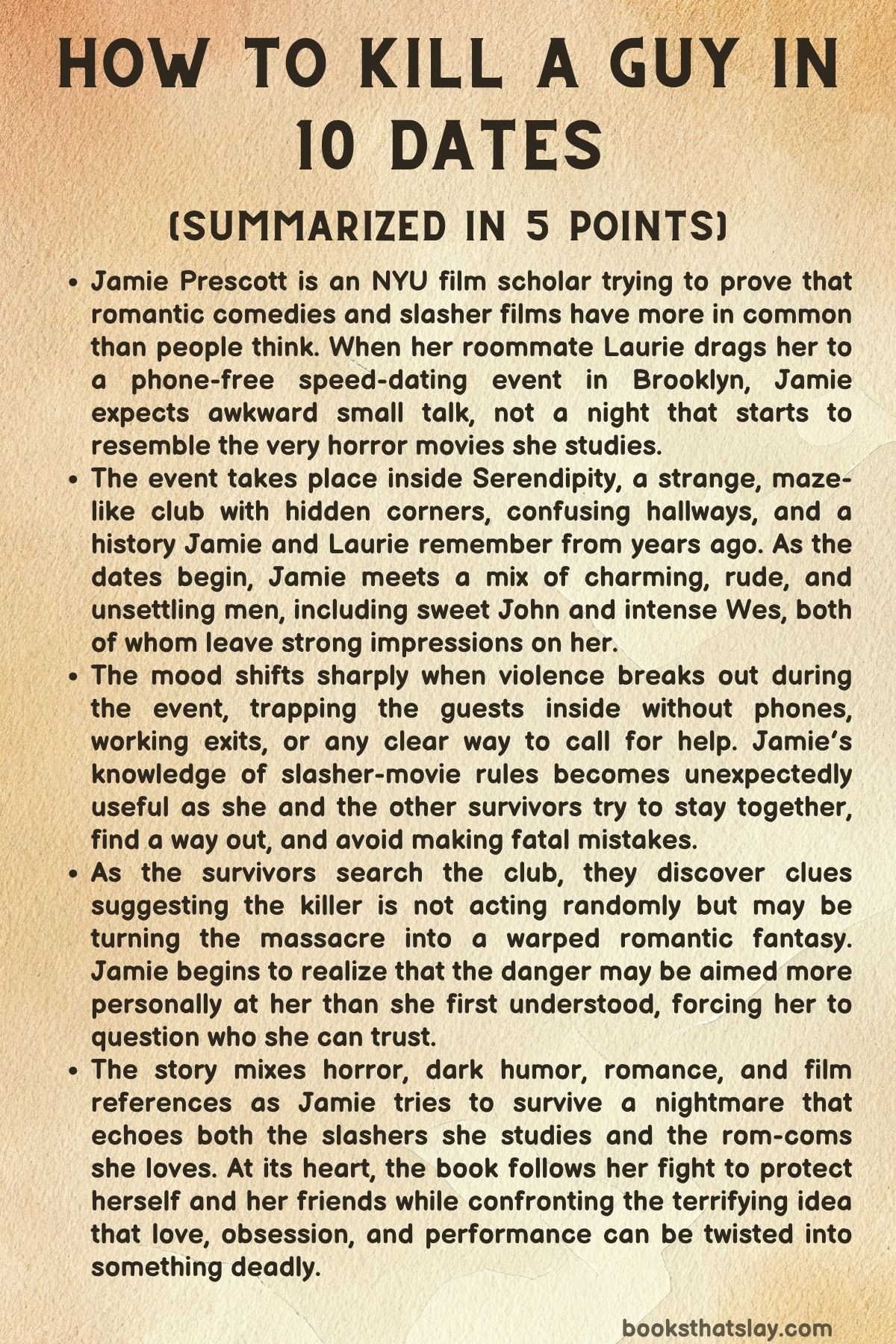
Summary
Jamie Prescott is a film scholar at NYU, trying to write a dissertation about the connection between romantic comedies and slasher films. She believes both genres follow patterns: the final girl and the leading lady, the killer and the love interest, the rules of survival and the rules of romance.
Her best friend and roommate, Laurie Hamilton, is not convinced. After reading Jamie’s draft, Laurie tells her the idea does not quite work and suggests she pick one genre.
Jamie is hurt, but Laurie insists she needs a break before meeting her adviser.
That break comes in the form of a phone-free speed-dating event in Brooklyn. Jamie and Laurie have made a pact to try in-person singles events instead of relying on dating apps.
As they get ready, news plays in the background about another murder by the Brooklyn Serial Killer. The latest victim, Casey Langenkamp, adds to the uneasy atmosphere, but the friends still head out for the night.
The event takes place at Serendipity, a large, strange club that used to be Cravin’, a place Jamie and Laurie remember from years earlier. The building is full of corridors, hidden spaces, stairs, dark corners, and odd rooms.
At the door, the coat check attendant takes everyone’s coats, bags, phones, and devices because the event is meant to encourage real conversation. The setup is simple: ten women, ten men, ten minutes per date, no job talk, no phones, and match cards at the end.
Jamie notices a shadowy figure above the room and feels uneasy, but she pushes the feeling aside. In the basement bar, the women mingle before the dates begin.
Jamie and Laurie meet several of them, including Colette, Dani, Jennifer, Nia, and Billie. Some are friendly, some are tense, and Billie seems especially unpleasant, but the women settle into the strange evening.
Jamie’s first few dates go badly. Drew stares at her body, Stu is irritated when she mixes up his name, and Lee spends most of the time talking about Nia.
Then she meets John, who is shy, sweet, and easy to talk to. They bond over movies, and Jamie feels comfortable with him.
He asks her to have a drink after the event, and she agrees.
Her next memorable date is Wes. He is intense, serious, and not like the men Jamie usually dates.
Their chemistry is immediate. They talk about happiness, movies, rom-coms, and slashers.
Jamie is drawn to him, but when Wes mentions he came to the event after getting time off and wondering what the worst that could happen was, Jamie nervously jokes that they could be murdered. She then starts talking about real serial killers and dating murders.
Wes becomes uncomfortable and leaves quickly when the bell rings.
Jamie is embarrassed, but the night soon turns from awkward to horrifying. During her date with Curtis, a crude and insulting man, the lights go out.
Jamie hears wet, violent sounds in the dark. When the lights return, Curtis is dead in front of her with his throat cut.
Blood pours from him, and Jamie screams.
Panic takes over. The lights go out again, and the killer attacks more people in the darkness.
Jamie hides under a table beneath Curtis’s body and sees Laurie hiding nearby. When the lights return, only eight people seem to be alive: Jamie, Laurie, Wes, John, Stu, Campbell, Colette, and Dani.
Curtis, the bartenders, and the host are dead. A scream from upstairs proves the killer is still inside the building.
The survivors try to escape, but the front doors are locked with a code. In the coat check room, they find the attendant dead, and all their phones, bags, and other devices are gone.
They cannot call for help. Jamie argues that they should not split up, because that is one of the worst mistakes people make in slashers.
Still, the group separates into two teams to search the club. Jamie goes with Laurie, Wes, and Campbell, while John, Stu, Colette, and Dani form the other group.
Jamie’s group searches the left side of the club. They find Billie hiding behind a curtain, then Jennifer nearby.
Both join them. Soon they discover more bodies, including Drew and another woman, killed with puncture wounds to the throat.
Rose petals are scattered around them and lead through the hallway. Jamie and Wes follow the petals and realize the trail loops back on itself, meaning the killer has been near them the whole time.
When they return, Campbell has disappeared. The group goes back to the dance floor and finds John alone.
He says Stu split up their group, Dani and Colette went to the basement, Stu went upstairs, and he stayed behind. Jamie is briefly suspicious, but she does not think John is the murderer.
They decide they need a map, and Jamie and Laurie use their memories of the old club to sketch one.
Jamie explains her slasher survival rules: stay hidden longer than seems necessary, keep weapons, watch your back, do not split up, and avoid obvious horror mistakes. Billie mocks her, but Laurie defends Jamie.
When Dani and Colette do not return, Wes and Billie head downstairs to look for them. Jamie, Laurie, Jennifer, and John go to the mezzanine.
On the mezzanine, John hears a noise and goes to investigate alone. He does not come back.
Jamie goes after him and sees the killer stabbing another man. The killer wears a pink mask with a zipper mouth and black heart-shaped eyes.
Jamie runs back to warn Laurie and Jennifer. The three hide behind a bar in a VIP room while the killer enters.
Jamie notices her blood dripping toward their hiding place and silently catches a glass before it can fall and expose them. The killer leaves.
Afterward, they find a red rose and a card with the message “Can’t you see? You belong to me.” Jamie realizes the killer may think the murders are romantic.
He may believe one of the women is his perfect match and is killing others as part of a twisted courtship.
Wes returns with Billie and Dani. He is bloody and carrying a knife, which makes Jamie nervous, but Dani explains that she hurt him by accident while hiding.
Wes also reports that the building was prepared for the massacre. Exit lights were removed, cameras were covered, phones were taken, and employees were killed first.
The killer planned everything.
Then the group sees something terrible on the dance floor below. Colette’s body has been used to form a heart, and Jamie’s name is written inside it.
Jamie realizes the killer has chosen her. Billie says this means Jamie is the reason everyone else is in danger, then leaves the group.
Jamie wants the others to separate from her, but Laurie, Wes, Jennifer, and Dani refuse. They examine match cards and consider which man could be the killer.
John reappears, claiming he got lost after finding another staircase. The group lets him back in.
Later, Laurie and Dani need the restroom. In the bathroom, Jamie discovers a vent and realizes Laurie can fit through it.
She urges Laurie to crawl out and get help. Laurie does not want to leave Jamie, but Jamie insists.
Before Laurie is fully gone, the killer enters with a cleaver. Jamie distracts him, hides in a stall, and survives as he attacks the door, then leaves after scratching a message into the mirror.
Wes finds Jamie and says he may have found a jammed exit. They also find John wounded in the men’s bathroom.
John claims he tried to stop the killer. As they move through the corridor, the killer appears.
John charges him, apparently sacrificing himself so Wes and Jamie can escape.
Jamie and Wes hide upstairs and share a quiet, vulnerable moment. They admit how much they care about each other, but danger interrupts them again.
Stu is killed by the masked killer, and Jamie and Wes flee deeper into the club. They pass Campbell’s posed body and try to find a way to trigger the alarms.
Jennifer appears with Billie, who claims she knows a way out. But Billie’s calmness feels wrong.
Suddenly, Billie kills Jennifer and reveals a Heart Eyes mask. She has been helping the killer.
She tells Jamie that Jamie is meant to be the “Final Girl” and hints that Wes is supposed to die. Billie attacks Wes, but Jamie fights back and knocks her over a railing.
Billie falls to her death.
Jamie realizes Billie could not have committed every murder alone. There is another killer.
She panics and briefly suspects Wes because he had disappeared during some attacks. She runs from him and finds John alive.
He reveals that he is the real killer. He kisses Jamie against her will and explains that everything was done for her.
He saw her when she entered the club and decided she was his soulmate. Billie helped him because she wanted to be his ideal partner, but John only saw her as useful.
John says the murders were a test to prove Jamie was “the One.” Other women had disappointed him before, and tonight was meant to confirm that Jamie was different. Jamie pretends she needs space, escapes him, and reunites with Wes.
Wes has found survivors hiding in a control room, but the security system has been ruined. Jamie remembers a pile of furniture that seemed to hide part of a hallway and realizes it may block access to the roof and fire escape.
They form a plan. Wes and the survivors will clear the roof exit while Jamie distracts John.
Jamie goes to the dance floor with John’s roses and calls him out. John plays “Love Story” and gives a dramatic speech from the mezzanine, calling Jamie his dream girl.
Jamie provokes him by saying she kissed Wes and slept with him. John loses control and comes closer.
As the sprinklers and alarms finally activate, Jamie uses a knife hidden in the bouquet to stab John. She keeps fighting until he dies.
Police and paramedics arrive. Outside, Jamie reunites with Laurie, who escaped through the vents and got help.
They embrace and admit they are each other’s favorite person.
Jamie is treated and questioned by Captain Strode, who recognizes Wes as a detective on leave. Wes finds Jamie, shaken and desperate to make sure she survived.
He confirms that the others escaped. Jamie and Wes admit they are falling in love despite the horror they have endured.
Eight months later, Jamie, Laurie, and Wes live together in a safer apartment. Jamie has gone to therapy, finished her dissertation, and become a film studies teacher.
Laurie is working on a documentary about the massacre, though Jamie chooses not to revisit the club. Wes and Jamie are happy together, still healing, and trying to build an ordinary life after surviving a night that turned Jamie’s theories about romance and horror into something terrifyingly real.
Characters
Jamie Prescott
Jamie Prescott is the central figure of How to Kill a Guy in Ten Dates, and her character is built around the collision between intellect, fear, romance, and survival. At the beginning of the book, she is a film scholar at NYU who is struggling to prove that romantic comedies and slasher films share meaningful structures.
This academic idea becomes far more than a dissertation argument once she is trapped inside Serendipity, because Jamie’s knowledge of slasher rules becomes a practical survival tool. She is nervous, awkward, observant, and sometimes socially clumsy, especially when she scares Wes away by talking about serial killers during their date.
Yet those same qualities later help her identify patterns, interpret the killer’s romantic symbolism, and understand the danger faster than many others.
Jamie’s emotional complexity comes from the fact that she is both terrified and incredibly resourceful. She hides under Curtis’s body, uses broken glass as a weapon, studies the killer’s behavior, helps create a map of the club, and repeatedly makes decisions under extreme pressure.
Her mind works through genre logic, which others initially mock, but the story gradually proves that her instincts are valuable. She is not a fearless action heroine; she is frightened, injured, embarrassed, suspicious, and overwhelmed.
This makes her courage feel more believable, because she keeps acting even when she is panicking. Her final confrontation with John is especially important because she uses both emotional intelligence and physical bravery.
She understands his fantasy, manipulates his jealousy, and finally kills him with the knife hidden in the bouquet.
Jamie’s relationships reveal her softer side. With Laurie, she is deeply dependent in the best sense: their friendship is intimate, protective, and emotionally honest.
Laurie is her anchor before, during, and after the massacre. With Wes, Jamie experiences attraction under impossible circumstances, and their bond grows because he respects her intelligence instead of dismissing it.
Her suspicion of him near the end also shows how trauma distorts trust, even when affection is real. By the end of the book, Jamie has survived not only physically but psychologically.
She finishes her dissertation, teaches film studies, attends therapy, and chooses a future with Laurie and Wes. Her journey turns her from a scholar analyzing horror and romance into a woman who has lived through both and reclaimed her life.
Laurie Hamilton
Laurie Hamilton is Jamie’s best friend, roommate, and emotional protector. She is introduced as blunt, practical, and honest, especially when she criticizes Jamie’s dissertation opening and tells her that the connection between slashers and romantic comedies does not yet work.
This honesty could make Laurie seem harsh, but the book quickly shows that her bluntness comes from love and concern. She wants Jamie to rest, live outside her academic stress, and participate in the real world.
Their speed-dating pact reflects Laurie’s role as someone who pushes Jamie into uncomfortable but potentially meaningful experiences.
Inside Serendipity, Laurie becomes one of the strongest emotional presences in the story. She is frightened, but she does not abandon Jamie.
She defends Jamie when Billie mocks her horror-movie survival rules, proving that she believes in Jamie even when others do not. Laurie’s loyalty is one of her defining traits.
She stays close to Jamie through the early chaos, hides with her, runs with her, and continues supporting her even when Jamie becomes the killer’s chosen target. Her accidental injury to Jamie’s arm adds realism to the panic of the situation: Laurie is not perfect or superhuman, but she remains devoted.
Laurie’s escape through the bathroom vent is one of the most important survival moments in the book. She resists leaving Jamie because she understands the danger of splitting up and because she cannot bear abandoning her best friend.
Jamie forces the choice because Laurie has the best chance of getting help. This moment shows both women’s love for each other: Laurie wants to stay, and Jamie wants her to live.
Laurie’s later reunion with Jamie outside the club gives the story one of its most emotionally grounded scenes. Their declaration that they are each other’s favorite person confirms that the central love story is not only romantic but also deeply rooted in friendship.
Wes
Wes is introduced as intense, serious, physically strong, and immediately different from Jamie’s usual romantic type. His first conversation with Jamie creates a strong contrast between attraction and unease.
He asks meaningful questions, listens closely, and responds to her interests with interest of his own. However, Jamie’s nervous discussion of murder unsettles him, making their first connection awkward and unfinished.
This initial discomfort gives their later bond more texture because their relationship does not begin as effortless perfection; it begins with attraction, misunderstanding, and fear.
As the massacre unfolds, Wes becomes one of the most capable survivors. He arms himself, supports Jamie’s instincts, searches for missing people, treats Jamie’s wound, and repeatedly places himself in danger to protect others.
His calmness and physical courage make him seem heroic, but the book complicates him by making his absences suspicious. Because he appears at strange moments, carries bloody weapons, and knows how to act under pressure, Jamie briefly doubts him.
This suspicion is effective because Wes is both romantic lead and possible suspect within the story’s slasher logic.
Wes’s true character is revealed through his respect for Jamie. He does not treat her genre knowledge as silly; he trusts her judgment when others dismiss it.
He is also emotionally vulnerable, especially after John appears to sacrifice himself and Wes feels guilty for surviving. His willingness to fight Heart Eyes for Jamie shows devotion, but Jamie’s plea that he not sacrifice himself shifts their relationship away from dramatic martyrdom and toward mutual survival.
The later reveal that Wes is a detective on leave adds another layer to his competence without reducing his emotional sincerity. By the end, Wes represents the possibility of love after horror: not a fantasy rescue, but a partner who sees Jamie clearly and chooses a life with her.
John
John is one of the most disturbing characters in the book because he begins as sweet, shy, and charming before being revealed as the central killer. During the speed dates, he seems like one of Jamie’s best options.
He talks with her warmly about movies, responds to her intelligence, and asks to have a drink with her afterward. His gentleness makes him appear safe, especially compared with crude or dismissive men like Curtis and Stu.
This false safety is crucial to his role in the story because John weaponizes the language and behavior of romance.
John’s villainy is rooted in entitlement and fantasy. He does not truly love Jamie; he projects an imagined soulmate identity onto her after seeing her at the event.
His belief that the massacre is “for us” reveals how completely he has replaced reality with his own romantic script. He uses murder as a test, treating women as candidates who can either fulfill or disappoint his fantasy.
The previous victims and the killings inside Serendipity show that John’s idea of romance is inseparable from control, punishment, and spectacle. His use of roses, hearts, love songs, and romantic messages transforms familiar romantic symbols into threats.
What makes John especially frightening is his ability to perform innocence. He disappears, returns with explanations, appears wounded, and even stages a false sacrifice.
He understands how to look like a survivor rather than a predator. His partnership with Billie also exposes his manipulative nature.
He allows her to believe she has a special role in his life, while he actually sees her as a useful assistant rather than his true partner. In the final confrontation, his jealousy and possessiveness destroy the charming mask completely.
Jamie defeats him by understanding the fantasy he lives inside and turning it against him.
Billie
Billie is one of the most unsettling characters because her cruelty is visible long before her guilt is confirmed. From the beginning, she seems defensive, hostile, and strangely detached from the group’s fear.
Her nasty looks, mocking attitude, and cold comments create tension around her, but the book initially allows those traits to be read as unpleasantness rather than outright villainy. She repeatedly challenges Jamie and questions why the others should risk themselves for her once it becomes clear that Heart Eyes has chosen Jamie.
Billie’s reveal as one of the killers reframes her earlier behavior. Her calmness, her insistence that the situation is not over, and her willingness to isolate people all become signs of her involvement.
When she slashes Jennifer’s throat, the violence confirms that her hostility was not just social cruelty but active participation in the massacre. Billie is driven by her own distorted romantic desire.
She wants to be John’s perfect partner, even though John only sees her as a friend and accomplice. This makes her both dangerous and pathetic, because she has built her identity around helping a man who will never choose her in the way she wants.
As a character, Billie functions as a dark mirror to Jamie. Both are connected to the rules of the story, but in opposite ways.
Jamie uses genre knowledge to survive and protect others, while Billie helps stage the horror as part of John’s fantasy. Billie also reinforces the book’s critique of romantic obsession.
She believes that helping John create a murderous love test will somehow prove her worth. Her death after Jamie fights back is sudden and brutal, fitting her role as a secondary killer whose confidence collapses when the intended victim refuses to behave according to the script.
Colette
Colette is one of the women Jamie and Laurie meet during cocktail hour, and she initially appears as part of the social world of the speed-dating event. Her early presence helps establish the group of women as real participants rather than anonymous victims.
She is included among the survivors after the first massacre in the basement, which briefly positions her as someone who might continue through the night alongside Jamie, Laurie, and the others.
Colette’s role becomes more tragic when the group splits up and she goes with Dani to search the basement. Her disappearance creates anxiety because it shows how quickly the killer can isolate and remove people from the group.
The later discovery of her body, with her intestines arranged into a heart and Jamie’s name placed inside it, turns Colette into one of the most horrifying symbols in the book. Her death is not just murder; it is a message.
John uses her body to announce Jamie as his chosen woman, making Colette a victim of his romantic delusion.
Although Colette does not receive the same development as Jamie, Laurie, or Wes, her importance lies in how her death changes the survivors’ understanding of the night. After Colette, the group can no longer think of the killer as simply attacking at random.
Her murder proves that the violence is theatrical, personal, and directed toward Jamie. Colette’s character therefore becomes central to the shift from general survival horror to targeted psychological terror.
Dani
Dani is one of the surviving women from the speed-dating event, and her character brings visible panic and vulnerability into the group dynamic. After the massacre begins, she reacts with fear and distress, which is realistic given the scale of the violence around her.
Her panic in the coat check area and later breakdown after Colette’s body is displayed show that she is deeply traumatized by what is happening. Unlike Jamie, who processes terror through genre logic, Dani responds more openly and emotionally.
Dani’s fear does not make her weak. She survives by hiding, reacting quickly, and eventually rejoining the group.
When Wes and Billie find her, she injures Wes by mistake because she believes she may be under attack. This moment shows how survival can blur judgment and make even allies seem threatening.
Dani’s explanation also helps clear Wes from immediate suspicion, at least temporarily, because she confirms part of his story.
Dani’s presence is important because she represents the ordinary person trapped inside an extraordinary nightmare. She does not have Jamie’s film knowledge, Wes’s physical confidence, or Laurie’s fierce steadiness, but she continues moving forward despite terror.
Her refusal to abandon Jamie after Heart Eyes marks Jamie as the target also matters. Even while frightened, Dani does not reduce Jamie to a liability in the way Billie does.
She helps show that fear and decency can exist together.
Jennifer
Jennifer is one of the women Jamie meets during the event, and she becomes a quiet but meaningful survivor for much of the story. She is present when Jamie, Laurie, and John search the mezzanine, and she participates in the group’s attempts to understand who the killer is and why roses are involved.
Her questions help the characters think through the symbolism of the murders, especially the possibility that the killer’s actions are tied to the dating event and to a twisted romantic motive.
Jennifer’s role grows more tense when she hides with Jamie and Laurie in the VIP room. During that scene, she becomes part of one of the book’s strongest suspense sequences: the women remain silent while the killer enters, Jamie’s blood threatens to reveal them, and a falling martini glass nearly gives them away.
Jennifer’s survival in that moment links her closely to Jamie and Laurie’s fear, making her later death feel more personal.
Her murder by Billie is one of the most shocking reveals because it happens after Jennifer appears alive and relieved, seemingly bringing hope. Billie’s sudden attack turns that hope into betrayal.
Jennifer’s death exposes Billie as a killer and proves that the danger is not limited to the masked figure. As a character, Jennifer represents the fragile trust among survivors.
Her final moments show how easily relief can be manipulated when the real threat is standing beside you.
Stu
Stu is one of the male participants at the speed-dating event, and he is characterized by insecurity, defensiveness, and poor judgment. His early interaction with Jamie goes badly when she accidentally calls him by the wrong name, and he reacts with offense rather than humor.
This gives him an unpleasant quality from the start. Later, he becomes one of the main voices pushing for the group to split up, even though Jamie argues that this is dangerous.
Stu’s conflict with Wes reveals his jealousy and suspicion. When Wes supports Jamie, Stu accuses him of following her because he is attracted to her.
This turns a survival debate into a personal confrontation, showing that Stu’s ego remains active even during a crisis. His decision to split from the group later confirms that he either does not understand the danger or refuses to accept Jamie’s logic because it comes from her.
Stu’s death is abrupt and violent, with Heart Eyes killing him with an ax. His role in the book reflects a classic slasher pattern: the character who dismisses survival rules and lets pride guide his choices becomes vulnerable.
However, Stu is not merely a disposable figure. He adds tension among the survivors by showing that human conflict can make a deadly situation worse.
The killer is the main threat, but Stu’s stubbornness demonstrates how fear, ego, and mistrust can weaken a group from within.
Curtis
Curtis is a minor but memorable character whose behavior immediately marks him as crude and hostile. During his date with Jamie, he makes a sexual comment about her dress and reacts badly when she challenges the disturbing undertone of what he says.
His conversation with Jamie exposes casual misogyny and entitlement. Jamie’s response to him is important because it shows her willingness to confront disrespect even before the physical danger begins.
Curtis’s death is the first major shock of the massacre. One moment he is arguing with Jamie, and the next he is sitting in front of her with his throat slashed open.
Because he dies directly across from Jamie, his body becomes the physical barrier between her ordinary embarrassment and the nightmare that follows. Jamie hiding beneath his body is gruesome and symbolic: the unpleasant date becomes the thing that helps her survive the first wave of violence.
Curtis is not developed sympathetically, but his role is structurally important. He is the bridge between the uncomfortable social horror of bad dating and the literal horror of murder.
His behavior also sharpens one of the book’s themes: the dangers women face in dating spaces can range from disrespect and objectification to extreme violence. Curtis is not the killer, but his presence helps establish the atmosphere of threat before Heart Eyes fully emerges.
Campbell
Campbell is one of the early survivors after the basement attack, and he initially seems like he may become part of the core group. He joins Jamie, Laurie, and Wes when they search the left side of Serendipity.
His presence helps balance the group at first, but he does not display the same steadiness as Jamie, Laurie, or Wes. When the group discovers more bodies and realizes the killer has been moving nearby, Campbell flees.
Campbell’s flight reveals the psychological pressure of the situation. He is not necessarily cowardly in a simple sense; he is overwhelmed by fear and chooses self-preservation in a way that isolates him.
In a slasher structure, isolation is deadly, and Campbell’s later body confirms the cost of separation. He is found gruesomely posed with knives and roses, making him another part of the killer’s theatrical display.
Campbell’s character shows how panic can remove people from communal safety. His death also contributes to the killer’s pattern of staging bodies as messages.
Like Colette, Campbell becomes part of the visual language of Heart Eyes’s fantasy. He is a reminder that in this book, being alone is not just dangerous because the killer may find you; it is dangerous because the killer wants to turn victims into symbols.
Drew
Drew is one of Jamie’s early dates, and his main defining trait is his objectifying behavior. He stares at Jamie’s chest instead of engaging with her as a person, which immediately places him among the disappointing men at the event.
His brief appearance contributes to Jamie’s frustration with speed dating and reinforces the awkward, uncomfortable social environment before the murders begin.
Drew later appears as one of the bodies found by Jamie’s group, killed by puncture wounds to the throat. His death, alongside the unnamed red-haired woman and the trail of rose petals, helps the survivors understand that the killer has been moving through the club in a controlled and deliberate way.
Even though Drew is not deeply developed, his body becomes part of the evidence Jamie and Wes use to connect the night’s violence to a larger pattern.
As a minor character, Drew’s purpose is partly thematic. He represents the shallow and objectifying side of the dating event, while his death shows that the massacre does not only punish the obviously cruel or suspicious.
Once the violence begins, everyone inside the club becomes vulnerable, regardless of how much or how little the reader knows about them.
Lee
Lee is another speed-dating participant, but unlike Curtis or Drew, he is not presented as threatening. His date with Jamie is unsuccessful because he spends the conversation talking about Nia, whom he clearly likes.
This makes him somewhat comic and awkward rather than malicious. He is physically present with Jamie but emotionally focused on someone else, which turns the date into a nonstarter.
Lee’s role helps show the variety of romantic mismatches at the event. Not every bad date is frightening or offensive; some simply reveal that two people are not suited to each other.
His interest in Nia also gives the event a more social, interconnected feeling. The participants are not just names moving through a dating structure; they have attractions, preferences, and private hopes.
Although Lee does not become central to the survival plot, he contributes to the book’s blend of romantic comedy and horror. Before the killings begin, his date with Jamie could belong to a light romantic comedy scene about mismatched singles.
After the massacre starts, that ordinary awkwardness is swallowed by violence, making the earlier dating structure feel grimly ironic.
Nia
Nia is one of the women Jamie and Laurie meet during the cocktail hour, and she becomes indirectly important through Lee’s interest in her. She helps populate the event with women who seem capable of connecting with one another more easily than the men connect with Jamie.
The women’s early conversations create warmth and social ease before the horror begins, and Nia is part of that atmosphere.
Nia’s significance lies less in individual action and more in what she represents within the speed-dating environment. She is one of the women who make the event feel like a real gathering rather than a simple setup for violence.
Lee’s obvious attraction to her suggests that some genuine romantic interest may have been possible that night if the event had not been hijacked by John and Billie’s murderous plan.
As a minor character, Nia adds to the contrast between the promise of the event and its outcome. The speed-dating night is supposed to create connection, flirtation, and possibility.
Characters like Nia remind the reader of the ordinary lives and potential relationships that are violently interrupted once Heart Eyes takes control of the space.
Marion
Marion is the host of the speed-dating event and represents the organized, cheerful surface of the night before everything collapses. She explains the rules, manages the structure, and helps create the illusion that the event is controlled and safe.
Her instructions about ten men, ten women, ten minutes per date, no devices, and light conversation establish the formal pattern that the killer later twists into a nightmare.
Marion’s death is significant because it marks the destruction of order. As the host, she is the person who should be able to guide participants, answer questions, and manage emergencies.
Once she is killed, the survivors lose not only a person but also the authority figure connected to the event. Her death helps trap the characters in uncertainty because there is no one left who understands the official setup or can help them access phones, exits, or staff resources.
Marion’s role also supports the book’s critique of artificial dating structures. The rules she introduces are meant to produce romance through controlled interaction, but the killer exploits that same structure.
The event’s format, with rotations, match cards, and enforced disconnection from phones, becomes part of the trap. Marion herself is not responsible for the violence, but her event becomes the stage on which John and Billie perform their fantasy.
Casey Langenkamp
Casey Langenkamp is not present at the speed-dating event, but her murder is mentioned in the news before Jamie and Laurie leave for Serendipity. She is the latest known victim of the Brooklyn Serial Killer, and her death establishes the broader atmosphere of fear surrounding the story.
Before Jamie becomes trapped in the club, Casey’s murder is part of the background noise of urban danger.
Her importance grows as Jamie begins connecting the events inside Serendipity to earlier killings of women. Casey becomes part of the larger pattern that suggests Heart Eyes has been escalating.
The murders are not isolated acts of violence but part of a distorted search for the perfect woman. Through Casey, the book shows that John’s fantasy existed before Jamie and that other women suffered because they failed to match his delusion.
Casey’s role is therefore symbolic and structural. She represents the victims whose stories frame the massacre but do not receive the same immediate attention as the survivors inside the club.
Her mention reminds the reader that serial violence has a history before it reaches the main characters, and that Jamie is not the beginning of John’s obsession with romanticized murder.
Ari
Ari is one of the men considered when the survivors use match cards to identify which speed-dating participant could be the killer. He does not receive much direct development, but his inclusion matters because it shows the survivors’ desperation to impose logic on chaos.
Every man from the event becomes a possible suspect because the killer appears to be connected to the dating structure.
Ari’s role is mainly atmospheric and investigative. His name on the match cards expands the sense that the event had many participants whose whereabouts and motives are uncertain.
In a locked, maze-like building, even a lightly developed character can become suspicious simply by being unaccounted for.
As a minor character, Ari contributes to the paranoia of the book. The survivors do not know who is dead, who is hiding, who is lying, or who might be wearing the mask.
His presence in the suspect pool helps maintain that uncertainty.
Jason
Jason, like Ari, is part of the group of male participants considered during the survivors’ attempt to identify Heart Eyes. He is important less as an individual personality and more as part of the uncertainty created by the speed-dating format.
Because the event brings strangers together under artificial rules, the survivors have very little reliable information about most of the men.
Jason’s inclusion on the suspect list helps show how the killer benefits from anonymity. In a room full of people who only spent ten minutes together, almost anyone can seem suspicious.
The survivors must work from fragments: dates, names, absences, injuries, and behavior under stress.
Jason’s role supports the mystery element of the book. He reminds the reader that the killer could be hiding behind any ordinary dating-event identity.
Even when a character has little direct action, their existence adds to the wider field of doubt.
Michael
Michael is another speed-dating participant whose name appears when the survivors examine possible suspects. Like Ari and Jason, he functions as part of the broader dating-event structure rather than as a fully developed character.
His presence matters because the killer’s plan depends on the confusion created by multiple strangers in one locked location.
Michael represents the unknown. The survivors cannot fully track everyone’s movements, and the missing or less visible participants become part of the fear.
In a normal romantic comedy setup, these men might simply be forgettable dates. In this story, forgettability becomes threatening because a person who leaves little impression can more easily disappear into the chaos.
His role also strengthens the connection between dating and danger. The speed-dating event is designed to make strangers briefly knowable, but the massacre reveals how little anyone truly knows about the person across the table.
Michael’s limited characterization helps preserve that unsettling idea.
Captain Strode
Captain Strode appears after the massacre, when police and paramedics finally enter and Jamie is taken for questioning and medical treatment. As an authority figure, Strode represents the return of official order after a night in which the characters had to survive without help.
His presence signals that the immediate nightmare is over and that the outside world has finally caught up with what happened inside Serendipity.
Strode’s recognition of Wes as a detective on leave also serves an important narrative function. It confirms Wes’s background and explains some of his competence under pressure, while also reframing Jamie’s earlier suspicion of him.
The reveal does not erase the fear Jamie felt, but it helps settle the question of who Wes really is.
Although Strode is a minor character, he helps transition the book from survival horror into aftermath. His role belongs to the world of consequences: investigation, testimony, trauma, and recovery.
Through him, the story begins to move beyond the locked-club nightmare and into the longer process of understanding and surviving what happened.
Themes
Romance Shaped by Fear
Romance in How to Kill a Guy in Ten Dates develops under extreme pressure, which makes attraction feel less like fantasy and more like a test of trust, courage, and emotional honesty. Jamie’s early encounters at the dating event show how modern romance can feel awkward, performative, and unsafe, especially when men treat women as objects or prizes.
Her connection with Wes stands apart because it grows through attention, protection, and shared vulnerability rather than perfect first-date charm. Yet the story also questions romantic idealization through John, whose obsession turns the language of love into violence.
He mistakes possession for devotion and treats Jamie as a role he has assigned rather than a real person with fear, choice, and agency. This contrast makes the theme sharper: healthy love respects another person’s autonomy, while toxic romance tries to control the ending.
Jamie and Wes survive not because their bond is magical, but because they listen, doubt, apologize, and keep choosing each other with care.
Survival and Female Agency
Jamie’s survival depends on knowledge, quick thinking, and refusal to become passive. Her understanding of slasher conventions becomes a practical tool, allowing her to read danger, predict mistakes, and guide others through the club.
The story gives power to a woman who is often underestimated, showing that intelligence shaped by film, fear, and observation can be as valuable as physical strength. Jamie is terrified throughout, but her fear does not make her weak; it keeps her alert.
She hides when needed, fights when cornered, protects Laurie, and eventually uses John’s fantasy against him. Laurie’s escape through the vent also strengthens this theme because friendship and trust become survival strategies.
The women are not merely victims waiting to be saved; they make plans, improvise weapons, and challenge the killer’s script. By the final confrontation, Jamie claims control of the story that John tried to write for her, proving that survival is not luck alone but the result of courage under pressure.
The Danger of Romantic Obsession
Obsession is presented as a corrupted version of love, one that turns desire into ownership. John’s belief that Jamie is “the One” is not romantic; it is a refusal to see her as fully human.
He builds a fantasy around her before knowing her, then uses murder as proof of devotion. His actions expose the danger of cultural ideas that frame persistence, grand gestures, and instant certainty as signs of true love.
The rose petals, love notes, songs, and dramatic speeches imitate romance, but their meaning becomes grotesque because they are tied to coercion and death. Billie’s role adds another layer, showing how obsession can also feed on insecurity and the need to be chosen.
Both killers treat love as performance and possession, while Jamie’s real emotional life is ignored. In How to Kill a Guy in Ten Dates, the horror comes not only from physical violence but from the way romantic language can be twisted into entitlement.
Genre, Storytelling, and Control
Jamie’s dissertation idea becomes central to the story’s meaning because the plot constantly compares romantic comedy patterns with slasher patterns. Speed dating, meet-cutes, attraction, rivalry, jealousy, and declarations of love appear alongside masks, rules, weapons, hiding places, and final confrontations.
This pairing shows how both genres often depend on structure: someone is chosen, obstacles appear, tension rises, and an ending promises resolution. The difference lies in who controls the story.
John tries to force Jamie into a role, making her both romantic heroine and final survivor for his own fantasy. Jamie resists by using her genre knowledge to understand the danger and change the outcome.
The story suggests that familiar narratives can comfort people, but they can also trap them when roles become more important than real choice. Jamie’s victory comes from recognizing the pattern without surrendering to it.
She survives by reading the story around her, then refusing the ending written by someone else.