The Authenticity Project Summary, Characters and Themes
The Authenticity Project is a contemporary social novel by Clare Pooley about loneliness, performance, and the quiet courage it takes to tell the truth. The story begins with a green notebook left in a café, inviting strangers to write honestly about their lives.
What follows is a chain of confessions that connects people who appear functional, stylish, successful, or carefree but are privately struggling. The book is warm, witty, and observant, showing how honesty can break isolation, though it can also expose uncomfortable lies. It is a story about chosen community, second chances, and the messy path toward being known.
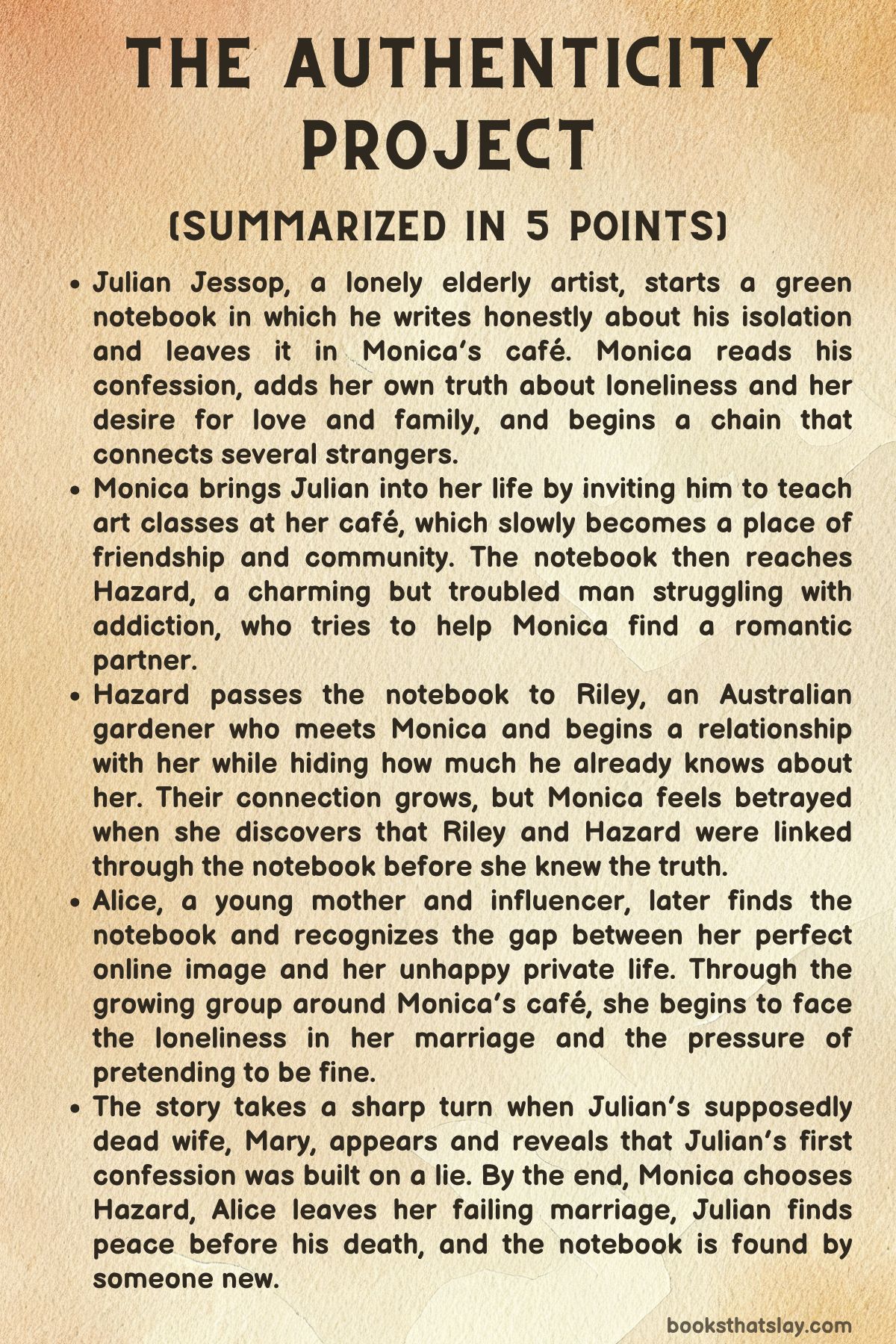
Summary
The Authenticity Project begins when Monica, the owner of a small café, discovers a green notebook left behind by one of her customers. The notebook contains an entry by Julian Jessop, an elderly artist who writes with painful honesty about his loneliness.
Julian presents himself as a man who once had a successful artistic life but now lives with grief, isolation, and a longing to be seen by another person. He challenges whoever finds the notebook to add their own truth and pass it on.
Monica is intrigued by the honesty of the entry and becomes determined to find Julian.
Monica researches Julian and learns that he was once a known portrait painter. She begins to see him as more than a strange old customer.
Her own life, though carefully organized, is also full of quiet unhappiness. She once worked as a corporate lawyer but left that world after seeing how empty and damaging it could be.
She opened her café with hopes of building a warmer, more meaningful life, but running the business is stressful and lonely. She wants a husband and child, yet she feels embarrassed by how much she wants these things.
In the notebook, she writes her own confession, admitting her longing for family, her fear of being unlovable, and the pressure she feels when comparing herself to other people’s polished lives.
Monica then creates a reason for Julian to enter her life by advertising for an art teacher. Julian notices the advertisement and accepts the job.
His art classes at the café soon begin to bring people together. Although Monica initially worries about the cost and attendance, the classes gradually become a source of connection and purpose.
Julian finds friendship and routine again, while Monica’s café begins to feel like the center of a small community.
The notebook next reaches Hazard, a charming but self-destructive man battling addiction. He finds the book after Monica has written in it and reads both Julian’s and Monica’s entries.
Hazard is amused, skeptical, and unsettled. He recognizes Monica’s café but avoids entering because he remembers an unpleasant encounter with her.
He has been using drugs and alcohol to escape his unhappiness and self-disgust. Wanting to make a dramatic change, he goes to Thailand, hoping distance will free him from his habits.
Instead, he finds sobriety frightening and boredom unbearable. Still, Monica’s confession stays with him, and he decides to help her find a suitable man.
In Thailand, Hazard meets Riley, an easygoing Australian gardener. Hazard sees Riley as a possible match for Monica and secretly places the notebook in his bag.
Riley later discovers it and reads the entries. When he meets Monica in London, he is already aware of her private hopes and insecurities, which makes him feel guilty.
Monica, however, is drawn to him. Riley’s relaxed nature contrasts with her controlled habits, and he brings out a more spontaneous side of her.
They spend time together, kiss, and begin to form a romantic bond. Riley also becomes close to Julian, helping him sort through old belongings and encouraging him to step back into the world.
The circle widens as Julian’s art classes grow. Betty Wu, an older woman who teaches tai chi, becomes part of the group.
Baz and Benji, connected to Betty, also appear in the social world around the café. Monica begins to feel that her life is improving.
Her business is doing better, Julian has become a friend, and Riley seems to care for her. Yet the notebook remains a hidden source of tension because Riley has not told Monica how much he knows about her before their relationship began.
Meanwhile, Alice, a young mother and social media influencer, is struggling behind the image she presents online. She has a baby, Bunty, and a seemingly stylish life, but motherhood has left her exhausted, lonely, and resentful.
Her marriage to Max is strained, and she suspects he may be hiding things from her. One night, while walking with Bunty, Alice sees Monica and Riley dancing in the café and imagines Monica’s life as freer and happier than her own.
Later, Alice finds the green notebook and reads the entries. The contrast between what people show and what they suffer privately makes her question her own carefully staged life.
At Christmas, the truth about the notebook begins to cause damage. Hazard returns from Thailand and appears at Monica’s café, where Riley and Monica are together.
Monica realizes that Riley and Hazard know each other and that Riley has been hiding his connection to the notebook. She feels betrayed and humiliated, wondering whether she has been treated like a project rather than a person.
She pushes everyone away, and her brief happiness collapses into anger and shame. Riley tries to explain, but Monica refuses to listen.
The group is pulled back together by concern for Julian. After Monica cancels the art class, Julian retreats into his old loneliness.
Riley and Hazard worry when they cannot reach him. They gather Monica, Betty, and Baz, then enter Julian’s house and find him alive but unwell, cold, hungry, and confused.
The incident reminds them all that Julian needs real human contact, not just admiration or occasional visits. Monica restarts the art classes, and Julian returns to the community.
Alice then brings Riley and Julian to a charity garden connected to a support organization for mothers, and this gives Riley a chance to reconnect with gardening. The group later travels to Paris for an art-class outing.
During the trip, Monica begins to understand Alice better. Alice admits that marriage can be deeply lonely and helps Monica rethink what it means to be maternal.
Monica has always believed that being a mother means having a child, but Alice suggests that Monica already mothers people by creating spaces, supporting others, and building community. This realization softens Monica’s jealousy and judgment.
Hazard also begins to change. He volunteers at the charity and speaks with mothers in recovery, discovering that his own experience with addiction can help others.
He starts developing a gardening business that could employ women from the charity. Monica gives him practical advice, and her approval means more to him than he wants to admit.
Their connection grows slowly, though Monica still distrusts him because of his earlier behavior.
At a wedding, Hazard relapses. Trying to hide his addiction from Monica, he drinks champagne and loses control, eventually turning back to drugs.
Monica sees the ugly side of his struggle, and Riley has to come help. The next morning, Hazard apologizes sincerely.
Monica, instead of shutting him out entirely, tells him about her own history with obsessive cleaning and handwashing after her mother’s death. The conversation becomes a turning point because both recognize that everyone in their group has used some form of escape: Julian hides in the past, Alice hides in social media, Monica hides in control, and Hazard hides in intoxication.
Just when Julian seems to be flourishing, a shocking truth is revealed. At a party arranged in his honor, a woman named Mary arrives and introduces herself as Julian’s wife.
Julian had written as though Mary had died, but she is alive. She left him years earlier because of his unfaithfulness and selfishness.
Julian had turned her absence into a tragic story because being abandoned was harder for him to admit than being widowed. The notebook, which was supposed to be built on truth, began with a lie.
This revelation forces everyone to reconsider authenticity. Monica realizes that good can still come from something flawed, but she must be honest in her own life.
She tells Riley that although she loves many things about him, she is not in love with him. Their relationship ends kindly.
Hazard realizes he loves Monica, but he fears she could never accept him after seeing his worst moments. When he finally confesses, Monica is angry after reading how he first described her in the notebook.
Still, she is drawn to him because he sees not only her strengths but also her flaws.
Alice’s life also reaches a breaking point. Her marriage to Max deteriorates, and when he insults her changed body and admits he misses their old life, she walks out.
She begins choosing honesty over the appearance of perfection. Julian, guided by Mary’s return, also starts letting go of old illusions.
Mary encourages him to sell his house and stop clinging to the past.
Monica eventually accepts her feelings for Hazard. She finds him at the cemetery, and they admit their attraction and hope for a future.
Julian’s final birthday party brings the group together again. Baz and Benji announce their engagement, Riley shows grace about Monica and Hazard, and Monica gives the notebook back to Julian as a sign that she still believes he can live more truthfully.
After the party, Julian sits peacefully in the park, feeling content and surrounded by memories. He dies there, and a stranger named Dave finds him along with the green notebook, suggesting that the project may begin again with another life.
Characters
Monica
Monica is one of the central figures in The Authenticity Project, and her character is built around control, longing, and the fear of not being enough. She appears organized, capable, and independent, but her inner life is marked by loneliness and a deep desire for family.
Her decision to leave corporate law and open a café shows courage, yet it also exposes how hard it is to build a meaningful life from scratch. Monica wants marriage and motherhood, but she feels ashamed of wanting them so badly, especially when other people seem to receive those things easily.
Her café becomes more than a business; it becomes an expression of her need to create order, warmth, and belonging. Her judgment of others, especially Alice and Hazard, often comes from insecurity rather than cruelty.
As the book progresses, Monica learns that authenticity does not mean being perfectly honest in one confession; it means accepting the parts of herself she has tried to hide. Her realization that she can “mother” through care, structure, and community changes how she sees herself.
Her romantic journey also reflects growth. Riley seems like the safe dream, but Hazard challenges her to accept messiness, imperfection, and emotional risk.
Julian Jessop
Julian is a lonely elderly artist whose first entry gives the notebook its purpose, yet he is also the character who most clearly shows that people can confuse emotional truth with factual honesty. In The Authenticity Project, Julian presents himself as a grieving widower, abandoned by fame and left behind by modern life.
Much of this is emotionally true: he is lonely, aging, and desperate to be noticed. However, the revelation that Mary is alive exposes his habit of reshaping reality to protect his pride.
Julian is vain, charming, theatrical, and often selfish, but he is not without warmth. His return to teaching art gives him a reason to live more fully, and the friendships formed around Monica’s café revive him.
His need for admiration is both comic and sad; he wants to be loved, but he often performs for attention instead of offering plain honesty. Mary’s return forces him to face the damage caused by his lies and his old behavior.
His final days suggest a measure of peace because he has moved from isolation into community. Julian’s death feels like the closing of one circle and the opening of another through the notebook.
Hazard
Hazard is one of the most complicated characters in the book because his charm constantly competes with self-loathing. He begins as arrogant, reckless, and emotionally careless, using drugs, alcohol, and sex to avoid facing himself.
His addiction is not treated as a simple moral flaw; it is shown as a form of escape from shame and discomfort. Hazard often behaves badly, but he is also capable of surprising kindness.
His attempt to find Monica a partner is misguided and intrusive, yet it shows that he wants to do something useful with the notebook. Sobriety forces him to encounter feelings he has spent years numbing.
His relapse at the wedding is painful because it reveals how fragile his recovery remains, especially when he tries to hide the truth from Monica. What makes Hazard important is his gradual movement from performance to responsibility.
Volunteering at the mothers’ charity allows him to use his experience in a constructive way, and his gardening business idea shows a desire to build rather than destroy. His love for Monica is believable because he does not idealize her into perfection.
He sees her anxiety, judgment, and need for control, yet he still wants to be with her.
Riley
Riley functions as both a romantic possibility and a test of what honesty requires. He is gentle, attractive, generous, and calmer than many of the London characters around him.
His love of gardening gives him a grounded quality, and he helps Julian reconnect with practical life by sorting through his belongings. Monica is drawn to Riley because he offers escape from pressure and routine.
Yet Riley’s flaw is avoidance. He reads the notebook before becoming close to Monica and then fails to tell her, allowing their relationship to grow on uneven ground.
His guilt proves that he understands the seriousness of the deception, but he delays the truth because he fears losing her. Riley’s emotional journey is quieter than Hazard’s or Monica’s, but it matters because he learns to let go with grace.
When Monica admits she is not in love with him, he is hurt but not cruel. By the end, he accepts Monica’s relationship with Hazard and leaves with dignity.
Riley represents the kind of good person who can still cause harm through silence.
Alice
Alice is a sharp portrait of modern loneliness hidden behind public perfection. She is young, stylish, and admired online, yet her daily life as a mother is exhausting and isolating.
Her social media presence depends on presenting beauty, ease, and control, while her real life is full of sleep deprivation, resentment, fear, and emotional hunger. Alice’s longing when she sees Monica dancing in the café reveals the book’s larger idea that people often envy lives they do not understand.
Monica envies Alice’s motherhood, while Alice envies Monica’s freedom. Alice’s marriage to Max is one of the clearest examples of how appearances can conceal emotional neglect.
She feels trapped by the version of life she once wanted. Her growth begins when she admits that motherhood has not made her automatically fulfilled and that marriage has become lonely.
Through Lizzie’s help and the support of the wider group, Alice begins to step away from the pressure to perform happiness. Her final confrontation with Max shows that she is no longer willing to preserve a false image at the cost of herself.
Betty Wu
Betty brings humor, discipline, and generational tension into the story. She first appears through tai chi and gradually becomes part of Julian’s circle, adding a practical and spirited presence to the group.
Betty’s relationship with Baz and Benji shows her struggle with acceptance. Her discomfort with their relationship reflects older social expectations, but the book does not leave her frozen in prejudice.
The Paris incident, where Benji helps recover her belongings after she is mugged, becomes an important emotional shift. Betty begins to see Benji not as an idea she disapproves of, but as a person connected to someone she loves.
Her character shows that growth can happen late in life and that community can soften fixed attitudes. She is not presented as perfect, but she is capable of change when experience challenges her assumptions.
Lizzie
Lizzie is nosy, blunt, and morally opinionated, but she also becomes one of the book’s practical rescuers. She finds the notebook at the charity center and reads the entries with a judgmental eye, especially when considering Monica’s desire for marriage and Alice’s struggles.
At first, Lizzie seems like someone who believes she already understands everyone else’s problems. Yet her actions reveal genuine care.
Her decision to help Alice with Bunty gives Alice something she desperately needs: support without performance. Lizzie’s entry and her decision to send the notebook to Mary show her intolerance for deception.
She may interfere, but her interference exposes Julian’s lie and forces the group to confront reality. Lizzie’s role suggests that honesty sometimes arrives through uncomfortable people who refuse to let false stories remain untouched.
Mary
Mary is crucial because her arrival overturns the emotional foundation Julian has built around himself. Until she appears, the others understand Julian as a grieving widower.
Mary reveals a more complicated truth: she left because Julian’s behavior made life with him painful. She is not the saintly dead wife of Julian’s story but a living woman who chose dignity and love elsewhere.
Her relationship with Anthony contrasts with her marriage to Julian, showing what it means to be appreciated rather than diminished. Mary’s presence exposes Julian’s vanity and self-pity, but she is not needlessly cruel.
She recognizes his loneliness and still shows him a measure of compassion. By encouraging him to sell his house and release the past, she helps him move toward a more honest final chapter.
Mary restores balance to the story by insisting that Julian’s pain does not erase the harm he caused.
Max
Max represents the quiet cruelty of a partner who resents change but refuses to understand its cause. His marriage to Alice has been damaged by parenthood, disappointment, and emotional distance.
He appears secretive, impatient, and increasingly dismissive of Alice’s exhaustion. His criticism of her body and his nostalgia for their old life reveal how shallow his support has become.
Rather than seeing Alice as a woman overwhelmed by motherhood, he treats her as someone who has failed to remain the version of herself he preferred. Max’s role is important because he exposes the false promise that marriage and a baby automatically create closeness.
Through him, the book shows how loneliness can exist inside a household, even beside a spouse and child. Alice’s decision to leave is not impulsive rebellion; it is a refusal to keep shrinking herself inside a relationship that no longer offers respect.
Baz and Benji
Baz and Benji represent love tested by family acceptance and social discomfort. Their relationship adds another dimension to the book’s concern with being seen honestly.
Baz is hurt when Julian carelessly reveals private information to Betty, and his anger is justified because Julian treats a sensitive truth as casual gossip. Benji’s role grows during the Paris trip, especially when he protects Betty after the mugging.
This action helps shift Betty’s view of him and allows their relationship to be recognized more warmly. Their later engagement marks a hopeful development, not only for them as a couple but also for the community around them.
Baz and Benji show that authenticity is not only about confession; it is also about having one’s relationships acknowledged with respect.
Blanche
Blanche appears briefly but serves an important purpose in Hazard’s development. At the beginning, she belongs to the kind of nightlife world Hazard uses to avoid himself: flirtation, sex, alcohol, and emotional distance.
When Hazard later tries to reconnect with that old life by going out with her again, he realizes it no longer fits him. Blanche is not deeply explored as a person, but her presence shows how much Hazard has changed.
What once seemed exciting now feels empty. Through his interaction with her, the story marks the point at which Hazard understands that recovery is not only about avoiding substances; it is also about leaving behind the identity that kept him trapped.
Roderick
Roderick is part of Hazard’s comic attempt to engineer Monica’s future. Hazard considers him as a possible match because he seems respectable and available, but the idea quickly falls apart.
Roderick’s function is partly humorous, showing how absurd it is for Hazard to treat Monica’s life as a matchmaking assignment. He also shows how little a person can know from surface details.
On paper, someone may appear suitable, but real compatibility cannot be built from a checklist. His later appearance at the wedding adds to the social network that grows around the notebook, but he remains mostly a reminder of Hazard’s early misunderstanding of intimacy.
Dave
Dave appears at the end as the stranger who finds Julian after his death and discovers the notebook. Although he is only briefly present, his role is symbolically important.
He represents continuation. The notebook does not end with Julian’s death, Monica’s relationship, Alice’s decision, or Hazard’s growth.
Dave’s discovery suggests that another person may now be invited into the same difficult experiment of telling the truth. His presence turns the ending outward, implying that loneliness and hidden pain are not limited to the characters already known.
The project can continue because there will always be another person who needs to be seen.
Themes
Authenticity and the Difficulty of Telling the Truth
In The Authenticity Project, truth is treated as necessary but complicated. The green notebook invites people to confess what they hide from the world, and this invitation changes many lives.
Monica admits her longing for family, Hazard admits his addiction, Alice admits the misery behind her polished image, and Riley admits the loneliness beneath his easygoing manner. Yet the book refuses to present honesty as simple or instantly healing.
The notebook begins with Julian’s lie about Mary, proving that even a project devoted to truth can be shaped by vanity and self-protection. The characters often tell emotional truths while avoiding factual ones, or they reveal one secret while hiding another.
Riley’s silence about the notebook damages his relationship with Monica because honesty delayed becomes deception. Hazard’s relapse worsens because he tries to conceal his addiction from her.
The theme shows that authenticity is not a single dramatic confession. It is a repeated choice to be less false in daily life, especially when the truth risks embarrassment, rejection, or loss.
Loneliness Behind Social Performance
Many characters appear to have lives that others envy, yet their private realities are marked by isolation. Monica sees Alice with a baby and imagines she has the one thing missing from her own life.
Alice sees Monica dancing in the café and imagines freedom, romance, and ease. Both are wrong, but their mistaken envy reveals how much loneliness is fueled by incomplete views of other people.
Alice’s social media presence makes this theme especially clear. She has followers, admiration, and a beautiful public image, but she lacks rest, emotional support, and honest companionship.
Julian once had artistic recognition, yet he is nearly forgotten and painfully alone. Hazard has charm and sexual confidence, but beneath that surface he is ashamed and self-destructive.
The book suggests that performance does not remove loneliness; it often deepens it because it prevents others from seeing the truth. Real connection begins only when the characters stop treating themselves as images to be managed and allow others to witness their need.
Community as a Chosen Family
The café becomes the emotional center of the story because it offers more than food and coffee. It becomes a place where people who might otherwise remain strangers begin to care for one another.
Monica creates the physical space, but the notebook gives the group its emotional beginning. Julian’s art classes bring people together, the cemetery meetings become rituals of friendship, and the Paris trip turns a loose collection of individuals into a community.
This chosen family is imperfect. People lie, judge, relapse, interfere, and disappoint one another.
Yet they also show up when it matters. When Julian is in danger, the group searches for him.
When Alice is overwhelmed, Lizzie helps with Bunty. When Hazard tries to rebuild his life, Monica’s practical support gives him confidence.
The community does not erase each person’s pain, but it makes survival less solitary. The theme argues that family can be built through repeated acts of attention, forgiveness, and presence, not only through blood, marriage, or romance.
Letting Go of False Lives
The characters are repeatedly asked to release versions of themselves that no longer serve them. Monica must let go of the idea that her worth depends on becoming a wife and mother in a conventional way.
Riley must let go of Monica when he understands that affection is not the same as lasting love. Hazard must leave behind the reckless persona that once made him feel powerful but kept him trapped in addiction.
Alice must release the fantasy of perfect motherhood and the online image that hides her distress. Julian faces the hardest version of this theme because his entire identity has become tied to a false story about Mary, his house, his past fame, and his suffering.
Letting go is painful because false lives often provide comfort, sympathy, or structure. However, the book shows that clinging to them prevents growth.
The characters move forward only when they stop defending illusions and begin accepting less flattering realities. Freedom comes not from becoming ideal, but from living with fewer lies.