The Armor of Light Summary, Characters and Themes
The Armor of Light is a historical novel by Ken Follett set in and around Kingsbridge during the Industrial Revolution and the Napoleonic Wars. It follows workers, mill owners, clergy, inventors, reformers, and social climbers as England changes under the pressure of new machines, political fear, poverty, religion, and war.
At its center are ordinary people trying to survive systems built to favor wealth and birth. The book explores how industry can create opportunity while also destroying livelihoods, and how courage often comes from people with very little power. This is the 4th novel in the Kingsbridge series.
Summary
The Armor of Light begins in late eighteenth-century England, where the old social order still controls the lives of working people. Sal Clitheroe lives in Badford with her husband Harry and their young son Kit.
Their family is poor but hardworking, and Sal earns extra money with her spinning wheel. Their fragile security is destroyed when Harry is ordered by Will Riddick, the arrogant son of the local squire, to help move an overloaded cart with a faulty brake.
The cart crashes into Harry, injuring him terribly. Sal tries to hold the family together, but Harry dies, and Will refuses responsibility.
When Sal asks for help, the Riddick family offers cruelty rather than justice. George Riddick, a rector and overseer of poor relief, forces Kit into service at the manor, separating him from his mother.
Kit’s life at the Riddick house is harsh. He works long hours, is frightened by Will, and suffers injuries, but he also meets Roger Riddick, Will’s younger brother, who is kind, intelligent, and fascinated by machines.
Kit admires Roger deeply. Sal, meanwhile, is eventually driven out of Badford after striking Will when he insults her son.
She and Kit move to Kingsbridge, where Amos Barrowfield, a young Methodist clothier, gives her work in his mill.
Amos has recently inherited his father’s struggling business. He discovers that the company is heavily indebted to Joseph Hornbeam, a ruthless businessman who hopes to seize the business.
With help from David Shoveller, known as Spade, and the Methodist community, Amos raises enough money to pay the debt and keep control. This creates a lasting rivalry with Hornbeam.
Amos wants to modernize while treating workers fairly, while Hornbeam sees people only as tools for profit.
Kingsbridge is changing quickly. New machines such as spinning jennies, scribbling engines, and steam-powered mills promise greater production, but they also threaten workers’ jobs.
Amos tries to balance efficiency with responsibility, while Hornbeam adopts machinery without concern for the people displaced by it. The working people begin to organize through discussion groups and later through labor action.
Spade becomes one of their strongest allies. He supports education, debate, and workers’ rights, but must avoid being accused of sedition in a time when fear of the French Revolution makes the ruling class suspicious of any reform.
Religion and class shape much of life in Kingsbridge. Methodists are viewed with suspicion by the Anglican establishment, and workers who discuss rights or politics are treated as dangerous.
Elsie Latimer, daughter of the Bishop of Kingsbridge, starts a Sunday School to educate poor children. At first, the school is a charitable project, but it becomes a crucial source of food and support during times of hunger and strikes.
Elsie is intelligent, compassionate, and quietly in love with Amos, though Amos spends years longing for Jane Midwinter, a beautiful woman who wants wealth and status above love.
Jane rejects Amos when he is poor and later marries Henry Northwood, an aristocrat and military leader. Her marriage gives her social standing but not happiness.
Amos remains emotionally tied to her for many years, even after she marries. Elsie, seeing that Amos cannot return her love, marries Kenelm Mackintosh, an ambitious clergyman.
Kenelm is proud, career-minded, and often dismissive of Elsie, though war later changes him.
Spade’s life also changes through love. A widower, he begins an affair with Arabella Latimer, the bishop’s wife.
Arabella has spent years in a cold marriage and finds passion and companionship with Spade. Their relationship is dangerous because it risks scandal, especially when Arabella becomes pregnant.
She tricks the bishop into believing the child may be his, but he suspects the truth. His revenge is cruel and personal: he destroys her beloved rose garden and uses his authority to punish her emotionally.
After the bishop’s death, Spade and Arabella marry openly.
The struggles of working people grow worse as food prices rise and wages fail to keep up. Joanie, a working-class woman close to Sal, leads a protest when Hornbeam tries to sell grain away from Kingsbridge while local people are starving.
She is arrested, convicted, and sentenced to transportation to Australia. Her punishment shows how the justice system protects property and power more readily than hungry families.
Sal eventually marries Jarge, Joanie’s brother. Their relationship is passionate but troubled.
Jarge loves Sal, yet he is impulsive, violent, and increasingly bitter as machines reduce the demand for labor. Sal’s life is marked by repeated loss, but she remains practical and fierce.
When she is imprisoned for labor organizing under new anti-union laws, she returns physically and emotionally damaged. The experience hardens her further, but it does not break her.
Hornbeam grows wealthier and more powerful through war contracts, bribery, and exploitation. He wants to become a political force in Kingsbridge, but his need for control comes from fear as much as greed.
He was born into poverty and carries shame from his past, especially the memory of his mother being hanged as a thief. He hides this history while punishing the poor for the desperation he once knew himself.
Years pass, and Kit grows into a gifted engineer. His early fascination with machines becomes his livelihood.
He and Roger start a business building textile equipment, and their bond becomes romantic. Because their love is forbidden by society, they must keep it secret.
Roger’s gambling causes trouble, and when debts become impossible, both men join the military. Kit’s technical skill makes him valuable in war, and he later serves near the center of the campaign against Napoleon.
As the Napoleonic Wars expand, Kingsbridge is drawn into a larger world of military demand, conscription, press gangs, and battle. Men are forced into service, families are broken, and poverty becomes even more dangerous.
Tommy Pidgeon, a hungry boy whose father has been taken by a press gang, steals ribbon to help feed his mother. Because the law values property more than motive, Tommy is sentenced to death.
His hanging devastates the community, and his mother later takes her own life. This event exposes the moral brutality of a legal system that claims order while destroying the vulnerable.
Amos eventually becomes a respected businessman and reform-minded public figure. He wins military contracts honestly after corrupt Will Riddick loses control of procurement.
He also has a brief affair with Jane, and she later gives birth to a son, Henry, who is likely Amos’s child. Amos is ashamed of his adultery, but he slowly moves beyond his obsession with Jane.
Over time, he recognizes Elsie’s strength, intelligence, and loyalty.
The final major action moves to the battlefield of Waterloo. Napoleon has escaped exile, and Europe is again at war.
Many characters converge near the conflict: Kit serves under Wellington, Roger is also in the army, Jarge is a soldier, Sal follows the troops in disguise to stay near her husband, Kenelm serves as chaplain, and Joe Hornbeam, Joseph Hornbeam’s grandson, is an officer. The battle is chaotic and deadly.
Kit carries messages, observes the movements of the Prussian army, and fights through fear and exhaustion. Sal experiences the terror of war from the margins, trying to feed men and protect herself.
Kenelm is fatally wounded. Jarge dies saving Joe Hornbeam’s life, an act that forces Joseph Hornbeam to confront his hatred of the working people he has spent years trying to crush.
After Waterloo, the survivors return to Kingsbridge. Jarge’s death leaves Sal grieving, but it also changes her future.
Joe Hornbeam, grateful that Jarge saved him, asks how he can repay the debt. Sal asks for a shop, and she becomes an independent businesswoman.
Joseph Hornbeam, shaken by guilt and unable to reconcile his pride with the truth that his grandson lives because of a man he despised, dies by suicide after climbing the cathedral.
The ending brings several forms of renewal. Amos and Elsie finally acknowledge their love and plan to marry.
Spade becomes a Member of Parliament and works for labor reform. Many unjust laws are repealed.
Kit and Roger return home together, rebuild their business, and eventually live openly in the old Riddick manor after Will’s death makes Roger the squire. Sal later marries Colin Hennessy and shares in a more secure life.
The social order has not been completely remade, but the people who endured its cruelty have gained ground. The book closes with a sense that history changes not only through kings, wars, and machines, but through workers, reformers, lovers, and survivors who refuse to accept the roles forced upon them.
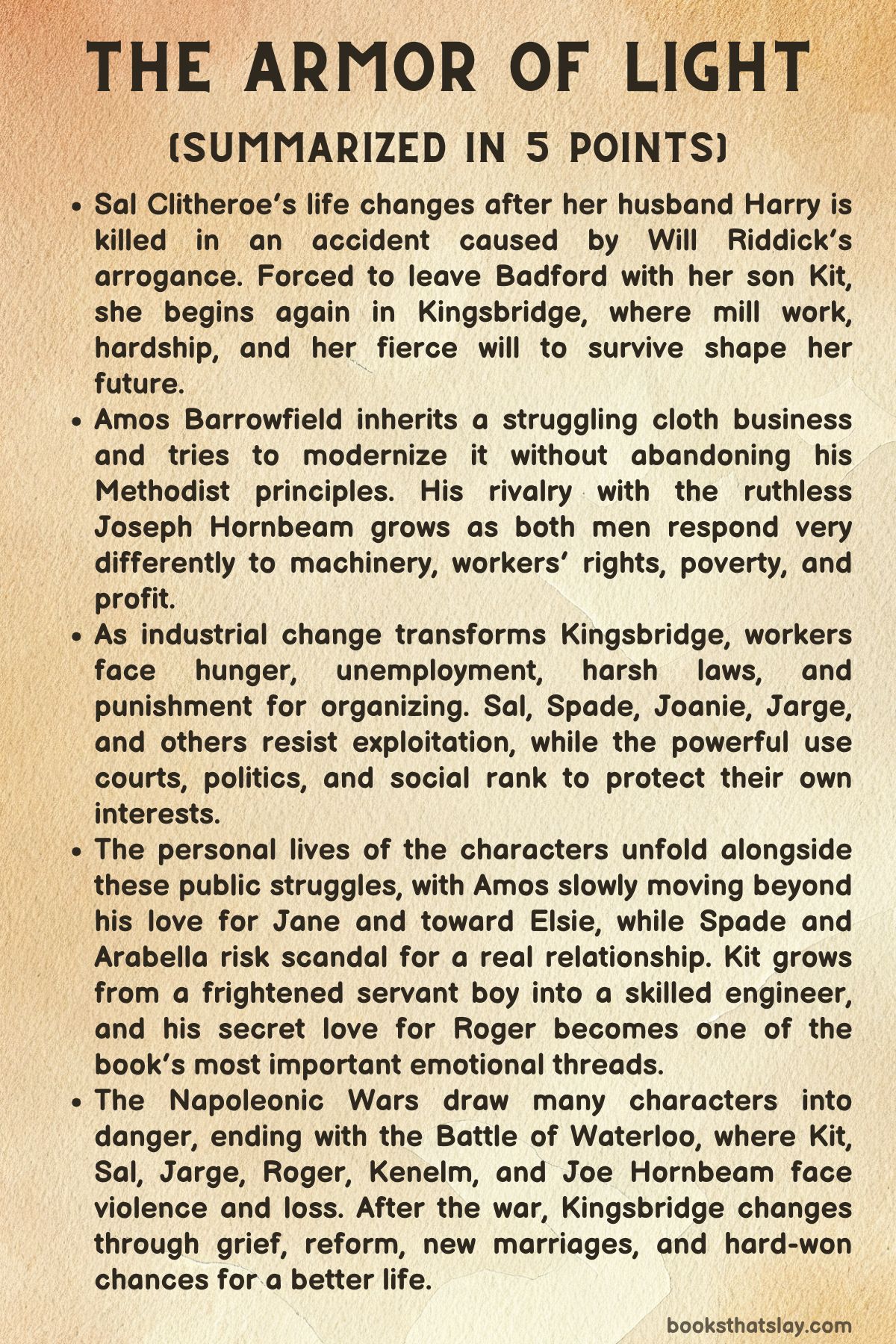
Characters
Sal Clitheroe
Sal Clitheroe is one of the strongest figures in the book, shaped by poverty, grief, motherhood, and political awakening. At the beginning, she is a working wife whose life is built around survival.
Harry’s death forces her to become more than a widow trying to feed her son; she becomes a woman who understands the full cruelty of class power. Her confrontation with Will Riddick shows both her courage and the danger of speaking against the gentry.
Sal’s defining trait is not softness but endurance. She loses her husband, is separated from Kit, leaves her home, works in the mills, suffers imprisonment, and later follows the army into war, yet she keeps finding ways to continue.
Her relationship with machines is practical rather than ideological. She understands workers’ fears, but she also sees that change cannot simply be wished away.
Her love for Kit is fierce and protective, and her later relationships with Jarge and Colin show her desire for companionship without making her dependent on men. By the end of The Armor of Light, Sal has moved from desperation to independence, owning a shop and claiming a more secure place in the world.
Kit Clitheroe
Kit Clitheroe begins as a vulnerable child trapped by the decisions of powerful adults. His early service at the Riddick manor teaches him fear, discipline, and social inequality, but it also introduces him to Roger, whose kindness and intelligence leave a lasting mark.
Kit’s development is one of the clearest examples of talent rising from difficult circumstances. He understands machines with unusual instinct, and his technical skill allows him to move beyond the life that seemed assigned to him at birth.
Yet Kit’s rise is not simple freedom. His love for Roger must remain hidden, and his professional ambitions are interrupted by military service.
In war, Kit proves brave not because he seeks glory, but because he performs his duties despite terror. His relationship with Sal remains central; even as he becomes successful, he stays emotionally tied to the mother who fought for him.
Kit’s return to the Riddick manor at the end is deeply meaningful. The place where he once served in fear becomes a home he can reshape with Roger.
Amos Barrowfield
Amos Barrowfield is a moral businessman in a world that often rewards corruption. He inherits a failing enterprise and must quickly learn that good intentions alone will not save workers or families.
His Methodist values guide him, especially his refusal to bribe Will Riddick for contracts, but he is not presented as perfect. His long attachment to Jane exposes his emotional blindness, and his affair with her becomes a source of guilt that complicates his self-image.
Amos’s strength lies in his willingness to combine business ambition with social responsibility. He embraces machinery, but he does not treat workers as disposable.
He listens, negotiates, and tries to imagine prosperity as something that can be shared. His bond with Elsie grows slowly because he fails for years to see what is in front of him.
When he finally recognizes her worth, it marks his emotional maturity. In The Armor of Light, Amos represents a model of reform from within commerce: imperfect, sometimes naive, but committed to fairness.
Elsie Latimer
Elsie Latimer is intelligent, observant, and morally serious. Her Sunday School begins as a project for poor children, but it becomes an institution of care, education, and resistance.
Elsie belongs to the privileged world of the cathedral, yet she repeatedly uses that position to help those with less power. Her love for Amos is quiet and painful, especially because he spends so long idealizing Jane.
Rather than waiting passively, Elsie marries Kenelm and builds a family, though her emotional life remains divided. She is one of the book’s clearest examples of duty complicated by private desire.
Elsie is also perceptive about hypocrisy. She sees the cruelty in systems that claim Christian morality while starving children, punishing workers, or defending status.
Her care for her mother after Arabella’s affair is revealed shows compassion without judgment. By the end, Elsie’s union with Amos feels earned because it comes after years of service, restraint, and emotional honesty.
David Shoveller, Known as Spade
Spade is a reformer, craftsman, strategist, lover, and political thinker. He is deeply connected to the working people of Kingsbridge, but he also understands how power operates among the wealthy.
His intelligence lies in patience and planning. When Hornbeam tries to trap reformers, Spade often sees through the scheme and responds with careful counteraction.
He supports the Socratic Society, workers’ organizing, petitions, and later parliamentary reform. His relationship with Arabella reveals another side of him: passionate, tender, and willing to risk reputation for love.
Yet he is not careless. He knows scandal can destroy people, especially women, and he tries to protect those he loves.
His loyalty to his sister Kate and her partner Rebecca also shows his humane understanding of love beyond public rules. Spade’s rise to Parliament is fitting because he turns local resistance into national advocacy.
He is one of the main forces pushing the story from suffering toward reform.
Arabella Latimer
Arabella Latimer begins as the bishop’s wife, a woman trapped inside respectability. Her marriage has status but little affection, and her rose garden becomes a symbol of the beauty and feeling she has cultivated privately.
Her attraction to Spade awakens a life she has long been denied. Arabella’s affair is risky, but the book presents it as a search for love and dignity rather than simple rebellion.
When she becomes pregnant, she must navigate a society that would punish her far more harshly than it would punish a man. The bishop’s destruction of her roses is one of the clearest acts of emotional cruelty in the story; he attacks the thing that gives her joy because his pride has been wounded.
Arabella’s later marriage to Spade allows her to live openly with the man she loves, though the shadow of scandal remains. She is a character whose quiet hunger for affection becomes a challenge to the cold moral authority surrounding her.
Joseph Hornbeam
Joseph Hornbeam is the main embodiment of ruthless capitalism and class insecurity. He is cruel to workers, manipulates courts, bribes when useful, crushes organizing, and treats poverty as a moral failure.
Yet his brutality grows from fear as well as greed. His hidden childhood poverty and his mother’s execution haunt him, making him desperate to erase any trace of weakness.
Instead of becoming compassionate because he once suffered, he becomes harsher, as though punishing the poor can distance him from his own past. Hornbeam’s desire for status drives his family plans, business choices, and political ambitions.
He wants control over mills, courts, contracts, marriages, and public opinion. His grandson Joe becomes the one person capable of disturbing his certainty.
When Jarge, a man Hornbeam hated, saves Joe’s life, Hornbeam faces a moral debt he cannot comfortably pay. His death is the collapse of a man who built himself on denial and domination.
Roger Riddick
Roger Riddick stands apart from the cruelty of his family. Unlike Will and George, he is curious, inventive, and capable of kindness across class lines.
His early compassion toward Kit shapes Kit’s life, and their later love grows from admiration, shared intelligence, and emotional trust. Roger’s weakness is gambling.
This flaw is not minor; it endangers his finances, his business with Kit, and their future. Still, Roger’s better qualities remain strong.
He values invention and sees machines as creative achievements rather than only instruments of profit. His relationship with Kit must exist in secrecy, making him both privileged and vulnerable.
When he eventually becomes squire, the old Riddick power structure changes meaning. Through Roger, the manor becomes not a place of fear and domination, but a place where love, repair, and new beginnings are possible.
Jarge
Jarge is passionate, loyal, angry, and self-destructive. His anger comes from real injustice: machines threaten his livelihood, employers exploit workers, and the law treats poor men as disposable.
However, his response often harms the people closest to him. His drinking, violence, and involvement in machine breaking place Sal, Kit, and himself in danger.
He is not a simple villain, because his bitterness is rooted in a world that gives him few choices and little dignity. Still, the book does not excuse the harm he causes.
Jarge’s final act at Waterloo changes how he is remembered. By saving Joe Hornbeam, he performs an act of courage that cuts across class hatred.
His death does not erase his flaws, but it gives him tragic depth. He is a man damaged by injustice who, at the end, proves capable of sacrifice.
Jane Midwinter
Jane Midwinter is beautiful, ambitious, and emotionally calculating. She understands the social limits placed on women and chooses to pursue security through marriage.
Her rejection of Amos is not only personal; it reflects her belief that love without money is not enough. Her marriage to Henry Northwood gives her rank, but not fulfillment.
She spends much of the story trying to gain access to higher society, and when that life disappoints her, she turns back toward Amos. Jane can be selfish, but she is also realistic about the narrow options available to women who want comfort and influence.
Her affair with Amos reveals both her desire and her disregard for moral consequences. As a mother, she is practical, asking Amos to play a role in Henry’s life when Northwood is damaged.
Jane is not warm in the usual sense, but she is one of the book’s sharpest portraits of social ambition.
Will Riddick
Will Riddick is violent, entitled, and morally careless. From the beginning, his arrogance causes Harry’s fatal accident, and his refusal to accept responsibility sets the tone for his character.
He uses birth and position as shields against consequence. His cruelty toward Kit, Sal, workers, and women shows a man who enjoys power without understanding duty.
Will also represents the decay of inherited privilege. He begins with authority, social standing, and access to money, but his gambling, drinking, corruption, and brutality hollow him out.
Over time, he loses influence and dignity. By the end, he is living in squalor, surrounded by the ruins of a status he never deserved.
His decline contrasts sharply with Kit’s rise, making clear that worth in the story is not determined by birth.
Kenelm Mackintosh
Kenelm Mackintosh begins as ambitious, polished, and self-serving. He hides parts of himself to fit English expectations and treats church advancement as a career ladder.
His marriage to Elsie is respectable but emotionally limited, and he often underestimates her judgment because she is a woman. Yet Kenelm is one of the characters most changed by war.
Military service strips away some of his vanity and exposes him to suffering that cannot be managed by social performance. As a chaplain, he becomes more sincere and humane, offering comfort to soldiers in brutal conditions.
His injury and death give Elsie real grief, even though their marriage was never the romance she wanted. Kenelm’s arc in The Armor of Light shows that flawed people can grow under pressure, though growth may come too late to create lasting happiness.
Joanie
Joanie is a working-class woman whose courage becomes political because hunger leaves no room for politeness. Her attempt to stop Hornbeam’s grain from leaving Kingsbridge is not abstract rebellion; it is a direct response to starving families.
She understands that law and justice are not the same thing. Her punishment, transportation to Australia, is one of the story’s harshest examples of the state protecting property at the expense of human need.
Joanie’s removal also changes Sal’s family life, leaving Sue in the care of Sal and Jarge. Though Joanie is not present for much of the later story, her fate remains important because it shows the cost paid by ordinary people who resist exploitation before society is ready to call them reformers rather than criminals.
Joe Hornbeam
Joe Hornbeam is important because he offers the possibility of breaking an inherited pattern. As Joseph Hornbeam’s grandson, he could have become another hard, class-conscious master.
Instead, his experience in the army and his rescue by Jarge force him to see working people as human beings rather than threats. Joe’s gratitude toward Sal and his willingness to learn from Spade suggest a new kind of employer may emerge after Hornbeam’s death.
He does not immediately become a perfect reformer, but he is open to advice and capable of moral discomfort. That openness separates him from his grandfather.
Joe represents generational change: not a full revolution, but a chance for power to be used with greater humility.
Themes
Industrial Change and the Human Cost of Progress
The new machines in The Armor of Light bring both promise and pain. For Amos, Kit, Roger, and other forward-looking characters, machinery represents skill, invention, productivity, and the chance to build better businesses.
For many workers, the same machines threaten hunger, unemployment, and loss of dignity. The book refuses to treat technology as either purely good or purely evil.
The real question is who controls it, who benefits from it, and who pays the price when production becomes more efficient. Amos tries to introduce machines while protecting his workforce, showing that progress can be guided by conscience.
Hornbeam, by contrast, uses machines to reduce labor costs and weaken workers’ bargaining power. Jarge’s anger at machinery is understandable because he sees it destroying the only form of work he knows, but his turn toward machine breaking shows how desperation can become dangerous when people are denied lawful ways to protect themselves.
Kit complicates the theme further because he comes from poverty yet becomes an engineer. Through him, machinery becomes a path upward.
The theme asks readers to see industrial progress as a moral test, not just an economic shift.
Class Power, Law, and Injustice
The legal system in the story often serves those who already have land, money, and influence. Working people are punished harshly for acts born of hunger or fear, while the powerful escape responsibility for cruelty, corruption, and exploitation.
Harry dies because Will Riddick abuses authority, but Will faces no real punishment. Joanie is transported for resisting the sale of grain while people are starving.
Tommy Pidgeon is sentenced to death for theft committed in desperation. Sal is imprisoned under laws designed to crush labor organizing.
These cases show a society where property is guarded more fiercely than human life. Hornbeam understands this system and uses it expertly.
He sits as a justice, manipulates proceedings, pressures juries, and turns law into a weapon. Yet the book also shows that law is not fixed forever.
Spade’s political work, Amos’s public service, and the testimony of workers help push reform forward. The theme is not only that injustice exists, but that injustice becomes durable when wrapped in official language.
Courts, churches, and councils can all claim order while preserving cruelty. Real justice requires people willing to challenge the respectability of unfair systems.
Religion, Morality, and Social Responsibility
Religion in the story is not presented as one simple force. It can comfort, control, inspire, or condemn depending on who uses it and why.
Methodism gives Amos, Sal, Spade, and many workers a language of discipline, mutual aid, and moral seriousness. It supports community fundraising, education, and resistance to corrupt business practices.
Anglican authority, represented at times by Bishop Latimer, George Riddick, and church hierarchy, often appears tied to status and social control. Yet the book does not reduce morality to denomination.
Elsie, though part of the Anglican establishment, creates a school that feeds and educates poor children. Kenelm begins as a career-minded clergyman but becomes more sincere through wartime suffering.
The central moral question is whether faith leads people toward compassion or merely protects their rank. Characters who speak most loudly about sin are often blind to cruelty, while those accused of radicalism often do the most practical good.
Arabella and Spade’s relationship also tests public morality against private truth. Their love violates social rules, but the bishop’s coldness and revenge appear far more spiritually empty.
The theme suggests that real faith must be measured by mercy, courage, and service rather than public respectability.
War, Sacrifice, and the Ordinary Lives Behind History
The Napoleonic Wars are not distant background events; they enter homes, mills, courts, marriages, and bodies. War increases demand for cloth, enriches contractors like Hornbeam, creates opportunities for Amos, and forces men into service through militia duty or press gangs.
It also leaves families hungry, widowed, displaced, or afraid. The book’s movement toward Waterloo shows how ordinary people are pulled into decisions made by rulers and generals.
Kit’s technical intelligence becomes military usefulness. Sal follows the army because love and fear matter more to her than rules about where women belong.
Jarge, despite his flaws, dies saving Joe Hornbeam, turning battle into the setting for an unexpected act of grace. Kenelm is changed by service and dies with a seriousness he lacked earlier in life.
War is shown as terrifying, wasteful, and morally confusing, but it also reveals character under pressure. Some people seek profit from it, some seek glory, some seek duty, and some simply try to keep loved ones alive.
The theme’s power lies in its focus on those who are usually left out of grand military history: workers, wives, messengers, chaplains, frightened soldiers, and families waiting for news.