The Argumentative Indian Summary and Analysis
The Argumentative Indian: Writings on Indian History, Culture and Identity is Amartya Sen’s wide-ranging collection of essays on India’s intellectual, political, and cultural life. The book argues that India cannot be understood through narrow religious, colonial, or nationalist labels.
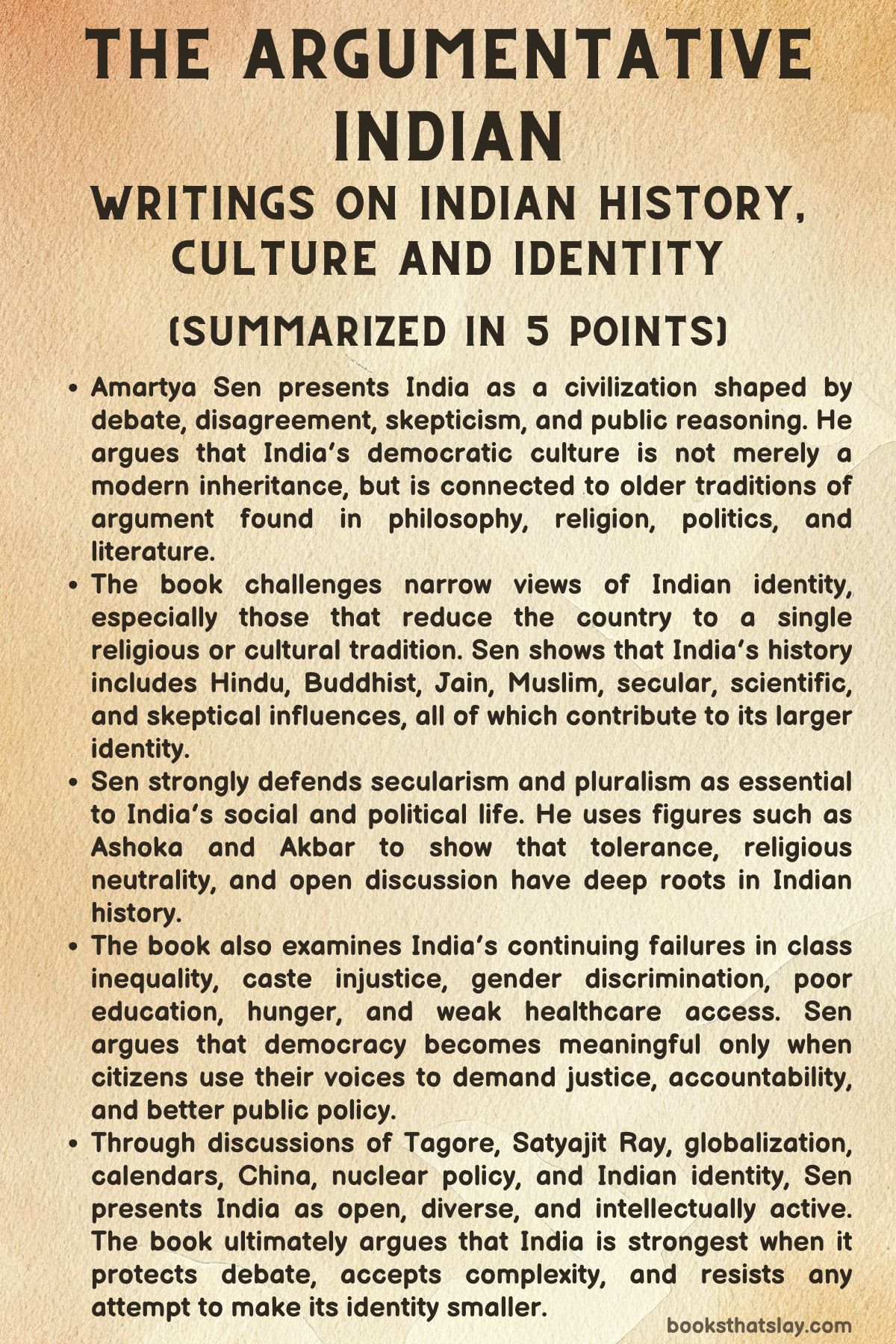
Sen presents India as a civilization shaped by debate, doubt, public reasoning, mathematical inquiry, religious diversity, and social criticism. He challenges the idea that reason is mainly a Western inheritance and shows how Indian traditions have long included skepticism, secular thought, and open argument. The book also examines inequality, gender, class, nationalism, globalization, and identity through India’s past and present.
Summary
Amartya Sen’s The Argumentative Indian is not a conventional story with a single plot, but it does have a strong intellectual movement. Across the essays, Sen builds a case for seeing India through its history of argument, public reasoning, cultural exchange, and social criticism.
He begins by presenting India as a place where debate has never been a marginal activity. From ancient epics to philosophical traditions, from Buddhist and Jain challenges to Brahminical dominance to later political debates about democracy and secularism, Sen argues that India’s identity has been shaped by disagreement as much as by continuity.
The book opens by rejecting simplified images of India. Sen challenges both Western stereotypes that treat India as mystical, passive, and anti-rational, and domestic political narratives that reduce India to a single Hindu civilizational identity.
He insists that Indian civilization has always contained multiple voices. The Vedas, the epics, classical philosophical schools, Buddhist and Jain traditions, materialist thought, and later social movements all show a culture where questioning has played a central role.
This tradition, for Sen, is not merely a matter of historical pride. It has practical value for modern India because democracy, secularism, and social justice all depend on the ability of people to speak, argue, criticize, and be heard.
Sen uses ancient and medieval figures to show that India’s public culture has often supported pluralism. Emperor Ashoka’s emphasis on respectful speech and tolerance across religious groups becomes one of the book’s major historical examples.
Akbar later appears as another ruler who valued interfaith discussion, religious neutrality, and reasoned judgment. These figures help Sen argue that secular thinking in India is not an imported Western idea.
It has roots in the subcontinent’s own history of religious diversity and public debate. Indian secularism, as Sen presents it, does not mean hostility to religion.
It means that the state should treat different religious communities with fairness and should not allow one religious identity to dominate public life.
The early essays also examine inequality. Sen recognizes that India’s argumentative tradition has not automatically produced justice.
The caste system, class divisions, gender inequality, and communal politics have all limited the freedom and dignity of large numbers of people. Yet he believes that public reasoning gives oppressed groups a way to challenge these injustices.
Democratic politics becomes meaningful only when people use their voices to demand education, healthcare, food security, legal fairness, and social recognition. Sen repeatedly returns to the idea that silence helps inequality survive, while public argument can expose it and create pressure for reform.
A major concern in the book is the danger of making India smaller than it really is. Sen criticizes Hindutva politics for trying to identify India primarily with Hindu civilization.
He does not deny the enormous importance of Hindu traditions in Indian history, but he argues that India’s past also includes Buddhist, Jain, Muslim, Sikh, Christian, Jewish, Parsee, secular, and skeptical contributions. The attempt to turn India into a culturally uniform Hindu nation ignores the historical evidence of exchange, disagreement, and coexistence.
Sen sees this narrowing of India as intellectually false and politically harmful. It weakens the inclusive idea of India that emerged during the independence movement and threatens the plural basis of Indian democracy.
The book then turns to major cultural figures, especially Rabindranath Tagore and Satyajit Ray. Through Tagore, Sen explores education, nationalism, freedom of mind, and cross-cultural openness.
Tagore admired India deeply but rejected blind patriotism. His disagreement with Gandhi over the spinning wheel, celibacy, earthquakes, and social policy shows that even among national icons, debate was central.
Sen values Tagore because he combined rootedness in Indian culture with openness to the world. Tagore’s school at Santiniketan becomes an example of education based on curiosity, freedom, and international contact.
Satyajit Ray allows Sen to examine culture and representation. Ray’s films resisted crude images of India made for foreign consumption.
Sen argues that real cultural understanding requires attention to complexity, not exotic stereotypes. He also rejects the idea that Indian culture becomes less Indian by absorbing foreign influences.
India’s history has always involved exchange, from food and language to science, art, and religion. Modernity, in Sen’s view, should not be judged by whether something is Western or Indian, but by whether it improves human lives and expands freedom.
Sen also studies how the West has imagined India. He identifies several patterns: the exotic view that celebrates India as strange and spiritual, the imperial view that treats India as backward and incapable, and the scholarly view that tries to understand Indian culture more carefully.
Colonial interpretations often damaged India’s self-understanding by underplaying its rational, scientific, and mathematical achievements. Sen objects to the habit of praising India only for spirituality while ignoring its traditions of logic, astronomy, mathematics, medicine, and political reasoning.
This imbalance has affected both Western views of India and Indian views of themselves.
The relationship between India and China becomes another example of cultural exchange. Sen shows that the two civilizations were historically connected through Buddhism, scholarship, science, mathematics, medicine, literature, and travel.
Chinese scholars visited Indian centers of learning, while Indian scholars contributed to Chinese astronomy and other fields. These exchanges challenge the idea that civilizations are sealed units defined by religion alone.
They also show how open communication can improve social life. Sen connects this history to modern issues such as public health, democracy, and the importance of transparent information.
In the political essays, Sen evaluates independent India’s achievements and failures. He honors Nehru’s vision of ending poverty, ignorance, disease, and inequality, but he does not romanticize the results.
India has succeeded in sustaining democracy, holding elections, maintaining civil freedoms, and avoiding famine after independence. Yet it has performed poorly in basic education, healthcare, nutrition, gender justice, and the removal of deep social inequalities.
Sen argues that democracy is not just voting; it must include active public pressure. Without strong public demands, governments neglect hunger, schooling, healthcare, and the needs of the poor.
Class receives careful attention. Sen argues that class inequality interacts with caste, gender, and communal identity.
Poverty makes other forms of disadvantage more severe. A poor woman, a poor Dalit, or a poor member of a targeted religious minority often faces layered injustice.
Sen also criticizes policies that are meant to reduce inequality but sometimes benefit better-off groups more than the poorest. Food policy and primary education become examples of systems where public resources do not always reach those who need them most.
For Sen, serious reform requires looking closely at who actually benefits from public action.
Gender inequality is treated as one of the most damaging forms of injustice. Sen examines survival inequality, sex-selective abortion, unequal access to education, unequal property rights, domestic labor, violence against women, and the limited recognition of women’s agency.
He stresses that improving women’s lives is not only a matter of welfare but also of freedom and power. Women’s education, income, property rights, and public participation can transform families and societies.
Kerala’s progress in literacy, health, and fertility shows how women’s agency can produce broad social benefits.
The book also addresses India’s nuclear policy. Sen questions whether nuclear weapons truly strengthen India.
He argues that nuclear pride can weaken moral judgment and strategic clarity. India’s nuclear tests created prestige for some, but they also intensified rivalry with Pakistan and reduced the space for conventional and diplomatic options.
Sen believes India’s real strength lies not in nuclear display but in democracy, economic progress, social justice, and global moral leadership.
In the later essays, reason and identity become central. Sen defends reason against the claim that it is cold, Western, or culturally limited.
He argues that reason works together with sympathy, moral imagination, and public discussion. Akbar’s use of reason in matters of religion, law, and social reform becomes a key example.
Sen also examines secularism, showing that it must be supported by justice, especially when religious personal laws affect women unequally. Secularism alone is not enough; it must be joined with fairness across gender, class, and community.
The essays on calendars and identity show how even technical matters can reveal cultural complexity. India’s many calendars reflect religion, astronomy, politics, mathematics, and regional life.
They demonstrate that India has long been plural rather than uniform. The final reflections on Indian identity argue that identity is not simply inherited.
People choose which identities to emphasize. India’s future, Sen suggests, depends on resisting narrow definitions and preserving a broad, reasoned, inclusive sense of belonging.
The book ends as a defense of India’s argumentative spirit: a tradition of speech, doubt, debate, and openness that remains essential for democracy, justice, and freedom.
Key Figures
Amartya Sen
Amartya Sen is the guiding intellectual presence in the book and the voice through which its arguments take shape. He appears not as a detached observer but as a thinker personally connected to India, Bengal, Bangladesh, and the wider subcontinent.
His perspective combines historical knowledge, moral concern, and political reasoning. In The Argumentative Indian, Sen repeatedly resists simplified explanations, whether they come from colonial scholarship, religious nationalism, anti-modern cultural criticism, or narrow economic thinking.
His character as an essayist is defined by balance: he values India deeply, but he refuses to idealize it. He celebrates its traditions of argument and tolerance, yet he also exposes caste oppression, gender inequality, poverty, hunger, and failures in education and healthcare.
Sen’s strength lies in his ability to connect ancient debate with modern democracy, showing that public reasoning is not a decorative part of civilization but a tool for justice. He is also a critic of intellectual laziness.
He asks readers to reject easy binaries such as East versus West, tradition versus modernity, religion versus reason, and Indian versus foreign. Through him, the book becomes an argument for a larger, more inclusive India, one that is intellectually confident enough to accept criticism and diverse enough to resist ownership by any single group.
Rabindranath Tagore
Rabindranath Tagore is presented as one of the book’s most important cultural figures because he represents freedom of mind, artistic range, and moral independence. He is not treated only as a poet or Nobel laureate, but as a thinker whose views on education, nationalism, religion, and world culture challenged the assumptions of his time.
Tagore’s character in the book is marked by openness. He came from a cultural background shaped by Hindu, Muslim, and British influences, and this helped form his non-sectarian outlook.
His disagreements with Gandhi are especially important because they show his courage in resisting popular symbols when he believed they were intellectually or practically weak. He questioned the economic value of the spinning wheel, rejected irrational explanations of natural disasters, supported contraception and family planning, and argued for education that cultivated curiosity rather than obedience.
Tagore loved India, but his love was never narrow. He criticized aggressive nationalism and warned against worshipping the nation as if it were above humanity.
His rejection of British honors after the Amritsar massacre shows that his international outlook did not make him passive before injustice. In the book, Tagore becomes a model of rooted cosmopolitanism: deeply Indian, deeply Bengali, and deeply committed to a world larger than any single nation.
Mahatma Gandhi
Mahatma Gandhi appears as a figure of immense moral power, but Sen’s treatment of him is careful rather than worshipful. Gandhi’s role in the book is important because he represents both the ethical force of the freedom movement and the limits of certain symbolic or religiously shaped approaches to social policy.
Sen respects Gandhi’s commitment to nonviolence, self-discipline, and the poor, but he also highlights the disagreements Gandhi had with Tagore. These disagreements make Gandhi more human and more complex.
His support for the spinning wheel came from his belief in sacrifice, simplicity, and self-reliance, but Tagore challenged whether it could solve India’s economic problems. Gandhi’s views on celibacy, abstinence, and the moral meaning of disasters also reveal a mind that often interpreted social and personal life through spiritual discipline.
In the book, Gandhi is not dismissed, but he is not placed beyond criticism. He is shown as a leader whose moral authority shaped India’s public life, while also becoming part of the argumentative tradition that allowed others to question him.
His presence strengthens Sen’s larger point: even India’s most revered leaders belong inside public debate, not outside it.
Emperor Akbar
Emperor Akbar is one of the strongest historical examples of reasoned pluralism in the book. Sen presents him as a ruler who understood that India’s diversity required more than conquest or administration; it required dialogue, fairness, and intellectual openness.
Akbar’s interest in interfaith discussion, his attempts to bring different religious communities into conversation, and his commitment to a state that did not simply privilege one faith make him central to Sen’s defense of Indian secular traditions. Akbar’s importance also lies in his use of reason in social matters.
He questioned inherited customs, opposed child marriage, examined unfair laws, and treated moral judgment as something that should be tested through reflection rather than accepted blindly from tradition. His experiments with calendars and religious understanding show his desire to create forms of unity without denying diversity.
In The Argumentative Indian, Akbar stands against the claim that secularism and rational inquiry are foreign to India. He shows that political power, when guided by discussion and curiosity, can support coexistence instead of domination.
Sen does not present him as flawless, but he uses Akbar to prove that India’s history contains strong resources for tolerance, state neutrality, and reasoned reform.
Emperor Ashoka
Emperor Ashoka is portrayed as an early advocate of public ethics, restraint, and respect across communities. His importance comes from his insistence that different sects and religious groups should not build themselves up by insulting others.
This principle becomes one of the book’s clearest historical foundations for civil discussion. Ashoka’s character matters because he shows that power can be joined with moral self-control.
Instead of using authority only to enforce obedience, he promoted communication, ethical reflection, and respect for multiple paths. Sen sees Ashoka as part of the long Indian tradition of public reasoning, especially because his political messages encouraged people to think about conduct, speech, and coexistence.
Ashoka’s relevance is not limited to the ancient past. His example becomes a challenge to modern sectarian politics, which often thrives on humiliation and suspicion.
In the book, Ashoka represents a form of governance that recognizes diversity as a permanent social reality. His public ideals suggest that plural societies need habits of speech as much as laws.
Respectful disagreement, for Sen, is not weakness; Ashoka’s presence proves that it can be a principle of political strength.
B. R. Ambedkar
B. R. Ambedkar appears as one of the book’s most powerful figures of justice, constitutional thought, and social criticism. Sen highlights Ambedkar’s warning that political equality cannot be enough when social and economic inequality remain severe.
As the chief architect of India’s constitution, Ambedkar represents the attempt to turn democratic ideals into legal and institutional reality. His character in the book is inseparable from the struggle against caste oppression.
He understood that formal rights could be hollow if people remained trapped by poverty, humiliation, exclusion, and inherited social rank. Ambedkar’s voice strengthens Sen’s argument that democracy needs active participation and social reform.
He does not represent abstract liberalism alone; he represents democracy as a weapon against entrenched inequality. His concerns about village narrowness, caste power, and social discrimination add depth to the book’s discussion of public reasoning.
Ambedkar shows that argument matters most when it gives the oppressed a way to challenge structures that present themselves as natural or sacred. In the story of modern India, he stands for the unfinished work of equality.
Jawaharlal Nehru
Jawaharlal Nehru is presented as a leader of aspiration, reason, and national reconstruction. His famous vision for independent India included the fight against poverty, ignorance, disease, and inequality, and Sen uses that vision as a measure of India’s later achievements and failures.
Nehru’s character in the book is closely tied to democratic hope. He valued India’s history of tolerance and debate, and he saw the new nation as a place where political freedom could support social and economic transformation.
Yet Sen’s treatment of Nehru is not merely admiring. Nehru’s goals remain only partly fulfilled.
Democracy survived and became a major Indian achievement, but education, healthcare, nutrition, and equality did not advance as quickly as they needed to. This makes Nehru a figure of both inspiration and unfinished responsibility.
He represents the promise of independence, but also the gap between political freedom and social justice. In the book, Nehru’s importance lies in the scale of his vision: India was not meant to become only a voting democracy, but a society in which freedom had real meaning for the poor, the ill, the illiterate, and the excluded.
Satyajit Ray
Satyajit Ray is presented as an artist of cultural honesty and humane observation. Sen values Ray because his films resist stereotypes, especially the simplified images of India often expected by foreign audiences.
Ray does not reduce social suffering to easy villains or melodrama. Instead, his work shows how people are shaped by social conditions, family structures, economic pressure, and moral choices.
This makes Ray important to Sen’s larger argument about culture. He proves that representing India truthfully means accepting complexity.
Ray’s character in the book is also marked by openness to global influence. He was not afraid of learning from world cinema or other artistic traditions, yet his work remained deeply connected to Indian life.
For Sen, this defeats the idea that foreign influence weakens cultural identity. Ray’s art shows that authenticity is not the same as isolation.
His films make room for internal diversity within Indian society, and they challenge the crude opposition between “our culture” and “their culture.” In the book, Ray becomes a model of artistic intelligence: clear-eyed, unsentimental, humane, and resistant to both exotic display and cultural defensiveness.
The Hindutva Movement
The Hindutva movement functions in the book less as a single person and more as a political force with a distinct character. Sen presents it as an attempt to narrow India’s identity by equating Indianness with a Hinduized national image.
Its character is marked by selectivity: it highlights parts of ancient Hindu tradition that support pride and unity, while ignoring skepticism, heterodoxy, religious diversity, and the contributions of non-Hindu communities. Sen criticizes its treatment of history, especially its tendency to portray Muslim rulers mainly as outsiders or destroyers and to reduce India’s past to a conflict between religious communities.
The movement also appears through organizations such as the Sangh Parivar, the RSS, the VHP, the Bajrang Dal, and the BJP, though Sen recognizes that many Hindus do not identify with Hindutva politics. In The Argumentative Indian, this movement becomes the main example of identity reduction.
It tries to make India smaller by denying the full range of its past. Its significance in the book comes from the danger it poses to secularism, historical accuracy, and democratic plurality.
Sen’s criticism is not anti-Hindu; it is directed against the political use of Hindu identity to define the nation in exclusionary terms.
J. R. D. Tata and the Tata Legacy
The Tata legacy appears in the book as an example of how identity can shape economic action without becoming isolationist. Sen discusses Indian industrial development through the Tatas to show that national pride and economic vision can inspire innovation, investment, and institution-building.
The Tatas did not merely pursue profit; their ventures in textiles, hotels, steel, and scientific education were linked to a larger idea of India’s future. Their story shows that identity can motivate people to build capacities that colonial power neglected or discouraged.
At the same time, Sen does not use the Tata example to defend closed nationalism. The growth of Indian industry required foreign expertise, scientific openness, and global exchange.
This makes the Tata legacy a balanced example: national purpose joined with international learning. The Indian Institute of Science especially represents this combination of patriotism and openness.
In the book, the Tatas show that identity becomes productive when it encourages confidence, effort, and collaboration. It becomes dangerous only when it turns into separation or hostility to outside knowledge.
Women as Political and Social Agents
Women appear in the book both as victims of injustice and as agents of social transformation. Sen’s treatment of women is not limited to suffering, though he gives full attention to survival inequality, sex-selective abortion, unequal schooling, property exclusion, domestic labor, and violence.
He is equally concerned with women’s agency: their ability to make decisions, earn income, own property, gain education, influence family life, and participate in public action. Women’s character in the book is therefore collective and transformative.
When women gain literacy, employment, and independent status, the effects reach beyond individual welfare. Child survival improves, fertility rates can decline through voluntary choice, household decisions change, and public priorities shift.
Sen rejects the idea that women’s interests should be treated as a secondary social issue. Gender justice is central to development, democracy, and freedom.
Women in the book expose the limits of a society that speaks of progress while denying half its population equal standing. Their agency becomes one of the clearest tests of whether India’s argumentative democracy can move from formal rights to real freedom.
Themes
Public Reasoning and the Argumentative Tradition
The central force of the book is the idea that India has a long history of public reasoning. Sen treats argument not as noise or division but as a civilizational resource.
Ancient debates, heterodox philosophies, Buddhist and Jain critiques, materialist schools, medieval poets, reformers, nationalist leaders, and modern democratic movements all become part of this tradition. The value of argument lies in its ability to challenge authority.
When people can question priests, rulers, customs, economists, nationalists, and social hierarchies, society gains a way to correct itself. This tradition also gives democracy deeper roots.
Democracy is not only a system of elections; it depends on discussion, criticism, protest, and the circulation of reasons. Sen’s larger claim is that India’s democratic survival should not be seen as an accidental borrowing from the West.
It connects with older habits of debate and public communication. At the same time, he does not romanticize this heritage.
Argument has often existed beside caste oppression, gender exclusion, poverty, and communal conflict. Its promise depends on who gets to speak and whose voice is taken seriously.
Public reasoning becomes meaningful only when marginalized people can use it to demand justice.
Secularism, Pluralism, and the Size of India
India’s identity is repeatedly shown as larger than any single religious or cultural definition. Sen argues that the country’s history includes Hindu traditions, but also Buddhist, Jain, Muslim, Sikh, Christian, Jewish, Parsee, secular, and skeptical inheritances.
This breadth is why attempts to define India mainly through Hindu identity appear so damaging in The Argumentative Indian. The problem is not pride in Hindu traditions; the problem is reducing national identity to one tradition while treating others as secondary or foreign.
Sen’s view of secularism grows from this plural history. Indian secularism is not a rejection of religion.
It is a political commitment to fairness among communities and to the protection of individual freedom. Yet he also shows that secularism must be supported by justice.
Religious neutrality is not enough if women suffer under unequal personal laws or if poor communities lack real protection. Pluralism, in this sense, is not passive coexistence.
It requires institutions, public criticism, historical honesty, and a willingness to resist both majority domination and minority injustice. A large India is one that allows multiple affiliations to exist without forcing citizens to pass through a single religious identity.
Inequality, Voice, and Democratic Responsibility
Sen’s treatment of inequality connects class, caste, gender, education, health, hunger, and political power. He argues that India’s democratic success is real but incomplete because voting rights have not automatically produced equal capabilities.
Large numbers of people remain limited by illiteracy, undernutrition, poor healthcare, insecure work, caste discrimination, and gendered restrictions. The book insists that these failures are not natural facts; they are political and social choices that can be challenged.
Voice is the key link between democracy and justice. When people do not protest poor schools, absent teachers, hunger, medical neglect, or violence, public systems can ignore them.
When disadvantaged groups organize, speak, and demand accountability, democracy becomes more than a formal structure. Sen is especially attentive to the way inequalities reinforce each other.
Poverty worsens caste disadvantage; gender bias becomes harsher when joined with class deprivation; communal violence often harms the poorest members of targeted groups most severely. This layered understanding prevents easy solutions.
A society cannot fight inequality only by raising income or passing laws. It must expand education, healthcare, public participation, food access, women’s agency, and institutional accountability together.
Identity, Openness, and Global Exchange
Identity in the book is treated as something people reason about, not something they simply inherit. Sen rejects the idea that Indians must discover one fixed identity from the past.
Individuals and nations carry many affiliations: religious, linguistic, regional, professional, ethical, political, and global. The danger begins when one identity is made supreme and all others are pushed aside.
This argument shapes Sen’s view of globalization as well. He does not accept the claim that global exchange is only Western domination, nor does he accept an uncritical celebration of markets.
Instead, he places modern globalization within a long history of cross-cultural movement. Mathematics, astronomy, medicine, Buddhism, printing, food, literature, and technology have travelled across borders for centuries.
India benefited from such movement and also contributed to it. Openness, then, is not a betrayal of Indian identity; it is part of its historical formation.
The Tata story, Tagore’s internationalism, Ray’s artistic influences, and India-China exchanges all support this point. A confident identity does not need isolation.
It can learn, borrow, criticize, adapt, and still remain rooted. Sen’s ideal is a form of belonging that is broad enough to welcome reasoned choice and global connection.