The Antichrist Summary and Analysis
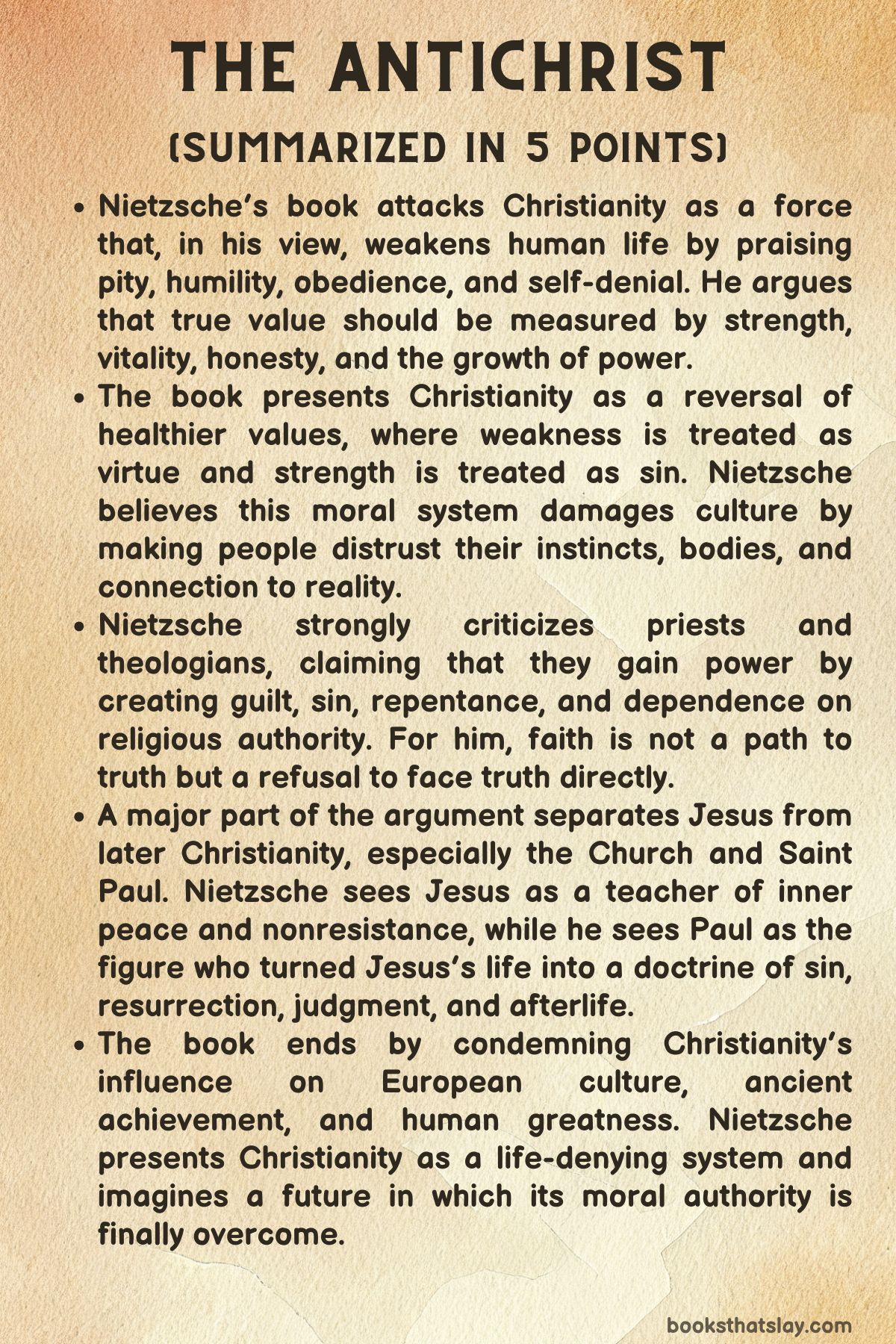
The Antichrist by Friedrich Nietzsche is a fierce philosophical attack on Christianity, Christian morality, priestly authority, and what Nietzsche sees as life-denying values. Written in 1888, near the end of his creative life, the book belongs to his late period, when his style became sharper, more direct, and more combative.
Rather than presenting a story with ordinary characters and events, it develops an argument about power, weakness, faith, pity, truth, and culture. Nietzsche contrasts Christianity with other traditions, especially Buddhism and ancient classical culture, while arguing that Christianity has damaged Europe’s strength, honesty, and intellectual freedom.
Summary
The Antichrist opens with historical framing from H. L. Mencken, who places the book within Friedrich Nietzsche’s final productive year. Nietzsche wrote it in 1888, a period in which he also completed other major works before his collapse in early 1889.
Mencken explains that Nietzsche intended this work to be part of a larger project connected to his broader attack on inherited morality and his ideas about power, strength, and cultural decline. Mencken also discusses the delay in publication, especially because Nietzsche’s sister, Elisabeth Förster-Nietzsche, inherited his writings and had religious commitments that made this particular work troubling to her.
For Mencken, the book is one of Nietzsche’s clearest and most organized attacks on Christianity, not merely a scattered collection of aphorisms.
Nietzsche begins by addressing the rare individuals he imagines as his true readers. These people are not ordinary believers, patriots, moralists, or political followers.
He imagines them as independent spirits who can stand apart from common assumptions and ask dangerous questions. He calls them Hyperboreans, using the image of a distant, strong, life-affirming people beyond the reach of ordinary weakness.
These readers are not meant to accept easy consolations. They are supposed to be capable of facing reality without the emotional supports offered by religion, nationalism, pity, or conventional morality.
From the start, Nietzsche defines his values against Christian values. For him, good means whatever increases power, strength, vitality, and the feeling of expansion.
Evil means whatever comes from weakness. Happiness is not comfort or heavenly reward but the feeling that power is growing.
This leads to his attack on pity, which he sees as Christianity’s central moral practice. Pity, in Nietzsche’s view, preserves weakness, protects what should decline, and spreads suffering by making people emotionally attached to decay.
He regards this as hostile to life because it turns weakness into something sacred.
Nietzsche then argues that Christianity has historically treated strong, independent, and intellectually fearless people as dangerous or sinful. The traits he admires, such as courage, self-command, pride, honesty toward reality, and independence from herd opinion, are recast by Christianity as evil.
He sees this as a reversal of healthy values. The best human types are made suspect, while the weak, submissive, and dependent are treated as morally superior.
Christianity, in his reading, does not merely comfort the weak; it gives them a moral weapon against the strong.
A major part of the argument concerns decadence, which Nietzsche understands as the loss of healthy instinct. A decadent culture no longer knows what strengthens life and what damages it.
Instead, it begins to prefer values that weaken the body, the mind, and the will. Nietzsche claims that Christian morality is decadent because it praises humility, obedience, pity, self-denial, and suspicion of the senses.
These values, he argues, train people to turn against their own instincts and to distrust the natural world. Christianity’s imaginary world of sin, salvation, heaven, hell, and divine judgment replaces direct contact with reality.
Nietzsche attacks theologians and priests as enemies of truth. He believes they create systems that make people dependent on faith rather than knowledge.
Faith, for him, is not a virtue but a refusal to see clearly. The priest gains power by defining sin, guilt, repentance, and forgiveness, then presenting himself as the necessary mediator between humanity and God.
In this way, religion becomes not simply belief but a structure of control. Nietzsche sees this priestly instinct not only in churches but also in philosophers who keep religious morality alive under the language of reason.
This leads to his criticism of Immanuel Kant and German philosophy. Nietzsche argues that Kant, despite appearing rational and philosophical, preserved Christian moral assumptions.
In Nietzsche’s view, Kant’s moral law and reverence for duty are continuations of theology in philosophical form. Nietzsche rejects any morality that claims authority apart from life, instinct, and strength.
He is suspicious of moral systems that treat obedience, duty, or universal obligation as higher than human flourishing.
Nietzsche also rejects the idea that human beings are superior because they possess a special soul separate from the body. He sees this as another Christian distortion.
For him, human life must be understood through the body, the senses, biology, and instinct. Christianity, by contrast, invents an inner spiritual world and treats physical existence as lower or corrupt.
Nietzsche argues that this move damages human self-understanding because it makes people ashamed of their natural drives.
The book then turns to the Christian idea of God. Nietzsche argues that a healthy people creates gods who express its strength, gratitude, fear, pride, and vitality.
The Christian God, however, becomes a god of pure goodness, compassion, and protection for the weak. Nietzsche sees this as a decline from earlier religious forms.
A god who represents only kindness and moral comfort is, for Nietzsche, a sign of cultural weakening. He believes Christianity’s God is hostile to life because this God condemns nature, pride, strength, sensuality, and the will to live.
Nietzsche compares Christianity with Buddhism. Although he sees both as religions of decline, he treats Buddhism with more respect.
Buddhism, in his view, is more realistic because it focuses on suffering without inventing sin, guilt, or divine punishment. It does not depend on a personal God, priestly revenge, or moral hatred of the world.
Christianity, by contrast, transforms suffering into proof of sin and builds a moral drama around guilt and redemption. Nietzsche believes Buddhism is calmer, more honest, and more psychologically refined, while Christianity is harsher, more resentful, and more hostile to reality.
The book then explores Christianity’s connection to Judaism. Nietzsche argues that Christianity did not simply oppose Judaism but developed from certain priestly tendencies within it.
He sees both traditions as connected to ressentiment, a form of moral revenge by those who lack direct power. At the same time, he credits the Jewish people with great strength in surviving under extreme historical pressure.
His treatment is conflicted and often harsh, but his larger claim is that priestly reinterpretation of history changed natural events into signs of sin, punishment, election, and divine will.
Nietzsche’s treatment of Jesus is complex. He separates Jesus from the later Church and from Christian doctrine.
He does not view Jesus primarily as a founder of dogma or theology. Instead, he sees him as a psychological type who lived a practice of inward peace, nonresistance, and freedom from resentment.
According to Nietzsche, Jesus taught a way of life rather than a system of beliefs. The “Kingdom of God” was not a future heaven but an inner condition.
Jesus did not demand revenge, judgment, punishment, or institutional religion.
For Nietzsche, Christianity begins to betray Jesus almost immediately after the crucifixion. The disciples, unable to accept the shock of his death, created explanations that gave the event cosmic meaning.
They turned his death into a sacrifice for sin and transformed his life into a doctrine about resurrection, judgment, and salvation. Nietzsche argues that this shift destroyed the original practice of Jesus.
What had been a way of living became a religion of belief, reward, punishment, and resentment.
Saint Paul becomes one of Nietzsche’s chief targets. Nietzsche presents Paul as the figure who redirected attention away from Jesus’s life and toward his death and resurrection.
Paul, in Nietzsche’s view, understood the power of promising eternal life and used that promise to build a movement. By placing Christianity’s center in the afterlife, Paul made earthly life less important.
Nietzsche sees this as one of Christianity’s deepest harms: it moves value away from this world and teaches people to live for another one.
Nietzsche then attacks the New Testament as a record shaped by revenge, priestly interest, and the needs of a growing religious movement. He sees Christian talk of love and humility as concealing hostility toward strength, nobility, intellect, and free inquiry.
He even praises Pontius Pilate as the one figure in the New Testament who resists the religious obsession with absolute truth. For Nietzsche, Pilate’s skeptical question about truth carries more dignity than the certainty of priests and believers.
The later sections expand the attack into a broader history of culture. Nietzsche argues that Christianity damaged ancient Greek and Roman achievements, weakened the Renaissance, and prevented Europe from fully recovering a noble, life-affirming culture.
He praises ancient classical civilization, the Renaissance, and even aspects of Islam and the Moorish world because he associates them with strength, refinement, intellectual seriousness, and respect for life. By contrast, he blames Christianity, especially through figures such as Augustine and Luther, for turning Europe away from vitality and culture.
Nietzsche also discusses the Code of Manu, which he praises as more life-affirming than the Bible because it accepts hierarchy, social order, and earthly existence. His admiration is tied to his belief that societies naturally contain different human types: intellectual rulers, warriors, and ordinary people.
He rejects equal rights as an unnatural doctrine when applied to all people in the same way. In his view, Christianity’s insistence on equality of souls weakens higher human development by denying differences of strength, talent, and rank.
The book ends with a sweeping condemnation of Christianity. Nietzsche calls it parasitic because he believes it feeds on weakness, guilt, fear, and resentment.
He sees the doctrines of sin, the afterlife, equality before God, and priestly forgiveness as tools that have damaged human greatness. His final gesture is symbolic: since history has counted time from the rise of Christianity, Nietzsche imagines a future in which time might be counted anew from Christianity’s defeat.
The ending is not calm or reconciliatory. It is a declaration of war against the moral world Christianity created.
Key Figures
Friedrich Nietzsche
Friedrich Nietzsche stands at the center of the book as its authorial mind, speaker, judge, and provocateur. He does not appear as a detached academic philosopher but as a combative thinker who wants to overturn the moral assumptions of Europe.
In The Antichrist, Nietzsche presents himself as one of the rare spirits capable of seeing through inherited religious ideas. His voice is forceful, impatient, and often deliberately shocking because he believes Christianity has survived through habit, fear, and moral sentiment rather than truth.
He defines life through strength, instinct, power, and intellectual courage, then uses those values to attack pity, faith, equality, priesthood, and otherworldly hope. Nietzsche’s role in the book is not simply to criticize Christianity but to expose what he sees as the psychological needs behind it.
He reads doctrines as symptoms. Sin, salvation, heaven, martyrdom, and faith become signs of weakness, resentment, or the desire for control.
As a character-like presence in the work, Nietzsche is severe, proud, and deeply invested in the recovery of a life-affirming culture. His intensity gives the book its shape.
H. L. Mencken
H. L. Mencken functions as the historical guide who prepares the reader for Nietzsche’s argument. His introduction does not soften the book, but it gives context for its composition, publication, and reputation.
Mencken presents Nietzsche as a thinker misunderstood by nationalists, Christians, wartime propagandists, and political movements that tried to use his ideas for their own purposes. He is especially concerned with defending Nietzsche from the charge that the book is the product of mental collapse or outside interference.
In doing so, Mencken frames The Antichrist as one of Nietzsche’s most coherent works, a text with a clear direction and a deliberate intellectual purpose. Mencken’s own voice is admiring and argumentative.
He sees Nietzsche as a late-born Greek spirit, someone out of step with modern democratic and Christian culture. At the same time, Mencken’s introduction carries its own prejudices, particularly in the way he discusses Judaism.
His role is therefore double: he clarifies Nietzsche’s place in intellectual history, but he also reminds the reader that interpretation is never neutral.
The Hyperboreans
The Hyperboreans are Nietzsche’s imagined audience and ideal human type. They are not ordinary characters in a narrative but symbolic figures representing strength, independence, discipline, and resistance to the moral climate of Christianity.
Nietzsche uses them to name those who stand outside common beliefs and are capable of living without the consolations of pity, faith, and herd approval. In the book, the Hyperboreans are defined by their distance from weakness.
They are courageous, but their difficulty lies in finding a worthy direction for that courage. They resist the “south-winds” of Christian compassion because they see such compassion as a force that lowers human vitality.
The Hyperboreans also represent Nietzsche’s hope that superior individuals have always existed, even when history has called them evil, dangerous, or immoral. Their importance lies in the contrast they create.
Against the Christian ideal of humility and equality, they embody rank, self-command, severity, and intellectual honesty. They are Nietzsche’s answer to the question of what kind of person might survive beyond Christian morality.
Jesus Christ
Jesus Christ is one of the most complex figures in The Antichrist because Nietzsche separates him sharply from the religion later built in his name. Nietzsche does not portray Jesus mainly as a theologian, lawgiver, or founder of an institution.
Instead, he treats him as a psychological type who lived a practice of inner peace, nonresistance, and freedom from resentment. In Nietzsche’s reading, Jesus does not teach revenge, punishment, dogma, or future reward.
His “Kingdom of God” is not a remote afterlife but a condition of inward blessedness available in the present. This makes Jesus radically different from the Church, Paul, and later Christian doctrine.
Nietzsche sees Jesus as someone who abolished distance between human beings and God by living in immediate unity with divine experience. Yet he also regards Jesus as fragile, overly sensitive to suffering, and detached from reality in a way that makes his way of life impossible as a public religion.
Jesus’s tragedy in the book is that his practice is transformed after his death into the very system of guilt, judgment, and belief that Nietzsche condemns.
Saint Paul
Saint Paul is presented as the decisive architect of Christianity as doctrine. Nietzsche treats him not as a faithful transmitter of Jesus’s life but as the figure who redirected the movement toward death, resurrection, judgment, and eternal life.
Paul’s importance in the book lies in his strategic understanding of religious power. Nietzsche argues that Paul had little use for the actual life of Jesus except as a foundation for the story of resurrection.
By making the crucifixion and resurrection central, Paul shifted Christianity away from a way of living and toward a belief system. This allowed Christianity to promise salvation beyond the world and to gather followers through hope, fear, and resentment.
Paul becomes, in Nietzsche’s eyes, the great falsifier. He turns Jesus into a divine victim, transforms inner blessedness into future reward, and gives the powerless a moral weapon against the strong.
As a figure in the book, Paul represents intelligence without honesty, religious genius without life-affirming truth, and the triumph of doctrine over lived example.
Priests and Theologians
Priests and theologians are Nietzsche’s primary enemies throughout the book. They represent the instinct to rule through guilt, faith, and dependence.
Nietzsche sees them as people who cannot command life directly, so they create moral and spiritual systems that allow them to command indirectly. By defining sin, repentance, forgiveness, salvation, and divine truth, they place themselves between human beings and reality.
Their power depends on making people distrust their instincts and fear their own nature. In the book, priests are not merely religious officials; they are psychological operators who reinterpret ordinary suffering as guilt and ordinary chance as divine punishment.
Theologians extend this pattern into thought itself. Nietzsche accuses them of replacing inquiry with faith and truth with comforting falsehoods.
Their danger lies in their ability to make weakness appear holy and strength appear sinful. They are central to the book because Nietzsche believes Christianity did not become powerful through Jesus’s original way of life but through priestly organization, doctrine, and moral control.
The Christian Believer
The Christian believer appears in the book as the product of a long moral training. Nietzsche often describes this figure harshly, not as an individual with private faith but as a type shaped by weakness, fear, guilt, and resentment.
The believer is taught to distrust the body, suspect pride, value suffering, and look beyond earthly life for meaning. This makes the believer dependent on the religious system that first creates the wound and then offers the cure.
Nietzsche’s criticism is not only that Christians believe false things, but that their beliefs train them to prefer what weakens life. The Christian believer’s hope in heaven lowers the value of earthly existence.
Belief in sin turns natural instincts into moral problems. Reverence for pity preserves suffering instead of overcoming it.
In Nietzsche’s argument, the believer is both victim and carrier of Christian morality. The believer suffers under the system but also helps spread it by treating weakness as virtue and obedience as truth.
Immanuel Kant
Immanuel Kant appears as a philosophical opponent rather than a central religious figure. Nietzsche attacks him because he sees Kant as preserving Christian morality under the authority of reason.
Kant’s language of duty, moral law, and universal obligation appears to Nietzsche as theology in another form. In the book, Kant represents a type of philosopher who seems to have moved beyond the Church while still protecting its deepest assumptions.
Nietzsche objects to the idea that morality can stand above life as an unquestionable command. He believes this kind of moral philosophy damages truth because it makes obedience more important than vitality, instinct, and honesty toward reality.
Kant is also important because Nietzsche sees him as part of a wider German problem. German philosophy, in Nietzsche’s view, too often shelters religious habits beneath abstract systems.
Kant therefore becomes a symbol of intellectual respectability masking moral submission. His role in the book is to show that Christianity survives not only in churches but also in philosophical concepts.
Pontius Pilate
Pontius Pilate receives a strikingly unusual treatment in the book. Nietzsche calls attention to him because Pilate refuses the religious obsession with absolute truth.
His famous skeptical stance toward truth becomes, for Nietzsche, a rare moment of dignity in the New Testament world. Pilate is not praised because he is morally pure or politically admirable.
Rather, he interests Nietzsche because he stands outside the fever of conviction. In a book that repeatedly attacks faith, martyrdom, and dogmatic certainty, Pilate represents a cooler, more worldly intelligence.
He does not surrender to the religious drama around him. Nietzsche values this distance because he believes convictions often turn people into slaves of their own beliefs.
Pilate’s role is brief but meaningful: he exposes, by contrast, the fanaticism of those who believe they possess sacred truth. In Nietzsche’s moral universe, skepticism can be healthier than certainty when certainty serves resentment, priestly power, or hostility to life.
The Jewish People and Judaism
The Jewish people and Judaism occupy a complicated place in the book. Nietzsche criticizes priestly Judaism as one source of the moral patterns that Christianity later expands, especially the reinterpretation of history through sin, punishment, guilt, and divine will.
He argues that after political defeat, priestly power reshaped Jewish religious life by turning natural events into moral signs and by making submission to priestly authority central. Yet Nietzsche also credits the Jewish people with extraordinary strength and survival.
He presents them as a people who faced danger and chose endurance at any cost. This creates a tension in the book.
Judaism is criticized as a source of priestly moral reversal, but the Jewish people are also recognized as historically powerful in their will to survive. Nietzsche’s treatment is severe and often troubling, but within the structure of the work, Judaism matters because Christianity is presented not as a clean break from it but as a development that universalizes and radicalizes certain priestly tendencies.
Martin Luther
Martin Luther appears as a destructive force in Nietzsche’s cultural history. Nietzsche blames him for damaging the Renaissance and strengthening Christianity at the very moment when Europe might have moved toward a more life-affirming culture.
Luther is important because Nietzsche sees the Renaissance as a noble attempt to revive strength, beauty, power, and classical vitality within Europe. Protestantism, in this reading, interrupts that possibility.
Luther’s German identity also matters to Nietzsche’s argument, since he often criticizes German culture for preserving and renewing Christian seriousness. Luther is not treated as a liberator of conscience but as someone who gave Christianity fresh power.
His rebellion against Catholicism does not impress Nietzsche because it remains Christian at its core. Instead of overcoming priestly morality, Luther renews it in another form.
In the book’s cultural argument, Luther stands for a missed historical chance: Europe could have moved away from Christian decadence, but Protestantism pulled it back.
Themes
Christianity as a Reversal of Life-Affirming Values
Nietzsche’s central attack is directed at the way Christianity reverses the values he associates with strength, vitality, courage, and honesty toward reality. Qualities that he admires, such as pride, self-command, sensuality, intellectual independence, and the will to grow stronger, are treated by Christianity as sinful or dangerous.
At the same time, weakness, humility, obedience, pity, and self-denial are raised into moral ideals. This reversal matters because Nietzsche does not see morality as neutral.
For him, a moral system either strengthens life or weakens it. Christianity, in his argument, teaches people to distrust their instincts and to value what reduces their power.
It turns suffering into virtue, need into holiness, and dependence into spiritual superiority. The result is not merely a religion but a cultural system that trains people to feel guilty for being strong and righteous for being weak.
Nietzsche’s anger comes from his belief that this moral reversal has shaped Europe for centuries, turning higher human possibility into something suspect. The Antichrist is therefore not only an attack on doctrine; it is an attack on the emotional and moral habits Christianity leaves behind.
Faith, Truth, and the Refusal to Know
Faith is treated as one of the most dangerous forces in the book because Nietzsche defines it as a refusal to know what is true. He does not regard faith as a noble leap beyond reason or as a private spiritual comfort.
Instead, he sees it as a disciplined closing of the eyes. Faith allows people to protect beliefs from evidence, criticism, and reality.
This is why Nietzsche connects faith to priestly power. A priestly system needs people to accept claims that cannot be tested and to treat doubt as sin.
Once that structure is accepted, truth loses its independence. What matters is no longer whether something corresponds to reality, but whether it supports the religious system.
Nietzsche’s criticism of theologians, moral philosophers, and martyrs all grows from this concern. Conviction, in his view, is not proof.
Dying for a belief does not make it true. Feeling comforted by a belief does not make it true either.
The book repeatedly insists that truth must be measured by intellectual honesty and contact with reality, not by emotional need, inherited reverence, or the authority of sacred institutions.
The Priest as a Figure of Power
The priest is one of Nietzsche’s most important symbolic figures because he represents power gained through weakness rather than direct strength. Nietzsche does not think priests are powerless.
On the contrary, he sees them as highly skilled in control. Their method is psychological.
They teach people to interpret suffering as guilt, instinct as sin, and obedience as salvation. Once people accept these ideas, they become dependent on the very authority that defines their condition.
The priest creates the disease and then sells the cure. This theme explains why Nietzsche attacks repentance, forgiveness, sin, and divine judgment so intensely.
These are not harmless religious concepts in his argument; they are tools for governing human beings from within. The priest does not need physical force when people have learned to accuse themselves.
Nietzsche also extends this priestly pattern beyond organized religion. Philosophers, moralists, and idealists can become priestly when they place abstract moral commands above life.
The priestly figure matters because it shows that Nietzsche’s critique is not only about belief in God. It is about the systems of authority that make people ashamed of their own nature.
Jesus Against Christianity
One of the book’s most striking themes is the separation between Jesus and Christianity. Nietzsche does not simply present Jesus as the founder of everything he condemns.
Instead, he argues that Jesus lived a practice that later Christianity betrayed. Jesus, in Nietzsche’s reading, did not create a doctrine of sin, punishment, resurrection, judgment, and institutional authority.
He embodied a way of life based on inward blessedness, nonresistance, and freedom from resentment. The disaster begins after his death, when his followers try to explain the crucifixion by giving it cosmic meaning.
In that process, Jesus’s life becomes less important than his death, and his practice becomes a belief system. Saint Paul then becomes the decisive figure who turns the movement toward resurrection, afterlife, and salvation.
This theme allows Nietzsche to make a sharp historical and psychological claim: Christianity is not the fulfillment of Jesus’s life but its distortion. The Church turns a present condition of inner freedom into a future reward, and it turns a teacher of nonresistance into the center of a doctrine filled with guilt, revenge, and judgment.