The Argonauts Summary and Analysis
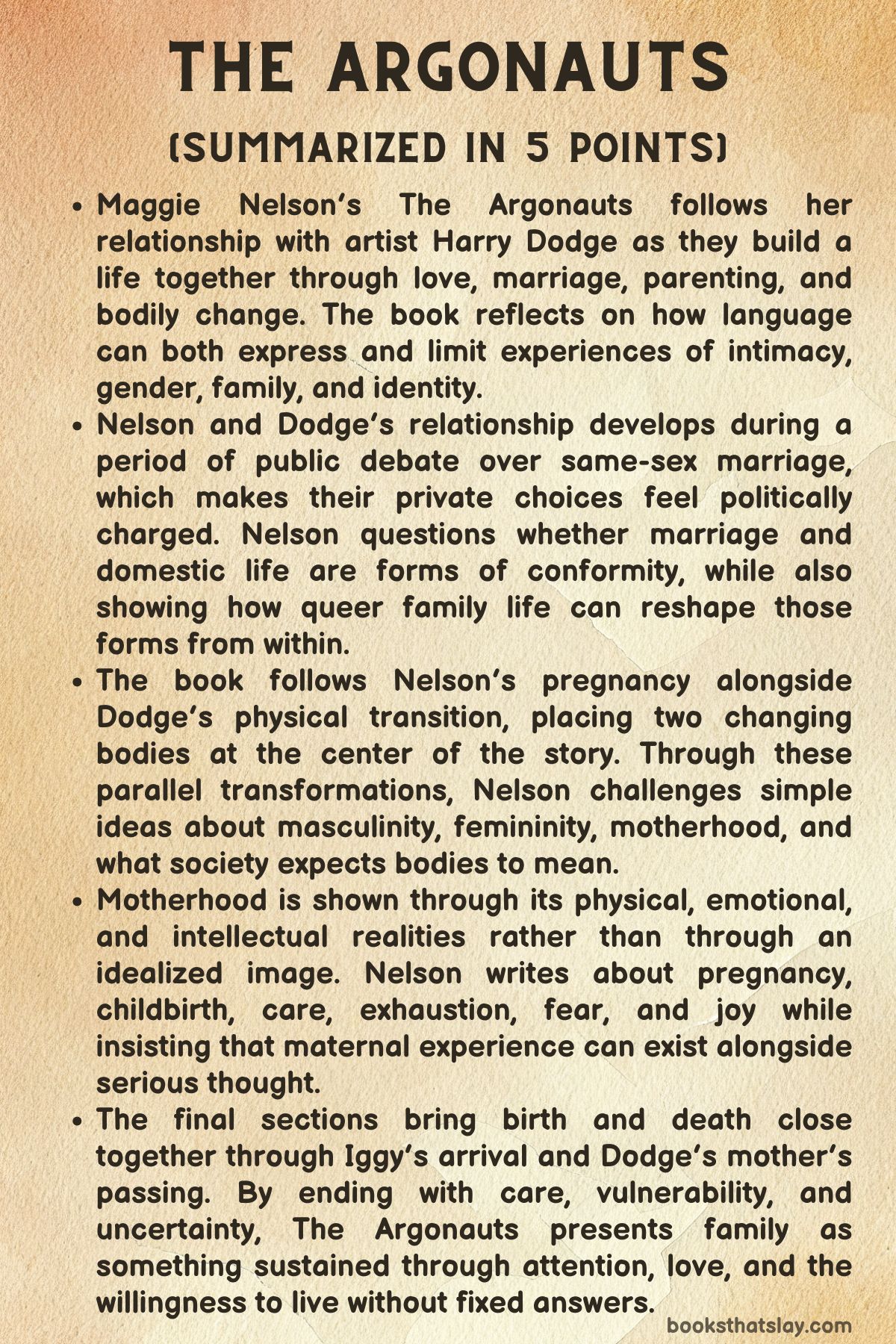
The Argonauts by Maggie Nelson is a hybrid memoir that blends personal experience, philosophy, queer theory, art criticism, and reflections on family life. It follows Nelson’s relationship with artist Harry Dodge, their marriage, Dodge’s transition, Nelson’s pregnancy, and the birth of their son, Iggy.
Rather than treating love, gender, motherhood, and domestic life as fixed ideas, the book keeps questioning what language can and cannot hold. Nelson writes about intimacy with unusual directness, but the book is also deeply intellectual, using theory not as decoration but as a way to think through lived experience.
Summary
The Argonauts begins with Maggie Nelson recalling the early force of her love for Harry Dodge. Their relationship starts with desire, risk, awkwardness, and an immediate awareness that language may never fully capture what passes between two people.
Nelson, as a writer, believes in words, but Dodge is more skeptical of them. He feels that language often limits the world by naming it too narrowly, while Nelson insists that words can also open meaning, carry emotion, and shift over time.
Their disagreement becomes one of the book’s central concerns: how people use language to describe love, gender, bodies, family, and identity when all of those things are changing.
As Nelson and Dodge begin building a life together, they also enter the ordinary and complicated space of domestic life. Nelson becomes a stepmother to Dodge’s son, and the couple moves into a shared home.
At the same time, public debates around same-sex marriage shape the background of their private decisions. Nelson is uneasy about queer people seeking acceptance through traditional institutions such as marriage, because she worries that such acceptance may require conformity.
Yet she also recognizes that marriage, parenting, pregnancy, and home life are not simple symbols of conformity. In the right context, they can become strange, difficult, and even resistant ways of living.
Nelson and Dodge marry quickly when they realize that the legal right to do so may soon be taken away in California. Their wedding is informal, unusual, and full of comic details, but it also carries political and emotional weight.
Nelson does not present marriage as a perfect solution or as a final destination. Instead, she treats it as one more form that may hold love for a time while also threatening to define it too narrowly.
Her mind keeps returning to the word queer, especially as a word that can name resistance, mismatch, and openness without becoming a single identity.
As their family life develops, hard events gather around them. Dodge’s mother is diagnosed with breast cancer.
Custody issues involving Dodge’s son become painful. Dodge’s body suffers from the strain of chest binding.
Nelson looks to other writers and artists in order to think through these pressures, not because theory solves pain, but because it helps her stay close to difficult questions. She thinks about literary couples, psychoanalysis, feminism, motherhood, and the limits of intellectual distance.
The book repeatedly asks how thinking and feeling can exist together without one canceling the other.
Nelson and Dodge decide to try to have a child. Nelson reflects on theories of parenting, especially the idea that mothering does not require perfection but ordinary devotion.
She is drawn to the emotional intensity of care, while also aware that mothering can feel like a loss of self. Because she becomes a mother later in life, she feels she has had time to become herself before risking the kind of self-undoing that parenting may bring.
She rejects the idea that motherhood and intellectual life cannot belong together. For Nelson, the body, the mind, and care are not separate categories.
Her pregnancy occurs alongside Dodge’s physical transition. As her body changes through pregnancy, his body changes through testosterone and surgery.
This parallel creates one of the book’s most powerful contrasts. Nelson’s body becomes visibly maternal while Dodge’s body becomes more visibly masculine, but neither change fits simple ideas about male and female, natural and artificial, queer and straight, or personal and public.
Nelson is interested in how bodies are read by others, how strangers respond to pregnancy, and how Dodge’s social experience shifts when he is perceived as male. These changes reveal that gender is not only something one feels internally; it is also something enforced, assumed, and interpreted by other people.
Nelson’s pregnancy is not idealized. She writes about constipation, fear, sexual discomfort, medical anxiety, and the raw physical facts of carrying a child.
She resists polished images of pregnancy and motherhood, preferring to describe what is strange, messy, and often embarrassing. When she is hospitalized for a possible placental problem, her understanding of reproductive choice becomes even sharper.
She feels the life inside her as deeply real, but this does not weaken her pro-choice beliefs. Instead, pregnancy makes her more certain that women understand the stakes of reproductive decisions and must be trusted with them.
The book also explores sexuality after motherhood. Nelson questions the pressure placed on new mothers to return quickly to their previous bodies, jobs, and sexual availability.
She is wary of the idea that sexual adventurousness is always the highest form of freedom. At one point, she suggests that in a culture where sexual rebellion can itself become commercial and expected, it may be more radical to defend fatigue, tenderness, care, and limits.
Her thinking about queerness becomes broader than sexual identity alone. Queerness, for her, includes ways of resisting fixed expectations about bodies, pleasure, family, and time.
Nelson also reflects on her own mother. She remembers childhood resentment after her mother left her father for another man, and she later connects that resentment to her difficulty imagining her mother as a full-bodied, desiring person.
Her mother’s concern with thinness and discipline troubles Nelson, who sees in it a painful link between body image, morality, class, and control. Yet Nelson’s view of her mother is not simply critical.
She recognizes that her own fears and anxieties partly come from her mother, especially the habit of imagining danger in order to prepare for it.
Fear becomes a major force as Nelson moves toward motherhood. Before Iggy is born, a man obsessed with her aunt’s murder and Nelson’s writing about it begins stalking her.
The incident reminds her that writing can expose a person to real danger. It also intensifies her anxiety about bringing a child into a world where harm cannot be prevented by intelligence, vigilance, or language.
Nelson often trusts articulation as a way of gaining control over experience, but the book admits that some experiences resist being spoken about. Iggy later survives a life-threatening illness as an infant, and Nelson refuses to fully narrate that event, suggesting that not everything painful must be transformed into material.
The final movement of the book brings together birth and death. Nelson describes the long process of labor: contractions, stalled progress, medical intervention, pain, and finally the arrival of Iggy.
His birth is physical, immediate, and astonishing. Nelson experiences him not as an abstract symbol of the future, but as a real child placed on her body.
Around this birth story, Dodge’s account of his mother’s death appears. His mother, after living with him and Nelson for a while, returns to Michigan to die.
Dodge visits her in hospice, speaks love and gratitude to her, and stays with her body after she dies. The closeness of these two events gives the book a profound sense of life’s bodily truth.
Birth and death are not opposites so much as experiences that demand surrender.
Nelson also gives attention to Dodge’s names and history. Dodge has lived under several names, and each name marks a different social, familial, or self-created identity.
His adoption history adds another layer to his sense of self. When he finds his birth mother, he discovers a connection that is both strange and revealing, including the existence of a brother whose life has been marked by addiction and imprisonment.
Dodge’s story shows identity as something shaped by bodies, names, families, chance, and chosen forms of self-making.
By the end, Nelson is thinking about care as a continuing condition rather than a closed lesson. Motherhood requires devotion, but also restraint: she must respect her child’s privacy, accept that he will become separate from her, and avoid turning him entirely into her subject.
Love requires language, but language must remain flexible enough to admit its failures. Queer family life does not need to prove itself through purity, rebellion, or normalcy.
It can exist in contradiction, ordinary routines, sex, illness, theory, fear, laughter, and care. The Argonauts ends not with certainty, but with the recognition that people continue, for as long as they can, held together by attention and care.
Key Figures
Maggie Nelson
Maggie Nelson is the central consciousness of the book, and her character is shaped by her constant effort to think honestly about her life without flattening it into easy conclusions. In The Argonauts, she is a lover, wife, stepmother, mother, writer, critic, and thinker, but she resists treating any one of these roles as a stable identity.
Her strength lies in her willingness to examine her own contradictions. She wants language to matter, yet she knows that language can fail.
She wants to protect the people she loves, yet she also turns private experience into art. She values queer resistance, yet she chooses marriage and motherhood.
Her voice is candid, sometimes severe, sometimes tender, and often self-questioning. Nelson’s importance in the book comes from the way she refuses to separate bodily life from intellectual life.
Pregnancy, sex, fear, labor, theory, and family all become part of the same field of thought. She is not presented as a perfect narrator or a perfectly confident mother.
Instead, she is someone trying to live carefully inside uncertainty.
Harry Dodge
Harry Dodge is one of the most important figures in The Argonauts, not simply as Nelson’s partner, but as a person whose life challenges fixed ideas about gender, naming, embodiment, and family. Dodge’s skepticism about language gives the book one of its central tensions.
While Nelson wants words to carry meaning, Dodge often senses how words can reduce or misread a person. His transition is treated with respect and complexity.
The book does not present him as moving from one simple category into another; instead, his masculinity, ambiguity, history, and selfhood remain open and layered. His physical changes take place alongside Nelson’s pregnancy, creating a powerful contrast between two bodies undergoing transformation in the same household.
Dodge is also marked by grief, especially through his mother’s illness and death. His account of being with her at the end of her life reveals him as loving, brave, and deeply attentive.
His adoption history and changing names add further depth, showing a person who has had to build identity through both inheritance and invention.
Iggy
Iggy represents new life in The Argonauts, but the book does not reduce him to a symbol. He is Nelson and Dodge’s child, and his arrival changes the emotional center of their family.
Before his birth, he exists as hope, fear, medical risk, bodily change, and imagined future. After his birth, he becomes immediate and real, a child whose needs require care rather than theory.
Nelson’s descriptions of feeding, tending, and protecting him show how motherhood becomes both ordinary and overwhelming. Iggy also forces Nelson to confront the ethics of writing.
As his mother and as an author, she must decide how much of his life belongs in her work and where his privacy begins. His later illness, which Nelson chooses not to fully describe, makes this boundary even more significant.
Through Iggy, the book asks what it means to care for a child without claiming ownership over his story. He is central because he changes Nelson’s sense of time, vulnerability, and responsibility.
Dodge’s Mother
Dodge’s mother is a powerful presence in the book because her illness and death unfold beside Nelson’s pregnancy and Iggy’s birth. She represents mortality, family history, and the bodily realities that no theory can soften.
Her breast cancer brings a season of fear and strain into Nelson and Dodge’s household, and her eventual death becomes one of the book’s most moving counterpoints to childbirth. Through Dodge’s account of her final moments, she appears as someone deeply loved, someone whose passing demands courage from both the dying and the living.
Her role also reveals Dodge’s capacity for care. He does not turn away from her decline; he stays close, speaks gratitude, and remains with her body after death.
In this way, she helps the book connect birth and death as experiences that require surrender. Her character is not developed through long scenes of dialogue or action, but through the emotional force of her place in Dodge’s life and in the family’s shared experience.
Nelson’s Mother
Nelson’s mother is important because she shapes Nelson’s understanding of fear, bodies, femininity, and maternal influence. Nelson remembers her mother with a mix of love, frustration, resentment, and recognition.
As a child, Nelson felt wounded when her mother left her father, and that wound affected how she saw her mother’s body and desire. Later, Nelson becomes more aware of the unfairness of that judgment and begins to understand her mother as a full person rather than only as a parent.
Her mother’s concern with thinness troubles Nelson because it seems tied to ideas of discipline, worth, and social approval. At the same time, Nelson recognizes that some of her own anxiety comes from her mother’s habit of imagining danger before it happens.
This inherited fear becomes especially visible after Iggy is born. Nelson’s mother therefore functions as both an influence and a challenge.
She is someone Nelson must think through in order to understand her own motherhood.
Christina Crosby
Christina Crosby appears as one of Nelson’s intellectual and feminist influences. As a professor and thesis supervisor, she represents a demanding form of thought, one that is suspicious of easy confession and wary of making the personal too public.
Her discomfort with Nelson’s interest in personal material becomes important because it mirrors one of the book’s major artistic questions: how can a writer use intimate life without simplifying it or exploiting it? Crosby’s classroom story, in which students demand clearer public identity from her, also brings forward questions about disclosure, identity, and the pressure to become legible to others.
Nelson respects Crosby not because Crosby offers comfort, but because she embodies intellectual rigor and resistance to simplification. Her presence helps show that feminist inheritance is not always gentle or approving.
Sometimes it arrives through disagreement, discipline, and discomfort. Crosby’s role in the story is brief compared with Nelson or Dodge, but she has lasting importance as a figure who helps sharpen Nelson’s thinking about exposure, privacy, and identity.
Eve Kosofsky Sedgwick
Eve Kosofsky Sedgwick functions as an intellectual guide whose ideas help Nelson think about queerness, identity, and the pleasure of not being fixed into a single form. Sedgwick’s understanding of queer as a broad field of mismatch and resistance matters deeply to Nelson because it allows queerness to exceed sexual orientation alone.
Nelson is drawn to this openness, especially as she tries to understand marriage, pregnancy, motherhood, and Dodge’s transition without forcing them into rigid categories. Sedgwick also appears through Nelson’s memory of a seminar exercise involving totem animals, an exercise that once made Nelson uncomfortable because it asked her to choose a form of identification.
Over time, Nelson comes to see that not every identity or practice is a trap. Some commitments can become sources of pleasure, discipline, and meaning.
Sedgwick’s role is therefore both theoretical and personal. She gives Nelson language for forms of life that remain unfinished, changing, and resistant to easy naming.
Jane Gallop
Jane Gallop matters as a model of intellectual motherhood. Nelson remembers a seminar in which Gallop presented images of herself with her newborn while discussing motherhood and photographic subjectivity.
What affects Nelson is the refusal to separate thought from the messy, intimate facts of caring for a baby. Gallop’s presentation becomes a challenge to academic expectations that serious thinking must be clean, detached, and free of domestic life.
The hostile reaction to Gallop’s work also exposes the gendered suspicion often directed at maternal experience when it enters intellectual spaces. Nelson’s admiration for Gallop reveals her own desire to make room for motherhood inside writing and theory without apologizing for it.
Gallop is not a major narrative actor, but she becomes an important example of how the maternal body can think, speak, and produce knowledge. Through her, the book argues against the idea that care weakens intelligence.
Nelson’s Stepson
Nelson’s stepson is part of the family structure that forms early in Nelson and Dodge’s relationship. His presence matters because Nelson does not enter family life only through pregnancy; she first becomes a stepmother.
This role places her inside an already existing network of care, obligation, and conflict. The custody dispute surrounding him contributes to the difficult period Nelson describes in her relationship with Dodge, and it shows that queer family life is not free from legal and emotional pressures.
As a character, he is not examined in the same depth as Iggy, partly because Nelson is careful about the boundaries of children’s privacy. Still, his presence is important because he makes family real before Nelson gives birth.
He helps establish domestic life as something complex, negotiated, and shared. Through him, the book treats parenting not only as biology but also as commitment, daily responsibility, and emotional participation.
Themes
Language, Identity, and the Limits of Naming
Language in The Argonauts is never treated as a neutral tool. Nelson wants words to carry intimacy, thought, and transformation, while Dodge often distrusts them because they can harden experience into categories that do not fit.
This tension shapes the book’s approach to love, gender, family, and selfhood. The repeated phrase “I love you” matters because it does not mean the same thing every time; its meaning changes as the relationship changes.
Pronouns, names, and identity terms also carry both necessity and danger. They help people recognize one another, but they can also reduce a living person into a label.
Dodge’s many names and shifting social perception show that identity is not simply discovered once and then permanently named. Nelson’s writing itself becomes part of this problem.
She depends on language to think, but she also knows that writing about loved ones can misrepresent them. The theme becomes most powerful when the book accepts that language is imperfect but still necessary.
Words may fail to hold everything, yet silence is not enough either.
Queer Family, Domestic Life, and Resistance
Domestic life is not shown as the opposite of queer life. Marriage, parenting, home, and care might appear traditional from the outside, but Nelson treats them as unstable forms that can be used in unexpected ways.
Her marriage to Dodge occurs in a political climate where the right to marry is fragile, making the act both practical and symbolic. At the same time, Nelson remains uneasy about gaining acceptance through institutions that have often excluded queer people.
This tension gives the book much of its energy. Family is neither rejected as conformity nor celebrated as pure liberation.
Instead, it becomes a living arrangement full of compromise, humor, fear, and care. Nelson’s role as stepmother, her pregnancy, Dodge’s transition, and Iggy’s birth all challenge simple divisions between queer and normal, radical and ordinary.
The book questions whether the familiar opposition between normativity and transgression is itself too limited. A queer family does not need to prove its difference at every moment.
Its resistance may lie in the way it survives without obeying fixed scripts.
Motherhood, the Body, and Intellectual Life
Motherhood in the book is physical, intellectual, emotional, and ethically demanding. Nelson rejects polished images of pregnancy and mothering, choosing instead to write about constipation, labor, breastfeeding anxiety, sexual change, exhaustion, and care.
These details are not included for shock; they insist that maternal experience is a serious form of knowledge. Nelson also refuses the idea that motherhood weakens thought.
Her reflections on Jane Gallop, feminist theory, psychoanalysis, and child development show that intellectual work can happen from within maternal life rather than outside it. At the same time, motherhood is not romanticized.
It can feel like self-loss, fear, fatigue, and exposure. Nelson recognizes the joy of tending to Iggy’s needs, but she also knows that the child is not an extension of herself.
He has boundaries and a future she cannot own. The theme is especially strong because it connects care with humility.
To mother is not to master another life, but to remain devoted while slowly accepting separation, uncertainty, and limits.
Birth, Death, and the Practice of Care
Birth and death stand close together in the story, especially through the pairing of Iggy’s arrival and Dodge’s mother’s passing. Both events are bodily, intense, and beyond full control.
Labor demands surrender from Nelson, while dying demands surrender from Dodge’s mother and from Dodge as he watches her go. The connection between these experiences prevents the book from treating birth as simple renewal or death as simple closure.
Each event exposes the body’s vulnerability and the limits of will. Care becomes the human answer to that vulnerability.
Dodge cares for his dying mother through presence, gratitude, and witness. Nelson cares for Iggy through feeding, protection, and attention.
Yet care does not eliminate fear. Iggy’s later illness and Nelson’s anxiety about harm show that love can make life feel more dangerous because there is more to lose.
The book’s final understanding of care is not sentimental. Care is ongoing work performed in uncertain conditions.
It is how people remain with one another while knowing that no body, family, or future is fully secure.