The Aquanaut Summary, Characters and Themes
The Aquanaut by Dan Santat is a graphic novel about grief, friendship, marine life, and the difficult line between wonder and exploitation. The story follows Sophia, a girl still living with the loss of her father, Michel Revoy, whose research vessel sank years earlier.
When a group of sea creatures arrive on land inside an old diving suit, Sophia discovers that they are connected to her father’s past and to the future of Aqualand, the marine facility he helped imagine. The book mixes adventure, humor, and emotional growth while asking what humans owe to the natural world.
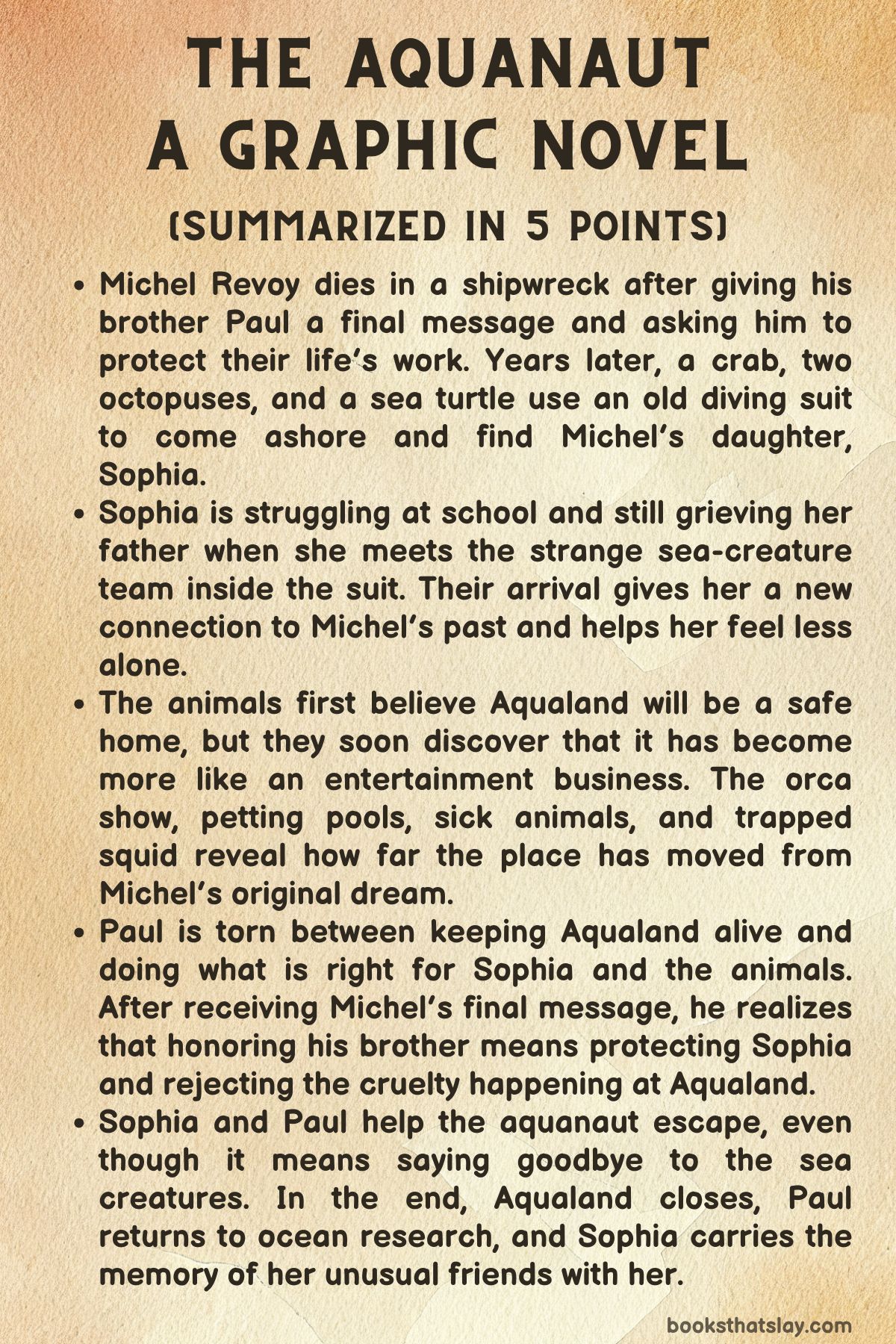
Summary
The Aquanaut begins in the Weddell Sea, where Paul Revoy, Michel Revoy, and their crew are aboard the Miette Research Vessel during a violent storm. The sea overpowers the vessel, and the situation quickly becomes desperate.
Water floods the ship, alarms sound, and Michel becomes trapped inside an automatic locking room. Paul tries to reach him, but the room cannot be opened in time.
Michel understands that he will not survive, so he gives Paul a yellow tube marked “Jules” and asks him to protect their life’s work. He also seals a final message inside a wine bottle.
Paul is pulled away by the remaining crew members and forced into a life raft. He watches the vessel sink, knowing his brother is still inside.
Michel disappears beneath the water, leaving behind his research, his message, and a daughter who will grow up without him.
Under the sea, Michel’s bottle attracts the attention of four creatures: a hermit crab named Sodapop, two octopuses named Carlos and Antonio, and a sea turtle named Jobim. These animals find the bottle and become connected to Michel’s unfinished work.
Years later, the same group has taken control of an antique diving suit called the aquanaut. By working together from inside the suit, they can walk on land and move among humans.
Sodapop steers, Carlos handles engineering, Antonio gives orders, and Jobim assists as best as he can. Their first steps into the human world are confusing and chaotic.
People mistake them for a robot, a prank, or something mechanical. The animals do not understand human behavior and misread even simple interactions, including a dog licking them in greeting.
Five years after the shipwreck, Michel’s daughter Sophia is struggling. She wakes up late for school, worried because she has missed class and has been doing badly on tests.
Her science fair project has become especially important because her teacher, Mrs. Wexler, tells her she needs an impressive project to pass. Sophia thinks of inviting her uncle Paul, now connected to Aqualand, to speak at the fair.
Paul agrees at first, giving Sophia hope that he might finally show up for her in a meaningful way.
The aquanaut arrives at Aqualand after seeing a poster that presents the place as a happy sanctuary for sea animals and children. The creatures believe it might be a safe home.
Aqualand was founded by Paul and Michel Revoy, and the animals are reassured when they see the founders’ advertisement. They carry Michel’s journal, which includes an image of a girl.
When they run into Sophia, Sodapop recognizes her as the girl from the journal. The aquanaut follows her into Aqualand, where the creatures see tanks, marine animals, and incubating sea turtle eggs.
Carlos leaves the suit to explore and search for food, and the animals discover a photograph of Sophia with Michel and Paul. They realize Sophia is Michel’s daughter.
Sophia’s first meeting with the aquanaut is strange and frightening. She sees the diving suit holding Carlos, and the animals’ awkward attempt at communication only makes things worse.
When the aquanaut drops Michel’s journal, Sophia immediately recognizes it as her father’s. Her fear turns into curiosity.
She wants to know where the animals came from and how they got the journal. Before she can understand everything, Paul arrives with Mr. Lula, a forceful businessman who pressures Paul to change Aqualand.
Mr. Lula wants attractions like an orca show and a dolphin petting zoo because investors want profit and spectacle. Paul wants to protect the “Jules” project, but his dependence on funding leaves him trapped.
When Sophia reminds him about the science fair, he says he is too busy to help. Sophia feels abandoned and lashes out, believing Paul has once again chosen work over family.
Sophia decides to use the aquanaut for her science fair project. The animals feel they owe her because Michel once helped them, so they try to cooperate.
The presentation starts awkwardly because Carlos has eaten Sophia’s original sea monkeys. The other animals force Carlos to become the project instead.
His bioluminescence impresses Mrs. Wexler, and for a moment Sophia seems to be succeeding. But when Carlos eats a sandwich, he becomes sick and vomits on the teacher.
Sophia is horrified and believes she has failed.
Over time, Sophia and the aquanaut become close friends. Three months later, they spend time together at Aqualand.
Sophia talks about her father and the seashells they used to trade before his research trips. She still wears the last shell he gave her on a necklace.
It is shaped perfectly for a hermit crab, giving it quiet importance for Sodapop. Their friendship gives Sophia comfort, but Aqualand itself becomes more troubling.
The animals see the new orca show and recognize the fear in the orca’s eyes. Sodapop senses that the orca is trapped and distressed.
In the petting pool, the animals look exhausted, and dead fish appear in the tanks. Sophia knows her father would never have approved of these conditions.
The dream of Aqualand as a reserve has been twisted into an entertainment business.
The aquanaut eventually sees a giant squid in a hidden room, and this shocks Sodapop deeply. A flashback explains why.
As a young crab, Sodapop explored an area full of human garbage with his father. His father taught him that some human objects are harmful, while others can be useful.
He also helped Sodapop understand the word “unique” and showed him an old can that he could use as a shell. Then a giant squid appeared.
Sodapop’s father believed they were safe inside an old car, but the squid grabbed him while Sodapop watched helplessly. This childhood trauma explains Sodapop’s terror when he sees the squid at Aqualand.
Paul discovers Sophia with the aquanaut and is amazed by the animals’ abilities. Sophia explains that they had her father’s journal.
Paul fears that if Mr. Lula finds them, he will turn them into another attraction. Sophia wants them to stay because they have become her friends, and she confronts Paul about how absent he has been in her life.
Paul agrees to let them remain, but only in the research lab, where he thinks they will be safe. Sodapop, however, cannot ignore the trapped orca.
That night, the aquanaut sneaks out to free the orca. The animals reach her tank and use a crane and a semi-truck in a daring escape attempt.
Guards chase them, and the truck ends up driving off the dock into the water. The orca is freed and returns the favor by helping the aquanaut reach the surface.
Paul later finds the suit washed up on shore and realizes the orca is gone. The next morning, Mr. Lula accuses Paul of freeing the animal and threatens him with jail.
Sophia tries to take responsibility, but the sea creatures protect her by revealing themselves. Mr. Lula becomes fascinated by them and agrees to let Paul keep his job if the aquanaut becomes an exhibit.
Before the animals are taken, they give Paul Michel’s bottle. Inside is Michel’s final message: “Take care of Sophia.” Paul breaks down because he finally receives his brother’s last words and understands how badly he has failed Sophia.
Six months later, Paul prepares a public presentation of the aquanaut, but he is actually helping the real animals escape. He hires a man to wear a fake suit while the sea creatures use a new one.
The plan begins well, but the fake aquanaut trips on stage and exposes the deception. Mr. Lula is furious and demands the real aquanaut.
Meanwhile, Sophia and the animals use an escape plan hidden in Michel’s journal to move through Aqualand. Paul no longer cares about losing his position, because he realizes that the work he loved has been corrupted and that he can return to real marine research.
Sophia and the aquanaut head toward the squid exhibit, where their escape route leads through the water system. Sodapop is terrified, but he keeps going.
Mr. Lula and the guards catch up, and Mr. Lula injures Carlos by breaking off one of his tentacles. Sophia opens the valve that will let the tank drain toward the sea.
The animals understand they must risk passing the giant squid. Before they go, Sophia gives them her father’s last shell, and they give her Sodapop’s can.
This exchange shows how much they have come to mean to one another. Sophia hugs them and sends them into the water.
Inside the dark tank, the aquanaut faces the giant squid. The squid crushes the suit, breaks their axe, and threatens to destroy them.
Sodapop panics at first, but then he sees that the squid is also afraid. Instead of fighting, he leaves the helmet and approaches the creature.
He takes the squid by the tentacle and guides it toward the way out. This act transforms Sodapop’s fear into courage and compassion.
The animals escape, and the squid is also led away from captivity.
Six months later, Paul closes Aqualand. He decides to return to the ocean, where his true work belongs.
He understands that home is not one fixed place but is found with the people one loves. He takes Sophia on a new boat named Michel Revoy, honoring his brother.
Sophia wears Sodapop’s can around her neck as a keepsake, carrying her friendship with the aquanaut into the future. Paul takes his submarine into the deep sea, where he sees the aquanaut again and finally approaches the wreckage of the vessel where Michel died.
The story ends with discovery, healing, and the promise of a more honest relationship between humans and the ocean.
Characters
Sophia Revoy
Sophia Revoy is the emotional center of the book, a girl shaped by loss, loneliness, and a deep need to feel connected to the father she lost. Her grief is not presented through long speeches but through her actions: she struggles at school, clings to the shell her father gave her, and reacts strongly when Paul fails to support her.
Sophia’s anger toward her uncle comes from disappointment rather than cruelty. She wants him to choose her, to notice her pain, and to honor Michel not only through research but through family.
Her bond with the aquanaut gives her something she has been missing: a living connection to her father’s world. Through the sea creatures, she learns more about Michel’s legacy, but she also gains friends who need her courage.
In The Aquanaut, Sophia grows from a child who feels abandoned into someone willing to protect others at great personal cost. She stands up to Mr. Lula, helps the animals escape, and lets them return to the ocean even though losing them hurts.
Her final exchange with Sodapop, trading her father’s shell for his can, shows that she has learned to carry love without needing to possess it.
Sodapop
Sodapop is one of the most layered figures in the story because his comic role as the crab steering the aquanaut is balanced by a painful personal history. His old can is not just a quirky shell; it is tied to his father, to survival, and to the trauma of watching a giant squid take someone he loved.
That history makes his fear of the squid understandable and gives his final act real emotional weight. Sodapop’s leadership is quiet but crucial.
He recognizes Sophia from Michel’s journal, senses the orca’s fear, and pushes the others toward action when captivity becomes impossible to ignore. He is small compared with the human world and the enormous sea creatures around him, yet he repeatedly makes choices that affect everyone’s fate.
His greatest growth comes when he faces the giant squid and chooses empathy rather than revenge or panic. By seeing the squid as frightened instead of purely monstrous, Sodapop breaks free from the memory that has controlled him.
His gift of the can to Sophia is a major act of trust. He gives away an object tied to his identity because their friendship has become part of who he is.
Paul Revoy
Paul Revoy is a grieving brother, an absent uncle, and a scientist caught between ideals and compromise. At the beginning, his defining wound is Michel’s death.
He survives the shipwreck, but survival leaves him with guilt, unfinished responsibility, and the burden of Michel’s last request. Paul tries to honor his brother through Aqualand and the Jules project, yet his dependence on investors allows Mr. Lula to distort the original mission.
His mistake is not that he stops caring, but that he allows pressure and work to pull him away from Sophia and from the values Michel cared about. Paul’s emotional turning point arrives when he reads Michel’s message telling him to take care of Sophia.
That sentence forces him to see that protecting a legacy is not the same as protecting the living person at its heart. In The Aquanaut, Paul’s growth is quiet but meaningful.
He stops defending a broken institution, risks his career to help the sea creatures escape, and eventually closes Aqualand. By naming his new boat after Michel and taking Sophia with him, Paul chooses family, honest research, and healing over public success.
Michel Revoy
Michel Revoy dies early in the book, but his influence remains present throughout the story. He is remembered as a loving father, a committed scientist, and a dreamer whose work was rooted in respect for marine life.
His final actions reveal his priorities clearly. Even as the ship sinks, he protects the Jules project, preserves his journal, and sends a message asking Paul to care for Sophia.
Michel’s legacy is therefore both scientific and personal. The journal guides the aquanaut, gives Sophia a bridge to her father, and becomes the key to freeing the animals later.
His dream for Aqualand was never the cruel attraction Mr. Lula promotes; it was closer to a sanctuary built around discovery and protection. Michel’s importance also lies in the emotional memory others carry of him.
Sophia remembers him through the shells they exchanged, Paul through guilt and love, and the sea creatures through the materials and knowledge that help them reach land. Although he is absent for most of the novel, Michel remains the moral reference point for what Aqualand should have been.
Carlos
Carlos brings humor, energy, and practical intelligence to the aquanaut team. As the engineer, he is essential to making the diving suit work, and his curiosity often moves the group into new situations.
He is also impulsive, especially around food, which creates some of the story’s funniest and most chaotic moments. His eating of Sophia’s sea monkeys and his disastrous reaction to the sandwich at the science fair show that Carlos can be reckless without meaning harm.
Yet his flaws make him feel alive rather than merely useful. Carlos is also brave and loyal.
He explores unfamiliar spaces, helps free the orca, and continues with the escape even after Mr. Lula injures him. His broken tentacle becomes a reminder of the cruelty the animals face when humans see them as property or spectacle.
In the book, Carlos represents the mix of comedy and vulnerability that defines the aquanaut crew. He can cause trouble, but he is never selfish in a lasting way.
His loyalty to Sophia and the group matters more than his appetite or mistakes.
Antonio
Antonio is the commanding voice inside the aquanaut, often shouting orders and helping the group behave like a single body. His role gives structure to the animals’ strange mission.
Because the suit requires cooperation, Antonio’s confidence helps keep the crew moving even when they do not fully understand the human world. He often adds comic tension because his seriousness contrasts with the absurdity of their situation.
Still, Antonio is more than a loud presence. He is committed to the safety of the group and to the mission that began with Michel’s journal.
His decisiveness helps the animals act when hesitation could trap them. Antonio’s leadership style is not gentle, but it is rooted in loyalty.
He believes in the group and helps them remain focused when fear, confusion, or Carlos’s appetite threatens to derail them. He shows how teamwork can depend on very different personalities working through conflict.
Without Antonio’s forceful direction, the aquanaut might not function as well as it does.
Jobim
Jobim, the sea turtle, is a calmer and more supportive member of the aquanaut crew. He often follows the others’ lead, but that does not make him unimportant.
His presence adds steadiness to a group full of nervous energy, strong opinions, and impulsive decisions. Jobim helps where needed and becomes part of the cooperative body that allows the aquanaut to move through the human world.
His uncertainty, such as when he admits he does not know how to brake the truck, gives the story humor while also showing the risk of the animals’ plans. They are brave, but they are not experts in human machines or human spaces.
Jobim’s value lies in his willingness to stay with the group even when events become dangerous. He does not need to dominate the story to matter.
His loyalty, patience, and participation make him an essential part of the crew’s survival. Through him, the book shows that support can be quiet and still deeply necessary.
Mr. Lula
Mr. Lula is the story’s clearest human antagonist, representing greed, spectacle, and the commercialization of marine life. He sees Aqualand not as a place of research or protection but as a business that must satisfy investors.
His push for an orca show and a dolphin petting zoo shows how little he cares about animal well-being. He treats living creatures as attractions and treats Paul’s ideals as obstacles.
Mr. Lula’s cruelty becomes more direct as the story continues. He threatens Paul with jail, wants to turn the aquanaut into an exhibit, and injures Carlos during the escape.
His fascination with the aquanaut is not wonder in a pure sense; it is the excitement of someone who has found a profitable object. Mr. Lula matters because he exposes what Aqualand has become.
Through him, The Aquanaut criticizes systems that use the language of education and entertainment while ignoring suffering. He is not complex in the same way as Paul or Sophia, but his role is effective because his values are so clearly opposed to the story’s moral center.
Mrs. Wexler
Mrs. Wexler plays a smaller role, but she helps reveal Sophia’s everyday pressures. As Sophia’s teacher, she is concerned with grades, performance, and the science fair.
Her warning that Sophia needs an impressive project raises the stakes for Sophia at school and pushes her toward using the aquanaut as her presentation. Mrs. Wexler is not cruel; she functions as an adult who sees Sophia’s academic problems but does not fully understand the grief and loneliness beneath them.
Her presence shows how children can be judged by visible results while their deeper struggles remain unseen. The science fair scene also allows the story to mix embarrassment and wonder.
Mrs. Wexler is impressed by Carlos’s bioluminescence before the moment turns disastrous. Through her, the book shows that Sophia’s life is not only shaped by the grand adventure at Aqualand but also by ordinary expectations that feel overwhelming when she lacks support at home.
The Orca
The orca is not given a long verbal role, but its presence is powerful because it reveals the moral failure of Aqualand. When the aquanaut sees the orca in captivity, Sodapop senses fear and distress.
The orca’s suffering makes the animals understand that Aqualand is not the sanctuary they hoped for. It is a place where sea creatures can be trapped and displayed for entertainment.
The rescue of the orca becomes one of the aquanaut crew’s boldest acts. Freeing it is dangerous, chaotic, and costly, but it proves that the animals are guided by compassion rather than self-preservation alone.
The orca’s return to the sea also shows what freedom means in the story. It is not an abstract idea; it is the difference between a life of performance and a life in one’s natural world.
The orca helps shift the plot from discovery to resistance.
The Giant Squid
The giant squid represents fear, trauma, and misunderstood power. To Sodapop, it is first a monster because of what happened to his father.
Its size and darkness make it seem like the embodiment of his worst memory. At Aqualand, the squid also becomes another victim of captivity, held in an environment that turns fear into danger.
The final encounter changes the meaning of the creature. When the squid attacks the aquanaut, it seems terrifying, but Sodapop eventually recognizes fear in it.
That recognition changes everything. Instead of treating the squid as an enemy, he guides it out.
The squid becomes a test of Sodapop’s growth and of the story’s larger belief that fear can be answered with understanding. Its role is important because it prevents the book from presenting animals as simply gentle or threatening.
They are living beings responding to pain, confinement, memory, and instinct.
Themes
Grief, Memory, and the Work of Healing
Loss shapes nearly every major choice in the story. Sophia’s grief for Michel appears in her attachment to the shell necklace, her school struggles, and her anger toward Paul.
She is not only mourning her father; she is also trying to live with the silence he left behind. Paul’s grief is different.
He carries guilt from surviving the shipwreck and tries to honor Michel through work, but that work becomes a way to avoid facing Sophia’s needs. Sodapop’s grief over his father adds another layer, showing that pain and memory are not limited to humans.
The story treats healing as something that happens through action, trust, and honest connection. Sophia does not forget Michel, and Paul does not erase his guilt, but both learn to respond differently.
The message in the bottle becomes crucial because it turns memory into responsibility. Michel’s words force Paul to understand that caring for Sophia is part of honoring the past.
The exchange of the shell and the can also shows how grief can become shared memory rather than private suffering. Healing does not mean letting go of love; it means learning how to carry it forward.
Freedom Versus Captivity
The contrast between the ocean and Aqualand creates a strong moral tension. The ocean is dangerous, unpredictable, and sometimes frightening, but it is also the place where marine life belongs.
Aqualand presents itself as a place of joy and education, yet its tanks, shows, and petting pools reveal a different truth. The orca, exhausted animals, dead fish, and captive squid show how easily care can become control when profit takes over.
The aquanaut crew’s journey begins with hope that Aqualand could be a sanctuary, but they gradually understand that safety without freedom is not enough. The orca rescue is the clearest expression of this theme because the animals risk themselves to restore another creature’s life in the sea.
The final escape through the squid tank expands the idea further. Even the creature Sodapop fears deserves release.
The Aquanaut argues that animals should not be valued only for what humans can learn from them or how humans can be entertained by them. Freedom is presented as a basic condition of dignity, even when the natural world carries risk.
Family, Responsibility, and Showing Up
Family in the story is defined less by words and more by presence. Michel loved Sophia, but his death leaves her dependent on Paul, who fails her for much of the book.
Paul believes he is protecting Michel’s dream, yet he misses the more immediate responsibility Michel gave him: taking care of Sophia. This creates the central emotional conflict between uncle and niece.
Sophia does not need Paul to be perfect; she needs him to show up, listen, and choose her when it matters. His repeated absence makes her feel secondary to work, funding, and Aqualand’s demands.
Michel’s message in the bottle becomes a direct correction to Paul’s priorities. It reminds him that responsibility is not abstract.
It is not enough to protect a project while neglecting a child. The sea creatures also form a kind of chosen family.
Sodapop, Carlos, Antonio, and Jobim survive because they cooperate, argue, protect one another, and act together. Sophia becomes part of that circle, and their farewell hurts because the bond is real.
The story presents family as an active commitment, something proven through care, sacrifice, and loyalty.
Courage Through Compassion
Courage in the story is not shown as fearlessness. The bravest characters are often afraid, confused, or hurt.
Sophia is scared of losing the aquanaut, scared of Mr. Lula, and still wounded by her father’s death, yet she acts to protect her friends. Paul fears losing his work and facing the truth about his failures, but he eventually helps the animals escape and closes Aqualand.
Sodapop offers the clearest example of courage shaped by compassion. His fear of the giant squid is rooted in trauma, so facing it requires more than physical bravery.
At first, the squid appears to be the monster from his memory, but Sodapop’s turning point comes when he recognizes that it is frightened too. That recognition changes his response from defense to guidance.
He saves himself and the others not by defeating the squid, but by helping it find a way out. This theme gives the story much of its emotional force.
Real courage is shown as the ability to act with care even when fear is present. Compassion becomes a form of strength, not a weakness.