The Apprenticeship of Duddy Kravitz Summary, Characters and Themes
The Apprenticeship of Duddy Kravitz is a satirical coming-of-age novel by Mordecai Richler about ambition, family pressure, class hunger, and moral compromise. Set largely in Montreal’s Jewish community, it follows Duddy Kravitz, a restless young man who believes success means owning land and proving himself to people who underestimate him.
The story presents him as clever, funny, wounded, and often cruel, showing how his desire for respect pushes him toward both enterprise and betrayal. Richler’s novel is not only about one boy’s rise, but also about the cost of confusing achievement with worth.
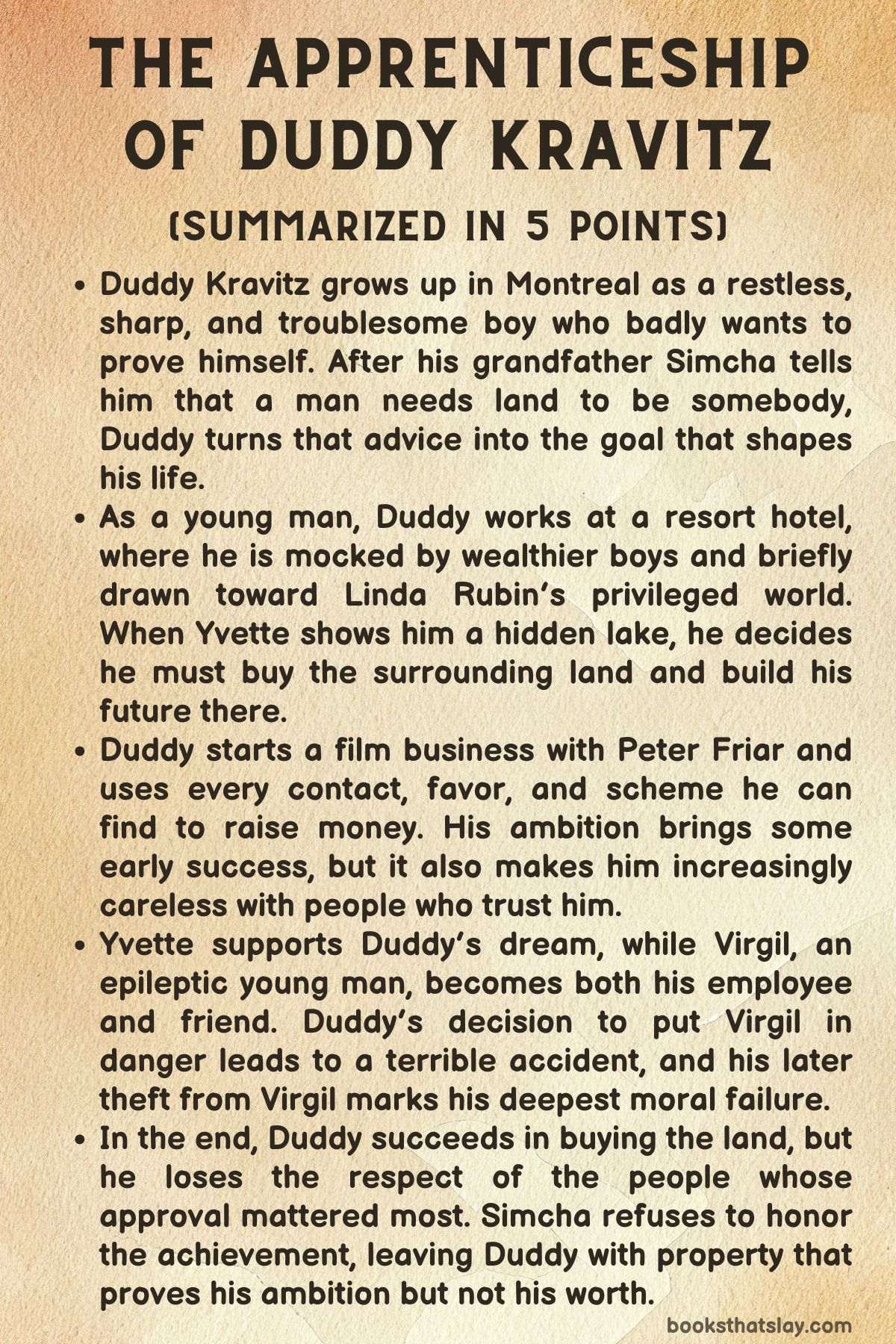
Summary
Duddy Kravitz grows up in Montreal as a bright, defiant, and disruptive boy whose energy is rarely guided toward anything useful. At school, he becomes a constant torment to John MacPherson, a history teacher who wants to believe that teaching can shape lives.
MacPherson is not a harsh man. He resists corporal punishment, tries to maintain fairness, and carries the private sorrow of caring for his very ill wife, Jennie.
Duddy, however, sees weakness and uses it. He mocks MacPherson, encourages other boys to misbehave, and turns the classroom into a place where the teacher’s ideals are tested daily.
MacPherson’s life begins to collapse under the weight of grief, disappointment, and alcohol. After an evening spent drinking with old university acquaintances, he comes home to find Jennie gravely injured after trying to reach the telephone.
Her death breaks something in him. When he returns to school, he is angry, drunk, and wounded.
Duddy provokes him again, and MacPherson finally abandons his principles by beating Duddy with a strap. Duddy feels victorious because he has forced the teacher to betray his own moral code, but the moment also shows Duddy’s early power to damage others without fully understanding what he has done.
Duddy’s home life is shaped by comparison. His father, Max, is a taxi driver who admires toughness, street knowledge, and legends of local success.
Max talks constantly about Duddy’s older brother, Lennie, who is studying medicine and represents respectability. Duddy wants attention from Max but often receives insult instead.
His uncle Benjy, a successful dress manufacturer, also favors Lennie and treats Duddy as a likely failure. The one older man who gives Duddy a clearer sense of destiny is his grandfather, Simcha.
Simcha, who came from Poland and built a life through hard labor, tells Duddy that a man must have land. Duddy takes this advice as a commandment.
From then on, land becomes the measure of manhood, dignity, and victory.
As a boy, Duddy is already skilled at manipulation. He forms a gang, torments weaker children, runs small schemes, cheats, steals, and looks for profit wherever he can find it.
He does not lack intelligence or drive; he lacks restraint. After high school, he works as a waiter at a resort hotel.
There, he is poorer and less polished than many of the other young men, especially Irwin, a privileged student who humiliates him. Duddy also meets Cuckoo, a comic performer, and Yvette, a chambermaid.
Yvette becomes deeply important to him because she treats him with tenderness and takes his dreams seriously.
Duddy is briefly drawn into the world of Linda Rubin, the owner’s daughter, who is clever, wealthy, and connected to the kind of social class he envies. Linda and Irwin help lure Duddy into a gambling setup in which he loses his summer savings.
The humiliation devastates him. He hides near the lake, and the hotel guests mistakenly think he has drowned himself.
Duddy enjoys the chaos created by this false assumption, returns alive, quits, and rejects Linda. Soon after, Yvette takes him to a hidden lake.
Duddy is entranced by the place and immediately imagines owning it, developing it, and making it the foundation of his future. Simcha’s advice about land suddenly has a specific object.
Back in Montreal, Duddy begins pursuing money with fierce urgency. He drives his father’s taxi, sells soap, and tries to enter more respectable circles.
He meets Peter Friar, a drunken, self-important filmmaker, and convinces him to join a business filming weddings and bar mitzvahs. Duddy plans to use the profits to buy the land around the lake.
Yvette helps with negotiations, and Duddy’s offer on the property is accepted before he has the money. This leaves him in a constant state of panic and invention.
He persuades community members to hire his film company, borrows reputations, uses names, and turns every contact into a possible source of cash.
One of Duddy’s hoped-for models is Jerry Dingleman, known as the Boy Wonder, a man who rose from poverty to wealth through real estate and shady dealings. Duddy imagines Dingleman as proof that someone from his background can become powerful.
Their first meeting humiliates him because Dingleman barely recognizes Max and offers Duddy only menial work. Later, Dingleman takes Duddy to New York and uses him to carry a suitcase through customs.
Duddy realizes he has been made useful in something illegal, but the money helps his plans, and he does not ask too many questions.
Duddy’s film business has an unexpected early success when Friar produces an odd, artistic bar mitzvah film that Duddy fears the clients will hate. Instead, they admire it.
For a time, Duddy’s future seems possible. Yet his family’s problems soon intrude.
Lennie disappears after becoming entangled with wealthy medical students, including Irwin and Sandra. Duddy tracks him down in Toronto and learns that Lennie was pressured into performing an illegal abortion on Sandra, which went badly.
Duddy sees that Lennie has been used by the rich friends he wanted to impress. He brings Lennie home and then confronts Sandra’s father, Hugh Calder, who unexpectedly takes a liking to Duddy and helps keep the incident quiet.
Duddy keeps expanding his network, but his methods remain unstable. Friar becomes unreliable and wastes money.
Duddy sells illegal pinball machines to raise funds. During this period, he meets Virgil, an epileptic American who wants work and acceptance.
Virgil begs for a job and argues that the discrimination he faces resembles the prejudice Jews experience. Duddy hires him at low wages, partly out of convenience, and only improves his pay after Yvette becomes angry.
Virgil and Yvette grow close. Duddy, however, sees people mainly by how they can serve his goals.
As Duddy’s business grows, he becomes more socially ambitious and emotionally careless. His apartment becomes a gathering place, but Yvette does most of the work.
He studies social manners, wants a richer Jewish wife, and treats Yvette as temporary, even though she has helped build his enterprise. Friar eventually leaves after proposing to Yvette and being rejected.
Duddy is more concerned about replacing equipment than about Yvette’s distress. Around the same time, Duddy learns that Uncle Benjy is dying of cancer.
He brings Benjy’s estranged wife, Ida, back from New York, then argues with Benjy about old resentments. Benjy wants to leave Duddy his business, but Duddy refuses because he wants success on his own terms.
The sharpest moral break comes through Virgil. Duddy gives him a delivery job that requires driving, even though he knows Virgil’s epilepsy makes this dangerous.
Virgil has a severe seizure while driving, crashes, and is left paralyzed. Yvette blames Duddy, but Duddy refuses to accept full responsibility.
He promises vaguely to care for Virgil but soon focuses on salvaging business property. Yvette leaves Duddy and takes Virgil with her.
Duddy reacts with cruelty, insulting both of them and pretending he does not need them. In truth, his life begins to fall apart.
His business deteriorates, clients become angry, and he loses control of himself. He later admits to Hersh that he had made the prank call to MacPherson’s house on the night Jennie died, a confession that reveals a buried guilt he has never truly faced.
Duddy eventually goes bankrupt and returns to driving a taxi. Mr. Cohen, one of his former clients, treats him kindly and offers encouragement, but Duddy remains ashamed.
Virgil writes to him, asking him to visit and sending copies of a magazine he has started to advocate for people with epilepsy. Duddy does visit Virgil and Yvette near the lake.
For a while, a different future seems possible. Duddy spends time with Virgil, softens toward Yvette, and considers moving with them into Benjy’s house.
Benjy’s final letter urges Duddy to reject the greedy self that has dominated him and choose a better path.
Then Duddy hears that the remaining lakefront land is for sale. The old hunger returns.
He tries to blackmail Dingleman, but Dingleman turns the threat back on him. He asks Lennie and Max for money and gets some help from his father.
He tries to sell things from Benjy’s house, upsetting Yvette. Still short of the needed amount, he turns to Virgil.
When Virgil refuses to lend him money because he promised Yvette he would not, Duddy steals his checkbook and forges checks in his name. At that moment, Virgil has another seizure.
Duddy still completes the purchase.
In the end, Duddy brings Max, Lennie, and Simcha to see the land he has finally acquired. He expects his grandfather to be proud.
Instead, Simcha refuses to step onto the property because Yvette has told him how Duddy got the money. Duddy insists that he has fulfilled Simcha’s lesson and become a man, but Simcha sees that the achievement has been morally ruined.
Yvette tells Duddy that Virgil never wants to see him again. Duddy enters a restaurant where Max and Lennie are ready to celebrate, but he is isolated from the approval he wanted most.
He owns the land, but the victory is empty.
Characters
Duddy Kravitz
Duddy Kravitz is the driving force of The Apprenticeship of Duddy Kravitz, and his character is built around a painful mix of intelligence, hunger, insecurity, and moral blindness. He is not lazy or passive; he is always moving, planning, selling, borrowing, persuading, and forcing his way into spaces that were not designed to welcome him.
His ambition grows from humiliation. He is dismissed by teachers, mocked by richer boys, underestimated by Uncle Benjy, and overshadowed by Lennie.
Simcha’s statement that a man without land is nobody gives him a simple goal, but Duddy turns that lesson into an obsession. What makes him compelling is that his desire is understandable even when his methods are ugly.
He wants dignity, not merely wealth, and he wants someone to say that he matters. Yet he repeatedly treats other people as tools.
Yvette becomes labor, loyalty, and comfort; Virgil becomes cheap help and then a source of stolen money; even family connections become possible business openings. Duddy’s tragedy is that he does achieve his dream, but he destroys the moral meaning of that dream in the process.
By the end of the book, he is successful in the narrowest sense and defeated in the deeper one.
Yvette
Yvette is one of the clearest moral centers in the book because she sees Duddy’s potential without excusing his cruelty. She first appears as someone outside his Montreal world, a young woman connected to the countryside and the lake that becomes the object of his dream.
Her importance is not limited to romance. She helps Duddy negotiate land deals, supports his business, manages practical tasks, and gives emotional shape to his ambitions.
Unlike Linda, who represents wealth and social status, Yvette offers steadiness and genuine care. She believes in Duddy before many others do, but she also sees when belief turns into enabling.
Her bond with Virgil reveals her compassion and her ability to value people apart from their usefulness. When Duddy exploits Virgil and later steals from him, Yvette becomes the person who names the betrayal for what it is.
Her final rejection of Duddy matters because it is not based on wounded pride alone; it is a moral refusal. She understands that love cannot survive when one person repeatedly uses others and calls it ambition.
Virgil Roseboro
Virgil Roseboro is vulnerable, hopeful, and far stronger than Duddy initially recognizes. He enters the story looking for work, dignity, and a chance to be treated as more than his epilepsy.
His appeal to Duddy is powerful because he compares the discrimination he faces to the prejudice experienced by Jews, asking Duddy to see a shared condition of exclusion. Duddy does give him work, but the help is compromised from the start by exploitation.
Virgil accepts low pay and rough treatment because he needs opportunity, and this makes Duddy’s later actions more disturbing. After the accident that leaves him paralyzed, Virgil does not become merely a symbol of Duddy’s guilt.
He continues to think, write, organize, and advocate for people with epilepsy through his magazine. His refusal to sue Duddy, even after being robbed, shows generosity but also a painful attachment to someone who never deserved that level of trust.
Virgil’s role in the novel exposes the human cost of Duddy’s ambition more directly than any financial loss could.
Simcha Kravitz
Simcha Kravitz is Duddy’s grandfather and the source of the sentence that shapes Duddy’s life. He is an immigrant who built dignity through labor, endurance, and modest achievement.
His belief in land comes from a lifetime of insecurity and displacement; for him, land represents permanence, independence, and manhood. Duddy hears the words but not the spirit behind them.
Simcha does not teach greed. He teaches rootedness and self-respect.
This difference becomes crucial at the end of The Apprenticeship of Duddy Kravitz, when Duddy expects praise for acquiring the lakefront property but receives silence and rejection instead. Simcha’s refusal to step onto the land is one of the book’s strongest judgments.
He understands that land gained through betrayal cannot carry honor. His love for Duddy makes that refusal painful, but it also gives it authority.
Simcha stands for an older moral world in which achievement must be connected to decency, memory, and community.
Max Kravitz
Max Kravitz is Duddy’s father, a taxi driver full of stories, boasts, resentments, and selective pride. He is not a conventionally nurturing father, and his favoritism toward Lennie wounds Duddy deeply.
Max praises Lennie’s medical studies and respectability while often treating Duddy as foolish or troublesome. Yet Max is not simply indifferent.
He exists in a world where survival requires performance, toughness, and association with local legends like the Boy Wonder. His admiration for street success helps shape Duddy’s idea of what power looks like.
Max’s stories teach Duddy that reputation matters and that clever men find ways around the rules. At the same time, Max occasionally shows rough affection, especially when he lends Duddy money despite suspecting that it may be wasted.
His failure as a father lies in his inability to give Duddy the direct approval he craves. Duddy’s hunger for recognition is partly a response to Max’s emotional evasiveness.
Lennie Kravitz
Lennie Kravitz is Duddy’s older brother and the family’s respectable hope. He studies medicine, receives Benjy’s admiration, and becomes the son Max can brag about.
Yet Lennie’s success is fragile because it depends heavily on external approval. He wants acceptance from wealthy Gentile classmates and is easily drawn into their world.
His involvement in Sandra’s abortion shows his weakness, vanity, and need to be seen as honorable by people who are using him. In contrast to Duddy, who sees social games with suspicious sharpness, Lennie is naive about class power and social manipulation.
Still, he is not a villain. He is frightened, ashamed, and overwhelmed by the consequences of his choices.
His relationship with Duddy is tense but revealing. Duddy resents Lennie’s favored position, yet he still searches for him, protects him, and confronts Hugh Calder on his behalf.
Through Lennie, the book shows that respectability can be another form of vulnerability when it rests on pleasing the powerful.
John MacPherson
John MacPherson is a tragic early figure whose collapse reveals the damage Duddy can cause before he understands consequence. MacPherson begins as a teacher committed to nonviolence, fairness, and a humane idea of education.
He wants to believe his work matters, even though his classroom gives him little evidence of success. His private life is marked by grief and exhaustion as he cares for Jennie, whose illness makes home a place of worry rather than rest.
Duddy’s harassment becomes one more pressure on a man already close to breaking. After Jennie’s death, MacPherson’s drinking and anger overtake his principles, and he strikes Duddy.
Duddy interprets this as a victory, but the reader sees a damaged adult losing the last part of himself that gave him dignity. Later, Duddy’s confession that he made the prank call to MacPherson’s house adds moral weight to this early conflict.
MacPherson represents one of Duddy’s first serious harms, even if Duddy only understands it much later.
Uncle Benjy
Uncle Benjy is stern, successful, disappointed, and more emotionally complicated than he first appears. As a businessman, he values discipline and respectability, which is why he admires Lennie and distrusts Duddy.
His treatment of Duddy at the factory confirms Duddy’s belief that his family expects nothing good from him. Yet Benjy’s harshness also comes from his own unhappiness.
His marriage to Ida is painful, his childlessness has shaped his emotional life, and his illness forces him to confront what his success has and has not given him. When he offers Duddy the chance to inherit his business, he is trying to create a connection, though he does so clumsily and too late.
Duddy’s refusal wounds him because it rejects not only the business but also Benjy’s belated attempt at recognition. His final letter is one of the clearest warnings Duddy receives.
Benjy understands that ambition can split a person into competing selves, and he urges Duddy to let the better self win. Duddy almost listens, but not for long enough.
Jerry Dingleman
Jerry Dingleman, the Boy Wonder, is the false model of success that haunts Duddy’s imagination. He represents what Duddy thinks he wants to become: a man from humble beginnings who has acquired wealth, influence, and fearsome reputation.
Dingleman’s physical disability after polio adds complexity to his image because he is both powerful and visibly damaged. He knows how to use people, and he recognizes Duddy’s hunger quickly.
By taking Duddy to New York and using him to carry illegal goods through customs, he gives Duddy a lesson in the real methods behind certain kinds of success. Dingleman is not a mentor in any generous sense.
He is a warning disguised as an example. When Duddy later tries to blackmail him, Dingleman easily turns the threat back on him, proving that Duddy is still an amateur in the corrupt world he thinks he can master.
His presence shows the emptiness of success without loyalty or moral limit.
Peter Friar
Peter Friar is an artist whose talk of creative freedom often masks irresponsibility, vanity, and selfishness. Duddy sees him as useful because he has technical skill and cultural polish, while Friar sees Duddy as a vulgar businessman who can finance his work.
Their partnership is uneasy from the start because they want different things from film. Duddy wants profit; Friar wants artistic control and admiration.
The bar mitzvah film shows that Friar has talent, but his talent is tied to instability. He drinks heavily, disappears, wastes money, and eventually abandons the business.
His proposal to Yvette also reveals his contempt for Duddy and his desire to see himself as the better man. Friar’s role is important because he exposes a different kind of selfishness from Duddy’s.
Duddy is crude and hungry, while Friar is cultured and self-pitying, but both are capable of using others while justifying themselves through ambition or art.
Linda Rubin
Linda Rubin represents the class world Duddy wants to enter and defeat. She is intelligent, attractive, privileged, and amused by Duddy’s raw eagerness.
Her early interest in him is mixed with condescension, and her connection to Irwin places her within the circle that humiliates him at the hotel. The gambling incident is central to Duddy’s resentment because Linda helps make him feel foolish, poor, and socially inferior.
Yet she is not only a simple antagonist. Her jealousy over Yvette and her later appearance with Dingleman suggest that she is also drawn to power, risk, and men who push against ordinary limits.
For Duddy, Linda is less a possible partner than a symbol of a world that mocks him while also tempting him. His rejection of her after the gambling humiliation is one of his early acts of self-defense, but his later hunger for rich Jewish girls shows that he never fully escapes the desire for status she represents.
Irwin
Irwin is one of the book’s clearest examples of privileged cruelty. At the resort, he humiliates Duddy because Duddy is poorer, rougher, and easier to target.
His role in the roulette incident shows that he understands how to hide malice behind games and social pressure. Later, he reappears in Lennie’s circle, where his manipulation becomes more serious.
He helps draw Lennie into the abortion crisis and then lets him carry the danger. Irwin’s power comes from confidence, class position, and the protection offered by his social group.
Unlike Duddy, whose schemes are often frantic and exposed, Irwin’s cruelty is smoother and safer because the world is more willing to protect him. He matters because he helps explain Duddy’s rage.
Duddy’s methods are wrong, but his hatred of people like Irwin comes from real experiences of humiliation and exclusion.
Hugh Calder
Hugh Calder is a wealthy, bored, influential man who becomes briefly fascinated by Duddy. His first reaction to Duddy’s visit is annoyance, especially because the subject concerns Sandra’s abortion and Lennie’s danger.
Yet Duddy’s nerve amuses him. Calder is impressed by Duddy’s boldness and entrepreneurial drive, and he agrees to help keep Lennie’s role quiet.
His interest in Duddy, however, is limited and conditional. He enjoys Duddy as a novelty, not necessarily as an equal.
Their later business conflict reveals how fragile such patronage is. When Duddy tries to renegotiate too aggressively, Calder sees him as greedy and insulting.
Calder’s character shows how access to power can appear generous while remaining unequal. Duddy wants men like Calder to validate him, but their approval can be withdrawn as soon as he stops being entertaining or useful.
Mr. Cohen
Mr. Cohen is one of the few community figures who responds to Duddy with a measure of kindness. He first helps Duddy by agreeing to hire his film company and letting his name be used to attract further clients.
Later, when Duddy has fallen into bankruptcy and is driving a taxi, Cohen does not simply mock or dismiss him. He invites him in, listens, and offers encouragement.
His sympathy is imperfect because it includes a prejudiced dismissal of Virgil as an outsider, but his role still matters. Cohen recognizes Duddy’s energy and survival instinct at a moment when Duddy feels ruined.
He represents the community’s capacity for support, but also its limits. His willingness to excuse Duddy too easily shows how loyalty to one’s own group can become morally evasive when it ignores harm done to someone outside that group.
Themes
Ambition and Moral Cost
Duddy’s ambition is never presented as simple greed alone. It grows from poverty, insult, family comparison, and a longing to be recognized as someone of consequence.
In that sense, his desire for land carries emotional truth. He wants proof that he is not the fool his father jokes about, not the failure his uncle expects, and not the poor boy men like Irwin can humiliate without consequence.
The problem is that Duddy begins to measure every act by whether it brings him closer to ownership. Once that happens, people become steps toward a goal rather than human beings with claims on his conscience.
His business drive produces real achievements: he finds clients, builds contacts, buys property, and refuses to surrender after bankruptcy. Yet the same drive makes him careless with MacPherson, exploitative toward Yvette, negligent toward Virgil, and finally criminal in forging checks.
The Apprenticeship of Duddy Kravitz shows ambition as a force that can create identity but also consume it. Duddy wins the land, but because he gains it through betrayal, the victory cannot give him the manhood he expected.
Land, Identity, and Belonging
Land carries a meaning far larger than property in the story. For Simcha, land represents stability after displacement, a sign that a man has a place in the world and cannot be easily pushed aside.
His belief comes from immigrant memory, hard work, and the insecurity of people who have known what it means to be unwanted. Duddy receives this lesson as a child and turns it into the central aim of his life.
The hidden lake becomes more than a beautiful location; it becomes the image of a future where he will be respected, secure, and self-made. Yet the book carefully separates owning land from belonging to it.
Duddy can buy the lakefront, sign papers, and claim legal possession, but he cannot force moral acceptance. When Simcha refuses to step onto the property, the meaning of land changes completely.
What was supposed to prove Duddy’s worth instead exposes the corruption of his methods. The story suggests that belonging cannot be purchased by ambition alone.
It must be earned through conduct, loyalty, and respect for others.
Family Approval and the Hunger to Be Seen
Duddy’s actions are often loud, aggressive, and selfish, but beneath them lies a deep need for approval. His family structure teaches him that love and pride are unevenly distributed.
Lennie receives praise because he is educated and respectable. Benjy invests hope in Lennie and treats Duddy as a likely embarrassment.
Max speaks with more excitement about local legends and Lennie’s achievements than about Duddy’s efforts. Simcha is the exception, and because his approval feels rare and sacred, Duddy clings to his words with unusual intensity.
This hunger to be seen helps explain why Duddy cannot simply make money quietly or live modestly. He needs witnesses.
He wants his father, grandfather, clients, rivals, and old enemies to recognize that he has become important. The tragedy is that his need for approval makes him vulnerable to distorted ideas of success.
He believes that land will force love and respect into existence. Instead, his final achievement separates him from the very person whose blessing he wanted most.
The book shows how neglected recognition can harden into obsession when a young person has no stable sense of worth.
Class, Exclusion, and Social Performance
Class pressure shapes nearly every part of Duddy’s world. At the resort, he is made to feel crude and poor beside college boys who have money, polish, and confidence.
Linda’s circle can laugh at him because they understand codes of behavior he has not mastered. Irwin’s cruelty is effective because it is backed by social ease and privilege.
Lennie’s downfall also comes from wanting acceptance among wealthy medical students who treat him as useful but not truly equal. Duddy responds to these pressures by performing success before he fully has it.
He rents an office, name-drops clients, studies manners, builds contacts, and tries to speak the language of influence. These performances are sometimes comic, but they are also sad because they reveal how strongly he believes worth must be displayed in recognizable social forms.
The novel criticizes both sides of this world: the privileged people who humiliate outsiders and Duddy’s willingness to answer humiliation with manipulation. Social exclusion helps form his ambition, but it does not excuse the harm he causes while trying to overcome it.