Ashes by Laurie Halse Anderson Summary, Characters and Themes
Ashes by Laurie Halse Anderson is the final novel in the Seeds of America trilogy. It follows Isabel, a young Black girl who has escaped slavery, as she searches for her younger sister Ruth during the American Revolutionary War.
The story is both a survival journey and a coming-of-age novel, showing how freedom is never simple when war, racism, hunger, fear, and broken trust shape every choice. Through Isabel, Curzon, Ruth, and Aberdeen, the book explores family, love, loyalty, and the painful gap between America’s promise of liberty and the reality faced by enslaved people.
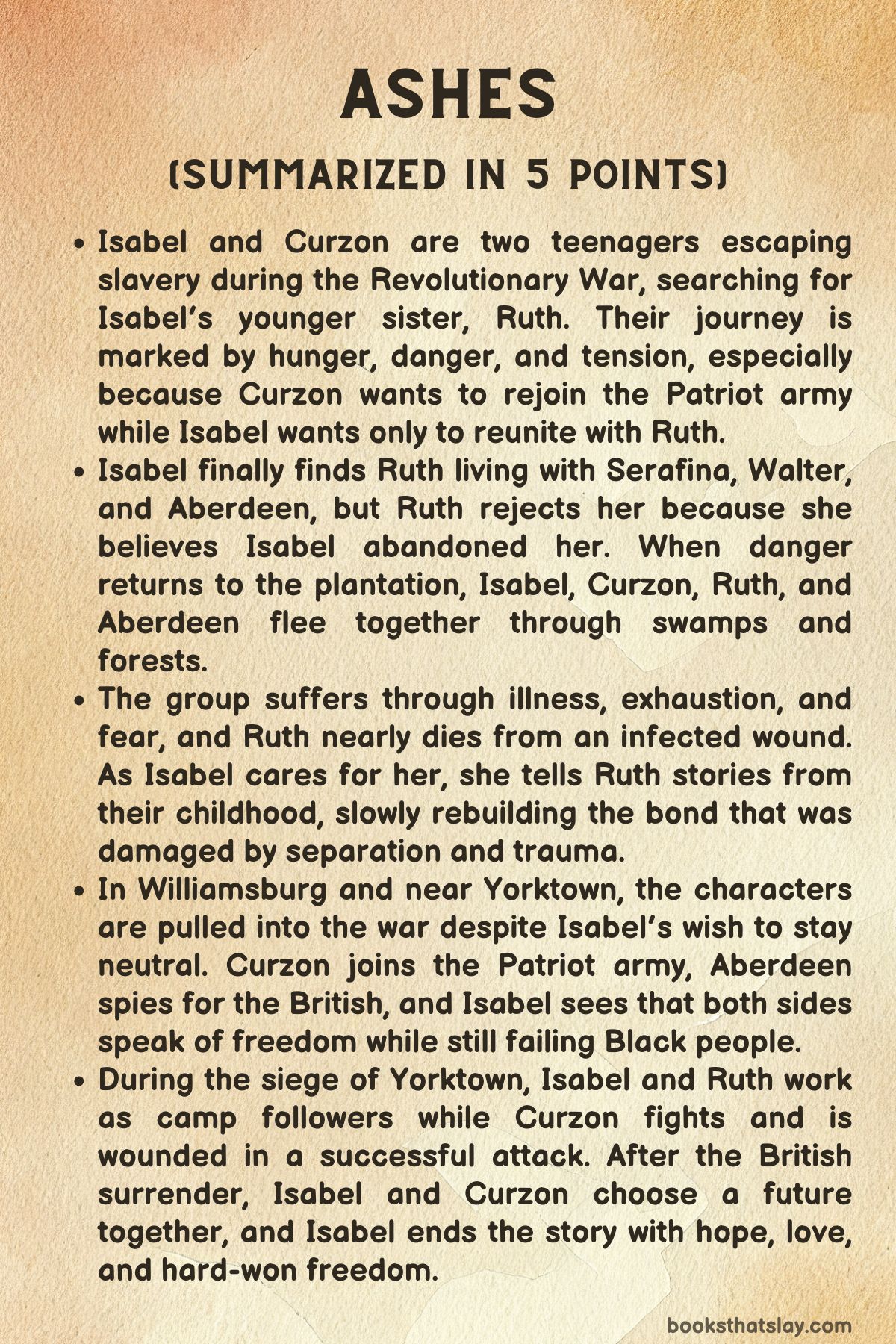
Summary
Ashes follows Isabel as she travels through the chaos of the American Revolutionary War with Curzon, the boy who has shared danger, hunger, and escape with her for years. They are searching for Isabel’s younger sister Ruth, who was taken from her long ago.
Isabel believes Ruth may be in South Carolina, and that hope has kept her moving even when her body is weak and her spirit is nearly spent. She and Curzon are no longer as close as they once were.
Curzon wants to rejoin the Patriot army, while Isabel wants only to find Ruth and keep moving toward safety.
Their journey is dangerous from the start. They hide from British soldiers, survive gunfire between British forces and Patriot militia, and narrowly escape a rattlesnake.
Isabel is tired in a way that goes deeper than hunger. She feels sadness and numbness creeping into her, and she worries that years of fear and running have changed her.
Still, she pushes forward because Ruth is the one person she cannot stop searching for.
At last, Isabel and Curzon reach a damaged plantation where Ruth is living with an elderly couple, Serafina and Walter, and a boy named Aberdeen. Isabel is overwhelmed when she sees Ruth alive, but the reunion is not what she imagined.
Ruth has grown older and does not welcome her. She acts as though Isabel abandoned her and refuses to accept her as a sister.
Isabel is crushed. She tries to explain that Ruth was stolen away, that she never stopped looking for her, but Ruth tells her to leave.
Serafina and Walter understand more than Ruth does at first. They feed Isabel and Curzon, and Isabel learns that Ruth has been loved and protected by them.
Ruth’s life has not been easy, but she has formed a home of sorts with these people. Isabel feels torn between gratitude and jealousy.
Ruth is her sister, yet Ruth belongs emotionally to the people who cared for her when Isabel could not.
Danger soon forces all of them to act. The overseer, Prentiss, returns, and Ruth is terrified of him.
Serafina and Walter decide that Ruth, Isabel, Curzon, and Aberdeen must leave. Walter guides them toward a path through the swamp, and the four young people begin a hard journey north.
Ruth still resists Isabel, while Aberdeen comforts her and Curzon grows increasingly restless. Isabel tries to reconnect with Ruth, but Ruth is angry and hurt.
Curzon tells Isabel that she cannot command Ruth’s feelings. Isabel understands this, but it does not make the rejection easier.
The journey through the swamp and woods tests them all. They are bitten by insects, weakened by hunger, and worn down by heat.
Ruth keeps a chicken named Nancy, whose daily egg becomes a small comfort. Curzon and Aberdeen argue over politics: Curzon supports the Patriots, while Aberdeen favors the British because he believes they may offer a better chance at freedom for enslaved people.
Their arguments show the painful truth that neither side fully deserves the trust of Black people seeking liberty.
Ruth becomes seriously ill after a seizure, and Isabel discovers that an untreated wound on her foot has turned dangerous. Isabel, Curzon, and Aberdeen must act without proper medicine.
Isabel cleans the wound as best she can, while Curzon goes into town to find food and supplies. During his absence, Aberdeen tells Isabel more about Ruth’s past and how she slowly began to heal after being taken in by Serafina and Walter.
He suggests that Isabel tell Ruth stories from their childhood, even if Ruth seems unable or unwilling to listen. Isabel does, speaking to Ruth about their mother, their early life, and the love that existed before they were separated.
Ruth begins to recover, though her trust remains fragile.
Curzon returns with food, a cart, and a donkey, bringing new hope. Ruth loves the donkey and names him Thomas Boon.
The group moves onward and eventually reaches Virginia, where military activity is building around Williamsburg and Yorktown. Curzon believes the confusion of war may actually make the area safer for them, because people will be too distracted to ask hard questions.
Isabel is uneasy but sees few better choices.
In Williamsburg, Isabel and Ruth find work through a laundry run by Widow Hallahan, while Curzon and Aberdeen claim to have found work elsewhere. Isabel soon realizes that everyone is keeping secrets.
The town is crowded with soldiers, officers, workers, and refugees. Washington’s army is gathering, and the conflict is moving toward a major confrontation.
Isabel works in the laundry and later in a tavern, where she hears bits of news but remains anxious about her safety and Ruth’s. Widow Hallahan and her son treat Isabel unfairly, and Isabel senses that they might exploit or betray her.
Curzon eventually reveals that he has enlisted in the Patriot army again. Isabel is furious and hurt.
She remembers how badly he was treated before and how easily white men who spoke of freedom still allowed Black people to be abused or recaptured. Curzon, however, believes in the possibility of a new nation and wants to fight for it.
Isabel feels that he has chosen war over her, and only then fully admits to herself that she loves him.
Aberdeen reveals his own secret: he is spying for the British. He dreams of escaping with Ruth and Isabel after the war, perhaps even going to Scotland.
He tells Isabel that she cannot stay neutral forever, because the war will force everyone into danger no matter what they choose. Isabel refuses to serve either army willingly.
She wants to protect Ruth and survive.
Soon Isabel’s free papers are destroyed, and she realizes that Mister Hallahan may intend to seize her and Ruth and sell them. She acts quickly, gathering Ruth and fleeing.
The sisters escape into the movement of the army and try to blend in with camp followers, women and children who cook, clean, haul, and survive in the shadow of soldiers. Their flight brings them closer to the battlefield and to the suffering caused by the war.
In the woods, they find bodies of people who died from smallpox, including enslaved people who had trusted British promises of freedom and safety. A shaken British soldier tells them those promises failed.
This moment deepens Isabel’s understanding that both armies use vulnerable people and then abandon them.
Isabel and Ruth finally confront the wound between them. Ruth believes Isabel gave her away because she was slow or unwanted.
Isabel breaks down and tells Ruth the truth: she never gave her away and never stopped loving her. Ruth reveals that she heard the stories Isabel told while she was sick.
The sisters begin to heal their relationship, not perfectly, but honestly.
They reach the Continental camp near Yorktown and find Ebenezer, an old friend of Curzon’s. Through him, they are brought back into Curzon’s orbit.
Isabel is shocked to learn that Curzon registered her and Ruth as his family so they could work safely with his company. More specifically, he has presented Isabel as his wife.
Isabel is startled and annoyed that he made the decision without asking her, but it also gives her and Ruth protection and a place among the camp followers.
Life in the army camp is exhausting. Isabel and Ruth cook, clean, carry water, split wood, and care for soldiers.
Curzon keeps his distance, partly because of the awkward false marriage and partly because of his duties. As the siege of Yorktown begins, the army digs trenches to move cannons closer to British positions.
Isabel learns more about the Black soldiers fighting for the Patriots and begins to see Curzon’s choice in a broader way. He is not simply chasing battle; he is trying to take part in shaping a future that might one day include freedom for people like them.
Aberdeen reappears secretly, hungry and worn down. Ruth has been feeding him.
He tells Isabel that conditions inside the British lines are terrible and asks her to leave with him and Ruth. Isabel refuses.
Aberdeen wants to know which side she is on, but Isabel’s answer is complicated. She is on the side of survival, of Ruth, of Curzon, and of whatever freedom can be built from the wreckage.
The fighting grows more intense. Isabel carries food and supplies near the trenches, even as shells fall nearby.
Curzon is assigned to a dangerous attack on a British position. Before he leaves, he tells Isabel he loves her.
She tries to convince herself she misheard, but the words stay with her. That night, Isabel learns from Curzon’s fellow soldiers that he told them the truth about their past so they could help her if he died.
Their kindness and their reasons for fighting move her. She begins to understand that loving one person and fighting for a larger freedom do not have to be separate things.
The attack succeeds, but Curzon is injured. Isabel tends to him, and this time she tells him plainly that she loves him.
He survives, and soon after, news arrives that the British have surrendered at Yorktown. The victory is enormous, but the book does not pretend that freedom has suddenly come for everyone.
Black soldiers and refugees remain vulnerable. Some are recaptured or handed over to enslavers.
The promises of liberty are still uneven and unfinished.
After the surrender, Isabel, Ruth, and Curzon face an uncertain future. Ruth mourns Aberdeen, whose fate remains unclear, and Isabel chooses not to crush Ruth’s hope.
Curzon, shaken by the treatment of Black prisoners, struggles with disappointment. Isabel, who once depended on Curzon for hope, now offers hope to him.
She compares building freedom to planting mixed seeds: no one can know exactly what will grow, but they must plant anyway.
By the end of Ashes, Isabel and Curzon decide to marry for real and begin a life together with Ruth. Isabel still carries grief, fear, and memories of all she has lost, but she also has love, choice, and a future she can help shape.
The novel closes with Isabel honoring her mother and claiming the truth she has fought so long to reach: she and her loved ones are free, strong, and ready to begin again.
Characters
Isabel
Isabel is the emotional and moral center of Ashes. She is a survivor of slavery, separation, violence, and repeated betrayal, but the book does not present her strength as simple fearlessness.
Her strength is often tired, angry, defensive, and lonely. She has spent years trying to find Ruth, and that search has become the purpose that keeps her alive.
When she finally finds her sister and is rejected by her, Isabel’s pain is intense because she has built her identity around being Ruth’s protector. Her greatest struggle is not only external danger but also the hardening of her own heart.
The war has taught her suspicion, and she often believes safety depends on trusting no one. Yet her journey forces her to learn that love cannot be controlled the way a route or escape plan can be controlled.
Ruth must be allowed to feel hurt. Curzon must be allowed to choose his own path.
Isabel’s growth comes through accepting vulnerability without surrendering her will. By the end of the novel, she becomes more open, more emotionally honest, and more capable of imagining a future built not only on escape, but on belonging, love, and choice.
Curzon
Curzon is brave, idealistic, stubborn, and deeply shaped by his belief that freedom must be fought for in public as well as protected in private. He has endured enslavement, military hardship, hunger, and betrayal, yet he continues to believe in the Patriot cause more strongly than Isabel does.
This makes him both admirable and frustrating. He sees the Revolution as a chance to help create a new country where liberty might eventually include Black people, while Isabel sees the hypocrisy of white men speaking of freedom while enslaving others.
Curzon’s decision to enlist again creates a painful divide between them because Isabel experiences it as abandonment. Yet Curzon is not choosing the army because he does not love her; he is choosing it because his imagination of freedom is broad and political.
He registers Isabel and Ruth as his family to protect them, though he does so without Isabel’s consent, showing both his care and his tendency to make dangerous decisions alone. His love for Isabel is quiet for much of the story, but it is constant.
By the end, his courage is softened by humility, and his idealism is tested by the continued mistreatment of Black people even after victory.
Ruth
Ruth is one of the most emotionally important characters in the book because she represents both what Isabel has lost and what she hopes to recover. At first, Ruth seems distant, angry, and childlike in ways that wound Isabel deeply.
Her rejection of Isabel is not cruelty for its own sake; it comes from trauma, confusion, and the belief that Isabel gave her away. Ruth has survived by attaching herself to Serafina, Walter, Aberdeen, animals, routines, and small comforts.
Her bond with Nancy Chicken and Thomas Boon shows her tenderness, her need for stability, and her ability to love creatures that make the world feel less frightening. Ruth’s seizures and illness also reveal how vulnerable she is in a world that has no patience for weakness.
Yet the novel never treats Ruth as empty or simple. She notices more than others realize, remembers more than Isabel expects, and makes choices of her own.
Her reconciliation with Isabel is a major emotional turning point because it restores family not as a perfect memory, but as a relationship rebuilt through truth, apology, and patience.
Aberdeen
Aberdeen is a conflicted and practical character who gives the story a different view of the Revolutionary War. Unlike Curzon, he places his hopes with the British, believing they may offer a better route to freedom for enslaved people.
His choice to spy for them is risky, but it is not presented as simple treachery. He is trying to survive in a world where every powerful side uses Black people when convenient and abandons them when necessary.
Aberdeen’s affection for Ruth reveals his gentler side. He treats her with patience and imagines a future in which he, Ruth, and Isabel might escape to a safer life.
Still, his dreams are fragile because they depend on promises made by an army that proves unreliable. His arguments with Curzon show the cruel uncertainty facing Black characters during the Revolution: neither side offers guaranteed justice.
Aberdeen’s disappearance leaves Ruth with grief and hope rather than closure. He stands for the many people whose lives were caught between armies, promises, and betrayals, and whose stories could not be neatly resolved.
Serafina
Serafina is a maternal figure whose strength comes from love, labor, and painful experience. She has lost children and grandchildren, yet instead of allowing grief to close her off, she has taken Ruth into her home and heart.
Her care for Ruth creates tension for Isabel, who feels both gratitude and jealousy. Serafina’s role is important because she shows that family in the story is not only biological; it can also be formed through protection, sacrifice, and daily care.
She understands Isabel’s pain quickly, but she also challenges her. She tells Isabel that survival is not enough if it destroys the ability to feel.
Through Serafina, the novel suggests that emotional openness is not weakness. Her decision to send Ruth away with Isabel is painful because she truly loves Ruth, but she knows staying would place Ruth in danger.
Serafina’s love is selfless, and her brief presence leaves a lasting mark on Isabel’s understanding of motherhood, grief, and responsibility.
Walter
Walter is quieter than Serafina, but he is equally important as a figure of protection and guidance. He helps shelter Isabel, Curzon, Ruth, and Aberdeen, and he leads them toward the swamp path when they must escape.
His tenderness is practical rather than dramatic. He gives directions, helps them leave safely, and accepts the pain of parting from Ruth because her safety matters more than his own comfort.
Like Serafina, Walter has suffered family separation, which connects him to the broader pain of enslaved families torn apart by sale, violence, and war. His character represents the older generation’s endurance.
He cannot undo the damage done to his family, and he cannot guarantee Ruth’s safety forever, but he gives the young people what help he can. His farewell carries the sorrow of someone who knows love often means letting go.
Prentiss
Prentiss is a brutal overseer whose presence brings terror even before he fully appears. Ruth’s fear of him suggests a history of abuse, and his treatment of Aberdeen shows his cruelty clearly.
He represents the everyday violence of slavery: not only the legal ownership of human beings, but also the beatings, threats, and constant fear used to control them. Prentiss does not need much complexity to be effective as a character because his role is to embody a system built on domination.
His return forces the escape from Riverbend, proving that even places of temporary shelter are unsafe when enslavers and overseers have power. For Ruth especially, Prentiss is a living reminder of why she fears being taken again.
His character shows how trauma follows people long after they leave the place where it happened.
Widow Hallahan
Widow Hallahan is a deeply unpleasant figure because her cruelty hides behind ordinary respectability. She gives Isabel and Ruth work, but she treats them unfairly and values their labor without respecting their humanity.
She is not openly violent in the same way as Prentiss, but her actions are dangerous because she participates in exploitation while pretending to be practical or proper. Her willingness to underpay, overwork, and possibly help trap Isabel and Ruth shows how easily people who are not battlefield villains can still become part of oppression.
She is especially important because she reminds readers that danger for Black girls in this world does not come only from soldiers, enslavers, or obvious enemies. It also comes from employers, households, and people who see poverty and Blackness as chances for profit.
Mister Hallahan
Mister Hallahan is a threatening character because he quickly sees Isabel’s vulnerability. His suspicion of her free papers and his later connection to their destruction suggest that he understands how fragile freedom can be when it depends on documents that others can steal, burn, or deny.
He represents the legal and social danger surrounding Black freedom during the Revolutionary era. Isabel may know who she is, but if a white man destroys the proof of her status, her liberty can be attacked.
Mister Hallahan’s danger lies in calculation. He is not merely rude; he appears ready to turn Isabel and Ruth into profit.
Through him, the book shows that freedom without protection is unstable, especially for Black people moving through a society eager to question, capture, and sell them.
Miss Marrow
Miss Marrow offers a small but meaningful contrast to Widow Hallahan. She is kinder to Isabel at the tavern and treats her work with more fairness and basic decency.
She does not become a savior figure, and her kindness does not erase the larger injustice around Isabel, but her presence matters because the book includes different shades of human behavior. In a world where Isabel has learned to distrust almost everyone, Miss Marrow shows that not every white employer is equally cruel.
Still, her goodness is limited by the society she inhabits. She can offer food, fairer treatment, and a measure of respect, but she cannot fully protect Isabel from the dangers surrounding her.
Her character adds realism by showing that individual kindness exists inside unjust systems, but it is not enough to repair them.
Ebenezer Woodruff
Ebenezer is an old friend of Curzon’s and one of the more honorable white soldiers in the novel. His reunion with Isabel and Curzon shows how much the war has changed everyone.
He has grown into a capable sergeant, and his respect for Curzon helps Isabel and Ruth find a place within the Continental camp. Ebenezer is important because he uses his position to help rather than exploit.
He intervenes when Curzon gets into trouble after searching for Aberdeen, showing that his loyalty is not just polite speech. At the same time, Ebenezer’s presence does not erase the racism of the army or the country forming around them.
He is a decent person within an imperfect cause. His character helps the book avoid making all white Patriots identical, while still keeping attention on the larger hypocrisy of a freedom movement that excludes many of the people fighting for it.
Sibby
Sibby is one of the camp followers who helps Isabel and Ruth adjust to life with the army. Her role is significant because she represents the women who sustain military life without receiving glory.
She teaches the girls the labor expected of them: cooking, cleaning, hauling, tending, and enduring. Through Sibby, the story recognizes that war is not only fought by soldiers.
It is also carried by women, children, workers, and families who live beside the army and absorb its dangers. Her later offer to take Isabel and Ruth to her mother’s home gives Isabel a possible path toward stability after so much movement.
Sibby’s pregnancy also adds emotional weight, suggesting that even amid war and uncertainty, people continue trying to create homes, families, and futures.
Henry
Henry is an older soldier whose wisdom helps Isabel understand the army and the meaning of the siege. He explains the trench strategy and offers spiritual care for the dead discovered near the camp.
His character brings steadiness to a section of the novel filled with fear, noise, and uncertainty. Henry’s respect for those who died of smallpox matters because so many enslaved and formerly enslaved people are treated as nameless losses by armies and governments.
By praying over them, he gives them dignity. He also helps Isabel understand why Black soldiers continue to fight for a country that has not treated them justly.
Henry’s perspective deepens the book’s political argument: the land belongs morally not only to those who claim power over it, but also to those whose blood, work, grief, and hope have shaped it.
Madam Lockton
Madam Lockton is a cruel figure from Isabel and Ruth’s past, and her influence remains powerful even when she is not physically present. She is responsible for separating the sisters and for the violence that marked Isabel’s body and memory.
The scar on Isabel’s face is not only a sign of personal suffering; it is a visible reminder of how slavery punishes resistance. Madam Lockton’s decision to sell Ruth away creates the central wound of the story.
She represents the selfishness and moral emptiness of enslavers who treat family bonds as obstacles to profit and control. Her absence in much of the book does not lessen her importance because the damage she caused drives Isabel’s journey, Ruth’s trauma, and the sisters’ long struggle to trust each other again.
Bellingham
Bellingham is another figure from the past whose actions shape Isabel’s distrust of both people and institutions. He enslaved Isabel again after her earlier escape, proving that even after a person reaches a place that seems safer, freedom can be stolen back.
His connection to Valley Forge also complicates Isabel’s view of the Patriot cause. For Curzon, the army can represent hope and future liberty, but for Isabel, it is tied to memories of being trapped and used.
Bellingham stands for betrayal wrapped in respectability. He shows that oppression does not always appear as open savagery; it can also come through wealthy, polished people who benefit from the labor and suffering of others while moving comfortably among famous names and political ideals.
Huntly
Huntly appears briefly, but his role is meaningful because he reflects the loneliness and grief of people escaping slavery during wartime. He has lost his wife and newborn child, and his offer to marry Isabel is both practical and sad.
It shows how desperate people are for partnership, protection, and some form of family after devastating loss. Isabel’s refusal is important because it shows her growing sense of self.
She is not willing to attach herself to a man simply because the world is dangerous. Huntly’s presence also widens the story beyond Isabel’s immediate group.
He reminds readers that many people are moving through the landscape with their own losses, hopes, and broken plans.
Thomas Boon
Thomas Boon, the donkey Curzon brings back with the cart, becomes more than an animal in the story. He is a source of help, movement, humor, and comfort, especially for Ruth.
His stubbornness protects the group when soldiers try to take him, and his presence makes travel possible after Ruth’s illness. For Ruth, naming him turns him into a blessing, something reliable in a world where people vanish or betray one another.
Thomas Boon also softens the harshness of the journey. He gives the young characters something ordinary to care for, and that care helps them feel less lost.
Nancy Chicken
Nancy Chicken is small but symbolically important. Ruth’s attachment to her shows Ruth’s tenderness and need for emotional safety.
The chicken’s daily egg gives the travelers nourishment, but her greater value is emotional. She cheers Ruth when almost nothing else can.
Isabel and the others agree not to eat Nancy because they understand that Ruth needs this bond. In a book filled with armies, hunger, illness, and danger, Nancy represents the fragile comforts that help people survive.
She also reveals Ruth’s character: Ruth may seem withdrawn or difficult to Isabel, but her care for animals shows patience, affection, and a quiet desire to protect life.
Themes
Freedom and Its Uneven Promises
Freedom in Ashes is never treated as a simple condition that arrives all at once. Isabel and Curzon are legally and physically trying to live as free people, but their safety can be threatened by a destroyed document, a suspicious employer, an army patrol, or a white stranger who sees them as property.
The Revolutionary War surrounds them with language about liberty, independence, and rights, yet the same society continues to enslave Black people and profit from their vulnerability. Curzon believes that fighting for the Patriots may help build a freer future, while Isabel sees how often such promises fail in daily life.
Aberdeen’s loyalty to the British adds another layer, because British promises of freedom also prove unstable and sometimes deadly. The theme becomes especially powerful because no side is presented as purely trustworthy.
Freedom must be claimed, protected, and built slowly by people who are often denied recognition. The book shows that political freedom means little if it does not include bodily safety, family unity, legal protection, and the right to shape one’s own future.
Family, Separation, and Chosen Bonds
Family in the novel is both a source of pain and a reason to keep living. Isabel’s search for Ruth begins as an act of devotion, but their reunion reveals that love does not erase years of separation.
Ruth believes Isabel abandoned her, while Isabel has built her life around the memory of a sister who no longer fully knows or trusts her. Their relationship must be rebuilt through truth, patience, and apology rather than simple recognition.
Serafina and Walter complicate the idea of family because they have cared for Ruth as their own. Isabel must accept that Ruth’s heart has been shaped by other people’s love too.
Curzon also becomes family before marriage makes it official; his loyalty, arguments, sacrifices, and protection create a bond that is chosen through shared hardship. Aberdeen’s love for Ruth and Sibby’s offer of shelter further show that family can form among people who have been displaced by slavery and war.
The novel treats family as something fragile but powerful, often broken by violence, yet capable of being remade through care.
Love as Courage, Not Weakness
Love in the story is not soft or easy. It requires risk, honesty, and the willingness to be hurt.
Isabel begins the book guarded because pain has taught her that attachment can become a weakness. Her love for Ruth has kept her alive, but it has also narrowed her purpose so much that Ruth’s rejection nearly breaks her.
Serafina teaches Isabel that survival alone is not enough if it leaves a person unable to feel. This lesson becomes central to Isabel’s growth.
She must learn to love Ruth as Ruth is, not as the child she remembers. She must also admit her love for Curzon without knowing whether it will protect her or wound her.
Curzon’s love is also shown through action, though he often makes mistakes by acting without explanation. The novel presents love as a form of courage because it asks characters to remain open in a world that gives them many reasons to close themselves off.
By the end, Isabel’s willingness to love becomes part of her freedom.
War, Moral Choice, and Survival
The war creates constant pressure, but the novel is less interested in battle glory than in the choices war forces on vulnerable people. Isabel wants to stay neutral, protect Ruth, and avoid being used by either army, but the conflict makes neutrality nearly impossible.
Roads, towns, food, jobs, papers, and safety are all shaped by military movement. Curzon joins the Patriots because he believes history can be changed through action.
Aberdeen spies for the British because he believes survival may depend on choosing the side that offers him the best chance. Isabel distrusts both perspectives because she has seen how easily powerful groups break promises.
The theme becomes most complex when the book shows that all three positions contain truth. Curzon’s idealism is brave, Aberdeen’s caution is understandable, and Isabel’s suspicion is earned.
War does not give them clean choices; it gives them dangerous choices. The siege of Yorktown may become a turning point for the country, but for the Black characters, victory does not immediately end fear.
Survival requires judgment, flexibility, loyalty, and the ability to keep imagining life beyond the battlefield.