Ashes Of Roses Summary, Characters and Themes
Ashes Of Roses by Mary Jane Auch is a historical novel about Rose Nolan, a sixteen-year-old Irish immigrant who arrives in New York in 1911 with her family, hoping for freedom, work, and a future different from the one expected of her in Ireland. The story follows her difficult entry into American life, from Ellis Island to cramped lodgings, factory work, friendship, danger, and loss.
Set around the Triangle Shirtwaist Factory fire, Ashes Of Roses shows how young immigrant women faced poverty, prejudice, unsafe labor, and pressure to grow up quickly while still trying to claim independence and dignity.
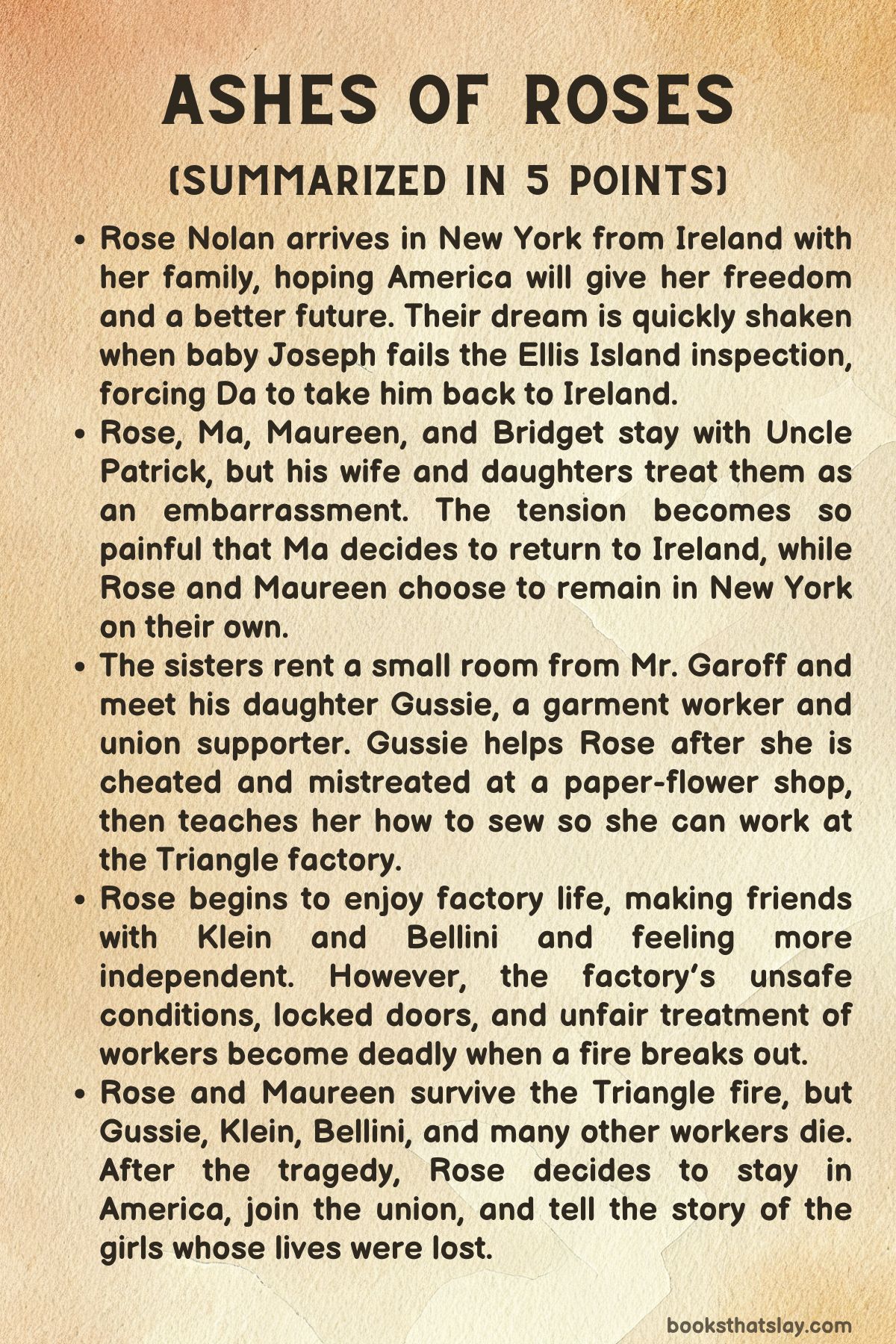
Summary
Rose Nolan arrives in New York Harbor with her family after a hard voyage from Ireland. She is sixteen, restless, and full of hope, though the journey in steerage has been uncomfortable and crowded.
She shares tight sleeping space with her mother, her younger sisters Maureen and Bridget, and her baby brother Joseph, while her father sleeps in the men’s section. When the ship nears New York, Rose goes on deck and sees the Statue of Liberty.
To her, it feels like the beginning of a new life. She imagines America as a place where she may have choices that Ireland never offered her, especially freedom from marrying young and spending her life raising children.
That hope is shaken almost immediately at Ellis Island. The family is separated into inspection lines, and Rose and Maureen endure humiliating medical checks.
The officials examine their eyes with a painful tool, listen to their breathing, and inspect them like problems to be sorted. Rose meets her father afterward and learns that baby Joseph has failed the eye inspection because officials suspect trachoma.
Since the disease is contagious, Joseph cannot enter the country. The family does not have enough money for everyone to return, so Rose’s father decides to take Joseph back to Ireland and leave the others in America.
Rose is devastated, especially because she does not get to kiss her baby brother goodbye.
Without her father, Rose, her mother, Maureen, and Bridget must convince officials that they can support themselves. Rose’s mother claims that she and Rose are skilled seamstresses, carefully making them sound employable without admitting to having illegal work arranged in advance.
Rose also chooses to call herself simply Rose, dropping “Margaret” because she wants a fresh identity in America. The family is allowed through, but even leaving Ellis Island is difficult.
Unescorted women risk being detained, so Rose and her mother pretend a stranger is their relative in order to board the ferry. Once in the city, they are nearly robbed by men pretending to help with their luggage, but an Irish police officer protects them and gives them directions and train fare.
The Nolans go to stay with Rose’s Uncle Patrick, who has settled in New York and become a local politician. Patrick welcomes them, but his German wife Elsa and their daughters, Trudy and Hildegarde, clearly resent the family’s arrival.
Rose notices every slight. Elsa and her daughters view the Nolans as dirty, poor, and foreign, though they hide some of their judgment behind polite behavior.
Rose feels humiliated when their feather bed is beaten outside as if it is infested. She also senses that Elsa’s household, with indoor plumbing and more space than Rose has known, gives Elsa and her daughters another reason to look down on them.
Religious differences deepen the strain. Rose’s mother is shocked to learn that Patrick no longer attends Catholic Mass and that his family goes to a Lutheran church.
She feels betrayed by what she sees as Patrick’s abandonment of Irish Catholic ways. The Nolans find a Catholic church on their own, and Rose finds comfort there because it reminds her of home.
Still, their position in Patrick’s apartment remains uneasy. Rose overhears Elsa asking when they will leave and learns that their presence has disrupted Trudy’s courtship.
Ashamed of being a burden, Rose decides to look for work.
Her first attempts are discouraging. A cobbler mocks her for assuming she can do skilled labor without training.
Other shops turn her away. A department store clerk dismisses her as unsuitable both as a customer and as a worker.
Finally, Rose meets a kind Irish bakery owner who sends her to a paper-flower shop run by Mr. Moscovitz. Rose lies and says she can make flowers, but her first attempt falls apart.
The other girls laugh, though one worker, Tessa, helps her learn. Tessa warns Rose that Moscovitz tests girls’ boundaries when he touches them.
Rose begins to understand that work in America can be unfair and dangerous in ways she had not imagined.
Rose tries to bring flower work home so her mother and Maureen can help. She does not fully understand that by accepting lower pay for home piecework, she is undercutting the girls who work in the shop.
Tessa is angry because Rose’s arrangement may allow Moscovitz to fire others once his orders are filled. At Uncle Patrick’s apartment, Elsa and Trudy discover the Nolans doing sweatshop work in the parlor.
Trudy is horrified and humiliated, especially because her suitor sees it. Maureen attacks Hildegarde after being insulted, and the household conflict becomes impossible to ignore.
Patrick tells Rose’s mother that they can no longer stay.
Rose’s mother decides to return to Ireland with Bridget. Rose is desperate not to leave America.
At the pier, she asks to stay behind alone, planning to return her ticket and make her own way until her father comes back. Maureen refuses to let Rose stay without her.
Their mother reluctantly leaves both girls in New York, making them promise to return to Uncle Patrick, go to school, and write to her. Rose has no intention of going back to Patrick’s apartment.
Instead, she and Maureen search for lodging until they find a tiny room rented by Mr. Garoff, an elderly Jewish immigrant. His daughter Gussie works at the Triangle Shirtwaist Factory and becomes an important friend and guide.
Rose continues trying to earn money from Moscovitz, but he cheats her by rejecting many of the flowers and withholding payment. When she returns to collect her wages, he assaults her.
Rose escapes by biting him, but she leaves behind her coat and receives no money. Back at the room, she breaks down.
Gussie comforts her and tells her about the labor movement, including strikes by working women who fought for better treatment. Gussie insists that Rose face Moscovitz and demand what she is owed.
With Gussie beside her, Rose gets her coat and wages. This moment teaches Rose that silence protects exploiters, not workers.
Gussie then helps Rose learn to use a sewing machine so she can work at the Triangle factory. Jacob Gerstein, a cutter at the factory and a friend of Gussie’s, brings Rose a machine to practice on.
Rose finds him attractive, though it becomes clear that he cares deeply for Gussie. At Triangle, Rose is frightened by the size and speed of the factory.
She learns that workers are locked in during work hours, that women are inspected when they leave, and that the stairs and elevators are controlled in ways that limit their freedom. Early on, Rose injures her finger with the sewing-machine needle, but she keeps going.
Despite the risks, Rose begins to enjoy factory life. She makes friends with two other workers, Rose Klein and Rose Bellini, and they use last names to avoid confusion among the many girls named Rose.
Klein and Bellini introduce her to dime novels, stylish clothing, and the nickelodeon. Rose feels young, excited, and newly American.
She wants to enjoy herself, while Gussie remains focused on union work and warns her about unfair pay, unsafe conditions, and the factory owners’ refusal to respect workers. Rose admires Gussie but thinks she worries too much.
She believes Triangle is better than the flower shop and does not yet understand how dangerous it is.
Maureen, frustrated by school and determined to help earn money, secretly gets hired at the factory through a subcontractor. Rose is furious when she sees her sister among a group of young workers, but Maureen argues that her wages will help bring their family back together.
Rose knows she cannot physically force Maureen to stay in school, so she gives in. This decision later haunts her.
On the day of the fire, Rose wears her “ashes of roses” dress because she plans to go to the nickelodeon after work with Maureen, Klein, and Bellini. At closing time, the workers wait to receive their pay and have their bags inspected.
The tables block movement, the exit is crowded, and escape is slow. Suddenly Rose sees flames.
Panic spreads across the floor. Workers scream, shove, and search for a way out.
Rose hides under a table and realizes that a girl beside her has been trampled to death. Gussie pulls Rose out and pushes her toward escape, then turns back to help an older woman.
Rose reaches a locked door and understands the full horror of the factory’s conditions. Klein and Bellini tell her the windows may be the only way out.
From the ninth floor, Rose sees women jumping and dying on the pavement below. Fire ladders cannot reach them, and safety nets fail.
Klein and Bellini either fall or jump, and Rose loses them in the chaos. Refusing to die at the window or in the flames, Rose soaks herself with water, pulls her wet skirts over her head, and runs through the fire toward the elevators.
She jumps into an elevator shaft and clings to the cable as bodies fall around her.
Rose survives and is pulled out by firemen, burned and shaken. She immediately searches for Maureen.
The streets around the factory are filled with smoke, blood, bodies, and frantic relatives. Rose returns home, but Maureen is not there.
She goes back to the scene and later to the police station and morgue, trying to identify the dead. Her guilt worsens when she learns that Maureen might have been safe if she had left from the eighth floor instead of going upstairs to meet Rose.
At last, Rose finds Maureen alive with Mr. Garoff. Maureen escaped by reaching the roof, where students from a nearby building helped workers cross over on a ladder.
Gussie is not so fortunate. At the morgue, Rose and Maureen identify the bodies of Bellini and Klein, then recognize Gussie by the steel plate on her shoe because her face is badly burned.
Mr. Garoff is crushed. The Jewish community helps arrange Gussie’s funeral, and the Women’s Trade Union League helps with expenses and his return to Russia.
Rose and Maureen are left grieving and uncertain, but they also understand that they have survived something that must change them.
In the aftermath, Rose sees strangers treating the burned factory like a spectacle. A vendor even tries to sell supposed belongings of the dead.
Rose is furious and knocks his tray away. She realizes that the workers who died were not nameless victims; they were girls with families, plans, jokes, friendships, and futures.
Jacob tells her that 146 people died. Rose thinks of Gussie, Klein, and Bellini and recognizes the importance of remembering them honestly.
By the end of Ashes Of Roses, Rose is no longer the hopeful girl who believed America would simply hand her freedom. She has learned that independence carries danger, that work can exploit the desperate, and that injustice survives when people are too afraid or too tired to challenge it.
Yet she chooses to stay. She plans to ask Uncle Patrick for help, write to her parents, find work again, and join the union.
Most of all, she resolves to tell the story of the Triangle fire and the young women whose lives were lost, so their suffering will not be ignored.
Characters
Rose Nolan
Rose Nolan is the central character of Ashes Of Roses, and her growth gives the book its emotional and moral shape. At the beginning, she is a hopeful sixteen-year-old immigrant who sees America as a place where she can become someone different from the girl she might have been in Ireland.
She does not want to be pushed quickly into marriage, motherhood, and a narrow life decided by poverty and tradition. This desire for independence makes her brave, but it also makes her impulsive.
She lies to get work, hides things from adults, refuses to return to Ireland, and takes risks because she believes staying in America is the only way to have a future. Rose’s courage is not perfect or polished; it often comes from fear, pride, desperation, and stubbornness.
As the book continues, Rose learns that freedom in America is not simple. She faces humiliation at Ellis Island, prejudice from relatives, exploitation by employers, sexual danger from Mr. Moscovitz, and the brutal reality of unsafe factory labor.
These experiences force her to mature quickly. Her early belief that work will automatically give her dignity changes when she sees how poor immigrant girls are treated as replaceable.
Rose is also deeply protective of Maureen, though she cannot always control her sister’s choices. Her guilt after the Triangle fire shows how seriously she takes responsibility, even when the disaster is not truly her fault.
By the end of the story, Rose has changed from a girl chasing a dream into a young woman who understands that survival must be joined with memory, justice, and action. Her decision to join the union and tell the truth about the fire shows that she has found a stronger kind of independence.
Maureen Nolan
Maureen is Rose’s younger sister, and she often acts as Rose’s opposite. Where Rose tries to measure danger and think through consequences, Maureen speaks and acts quickly.
She is sharp-tongued, bold, and often defiant, especially when she feels that someone is looking down on her family. Her fight with Hildegarde shows both her fierce loyalty and her lack of restraint.
Maureen cannot quietly accept insult, and this makes her both admirable and troublesome. She does not have Rose’s patience for strategy or appearances; she wants to answer disrespect immediately.
Maureen’s desire to work instead of attend school reveals another side of her character. She is not lazy or childish; she wants to contribute.
She understands that money may help reunite the family, and she resents being treated as too young to make sacrifices. At the same time, her eagerness to work places her in danger.
Her secret entry into the factory shows how poverty pushes children into adult burdens before they are ready. Maureen’s survival in the fire is one of the book’s greatest reliefs, but it also strengthens the story’s criticism of child labor.
She is a child who has been forced to think like a wage earner. Her final belief that she and Rose should stay in America shows her resilience.
Even after terror and loss, Maureen does not give up easily.
Ma Nolan
Ma Nolan is a complex figure because she is both loving and limited by fear. She travels to America with her family, but she never embraces the move with the same hunger that Rose does.
Her attachment to Ireland, Catholic tradition, and familiar ways makes America feel less like opportunity and more like threat. When Joseph is rejected at Ellis Island and Da returns with him, Ma is emotionally shattered.
Her grief is intense, and her helplessness in that moment shows how immigration can tear families apart without giving them time to prepare.
Ma is practical when she must be. She exaggerates Rose’s sewing ability to convince officials that the family can support itself, and she helps make paper flowers when the girls need money.
Yet her pride also shapes her choices. She does not want to live on Patrick’s charity, and she is deeply wounded by Elsa’s judgment.
Her decision to return to Ireland is not simple weakness; it comes from exhaustion, humiliation, homesickness, and fear of being stranded without her husband. Still, from Rose’s point of view, Ma’s choice feels like surrender.
When she allows Rose and Maureen to stay behind, she shows that she understands something important about her daughters: their futures may no longer belong entirely to the old world. Ma represents the painful pull of home, tradition, and family duty in a story where the younger generation is already being changed by America.
Da Nolan
Da Nolan appears for a limited part of the book, but his presence remains important. He is the parent most closely associated with Rose’s hope for America.
He believes work and opportunity are possible there, and he imagines a future in which the family can rebuild itself. His confidence helps carry the family through the voyage, but Ellis Island quickly exposes how fragile that hope is.
When Joseph is diagnosed with trachoma, Da must make an impossible decision. By taking Joseph back to Ireland, he protects the baby and gives the rest of the family a chance to enter America, but he also leaves Ma and the girls vulnerable.
Da’s decision shows love mixed with practical judgment. He knows Ma may not return if she goes back, so he chooses to take Joseph himself.
That choice reveals his understanding of his wife and his determination to keep the American plan alive. Even after he leaves the story physically, he remains a symbol of the divided immigrant family.
Rose often measures her choices against the hope that Da will return and help them establish a stable life. His absence is one of the reasons Rose is forced into responsibility so quickly.
He represents both protection and loss: the father who wants to provide, but who cannot shield his family from the systems that separate, judge, and exploit them.
Joseph Nolan
Joseph is the baby of the Nolan family, and although he does not act independently in the story, he has a major effect on the plot. His rejection at Ellis Island changes everything.
Because officials believe he has trachoma, he becomes the reason the family is divided before their American life can even begin. Through Joseph, the book shows the cold power of immigration inspection.
A baby who cannot understand what is happening becomes the center of a decision that changes the lives of everyone around him.
Joseph also represents innocence caught in history. He has no control over disease, travel, poverty, or official rules, yet his condition determines whether the family can stay together.
Rose’s pain over not kissing him goodbye shows how sudden and cruel the separation is. Joseph is also tied to Ma’s homesickness and Da’s sacrifice.
His return to Ireland keeps part of the family rooted in the old country, while Rose and Maureen move deeper into the American struggle. In that sense, Joseph becomes a quiet symbol of what immigration costs: not only money and labor, but closeness, childhood, and family unity.
Bridget Nolan
Bridget, Rose’s younger sister, is less developed than Rose and Maureen, but she plays an important role in showing the family’s vulnerability. She is young enough to remain under Ma’s care and does not share the older girls’ fierce desire to stay in America.
Her presence reminds the reader that the Nolan family includes children who cannot make decisions for themselves and must live with the consequences of adult choices. When Ma returns to Ireland with Bridget, the separation becomes even more painful because Rose and Maureen are not only leaving their mother but also losing daily contact with a younger sibling.
Bridget also helps reveal Rose’s changing role. Once Ma and Bridget leave, Rose can no longer think of herself simply as a daughter.
She becomes Maureen’s protector and partner in survival. Bridget’s departure marks the breaking of the family into pieces: Da and Joseph in one place, Ma and Bridget in another, and Rose and Maureen alone in New York.
This division gives the book much of its emotional pressure. Bridget may not shape events through action, but she helps show what is at stake when poverty and immigration force families into unbearable choices.
Uncle Patrick
Uncle Patrick is a divided character. He is Irish by birth, but he has built a new identity in America as a local political figure.
He is kinder than Elsa and more willing to help the Nolans, yet he has also changed in ways that disturb Ma. His decision to marry a Lutheran woman and no longer follow Catholic practice makes him seem, to Ma, as if he has abandoned part of himself.
To Rose, Patrick is both familiar and distant. He resembles Da in some ways, but his household does not feel safe or welcoming.
Patrick’s kindness has limits. He allows Ma and the girls to stay, offers support, and later gives them tickets when the household conflict becomes too great.
He does not throw them into the street, but he also does not fully challenge Elsa’s contempt. His position as a councilman matters to him, and the presence of poor immigrant relatives doing sweatshop work in his parlor threatens his respectability.
Patrick represents a version of immigrant success that has required compromise. He has gained status, but that status separates him from newer arrivals like Rose.
His character shows that America can create distance between people who once shared the same background.
Elsa
Elsa is one of the book’s clearest examples of social prejudice within immigrant communities. She is not openly cruel in every action, but her politeness often hides judgment.
She sees the Nolans as dirty, backward, and embarrassing. Her concern with cleanliness, order, reputation, and proper behavior makes Rose feel constantly watched and measured.
Elsa’s household becomes a place where the Nolans are technically sheltered but emotionally unwelcome. This is important because the book does not show prejudice only between native-born Americans and immigrants; it also shows how immigrants who have gained stability may look down on those who arrive later.
Elsa’s behavior is shaped by class anxiety as much as personal dislike. She worries that Rose’s family will damage her household’s respectability and interfere with her daughter’s courtship.
When she discovers the paper-flower work, her reaction is not compassion for their need to earn money but horror that sweatshop labor has entered her home. Elsa is not a villain in a simple sense; she does perform social duties and maintains a disciplined household.
However, her inability to see the Nolans with generosity makes her a painful figure. She shows how dignity can be denied not only through open hatred but also through quiet superiority.
Trudy
Trudy reflects Elsa’s values in a younger and more dramatic form. She is concerned with appearance, courtship, and social standing, and she sees Rose’s family as a threat to all three.
Her embarrassment when Walter sees the Nolans working in the parlor reveals how deeply she associates manual labor and immigrant poverty with shame. Trudy does not view Rose and her family as relatives in need; she views them as a social problem.
This makes her an important contrast to Rose, who is also young and concerned with clothes, romance, and American life but who cannot escape the economic realities Trudy wants hidden.
Trudy’s fainting and outrage show her privilege within the household. She can afford to be humiliated by the sight of labor because she is not the one who must depend on that labor to eat.
Her character helps expose the difference between wanting to look respectable and needing to survive. Trudy is not central to the later factory plot, but she helps push Rose out of Patrick’s home and into the world where she must support herself.
In that way, Trudy’s rejection indirectly moves Rose toward the experiences that define her growth.
Hildegarde
Hildegarde is younger than Trudy but equally shaped by her family’s sense of superiority. She taunts Rose and Maureen, and her insults help trigger Maureen’s physical attack.
Hildegarde’s behavior shows how prejudice is learned inside the home. She repeats the attitudes she sees in Elsa and Trudy, treating the Nolans as inferior because of their poverty, Irishness, and lack of American polish.
Her cruelty is childish, but it still causes real harm because the Nolans are already in a powerless position.
Hildegarde also serves as a contrast to Maureen. Both girls are young, sharp, and quick to react, but they stand on opposite sides of the household divide.
Hildegarde has security and uses it to mock; Maureen has insecurity and uses anger to defend herself. Their conflict shows how children absorb adult tensions and turn them into direct hostility.
Hildegarde may not fully understand the larger class and ethnic issues around her, but she participates in them. Through her, the book shows that social contempt does not need to be mature or reasoned to be damaging.
Tessa
Tessa is one of Rose’s first real guides in the working world. She helps Rose learn to make paper flowers and speaks honestly about Mr. Moscovitz’s behavior.
Her warning about his touch is one of the earliest signs that Rose has entered a world where young working women must constantly guard themselves. Tessa’s kindness is practical rather than sentimental.
She teaches Rose because she recognizes another immigrant girl trying to survive, but she also expects Rose to understand the consequences of her choices.
When Rose accepts home piecework for lower pay, Tessa’s anger is justified. She sees that Rose’s arrangement threatens the workers already in the shop.
This conflict is important because it teaches Rose that survival choices can hurt others in the same position. Tessa is not simply a friend or helper; she is a worker who understands exploitation more clearly than Rose does at that stage.
Her response introduces one of the book’s central labor questions: poor workers are often pushed into competing with one another when the real power belongs to employers. Tessa’s role may be brief, but she helps Rose begin to understand workplace solidarity.
Mr. Moscovitz
Mr. Moscovitz is one of the most exploitative figures in the book. He runs the paper-flower shop with charm, teasing, and false friendliness, but underneath that manner is a willingness to cheat and prey on vulnerable girls.
He lets Rose work because he can benefit from her desperation. He refuses to pay fairly, rejects work to reduce wages, and takes advantage of her ignorance about labor practices.
His shop shows Rose that employment does not automatically mean independence; without protection, work can become another form of control.
His assault on Rose reveals the full danger of his power. He understands that immigrant girls without family protection, money, or legal knowledge are easy targets.
Rose’s confrontation with him afterward, supported by Gussie, becomes a turning point. For the first time, she challenges an employer directly and sees that fear can be used against men like him if workers stand together.
Mr. Moscovitz represents the small-scale predator within the larger world of immigrant labor. He is not as historically large as the Triangle owners, but his actions show the daily abuse that poor working women could face before they even reached factory life.
Gussie Garoff
Gussie is one of the strongest moral forces in Ashes Of Roses. She is young, only a little older than Rose, but she carries the weight of an adult life.
She supports her father, works long hours, and remains committed to union activism even when it costs her status and pay. Gussie understands the garment industry not as a place of opportunity alone but as a system where workers must fight constantly for safety, wages, and dignity.
At first, Rose sees her as too serious, too political, and too unwilling to enjoy life. Over time, the reader sees that Gussie’s seriousness comes from experience, not bitterness.
Gussie’s compassion is practical and brave. She comforts Rose after Moscovitz assaults her, teaches her to use a sewing machine, helps her get work, and insists that she stand up for herself.
She also defends Rose and Maureen to her father, showing that her solidarity crosses ethnic and religious lines. Her death in the Triangle fire is devastating because she is one of the characters most aware of the danger.
She warned others, fought for reform, and still became a victim of the very conditions she opposed. Gussie’s character gives the book its clearest connection between personal suffering and collective action.
Her memory pushes Rose toward union commitment and public truth-telling.
Mr. Garoff
Mr. Garoff is a weary but compassionate immigrant father. He is cautious when Rose and Maureen first ask for lodging, but he allows them to stay, and his home becomes their safest refuge in New York.
He is old, tired, and physically diminished by years of hard work. Through him, the book shows what immigrant labor can do to the body over time.
He came to America seeking survival, but the conditions he faced damaged his health and left him dependent on Gussie.
His relationship with Gussie is loving but strained. He worries that her union work is useless or dangerous, and he is troubled by her distance from religious observance.
Yet his criticism comes from fear, not lack of love. After the fire, his grief is almost unbearable.
Identifying Gussie’s body destroys the fragile life he had left in America, and his plan to return to Russia shows that America has taken more from him than it gave. Mr. Garoff’s character deepens the book’s view of immigration by showing that not every immigrant dream ends in success.
Sometimes survival itself becomes too costly.
Jacob Gerstein
Jacob Gerstein is a kind and steady presence connected to the factory world. As a cutter, he occupies a slightly different position from the women sewing shirtwaists, and the book notes that men are treated differently from women in workplace inspections and pay.
Jacob’s ability to bring Rose a sewing machine and fabric scraps shows his usefulness, but his importance is emotional as well. Rose is initially drawn to him, but his deeper attachment is to Gussie.
This creates a quiet emotional tension without turning the story into a romance.
Jacob’s love for Gussie becomes especially meaningful after her death. His revelation that he had asked her to marry him adds another layer to the loss.
Gussie was not only a worker, activist, and daughter; she was also a young woman with the possibility of personal happiness. Jacob also supports Rose after the fire, especially when she confronts the vendor selling supposed relics from the tragedy.
He represents decency within a brutal environment. He cannot prevent disaster, but he honors the dead and stands beside the living.
Rose Klein
Rose Klein is one of Rose Nolan’s factory friends and helps introduce her to the pleasures of young working women’s social life. She is lively, confident, and interested in clothes, boys, books, and entertainment.
Through Klein, Rose experiences a version of American girlhood that feels exciting and modern. Klein encourages Rose to read dime novels, go to the nickelodeon, and enjoy the small freedoms wages can buy.
She helps Rose feel that factory work is not only hardship but also a doorway into friendship and independence.
Klein’s death in the fire is especially painful because the reader has seen her as full of ordinary desires. She is not presented only as a worker; she is a girl with humor, taste, plans, and social confidence.
Her final moments near the window show the impossible choices faced by those trapped in the factory. Klein’s character helps make the tragedy personal.
She stands for the many young women whose lives were reduced in public memory to a death toll, though each one had a full inner and social life.
Rose Bellini
Rose Bellini is another of Rose Nolan’s close factory friends. Like Klein, she brings warmth, fun, and companionship into Rose’s new life.
Bellini is practical about men, warning that girls should not let boys pay for them because payment can create expectations. This detail shows that she understands the social risks young working women face, even outside the factory.
Bellini’s friendship helps Rose feel less alone and gives her a place among girls who are also trying to balance work, pleasure, caution, and independence.
Bellini’s death is one of the losses that changes Rose permanently. The moment Rose finds Bellini’s hat after the fire is a quiet but crushing recognition that her friend is gone.
Bellini represents the ordinary beauty of a life interrupted. She is not a public leader like Gussie, but her life matters just as much.
Her presence in the book reminds the reader that the Triangle fire killed not only activists and laborers, but friends, daughters, readers, moviegoers, and girls who had plans for the evening after work.
Colleen Murphy
Colleen Murphy plays a small but important role as one of the first strangers in America to show Rose genuine kindness. As an Irish bakery owner, she offers Rose warmth after several humiliating attempts to find employment.
She cannot give Rose a job, but she gives her food and directs her toward possible work. In a city that often feels hostile and suspicious, Colleen’s kindness gives Rose a brief sense of ethnic connection and human sympathy.
At the same time, Colleen’s recommendation indirectly leads Rose to Mr. Moscovitz’s shop, which becomes dangerous. This does not make Colleen responsible for what happens; instead, it shows how limited the options are for poor immigrant girls.
Even well-meant advice can lead into exploitative labor because the city’s work system is full of traps. Colleen represents the informal networks immigrants depend on, where a friendly word or address can matter greatly, even when it cannot guarantee safety.
Walter
Walter is Trudy’s suitor, and his role is mainly to reveal the social tension inside Patrick’s household. His presence during the discovery of the paper-flower work turns Trudy’s embarrassment into a crisis.
For Trudy and Elsa, Walter’s opinion matters because he represents courtship, respectability, and the family’s public image. The Nolans’ poverty becomes intolerable to them when it is witnessed by someone outside the household.
Walter is not deeply developed, but he serves a clear purpose. He shows how women’s reputations and marriage prospects could be affected by class perception.
Trudy fears being associated with immigrant labor because it may lower her in Walter’s eyes. Through him, the book shows that respectability is often maintained by hiding the labor and poverty that make survival possible.
Leah
Leah appears after the fire as a figure of care, community, and mourning. She helps Mr. Garoff and the girls after Gussie’s death, offering tea, food, bandages, and comfort.
Her presence shows the strength of immigrant religious and neighborhood networks. When official systems can only count bodies and manage crowds, people like Leah provide the human care that survivors need.
Leah’s tenderness is especially important because Rose and Maureen are nearly alone by this point. They have no mother with them, no father, and no secure home.
Leah’s song and care help them sleep after trauma, and her treatment of Rose’s burns shows practical compassion. She is not a major character in terms of plot, but she helps show how communities respond to catastrophe through shared responsibility.
Themes
Immigration, Hope, and Disillusionment
Immigration in the novel begins with a powerful promise: the sight of the Statue of Liberty, the skyline of New York, and Rose’s belief that America may give her a freer life. For Rose, America first appears as an escape from the limits of poverty and tradition in Ireland.
She wants work, choice, and self-direction. Yet the book quickly complicates that hope.
Ellis Island is not a simple gateway but a place of inspection, fear, humiliation, and separation. Joseph’s rejection divides the Nolan family before they even begin their new life, showing that immigration can demand terrible personal costs.
Once in New York, Rose discovers that arrival does not equal belonging. Her family is treated as dirty and backward even by relatives who were once immigrants themselves.
Work is difficult to find, housing is hard to secure, and every choice is shaped by money. Still, the book does not present hope as foolish.
Rose’s dream changes, but it does not disappear. By the end, she understands that America is not automatically generous or fair, yet she still chooses to stay and fight for a better life.
Ashes Of Roses presents immigration as a painful movement between possibility and loss, where survival depends on courage, adaptation, and the refusal to be erased.
Labor Exploitation and Workers’ Rights
Work in the story is never just a way to earn money; it is a test of power. Rose first believes that employment will help her become independent, but her experiences show how easily poor immigrant girls can be exploited.
The paper-flower shop introduces unfair wages, unpaid labor, competition among workers, and sexual danger. Mr. Moscovitz uses Rose’s ignorance and need against her, proving that a job can become a place of control rather than freedom.
The Triangle factory at first seems better because it offers wages, friendship, and a sense of modern city life. Yet Gussie repeatedly points out the truth beneath that surface: locked doors, crowded floors, unpaid overtime, unequal treatment of women, and management practices that place profit above human life.
Rose’s early dismissal of Gussie’s warnings is important because it shows how unsafe systems can appear normal to those who need work badly enough. The fire reveals the deadly result of ignoring workers’ rights.
The tragedy is not presented as random misfortune but as the consequence of choices made by people with power. Through Gussie, the union, and Rose’s final resolution, the book argues that dignity at work requires collective action, not silent endurance.
Family, Separation, and Chosen Community
Family in the book is both a source of love and a source of pain. The Nolan family begins the journey together, but America breaks them apart almost immediately.
Da and Joseph return to Ireland, Ma and Bridget later follow, and Rose and Maureen remain in New York alone. Each separation is shaped by poverty, immigration rules, fear, and conflicting ideas of what the future should be.
Rose loves her family deeply, but she also resists being bound by her mother’s desire to return home. This tension makes the family relationships feel real: love does not always mean agreement, and staying together is not always possible.
As Rose loses the daily protection of her parents, she begins to form a chosen community. Gussie, Mr. Garoff, Jacob, Klein, Bellini, Leah, and even brief helpers like Colleen Murphy become part of her survival.
These relationships cross lines of nationality, religion, and language. The Jewish Garoff household becomes safer for Rose than her own uncle’s apartment, proving that kindness is not limited to blood relations.
After the fire, community becomes even more important because grief is too heavy for one person to carry alone. The book shows that family can be inherited, but it can also be built through care, loyalty, and shared struggle.
Identity, Belonging, and Becoming American
Rose’s identity changes throughout the story, beginning with her decision to call herself Rose instead of Margaret Rose. That small act reveals her desire to shape herself in America rather than simply carry forward the identity given to her in Ireland.
She wants to be modern, independent, and capable of choosing her own future. Clothing, work, movies, dime novels, wages, and friendships all become part of her idea of becoming American.
Yet the book makes clear that belonging is complicated. Rose is seen as a greenhorn, a poor Irish girl, a burden in Elsa’s home, and a replaceable worker in the labor market.
She wants acceptance, but she also does not want to lose her dignity or forget where she came from. Other characters show different versions of assimilation.
Uncle Patrick has gained status but seems distant from his Irish Catholic roots. Elsa’s family uses respectability to separate itself from poorer immigrants.
Ma resists American change and clings to Ireland. Gussie, meanwhile, offers a different model: she is shaped by immigrant struggle but uses that experience to fight for justice.
Rose’s final identity is not simply Irish or American. She becomes someone formed by both memory and action, someone who understands that belonging must include the right to speak, work safely, and be treated as fully human.