The Absent Author Summary, Characters and Themes
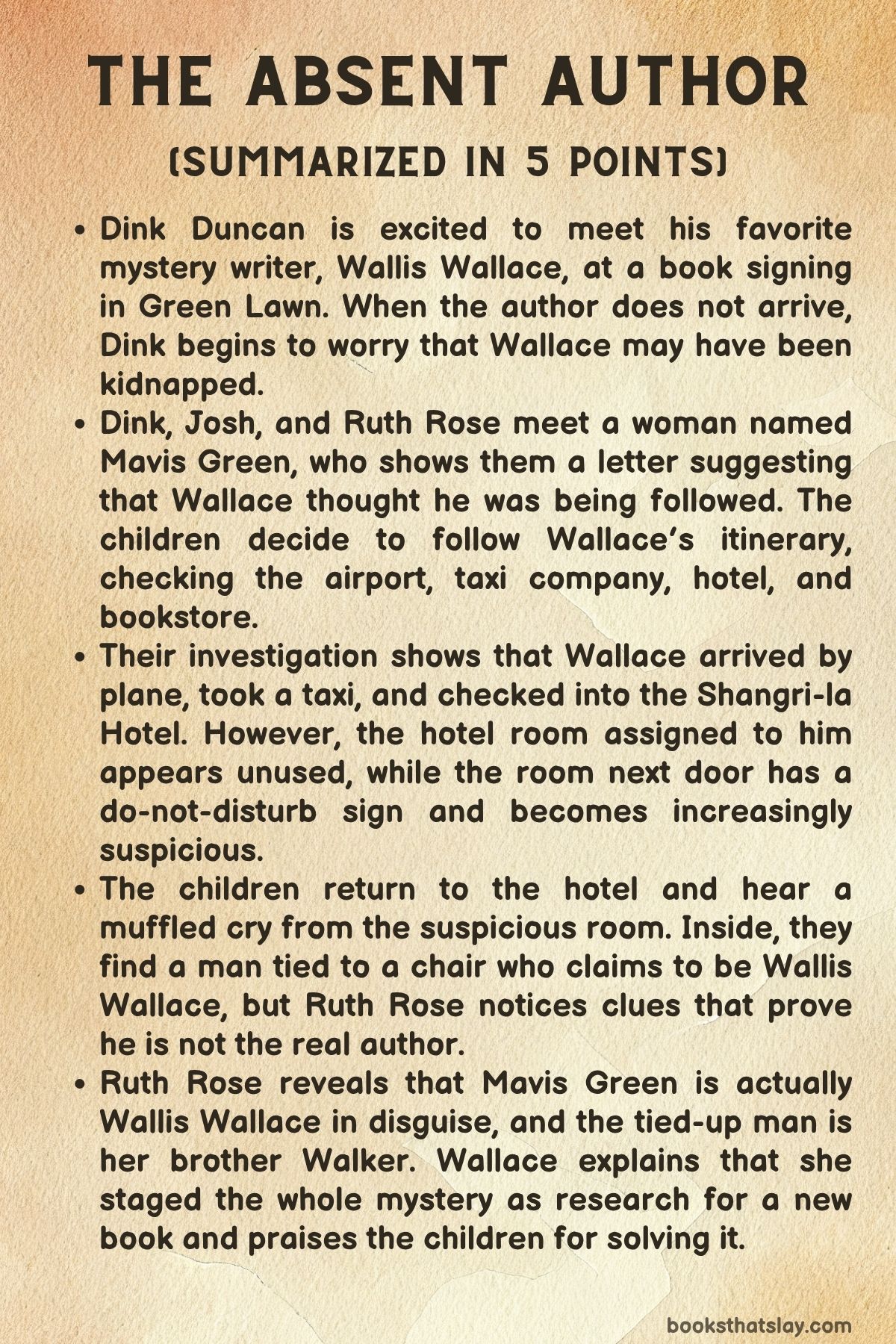
The Absent Author by Ron Roy is a children’s mystery about three young friends who turn an ordinary author event into a real investigation. Set in Green Lawn, Connecticut, the book follows Dink Duncan, Josh, and Ruth Rose as they try to find Wallis Wallace, a famous mystery writer who fails to appear at a scheduled book signing.
What begins as worry soon becomes detective work, with clues hidden in letters, hotel records, strange behavior, and careful observations. The story is light, clever, and fast-moving, built around curiosity, friendship, and the fun of solving a puzzle. It’s the 1st book of the A-Z Mysteries series by the author, with the title signifying A.
Summary
Dink Duncan is very excited because his favorite mystery writer, Wallis Wallace, is supposed to come to Green Lawn for a book signing. Dink, whose full name is David Donald Duncan, has personally written to the author and invited him to visit the Book Nook, the local bookstore.
For Dink, this is not just another event. Wallis Wallace is someone he deeply admires, and the idea of meeting him makes Dink both thrilled and nervous.
His best friend Josh is with him as he gets ready, watching Dink pack many Wallis Wallace books into his backpack so they can all be signed.
Josh is not as serious about the author as Dink is, but he agrees to come along. The boys look at the backs of the books and notice details about Wallis Wallace’s life.
One book says that Wallace lives in a castle in Maine called Moose Manor. Dink imagines becoming a famous writer someday, while Josh imagines becoming a famous artist.
Neither of them knows exactly what Wallis Wallace looks like, though Dink has sent the author a photograph of himself. Josh says he can draw the author when they meet him.
Before going to the bookstore, the boys stop to get their friend Ruth Rose. She also enjoys Wallis Wallace’s books and has one ready to be signed.
The children wonder whether the author will read from a new book or talk about his work. Dink shares letters he received from Wallis Wallace.
One letter thanks Dink for sending his picture, and another mentions the author’s plan to visit Green Lawn and do research while in Connecticut. The signature on the letters is large and loopy.
When the children reach the Book Nook, they look through the window and see a table prepared for the signing. There is a welcome sign, but Wallis Wallace is not there.
Dink rushes inside, worried because they are only a few minutes late. They ask Tommy Tonko, a boy at the store, where the author is, but Tommy says Wallace has not arrived.
Mr. Paskey, the bookstore owner, looks anxious but tells everyone that the author should be there soon.
The crowd waits, but Wallis Wallace still does not appear. Dink becomes increasingly worried as the minutes pass.
He looks again at one of Wallace’s letters and notices a strange line saying that the only thing that could keep the author from coming would be being kidnapped. Dink takes this seriously and begins to fear that Wallace really has been kidnapped.
Mr. Paskey eventually apologizes and ends the event. Most people leave disappointed, but Dink cannot let go of the idea that something has gone wrong.
Outside the store, Josh and Ruth Rose think Dink’s kidnapping theory is unlikely. Then they notice a woman watching them.
She is dressed mostly in brown, with a red scarf, half-glasses, and her hair in a neat bun. She carries a book with a moose on the cover and introduces herself as Mavis Green.
She says she heard them talking about Wallis Wallace possibly being kidnapped. Mavis shows the children a letter she received from Wallace, in which he says he thinks someone may be following him.
The letter also says Wallace was looking forward to having lunch with her after the signing.
The children begin to wonder why someone might kidnap Wallis Wallace. Since he is a famous writer, they think money could be a motive.
Officer Fallon, a local police officer and the grandfather of Jimmy, another boy from the signing, approaches them. The children show him the letters, but he does not take the kidnapping idea very seriously.
He thinks Wallace may simply have missed his flight. Dink is not convinced.
Because he invited Wallace to Green Lawn, he feels personally responsible for whatever has happened.
The children and Mavis return to the Book Nook to talk to Mr. Paskey. He looks nervous but advises them not to jump to conclusions.
He shows them the author’s itinerary. Wallis Wallace was supposed to arrive at the airport, take a taxi to the Shangri-la Hotel, attend the book signing, have lunch, and then leave later that day.
Dink decides they should follow the route Wallace was supposed to take. He marks the airport, taxi, hotel, and bookstore as the key places to investigate.
The group goes to Ellie’s Diner so Dink can use the phone. Mavis offers to buy the children ice cream.
Dink refuses because he is too worried, but Josh orders green ice cream, which Mavis says is also her favorite. Dink calls the airport and learns that Wallis Wallace did arrive on the correct flight the previous evening.
Since the airport confirms the author’s arrival, Dink crosses the airport off the itinerary and turns his attention to the taxi company.
The children and Mavis go to the taxi station near the river. There they learn that a driver named Maureen Higgins picked up Wallis Wallace from the airport.
Maureen is eating lunch nearby, and when the children question her, she confirms that she picked Wallace up at exactly the right time. She describes him as strange-looking because he wore a large hat, a raincoat, and sunglasses even though it was night.
He did not speak during the ride. Maureen says she dropped him off at the Shangri-la Hotel and that he paid her with a twenty-dollar bill.
She remembers he smiled as if he knew a secret.
With the airport and taxi both confirmed, the group goes to the Shangri-la Hotel. At the front desk, they meet Mr. Linkletter, a sad-looking man with a mustache.
At first, he refuses to give out information about guests because of hotel rules. When Ruth Rose explains that Wallis Wallace may be missing, and the children show him the itinerary and letters, he checks the hotel register.
He confirms that Wallace arrived and checked into the hotel. The register shows a loopy signature matching the one on Dink’s letters.
Wallace was assigned to Room 303.
The children also notice that someone checked into the room next door shortly after Wallace arrived, but the signature is smudged and difficult to read. Mr. Linkletter calls Wallace’s room, but there is no answer.
This worries the children even more. Ruth Rose asks to go upstairs, but Mr. Linkletter refuses, again citing hotel rules.
Josh jokingly suspects Mr. Linkletter may be part of the kidnapping plot.
A man wearing a red cap appears and offers help. He says he knows the maid who cleans the third floor and gives the children her name and address.
The maid is Olivia Nugent, known as Livvy, and Ruth Rose remembers that Livvy used to babysit her. The group visits Livvy at the Acorn Apartments.
Livvy is home with her children. She tells them that Room 303 did not look as if anyone had slept there.
She also says Room 302 had a do-not-disturb sign on the door, so she did not clean it. This information is troubling because Wallace was supposed to be in Room 303, yet the room showed no signs of use.
The children take a break to eat and think. Dink, Josh, and Ruth Rose go to Dink’s house for a backyard picnic.
They review what they know. Wallace arrived at the airport, took a taxi, checked into the hotel, and then vanished.
Josh suspects nearly everyone they have met, including Mr. Paskey, Maureen, Mr. Linkletter, and Livvy. Ruth Rose recalls advice from a Wallis Wallace mystery: the more a detective knows about the victim, the easier it is to solve the crime.
They begin looking at Wallace’s books for information about him.
They learn that Wallis Wallace likes gardening, supports wildlife conservation, lives at Moose Manor, and has green as a favorite color. These details seem small, but Ruth Rose senses that something about them matters.
When Dink’s mother arrives and asks about the book signing, Josh spills lemonade on Dink’s pants to distract her, because the children know she would not approve of their investigation. They decide to return to the Shangri-la Hotel and meet Mavis again.
At the hotel, Mavis is waiting. Dink notices her red scarf has the letter M on it.
The children tell her what they have figured out and go inside to confront Mr. Linkletter with their theory. They believe Wallis Wallace may be hidden in Room 302, the room with the do-not-disturb sign.
Mr. Linkletter reluctantly agrees to take them upstairs. Room 303 seems ordinary, but Room 302 still has the sign on the door.
When they knock, they hear a muffled voice calling for help.
Mr. Linkletter forces the door open. Inside, they find a man with curly blond hair tied to a chair with a towel in his mouth.
They untie him, and he claims to be Wallis Wallace. He says two men from room service knocked on his door, dragged him into Room 302, and tied him up.
He recognizes Dink and asks how the children found him. Dink explains that they followed the itinerary.
At first, it seems the mystery has been solved. But Ruth Rose notices something wrong.
She studies Mavis’s red scarf and then says the man in the chair is not Wallis Wallace. Instead, she declares that Mavis is the real author.
Ruth Rose explains her reasoning. The letters on Mavis’s scarf looked like Ms, but when turned upside down, they became Ws for Wallis Wallace.
The man in the chair said he lived in a little cottage, but the children know Wallace lives in a castle. Mavis has a moose design on her bag, matching Moose Manor.
Her last name, Green, connects to Wallace’s favorite color.
Mavis admits Ruth Rose is right. She is Wallis Wallace.
The man tied to the chair is her brother, Walker. She explains that she created the entire fake kidnapping as research for a new book about children solving the disappearance of a mystery writer.
Dink’s letter gave her the idea, and she planted hints in her own letter, including the remark about being kidnapped. Mr. Paskey knew about the plan, which explains why he acted nervous.
Wallis Wallace explains how she checked into the hotel, then disguised herself again and checked into the next room using a blond wig. She accidentally started signing her real name in the register, which is why the second signature was smudged.
She tied up Walker as part of the act and then appeared as Mavis Green to join the investigation. The children are surprised, especially Dink, who had assumed Wallis Wallace was a man.
Wallis Wallace praises Dink, Josh, and Ruth Rose for being excellent detectives. Ruth Rose asks why Wallace hides her identity as a woman.
Wallace explains that having other identities helps her research. In the end, she tells the children that she enjoyed the adventure and says she will dedicate her new book to her three new friends.
The mystery ends not with a crime, but with a clever lesson in observation, clues, and the power of young detectives to notice what adults miss.
Characters
Dink Duncan
Dink Duncan is the central young detective in The Absent Author and the character whose admiration for Wallis Wallace starts the entire adventure. His real name, David Donald Duncan, gives him a slightly formal identity at home, but as Dink he is curious, energetic, and determined.
He is deeply invested in Wallis Wallace’s books, not only as a reader but as someone who dreams of becoming a writer himself. This explains why the author’s disappearance affects him so strongly.
Dink does not treat the missed signing as a simple inconvenience; he immediately feels that something serious may have happened and, more importantly, that he may be responsible because he invited Wallace to Green Lawn. His guilt becomes a major part of his motivation.
Dink is observant, organized, and practical. He uses the itinerary almost like a detective’s map, crossing off confirmed locations and narrowing the search step by step.
He is not always right, and his fear sometimes pushes him toward dramatic conclusions, but his instincts keep the group moving. In the book, Dink represents the kind of child detective who combines imagination with action.
He cares about truth, loyalty, and responsibility, and by the end he proves that his love of mysteries has taught him to think seriously when faced with a real puzzle.
Josh
Josh is Dink’s best friend and adds humor, skepticism, and creative energy to the story. At first, he does not share Dink’s intense excitement about meeting Wallis Wallace, and his jokes about trading attendance for Dink’s guinea pig show his playful personality.
Josh often lightens tense moments, but he is not just comic relief. He is imaginative in his own way, dreaming of becoming a famous artist and offering to draw Wallis Wallace when they meet him.
His creativity affects how he sees the investigation, though it also makes him suspicious of nearly everyone. Josh is quick to invent dramatic theories, including the idea that several adults might all be working together in a kidnapping plot.
This habit can make him seem impulsive, but it also keeps the group open to possibilities. He is loyal to Dink and Ruth Rose, joining the investigation even when it becomes stranger than expected.
His quick thinking appears when he spills lemonade to distract Dink’s mother, protecting the group’s secret detective work. In The Absent Author, Josh gives the detective team liveliness and comic confidence.
He may not solve the central clue, but his presence helps balance Dink’s seriousness and Ruth Rose’s careful reasoning.
Ruth Rose
Ruth Rose is the sharpest observer among the three children and the one who finally solves the mystery. She is intelligent, calm, and attentive to details that others either overlook or do not connect.
Her love of Wallis Wallace’s books is not passive; she remembers the detective lessons inside them and applies them to the investigation. When she points out that knowing more about the victim can help solve a crime, she guides the group toward studying Wallis Wallace’s personal details.
This becomes essential to the solution. Ruth Rose notices the red scarf, the letters that can be read as Ws, the moose symbol, the false statement about a cottage, and the connection between green and Mavis Green.
Each clue alone might seem minor, but Ruth Rose gathers them into a clear argument. Her strength lies in pattern recognition and patience.
She does not rush to accuse everyone, and when she finally speaks, her reasoning is strong enough to reveal the truth. Ruth Rose also asks an important question about why Wallis Wallace hides her identity as a woman, showing that she thinks beyond the puzzle and into the reasons behind people’s choices.
In the book, Ruth Rose is the clearest example of careful observation becoming real intelligence.
Wallis Wallace / Mavis Green
Wallis Wallace is the famous mystery writer whose supposed disappearance drives the plot. For much of the story, the children think of Wallace as a missing male author, partly because of assumptions and partly because Wallace has chosen to keep her true identity hidden.
When she appears as Mavis Green, she presents herself as a helpful stranger who is also concerned about the author’s safety. This disguise allows her to join the children’s investigation from the inside.
As Mavis, she is controlled, friendly, and clever, feeding the mystery without openly directing the children too much. Her letters contain hints, including the mention of kidnapping, and her appearance includes clues such as the scarf and the moose design.
Wallis is imaginative and theatrical, willing to stage an elaborate fake kidnapping to gather material for a new story. This makes her both charming and morally questionable.
She causes genuine worry, especially for Dink, who feels responsible for her disappearance. Still, she does not intend harm, and she admires the children’s intelligence.
Her choice to use a male pen name reflects her interest in secrecy, research, and perhaps control over how readers see her work. In The Absent Author, Wallis Wallace is both the missing person and the hidden architect of the mystery, making her the story’s most surprising figure.
Walker
Walker is Wallis Wallace’s brother and the man found tied to a chair in Room 302. His role is small but important because he gives the staged kidnapping its most dramatic moment.
When the children discover him bound and gagged, they believe they have found the missing author. Walker’s appearance, including his curly blond hair, supports the illusion that he is Wallis Wallace, at least briefly.
His performance depends on giving enough information to seem believable while also making one mistake that Ruth Rose catches: he claims to live in a little cottage, which contradicts what the children know about the real Wallis Wallace. Walker is willing to help his sister with her plan, which suggests trust, affection, and a shared sense of play.
However, his part also shows the risk in Wallace’s scheme. His false identity could have convinced the children if Ruth Rose had not been so alert.
Walker functions as a living clue. He is not a villain, even though he participates in deception, because the entire act is meant as research rather than crime.
His presence turns the investigation from a search into a test of whether the children can question what appears to be an obvious answer.
Mr. Paskey
Mr. Paskey is the owner of the Book Nook and the adult who hosts the planned author event. His nervous behavior makes him suspicious to the children, especially because he seems uneasy when Wallis Wallace fails to arrive.
At first, this nervousness looks like the anxiety of a shopkeeper whose important event has gone wrong. Later, it becomes clear that he knows more than he admits.
Mr. Paskey is in on Wallis Wallace’s plan, which explains why he is uncomfortable and careful with his words. He does not directly reveal the trick, but he does give Dink the itinerary, which becomes the main tool for the investigation.
This makes his role slightly complicated. He helps create the false mystery, yet he also gives the children the means to solve it.
As an adult, he stands between the world of ordinary responsibility and the playful world of the staged case. His bookstore is also the starting point of the plot, a place where reading leads directly into detective work.
Mr. Paskey’s anxiety shows that even a harmless trick can feel risky when children take it seriously. He is not malicious, but his participation raises questions about whether adults should mislead children for the sake of surprise.
Tommy Tonko
Tommy Tonko is a minor character who appears at the Book Nook during the failed signing. His main function is to confirm that Wallis Wallace has not arrived and to show that the event has drawn local attention.
He is part of the crowd of young readers waiting for the famous author, and his presence helps establish that Dink is not the only child excited by the visit. Tommy also notices Mr. Paskey’s worried behavior, which adds to the uncertainty in the bookstore.
Although Tommy does not take part in the investigation afterward, his brief role helps set the mood of confusion when the author does not appear. In a mystery, even small witnesses matter because they provide early impressions.
Tommy’s comment about Mr. Paskey looking worried becomes one of the first signs that something is not normal. He represents the ordinary reader who comes for a book signing and leaves disappointed, while Dink, Josh, and Ruth Rose move beyond disappointment into action.
Tommy’s presence also helps show the social setting of Green Lawn, where children know one another and community events bring people together.
Mr. Linkletter
Mr. Linkletter is the desk clerk at the Shangri-la Hotel. He is serious, rule-bound, and reluctant to share guest information.
When the children first question him, he hides behind hotel policy, which makes him appear unhelpful and possibly suspicious. His sad appearance and strict manner add to the uneasy mood at the hotel.
However, Mr. Linkletter is not part of the central deception in the same way Mr. Paskey is. He eventually checks the registry and confirms that Wallis Wallace arrived, giving the children important information.
His accuracy matters because Livvy later says he does not make mistakes, which supports the importance of the room numbers. Mr. Linkletter’s role is to act as a gatekeeper.
He controls access to the hotel’s records and rooms, and the children must persuade him to take their concerns seriously. His hesitation creates tension, but when he finally agrees to check the rooms, he helps uncover Walker.
He represents adult procedure and caution, which contrasts with the children’s urgency. His character shows how rules can protect privacy, but they can also slow down action when something appears to be wrong.
Maureen Higgins
Maureen Higgins is the taxi driver who picked up Wallis Wallace from the airport. She is direct, sarcastic, and memorable despite appearing briefly.
Her joking response when Dink asks whether she is Maureen shows that she has a sharp tongue and a no-nonsense personality. She gives the children crucial confirmation that Wallace arrived in Green Lawn and reached the hotel.
Her description of the passenger is important: a person wearing a large hat, raincoat, and sunglasses at night, refusing to speak. At first, this makes Wallace seem mysterious or frightened, but later it fits the idea of disguise and performance.
Maureen’s memory of Wallace smiling as if he knew a secret becomes especially meaningful after the truth is revealed. She is observant enough to notice unusual behavior but does not interpret it as part of a larger plan.
Her role in the book is that of a practical witness. She moves the investigation from the airport to the hotel and helps Dink cross another location off the itinerary.
Her personality also adds local color, making Green Lawn feel populated by distinct adults rather than background figures.
Officer Fallon
Officer Fallon is the police officer who hears the children discussing the possibility that Wallis Wallace has been kidnapped. He is also Jimmy’s grandfather, which connects him to the community in a friendly, familiar way.
Unlike Dink, he does not immediately believe the kidnapping theory. He reads the letters but suggests a more ordinary explanation, such as a missed flight.
His reaction is sensible from an adult perspective, because the evidence is strange but not yet strong. However, his dismissal also shows why the children must investigate on their own.
Officer Fallon is not careless; he simply does not see enough reason to treat the case as an emergency. His presence gives the story a contrast between official authority and child curiosity.
The adults with authority either do not know the truth or are slow to act, while the children continue asking questions. Officer Fallon’s role is brief, but it helps establish that the mystery will be solved not by the police, but by Dink, Josh, and Ruth Rose.
He represents normal adult skepticism in a situation that turns out to be unusual but not truly dangerous.
Jimmy Fallon
Jimmy Fallon is a minor character who attends the book signing and is connected to Officer Fallon as his grandson. His role is small, but he helps show that the signing is a community event filled with children who admire Wallis Wallace.
Jimmy’s presence also gives Officer Fallon a natural reason to be nearby, allowing the children’s kidnapping theory to reach a police officer without requiring a formal report. When Jimmy leaves with his grandfather for ice cream, the moment lightly undercuts the seriousness of Dink’s fear.
For Dink, the situation feels urgent and personal; for others, it still seems like a disappointing but ordinary day. Jimmy does not contribute directly to solving the case, but he helps build the setting around the main trio.
He is part of the wider group of young readers and shows how Dink, Josh, and Ruth Rose differ from the others. While most children accept that the signing is over, the three main characters keep searching.
Jimmy therefore works as a contrast: an ordinary child at the event beside children who choose to become detectives.
Freddie
Freddie is the man in the red cap at the Shangri-la Hotel who quietly helps the children by giving them information about the maid who cleans the third floor. He does not take a large role in the investigation, but his action is useful because it leads the children to Livvy Nugent.
Freddie appears at a moment when Mr. Linkletter refuses to let the children go upstairs, so his help gives them another path forward. He seems friendly and willing to bend ordinary boundaries when he senses the children are worried.
His note with Livvy’s name and address becomes a bridge between the hotel and the next clue. Freddie’s role also shows that not every adult is dismissive or secretive.
Some adults in the story provide help in small ways, even if they do not solve the case themselves. Because he knows Livvy, he adds to the connected feeling of Green Lawn, where people’s relationships help information travel.
Freddie is a minor but functional character: without him, the children might not have learned that Room 303 was unused and Room 302 had remained closed.
Olivia “Livvy” Nugent
Olivia Nugent, called Livvy, is the maid who cleans the third floor of the Shangri-la Hotel and a former babysitter of Ruth Rose. Her connection to Ruth Rose helps the children gain her trust quickly.
Livvy is practical, busy, and straightforward, appearing at home with young children when the group visits her. She provides one of the most important clues in the mystery: Room 303, where Wallis Wallace supposedly stayed, had not been slept in, while Room 302 had a do-not-disturb sign.
This information shifts the children’s attention from the official room to the room next door. Livvy’s statement also supports the idea that something odd happened at the hotel after Wallace checked in.
Her comment that Wallace might be a ghost adds a playful touch, but her real purpose is to report what she saw. Livvy is not involved in the trick, and there is no sign that she understands the whole situation.
She represents the value of ordinary work and ordinary observation. Because she sees the rooms after guests leave or hide behind signs, she knows details that the front desk does not.
Her information helps turn a vague worry into a focused theory.
Dink’s Mother
Dink’s mother appears briefly, but she helps define the boundary between the children’s secret investigation and normal family life. She calls Dink by his full name, David Donald Duncan, which shows her authority and her role as a parent.
When she asks about the Wallis Wallace event, Dink and his friends avoid telling her the full truth because they know she would not approve of them running around town investigating a possible kidnapping. Her arrival creates a moment of tension at the picnic, and Josh’s spilled lemonade becomes a comic way to distract her.
Though she does not know much about the mystery, Dink’s mother represents safety, rules, and the adult world the children are temporarily avoiding. Her brief presence also reminds readers that Dink is still a child, not a professional detective.
His independence has limits, and the adventure carries a feeling of secrecy because the children are acting beyond what their parents would likely allow. She is not an obstacle in a harsh way, but her role helps show why the children’s detective work feels daring.
Themes
Curiosity and Observation
Curiosity drives the story forward, but observation is what solves it. Dink’s first reaction to Wallis Wallace’s absence is emotional: he worries that something terrible has happened.
Yet that worry becomes useful only when the children begin gathering facts. They check the airport, speak to the taxi driver, question the hotel clerk, visit the maid, and compare letters, signatures, rooms, clothing, and personal details.
The book shows that curiosity alone can lead to wild guesses, as seen when Josh suspects almost everyone. Careful observation turns guessing into reasoning.
Ruth Rose is the clearest example of this theme because she notices the scarf, the moose symbol, the false claim about the cottage, and the color green. These clues are visible to everyone, but she connects them.
The Absent Author suggests that solving a mystery depends less on dramatic action than on paying attention to small details. The children succeed because they keep asking questions after others stop.
Their curiosity is active, not passive. They do not wait for adults to explain the situation; they test each fact against what they already know.
In this way, the story celebrates young intelligence and shows that children can think clearly when they take their own observations seriously.
Assumptions and Hidden Identity
The mystery depends on assumptions, especially the assumption that Wallis Wallace must be a man. Dink and his friends admire the author but know very little about the person behind the books.
Because the name Wallis Wallace sounds ambiguous and because the public identity has been carefully managed, the children form an image that turns out to be wrong. Mavis Green is able to stand beside them throughout the investigation because they do not imagine that she could be the missing author.
This theme gives the story more than a simple trick ending. It asks readers to notice how easily people accept an identity based on names, appearances, and expectations.
Wallis Wallace uses disguise deliberately, but the disguise works because others are already prepared to believe the wrong thing. The man tied to the chair seems convincing because he fits what the children expect more closely than Mavis does.
Ruth Rose breaks through this assumption by trusting evidence over appearance. The story suggests that identity can be performed, hidden, or misunderstood, and that truth often requires looking past first impressions.
It also raises a quiet point about authorship: readers may feel they know a writer through books, but the real person can be very different from the public image.
Friendship and Teamwork
The children solve the case because they work together, even when they disagree. Dink brings passion and determination, Josh brings imagination and humor, and Ruth Rose brings steady attention to detail.
None of them alone would have handled the investigation in the same way. Dink might have remained too focused on his guilt, Josh might have chased too many dramatic theories, and Ruth Rose might not have had all the information without the group’s shared effort.
Their friendship allows them to challenge and support one another. Josh teases Dink, but he still goes with him.
Ruth Rose questions ideas without dismissing her friends. Dink listens when the others notice something useful.
Their teamwork also gives them courage. Speaking to adults, visiting the taxi company, going to the hotel, and following clues around town would feel much harder alone.
The story presents friendship as practical as well as emotional. These children are not just companions; they are partners in thinking.
Even moments of comedy, such as Josh spilling lemonade to distract Dink’s mother, show loyalty in action. The case becomes a shared adventure because each friend contributes something different.
Their success comes from combining their strengths rather than from one person controlling everything.
Fiction, Reality, and the Making of a Mystery
The story plays with the relationship between mystery books and real-life detective work. Dink admires Wallis Wallace because of the author’s fictional mysteries, and when Wallace disappears, Dink begins acting like the detectives he has read about.
Ruth Rose even uses advice from one of Wallace’s books to guide the investigation. At the same time, the final reveal shows that the “real” mystery was partly created by an author looking for material.
This turns the children’s adventure into both an investigation and a kind of research experiment. Wallis Wallace creates a false crime so she can watch how children respond, which is clever but also unfair to them, especially because Dink feels genuine guilt and fear.
The theme raises questions about how stories are made. Writers may use observation, disguise, and staged situations to understand people, but the book also shows that real emotions can be affected by such games.
The children are not simply characters in Wallace’s plan; they prove themselves capable of independent thought. By the end, fiction and reality meet in a playful way: the children solve a mystery inspired by mystery books, and their solution will become part of a future book.
The story therefore presents reading as active, shaping how children think, notice, and act.