Evil Genius Summary, Characters and Themes | Claire Oshetsky
Evil Genius by Claire Oshetsky is a dark, sharp novel about a young woman trying to understand the violence around her and inside her. Set mostly in 1970s California, it follows Celia, a phone company worker trapped in a cruel marriage and a punishing workplace.
Her fascination with a coworker’s scandal, a murdered woman, knives, strange desire, and death begins to reshape how she sees herself. The book mixes black humor, psychological tension, and social observation to show a woman moving from fear and confusion toward freedom, even when that freedom arrives through chaos and loss.
Summary
In Evil Genius, nineteen-year-old Celia works in the Resident Billing Office of a San Francisco phone company in 1974. Her job is repetitive, harsh, and emotionally draining.
She spends her days wearing a headset, speaking to customers whose phone service may be cut off because they cannot pay. Many callers are desperate, angry, or ashamed, and Celia is expected to follow rules rather than show compassion.
The office is controlled by male supervisors who watch the women closely, time their breaks, and interrupt their conversations. Celia feels both small and trapped in this world, but she is also alert to danger, secrets, and strange stories.
At work, Celia becomes fascinated by a scandal involving Randall Smiley, a coworker who had an affair with Vivienne Bianco, a woman in a higher position at the company. Randall tells the other workers that he and Vivienne were together at her Pacific Heights home when her husband, Gene, unexpectedly came back.
Vivienne told Randall to hide under the bed, but they had forgotten a used condom on the floor. Gene entered the bedroom, saw the proof of the affair, and shot Vivienne.
Randall was stuck under the bed while Gene cried over his wife’s body. Everyone wants to know how Randall escaped, but a supervisor interrupts before he can finish the story, and Randall is soon taken away from the office.
The murder story lodges in Celia’s mind. She has always been interested in death, violence, and hidden urges.
She remembers hearing as a child about a woman who murdered her husband. She recalls secretly damaging fabric in stores, stabbing Barbie dolls, and collecting odd private objects.
Her childhood was also marked by her mother’s mental illness. Her mother became afraid of shadows, made protective fabric charms, and eventually died of a wasting disease.
Celia’s absent father, Dirk, is another shadow in her thoughts. When she sees his photograph, she connects his name with a dagger, as if danger and inheritance are somehow joined.
Celia lives in Redwood City with her husband Drew, an older surgical scrub tech. Drew presents himself as practical, decent, and morally superior, but he is controlling and cruel.
He does not usually beat Celia outright, but he pushes her, holds her down, shames her, and makes her feel abnormal. He accuses her of being dirty, flirtatious, and wrong.
He controls her through scolding, silence, and intimidation. Celia remembers their first sexual encounter at a motel, where he made cruel remarks about her body and then acted as if she belonged to him.
Their marriage is not a partnership; it is a cage.
After hearing Randall’s story, Celia becomes more restless. At work she meets women from another floor: Meena, Joan, Tammy, and Helen.
They seem freer than she is, and they speak more openly about sex, men, and danger. Meena is involved with Randall, and Helen suggests that Randall may not be as innocent as he seems.
Perhaps he pushed events toward violence. Celia is drawn to these women, especially Helen, whose sympathy and oddness make Celia feel less alone.
Celia also begins speaking by phone with a strange male customer she calls Mr. Willy, later known as the Sock Man. He asks her to put a sock on his “willy,” and the situation becomes both absurd and unsettling.
Celia agrees to meet him at the St. Francis Hotel, though she has no real intention of doing what he wants. Around the same time, she buys a Scottish dirk and a smaller black knife from a pawn shop.
The purchase feels connected to her father’s name and to a part of herself she does not fully understand. She hides the smaller knife in her boot.
Drew continues to endanger and humiliate her. During a visit to his mother Augusta’s house, Celia feels judged and mocked.
Augusta’s home, full of hunting trophies, reflects a family culture of dominance and cruelty. Later, Drew takes Celia to a shooting range and treats her like a foolish child.
On the drive home, after an argument, he deliberately swerves the car into a tree on Celia’s side. She is injured, but Drew blames her and tells her to keep going as if nothing serious has happened.
Despite her pain, Celia returns to work. Helen comforts her and admits that she hears voices too, which makes Celia feel seen rather than condemned.
Encouraged by the second-floor women, Celia defies Drew by saying she is going out with friends and hanging up on him. After work, a group from the phone company goes to the St. Francis Hotel to spy on the Sock Man.
Joan pretends to be Celia, but the Sock Man recognizes the real Celia and places a sock on her shoulder before he is forced to leave. Celia keeps the sock, another strange token in her growing collection of objects tied to fear, desire, and power.
Later that night, drunk and late, Celia takes the train home. The train stops because someone has jumped in front of another train.
A well-dressed stranger offers her a ride. Celia accepts, but instead of taking her home, he brings her to his grand house, saying he wants to show her his puppy.
The man, Blake Goodman, is married, and his neglected dog, Ace, has been left in terrible conditions. Blake begins touching Celia against her will.
When saying “stop” does not work, Celia says “wait,” takes out her black knife, and cuts him across the body. Ace bites Blake and protects Celia, giving her a chance to escape.
Celia walks through the night feeling, for a brief time, powerful and fearless.
When she reaches home, dread returns. Drew has bought a new Ford Pinto, and Celia briefly feels affection for his ordinary practicality.
But her key does not work because Drew has bolted the door against her. Instead of begging, she breaks a kitchen-door window and enters.
Drew is waiting with her .38 Special and fires a shot that narrowly misses her. He claims he could have killed her legally because he thought she was a burglar.
Then he shows her that he has destroyed her Barbie collection, tearing the dolls apart and arranging them obscenely. When Celia tries to go to bed, he shoves her and locks her in the pantry with the ruined dolls.
Celia spends the night imprisoned there. By morning Drew is gone, along with some guns.
She is furious and makes a sheath for her dirk from Drew’s jacket, but she later calms herself. She calls work and says she was in a serious car accident.
She also calls Augusta, who says Drew has come home and told her everything, painting Celia as drunken, unfaithful, and abusive. Drew then calls Celia himself, crying and apologizing.
Looking at the bullet hole in the wall, Celia tells him she needs space and agrees that he should stay away for now.
With Drew gone, Celia begins to change. At work, she tries to treat callers with more kindness.
She spends time with Helen, and over dim sum she admits she has thought about killing Drew. Helen talks her out of it with humor, saying prison visits would ruin their friendship.
They skip work and go to a trampoline gym, where Celia feels alive and light in a way she has rarely felt. She wonders whether she is falling in love with Helen, though she resists the thought because she is married.
The consequences of Celia’s job return through Mrs. Brisket, a woman whose phone service Celia had cut off. On the train, Mrs. Brisket gives Celia a note beginning “DEAR KILLER—” and explains that her son Bobby killed himself after his father discovered a phone-sex bill and threw him out.
Mrs. Brisket blames Celia, though she knows the blame may not be entirely fair. Celia feels pity and brings her home.
There, Mrs. Brisket smokes, relaxes, and speaks about her dead son. When she breaks down in Celia’s arms, Celia realizes there is a gun between them.
At that moment, Drew bursts in. He seems to have seen Celia embracing Mrs. Brisket and assumes the worst.
Startled, Mrs. Brisket shoots Drew dead, then kills herself. Celia sits in shock through the night.
The police come the next morning after neighbors complain about Drew’s badly parked Pinto, which has a dead deer tied to it. Celia is questioned and treated as suspicious, especially because of the earlier bullet hole in the house.
Randall Smiley helps her get a lawyer, Tony Petrocelli. The danger to Celia eases when police find Mrs. Brisket’s confession, which says she intended to kill a phone company employee.
Celia is released.
Afterward, Celia cannot return to ordinary life. Her house is stained by death, and she drives aimlessly for days, sleeping in her car.
She eventually decides to rescue Ace, Blake Goodman’s neglected dog. Pretending to be the new dog walker, she takes Ace from Blake’s wife and drives him to the beach.
Celia nearly drowns in a riptide, but a surfer rescues her and tells her everything will be all right. She returns to her house at dawn with Ace, but she understands that she cannot live there anymore.
Celia lets go of the house, the marriage, and the life that had trapped her. A bitter letter from Augusta confirms that there is nothing left for her in Drew’s family or in the role she once tried to occupy.
She calls Helen and begins moving forward. In time, she rents out and sells the house, works on the Larkspur Ferry, and builds a life with Helen.
Their relationship lasts until Helen’s death in 2020. By the end, Evil Genius becomes the story of a woman who survives cruelty, guilt, fear, and violence, then finds a life beyond the narrow one others tried to force on her.
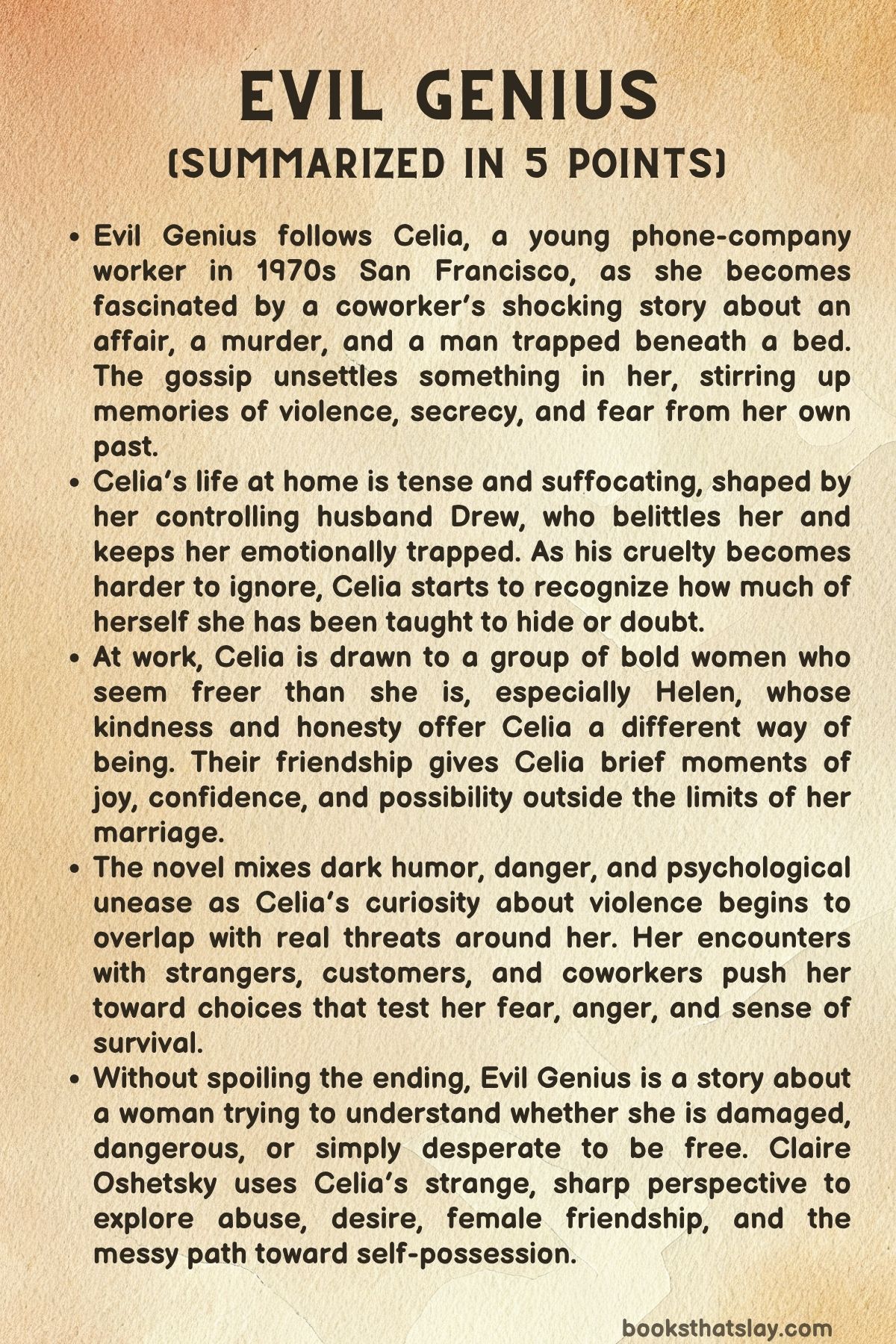
Characters
Celia
Celia is the central character of the book, and her inner life is marked by a mixture of fear, curiosity, anger, shame, and strange imaginative intensity. At nineteen, she works in the Resident Billing Office of the phone company, a place that teaches her to suppress her own feelings while absorbing the desperation and rage of others.
She is drawn to stories of death, scandal, murder, and hidden violence because these stories seem to give shape to emotions she cannot easily name. Her fascination with Randall and Vivienne’s affair is not simple gossip; it becomes a mirror for her own thoughts about danger, desire, secrecy, and escape.
Celia often seems passive on the surface, but her mind is restless, observant, and deeply alive. She notices cruelty, humiliation, objects, bodies, voices, and gestures with unusual sharpness.
Celia’s marriage to Drew reveals how trapped she has become before she fully understands the nature of her captivity. Drew controls her through scolding, intimidation, contempt, and emotional manipulation, and Celia has learned to move through life as though endurance is the same as safety.
Her childhood also helps explain her troubled relationship with violence and identity. Her mother’s mental illness, her absent father Dirk, and her own disturbing childhood actions all contribute to her sense that something dangerous lives inside her.
When she buys the dirk and the smaller black knife, the act feels symbolic as much as practical. The weapons connect her to power, inheritance, rage, and self-protection.
Celia’s development is not a simple transformation from weakness to strength. Instead, she moves through confusion, bad judgment, terror, and moments of awakening.
Her encounter with Blake Goodman shows both her vulnerability and her instinct for survival. Her response to Drew after he locks her out, fires at her, destroys her dolls, and imprisons her in the pantry shows that she is beginning to understand the full horror of her domestic life.
Yet Celia is not written as a heroic avenger. She is frightened, inconsistent, lonely, and sometimes reckless.
Her freedom comes gradually, through pain, accident, friendship, and the realization that she does not have to keep living inside the story Drew has written for her.
By the end of the book, Celia becomes a survivor who chooses life beyond the house, the marriage, and the violent patterns that once seemed to define her. Her relationship with Helen gives her a future based on tenderness rather than domination.
Her decision to leave the bloodstained house behind is also a rejection of the old self who believed she had to remain trapped. Celia’s journey is disturbing but ultimately liberating because she learns that survival is not only about escaping death; it is also about choosing a life in which she can finally breathe.
Drew
Drew is Celia’s husband and one of the most oppressive figures in the story. He presents himself as calm, practical, reasonable, and morally superior, but beneath that surface is a deeply controlling and abusive man.
His cruelty is often psychological before it becomes openly violent. He insults Celia’s body, shames her sexuality, accuses her of being abnormal, and treats her as though she is a problem that must be corrected.
He does not need to beat her regularly in order to dominate her; he controls her through intimidation, silence, confinement, and the constant suggestion that she is dirty, foolish, or dangerous.
Drew’s abuse is especially chilling because he frames himself as the rational person in the marriage. He makes Celia doubt her own judgment while presenting his own actions as justified.
His deliberate swerving of the car into a tree on Celia’s side reveals how far his need for control can go, and his later decision to lock her out of the house shows his willingness to punish her physically and emotionally. When he fires the gun after she breaks in, he hides behind the excuse that he thought she was a burglar, but the act exposes the lethal threat beneath his domestic authority.
His destruction of Celia’s Barbie collection is another form of intimate violence because he attacks something private, symbolic, and connected to her childhood imagination.
Drew’s relationship with his mother Augusta also helps explain his entitlement. He runs back to her and portrays Celia as drunken, promiscuous, and abusive, showing how easily he turns himself into the victim.
He wants sympathy, obedience, and control, not accountability. His death is sudden and accidental in relation to Celia’s intentions, but it is not emotionally random.
The violence he has brought into the house finally returns to him. Drew represents the kind of man whose cruelty hides behind respectability, and his presence in the book makes Celia’s eventual escape feel necessary rather than merely dramatic.
Helen
Helen is one of the most important figures in Celia’s emotional awakening. She belongs to the freer, bolder world of the second-floor women, and she quickly becomes a source of comfort, humor, and possibility for Celia.
Unlike Drew, Helen does not treat Celia’s strangeness as something disgusting or shameful. When Celia is in pain and emotionally shaken, Helen responds with warmth rather than judgment.
Her admission that she also hears voices creates a moment of recognition between them, suggesting that Celia is not as alone or monstrous as she fears.
Helen’s role in the story is not only romantic; she is also a guide toward a different way of living. She encourages Celia to defy Drew in small but meaningful ways, such as going out with friends and hanging up on him.
During their dim sum lunch, when Celia casually admits that she has considered killing Drew, Helen redirects her without moral grandstanding. Her joke about prison visits is funny, but it also saves Celia from confusing revenge with freedom.
Helen understands darkness without being consumed by it, and this makes her especially important to Celia.
The trampoline scene captures what Helen gives Celia: lightness, movement, laughter, and the feeling of being alive in her own body. Celia’s dawning realization that she might be falling in love with Helen is frightening to her because it challenges her marriage and her understanding of herself.
Yet Helen represents a love that is not based on ownership. By the end, Celia’s life with Helen becomes the clearest sign that she has moved beyond survival into genuine companionship.
Helen is the character who helps Celia imagine a future not ruled by fear.
Randall Smiley
Randall Smiley is the coworker whose scandalous story helps set Celia’s imagination in motion. His affair with Vivienne Bianco and his account of hiding under the bed during her murder become a source of fascination for the employees at the phone company.
Randall is dramatic, secretive, and somewhat slippery. He knows how to hold an audience, and the unfinished nature of his story makes him even more compelling to Celia and the others.
His presence brings together sex, danger, performance, and workplace gossip.
Randall is not simply a victim of circumstance. Helen’s suggestion that he may have manipulated Gene into killing Vivienne casts him in a more sinister light.
Whether or not this is true, the possibility makes Randall morally ambiguous. He seems to thrive in situations where desire and danger overlap.
His later involvement with Meena also suggests that he moves quickly from one intense attachment to another, leaving questions about his sincerity and motives. He is charming enough to draw people in, but not transparent enough to be trusted.
At the same time, Randall unexpectedly helps Celia after Drew’s death by getting her a lawyer, Tony Petrocelli. This action complicates him.
He may be manipulative, theatrical, and morally questionable, but he is not useless or purely selfish in that moment. Randall’s function in the book is to introduce Celia to a story of hidden violence that echoes her own life.
He is less central as a fully transformed character and more important as a catalyst, someone whose scandal cracks open Celia’s awareness of the dangerous stories happening around and inside her.
Vivienne Bianco
Vivienne Bianco is dead before Celia can know her directly, but her presence haunts the early part of the story. She is a higher-ranking phone company employee, and her affair with Randall turns her into an object of gossip, speculation, fascination, and judgment.
Because readers know her largely through Randall’s story and the reactions of others, Vivienne becomes both a person and a symbol. She represents forbidden desire, workplace hierarchy, marital betrayal, and the deadly consequences of male possessiveness.
Vivienne’s murder is central to Celia’s imagination because it shows how quickly private passion can become public horror. The detail of the forgotten condom makes the scene feel humiliatingly intimate, while Gene’s act of shooting her turns that intimacy into violence.
Vivienne is not given the chance to explain herself, defend herself, or define her own desires. Her story is controlled by the people who survive her, especially Randall.
This absence is important because it reflects how women in the book can be turned into evidence, scandal, or warning.
Although Vivienne appears mostly through memory and narration, she influences Celia profoundly. Celia’s obsession with her death is really an obsession with the danger of being a woman whose desires exist inside a world ruled by male control.
Vivienne’s fate becomes one of the dark examples that Celia carries with her as she tries to understand her own marriage, her own sexuality, and the possibility that love and violence may be terrifyingly close to each other.
Gene Bianco
Gene Bianco is Vivienne’s husband and the man who kills her after discovering evidence of her affair. He is a figure of grief, rage, and possessive violence.
In Randall’s account, Gene enters the bedroom, sees what has happened, and responds with lethal force. His sobbing over Vivienne’s body suggests that he is not emotionless, but the book does not allow grief to excuse what he has done.
His love, if it can be called love, is inseparable from ownership.
Gene’s importance lies in the way he embodies a familiar pattern of male violence: the belief that betrayal gives a man the right to destroy. He does not merely confront Vivienne; he kills her.
The fact that Randall is hiding under the bed makes the scene grotesque and claustrophobic, turning Gene’s grief into a terrifying performance witnessed by the very man involved in the affair. Gene’s violence becomes part of the phone company’s gossip, but for Celia it also becomes part of a larger meditation on marriage, sex, punishment, and death.
Gene is not developed through interior reflection, but his role is powerful because he stands as a warning. He shows what can happen when wounded pride becomes violence.
His act echoes later in Drew’s behavior, especially when Drew sees Celia with Mrs. Brisket and responds by bursting into the house with rage and suspicion. Gene’s presence in the story helps establish a world where women’s bodies and choices are treated as things men believe they have the right to punish.
Meena
Meena is one of the second-floor women who attract Celia because they seem freer, louder, and less obedient than the women in the Resident Billing Office. She is connected to Randall after the scandal with Vivienne, which places her near the center of the workplace gossip.
Meena’s involvement with Randall suggests boldness and risk, but it also hints that she may be drawn into the same dangerous patterns of charm, secrecy, and male manipulation that surround him.
Meena represents a kind of female confidence that Celia both admires and does not fully possess at the beginning. The second-floor women move through the workplace with more social ease and rebellious energy.
They talk openly, speculate, laugh, and create a community that contrasts with the strict, monitored atmosphere of Celia’s regular work environment. Meena contributes to this sense of a world where women can speak more freely, even when the subjects are dark or scandalous.
Though Meena is not explored as deeply as Celia or Helen, her role matters because she helps widen Celia’s social world. Through Meena and the others, Celia begins to step outside Drew’s control and outside the narrow obedience expected of her at work.
Meena’s presence shows that female freedom can be messy, risky, and imperfect, but still attractive to someone like Celia, who has spent so much of her life being watched and corrected.
Joan
Joan is another of the second-floor women, and she plays a memorable role during the St. Francis Hotel episode. She pretends to be Celia when the group goes to spy on the Sock Man, turning the disturbing phone flirtation into a strange public performance.
Joan’s willingness to take on the role suggests boldness, humor, and a taste for mischief. She is part of the group energy that allows Celia to feel, at least briefly, less isolated and less trapped by fear.
Joan also functions as a temporary mask for Celia. When Celia later calls herself Joan in Blake Goodman’s house, the name becomes a way for her to distance herself from danger and from her own identity.
This is important because Joan is not merely a coworker; she becomes a symbolic alternative self. To use Joan’s name is to borrow some of the second-floor women’s confidence and detachment.
It allows Celia to perform a version of herself that is less immediately vulnerable.
As a character, Joan brings levity into situations that are still charged with danger. The Sock Man scene could be purely frightening, but Joan’s performance makes it bizarre, comic, and socially theatrical.
Her role shows how women in the book sometimes survive discomfort by turning it into play, disguise, or group spectacle. Joan’s boldness helps Celia step outside the private shame that men like Drew try to impose on her.
Tammy
Tammy is part of the second-floor circle of women who help create an atmosphere of female solidarity and rebellion. While she is less individually developed than Helen, her presence matters because she belongs to the group that draws Celia away from isolation.
The second-floor women are important not because each of them transforms the plot alone, but because together they represent a social world Celia has been missing. They gossip, tease, speculate, and act together, offering Celia a sense of belonging that contrasts sharply with her life at home.
Tammy’s role is tied to the collective energy of women who are not fully obedient to the systems around them. The phone company is strict, hierarchical, and controlled by male supervisors, but Tammy and the others create their own informal culture inside it.
That culture gives Celia permission to be curious, amused, daring, and disobedient. Through Tammy’s group, Celia begins to experience friendship as something active rather than merely comforting.
Although Tammy does not dominate the story, she contributes to its emotional texture. She helps show that Celia’s awakening is not caused by one person alone.
It happens through overheard stories, workplace friendships, risky outings, jokes, shared meals, and small acts of defiance. Tammy belongs to the chorus of women who help Celia imagine herself outside Drew’s control.
Mr. Willy / The Sock Man
Mr. Willy, later known as the Sock Man, is one of the strangest and most unsettling figures in the book. He first appears through phone calls, asking Celia to put a sock on his “willy.” His request is absurd, sexual, and pathetic at the same time.
Celia’s decision to flirt with him and agree to meet him at the St. Francis Hotel shows her growing restlessness and curiosity about risk, but it also shows how her work exposes her to the loneliness and perversity of strangers.
The Sock Man is not portrayed as conventionally dangerous in the way Blake or Drew is, but he still crosses boundaries. His desire is needy and intrusive, and when he appears at the hotel with a sock, he turns fantasy into physical reality.
His ability to identify the real Celia by placing the sock on her shoulder is eerie because it suggests that he sees through the group’s performance. The gesture is quiet, but it marks Celia in a way that unsettles her.
Later, when he calls and bitterly says that Celia rejected true love, he becomes more openly resentful. This makes him part of the book’s larger pattern of men who interpret women’s refusal as betrayal.
Yet he is also lonely and ridiculous, which makes him more complicated than a simple villain. The Sock Man represents the strange, desperate forms of intimacy that pass through Celia’s headset at work, and his sock becomes one of the odd objects Celia carries from an encounter that is both comic and disturbing.
Blake Goodman
Blake Goodman is the well-dressed stranger who offers Celia a ride after the train is stopped. At first, he appears helpful, polished, and socially respectable, but his behavior quickly becomes predatory.
He takes Celia to his own grand house instead of safely bringing her home, using the excuse that he wants to show her his puppy. His charm is shallow, and the state of his home reveals neglect beneath the surface.
The mess made by his dog, Ace, becomes a physical sign of Blake’s irresponsibility and selfishness.
Blake’s assault on Celia is clumsy but frightening because he ignores her refusal. When “stop” only provokes him, Celia realizes that direct resistance may not work and changes tactics.
Her use of the black knife is one of the clearest moments in which she actively protects herself. She does not attack out of cruelty or fantasy; she acts because she needs to escape.
Blake’s weakness as a man is exposed in that scene. He is not powerful in a grand way, but he is dangerous because he assumes access to a vulnerable woman’s body.
Blake also serves as a contrast to Ace. He neglects the dog, while Celia immediately recognizes the animal’s loneliness and need.
When Ace bites Blake and stands beside Celia, the scene reverses the expected power structure. The neglected creature protects the threatened woman from the respectable man.
Blake represents predatory entitlement hidden behind social polish, and Celia’s escape from him becomes an important step in her movement from passivity toward self-defense.
Ace
Ace, Blake Goodman’s dog, is one of the most emotionally significant nonhuman characters in the story. He is neglected, lonely, and trapped in Blake’s filthy house, but he responds to Celia with loyalty and protective instinct.
Celia’s attention shifts from Blake to Ace because she recognizes the dog’s suffering more clearly than she cares about Blake’s advances. This recognition reveals Celia’s compassion.
Even in danger, she notices another vulnerable being.
Ace’s decision to bite Blake and stand protectively beside Celia gives him a heroic role in the book. He becomes an ally at a moment when Celia is isolated and threatened.
His protection is instinctive, but it is also morally meaningful within the story because he chooses the person who has shown him care over the owner who has neglected him. Ace’s presence transforms Celia’s escape from Blake into something larger than self-preservation; it becomes the beginning of a bond.
Celia’s later decision to rescue Ace shows how much he matters to her recovery. After Drew and Mrs. Brisket die, Celia is unable to return to ordinary life, but she can act on behalf of the dog.
Saving Ace gives her a purpose when her own future feels shattered. He represents loyalty, survival, and the possibility of rebuilding life through care.
In rescuing him, Celia also rescues a part of herself that still believes in tenderness.
Mrs. Brisket
Mrs. Brisket is one of the most tragic characters in the book. She first appears as a woman whose phone service Celia had cut off, but her later encounter with Celia reveals the grief behind her anger.
Her son Bobby killed himself after his father discovered a phone-sex bill and threw him out, and Mrs. Brisket blames Celia because Celia’s work connects her to the machinery of billing, disconnection, shame, and consequence. Even though Mrs. Brisket admits that her blame may be irrational, her grief needs a target.
Mrs. Brisket is frightening because she carries a gun and eventually kills Drew and herself, but she is also deeply pitiable. Her note reading “DEAR KILLER—” shows that she sees Celia as part of the system that destroyed Bobby, even if Celia did not intend harm.
When Celia brings her home and comforts her, the scene becomes emotionally complex. Mrs. Brisket is both accuser and grieving mother, both threat and broken person.
Celia’s pity for her shows Celia’s growing ability to respond to suffering with compassion rather than only fascination.
Her shooting of Drew is sudden and chaotic. She does not arrive as Celia’s savior, yet her act frees Celia from Drew in the most violent and traumatic way possible.
Her suicide immediately afterward confirms that she is not seeking power or escape; she is consumed by grief. Mrs. Brisket represents the human cost of shame, isolation, and systems that turn private pain into financial or moral punishment.
Her tragedy collides with Celia’s marriage and changes Celia’s life forever.
Bobby Brisket
Bobby Brisket never appears alive in the story, but his death gives Mrs. Brisket’s actions their emotional force. He is remembered as a son whose life ended after his father discovered a phone-sex bill and threw him out.
Bobby’s story connects private sexuality, family shame, and institutional billing in a devastating way. A charge on a phone bill becomes the visible trace of a hidden life, and that exposure leads to rejection and suicide.
Bobby is important because he shows that the phone company’s work is not abstract. Celia and the other operators deal with bills, accounts, anger, and disconnections, but behind those calls are households full of fear, secrets, poverty, and shame.
Bobby’s death forces Celia to confront the possibility that her routine actions at work can become part of someone else’s catastrophe. She did not intend to harm him, but the system she works within has consequences she cannot control.
As a character remembered through his mother’s grief, Bobby also deepens the book’s concern with loneliness. His phone-sex bill suggests a search for connection, desire, or comfort that becomes punishable once discovered.
His absence haunts the later part of the story, and Mrs. Brisket’s inability to survive that absence leads directly to the deaths in Celia’s home. Bobby’s life and death expose how shame can become lethal when there is no mercy around it.
Augusta
Augusta is Drew’s mother, and she reinforces the world of judgment, control, and emotional coldness from which Drew comes. Her house, filled with hunting trophies, feels hostile and predatory to Celia.
The atmosphere around Augusta suggests a family culture comfortable with domination, display, and violence. Celia feels mocked and trapped there, which makes Augusta’s home an extension of Drew’s power rather than a place of welcome.
Augusta’s loyalty to Drew is immediate and unquestioning. When Drew runs to her and tells his version of events, she accepts his portrayal of Celia as drunken, promiscuous, and abusive.
This reveals Augusta’s function in the story as an enabler. She protects Drew’s self-image and helps him avoid accountability.
Her response to Celia is not curiosity or concern, but judgment. She represents the social and familial structures that often protect abusive men by treating their victims as unstable or immoral.
Her bitter bereavement letter after Drew’s death shows that even tragedy does not soften her toward Celia. Augusta cannot see the full reality of Celia’s suffering because her loyalty is bound to Drew and to the version of respectability he represents.
She is not physically violent in the way Drew is, but her moral certainty and emotional hardness contribute to the system that keeps Celia trapped. Augusta is a reminder that abuse is often supported by people who refuse to believe the victim.
Celia’s Mother
Celia’s mother is a haunting figure whose illness and death shape Celia’s imagination. She becomes mentally ill, fears shadows, creates protective fabric hexes, and eventually dies of a wasting disease.
Her decline leaves Celia with memories of fear, helplessness, and strange rituals. The mother’s fabric hexes connect protection with disorder, suggesting a desperate attempt to defend herself from invisible threats.
For Celia, this becomes part of a childhood atmosphere in which danger feels both real and mysterious.
Celia’s memories of her mother also help explain her own fascination with cutting, stabbing, collecting, and hidden violence. The mother’s illness does not simply traumatize Celia; it gives her a model of a woman overwhelmed by forces no one else understands.
Celia inherits not only grief but also fear that she may be abnormal or doomed. Drew later exploits this fear by treating Celia as disgusting or unstable, making her more vulnerable to his control.
Yet Celia’s mother is not only a source of damage. Her presence also deepens Celia’s sensitivity to suffering and strangeness.
Celia’s inner life, with all its disturbing images and associations, is partly formed by having watched her mother disappear into illness. The mother remains important because she shows that Celia’s story did not begin with Drew.
Celia enters adulthood already carrying loss, confusion, and a sense that love can be inseparable from fear.
Dirk
Dirk, Celia’s absent father, is less a present character than a powerful absence. Celia finds a photograph of him, and his name becomes deeply meaningful to her because she associates “Dirk” with a dagger.
This association gives him symbolic importance. He becomes linked in Celia’s mind to sharpness, inheritance, danger, and perhaps protection.
Because he is absent, Celia can imagine him more freely than she could a father who actually raised her.
Dirk’s absence leaves Celia without a stable paternal figure, and that emptiness may partly explain why Drew’s authority enters her life so forcefully. Drew positions himself as someone who knows better, judges better, and controls the terms of Celia’s adulthood.
Against that, the name Dirk offers Celia a different masculine symbol: not a controlling husband, but a blade she can hold. When she buys the Scottish dirk, she is not simply purchasing a weapon; she is reaching toward an imagined lineage and an identity that feels stronger than the one Drew has forced on her.
Dirk matters because he shows how Celia builds meaning from fragments. A name, a photograph, and an object become part of her private mythology.
He does not need to appear directly to influence her. His absence creates space for fantasy, and that fantasy helps Celia imagine power at a time when she feels powerless.
Tony Petrocelli
Tony Petrocelli is the lawyer Randall Smiley gets for Celia after Drew and Mrs. Brisket die. His role is brief but crucial.
In the police questioning, Celia is vulnerable because the circumstances look suspicious, especially with the earlier bullet hole in the house. Petrocelli protects her by keeping her silent until the truth about Mrs. Brisket’s confession becomes clear.
His practical competence prevents Celia from being swallowed by another system of judgment.
Tony represents a form of help that is procedural rather than emotional. He does not heal Celia or transform her life, but he understands the danger she is in and acts effectively.
This matters because Celia has often been surrounded by people who misread, shame, or control her. Petrocelli’s intervention shows that survival sometimes depends not only on courage, but also on having someone who knows how to navigate power.
His presence also complicates Randall, since Randall is the one who brings him in. Through Tony, the story briefly shifts from domestic horror to legal danger.
Celia’s freedom after Drew’s death is not automatic; she must still pass through suspicion and institutional control. Tony helps make that possible, allowing the next stage of Celia’s life to begin.
Lavinia Goodman
Lavinia Goodman is Blake Goodman’s wife, and her brief appearance reveals more about Blake’s world. She lives in the grand house where Ace has been neglected, and when Celia later pretends to be the new dog-walker, Lavinia allows her to take the dog.
Lavinia seems disconnected from the reality of Ace’s suffering, or at least unable to respond to it with the urgency Celia feels. Her presence shows that Blake’s household is not simply dangerous because of Blake’s assault, but also because of neglect and emotional emptiness.
Lavinia is important because she occupies a socially respectable position that contrasts with the filth and loneliness inside the home. The grandness of the house hides disorder.
As Blake’s wife, she also complicates Celia’s encounter with him. Celia discovers that he is married only after he has brought her there, which makes his behavior even more dishonest and predatory.
Lavinia’s existence exposes Blake’s lies and the false respectability surrounding him.
Although Lavinia does not become a major character, she helps make Ace’s rescue possible. Celia’s deception works because Lavinia does not recognize the depth of the situation.
In that sense, Lavinia represents a world of people who live near suffering without truly seeing it. Celia, by contrast, sees Ace clearly and acts.
Rick
Rick is Drew’s friend in Chico, the person Drew supposedly goes to stay with after leaving Celia. Rick does not appear directly in the events described, but his role matters because he gives Drew a place to retreat.
Drew’s plan to stay with Rick allows him to step away from the immediate consequences of his violence while still controlling the story from a distance. Through Rick, Drew can present himself as a wronged husband seeking refuge rather than an abuser avoiding accountability.
Rick’s importance is mostly structural. He represents the outside male network that supports Drew’s escape from the home after he has terrorized Celia.
Whether Rick knows the truth is less important than the fact that Drew has somewhere to go and someone connected to him beyond Celia. This reinforces Celia’s isolation.
Drew has his mother, his friend, his guns, and his version of events. Celia has to build support more slowly, through Helen and the second-floor women.
As a minor character, Rick shows how abusers can use distance and allies to reshape the narrative. His presence in the story helps explain why Celia initially agrees that Drew should stay in Chico.
She needs space, but Drew’s retreat also allows him to avoid facing what he has done.
Themes
Control, Marriage, and Domestic Captivity
Celia’s marriage shows how abuse can exist without constant visible violence. Drew controls her through humiliation, fear, surveillance, blame, and physical intimidation, making the home feel less like a place of safety and more like a private prison.
His cruelty is often disguised as moral superiority: he calls her disgusting, accuses her of abnormal desires, and positions himself as the rational adult who must correct her. This makes Celia doubt her own judgment even when she is clearly being harmed.
The locked pantry, the destroyed Barbie dolls, the gunshot, and the slide bolt on the door turn ordinary domestic objects into tools of domination. In Evil Genius, marriage becomes a structure where ownership is mistaken for love and obedience is demanded as proof of loyalty.
Celia’s eventual refusal to plead, explain, or return to her old role marks a major emotional shift. Freedom begins when she stops seeing Drew’s approval as necessary for survival.
Violence, Fantasy, and the Desire for Power
Celia is drawn to stories of murder, weapons, scandal, and danger because violence seems to offer a language for feelings she has never been allowed to express. Her fascination with Randall and Vivienne’s story is not simple curiosity; it awakens buried memories of childhood cruelty, her mother’s terror, and her own strange impulses.
The knives she buys connect violence with identity, especially through the association between the dirk and her absent father. Yet the novel does not present Celia as purely dangerous.
Her violent imagination grows from powerlessness, shame, and years of being controlled. When she cuts Blake Goodman, the act is not romanticized as heroism, but it becomes one of the first moments when she successfully defends her body.
The story repeatedly asks whether violent thoughts make someone evil, or whether they can be a distorted survival response. Celia’s darkest impulses are frightening, but they also reveal how badly she wants agency over her life.
Female Friendship, Queer Awakening, and Emotional Rescue
The women from the second floor offer Celia a model of life outside fear. Meena, Joan, Tammy, and especially Helen are loud, funny, bold, and imperfect, but they create a kind of community that contrasts sharply with Drew’s isolation of Celia.
Helen’s importance lies in the way she accepts Celia without trying to fix or shame her. When Celia admits ugly thoughts, Helen does not recoil; she responds with humor, tenderness, and practical care.
Their time together at dim sum and the trampoline gym gives Celia a glimpse of joy that is physical, ordinary, and freeing. Her possible love for Helen unsettles her because it challenges the entire story she has been taught about marriage, duty, and desire.
By the end, Helen becomes more than a friend or romantic possibility; she represents the life Celia can choose after violence and grief. Their bond suggests that rescue does not always arrive dramatically.
Sometimes it appears as recognition, laughter, and someone who believes you can keep living.
Guilt, Survival, and Reinvention
Celia repeatedly finds herself near disaster, death, and blame, yet the central question is not whether she is innocent in a simple sense. She feels guilt for cutting off Mrs. Brisket’s phone service, for her violent thoughts toward Drew, for surviving situations others do not, and for carrying desires she has been taught to see as monstrous.
Mrs. Brisket’s accusation forces Celia to face the unintended consequences of small bureaucratic acts, showing how ordinary work can participate in real suffering. Still, the deaths of Drew and Mrs. Brisket also free Celia from a life that had become unbearable, creating a painful mix of horror and release.
Evil Genius treats survival as morally complicated rather than clean. Celia does not emerge purified; she emerges changed.
Her decision to rescue Ace, leave the house, call Helen, and build a different future shows reinvention as a gradual rejection of the roles assigned to her. She survives by refusing to remain trapped inside other people’s stories about who she is.