Family Drama Summary, Characters and Themes
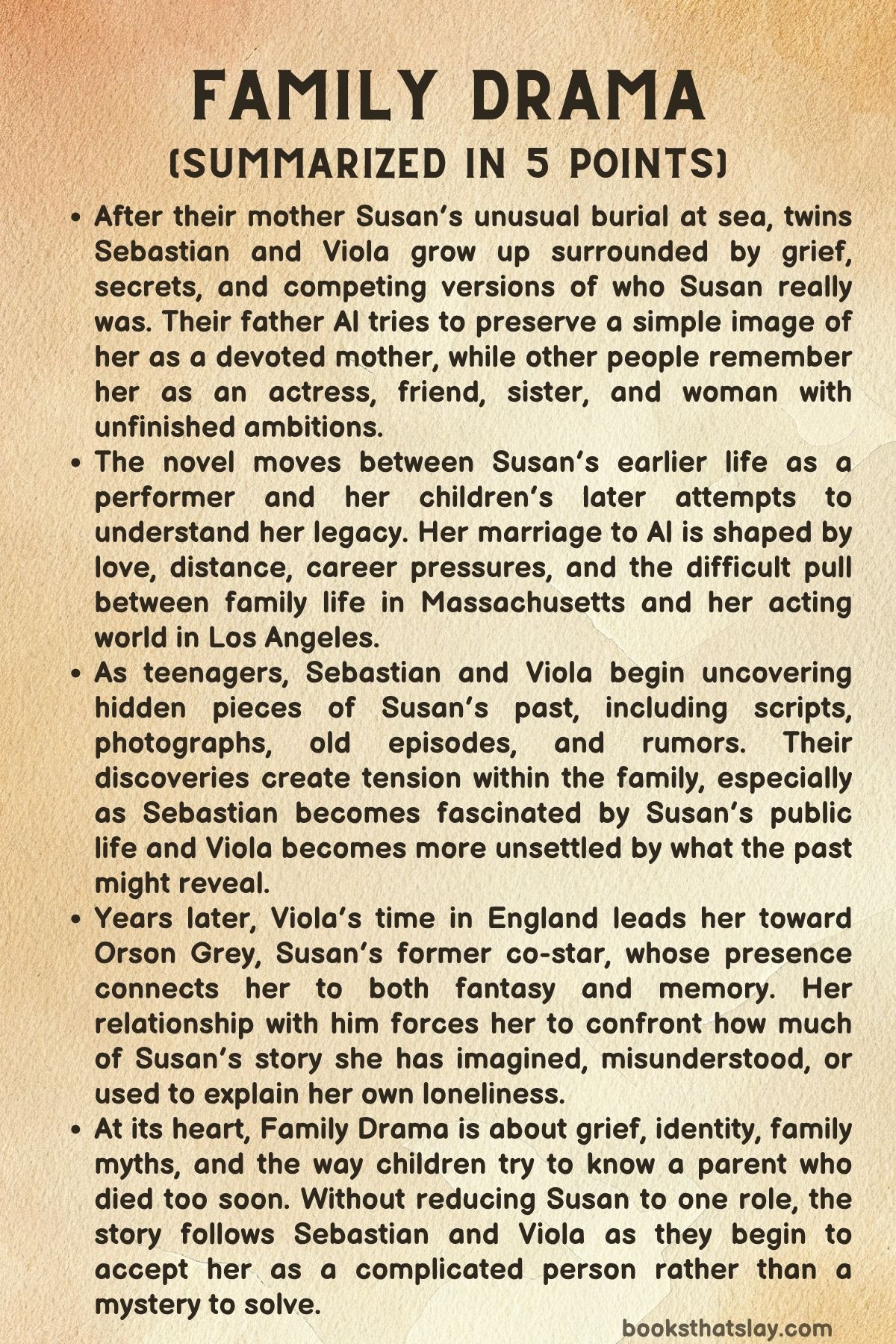
Family Drama by Rebecca Fallon is a family novel about memory, grief, secrecy, and the stories people build around those they have lost. At its center are twins Sebastian and Viola Bliss, whose mother, Susan, dies when they are children.
As they grow up, they discover that Susan was not only their mother but also an actress with ambitions, friendships, compromises, and private longings. The book follows the twins as they try to understand her life, their father’s silence, and their own fractured bond. Family Drama is about how families survive loss, and how truth can hurt and heal at once.
Summary
In Family Drama, seven-year-old twins Sebastian and Viola Bliss attend the burial of their mother, Susan, at sea off the Massachusetts coast in 1997. Susan, once an actress and later a mother fighting cancer, is sent into the ocean in a ceremony that feels unreal and frightening to the children.
Her body is brought aboard in a weighted cotton bag, briefly shown, and then dropped into the water. For Viola, who already fears illness and death, the event is almost unbearable.
Sebastian tries to comfort her, hiding with her under the dining table during the gathering that follows.
Back at the house, grief takes different forms. Their aunt Sadie, Susan’s sister, is angry that Susan has not been buried in the earth.
She is loud, messy, and unable to accept the polite sadness around her. She pulls Sebastian into the living room and begins playing Susan’s favorite pop songs, turning the funeral into a wild dance.
For Sebastian, the music briefly makes it feel as if Susan has returned. Their father, Al, is lost in his own sorrow.
He is unsettled by the number of people who remember parts of Susan he did not know well, especially Orson Grey, Susan’s Scottish former co-star. Orson’s memories of Susan suggest a life larger than the one Al wants to preserve for the children.
Al tries to control Susan’s memory. When Sadie brings a box of videotapes of Susan’s soap-opera performances, he drives away and throws them over a cliff.
He decides that Sebastian and Viola should remember Susan only as their mother, not as a performer or a woman with a separate past. This choice shapes the twins’ childhood.
Susan becomes both sacred and incomplete, loved but hidden.
The novel then looks back to Susan’s younger life. In 1983, she is acting in a Salem witch-trial reenactment as Bridget Bishop.
Bored by the lifeless production, she makes the performance more dramatic and emotional. Al, a young historian, meets her backstage and pretends to have influence with the museum board, helping her keep her job.
Their connection begins with charm, rebellion, and a shared attraction to the past. They fall in love and eventually marry.
By 1986, Susan’s acting career has taken her to Los Angeles, where she wins the role of Margie Ludlow on the soap opera Life and Times. Al proposes after her audition, hoping marriage will hold them together, but Susan is already being pulled toward California and the creative life she finds there.
Al remains tied to New England and academic work, while Susan grows close to her colleagues, especially Orson Grey, who plays bartender Joe. The marriage becomes divided between two places and two versions of Susan: wife and actress, mother-to-be and performer.
When Susan becomes pregnant in 1989, she is terrified that motherhood will end her career. She hides her sickness on set, secretly vomiting between takes.
Orson helps protect her, and members of the crew adjust make-up, costumes, and scripts to conceal her changing body. For a time, the show quietly makes room for her.
But producer Mark Flowers eventually learns the truth. Susan argues that the pregnancy could be written into the show, even telling him she is having twins, but he refuses.
She is pushed away from the role and sent back to the life Al wants for them.
Susan gives birth to Viola and Sebastian in 1990. At first, motherhood overwhelms her.
She loves her children, but she also watches Life and Times every day and misses the set, the work, and Orson. When Orson calls and tells her she may be able to return, she feels the pull of the life she lost.
Al argues that the family needs stability, but Susan cannot accept disappearing into motherhood completely. She returns to California, leaving the twins with Al, and begins living between two worlds.
The strain damages the family. Susan misses birthdays and ordinary moments.
Al handles the daily work of raising the children and grows more resentful. Susan even considers taking the twins to California permanently, but Al discovers the plan and begs her not to break the family apart.
She stays connected to home, but the marriage remains wounded. In 1995, after heavy bleeding, Susan is diagnosed with advanced cancer.
She leaves the show for good and asks for Margie to be killed off. Her final scene gives her character a dramatic ending, but Susan’s own goodbye from the set is quiet and unsatisfying.
As Susan’s illness worsens, Al cares for her. She tries to leave memories and words behind for the children.
Viola sees her mother’s bald head and asks whether she is going to die. Susan cannot promise she will live; she can only promise love.
By the time she dies, she is confused and weakened, but surrounded by the family and life she made.
Years later, Sebastian and Viola begin to question the version of Susan they were given. In 2004, when they are thirteen, they skip a visit to their grandmother and see an Orson Grey film.
Friends suggest that Susan may have been more famous than Al ever admitted. Al continues to minimize her career and even invents memories that make Susan seem more present in family life than she really was.
Sebastian catches him in one false memory and realizes his father has been reshaping the past.
In 2008, the twins discover a hidden box of Susan’s scripts, photographs, and belongings. Sebastian is excited by proof that Susan had a public, creative life.
Viola finds nude photographs of Susan and is disturbed by them. Sebastian reconnects with Sadie and learns that Al lied about the videotapes.
He searches online and finds old episodes, fan forums, and gossip about Susan and Orson. He becomes obsessed with the idea that Susan had a freer life than Al allowed them to know, and perhaps a secret romance.
The tension at home grows when Al begins dating Tillie. Sebastian creates a large collage from a gossip photograph of Susan and Orson, humiliating Tillie and provoking Al.
Later, at a party, Sebastian drunkenly suggests that Al may not be their father. Viola is frightened by the possibility and angry at Sebastian for making it real.
At the same party, Viola is assaulted by Zach in a closet while Sebastian is elsewhere, distracted and kissing another girl. Feeling abandoned and desperate to protect the family from uncertainty, Viola returns home and burns Susan’s scripts.
When Sebastian discovers what she has done, he slaps her and then crashes his car into Tillie’s. Afterward, he asks to move in with Sadie.
Al allows it, and the bond between the twins is badly damaged.
By 2010, Viola is studying at Cambridge. She remains distant from Sebastian and haunted by Susan, Orson, and the question of loyalty.
When she encounters Orson, he does not recognize her at first. Their meeting is charged by attraction and by Viola’s longing to touch some hidden part of Susan’s life.
Over time, Orson contacts her, and they begin a secret relationship in England. Viola idolizes him, visits him, exchanges messages with him, and eventually becomes his lover.
She hides the relationship from both Al and Sebastian.
Sebastian, meanwhile, lives with Sadie and makes collage art from old images, including the nude photographs of Susan that Viola had hidden. He remains fixated on whether Susan and Orson had been lovers.
In 2012, Al visits Viola for her graduation and learns that she plans to remain in England for further study and is seeing an older man. He accepts the news with pain, not yet knowing the man is Orson.
Viola and Orson travel together, but secrecy becomes harder to maintain after an incident on Cape Cod brings press attention. Orson wants to be open, while Viola is afraid of what the truth will do.
She invites Sebastian to London and introduces him to Orson. Sebastian is shocked at first, but he warms to Orson and eagerly asks about Life and Times.
Viola becomes jealous and anxious, especially as Sebastian seems to connect with the man she has kept private. She finally raises Sebastian’s old suspicion that Orson slept with Susan.
Orson denies it, but the accusation changes everything. He ends the relationship, telling Viola that she has treated Susan like a melodrama instead of accepting her as a complicated person.
Devastated, Viola turns back toward Sebastian. The twins begin to repair their relationship, not by solving every mystery, but by admitting how much they have hurt each other and how deeply they both wanted to know their mother.
Sebastian organizes a memorial party for Susan, inviting family, old colleagues, and fans. At the gathering, Susan is remembered as actress, friend, mother, sister, and inspiration.
No single version of her is complete, but together they make her more real.
Al, Sadie, Viola, and Sebastian begin speaking more honestly. Viola understands that her memories of Susan are incomplete, but still true.
After the memorial, she walks to the beach and texts Orson. He replies, leaving open the possibility of future connection.
In 2013, Viola and Sebastian arrive in Los Angeles, where Orson, disguised as their driver, greets them. Sebastian asks to see everything.
The novel ends with the siblings entering the place where Susan’s other life began, ready to face the fuller truth of who she was.
Characters
Sebastian Bliss
Sebastian Bliss is one of the central emotional forces in Family Drama, and his character is shaped by grief, curiosity, anger, and a desperate need to know the full truth about his mother. As a child, he appears protective and sensitive, especially in the way he tries to comfort Viola during Susan’s burial and the mourners’ gathering afterward.
He understands that his sister is frightened, and even while he is grieving himself, he instinctively tries to shield her from pain. This early protectiveness makes his later failures more painful, because the book shows how grief can distort even loving relationships.
Sebastian grows into a teenager who feels betrayed by the version of Susan that Al has preserved for him. Once he discovers evidence of her acting career, he becomes almost hungry for the hidden parts of her life.
His obsession with Susan’s past is not simple admiration; it is also a rebellion against Al’s control over memory. He wants his mother to be larger, stranger, more glamorous, and more complicated than the quiet maternal image he has been given.
Sebastian’s emotional intensity often pushes him toward cruelty and recklessness. His collage of Susan and Orson is an act of artistic expression, but it is also meant to wound, expose, and embarrass.
At the party, his drunken speculation about Al not being their father reveals how carelessly he can turn private fear into public drama. His abandonment of Viola at a vulnerable moment becomes one of the deepest fractures between the twins.
When Viola burns Susan’s scripts, Sebastian’s slap shows how much he has invested in those objects as sacred proof of his mother’s other life. To him, the scripts are not just papers; they are a route into Susan’s identity and into a truth he believes has been stolen from him.
His move to Sadie’s house represents both escape and self-exile. He cannot remain in Al’s home because he associates it with repression, denial, and emotional dishonesty.
As an adult, Sebastian becomes an artist, which feels like a natural extension of his need to assemble fragments into meaning. His collage work mirrors the book’s larger concern with memory: people are made from images, stories, rumors, objects, and absences.
His use of Susan’s old photographs, including the nude images, shows that he still struggles with boundaries between reverence, possession, and violation. Yet Sebastian also matures.
His reaction to Viola’s relationship with Orson begins in shock, but he eventually responds with curiosity rather than condemnation. This matters because Sebastian has spent years imagining Orson as part of Susan’s secret life; meeting him allows fantasy to become human reality.
By the end of the story, Sebastian is less interested in proving one scandalous truth and more open to experiencing the world Susan once inhabited. His desire to “see everything” in Los Angeles suggests that he still seeks connection through place and memory, but he is no longer only chasing betrayal.
He is learning to live with incompleteness.
Viola Bliss
Viola Bliss is Sebastian’s twin, but her response to loss is very different from his. Where Sebastian turns outward, searching for evidence and confrontation, Viola turns inward, becoming guarded, anxious, and secretive.
As a child, she is deeply frightened by sickness and death, and Susan’s burial at sea leaves a lasting wound in her imagination. The physical strangeness of the ceremony, combined with the sight of her mother’s body and the terrifying finality of the ocean, helps explain Viola’s lifelong need to control what can and cannot be known.
She is not simply fragile; she is someone who experiences uncertainty as danger. Her fascination with Orson begins early because he treats her seriously and because he belongs to a world connected to Susan but not controlled by Al.
Orson becomes, in her mind, a living doorway into her mother’s hidden life.
Viola’s adolescence is marked by fear of family collapse. When she discovers the nude photographs of Susan, she is disturbed not only by the images themselves but by the possibility that her mother had desires, secrets, and a body that existed outside motherhood.
Viola is more threatened than Sebastian by Susan’s complexity because she wants the family story to remain emotionally survivable. Her burning of Susan’s scripts is a destructive act, but it comes from a protective impulse.
She believes she is defending the family from uncertainty, especially from the possibility that Susan and Orson’s relationship might destabilize their identity. This moment shows Viola at her most frightened and morally complicated.
She destroys what Sebastian treasures because she cannot bear the emotional consequences of those objects. The assault by Zach and Sebastian’s absence intensify her sense of abandonment, making her retreat from her brother both understandable and tragic.
At Cambridge, Viola appears more independent, but she remains haunted by Susan and Orson. Her relationship with Orson is one of the most psychologically complicated parts of the story.
She is drawn to him as a man, but also as a figure who knew Susan, preserved her image, and seems to carry answers Viola has never received. This makes the relationship charged with desire, grief, rivalry, and self-invention.
Viola’s secrecy shows that she knows the relationship is emotionally dangerous, especially because it touches the deepest wounds in her family. Her jealousy when Sebastian connects with Orson reveals that she wants exclusive access to this bridge to Susan.
When Orson accuses her of turning Susan into melodrama rather than accepting her as complicated, he identifies Viola’s central struggle. She wants truth, but only if truth can be shaped into something meaningful and bearable.
By the end, Viola begins to accept that her mother cannot be solved. Her repaired bond with Sebastian and her return to Los Angeles suggest a more mature willingness to enter Susan’s past without needing to own or purify it.
Susan Bliss
Susan Bliss is the absent center of the book, a character whose life is reconstructed through memory, objects, performances, and the emotional damage left behind. She is a mother, actress, wife, sister, friend, and fantasy, but no single role fully contains her.
In youth, Susan is vivid, rebellious, and hungry for theatrical life. Her performance as Bridget Bishop shows her refusal to accept dullness or confinement.
She wants drama, intensity, attention, and creative freedom. This same energy draws Al to her, but it also foreshadows the central conflict of her adult life: she cannot easily fit inside the domestic stability Al wants to build around her.
Susan is not portrayed as a simple victim of ambition or a selfish artist. Instead, she is someone whose desires are real, powerful, and often incompatible with the expectations placed on her.
Her acting career gives her a selfhood that motherhood and marriage do not replace. As Margie Ludlow on Life and Times, Susan experiences the thrill of recognition, collaboration, and reinvention.
Her bond with Orson and the crew reveals that the set is not merely a workplace; it is a chosen world where she is seen as an artist. Pregnancy terrifies her because she understands how easily motherhood can be used to erase a woman’s professional life.
Her fear that Mark Flowers will fire her is justified, and the crew’s efforts to protect her show both her vulnerability and her importance to them. When she returns home to give birth and then later chooses to go back to California, the book refuses to make that choice easy.
Susan loves her children, but she also misses the show, the work, and the version of herself that exists away from the nursery.
Susan’s divided life causes real pain. She misses family moments, strains her marriage, and considers taking the twins to California in a way that would have shattered Al.
Yet the story also shows the pain of a woman being asked to shrink. Her illness adds another layer of tragedy because cancer forces the end of the career she fought to keep.
Her request that Margie be killed off gives her a final professional ending, but even that farewell is unsatisfying. As a dying mother, Susan tries to leave memories and words behind, but she cannot control how she will be remembered.
After her death, everyone claims a different Susan: Al preserves the mother, Sadie mourns the sister, Orson remembers the actress and friend, fans remember the performer, and the twins search for the woman behind all of these versions. Susan’s character matters because she exposes the limits of memory.
She was loving and evasive, ambitious and vulnerable, glamorous and frightened, devoted and restless. Her complexity is the truth the surviving characters must learn to accept.
Al Bliss
Al Bliss is a grieving husband and father whose love is inseparable from control. After Susan’s death, he tries to protect Sebastian and Viola by simplifying her memory.
He wants them to remember Susan as their mother rather than as an actress with fans, colleagues, sexuality, ambition, and possible secrets. His decision to throw away the videotapes is one of his defining actions.
He believes he is preserving innocence, but he is also erasing evidence. This makes him both sympathetic and damaging.
Al is overwhelmed by grief, and the funeral gathering forces him to confront the fact that Susan belonged to many people in ways he did not fully understand. Orson’s casual intimacy with Susan’s past unsettles him because it challenges Al’s belief that marriage gave him the deepest claim to her.
Al’s relationship with Susan begins in admiration and romance, but it becomes marked by unequal dreams. He is tied to New England, history, and academic stability, while Susan is pulled toward California and performance.
His proposal after her audition can be read as loving, but also as an attempt to anchor her before she drifts too far away. Later, when Susan wants to return to acting after the twins’ birth, Al’s resistance comes from genuine concern for the family, yet it also reflects his discomfort with the parts of Susan that do not revolve around home.
He becomes the parent who stays, manages, cares, and endures, and the book does not dismiss the difficulty of that role. His caregiving during Susan’s illness shows devotion, patience, and pain.
Still, his later habit of inventing memories reveals how grief can become revision. He does not only remember Susan; he edits her.
As a father, Al is loving but often emotionally dishonest. He tries to give the twins stability, but the stability is built on omissions.
Sebastian sees through this earlier and more aggressively, while Viola internalizes the pressure to protect the family story. Al’s relationship with Tillie shows his attempt to move forward, but Sebastian’s hostility reveals how unresolved the household remains.
In later years, Al’s visit to Viola at graduation shows a softer, sadder version of him. He accepts her choices even when they hurt him, suggesting that he has learned, at least partly, that love cannot mean possession.
Al’s tragedy is that his efforts to protect his children from Susan’s complexity help make that complexity more powerful and dangerous. By hiding the past, he turns it into a mystery.
Sadie
Sadie is Susan’s sister and one of the book’s most emotionally honest characters. At the funeral, she is messy, furious, and theatrical, but her chaos carries truth.
She is angry that Susan has been buried at sea rather than in the earth, and her grief refuses to behave politely. By pulling Sebastian into the living room and playing Susan’s favorite pop music, Sadie disrupts the solemnity of mourning.
The dance party is inappropriate by conventional standards, yet it briefly restores Susan’s presence in a way the formal ceremony cannot. Sadie understands that Susan was not only a tragic dead mother; she was also lively, dramatic, funny, and connected to music, performance, and excess.
Sadie functions as an alternative guardian of memory. Unlike Al, she does not want to reduce Susan to a safe domestic image.
She keeps the tapes and later becomes the person Sebastian turns to when he wants access to the hidden Susan. Her home offers him refuge because it allows mess, art, grief, and contradiction.
Sadie is not idealized; she can be unstable, emotional, and imperfect. Yet those flaws make her a necessary counterweight to Al’s controlled version of family history.
She gives Sebastian permission to be angry and curious, even when that curiosity becomes unhealthy. Through Sadie, the book shows that grief can be disorderly and still truthful.
Sadie’s importance also lies in her loyalty to Susan as a sister rather than as a symbol. She remembers Susan before marriage, before motherhood, and before illness.
This gives her perspective that the twins need, even if it arrives unevenly. Her relationship with Sebastian helps him develop as an artist and as a person who works through fragments.
At the memorial party, Sadie’s presence contributes to the fuller restoration of Susan’s memory. She helps create a space where multiple versions of Susan can coexist.
Sadie may not be the most stable adult in the story, but she is one of the least false.
Orson Grey
Orson Grey is a glamorous, ambiguous, and emotionally charged figure in the book. He first appears to Viola as someone from Susan’s mysterious other life, and his presence immediately unsettles the family’s controlled mourning.
He speaks to Viola like an adult, which makes a strong impression on her because the adults around her are mostly trying to manage or soften reality. Orson belongs to the world of acting, desire, fame, and possibility.
To Al, he represents a rival form of intimacy with Susan; to Viola, he becomes a figure of fascination; to Sebastian, he becomes evidence that Susan’s life may have been bigger and more romantic than anyone admitted.
In Susan’s working life, Orson is supportive, observant, and protective. When she becomes pregnant and fears losing her job, he helps coordinate the quiet effort to hide her condition.
His bond with Susan is close enough to generate later suspicion, but the story keeps it emotionally complex rather than reducing it to scandal. Whether or not others imagine romance, Orson clearly understands Susan as an actress and colleague.
He values the part of her that Al struggles to accommodate. This makes him central to the twins’ later fantasies: he seems to hold the missing key to who Susan really was.
Orson’s relationship with Viola is troubling and complicated because it is built on attraction, grief, secrecy, and substitution. He is much older, deeply connected to her mother, and aware of the emotional danger surrounding them.
Viola’s attraction to him is not purely romantic; she is drawn to the Susan he knew and the life he represents. Orson, for his part, appears genuinely drawn to Viola, but he also becomes part of her unresolved mourning.
His eventual breakup with her is painful but revealing. By telling her that she has turned Susan into melodrama, he challenges the way Viola has used him as a route into fantasy.
Orson’s final reappearance in Los Angeles, disguised as the siblings’ driver, restores some of his charm and theatricality. He remains a figure of performance, secrecy, and possibility, but by then the twins are better prepared to meet him as a person rather than as an answer.
Tillie
Tillie is important because she exposes how frozen the Bliss family remains after Susan’s death. As Al’s new romantic partner, she enters a household where the past is not past.
Her presence threatens Sebastian because she seems to represent replacement, normalization, and Al’s attempt to move on without fully acknowledging what has been hidden. Sebastian’s humiliation of Tillie through the collage is cruel because she becomes the target of anger that is really directed at Al, Susan, and the family’s unresolved grief.
Tillie does not need to be deeply involved in Susan’s history to be harmed by it; her role shows how unprocessed mourning spreads outward and damages people who arrive later.
Tillie also reveals Al’s loneliness. His relationship with her suggests that he wants companionship and perhaps a life beyond widowerhood, but the family’s emotional structure cannot easily make room for her.
Sebastian sees her as an intruder, while Viola is caught in the family tension. Tillie’s car being hit after Sebastian’s breakdown symbolically connects her to the collision between past and present.
She is less a fully central figure than a pressure point. Through her, the book shows that moving on is impossible when memory has been built on concealment.
Zach
Zach is a disturbing figure whose significance lies in the harm he causes Viola and in the way that harm intersects with family fracture. His assault on Viola in the closet is a major violation, and the emotional damage is intensified by Sebastian’s absence.
Viola is abandoned at the very moment when she most needs protection, and Zach becomes part of the reason her bond with Sebastian breaks so sharply. He represents predatory entitlement and the danger that exists outside the family’s private grief, but his action also exposes the family’s internal failures.
Sebastian’s self-absorption, intoxication, and obsession with Susan’s secrets leave Viola isolated.
Zach does not require extensive psychological development to matter in the story. His role is not to offer complexity but to mark a turning point in Viola’s life.
After the assault, her need for control and withdrawal becomes more understandable. The event contributes to her later secrecy and her difficulty trusting others with vulnerability.
Zach is therefore a catalyst for one of the book’s deepest emotional ruptures, even though he remains a secondary character.
Mark Flowers
Mark Flowers, the producer of Life and Times, represents the cold machinery of the entertainment industry. He values Susan’s performance only as long as it serves the show’s needs.
When he discovers her pregnancy, he refuses to write it into the story and sends her away, even after she reveals she is having twins. His decision shows how little control Susan ultimately has in the professional world she loves.
The set may contain friendship and loyalty, but the industry around it remains practical, gendered, and unforgiving.
Mark is not simply a workplace antagonist; he embodies the pressures that force Susan to choose between motherhood and artistic identity. His treatment of her confirms her fear that pregnancy can end a woman’s role, both literally and symbolically.
Later, when Susan asks him to kill off Margie after her cancer diagnosis, he becomes part of her final separation from acting. Through Mark, the book shows that performance can offer freedom, but it is still controlled by people and systems that may discard the performer when her body or life becomes inconvenient.
Rip
Rip is a quieter but meaningful character because he shows the loyalty Susan inspires among her colleagues. As a writer on Life and Times, he helps adjust scenes to conceal Susan’s pregnancy.
His actions are practical and creative, but they also carry emotional warmth. He is part of the informal protective network that forms around Susan when she is vulnerable.
Unlike Mark, Rip responds to Susan as a person rather than merely as a production problem.
Rip’s role also helps define the set as a community. For Susan, acting is not only ambition or fame; it is collaboration, rhythm, and belonging.
Rip’s willingness to help makes it easier to understand why Susan misses that world after the twins are born. He contributes to the sense that California holds a version of family for Susan too, one built through work, performance, and shared secrecy.
Themes
Grief and the Unstable Nature of Memory
Grief in Family Drama is not shown as a clean process of mourning but as something that changes the way characters remember, protect, and distort the dead. Susan’s burial at sea immediately makes loss feel strange, violent, and unfinished for the twins, especially because her body is both revealed and taken away in the same moment.
Al responds to grief by controlling Susan’s image. He throws away her tapes, hides her acting career, and later invents family memories that make her seem more present in the domestic life he wanted.
His lies are not simple cruelty; they come from pain, fear, and a desire to give his children a mother he can understand. Sebastian reacts in the opposite way.
He searches for every trace of Susan’s public life, convinced that hidden facts will bring him closer to her. Viola fears those discoveries because they threaten the fragile version of family she still needs.
The novel shows that memory is emotional, selective, and often shaped by what people cannot bear to know.
Identity Beyond Family Roles
Susan’s life challenges the idea that a person can be reduced to one role, even by the people who love them. To Al, she is wife and mother; to Sebastian and Viola, she becomes an absence they try to explain; to fans and colleagues, she is Margie Ludlow, a performer with talent, charm, and ambition.
The conflict begins because these versions of Susan do not fit neatly together. Her desire to act is not treated as a shallow dream but as a real part of her identity, one that motherhood and marriage cannot erase.
At the same time, her career choices carry emotional costs for her family, especially when she misses birthdays, lives between coasts, and considers taking the children away. The children later inherit this struggle.
Sebastian tries to build himself through art and through Susan’s lost image, while Viola shapes herself through secrecy, desire, and escape. Family Drama suggests that love becomes damaging when it demands that someone become only one version of themselves.
Secrecy, Protection, and Harm
Secrets in the novel often begin as acts of protection, but they gradually become sources of damage. Al hides Susan’s tapes because he believes the children should remember her only as their mother, not as a glamorous actress with a life outside the home.
Viola burns Susan’s scripts because she fears that uncertainty about Susan, Orson, and even the twins’ parentage will destroy what remains of the family. Sebastian hides his obsession with Susan’s career until it turns into anger, humiliation, and recklessness.
Viola later hides her relationship with Orson, partly because she knows it will hurt Al and Sebastian, but also because secrecy allows her to keep Susan close in a private, troubling way. These choices show that concealment does not preserve innocence; it delays pain until it becomes harder to face.
The novel treats truth as painful but necessary. When the family finally begins speaking more honestly at Susan’s memorial, the past does not become simple, but it becomes shared.
That shared honesty allows healing to begin.
Sibling Bonds, Betrayal, and Repair
Sebastian and Viola’s twin relationship begins as a shelter from fear. At Susan’s funeral, Sebastian comforts Viola and tries to protect her from death, illness, and adult chaos.
Their closeness depends on a shared loss, but as they grow older, they respond to that loss in opposing ways. Sebastian wants answers, images, proof, and drama; Viola wants control, safety, and silence.
The party scene marks the deepest break between them: Sebastian abandons Viola when she needs him, then later reacts with violence after she burns Susan’s scripts. Their bond is damaged not only by betrayal but by the fact that each twin feels the other has mishandled Susan’s memory.
Years later, Viola’s relationship with Orson repeats the same pattern of secrecy and hurt, but it also leads her back to Sebastian. Their reconciliation matters because it is not based on returning to childhood innocence.
Instead, they accept that both of them have been selfish, wounded, and afraid. By the end, their journey to Los Angeles signals a more mature bond built on shared curiosity rather than shared denial.