Famous Once Summary, Characters and Themes
Famous Once by Jane Green is a story about fame, memory, family damage, and the cost of silence. It follows Astrid Lane, a former model whose glamorous past with rock star Callum Blake still shapes her present life.
Decades after their relationship ended, a podcast about Callum forces Astrid to face the death of Lily Morehouse, a young woman who drowned under troubling circumstances. As Astrid’s daughter Zara begins investigating, old secrets return with real danger. The book moves between the free-spirited world of the 1970s and Astrid’s quieter life in 2025, showing how one hidden truth can shape many lives.
Summary
In Famous Once, Astrid Lane is living a quiet and lonely life in 2025 when her daughter Zara sends her a podcast about a retrospective connected to the 1970s music scene. The program features Callum Blake, Astrid’s former partner and Zara’s father, who was once a celebrated rock star.
Astrid has little desire to hear about him. The past is not romantic to her anymore; it carries shame, loss, disappointment, and one terrible mystery that has never left her mind.
That mystery is the death of Lily Morehouse, an eighteen-year-old girl who drowned forty years earlier. Though the death was treated as an accident, Astrid has never felt fully at peace with what happened.
As Astrid listens while driving, memories return. She remembers her life with Callum at Latchkey Farm, where they once lived with young Zara.
In Astrid’s memory, that period had warmth, music, beauty, and the feeling of being part of something extraordinary. Callum was not only famous but magnetic, creative, and deeply loved by her.
Their home had seemed like a refuge from the chaos of the music world. Yet that happiness did not last.
Lily’s death changed everything, and after it, the family slowly came apart.
The story returns to the 1970s, when Astrid is a successful young model. She shares a flat with Birgit, who encourages her to go to Annabel’s, a fashionable club where Callum Blake might appear.
Astrid goes along, not expecting the night to change her life. At the club, she finds herself seated near Vic Roth, Callum’s manager.
Vic is rich, powerful, and used to taking whatever he wants. He behaves aggressively toward Astrid and later corners her in a corridor, where he assaults her.
Callum intervenes and gets Vic away from her. Unlike the careless rock star Astrid expected, Callum is gentle and apologetic.
He takes her for coffee, and the two talk for hours.
That conversation begins their relationship. Astrid discovers that Callum is thoughtful, vulnerable, and curious beneath his public image.
Callum, in turn, sees that Astrid is not simply a beautiful model but a sharp and serious woman with her own inner life. Their connection grows quickly.
They are drawn to each other’s charm and intelligence, but also to the sense that they have found someone who sees beyond appearance. Their romance carries the energy of the era: music, travel, freedom, and the belief that love can exist outside ordinary rules.
By 1976, Astrid and Callum marry in a spiritual ceremony in Ibiza. The wedding is filled with friends, flowers, music, and the loose, dreamy confidence of their circle.
Astrid believes she has reached the happiest point of her life. She imagines a lasting future with Callum and later with their daughter Zara.
For a time, that dream seems possible. But the life of a rock star is unstable, and Callum is often away on tour.
Drugs, parties, and women surround him. Astrid remains at home with Zara, trying to hold together the family image while knowing that Callum is betraying her.
Over the years, Callum’s infidelities become harder to ignore. Astrid often suspects the truth, but she accepts his explanations because facing the full reality would mean losing the life she has built around him.
She continues to hope that the man she fell in love with will return to her. Instead, Callum’s fame, weakness, and selfishness deepen the distance between them.
The final blow comes in 1998, when a tabloid reveals that Callum has fathered a secret child with another woman. Astrid can no longer pretend.
She leaves him, but the separation brings another humiliation: Callum and Vic argue that the Ibiza ceremony was never legally valid. Because of that, Astrid receives almost nothing.
After years spent as Callum’s partner and the mother of his child, she is left financially exposed and emotionally bruised.
In 2025, the past begins intruding in more immediate ways. Astrid discovers that her spare room has been broken into.
A window is smashed, and papers have been searched, though nothing obvious is missing. She suspects the intruder may have been looking for Callum’s old tapes.
Callum had mentioned them on the podcast, and Astrid still has them hidden. These tapes contain Callum’s recorded thoughts and messages from years earlier.
Astrid has kept them quietly, perhaps out of habit, perhaps because some part of her always knew they mattered.
Astrid visits Zara in London before attending Callum’s retrospective with her. Zara, now a journalist, has become interested in Lily Morehouse’s death.
She asks Astrid about the tapes, and Astrid admits she has them. Zara believes they might contain important evidence.
Astrid is hesitant, but Zara’s determination is strong. For Zara, this is not only a professional opportunity but a way to understand her own family.
Lily’s death was not just a sad event from the past; it marked the beginning of the collapse of her childhood.
At the retrospective, Astrid is surrounded by images of the life she once lived. Photographs of her younger self and Callum’s rise remind her of beauty, fame, and everything that was lost.
She reconnects with old acquaintances, but the event is uncomfortable. The public version of the past feels polished and false compared with what Astrid remembers.
She and Zara leave early and eat Chinese food at Zara’s flat. There, Astrid admits that she is struggling financially and tells Zara about the break-in.
Zara lends her money and becomes even more determined to find out why someone wants the tapes.
The danger soon becomes clearer. A threatening man appears at Astrid’s cottage and warns her not to let “a ghost” ruin her final years.
He demands the tapes. Astrid lies and says she destroyed them, but his visit confirms that someone is afraid of what the recordings contain.
The old mystery is not dead. Someone powerful still wants it buried.
Zara begins listening to and transcribing the tapes. Eventually, she finds a recording that changes everything.
On it, Callum describes what happened on the night Lily died. He says Vic Roth was drunk and fooling around in the pool with Lily.
Vic held her underwater too long. Callum believes it may have been an accident, but Vic forced him to swear that he would never reveal the truth.
The recording suggests that Vic was responsible for Lily’s death and that Callum helped conceal it by remaining silent.
Zara understands the importance of what she has found. She begins preparing an exposé and investigates Vic’s history.
She learns that he has long been connected to intimidation, violence, and criminal behavior. Astrid is frightened for Zara, knowing how dangerous Vic can be, but Zara refuses to step back.
She believes Lily deserves justice and that the truth has already been hidden for far too long.
The investigation changes Zara and Astrid’s relationship. Zara tells Astrid how Lily’s death affected her childhood.
After the tragedy, Callum disappeared further into drugs, touring, and avoidance, while Astrid turned inward and numbed herself with alcohol. Zara felt abandoned by both parents in different ways.
Astrid, hearing this, begins to understand the depth of Zara’s pain. She apologizes for not being the mother Zara needed.
Zara does not erase the damage, but she begins to understand that her mother had also been broken by the same events. Their shared search for the truth becomes a way for them to repair some of what was lost.
When Zara’s story is published, it becomes international news. Vic Roth is arrested for manslaughter, and Callum faces public criticism for keeping silent for decades.
Zara’s career rises quickly because of the strength and impact of her reporting. The money from the story helps both her and Astrid, giving them some security after years of struggle.
Vic is sent to prison, and the threat over Astrid finally lifts.
Callum withdraws from public life, but he later appears at Zara’s celebration party. He and Astrid speak with warmth and honesty.
They acknowledge what they once meant to each other, but Astrid is no longer the woman who can be pulled back by his charm. Callum admits that she was the great love of his life.
Astrid hears this without surrendering to it. She understands that love alone cannot repair betrayal, silence, or lost years.
Near the end of Famous Once, Zara brings her parents together for a brief moment. They stand as a family, not restored to what they once were, but changed by truth.
Astrid feels that her daughter has finally come back to her in an emotional sense. The past cannot be undone, but its power has shifted.
Lily’s death has been named, Vic has been held responsible, and Astrid no longer has to live under the weight of secrets. The book closes with a sense of release, showing that honesty may arrive late, but it can still make room for peace.
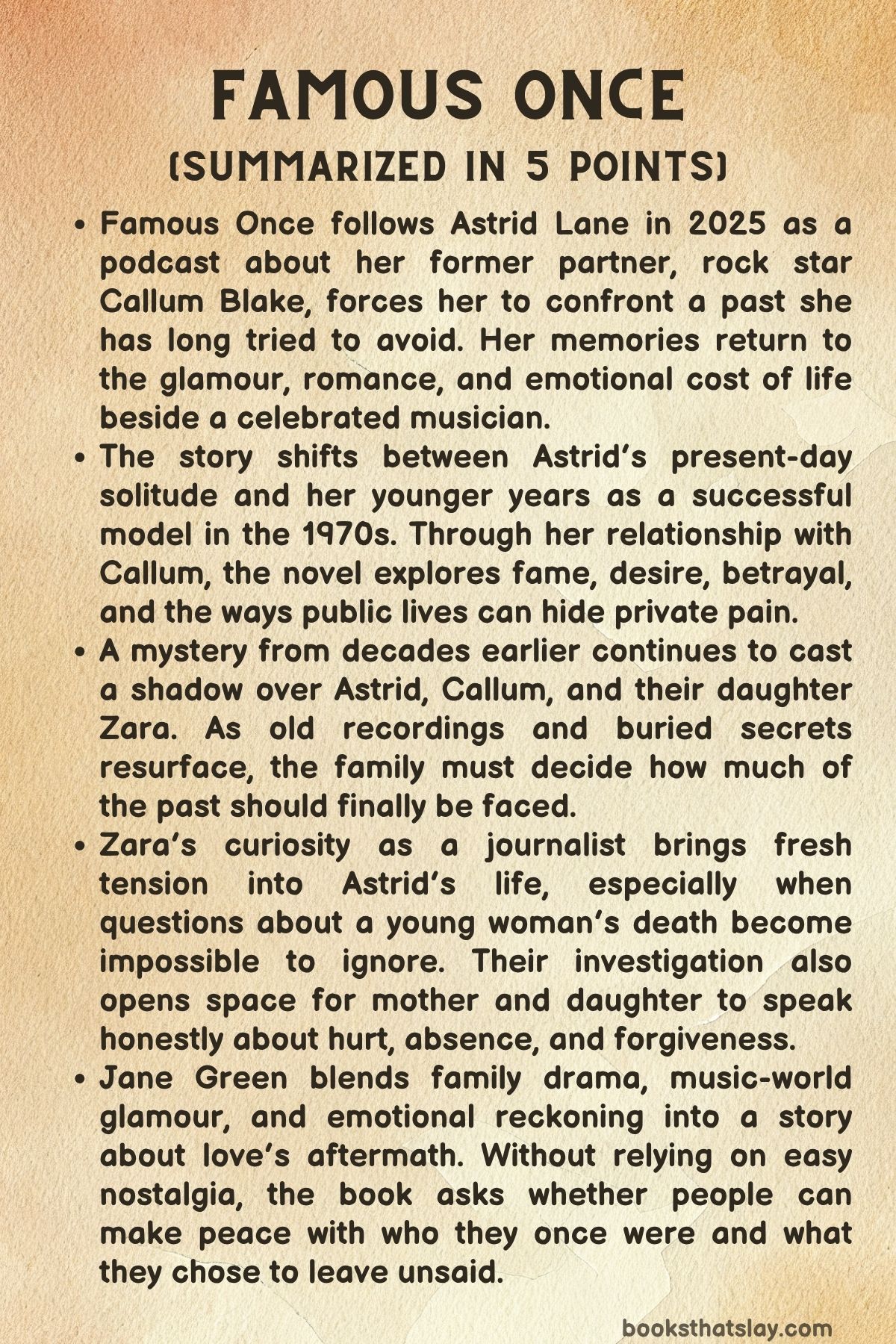
Characters
Astrid Lane
Astrid Lane is the emotional center of Famous Once, and her character is shaped by memory, regret, survival, and the slow recovery of truth. In 2025, she appears as a woman living quietly and somewhat precariously, physically separated from the glamour that once defined her youth.
Her loneliness is not only practical but emotional; she has spent decades trying to avoid the past because revisiting it means facing the death of Lily Morehouse, the collapse of her relationship with Callum, and her own failures as a mother. Astrid’s reluctance to listen to the podcast shows that she has built a fragile peace by suppressing painful memories, but the break-in and the reappearance of Callum’s tapes force her to confront what she has avoided.
In her younger years, Astrid is intelligent, beautiful, and more thoughtful than the world around her expects. As a model in the 1970s, she moves through glamorous spaces, but she is not shallow or easily impressed.
Her first meeting with Callum reveals both her vulnerability and her strength: she is attacked by Vic, rescued by Callum, and then gradually drawn into a relationship that feels emotionally real rather than merely glamorous. Her love for Callum becomes one of the defining forces of her life, and the Ibiza ceremony represents her belief in freedom, romance, and an idealized version of family.
Yet Astrid’s tragedy is that she keeps believing in that dream even after it begins to betray her.
As Callum grows distant, unfaithful, and destructive, Astrid becomes a woman who sees the truth but repeatedly chooses denial because the alternative would destroy the life she has built around him. Her emotional dependence on Callum, combined with the culture of celebrity surrounding him, traps her in a relationship where she is expected to forgive, ignore, and endure.
The revelation that their marriage was not legally valid is especially cruel because it shows how little protection she truly had, despite giving years of love and loyalty. In the later part of the book, Astrid becomes more courageous.
She admits her financial struggles, shares the tapes with Zara, apologizes for her failures as a mother, and finally learns to stand near Callum without being pulled back into his power. Her growth lies in accepting the past without letting it control her future.
Callum Blake
Callum Blake is one of the most charismatic and morally conflicted figures in the book. As a famous rock star, he carries the glamour, danger, and self-indulgence of the 1970s music world.
When Astrid first meets him, he appears different from the arrogant celebrity she expects. He is attentive, thoughtful, and capable of emotional intimacy, which makes their early connection feel sincere.
His rescue of Astrid from Vic suggests that he has a protective and decent side, and this is part of what makes him compelling: Callum is not presented as simply cruel or empty. He is capable of love, tenderness, and deep feeling.
However, Callum’s weakness is his inability to act with moral courage when it matters most. His silence after Lily’s death becomes the central stain on his character.
Even if he believes her drowning was accidental, he allows Vic’s influence to keep him quiet for decades. That silence damages not only the search for justice but also his own family.
After Lily dies, Callum escapes into drugs, touring, and emotional absence, leaving Astrid and Zara to live with the consequences of a trauma they do not fully understand. His fame gives him freedom, but it also enables his selfishness.
He moves through affairs, public admiration, and private collapse while others absorb the emotional cost.
Callum’s relationship with Astrid is deeply important because it shows both the beauty and danger of loving someone whose charm can hide cowardice. He may truly love Astrid, and his later admission that she was the great love of his life feels emotionally sincere, but love does not erase his betrayals.
His secret child, his affairs, and his failure to protect Astrid legally or emotionally reveal a man who repeatedly chooses comfort over responsibility. By the end of Famous Once, Callum is diminished by the truth.
He is not fully redeemed, but he is humanized. His final warmth with Astrid and Zara allows a brief image of family, yet the book makes clear that Astrid’s strength lies in not mistaking nostalgia for renewal.
Zara Blake
Zara Blake represents truth, accountability, and the possibility of healing between generations. As Astrid and Callum’s daughter, she has grown up in the shadow of a family history shaped by secrets.
At first, her interest in Lily Morehouse’s death seems professional because she is a journalist, but it quickly becomes personal. Zara understands that Lily’s death did not only end one young woman’s life; it also shattered her parents’ relationship and changed the emotional climate of her own childhood.
Her investigation is therefore both a public act of journalism and a private act of recovery.
Zara is determined, intelligent, and morally brave. Unlike Astrid, who has survived by avoiding the past, Zara moves toward it.
She asks questions, listens to the tapes, researches Vic’s criminal connections, and prepares to expose the truth even when danger becomes real. Her courage is not reckless for its own sake; it comes from her belief that silence protects the powerful and harms the vulnerable.
Through Zara, the story shows how the younger generation can challenge the evasions and compromises of the older one. She refuses to accept that fame, fear, or time should excuse wrongdoing.
Zara’s relationship with Astrid is one of the most emotionally important parts of the novel. She carries hurt from her childhood because Astrid’s grief and drinking made her emotionally unavailable.
Yet Zara is not simply resentful. As she learns more about Lily’s death and Callum’s silence, she begins to understand the forces that broke her parents.
This understanding does not erase Astrid’s failures, but it allows compassion to enter their relationship. Zara’s greatest achievement is not only exposing Vic; it is helping her mother come back into emotional life.
By the end, Zara becomes the bridge between past and future, between Astrid and Callum, and between pain and forgiveness.
Vic Roth
Vic Roth is the most openly predatory and corrupt figure in the book. As Callum’s manager, he represents the darker side of the music industry: power without conscience, wealth without morality, and control maintained through fear.
From his first appearance, Vic is associated with menace. His harassment and assault of Astrid reveal his entitlement and his belief that women around famous men are available for exploitation.
He is not merely unpleasant; he is dangerous, and his power comes from the fact that others are afraid to challenge him.
Vic’s role in Lily Morehouse’s death confirms the violence that has been present in him from the beginning. The tape suggests that his drunken horseplay in the pool led to Lily being held underwater too long.
Whether he intended to kill her or not, his response afterward defines him more clearly than the act itself. He forces Callum into silence, hides the truth, and uses intimidation to protect himself for decades.
The threatening man who comes to Astrid’s cottage shows that Vic’s influence has not faded with age. Even after forty years, he still depends on fear to control the narrative.
As a character, Vic functions as the embodiment of buried guilt. He is what happens when power is never held accountable.
His arrest is therefore not only a plot resolution but a moral correction. The truth finally reaches him, and the silence he relied on collapses.
In Famous Once, Vic’s downfall shows that secrets may remain hidden for years, but they continue to create damage until someone is brave enough to uncover them.
Lily Morehouse
Lily Morehouse is absent from most of the present action, but her presence haunts the entire story. She is an eighteen-year-old whose drowning becomes the hidden wound beneath the lives of Astrid, Callum, and Zara.
Because she dies young and under mysterious circumstances, Lily becomes both a person and a symbol: she represents innocence destroyed by the recklessness and corruption of the adult world around her. Her death is not treated as a distant tragedy; it is the event that quietly shapes everything that follows.
Lily’s importance lies in the way her story exposes the moral failures of others. Vic’s violence, Callum’s silence, and Astrid’s long avoidance all circle around what happened to her.
She cannot speak for herself, so the tapes and Zara’s investigation become ways of restoring her voice. The injustice of her death is intensified by the fact that the people who knew the truth allowed her memory to remain trapped in uncertainty for decades.
Lily’s character therefore represents the cost of silence. She reminds the reader that hidden crimes do not simply disappear; they continue to damage families, relationships, and the truth itself.
Birgit
Birgit is an important figure in Astrid’s early life because she helps place Astrid in the social world where her relationship with Callum begins. As Astrid’s flatmate, she represents the excitement, possibility, and social energy of the 1970s.
Her persuasion of Astrid to go to Annabel’s is a small action with enormous consequences, because it leads Astrid to meet Callum and Vic on the same night. Birgit’s presence helps show Astrid as a young woman standing at the edge of glamour, fame, danger, and romance.
Although Birgit is not as central as Astrid, Callum, Zara, or Vic, she helps define the atmosphere of Astrid’s youth. Through her, the story captures a world of clubs, models, musicians, and chance encounters.
Birgit’s role also reminds us that life-changing events often begin casually. What seems like a night out becomes the beginning of Astrid’s great love story and also the beginning of her long connection to the darker forces surrounding Callum.
Themes
The Weight of Buried Truth
In Famous Once, silence becomes a force that damages lives long after the original event has passed. Lily Morehouse’s death is not only a personal tragedy but also the hidden center of Astrid, Callum, and Zara’s broken family history.
Callum’s decision to protect Vic Roth allows a powerful man to escape responsibility, while everyone around the secret pays the price in different ways. Astrid loses the stability of her marriage, Zara grows up with emotional distance and confusion, and Callum carries guilt that slowly eats away at him.
The old tapes represent truth preserved in private, waiting for someone brave enough to face it. Once Zara listens to them, the past can no longer remain controlled by fear, fame, or intimidation.
The theme shows that truth does not disappear simply because people refuse to speak it. It waits, and when it finally surfaces, it has the power to expose injustice, restore clarity, and begin healing.
Fame, Power, and Exploitation
The world of celebrity is shown as glamorous on the surface but deeply unsafe beneath it. Astrid’s early encounters with the music industry reveal how fame protects men like Vic Roth, who uses his position to harass, intimidate, and control others.
Callum’s status as a rock star brings admiration, wealth, and freedom, but it also surrounds him with people who excuse bad behavior and hide serious wrongdoing. Astrid is drawn into this dazzling world through love, but she gradually discovers how little protection it offers her when power is used against her.
Even her marriage becomes vulnerable because others can dismiss its legitimacy when it no longer benefits them. Vic’s long escape from justice shows how influence can silence victims and witnesses.
The theme criticizes a culture where fame creates distance from ordinary consequences. It also shows how public admiration can hide cruelty, selfishness, and cowardice until someone challenges the image built around powerful men.
Motherhood, Regret, and Repair
Astrid and Zara’s relationship carries years of hurt, misunderstanding, and emotional absence. Zara’s childhood was shaped by the collapse of her parents’ relationship, Callum’s retreat into drugs and touring, and Astrid’s struggle with alcohol and grief.
Astrid’s regret is not abstract; it is tied to specific failures as a mother, especially the ways she withdrew when Zara needed steadiness. Zara’s investigation forces both women to confront the past honestly rather than protecting themselves with silence.
As Zara learns more about Lily’s death, she begins to understand that her mother’s distance came from damage, not lack of love. Astrid’s apology is important because it does not erase the pain, but it allows Zara to see her mother more fully.
Their shared search for truth becomes a path back to each other. This theme presents healing as slow, imperfect, and earned through honesty.
By the end, the bond between mother and daughter feels stronger because it has survived truth rather than avoidance.
Love, Disillusionment, and Self-Respect
Astrid’s love for Callum begins with intensity, romance, and the belief that she has found a rare emotional connection. Their early relationship is filled with promise, and the Ibiza ceremony reflects Astrid’s faith in a shared future.
Over time, however, love becomes mixed with humiliation, denial, and loneliness. Callum’s affairs, absences, and secret child force Astrid to see that devotion cannot survive without respect.
Her decision to leave him marks a painful but necessary act of self-preservation. In Famous Once, romantic memory remains powerful, but it is not allowed to rewrite the damage Callum caused.
When Astrid and Callum meet again years later, their warmth shows that love can remain part of a person’s history without becoming their future. Astrid’s refusal to be drawn back in proves that growth means knowing the difference between affection and surrender.
The theme shows that self-respect sometimes begins when a person stops confusing past happiness with present truth.