Enola Holmes and the Clanging Coffin Summary, Characters and Themes
Enola Holmes and the Clanging Coffin by Nancy Springer is a young adult mystery adventure featuring Enola Holmes, the sharp, independent younger sister of Sherlock and Mycroft Holmes. The book blends Victorian danger, family secrets, coded clues, and Enola’s fierce commitment to helping vulnerable people.
At its center is Trevina Hathaway, a brilliant young woman whose gift for mathematics has made her the target of a ruthless criminal mind. As Enola investigates a shocking live burial, she uncovers a plot tied to Professor Moriarty, Sherlock’s most feared enemy, and proves once again that her courage and intelligence make her a true Holmes. It’s the 10th book of the Enola Holmes series.
Summary
The story begins with the dark history of Trevina Hathaway’s family. Her mother, Maud, grew up under a cruel father who believed obedience mattered more than kindness.
When Maud’s mother failed to submit to him, he sent her away to an asylum. Maud was raised with three brothers, James, Robert, and Philip, all shaped by violence and control.
Robert, the most brilliant of them, showed an extraordinary talent for mathematics and became a professor. Yet his gifts did not make him moral.
After losing his position, he turned toward crime and moved to London.
Maud later married Trevor Hathaway, a gentle schoolteacher, and they had a daughter named Trevina. Trevina inherited a rare mathematical genius.
Robert noticed this and became obsessed with her abilities. He began to see her not as a child but as a useful tool.
When Trevina was still young, he sent men to kidnap her and separated her from her parents. He held her captive and forced her to assist him with criminal calculations.
For years, Trevina lived under fear, control, and isolation. Her mother was later told that Trevina had died.
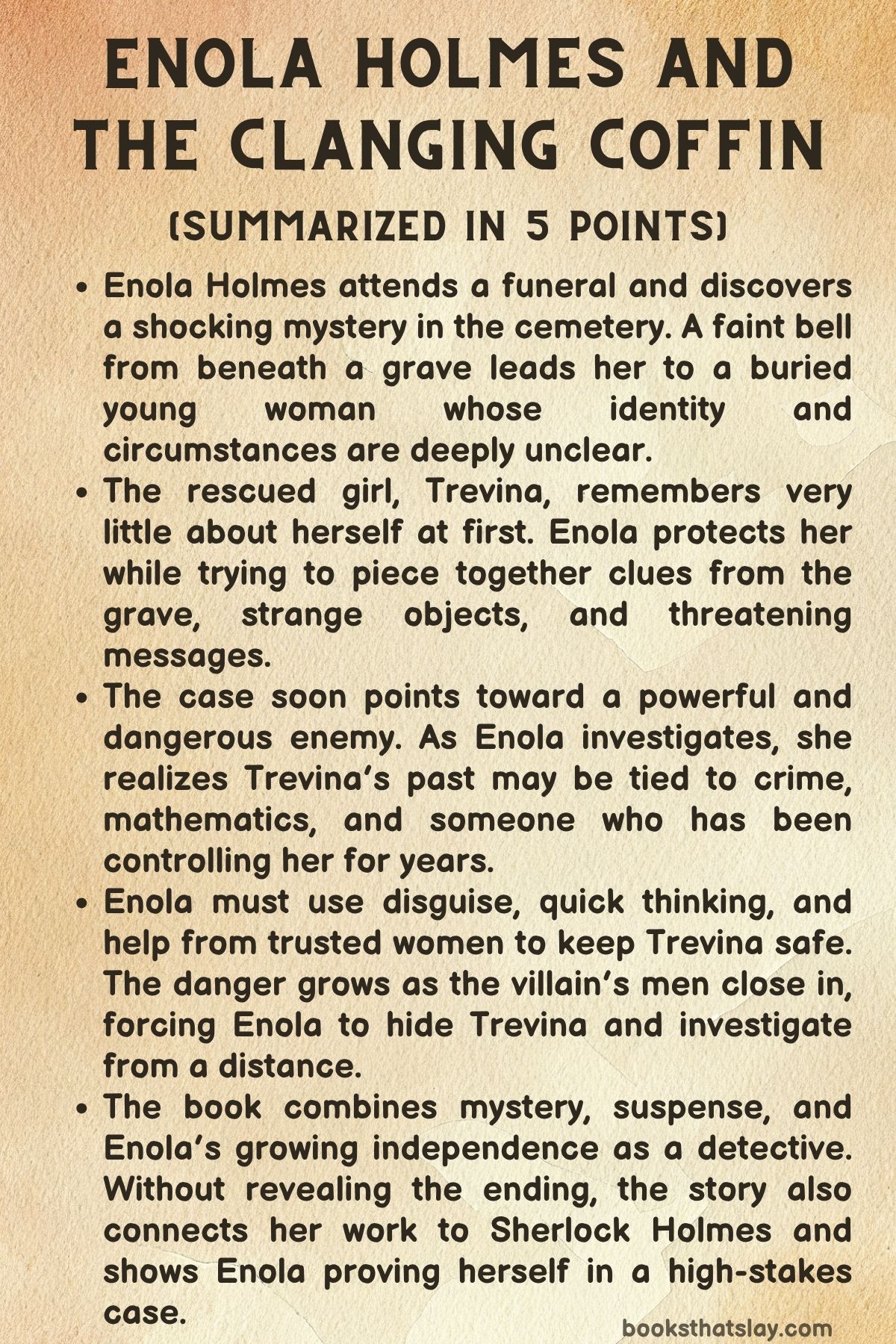
Years afterward, Enola Holmes attends the funeral of Mrs. Tupper, her former landlady, at Besselgreen Cemetery. While leaving the burial ground, Enola hears a faint bell ringing.
Others dismiss it, but Enola follows the sound. It leads her to a newly dug grave marked with the name Trevina Y. Trairom.
The grave has a safety coffin bell, meant to alert the living if someone has been buried by mistake. Enola quickly understands that someone is alive below.
She opens part of the grave marker and finds an air pipe with bellows. She pumps air into the coffin while help is called.
When the coffin is dug up, a young woman is found alive but unconscious. She is dressed in a thin white garment and surrounded by strange objects: pink roses, a broken jug, and a ribbon circlet.
Enola realizes this was not an accident. Someone buried this woman alive as a deliberate act of cruelty.
Enola takes the rescued woman to Florence Nightingale’s house, where she has been staying while caring for Mrs. Tupper. A doctor says the woman has been drugged with an opiate and may have been beaten.
When she wakes, she remembers only her first name, Trevina. She does not know her surname, her history, or how she came to be buried.
Enola decides not to place public notices about her. She suspects the person who buried Trevina may return to finish the job.
Enola investigates the grave, coffin, and cemetery. Soon a bouquet of pink roses arrives for Trevina at Florence Nightingale’s house.
It is addressed to Trevina Yael Trairom and contains tent pegs along with a Biblical reference to Yael killing Sisera. Trevina is terrified and understands that someone is mocking her.
The cemetery keeper tells Enola that a tall, thin, skeletal man had asked for Florence Nightingale’s address. Enola later sees this same man near the Professional Women’s Club, where she has moved Trevina for safety.
He leaves another cruel parcel, this one containing carved ammonite stones known as snakestones. Trevina recognizes him but cannot remember his name.
Trevina’s small dog, Euclid, eventually finds her at the Club. His arrival helps restore some of her memory.
She remembers that her uncle was cruel to both her and the dog. Enola traces the mysterious man to a grim house near Florence Nightingale’s home.
She calls it the Cage because of its harsh, confining appearance. While spying on it, she meets Sherlock Holmes, who is also watching the house in disguise.
Sherlock warns her that the man is not named Trairom and is one of the most dangerous men in London. He orders her to stay away.
Trevina slowly recalls that her uncle stole her from her parents because of her mathematical gift. He forced her to work for him in what she calls criminal mathematics.
Enola realizes he may be tracking Trevina through Euclid. She also discovers that the strange burial costume was copied from a painting called The Broken Vessel, turning Trevina’s rescue into another humiliation.
The danger soon becomes open violence. The criminal’s men attack the Professional Women’s Club and try to seize Trevina.
The women inside defend the building with whatever weapons they can find. Trevina herself helps prevent dynamite from blasting open the door by ordering water poured on the fuse.
After the attack, Trevina understands that staying at the Club puts everyone there at risk.
Enola creates a false trail. She stages a public departure, then secretly disguises Trevina as a Quaker woman named Maud Hatherley.
She dyes Euclid with henna to alter his appearance and hides them both in Dr. Ragostin’s old office, a secret property Enola controls. The next day, Enola’s cabman Harold reports that rough men raided the hotel room where Trevina had only pretended to stay.
This proves the enemy is close behind.
Enola goes to Baker Street hoping to find Sherlock, but Mrs. Hudson says he is away. She also reveals that Sherlock has been exhausted and deeply troubled by a case.
Enola suspects this is connected to Trevina’s enemy. Florence Nightingale then summons Enola and shares what she has discovered.
The strange neighbor’s real name is Professor Robert Moriarty. He was once a mathematics professor, now lives in suspicious wealth, and has a sister named Maud who married Trevor Hathaway.
Enola realizes Trevina’s true name is Trevina Hathaway, and that Trairom is Moriart written backward with extra letters added to point toward Moriarty.
When Enola tells Trevina the name Moriarty, her memory returns. Trevina explains that her uncle kidnapped her in 1885 and claimed she would become his heir.
He intended to train her as a female criminal mastermind, someone society would never suspect. He used threats against her parents to control her.
When she finally refused to help plan a murder, he beat her, drugged her, and buried her alive.
Enola travels to Gloucestershire to find out what happened to Trevina’s parents. At Bent End, the villagers are frightened and unwilling to speak.
She eventually finds the Hathaway home abandoned and ruined. On the lawn, she discovers a sunken rectangular patch marked with ammonites and realizes Trevor Hathaway was probably buried there.
A poor local woman confirms the truth: Moriarty’s men kidnapped Trevina, returned later, murdered Trevor, buried him at Patchwoodie Villa, and took Maud away.
Enola tells Trevina that her father is dead but her mother may still be alive. Trevina explains Fibonacci spirals and ammonites, helping Enola connect Moriarty’s strange house design to a hidden pattern.
Meanwhile, Enola learns from Mycroft that Sherlock has been secretly gathering evidence against Moriarty, who controls much of London’s criminal world. Mycroft expects Moriarty to be arrested soon, but warns Enola not to get involved.
Moriarty’s men keep searching for Trevina. They invade Dr. Ragostin’s office, forcing Enola to move her again.
Enola later sees Moriarty himself at Sherlock’s rooms, where he threatens Sherlock. Before leaving, Sherlock gives Enola his second-best fiddle.
She later discovers it is packed with banknotes, giving her the means to keep herself and Trevina hidden.
Moriarty escapes arrest and flees to Europe. Sherlock and Dr. Watson pursue him.
Enola later hears from Watson that Sherlock and Moriarty apparently died together at the Reichenbach Falls in Switzerland. She is crushed by grief and mourns deeply.
Even so, Enola continues thinking. She solves the mystery of Maud Hathaway by studying the Fibonacci spiral suggested by Moriarty’s house.
With Trevina and Harold, she enters the deserted house and finds a hidden cellar beneath the cellar. There they discover Maud, imprisoned for six years.
They rescue her and take her to Florence Nightingale, where she begins to recover.
Later, Enola notices that Mycroft has paid to keep Sherlock’s rooms untouched for a year. She realizes Mycroft would not spend money out of sentiment alone.
From this, she deduces Sherlock is alive. Mycroft confirms that Sherlock survived the struggle with Moriarty, escaped from the falls, and sent him a coded message.
Enola agrees to keep the secret.
Trevina and Maud move into Moriarty’s former house and begin rebuilding their lives. They eventually inherit from his estate.
Enola reopens Dr. Ragostin’s detective business and returns to her work as a finder of lost people and things. In the final reflection, Mycroft admits that he once underestimated Enola, but now recognizes that she is truly a Holmes.
Characters
Enola Holmes
Enola Holmes is the central figure of Enola Holmes and the Clanging Coffin, and the book presents her as brave, observant, compassionate, and sharply independent. Her intelligence appears not only in the way she notices clues, but also in how quickly she understands danger when others hesitate or misunderstand what is happening.
At the cemetery, she refuses to ignore the sound of the bell, and this instinctive refusal to dismiss something strange becomes the action that saves Trevina’s life. Enola’s courage is practical rather than showy.
She pumps air into the buried coffin, protects Trevina from public exposure, hides her from Moriarty, and repeatedly risks her own safety to uncover the truth.
Enola is also deeply empathetic. She is not satisfied with merely rescuing Trevina from the coffin; she wants to restore her identity, safety, dignity, and future.
Her decision not to advertise for Trevina’s relatives shows her emotional intelligence, because she understands that family connections may be part of the danger rather than the solution. Throughout the story, Enola acts as both detective and protector.
She notices physical clues, interprets symbolic threats, creates disguises, arranges hiding places, and thinks several steps ahead of Moriarty’s men.
Her relationship with Sherlock and Mycroft also reveals her growth. She respects Sherlock’s abilities but does not simply obey him when he tells her to stay away from danger.
She is hurt by the possibility of his death, yet she later uses reason rather than emotion to deduce that he is alive. By the end of the book, Enola has proven herself as a true Holmes: not because she imitates her brothers, but because she combines intelligence with moral courage and compassion.
Trevina Hathaway
Trevina Hathaway is one of the most tragic and important characters in the book. When she is first found, she has been buried alive, drugged, stripped of her dignity, and separated from her past.
Her condition makes her seem helpless at first, but as the story develops, it becomes clear that she is not weak. She is a deeply gifted young woman whose mathematical genius has been exploited by her uncle, Professor Moriarty.
Her tragedy comes from the fact that her talent, which should have brought her freedom and recognition, becomes the reason she is imprisoned and controlled.
Trevina’s fear is understandable because Moriarty has shaped her life through violence, isolation, and threats. Yet even while frightened, she shows signs of courage and intelligence.
During the attack on the Professional Women’s Club, she helps stop the dynamite by ordering water to be poured on the fuse. This moment is important because it shows that her mind remains quick and useful under pressure.
She is not merely someone Enola must save; she also participates in her own survival.
Her recovery of memory is also central to her character. As she remembers Euclid, her uncle, her parents, and the truth about her imprisonment, she begins to regain the self that Moriarty tried to erase.
By the end of Enola Holmes and the Clanging Coffin, Trevina represents survival after cruelty. Her reunion with her mother and her eventual inheritance of Moriarty’s house suggest that she can reclaim not only her past, but also the future that was stolen from her.
Professor Robert Moriarty
Professor Robert Moriarty is the main villain of the story and one of the most dangerous figures in the book. He is frightening because his evil is not impulsive or simple.
He is a brilliant mathematician who uses intelligence as a weapon. His mind, which once gave him academic success, becomes the foundation of a criminal empire.
Moriarty’s cruelty is cold, controlled, and symbolic. He does not merely try to kill Trevina; he humiliates her, frightens her, sends coded threats, and turns mathematical and artistic references into instruments of psychological torture.
Moriarty’s treatment of Trevina reveals his possessiveness and moral emptiness. He sees her not as a niece, child, or independent person, but as property and as a possible tool for his crimes.
He abducts her because of her mathematical gift, forces her into his schemes, and punishes her when she refuses to help arrange a murder. His violence toward Maud and Trevor Hathaway further shows that he destroys anyone who stands between him and control.
He imprisons Maud for years and has Trevor murdered, creating a private world of fear around his own family.
He is also a strong contrast to Sherlock Holmes. Both men are brilliant, disciplined, and capable of complex reasoning, but Sherlock uses intellect in pursuit of justice while Moriarty uses it for domination.
His house, designed around a Fibonacci spiral, reflects his character: ordered, secretive, elegant, and monstrous beneath the surface. Moriarty’s apparent death at the Reichenbach Falls marks the collapse of his visible power, but the damage he leaves behind continues to shape the lives of Trevina, Maud, Enola, and Sherlock.
Maud Hathaway
Maud Hathaway is Trevina’s mother and one of the most sorrowful figures in the story. Her early life is marked by patriarchal cruelty, beginning with a harsh father who sends her mother to an asylum for disobedience.
This background helps explain the world she comes from: a world where women can be silenced, imprisoned, or declared troublesome when they resist male authority. Maud’s suffering continues after her marriage, when her brother Robert Moriarty targets her daughter and destroys her family.
Maud’s role in the book is deeply connected to endurance. She loses her daughter, her husband, her freedom, and almost her identity, yet she survives years of imprisonment beneath Moriarty’s house.
Her captivity is one of the darkest revelations in the story because it shows the full extent of Moriarty’s cruelty. He does not only remove obstacles; he preserves them in hidden suffering, as though their pain is another part of his control.
Her rescue is emotionally powerful because it restores Trevina’s family after years of separation and lies. Maud is not a highly active character in the main investigation, but her presence gives the mystery its emotional depth.
Through her, the book shows how crimes of control can pass through generations, and how rescue is not only about solving a puzzle but also about restoring human bonds.
Sherlock Holmes
Sherlock Holmes appears as a brilliant but strained figure. In this story, he is not simply the famous detective who always seems in control.
He is exhausted, secretive, irritable, and deeply troubled by his investigation of Moriarty. This makes him more vulnerable than usual.
His pursuit of Moriarty has taken a heavy toll on him, and even those around him, such as Mrs. Hudson and Enola, notice the strain.
Sherlock’s relationship with Enola is complex. He warns her to stay away from Moriarty, not because he doubts her intelligence completely, but because he understands the scale of the danger.
However, his warning also shows that he still underestimates her independence and capability. Enola respects him, worries about him, and grieves when she believes he has died, yet she does not become passive in his absence.
In this way, Sherlock’s role helps reveal Enola’s strength.
His apparent death at the Reichenbach Falls gives the story a heavy emotional turn. For Enola, the loss feels personal, not merely dramatic.
Later, when she deduces that he survived, the moment reinforces both Sherlock’s cleverness and Enola’s Holmes-like reasoning. Sherlock is therefore important not only as Moriarty’s great opponent, but also as a measure of Enola’s growth.
Mycroft Holmes
Mycroft Holmes is a reserved, practical, and calculating presence in the book. He is less emotionally expressive than Enola and less visibly active than Sherlock, but he plays an important role in the larger Holmes family dynamic.
Mycroft understands more than he openly says, especially about Sherlock’s secret struggle with Moriarty. His warnings to Enola show caution and authority, though they also reveal that he does not fully recognize her ability at first.
Mycroft’s most important development comes near the end. His decision to pay for Sherlock’s rooms to remain untouched appears sentimental on the surface, but Enola correctly understands that Mycroft is too practical to waste money for mere emotion.
This allows her to deduce that Sherlock is alive. In that moment, Mycroft becomes part of a hidden network of Holmes intelligence, secrecy, and coded communication.
The epilogue gives Mycroft an additional layer. By admitting that he underestimated Enola, he confirms one of the story’s major points: Enola has earned recognition not as a child to be managed, but as a capable detective in her own right.
His final judgment strengthens the book’s closing sense of Enola’s maturity and professional identity.
Florence Nightingale
Florence Nightingale is a wise, disciplined, and protective figure in the story. She gives Enola and Trevina a place of refuge, and her home becomes a temporary shelter from the violence surrounding Moriarty.
Her presence adds moral authority to the book because she represents intelligence, service, and female strength. She is not physically involved in every dangerous moment, but her knowledge and influence are essential.
Florence also contributes directly to the investigation. Her information about the strange neighbour helps reveal that the man Enola has known through clues and threats is actually Professor Robert Moriarty.
She connects social observation with practical intelligence, showing that detection is not limited to professional detectives. Her awareness of Moriarty’s background helps Enola identify Trevina’s real family and understand the meaning of the false name “Trairom.”
She also represents a wider community of capable women. Along with the women at the Professional Women’s Club, Florence helps create an alternative support system for Trevina.
In a story filled with male control and violence, Florence stands for protection, order, and moral courage.
Mrs. Tupper
Mrs. Tupper is Enola’s former landlady, and although she dies before the main mystery begins, her funeral becomes the event that places Enola at the cemetery where Trevina is discovered. Her character is therefore important in a structural sense: her death leads Enola to the graveyard, and without that moment, Trevina might not have been saved.
Mrs. Tupper also connects to Enola’s past. As a former landlady, she belongs to the network of ordinary people who have supported Enola’s independent life.
Her funeral creates a mood of loss at the beginning of the story, which is quickly transformed into urgency when the coffin bell rings. In that way, Mrs. Tupper’s presence helps shift the book from mourning into mystery.
Trevor Hathaway
Trevor Hathaway, Trevina’s father, is a tragic character whose fate reveals the brutality of Moriarty’s power. He is described as a schoolteacher and the husband of Maud Hathaway.
His family life seems to have offered Trevina a more loving and stable origin before Moriarty’s interference. Because Moriarty wants Trevina for himself, Trevor becomes an obstacle.
His murder at Patchwoodie Villa is one of the clearest signs that Moriarty’s crimes are not limited to manipulation or intimidation. Moriarty is willing to erase a family to secure control over a child’s mind and talent.
Trevor’s hidden grave also gives the investigation a grim emotional weight. He does not appear actively in the main events, but his death explains the depth of Trevina and Maud’s suffering.
Euclid
Euclid, Trevina’s little dog, is more than a pet in the story. He is a living connection to Trevina’s lost identity.
When he finds her at the Professional Women’s Club, he helps trigger her memories, especially memories of her uncle’s cruelty. His name also reflects Trevina’s mathematical world, linking affection and intellect in a way that contrasts sharply with Moriarty’s cold use of mathematics.
Euclid also becomes a source of danger because Enola realizes Moriarty may be able to track Trevina through him. This forces Enola to disguise not only Trevina but also the dog, showing how thoroughly Moriarty’s reach threatens every part of Trevina’s life.
Despite this danger, Euclid remains emotionally important because he represents loyalty, innocence, and the part of Trevina’s past that still loves her.
Harold
Harold, Enola’s cabman, is a practical and loyal helper. He does not dominate the story, but he provides important support at several key moments.
His reports help Enola confirm the danger surrounding Trevina, especially when rough men raid the hotel room where Trevina had pretended to stay. This makes Harold valuable not only as transportation, but also as a trusted observer.
His role in the rescue of Maud Hathaway is especially important. He accompanies Enola and Trevina into Moriarty’s deserted house and helps them reach the hidden underground prison.
Harold represents the dependable allies Enola gathers around herself. He is not a detective like Enola or Sherlock, but his courage and reliability make him part of the successful rescue effort.
Mrs. Hudson
Mrs. Hudson is a minor but meaningful character. As the caretaker of Sherlock’s rooms, she gives Enola important insight into Sherlock’s condition.
Her description of him as exhausted, sleepless, irritable, and troubled helps Enola understand that Moriarty is not an ordinary criminal. Through Mrs. Hudson, the book shows the emotional cost of Sherlock’s work before the danger fully becomes public.
She also represents domestic observation. Although she is not part of the investigation in a formal way, she notices changes in Sherlock that others might overlook.
Her concern gives Sherlock a more human presence and helps Enola connect the mystery of Trevina to the larger battle between Sherlock and Moriarty.
Dr. Watson
Dr. Watson appears as the loyal companion of Sherlock Holmes and as the bearer of devastating news. His report that Sherlock and Moriarty apparently died together at the Reichenbach Falls deeply affects Enola.
Through Watson, the story connects Enola’s personal investigation with the famous confrontation between Sherlock and Moriarty.
Watson’s importance lies in his credibility and emotional seriousness. When he brings news of Sherlock’s apparent death, it feels trustworthy, which makes Enola’s grief more intense.
He stands for loyalty, witness, and the human cost of heroic conflict. Even though he is not central to Trevina’s rescue, his role gives weight to Sherlock’s sacrifice and to the danger Moriarty represents.
Huff
Huff, the cemetery keeper, is a small but useful character in the investigation. He provides Enola with information about the tall, thin, skeletal gentleman who asked for Florence Nightingale’s address.
This detail helps Enola trace the danger surrounding Trevina and confirms that the person responsible is still watching and moving nearby.
Huff’s role shows how minor witnesses matter in detective fiction. He is not heroic in a dramatic sense, but what he notices becomes important evidence.
Through him, Enola gains another piece of the pattern that leads toward Moriarty.
Jackanapes
The young man Enola calls Jackanapes appears at the cemetery and objects when she follows the sound of the bell. His main purpose is to contrast with Enola’s decisiveness.
Where he hesitates or dismisses the situation, Enola acts. This makes him useful as a character because he highlights her courage and independence at the very beginning of the mystery.
He also reflects the social attitudes Enola often has to resist. As a young woman, she is frequently expected to defer, wait, or behave conventionally.
By ignoring his objections and trusting her own judgment, Enola proves once again that her instincts are stronger than the assumptions others place on her.
Heavy Neville
Heavy Neville is one of Moriarty’s men and represents the physical force behind Moriarty’s intellectual criminal empire. Moriarty may be the mind of the operation, but men like Heavy Neville make his threats immediate and bodily.
His pursuit of Enola and search for Trevina show that Moriarty’s power extends into the streets through hired violence.
Heavy Neville’s role is important because he turns the mystery into active danger. Enola is not merely solving clues from a safe distance; she is being followed, watched, and hunted.
Through characters like Heavy Neville, the book shows how Moriarty’s criminal world depends on intimidation as much as intelligence.
James and Philip Moriarty
James and Philip Moriarty are mentioned as two of Maud’s violent brothers. They do not play as large a role as Robert Moriarty, but they help establish the disturbing family background from which both Maud and Robert come.
Their violence suggests that cruelty and domination have long been present in the family environment.
Their presence also helps explain why Maud’s early life was shaped by fear. Robert may become the most intellectually dangerous member of the family, but James and Philip contribute to the sense that Maud grew up surrounded by male aggression.
They deepen the book’s portrait of a family damaged by control, violence, and the silencing of women.
Maud’s Father
Maud’s father is an important background figure because his harshness shapes the family’s history. His decision to send Maud’s mother to an asylum for “failure to obey” reveals a cruel belief in male authority and female submission.
This act creates one of the earliest examples of unjust confinement in the story.
His character also foreshadows Moriarty’s later treatment of Maud and Trevina. The same pattern appears again and again: women who resist are controlled, hidden, imprisoned, or declared powerless.
Although Maud’s father is not active in the main mystery, his behavior helps establish the atmosphere of inherited cruelty that Robert Moriarty later turns into something even more calculated and criminal.
Maud’s Mother
Maud’s mother is a silent but deeply significant figure. She is sent to an asylum because she fails to obey, which suggests that she is punished not for madness but for resistance.
Her fate reflects the vulnerability of women in the world of the story, especially when male relatives are allowed to define obedience as sanity and independence as disorder.
Her absence haunts the family history. She represents the first broken link in Maud’s family, and her treatment helps explain Maud’s fear of male power.
Like Maud and Trevina later, she becomes a victim of confinement. Her story strengthens one of the book’s central concerns: the struggle of women to survive systems designed to control them.
Themes
Control, Possession, and the Abuse of Power
Robert Moriarty’s treatment of Trevina shows how control can become a form of violence when one person believes another exists only to serve his ambition. He does not see Trevina as a child with feelings, choices, or a future of her own; he sees her mathematical gift as property that he can seize and use.
His crime is not only kidnapping her but also trying to erase her identity by separating her from her parents, isolating her, renaming her through the false “Trairom” burial, and forcing her into work she never chose. The same pattern appears earlier in the family history, when Maud’s father sends her mother to an asylum for disobedience.
Women in the story are punished when they refuse submission. Through Trevina and Maud, Enola Holmes and the Clanging Coffin presents power as most frightening when it hides behind family authority, intellect, money, and social status.
Female Courage and Mutual Protection
The story places women at the center of survival, rescue, and resistance. Enola does not wait for male approval before acting; she hears the coffin bell, trusts her judgment, and saves Trevina from death.
Florence Nightingale provides shelter, information, and moral authority, while the women at the Professional Women’s Club defend Trevina when Moriarty’s men attack. Their courage is practical rather than decorative: they hide people, investigate clues, block danger, and make quick decisions under pressure.
Trevina herself is not merely a victim; even while frightened, she helps stop the dynamite attack and later joins Enola in rescuing her mother. The theme shows that protection does not always come from official power or famous detectives.
It often comes from women who have been ignored, underestimated, or dismissed, yet act with intelligence and firmness when others are in danger.
Identity, Memory, and Recovery
Trevina’s lost memory reflects the damage caused by captivity and fear. When Enola first rescues her, Trevina knows almost nothing about herself except her first name.
This loss is not just medical; it represents how Moriarty has tried to strip her of her past, family, dignity, and independence. Each recovered memory becomes a step toward reclaiming herself.
Euclid’s return, the name Moriarty, and the truth about her parents all help Trevina rebuild the story of who she is. Enola’s investigation matters because it restores more than facts; it gives Trevina back her name, her family history, and her right to decide what happens next.
In Enola Holmes and the Clanging Coffin, identity is shown as something that can be attacked through fear and isolation, but also something that can be recovered through truth, care, and courage.
Intelligence, Morality, and Responsibility
Mathematical brilliance appears in two sharply different forms. Moriarty uses intellect as a weapon, turning patterns, planning, and calculation into tools for crime.
His intelligence makes him dangerous because it is detached from compassion. Trevina’s gift, however, is connected to innocence, creativity, and problem-solving.
She understands numbers deeply, but she does not want her talent used to harm anyone. This contrast raises an important moral question: intelligence alone does not make a person admirable.
What matters is how knowledge is used. Sherlock, Enola, Florence, and Trevina all rely on observation and reasoning, but their purpose is rescue, justice, and protection.
Moriarty’s downfall comes because his cleverness cannot fully control people who act from loyalty and conscience. The story suggests that true intelligence includes moral responsibility, not just skill, strategy, or power over others.