The Abolition of Man Summary and Analysis
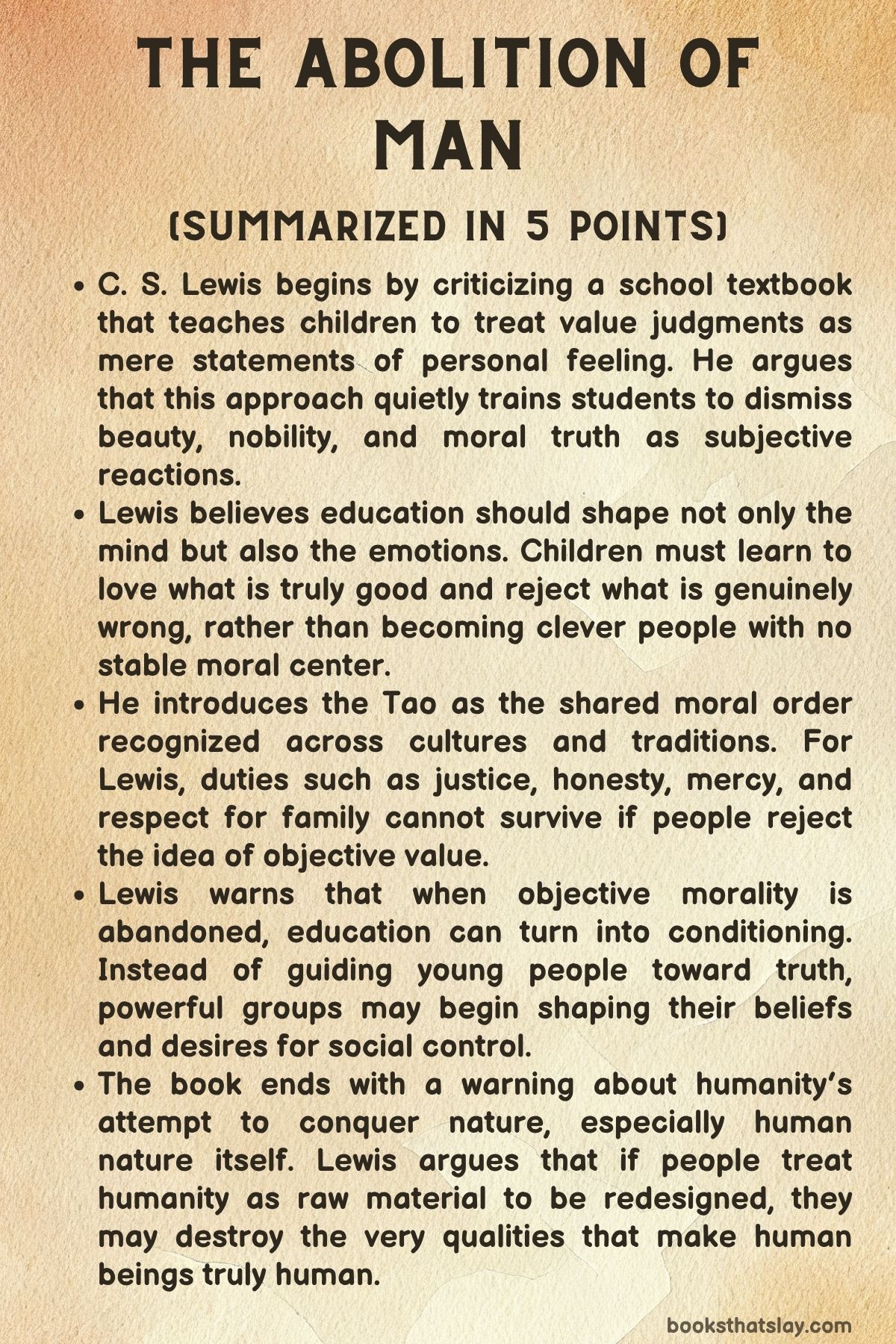
The Abolition of Man is a short philosophical work by C. S. Lewis about education, morality, and the danger of treating values as mere personal feelings. Lewis begins with a critique of school textbooks, but his argument grows into a larger warning about modern thought.
He believes that when children are taught to dismiss moral and emotional judgments as subjective, they lose the inner formation needed for virtue. The book defends the idea of a shared moral order, which Lewis calls the Tao, and warns that abandoning it may lead to manipulation, social control, and the loss of true humanity.
Summary
The Abolition of Man begins with C. S. Lewis considering the hidden moral influence of education. He does not start with an abstract political warning or a broad attack on modern society.
Instead, he begins with a school textbook intended to teach English composition to children. This choice is important because Lewis believes that the formation of young minds often happens indirectly.
A textbook may appear to teach style, grammar, or clear writing, but it can also pass on assumptions about truth, beauty, emotion, and morality. For Lewis, the danger is not only in what teachers openly say, but also in the habits of judgment they train students to accept without noticing.
Lewis refers to this textbook as The Green Book and calls its authors Gaius and Titius, not because those are their real names, but because he wants to criticize their ideas without making the matter personal. He focuses on their discussion of a story involving Samuel Taylor Coleridge and a waterfall.
In that story, one observer calls the waterfall sublime, while another calls it merely pretty. Coleridge approves of the first response and rejects the second.
Gaius and Titius, however, interpret the statement “the waterfall is sublime” as if it only means that the speaker has certain feelings. In their view, such a statement says nothing real about the waterfall itself.
It only reports the speaker’s inner emotional state.
Lewis sees this as far more dangerous than a simple lesson in wording. He argues that the authors are teaching children to believe that all judgments of value are only descriptions of private feelings.
If a child learns this lesson, the child may begin to think that calling something noble, beautiful, shameful, honorable, or contemptible never says anything meaningful about the thing itself. It only says something about the person who reacts to it.
Lewis believes this strips value judgments of seriousness. Once value language becomes only emotional noise, young people are trained to distrust the very sentiments that connect them to morality.
Lewis does not deny that people can write badly about emotions, beauty, travel, animals, or nature. He agrees that sentimental writing can be excessive or false.
Yet he objects to the method used by the authors of The Green Book. They mock weak emotional language without showing students what a proper emotional response might look like.
Instead of teaching children to distinguish good sentiment from false sentiment, they seem to encourage suspicion toward sentiment itself. Lewis thinks this is a grave educational failure.
Children do not need to have emotion removed from them; they need their emotions trained so that they love what is worthy of love and reject what is genuinely hateful.
From this point, Lewis explains an older idea of education. In the older view, the aim of education is not only to fill the mind with facts or sharpen the intellect.
It is also to shape the affections. A well-educated person should not merely know what is good in a cold intellectual sense; such a person should also be properly moved by goodness.
Courage, justice, honor, mercy, gratitude, and shame all depend on rightly ordered emotions. Lewis uses the image of “Men without Chests” to describe people who have intellect and appetite but lack trained, noble sentiment.
The head may reason, and the belly may desire, but without the chest, there is no stable moral center between thought and impulse.
Lewis then turns to the deeper foundation of morality. He calls this foundation the Tao, borrowing a term from Chinese philosophy, though he uses it in a broad sense.
By the Tao, Lewis means the shared moral order recognized in many cultures and traditions. It includes basic duties such as honoring parents, telling the truth, showing mercy, practicing justice, caring for future generations, and respecting human obligations.
Lewis does not argue that every culture has been identical in every moral detail. Rather, he argues that across human civilizations there has been a broad common recognition that some things are truly right and others truly wrong.
Lewis believes that modern critics of traditional morality often pretend they can reject the Tao while keeping certain values they personally prefer. They may reject inherited moral law but still claim to value the future of humanity, social progress, survival, or public welfare.
Lewis argues that this is inconsistent. Once objective value is rejected, there is no firm reason to prefer the welfare of future generations over present pleasure, or human survival over human extinction.
Facts alone cannot produce moral obligation. A biological fact may tell us that a species tends to preserve itself, but it cannot prove that the species ought to preserve itself.
The word “ought” must come from a moral source, and for Lewis that source is the Tao.
He also examines the appeal to instinct as a basis for morality. Some might say that moral behavior comes from natural instinct, but Lewis finds this inadequate.
Human beings have many instincts, and these instincts often conflict. A person may feel an instinct to help someone in danger, but also an instinct for self-preservation.
To decide which instinct should be followed, a person needs a standard beyond instinct itself. Instincts may push and pull, but they do not judge their own moral rank.
The act of choosing one instinct over another already assumes a moral measure. Therefore, instinct cannot replace the Tao; it depends on something like the Tao for direction.
Lewis then develops the consequences of rejecting objective value. If educators no longer see themselves as passing on a moral inheritance, they may begin to see themselves as creators of values.
Education then changes into conditioning. Instead of helping young people grow into moral freedom, the new educators shape children according to whatever ideals they choose.
The old teacher stood within the Tao and introduced the student to a moral reality greater than both teacher and student. The new conditioner stands outside inherited morality and treats the student as material to be shaped.
This leads Lewis to his final and most serious warning. He discusses what is often called humanity’s conquest of Nature.
At first, this phrase appears to describe progress. Scientific knowledge allows human beings to overcome disease, travel farther, produce more, and control parts of the physical world.
Lewis does not reject science itself. He respects true scientific inquiry.
However, he asks who actually gains power when nature is conquered. Often, the conquest of nature means that some human beings gain power over other human beings through technology, institutions, and expert knowledge.
For example, if one generation gains the power to shape the values and behavior of future generations, then this is not simply humanity mastering nature. It is one group of people mastering other people.
Lewis imagines a future in which a small elite group, whom he calls the Conditioners, uses science, psychology, education, and social planning to shape humanity according to its own desires. These Conditioners would no longer submit their choices to the Tao.
They would decide what future people should value. They would manufacture conscience rather than educate it.
Yet Lewis argues that the Conditioners would not really be free creators of value. If they stand outside the Tao, their choices cannot be guided by reasoned morality.
Their decisions will finally come from impulse, preference, heredity, environment, or appetite. In trying to conquer human nature, they become servants of nature in its lowest sense.
They may claim to rule humanity, but they are themselves ruled by irrational drives. Thus, the final victory over nature becomes nature’s victory over man.
The title of the book becomes clear here. The abolition of man does not mean the physical destruction of the human species.
It means the destruction of what makes human beings fully human: moral reason, trained emotion, conscience, and participation in an objective order of value. If human beings become raw material for manipulation, then humanity has not advanced.
It has surrendered its own nature.
Lewis ends by defending himself against the charge of being anti-science. He does not want less knowledge or a rejection of scientific discovery.
He wants a different spirit of knowledge. A healthy science would explain without explaining away.
It would study nature without reducing all value, meaning, and beauty to mere mechanisms. Such a science would recognize that human beings are part of reality, not detached masters standing above it.
For Lewis, the cure is not ignorance, but humility: a renewed acceptance that truth and value are not invented by human power.
The appendix reinforces his argument by gathering moral teachings from many cultures. These include duties to parents, elders, spouses, children, ancestors, and future generations, as well as rules about justice, honesty, mercy, and generosity.
By placing these examples together, Lewis shows that the Tao is not a narrow private code. It represents a broad human inheritance.
The book closes, therefore, with a defense of moral reality against subjectivism, social engineering, and the misuse of education. Its central claim is that when people try to step outside all value, they do not become gods; they become less than human.
Key Figures
C. S. Lewis
C. S. Lewis is the central voice and guiding intelligence of The Abolition of Man. Since the work is philosophical rather than fictional, he functions less as a character in a plot and more as the moral speaker who shapes the book’s argument.
He appears as a defender of older educational ideals, especially the belief that children must be trained not only to think clearly but also to feel rightly. Lewis is sharp, controlled, and often severe in his criticism, but his concern is protective rather than merely argumentative.
He worries that modern education may damage children before they are old enough to understand what has been taken from them. His role in the book is also that of a bridge between ancient moral traditions and modern anxieties.
He does not reject reason or science, but he refuses to accept a version of reason that cuts itself off from value. His voice combines literary sensitivity, philosophical logic, and moral urgency.
Gaius and Titius
Gaius and Titius are the names Lewis gives to the authors of The Green Book. They are not developed as personal figures with private lives, motives, or emotional histories, but they are important representatives of a modern educational habit Lewis strongly opposes.
In the book, they stand for teachers who may not consciously intend harm but still pass on dangerous assumptions. Their treatment of the waterfall example suggests that value judgments are only statements about personal feelings.
Lewis sees this as damaging because children may learn to treat beauty, nobility, and moral approval as subjective reactions rather than responses to real qualities. Gaius and Titius are significant because they are ordinary rather than monstrous.
They are not tyrants or villains in a dramatic sense. Their danger lies in the quiet authority of school instruction.
They show how a seemingly small lesson in language can carry a large philosophical consequence.
Orbilius
Orbilius is another educational figure mentioned by Lewis, and he serves a similar purpose to Gaius and Titius. He represents a type of teacher or critic who tries to correct sentimentality but risks attacking sentiment itself.
Lewis discusses Orbilius in connection with attitudes toward animals, suggesting that attempts to expose false or exaggerated feeling may end up training students to distrust emotional response altogether. Orbilius is important because he helps Lewis widen the argument beyond a single textbook.
The problem is not just one mistaken paragraph or one pair of authors. It is a broader educational tendency to treat emotion as something embarrassing, irrational, or intellectually inferior.
In the book, Orbilius stands for the kind of instruction that mistakes debunking for wisdom. He may be right to criticize false sentiment, but he fails if he does not also preserve the possibility of true sentiment.
His presence strengthens Lewis’s claim that education must discipline feeling rather than destroy it.
Samuel Taylor Coleridge
Samuel Taylor Coleridge appears as a literary and moral reference point rather than as an active participant. His response to the waterfall becomes the starting example for Lewis’s critique of subjectivism.
Coleridge’s approval of the word “sublime” matters because it assumes that the waterfall can rightly call forth awe. He represents a tradition in which emotional and aesthetic judgments are not dismissed as private moods but are treated as responses to qualities in the world.
In this sense, Coleridge stands for a more generous and serious view of human perception. His role in the book is brief, but it is crucial because the disagreement over his waterfall story opens the central question: are value judgments only about the speaker, or can they say something true about the object?
Through Coleridge, Lewis defends the idea that the human imagination and moral sense can respond meaningfully to reality rather than merely project feelings onto it.
The Schoolchildren
The schoolchildren are among the most important human figures in the book, even though they are not individually named. They are the vulnerable recipients of the educational methods Lewis criticizes.
Lewis’s concern is that children are being trained in a philosophy before they can recognize it as philosophy. They believe they are learning English, but they may also be learning to distrust value, feeling, and inherited moral judgment.
The children matter because Lewis sees education as formation. A child who is repeatedly taught that noble language only expresses emotion may grow into an adult unable to recognize nobility itself.
These students are not blamed for the condition Lewis fears; they are the ones at risk. They show the ethical responsibility of educators.
For Lewis, the child’s imagination, conscience, and emotional life need protection and cultivation. The schoolchildren give the argument its urgency because the damage described in the book begins quietly, early, and under respectable authority.
Men Without Chests
“Men without Chests” is one of Lewis’s most memorable symbolic figures. The phrase describes people whose intellect and appetites remain active, but whose trained moral emotions have been weakened or removed.
The head represents reason, and the belly represents desire, but the chest represents the seat of honorable sentiment, courage, disciplined love, and moral response. In The Abolition of Man, these figures are not stupid, and they are not necessarily cruel.
Their tragedy is that they have been educated out of the very qualities that make virtue possible. Lewis believes society asks such people to be brave, loyal, self-controlled, and noble while also teaching them to dismiss the sentiments that sustain those virtues.
The phrase therefore exposes a contradiction in modern education. It wants moral results without moral formation.
Men without Chests are empty at the center, able to analyze and desire, but unable to respond rightly to value.
The Tao
The Tao is not a character in the ordinary sense, but in the structure of the book it acts almost like a central presence. Lewis uses the term to describe the objective moral order recognized across cultures.
It includes duties of justice, honesty, mercy, respect for parents, care for children, and responsibility toward future generations. The Tao is important because it gives moral judgments their grounding.
Without it, Lewis argues, values become preferences, instincts, or tools of power. The Tao also serves as the standard by which both teachers and students are judged.
A traditional educator does not invent morality but initiates the young into a moral order that stands above personal desire. The Tao gives the book its positive center.
Lewis is not only criticizing modern subjectivism; he is defending a shared moral inheritance. As a figure in the argument, the Tao represents continuity, humility, restraint, and the possibility of genuine moral education.
The Conditioners
The Conditioners are Lewis’s imagined future elite, and they are among the most disturbing figures in the book. They represent those who use science, psychology, education, and social power to shape future human beings according to chosen designs.
Unlike traditional teachers, the Conditioners do not see themselves as servants of an objective moral order. They stand outside inherited value and decide what values others should have.
Their power is frightening because it is not only political or physical; it reaches into conscience, desire, and identity. Lewis portrays them as people who may believe they are liberating humanity from old restraints, but their freedom is false.
If they reject the Tao, their decisions are not guided by moral truth. They are ruled by impulse, preference, and nature in a lower sense.
The Conditioners show the final danger of education without objective value: it becomes control rather than formation, and human beings become material rather than persons.
Nature
Nature functions as a major conceptual force in the book. Lewis uses the term in more than one way.
At one level, nature is the physical world that science studies and technology seeks to master. At another level, nature means the realm of impulse, appetite, and raw causation when separated from moral reason.
Lewis’s argument about “Man’s conquest of Nature” depends on this double meaning. What appears to be humanity’s victory over nature often becomes the victory of some people over others through the tools nature provides.
When the Conditioners reject the Tao, they do not rise above nature. They become instruments of natural impulse.
Nature is therefore not simply trees, rivers, bodies, or physical laws. In The Abolition of Man, it becomes a name for what remains when value has been stripped away.
It is powerful, morally blind, and finally victorious over those who think they have mastered it.
Man
Man, in Lewis’s argument, represents humanity as a moral and spiritual kind of being, not merely as a biological species. This figure is central to the book’s title.
Lewis does not fear that human bodies will instantly disappear. He fears that the qualities that make human beings truly human will be removed: conscience, rightly trained emotion, reverence for value, and obedience to moral reality.
Man is therefore both the conqueror and the victim in the book. Human beings seek to conquer nature through knowledge and technique, but when they try to conquer their own nature by rejecting the Tao, they destroy the basis of their own dignity.
Man is also divided across generations. One generation may gain the power to shape the next, which means “human progress” can become domination by the living over the unborn.
Through this figure, Lewis asks whether humanity can survive as humanity if it treats itself as raw material.
Parents and Traditional Teachers
Parents and traditional teachers appear indirectly, but they have an important role in Lewis’s educational vision. They represent the older responsibility of passing on moral knowledge rather than inventing values.
Lewis suggests that parents and teachers who buy textbooks for grammar or composition may not realize that a hidden philosophy is being taught alongside language skills. This makes them figures of misplaced trust.
At their best, however, parents and traditional teachers stand within the Tao and guide children toward proper loves and proper dislikes. They do not merely impose arbitrary rules.
They help children become the kind of people who can recognize courage, justice, beauty, and shame. Their role contrasts strongly with that of the Conditioners.
Traditional teachers respect the child as a future moral agent; Conditioners treat the child as material to be shaped. Parents and teachers therefore represent the human chain of moral inheritance, a chain Lewis believes modern education is in danger of breaking.
Scientists
Scientists are important because Lewis takes care not to make them villains. He criticizes the misuse of science, not science itself.
In the book, scientists represent both danger and hope. When scientific knowledge is joined to moral emptiness, it can become a tool of control.
It may allow experts to manage human behavior, weaken freedom, or reduce persons to objects of experiment. Yet Lewis also says that science could help cure the very problems he describes if practiced with humility.
A reformed science would explain nature without reducing all meaning to mechanism. Scientists, then, are morally ambiguous figures in the argument.
Their work can serve truth, healing, and wonder, or it can serve domination. Lewis’s treatment of them is careful because he does not want ignorance in place of knowledge.
He wants knowledge governed by a proper understanding of value. Scientists become dangerous only when expertise is separated from moral wisdom.
The Ancient Moral Witnesses
The ancient moral witnesses appear most clearly through the appendix, where Lewis gathers examples of moral rules from many cultures. They are not individual characters, but they form a collective presence in the book.
They include voices from religious, philosophical, and cultural traditions that affirm duties such as truthfulness, justice, mercy, respect for elders, and care for family. Their role is to show that the Tao is not a private invention of one society.
They give historical weight to Lewis’s claim that humanity has long recognized a shared moral law. These witnesses also challenge the arrogance of modern thinkers who assume that rejecting tradition is automatically a sign of progress.
In the book, the ancient moral witnesses speak for continuity and accumulated wisdom. They remind readers that moral knowledge is not created from nothing by each generation.
It is received, tested, practiced, and passed on.
Themes
Objective Value and Moral Reality
Lewis’s argument depends on the claim that values are not merely private emotions. When someone calls an act noble, a duty binding, or a natural scene sublime, that person is not only reporting an inner sensation.
For Lewis, the response may be either fitting or unfitting to the object. This does not mean every emotional reaction is automatically correct.
It means that education should train people to respond properly to what is genuinely admirable, shameful, beautiful, or base. The rejection of objective value seems small when it appears in a schoolbook’s comment about a waterfall, but Lewis sees the larger consequence.
If all value judgments are reduced to personal feeling, then moral language loses authority. Words such as justice, courage, loyalty, and mercy become expressions of preference rather than claims about reality.
The Abolition of Man therefore defends the idea that human beings live inside a moral order they do not invent. Freedom does not come from escaping that order.
It comes from learning to recognize and love it rightly. Without objective value, moral education has no stable foundation, and public life becomes vulnerable to manipulation by whoever has power.
Education as the Training of Emotion
Lewis treats education as a moral art, not just the transfer of information. A child can memorize facts, learn grammar, and reason sharply while still being poorly formed as a person.
What matters is whether the child’s emotions are trained to support truth and virtue. Lewis believes that courage, self-control, gratitude, loyalty, and justice require more than abstract knowledge.
A person must feel approval, shame, admiration, anger, or pity in the right way and toward the right objects. This is why Lewis objects so strongly to educational methods that debunk emotion without replacing false sentiment with true sentiment.
The goal is not to make children sentimental. The goal is to make them morally responsive.
A student who laughs at all noble feeling may become clever, but that cleverness can be spiritually thin. Lewis’s image of the chest captures this need for ordered emotion between reason and appetite.
Without the chest, the mind knows but does not love, and the body wants but does not obey. Education fails when it produces people who can criticize every value but cannot honor any value deeply enough to live by it.
The Danger of Human Control Over Human Nature
The book’s warning about the conquest of nature becomes most serious when Lewis turns to the conquest of human nature itself. Scientific and technological progress can appear to increase the power of humanity as a whole, but Lewis asks who actually holds that power.
If one group gains the ability to shape the beliefs, desires, and moral instincts of another group, then progress may become domination. The most frightening possibility is not machines replacing people or science discovering too much.
It is the rise of experts who treat future human beings as products to be designed. Lewis calls these figures the Conditioners.
They do not educate by leading students toward a moral order. They condition by creating the responses they want.
Once this happens, values are no longer received as true; they are manufactured as useful. The danger is especially severe because the Conditioners themselves are not guided by anything higher if they reject the Tao.
Their choices will come from impulse, preference, or desire for control. Human nature, once treated as raw material, loses the dignity that justified progress in the first place.
Tradition, Humility, and the Tao
Lewis’s use of the Tao gives his argument a broad moral scope. He is not defending one narrow social custom or one temporary code of manners.
He is pointing to a shared moral inheritance found across civilizations: duties to parents and children, respect for truth, justice toward others, mercy toward the weak, and responsibility toward future generations. This tradition matters because it teaches humility.
Human beings are not born with the right to invent good and evil from nothing. They enter a world where moral claims already stand before them.
Lewis does not deny that moral understanding can develop or that societies can apply principles imperfectly. His point is that any improvement must happen from within the moral order, not from a position outside all value.
To reject the Tao completely is not to become more rational; it is to lose the ground on which rational moral judgment depends. Tradition, in this sense, is not dead weight.
It is a living inheritance that protects humanity from arrogance. It reminds each generation that it is not the owner of moral truth, but its temporary guardian.