The Abduction Summary, Characters and Themes | John Grisham
The Abduction by John Grisham is a young-adult legal mystery centered on Theodore Boone, a sharp eighth grader with an unusual knowledge of courts, police procedure, and law. When his close friend April Finnemore vanishes from her troubled home, Theo is pulled into a frightening case involving an escaped convict, worried parents, unreliable adults, false leads, and a city gripped by rumor.
The story combines suspense with courtroom life, family conflict, friendship, and Theo’s growing sense of responsibility as he tries to help April when the adults around her fail to protect her. It’s the 2nd book of the Theodore Boone series.
Summary
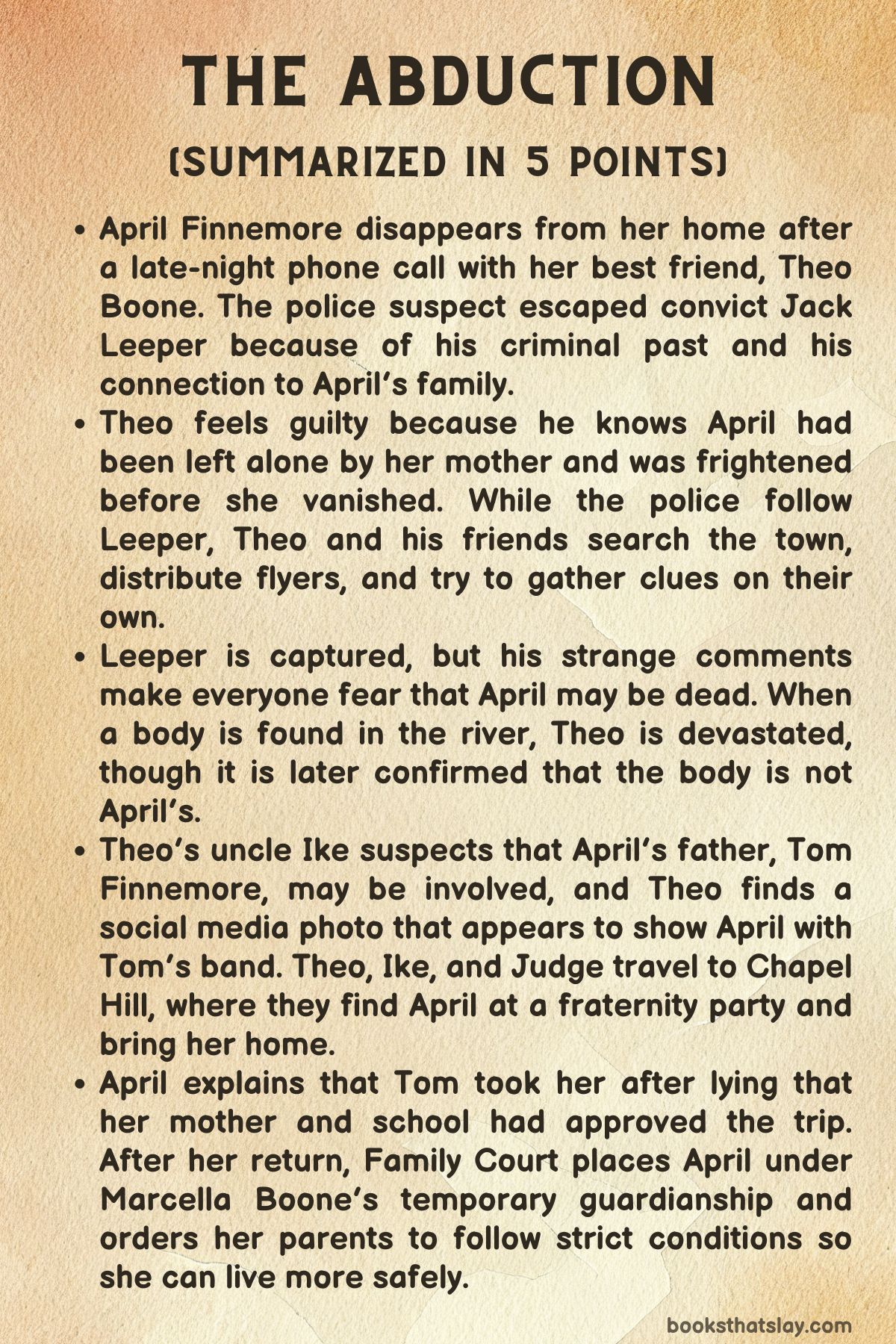
April Finnemore disappears during the night after speaking on the phone with her best friend, Theodore Boone. Her mother discovers she is missing in the early morning, and the circumstances immediately suggest that something unusual has happened.
April’s laptop, toothbrush, and backpack are still at home, which makes it unlikely that she carefully planned to leave. At the same time, her favorite sweater and sneakers are gone.
The police find all doors and windows locked from the outside and see no sign of forced entry. Because April seems to have opened the house to someone she knew, the officers turn their attention to people connected to her family.
Theo’s parents, Woods and Marcella Boone, both lawyers, take Theo to April’s house so the police can question him. Theo knows more than he wants to say.
April had told him that her mother, May, had been gone for two nights, leaving April frightened and alone in the house. April had made Theo promise not to tell anyone, and he struggles between protecting her secret and helping the investigation.
When Sergeant Bolick questions him, Theo avoids giving direct answers. His guilt grows because he realizes that April had been in danger long before she vanished.
The police introduce another frightening possibility. Jack Leeper, an escaped convict and distant relative of April’s mother, has recently been seen near Strattenburg.
He was serving a life sentence for kidnapping in California, and investigators find letters from April in his prison cell. Since the police find no responses from Leeper in April’s room, the connection remains uncertain, but it gives them a suspect.
To Theo, the idea is terrifying. If April trusted Leeper enough to open the door, then the situation may be far worse than anyone imagined.
At breakfast after the police interview, Theo finally admits to his parents that April had been left alone. Marcella and Woods realize the seriousness of May’s neglect, but they are unsure whether revealing this detail will help find April.
Theo wants to avoid school and join the search, but his parents insist he attend. At school, April’s disappearance dominates every conversation.
Students cry, speculate, and watch news coverage. Theo feels the weight of everyone’s questions because he is April’s closest friend and because other students know he understands legal matters better than most adults.
After school, Theo goes to Boone & Boone, his parents’ law office. He wants to do something useful instead of waiting helplessly.
He forms a plan with his friends to distribute reward flyers around town. A group of students gathers and decides to focus on Delmont, a poorer neighborhood where they believe a kidnapper might hide.
The search soon brings conflict with the police. Officer Bard confronts the children and claims that their flyers violate city rules.
Theo challenges him by citing the law correctly. The situation becomes tense, but Officer Sneed recognizes Theo and calms things down.
The students are allowed to distribute flyers under restrictions, though Theo knows the police are exceeding their authority.
As the search expands, the news continues to focus on Leeper. Theo begins to doubt everything.
He wonders whether April might have run away and not told him. This thought hurts him almost as much as the fear that she was abducted.
Their friendship was important to him, and the possibility that she kept such a major secret makes him question what he truly knew about her.
The case takes a dramatic turn when Leeper is spotted near the river. A drunken local man named Buster Shell recognizes him and tries to organize a reckless search party for the reward money.
Soon after, an elderly woman, Miss Ethel Barber, catches Leeper trying to break into her home and scares him off with a pistol. The police respond with helicopters and a SWAT team.
Leeper is captured hiding in a ditch. Theo and his parents watch the arrest live on television.
When a reporter asks Leeper where April is, he gives a cruel answer suggesting that she will never be found. Theo breaks down, believing April may be dead.
Fear spreads through Theo’s school. Teachers cannot keep students focused, and the constant sound of helicopters makes the city feel unsettled.
Detectives Slater and Capshaw interrogate Leeper, but he refuses to give useful answers. He hints that he knows where April is and demands a deal involving prison placement and money.
The detectives reject his demand, and Leeper responds with mockery. His behavior keeps the police focused on him, even though the truth remains hidden.
Theo and his friends continue searching on their own. After slipping away from a soccer game, Theo, Woody, Aaron, and Chase ride their bikes toward the river when they hear of police activity there.
From a hidden vantage point, they see officers, boats, divers, and an ambulance. It appears that a body has been recovered from the river.
Theo is devastated and assumes the worst. Later, at his parents’ office, he looks at a sketch April gave him and cries in private.
Detectives later ask Theo what April might have been wearing when she disappeared. He tells them about the Minnesota Twins jacket he gave her, which was not found at her house.
Their reaction makes Theo fear that the recovered body might match his description. He spends the evening in grief, imagining a trial and thinking back on his friendship with April.
He remembers how their bond deepened in gym class when April stayed with him during an asthma attack, refusing to leave him alone.
The next morning, Theo’s uncle Ike Boone calls with important news. Ike, a disbarred lawyer with a troubled past, tells Theo that the body from the river is not April.
It is an adult male who had been in the water for much longer. Theo is relieved, and when the police later confirm it, the entire school reacts with hope.
Still, April remains missing. Ike begins to suspect that the police are looking in the wrong direction.
He asks about April’s father, Tom Finnemore, a musician who has often failed his daughter. Ike believes Tom may have taken April.
While the main case continues, Theo helps a younger student named Anton in Animal Court. Anton’s parrot, Pete, has been accused of causing trouble at a riding stable by shouting commands and frightening horses.
Theo represents Anton and his grandparents before Judge Sergio Yeck. The hearing is chaotic because Pete keeps talking and insulting people, but Theo negotiates a fair result.
Pete can go home, though he will be punished if he returns to the stable. This episode shows Theo’s confidence in legal settings and provides a brief break from the fear surrounding April.
Ike keeps investigating Tom Finnemore and learns that Tom’s band, Plunder, has been playing around North Carolina. Theo and Chase search online for clues.
After calling clubs and checking fraternity and sorority websites, they find a public Facebook photo from a college party. In the background, near the band, Theo sees a small figure wearing the Minnesota Twins jacket.
He is convinced it is April. The discovery changes everything.
April may be alive, and she may be traveling with her father’s band.
Theo and Chase learn that Plunder is scheduled to play at a fraternity party in Chapel Hill. Instead of calling the police, Theo consults Ike.
Ike warns that police involvement could scare Tom or put April at risk. Since April trusts Theo, Ike argues that Theo may be the best person to bring her home.
Theo’s parents are away at a bar convention, and Chase’s parents are unlikely to agree, so Ike decides to drive Theo to Chapel Hill. Theo lies to his parents by text and helps create a cover story involving Chase.
Though anxious about deceiving everyone, he believes saving April matters most.
In Chapel Hill, Ike and Theo enter the crowded fraternity house by bluffing their way past a bouncer. They find Plunder performing in the basement.
Theo spots April sitting behind the drummer, who is her father. He reaches her, and she immediately recognizes him.
Theo tells her he has come to take her home. April leaves with him, confused but willing to trust him.
A roadie named Zack questions them, but Ike quickly invents false identities and explains their presence. They escape before Tom realizes what has happened.
On the drive home, April learns how serious the situation became in Strattenburg. She had no idea that people believed she had been kidnapped by Leeper or possibly murdered.
She explains that her father came to the house after midnight when she was alone and terrified. He told her that he had spoken with her mother and the school principal and that everyone knew she would be away for a week.
April believed him. Tom took her with the band, kept her away from some of the band’s drinking and drug use, and lied about the situation.
April insists she was not physically harmed, but it is clear that Tom manipulated her trust and took advantage of her fear.
Ike calls Marcella and Chase’s father to explain what has happened. The Boones return home early.
April tries to call her mother but cannot reach her. When they arrive in Strattenburg early Sunday morning, May is waiting at the Boone home with Detective Slater.
Mother and daughter reunite emotionally. Slater questions April and concludes that because she left willingly and was not harmed or restrained, no criminal case will move forward.
He views the matter as a Family Court problem.
The police announce that April has returned safely, and the news spreads quickly through town. At school, students celebrate, and Theo and April receive intense attention.
April, however, is uncomfortable being treated like a public figure. Marcella files to become April’s temporary legal guardian, and Judge Jolly appoints her.
A hearing is held to decide April’s living situation. Theo is ordered out because the hearing is closed, but he secretly listens from a crawl space above the courtroom.
During the hearing, Tom apologizes and promises to stay home. May submits evidence that she has begun outpatient rehabilitation.
April speaks honestly about wanting her parents to stop abandoning her and give her stability. Marcella recommends that April remain at home only under strict conditions: both parents must attend counseling, they must inform Marcella if either leaves overnight, and Marcella will monitor the situation.
The judge accepts the plan. April is allowed to return home with protections in place.
Theo leaves knowing that his friend is safe for now, though her family must still prove that they can care for her.
Characters
Theodore “Theo” Boone
Theo Boone is the central character of the book and the emotional force behind the search for April. He is only in eighth grade, but he has grown up surrounded by legal work through his parents’ law firm, and this gives him an unusual confidence around police officers, judges, courtrooms, and legal language.
In The Abduction, Theo’s intelligence is balanced by his vulnerability. He knows how to challenge Officer Bard, assist Anton in Animal Court, and reason through police theories, yet he is still a frightened boy who cries alone when he believes April is dead.
His loyalty to April drives many of his choices, including some dishonest ones. He hides information at first because he promised April he would, then later lies to his parents because he believes he can rescue her.
Theo’s moral growth lies in this tension between rules and responsibility. He wants to do what is legally correct, but he also learns that real life can force difficult choices when adults fail to act quickly enough.
April Finnemore
April Finnemore is the missing girl whose disappearance sets the story in motion. She is quiet, artistic, socially withdrawn, and shaped by years of instability at home.
Her parents’ neglect has made her cautious and lonely, but it has not made her cold. Her friendship with Theo matters deeply because he sees her as more than the strange girl from an unconventional family.
April’s decision to leave with Tom is not simple rebellion; it comes from fear, exhaustion, and a desperate need to trust a parent. She is alone in the house, abandoned by her mother, and her father offers an explanation that seems to make sense.
April’s tragedy is that both parents fail her in different ways. Her return home does not erase the damage, but her speech in Family Court shows new strength.
She asks not for luxury or attention, but for basic safety, honesty, and stability.
Woods Boone
Woods Boone, Theo’s father, is a lawyer and a steady parental figure. He represents caution, order, and professional discipline.
When Theo wants to skip school and search for April, Woods insists that he leave the investigation to the police. This can make him seem less active than Theo, but his caution comes from experience.
He understands legal boundaries and does not want his son to place himself in danger. Woods also reflects the stable family life Theo has, especially when compared with April’s home.
Though Theo disobeys him, Woods’s presence matters because he gives Theo a moral and practical framework. His borrowed SUV becomes part of the rescue, even if without his permission, which adds irony to his role as the responsible adult whose resources help make Theo’s risky plan possible.
Marcella Boone
Marcella Boone is Theo’s mother, a lawyer, and one of the most important adult protectors in the story. She notices quickly when Theo is withholding information, showing both her intelligence and her deep understanding of her son.
Marcella is firm but compassionate. Her concern for April grows from legal awareness and human decency, and she eventually becomes April’s temporary legal guardian.
Her work in Family Court gives the book a serious moral center. Rather than treating April’s return as the end of the problem, Marcella recognizes that the deeper issue is April’s unsafe home life.
Her proposed conditions for April’s parents show practical compassion: she does not seek to punish them for the sake of punishment, but she insists on accountability. Marcella becomes the adult who converts rescue into protection.
May Finnemore
May Finnemore, April’s mother, is eccentric, unstable, and neglectful, yet the story does not present her as completely without feeling. She makes goat cheese, drives a painted hearse, and lives outside ordinary social expectations.
These details make her memorable, but her real importance comes from her failure to protect April. By leaving April alone for nights, May creates the conditions that allow Tom to take her.
Her absence forces April into fear and secrecy. At the same time, May’s emotional reunion with April and her later enrollment in outpatient rehabilitation suggest that she is capable of recognizing her failures.
She is a damaged parent whose love is not enough unless it becomes responsible action. Her future with April depends not on affection but on consistency.
Thomas “Tom” Finnemore
Tom Finnemore is April’s father and one of the most irresponsible adults in the book. He is a musician who wants the freedom of band life without accepting the duties of parenthood.
His decision to take April on the road with Plunder is selfish, deceptive, and dangerous. He tells April that her mother and school know about the trip, using her trust to control her.
Though he may not intend to physically harm her, he causes panic across Strattenburg and places April in chaotic adult environments. Tom’s failure is especially painful because April wants to believe him.
His role shows how a parent can harm a child through lies and irresponsibility even without overt violence. His remorse in court matters, but the story treats words as insufficient unless followed by changed behavior.
Jack Leeper
Jack Leeper is the escaped convict whose presence creates the main false lead. His past conviction for kidnapping, his connection to May’s family, and April’s letters to him make him seem like the obvious suspect.
Leeper is frightening not only because of his criminal record but because he enjoys manipulating fear. When captured, he hints that April will never be found, allowing the town to believe the worst.
Later, he tries to bargain with detectives by pretending he knows April’s location. His cruelty lies in using a child’s disappearance for leverage.
In The Abduction, Leeper functions as a symbol of how easily public fear can attach itself to a convenient villain. He is dangerous, but he is not the answer to April’s disappearance, and the police lose time by focusing too heavily on him.
Sergeant Bolick
Sergeant Bolick is one of the first officers to question Theo after April vanishes. His role is brief but important because he places Theo under immediate moral pressure.
Bolick’s questions force Theo to decide how much of April’s private fear he should reveal. Through this interview, the story shows that even a child witness can carry heavy responsibility.
Bolick represents the official investigation at its earliest stage, when the police are trying to gather facts but do not yet understand the emotional complexity of April’s life.
Detective Slater
Detective Slater is one of the main investigators in April’s case. He pursues the Leeper theory, questions Theo, interrogates Leeper, and later speaks with April after her return.
Slater is not portrayed as foolish, but his work shows the limits of official procedure when the wrong assumption takes hold. He follows evidence that appears convincing: an escaped kidnapper, family ties, prison letters, and Leeper’s taunts.
Yet he misses Tom’s role until Theo and Ike discover it. After April returns, Slater concludes that the matter belongs in Family Court rather than criminal court.
This decision may feel unsatisfying, but it reflects the legal difficulty of proving a crime when April says she left willingly and was not restrained.
Detective Capshaw
Detective Capshaw works alongside Slater and shares the frustrations of the investigation. He is part of the official effort to pressure Leeper and uncover April’s whereabouts.
His role is quieter than Slater’s, but he helps represent the procedural side of the case: interrogation, evidence, suspect management, and coordination with prosecutors. Capshaw’s presence reinforces the seriousness of the police response and the way the investigation becomes trapped by Leeper’s manipulations.
Woods and Marcella’s Law Office Staff: Elsa, Dorothy, and Vince
Elsa, Dorothy, and Vince make Boone & Boone feel like a lived-in legal world rather than only a family business. Elsa, the receptionist, is especially warm toward Theo and gives him affection and emotional support when he comes into the office.
Dorothy and Vince are less central, but they contribute to the everyday rhythm of the firm. Their presence shows that Theo’s legal education is not abstract.
He grows up in an environment where paperwork, clients, court schedules, and adult conversations surround him daily. This atmosphere helps explain why he is unusually capable when legal problems appear.
Judge
Judge, the Boone family dog, is a comforting presence throughout the story. He stays with Theo at the law office, sleeps near him, travels with him, and witnesses his moments of fear and sadness.
Judge does not influence the plot in a legal or investigative sense, but he matters emotionally. He gives Theo companionship when human comfort is difficult to accept.
During Theo’s grief over April, Judge’s quiet presence helps show Theo’s loneliness without needing long explanations. He is also part of Theo’s home stability, contrasting with April’s unstable family life.
Mr. Mount
Mr. Mount is Theo’s teacher and one of the school adults trying to maintain routine after April disappears. His classroom becomes a space where students process fear, rumor, and grief.
He also assigns extra credit connected to the girls’ soccer game, which indirectly gives Theo and his friends a chance to slip away and continue searching. Mr. Mount represents the school’s attempt to keep order during a crisis, but like many adults in the story, he cannot fully control what the children are feeling or doing.
Woody
Woody is one of Theo’s close friends and part of the student search effort. He helps distribute flyers, communicates updates, and uses information from his brother’s police scanner to guide the boys toward major police activity near the river.
Woody is practical, active, and willing to take risks with Theo. His knowledge of East Bluff and local back trails helps the boys reach a hidden viewpoint.
He represents the way Theo’s friendships become a small investigative network, with each child contributing something useful.
Aaron Helleberg
Aaron Helleberg is another student involved in the search for April. His most important moment comes during the confrontation with Officer Bard, when he questions why the police are bothering children who are trying to help instead of focusing on finding April.
Aaron’s reaction captures the frustration of the students. They may be young, but they understand the urgency of the situation and resent being treated like troublemakers.
His role supports the idea that children in the book often see moral priorities more clearly than some adults.
Chase Whipple
Chase Whipple is Theo’s friend and key partner in finding April. He helps search online, studies social media photos, and takes part in identifying the image that appears to show April with Plunder.
Chase is also central to maintaining the cover story while Theo and Ike drive to Chapel Hill. His lies to Daphne and his parents are comic at times, but they also show his loyalty and nerve.
Chase is not as legally skilled as Theo, but he is clever, dependable, and willing to share risk. Theo later gives him credit, which shows that their friendship is based on trust rather than competition.
Sibley Taylor
Sibley Taylor appears during the flyer confrontation and gives voice to a simple but important question: why can’t the police cooperate with students who are trying to find April? Her role is small, but her comment cuts through the adult defensiveness in the scene.
She represents the common-sense compassion of April’s classmates, who may not know legal codes but understand that helping a missing girl should matter more than controlling flyers.
Officer Bard
Officer Bard is a hostile police officer who tries to stop Theo and the other students from distributing flyers. He misstates the law and reacts badly when Theo corrects him.
His hand moving toward his weapon adds unnecessary tension to a situation involving children. Bard represents authority used insecurely.
Instead of welcoming help or calmly explaining limits, he turns a public search into a power struggle. His behavior contrasts sharply with Theo’s legal confidence and with Sneed’s more reasonable approach.
Officer Sneed
Officer Sneed helps defuse the conflict between Bard and the students. He recognizes Theo’s family name and steers the encounter toward compromise.
Though the restrictions he proposes still go beyond what Theo believes the law requires, Sneed prevents the scene from worsening. He represents a more practical form of authority: not perfect, but less ego-driven and more focused on ending conflict without harm.
Buster Shell
Buster Shell is a drunken resident near the river who recognizes Leeper and tries to turn the situation into a reward-winning adventure. His armed, disorderly search party is reckless rather than heroic.
Buster’s role adds dark humor and social texture to the manhunt, while also showing how public panic can attract opportunists. His arrest for intoxication, illegal firearm possession, and resisting arrest destroys his reward hopes and exposes the foolishness of his actions.
Miss Ethel Barber
Miss Ethel Barber is the elderly woman who discovers Leeper trying to break into her house. At 85, she refuses to be helpless and confronts him with a pistol, forcing him to flee.
Her courage directly leads to the emergency call that brings police attention to Leeper’s location. She is a minor character, but her action has major consequences.
She shows that strength in the story is not limited by age, and that an ordinary citizen can change the direction of a case.
Madame Monique
Madame Monique is Theo’s Spanish teacher. Her struggle to keep students engaged after Leeper’s televised comments shows how deeply April’s disappearance affects the school.
Her classroom scene matters because it reveals that the crisis has overwhelmed ordinary education. Even teachers with lesson plans and authority cannot make students ignore the fear surrounding them.
Principal Mrs. Gladwell
Principal Gladwell is the school leader who tries to guide students through April’s disappearance. She holds assemblies, responds to student anxiety, and later asks Theo to help Anton with the Animal Court matter.
Gladwell respects Theo’s unusual abilities, even though he is still a student. Her willingness to involve him in Anton’s case shows that she sees his legal talent as real.
At the same time, she must maintain order at school, especially when reporters gather after April’s return. She represents responsible institutional care, even if her power is limited.
Miss Highlander
Miss Highlander is a seventh-grade teacher who briefly distracts Mr. Mount during the soccer game. Her role is minor, but her presence helps create the opening that allows Theo and his friends to slip away.
She is part of the school background that gives the story its everyday setting, where normal teacher interactions continue even while students are quietly planning their own search.
Ike Boone
Ike Boone, Theo’s uncle, is one of the most interesting adults in the story. A disbarred lawyer who has served prison time and now works as a tax accountant, Ike carries a damaged reputation.
Yet he proves essential to finding April. He distrusts the police theory about Leeper, investigates Tom, encourages Theo to search for Plunder, and ultimately drives to Chapel Hill.
Ike’s flaws make him more willing than other adults to operate outside normal rules. That is both risky and useful.
He helps Theo lie, borrows Woods’s SUV without permission, and invents identities at the fraternity house, but he also brings April home safely. In The Abduction, Ike shows that a morally imperfect person can still act with courage and loyalty when it matters.
Anton
Anton is the sixth-grade Haitian student whose parrot has been taken by Animal Control. He is nervous and dependent on Theo’s help, but he clearly loves Pete and wants to protect him.
Anton’s subplot gives Theo a chance to act as an advocate in a lower-stakes legal conflict. Through Anton, the story also shows how intimidating legal systems can be for children and immigrant families.
His gratitude and concern for Pete make him sympathetic.
Mr. and Mrs. Regnier
Anton’s grandparents, the Regniers, are elderly Haitian guardians who appear frightened in Animal Court and speak to each other in Haitian Creole. They are loving caretakers but are overwhelmed by the legal setting and the threat against their family pet.
Their presence highlights Theo’s ability to bridge the gap between ordinary people and court procedure. They also bring a quiet dignity to the Animal Court scene, where the conflict may seem comic but is serious to them.
Pete the Parrot
Pete, the 50-year-old African gray parrot, is one of the most comic characters in the story. His mimicry, insults, and disruptive speech create chaos in Animal Court.
Yet Pete is not merely a joke. To Anton and his grandparents, he is a beloved family member.
The question of clipping his wings becomes a question of punishment, responsibility, and mercy. Pete’s behavior causes real trouble at the stables, but Theo’s negotiated solution gives him another chance while holding his owners accountable.
Kate Spangler
Kate Spangler is one of the owners of SC Stables and a complainant in the Animal Court case. She testifies that Pete disrupted riding classes, frightened horses, and contributed to a student’s injury.
Her frustration is understandable because the parrot’s behavior creates danger in a setting where control and safety matter. Kate is not a villain; she is someone seeking protection for her business and students.
Her role gives the court scene a fair conflict rather than a simple case of adults picking on a child.
Judy Cross
Judy Cross, another owner of SC Stables, supports the complaint against Pete and describes his habit of hiding in trees and shouting commands. Pete repeatedly insults her, which turns her testimony into comic chaos.
Like Kate, Judy has a reasonable concern about safety, but the parrot’s mockery makes her seem more flustered and less sympathetic. Her role adds humor while still showing that even absurd legal disputes can involve real consequences.
Kevin Blaze
Kevin Blaze is the attorney representing the stable owners in Animal Court. He objects to Theo’s participation, but Judge Yeck dismisses the objection.
Blaze represents formal adult legal authority, yet he is outmaneuvered in spirit by Theo’s preparation and calm advocacy. His role helps establish Theo’s unusual talent: even when facing a real lawyer, Theo can hold his own in a courtroom setting.
Judge Sergio Yeck
Judge Sergio Yeck presides over the Animal Court hearing. He is informal, practical, and familiar with Theo from an earlier case.
Yeck allows Theo to participate despite objection and later praises his work. His ruling on Pete balances accountability with mercy.
He does not ignore the stable owners’ concerns, but he also avoids an immediate harsh punishment. Judge Yeck represents the kind of judge who values solutions over drama.
Teresa Knox
Teresa Knox is the prosecutor involved in negotiating with Leeper. She rejects his attempt to gain an easy deal and offers a much harsher counterproposal if he can return April unharmed.
Her role shows the legal system’s refusal to let Leeper control the situation entirely. Knox understands the seriousness of kidnapping charges and treats Leeper’s bargaining with appropriate skepticism.
Though her scene is brief, she adds weight to the criminal side of the investigation.
Kip Ozgoode
Kip Ozgoode is Leeper’s lawyer. His role is limited, but his presence formalizes Leeper’s attempt to bargain.
Once Ozgoode enters the scene, Leeper’s manipulations shift from taunting detectives to trying to use legal negotiation for personal advantage. Ozgoode is part of the machinery of criminal defense, reminding readers that even a dangerous and dishonest suspect has legal representation.
Vince Snyder
Vince Snyder is the student whose public Facebook page provides the key photograph that helps Theo identify April near Plunder’s performance. Vince is not personally important to the emotional story, but his online photo becomes crucial evidence.
His role shows how social media can accidentally reveal what official investigators miss. A casual party image becomes the clue that changes the case.
Zack
Zack is the roadie who confronts Theo, Ike, and April as they leave the fraternity party. His suspicion briefly threatens the rescue.
Ike’s quick lie convinces him that they are old family friends, and Zack lets them go. Zack’s role creates one final obstacle before April’s escape from the band environment.
He also helps show that Tom has kept the truth from those around him; Zack does not appear to understand that April is the subject of a major missing-person case.
Mr. Whipple
Mr. Whipple is Chase’s father. He becomes involved after Ike calls to explain the truth about the rescue plan.
His role is mainly parental and practical. He represents the adult world that Chase and Theo have deceived in order to carry out the rescue.
The call to him marks the point at which the boys’ secret plan begins turning back into an accountable adult situation.
Mrs. Whipple
Mrs. Whipple is Chase’s mother and one of the adults Theo and Chase must mislead to keep their plan moving. Theo fears that if she knows what is happening, she will call Marcella and stop the trip.
Her protectiveness is understandable, especially with April missing and parents across town becoming more cautious. She represents normal parental caution, the kind Theo sees as an obstacle even though it comes from care.
Daphne Whipple
Daphne is Chase’s older sister, left in charge while Chase’s parents go out. Chase’s attempt to avoid returning home under her supervision leads him to invent a wild story about Judge becoming sick and making a mess.
Daphne’s role adds comic tension to the rescue plot. She is not part of the investigation, but she becomes one of the people Chase must fool to buy Theo and Ike enough time.
Judge Jolly
Judge Jolly, nicknamed “St. Nick,” presides over the Family Court hearing about April’s living situation. His informal style contrasts with the more dramatic courtroom atmosphere Theo prefers, but Jolly takes the matter seriously.
He listens to Tom, May, April, and Marcella before making a decision. His ruling allows April to remain home under strict conditions.
Jolly’s importance lies in recognizing that family preservation must be paired with oversight. He does not simply trust the parents’ promises; he turns Marcella’s plan into a court order.
Speedy Cobb
Speedy Cobb is the elderly courthouse janitor whom Theo uses as part of his plan to secretly listen to April’s Family Court hearing. Theo spills root beer, wakes Speedy, and uses the cleaning distraction to enter the utility closet and reach the crawl space.
Speedy’s role is small and partly comic, but he helps make Theo’s courtroom eavesdropping possible. His presence also adds to the courthouse’s familiar world, where Theo knows routines, people, and hidden spaces.
Judge Henry Gantry
Judge Henry Gantry appears near the end and reminds Theo of the more formal, dramatic style of Criminal Court. He congratulates Theo for finding April and mentions Pete Duffy’s upcoming murder trial.
Gantry’s role links this story to Theo’s wider legal adventures and reinforces Theo’s unusual connection to judges and court cases. He is also another adult authority figure who recognizes Theo’s abilities while still telling him to return to school.
Pete Duffy
Pete Duffy is mentioned as the defendant in an upcoming murder trial connected to Theo’s earlier involvement. He does not take direct action in this story, but his mention expands the legal world around Theo and reminds readers that Theo’s life is often close to serious criminal cases.
Duffy’s upcoming trial also hints that Theo’s legal curiosity will continue beyond April’s case.
Winky Leeper
Winky Leeper is Jack Leeper’s father and is mentioned during the detectives’ questioning of Jack. His role is minimal, but he helps establish Jack’s family background and confirms the line of questioning about Leeper’s connection to May Finnemore.
Winky’s mention supports the investigation’s focus on family ties, even though that focus ultimately leads away from the truth.
Themes
The Failure and Repair of Adult Responsibility
Adult responsibility in the story is measured not by age, status, or authority, but by whether adults actually protect children. April’s crisis begins because both of her parents fail her.
May leaves her alone for nights, forcing a frightened child to manage an unsafe home by herself. Tom then exploits that fear by arriving in the middle of the night and lying to her.
His behavior is not presented as a harmless father-daughter trip; it is a selfish act that causes public panic and deep emotional harm. Against these failures, the book places adults who try to repair damage.
Marcella’s role is especially important because she understands that bringing April home is not enough. The Family Court process must create rules, supervision, and consequences.
Ike also acts responsibly in an unconventional way. His methods are dishonest and risky, but his goal is protective.
The Abduction suggests that children suffer most when adults treat responsibility as optional, and they heal only when care becomes consistent action.
Friendship as Active Loyalty
Theo’s friendship with April is not passive sympathy. It becomes a demanding form of loyalty that requires action, courage, and moral judgment.
At first, Theo honors April’s request for secrecy about being left alone, but this loyalty becomes painful when she disappears. He begins to understand that keeping a promise can conflict with protecting someone.
His search for April grows from guilt, fear, and love, but it is also practical. He organizes flyers, follows leads, studies online photos, calls clubs, and travels to Chapel Hill because he knows April might trust him when she trusts no one else.
April’s own response confirms the depth of that bond. When Theo appears at the fraternity party, she leaves with him because his presence means safety.
Their friendship is not shown through sentimental speeches, but through recognition, memory, and action. The story treats true friendship as responsibility: knowing when to listen, when to keep faith, and when to break silence because someone’s safety matters more.
The Limits of Official Systems
Police departments, schools, and courts all play major roles in the story, but none of them is shown as perfect. The police act quickly and seriously, yet they become fixed on Jack Leeper because he seems to fit the role of suspect.
Their theory is understandable, but it narrows their vision. Leeper’s criminal past, family connection, and cruel hints make him convincing, while Tom’s involvement remains outside their focus.
The school tries to maintain order, but it cannot stop fear from spreading among students. Family Court, by contrast, comes closest to addressing the root problem, but even that system depends on honest testimony, responsible monitoring, and future compliance.
Theo’s role exposes both the value and weakness of institutions. He respects the law, but he also sees that official channels can move slowly or look in the wrong direction.
The story does not reject systems; it argues that systems need alert, caring individuals who are willing to notice what procedures miss.
Truth, Lies, and Moral Risk
Lies shape nearly every major turn in the story. May’s silence about leaving April alone hides neglect.
Tom’s lies persuade April to leave with him. Leeper lies about knowing April’s location to gain leverage.
Theo and Chase lie to their parents to carry out the rescue. Ike lies at the fraternity house to get April away safely.
The story does not treat all lies as equal, which makes its moral world more complex. Some lies are selfish and harmful because they protect adults from consequences or use a child’s trust.
Other lies are risky but aimed at preventing greater harm. Theo’s dishonesty creates real danger and could have failed badly, yet it leads to April’s return.
This does not make lying harmless; instead, it forces readers to consider motive, consequence, and accountability. The story’s moral tension comes from the fact that truth is necessary for justice, but in moments of danger, characters sometimes use deception to reach safety before truth can be fully restored.