The ABC Murders Summary, Characters and Themes
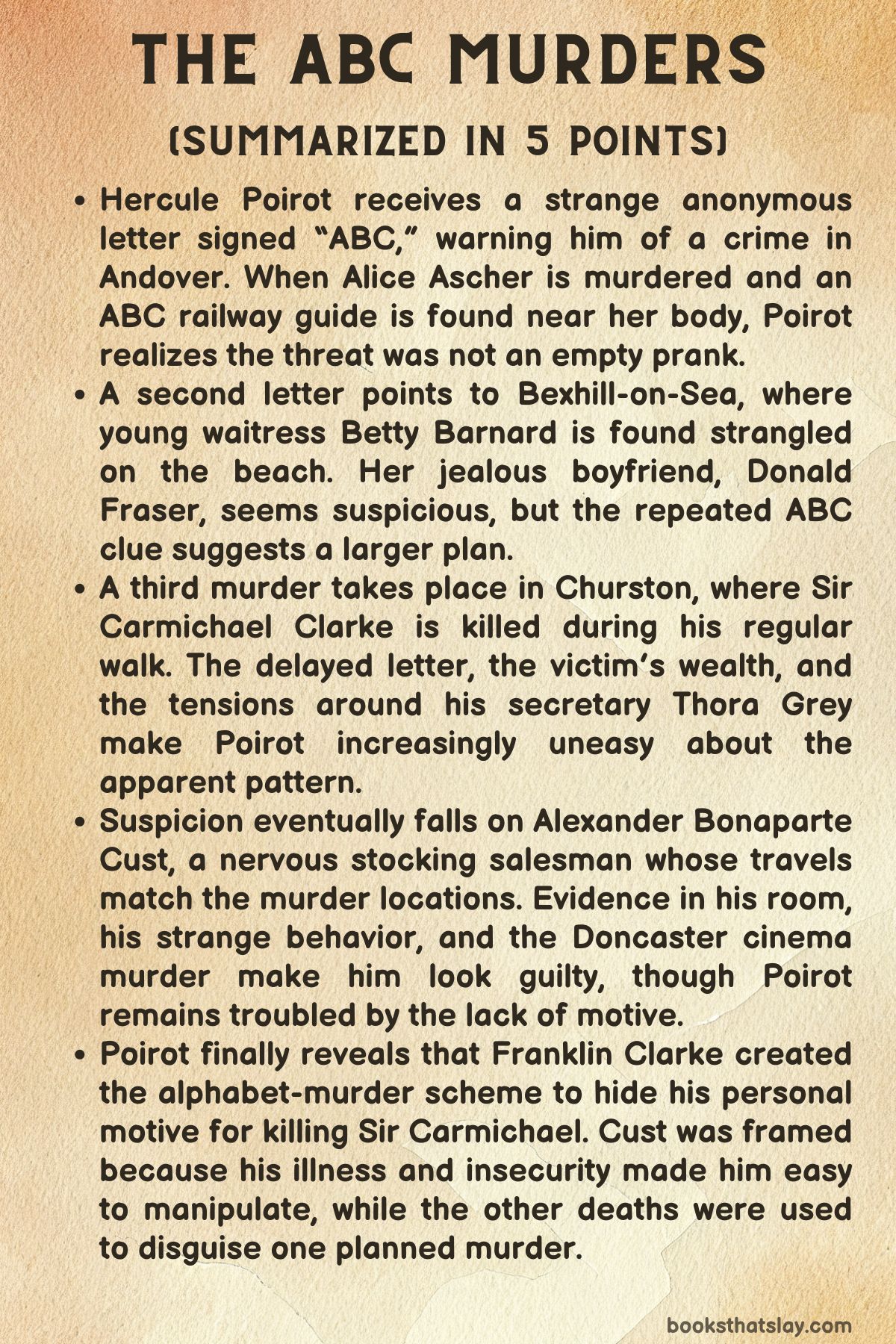
The ABC Murders is a detective novel by Agatha Christie featuring Hercule Poirot and Captain Arthur Hastings. It begins as a strange contest between Poirot and an anonymous letter-writer who signs as “ABC,” warning him before each murder.
The killings appear to follow an alphabetical pattern, with victims and places chosen in sequence, and each crime is marked by an ABC railway guide. What looks like a serial killer case soon becomes a test of motive, psychology, and misdirection. Christie uses the structure of a public murder hunt to hide a far more private crime. It’s the 13th book of the Hercule Poirot Series.
Summary
Captain Arthur Hastings introduces the case as one of Hercule Poirot’s most remarkable investigations. Hastings has returned to England after living in South America and goes to visit his old friend Poirot, who is still active as a detective despite repeated claims that he wants to retire.
Their reunion is friendly and comic, marked by Poirot’s vanity about his appearance and Hastings’s familiar admiration for him. Yet the light mood changes when Poirot shows Hastings an anonymous letter signed “ABC.” The writer challenges Poirot and announces that something will happen in Andover on a specific date.
Hastings thinks the letter may be a prank, but Poirot is disturbed by it. His experience tells him that something is wrong, and he fears the message points toward murder.
The warning proves true. Alice Ascher, an elderly woman who runs a tobacco and newspaper shop in Andover, is found dead.
She has been struck from behind, and an ABC railway guide is discovered at the scene. At first, suspicion falls on her estranged husband, Franz Ascher, a violent alcoholic who often threatened her.
Poirot and Hastings investigate the shop, speak to the local police, and interview Mary Drower, Alice’s niece. Mary is grieving and loyal to her aunt, and she agrees to help Poirot if needed.
Poirot also questions neighbors and customers, including Mr. Partridge and Mr. Biddell, but the evidence remains unclear. The railway guide seems deliberately placed, and Poirot begins to sense that the killer is not simply leaving clues but constructing a performance.
A second letter arrives. This time the writer warns of a crime in Bexhill-on-Sea.
The police try to prevent it, but the task is too broad, especially in a busy seaside town. The murder takes place as promised.
The victim is Elizabeth “Betty” Barnard, a young waitress who is found strangled on the beach with her own belt. Another ABC railway guide is found nearby.
Poirot, Hastings, and Inspector Crome go to Bexhill to investigate. Crome is competent but patronizing toward Poirot, and Hastings dislikes his confidence.
Poirot is more interested in details that others dismiss, especially Betty’s attractiveness and the nature of her relationships.
Betty’s family is devastated. Her parents remember her warmly, but her older sister, Megan Barnard, gives a sharper account.
Megan explains that Betty was pretty, flirtatious, and fond of attention from men, even though she had a serious boyfriend, Donald Fraser. Donald loved Betty intensely but was jealous and angry when she lied about seeing other men.
He once threatened to kill her, which would normally make him a strong suspect. However, the ABC letter and railway guide complicate the matter, making it seem that Betty has been chosen as part of a wider pattern.
Poirot notices that each crime seems to draw suspicion away from a convenient local suspect rather than toward one.
After the second murder, public anxiety grows. Poirot and the police debate whether the crimes should be treated as the work of a mentally unwell killer seeking fame.
Dr. Thompson, a psychiatrist, considers the possibility that the killer follows a private logic. Poirot is less satisfied.
He keeps asking why the murderer writes to him and why the killer appears to help innocent suspects by making the crimes seem connected. The idea of a “magnanimous murderer” troubles him because it does not fit ordinary criminal purpose.
A third letter arrives, but there is a problem. It has been misaddressed and reaches Poirot late.
By the time Poirot reads it, the promised date has already arrived. The location is Churston, and the victim is Sir Carmichael Clarke, a wealthy retired doctor and collector of Chinese art.
He has been struck from behind during his regular walk near his home. His death brings the case even more attention because he is socially prominent.
At the Clarke house, Poirot and Hastings meet Franklin Clarke, Sir Carmichael’s energetic younger brother, and Thora Grey, Sir Carmichael’s beautiful secretary. They also learn that Lady Clarke, Sir Carmichael’s wife, is dying of cancer.
Thora Grey claims she saw no suspicious strangers, but Lady Clarke later tells Poirot that Thora is lying. Lady Clarke dislikes Thora and believes Sir Carmichael was too attached to her.
She also suggests that Franklin may be vulnerable to Thora’s charm. Poirot does not simply accept Lady Clarke’s bitterness, but he does not ignore her either.
Around this time, the relatives and friends of the victims begin to gather around Poirot. Franklin proposes that they help investigate as a group.
Mary Drower, Megan Barnard, Donald Fraser, Thora Grey, and Franklin Clarke all become part of this informal circle. Poirot believes one of them may know something important without realizing it.
During a group discussion, small details begin to matter. Mary remembers her aunt’s ordinary life.
Megan recalls her mother buying stockings from a door-to-door salesman before Betty’s death. Thora eventually admits that she also met a stocking salesman near the Clarke house.
Alice Ascher’s neighbor had earlier complained of traveling salesmen too. Poirot sees a connection.
The killer may be a quiet, forgettable man selling stockings, someone so ordinary that no one pays attention to him.
The narrative also follows Alexander Bonaparte Cust, a shabby, anxious man with a grand name and a defeated life. Cust is a war veteran who suffers from headaches and memory problems.
He works as a stocking salesman and appears to have traveled to the towns connected with the murders. He owns railway guides and seems disturbed by newspaper reports of the crimes.
His behavior grows increasingly suspicious, especially when he lies about where he is going. His landlady, Mrs. Marbury, her daughter Lily, and Lily’s boyfriend Tom Hartigan gradually realize that Cust’s movements match the murder locations.
The next letter warns of a murder in Doncaster on the day of the St. Leger horse race. The crowds make prevention nearly impossible.
Poirot, Hastings, the police, and the victim’s relatives spread out to watch for the suspect. Yet the murder does not happen at the race itself.
A man named George Earlsfield is found stabbed in a cinema, with an ABC railway guide nearby. The name disrupts the expected pattern because the victim’s surname does not begin with D, but another man nearby, Downes, does.
Cust returns to his lodgings afterward and finds blood on his sleeve and a knife hidden in his clothing. Terrified and confused, he runs away.
The evidence against Cust builds quickly. Witnesses place him near the crimes.
His room contains railway guides, stockings, and stationery matching the letters sent to Poirot. The police find the knife.
Cust eventually turns himself in after wandering back to Andover, exhausted and frightened. Everyone appears to think the case is solved, but Poirot remains troubled.
Cust has an alibi for Betty Barnard’s murder: he was playing dominoes with a man at the time she was killed. More importantly, Poirot cannot understand the motive.
Cust is too passive, too confused, and too contradictory to fit the clever design of the crimes. He does not even recognize Poirot when they meet, which weakens the idea that the letters were written out of personal hostility toward the detective.
Poirot interviews Cust and sees a man who has been used. Cust believes there may be a conspiracy against him, but he also fears he may have committed the murders during memory lapses.
His name, his failures, his illness, and his loneliness have made him easy to manipulate. Poirot realizes the crimes were never truly about alphabetical murder.
The alphabet scheme was a screen. The real killer committed several murders to conceal one murder that mattered personally.
Poirot gathers the group and explains the truth. The murderer is Franklin Clarke.
His real target was his brother, Sir Carmichael Clarke. Franklin wanted to inherit Sir Carmichael’s fortune.
If Sir Carmichael had married Thora Grey after Lady Clarke’s death, or if Thora had gained influence over him, Franklin’s prospects would be threatened. To hide a personal murder, Franklin created the illusion of a serial killer.
He met Cust, read his palm, learned his weaknesses, and later used him as a tool. Franklin arranged for Cust to receive assignments as a stocking salesman in the relevant towns, sent him the typewriter, and planted evidence around him.
The letters to Poirot were essential to Franklin’s plan because one of them needed to go astray. A letter to Scotland Yard would not easily be misdirected, but a letter to Poirot at a private address could be.
The delayed Churston letter ensured that Sir Carmichael could be killed without effective warning while still appearing to belong to the ABC pattern. Franklin then committed the Doncaster murder to make Cust look guilty beyond doubt, planting the weapon and relying on Cust’s fear and poor memory to complete the frame-up.
Poirot reveals that witnesses can connect Franklin with Betty Barnard and the Doncaster cinema. He also exposes Franklin’s motive through his reaction to questions about Thora.
Franklin admits his guilt and tries to shoot himself, but Poirot has already arranged for the gun to be emptied. Franklin is arrested.
Cust is cleared, and his life changes because the fame of the case brings him public attention and offers for his memoirs. Poirot also explains Donald Fraser’s disturbing dream: Donald has fallen in love with Megan and feels guilty because his feelings changed after Betty’s death.
The case ends with Poirot triumphant, Hastings admiring, and the false image of the ABC murderer replaced by the truth of a selfish man who used strangers’ deaths to hide his own greed.
Characters
Hercule Poirot
Hercule Poirot is the intellectual center of the book, a detective whose strength lies not only in noticing clues but in understanding why a clue exists. At the beginning, he appears comic and vain, especially in his concern with hair dye, his moustaches, and his reputation, but Christie quickly shows that this vanity coexists with deep seriousness.
Poirot treats the first ABC letter as dangerous when Hastings and others are ready to dismiss it, proving that his instincts are really the result of long experience. Throughout The ABC Murders, Poirot is repeatedly set against official police confidence, especially Inspector Crome’s brisk certainty.
Poirot’s method is slower and more psychological. He keeps returning to motive, to the purpose of the letters, and to the odd generosity of a killer who seems to save obvious suspects from blame.
His greatness lies in refusing to accept the easiest pattern. While everyone else sees a serial killer, Poirot sees contradiction.
His compassion also matters: he pities the victims, understands Cust’s weakness, and protects even those who irritate him. He is proud, theatrical, and sometimes teasing, but his moral vision is exact.
He solves the case because he knows that murder is never abstract; behind even the most elaborate performance, there is always a human reason.
Captain Arthur Hastings
Captain Arthur Hastings is the narrator and Poirot’s loyal friend. He is warm, honest, conventional, and often slower than Poirot in recognizing the meaning of events.
His role is not simply to admire Poirot, though admiration is a large part of his personality. Hastings gives the book its human texture because he reacts emotionally to the murders, the victims, and the women involved in the case.
He is easily impressed by beauty, particularly Thora Grey, and Poirot often teases him for his romantic assumptions. Hastings likes dramatic mysteries with visible clues, suspicious characters, and action, while Poirot is more interested in hidden motive and psychology.
This contrast makes Hastings useful as a narrator because he often represents the ordinary reader’s expectations. He wants the case to move in a clear direction; Poirot knows it will not.
Hastings also has what Poirot calls a gift for stating the obvious. He may not solve the mystery, but his plain reactions sometimes help Poirot clarify what has been overlooked.
His loyalty is never in doubt, and his mixture of innocence, bravery, vanity, and decency makes him a vital companion.
Franklin Clarke
Franklin Clarke is the true murderer and one of the most carefully disguised figures in the story. Outwardly, he is energetic, helpful, practical, and public-spirited.
He appears to be the ideal bereaved brother: shocked by Sir Carmichael’s death, eager to support Poirot, and willing to organize the victims’ relatives into an investigative group. His charm and decisiveness make him seem trustworthy.
Yet these qualities are the tools of his crime. Franklin is not a chaotic killer but a calculating man who understands appearances.
His boyish manner, enthusiasm, and confidence hide greed and cruelty. He murders strangers not because they matter to him, but because they help bury the one death that does matter: his brother’s.
His motive is inheritance, sharpened by fear that Thora Grey could marry Sir Carmichael and change the future of the estate. Franklin’s use of Cust is especially cruel because he exploits a damaged, lonely man’s fear of his own mind.
In The ABC Murders, Franklin stands as an example of evil disguised as efficiency and good humor. His final rage shows the arrogance beneath his friendly surface.
Alexander Bonaparte Cust
Alexander Bonaparte Cust is one of the most tragic figures in the book because his life has trained him to believe the worst of himself. His grand name suggests greatness, conquest, and destiny, but his actual life is marked by failure, illness, poverty, and social invisibility.
He is a war veteran with headaches, memory problems, and deep insecurity. His mother’s ambition for him only increases the sense that he has disappointed everyone.
Cust’s work as a stocking salesman places him in the right towns at the wrong times, and Franklin Clarke manipulates this perfectly. Because Cust has gaps in memory and a fearful imagination, he becomes almost willing to accept guilt without understanding why.
He is not innocent in a simple, cheerful way; he is confused, frightened, and suggestible. His tragedy is that he has so little faith in himself that planted evidence feels more convincing to him than his own conscience.
When he is cleared, the possibility of public attention and financial reward gives him a strange second life. Cust’s character allows Christie to explore how a vulnerable person can be framed not just through evidence but through self-doubt.
Alice Ascher
Alice Ascher is the first victim and represents the quiet suffering hidden inside ordinary lives. She runs a small shop in Andover and lives with the long shadow of an unhappy marriage.
Her estranged husband, Franz Ascher, drinks, threatens her, and depends on her for money, yet she continues to endure the situation with toughness. The investigation reveals that she had once been beautiful and had built a modest independence after receiving an inheritance.
Her death is especially cruel because she is selected not for anything she has done, but because her name and location fit Franklin’s plan. Even so, she is not treated as a mere starting point.
Poirot and Hastings are moved by her body and by the remains of dignity in her life. Alice’s story adds sadness to the crime because it shows how an already hard life is reduced by the murderer into a letter of the alphabet.
Through her, the book insists that even the least socially powerful victim deserves full attention.
Franz Ascher
Franz Ascher is Alice Ascher’s estranged husband and the first obvious suspect. His alcoholism, violent language, and repeated threats make suspicion natural.
He is a broken and unpleasant man, and his relationship with Alice appears to have been damaged beyond repair. Yet Christie uses him to show the difference between moral ugliness and legal guilt.
Franz may be cruel, unstable, and dependent, but he is not the murderer. His presence helps Franklin’s plan because he is exactly the sort of person the police might blame in a normal domestic murder.
Poirot’s growing concern comes partly from the fact that the ABC clue prevents the case from settling on Franz too easily. Franz is important because he exposes how convenient suspicion can be.
A person may look guilty because of character, class, or history, but truth requires more than dislike.
Mary Drower
Mary Drower, Alice Ascher’s niece, brings sincerity and emotional clarity to the investigation. She is young, grieving, and deeply attached to her aunt.
Her sadness is direct rather than dramatic, and her desire to help Poirot comes from a strong sense that Alice’s death was wrong and must be answered. Mary’s social position is modest, and she does not have the confidence of Franklin or the sharpness of Megan, but she has loyalty and courage.
She later joins the group of victims’ relatives, showing that the case is not only a police matter but a shared moral effort by those left behind. Mary also helps connect the ordinary details of the first murder to later clues, particularly through memories of everyday life around her aunt.
Her role may be quieter than others, but she gives the first victim a continuing presence in the story.
Elizabeth “Betty” Barnard
Betty Barnard is the second victim, a young waitress whose beauty and flirtatious nature shape the investigation. She enjoys male attention, lies casually about her outings, and tests Donald Fraser’s jealousy.
Megan sees her clearly and calls her foolish, but the book does not reduce Betty to her flaws. She is young, lively, vain, and careless, yet none of this makes her responsible for her death.
Her behavior creates a plausible local suspect in Donald, which is exactly why her murder fits Franklin’s design. Betty is also crucial because her killing requires a murderer who can approach and attract her.
Poirot recognizes that this detail does not fit Cust, who is shy and socially awkward. Betty’s character therefore becomes one of the keys to the truth.
She is both a person with a complicated private life and a victim exploited by a killer who understood how easily society would judge her.
Megan Barnard
Megan Barnard is one of the strongest characters in the book. She is Betty’s older sister, but she is not sentimental about the dead.
Her honesty shocks because she refuses to pretend that Betty was perfect simply because she has been murdered. Megan is intelligent, direct, observant, and emotionally intense.
Poirot respects her because she sees through comforting performances and does not easily accept staged behavior. Her relationship with Donald Fraser develops through shared grief, guilt, and fear.
She suspects that Donald may have killed Betty, and that fear makes her answer Poirot truthfully when he asks whether she wants the case solved. Megan’s emotional courage lies in her willingness to face ugly possibilities.
Unlike Thora, who manages appearances, Megan cuts through them. By the end, her bond with Donald suggests a future built not on illusion but on painful honesty.
Donald Fraser
Donald Fraser is Betty Barnard’s boyfriend, a man whose love is mixed with jealousy, anger, and possessiveness. He is not a villain, but he is emotionally dangerous enough to be believable as a suspect.
His threats against Betty, his attempts to follow her, and his humiliation over her flirtations all create a dark portrait of wounded pride. Yet Donald is also deeply miserable after her death, and his distress is genuine.
His nightmares about strangling Megan reveal his guilt and confusion after transferring his love from Betty to her sister. Poirot understands the dream not as proof of murder but as evidence of emotional conflict.
Donald’s character matters because he shows how suspicion can grow from real but incomplete truths. He had anger, motive, and opportunity in a broad emotional sense, but he did not commit the crime.
His arc moves from jealousy and grief toward self-knowledge.
Mr. Barnard
Mr. Barnard, Betty and Megan’s father, is a minor but important figure in the emotional background of the Bexhill murder. He is presented as a grieving parent who cannot fully understand why his daughter has been killed.
His view of Betty is gentler than Megan’s, shaped by parental affection and shock. He represents the family’s need to remember the dead lovingly, even when others know the truth was more complicated.
His presence also shows the damage caused by Franklin’s plan beyond the immediate victim. The murder does not only end Betty’s life; it leaves parents bewildered, helpless, and publicly exposed.
Mrs. Barnard
Mrs. Barnard is Betty’s mother and shares in the grief and confusion surrounding her daughter’s death. She appears as a domestic figure whose life has been violently disrupted.
Her purchase of stockings from the traveling salesman becomes an important detail, though she does not understand its meaning at first. Like many characters in the book, she possesses a small piece of the truth without knowing it.
Her role shows Poirot’s belief that ordinary memories matter. Mrs. Barnard also helps frame Betty as someone loved at home, even if her conduct outside the home was more complex than her parents realized.
Sir Carmichael Clarke
Sir Carmichael Clarke is the third victim and the real target hidden inside the false serial pattern. He is wealthy, respected, and cultured, with a background in medicine and a passion for Chinese art.
His routine evening walks make him vulnerable, and his social position ensures that his death becomes a national sensation. In personal terms, he is surrounded by emotional tension.
His wife is dying, his secretary Thora Grey is admired by him, and his brother Franklin has a financial interest in his future. Sir Carmichael’s importance lies in the fact that his death gives meaning to all the others.
Franklin kills Alice, Betty, and George to hide the murder of Sir Carmichael among them. Sir Carmichael is therefore both victim and motive-center, the person whose wealth and possible remarriage threaten Franklin’s ambitions.
Lady Clarke
Lady Clarke is physically weak but mentally sharp. Dying of cancer and affected by medication, she could easily be dismissed as bitter or unreliable, especially because she openly dislikes Thora Grey.
Yet Poirot listens to her because resentment does not mean falsehood. Lady Clarke sees the danger in Thora’s position more clearly than Hastings does, and she understands Franklin’s impulsive nature.
Her dislike of Thora is personal, but it is also rooted in awareness of the emotional and financial currents inside the Clarke household. She tells Poirot that Thora lied about seeing a stranger, a detail that helps reveal the stocking salesman connection.
Lady Clarke is important because she shows that uncomfortable testimony can still be valuable. Pain, jealousy, and illness cloud her manner, but they do not erase her perception.
Thora Grey
Thora Grey is beautiful, composed, ambitious, and socially skilled. Hastings sees her through a romantic lens, admiring her fairness and dignity, but Poirot is more cautious.
Thora presents herself as loyal to Sir Carmichael and wounded by Lady Clarke’s hostility. She may not be a criminal, but she is not entirely innocent in the social sense.
Her presence creates tension because she could plausibly become Sir Carmichael’s second wife after Lady Clarke’s death, whether or not she admits it. This possibility gives Franklin his motive.
Thora’s lie about the man she met near the Clarke house may come from fear, embarrassment, or calculation, but it matters because it delays recognition of the stocking salesman pattern. In The ABC Murders, Thora represents the power of charm and beauty to shape other people’s judgments.
Hastings idealizes her; Lady Clarke distrusts her; Franklin reacts to her as part of his threatened future; Poirot tries to see her plainly.
Inspector Crome
Inspector Crome is the official investigator who most clearly contrasts with Poirot. He is educated, modern, controlled, and confident in police procedure.
Hastings dislikes him because he seems patronizing toward Poirot, and Crome often appears too satisfied with his own methods. Yet he is not foolish.
He pursues evidence, organizes police work, interviews witnesses, and follows leads. His weakness is not incompetence but rigidity.
He accepts the idea of Cust’s guilt too readily once the evidence points that way, while Poirot remains troubled by motive and contradiction. Crome represents a procedural mind that can gather facts but may miss the false pattern those facts have been arranged to create.
His role sharpens the difference between solving a case by evidence alone and solving it by understanding why evidence has been made to look convincing.
Chief Inspector Japp
Chief Inspector Japp is an old Scotland Yard acquaintance of Poirot and Hastings. His early reaction to the first letter is casual, and he does not share Poirot’s alarm.
Japp’s humor about age and death reflects his long familiarity with crime, but it also shows why Poirot’s anxiety is unusual. Later, Japp brings information about Cust and discusses the legal and psychological difficulties of the case.
He is more open to Poirot than Crome is, partly because he knows Poirot’s record. Japp’s function is to connect the investigation to the wider police world while also reminding readers of Poirot’s history.
He is practical, sometimes blunt, and not always imaginative, but he respects results.
Dr. Thompson
Dr. Thompson, the psychiatrist, gives the investigation a language for discussing mania, obsession, and criminal logic. His comments help frame the early assumption that the ABC killer may be driven by a mental disorder.
He explains that such a killer might follow a coherent private pattern even if the pattern seems irrational to others. This is useful, but it also helps mislead the investigation, because Franklin has designed the letters to imitate that kind of criminal mind.
Dr. Thompson is not wrong in theory; he is wrong in application. His role shows how expert knowledge can be accurate yet still misused when the facts have been staged.
Mrs. Fowler
Mrs. Fowler is Alice Ascher’s neighbor and one of the local voices around the Andover murder. She is practical, overburdened, suspicious of door-to-door salesmen, and convinced Franz Ascher is guilty.
At first her remarks seem like ordinary neighborhood chatter, but Poirot senses that even casual comments may gain importance later. Her complaint about salesmen becomes one of the early hints that a stocking seller moved through the victims’ lives.
Mrs. Fowler’s importance lies in how Christie uses minor testimony: people often speak the truth accidentally, without knowing which part of what they say matters.
Mr. Partridge
Mr. Partridge is a careful bank clerk and one of the last known customers to see Alice Ascher alive. He comes forward because of duty, and his manner is orderly and proper.
Poirot briefly considers whether such a personality could fit a calculating murderer better than a more obviously hostile figure. Mr. Partridge’s role is small, but he adds to the range of possible suspects and reinforces the uncertainty of early witness work.
He also shows how respectability can become suspicious in a detective story, even when it proves harmless.
Mr. Biddell
Mr. Biddell is a railway employee and another customer connected with Alice Ascher’s shop. He is hostile, loud, and prejudiced, especially toward foreigners.
His unpleasantness makes Hastings more inclined to notice him, but his testimony mainly matters because he saw the ABC railway guide on the counter. Biddell’s character demonstrates how abrasive behavior can distract from actual guilt.
Like Franz Ascher, he may be disagreeable, but that does not make him the murderer. His evidence, however, helps establish that the railway guide was present before the body was discovered.
Milly Higley
Milly Higley works with Betty Barnard and becomes useful in reconstructing Betty’s movements and social contacts. She is part of the everyday world Betty inhabited outside her family’s view.
Poirot later questions her in a manner that surprises Hastings, using charm to draw out information. Milly’s importance is connected to Betty’s social life and to the identification of Franklin as a man seen with Betty.
She is not central emotionally, but she helps turn the case away from theory and toward proof.
Mrs. Marbury
Mrs. Marbury is Cust’s landlady and one of the people who sees his odd behavior up close. She is ordinary, observant, and not immediately eager to think the worst of him.
Her conversations with Cust reveal his anxiety, his false statements about travel, and his strange mood. At one point, the idea that he may simply be visiting family comforts her, showing her reluctance to believe she has housed a murderer.
Mrs. Marbury’s role is important because she helps build the public case against Cust while also showing how easily his vulnerability can be mistaken for guilt.
Lily Marbury
Lily Marbury, Mrs. Marbury’s daughter, is sharper than she first appears. She notices Cust’s behavior and speaks with Tom Hartigan about his travels.
She does not want harm to come to him, and Cust believes that a warning phone call may have come from her. Lily represents the ordinary citizen drawn into a national murder panic.
Her curiosity and unease help move suspicion toward Cust, but her concern also keeps him human. She is not merely an informer; she is someone troubled by the possibility that a familiar lodger could be dangerous.
Tom Hartigan
Tom Hartigan is Lily Marbury’s boyfriend and an eager witness. He notices that Cust has gone to Doncaster rather than Cheltenham and later brings his suspicions to Crome.
Tom enjoys the importance of being connected to the case and hopes for some recognition, yet his information is genuinely useful. He represents the “amateur sleuth” mood that spreads through the country once the murders become public.
His role adds social energy to the investigation, showing how newspapers, gossip, and private observation become part of the hunt.
George Earlsfield
George Earlsfield is the Doncaster victim, killed in a cinema. His death is especially revealing because his name does not properly fit the expected alphabetical pattern, which creates confusion.
He is a random victim, chosen to strengthen the case against Cust and keep the false pattern alive. Unlike Sir Carmichael, he has no personal connection to the killer’s motive.
That randomness makes his death chilling in a different way. He is murdered because Franklin needs another body, not because of anything in his own life.
George’s role exposes the full cruelty of Franklin’s plan.
Mr. Ledbetter
Mr. Ledbetter is a cinema patron who witnesses part of the Doncaster incident without understanding it. He is absorbed in the film and irritated by disruptions around him.
His later testimony is unreliable because he is suggestible and confused, inventing or accepting details that may not be true. Ledbetter’s role shows the weakness of eyewitness evidence under stress.
He is not dishonest, but he is limited by distraction, shock, and imagination. Through him, the book shows how a public crime can produce many statements without producing clarity.
Mr. Downes
Mr. Downes is another cinema patron, seated near the Doncaster victim. Because his name begins with D, he briefly seems as though he may have been the intended target.
He is fussy, fragile, and badly shaken by the discovery of the body. His presence helps Franklin’s plan because it allows the police to explain the apparent break in the alphabetical pattern.
Downes’s role is minor but clever: he exists partly to preserve the illusion that the ABC sequence still holds.
The Nurse
Lady Clarke’s nurse is brisk, optimistic, and professionally controlled. She manages the sickroom and filters access to Lady Clarke, trying to maintain order around a dying woman.
Her refusal to speak too plainly about Lady Clarke’s condition reflects both professional habit and emotional discipline. She also confirms Lady Clarke’s dislike of Thora Grey, helping establish the domestic tension inside the Clarke household.
Her role is small, but she strengthens the atmosphere of illness, secrecy, and suppressed conflict around Sir Carmichael’s home.
The Clarke Butler
The Clarke butler is a minor household figure who helps establish the formal world of Sir Carmichael Clarke’s estate. He admits investigators, reports on whether strangers were seen, and contributes to the sense of a controlled upper-class environment disrupted by murder.
His role is mostly functional, but that function matters. In a house where appearances and routines are important, the butler stands for order.
The murder shows how easily that order can be invaded from outside, or seem to be.
The Local Police Inspector at Andover
The local inspector at Andover is practical but overwhelmed by the strange nature of Alice Ascher’s murder. He begins with the obvious suspect, Franz Ascher, but the anonymous letter and the railway guide force him to recognize that the matter may be beyond a routine domestic crime.
His uncertainty allows Poirot to enter the case more deeply. He represents local police procedure faced with a crime that has been staged to look larger than the town itself.
The Medical Examiner
The medical examiner in Andover gives Poirot important information about Alice Ascher’s death. He confirms that she was struck from behind and discusses the physical force required.
Poirot pushes him to consider whether a woman could have committed the act, not because Poirot believes it strongly, but because he resists assumptions. The medical examiner’s role is brief but useful because he anchors the investigation in physical fact while also showing how easily professional opinion can follow the most obvious suspect.
The Assistant Commissioner
The assistant commissioner appears during the Scotland Yard discussions of Cust’s apparent guilt. He represents the higher level of official authority involved once the case becomes national.
His role is to weigh evidence, police conclusions, and the practical question of prosecution. Like Crome and others, he is inclined to see the case against Cust as strong.
His presence emphasizes how complete Franklin’s frame appears before Poirot dismantles it.
The Superintendent at Doncaster
The Doncaster superintendent handles the immediate aftermath of the cinema murder. He is polite to Poirot and Hastings and manages the flow of witnesses.
His role contrasts slightly with Crome’s sharper attitude, suggesting that not every official is dismissive of Poirot. He helps organize the facts of the Doncaster crime, including the awkward issue that the victim’s name does not fit the expected letter.
He is a functional but necessary part of the police machinery.
Mary, the Maid at the Doncaster Lodging House
Mary, the maid, sees Cust with a bloody sleeve after the Doncaster murder. Her testimony becomes one of the strongest pieces of evidence against him.
She describes his shabby appearance and frightened behavior, helping police build a convincing picture of guilt. Yet because the reader later learns Cust has been framed, Mary’s evidence becomes an example of truthful observation leading to a false conclusion.
She sees what Franklin wants someone to see.
The Doncaster Lodging House Owner
The lodging house owner brings Mary to the police and speaks with forceful certainty once the connection to Cust becomes clear. He is a practical man who wants to report what has happened under his roof.
His role helps move the investigation rapidly toward Cust after the Doncaster murder. Like many minor witnesses, he does not understand the whole truth, but his actions push the false solution forward.
The Theater Employee
The theater employee at Doncaster notices the railway guide after another customer draws attention to the blood. His role is small but important in confirming that the ABC sign has been planted at the scene.
He is part of the chain of witness evidence that makes the Doncaster murder appear to match the earlier crimes. His testimony contributes to the illusion of pattern.
The Young Man in the Public Garden
The young man who speaks with Cust after the Churston murder gives readers a glimpse of Cust’s mental and emotional state. Their conversation about war unsettles Cust and draws out his confession that his head has never been right since his service.
The young man is not important to the plot mechanically, but he is important to the portrayal of Cust. He shows how Cust appears to strangers: odd, wounded, and uncomfortable enough to make people withdraw.
Mr. Strange
Mr. Strange is the mining engineer who gives Cust an alibi for the Bexhill murder by playing dominoes with him. His stubborn certainty becomes a major obstacle to the police case.
Poirot tests the possibility that Strange has mistaken the date, but Cust’s memory of the game supports the alibi. Strange’s role is vital because without him Cust might be condemned entirely by circumstantial evidence.
He represents the inconvenient fact that prevents the false solution from becoming complete.
Themes
The Danger of False Patterns
The crimes appear to follow a clean alphabetical order, and that order gives everyone a framework for fear. Andover, Bexhill, Churston, and Doncaster seem to form a sequence that must reveal the killer’s mind.
Yet the central trick is that the pattern is not the truth; it is bait. Franklin Clarke understands that people trust order, even frightening order, because it gives chaos a shape.
Once the police and public accept the alphabet as the key, they stop asking which murder actually benefits someone. This theme is central to The ABC Murders because the book turns the detective problem inside out.
The question is not only who fits the evidence, but who arranged the evidence to be fitted. Poirot succeeds because he notices that the pattern explains too much and too little at the same time.
It links unrelated victims, but it does not explain motive. It creates fear, but it also protects local suspects.
Christie shows that a pattern can be a form of concealment. The more elegant it looks, the more suspicious it may be.
Motive as the Heart of Detection
Poirot’s investigation keeps returning to motive when others are satisfied with evidence. Cust has railway guides, matching stationery, suspicious travel, strange behavior, and apparent blood evidence against him.
For the police, this seems enough. For Poirot, it is not enough because the emotional and practical reason for the crimes remains missing.
Why would Cust write to Poirot? Why would he leave clues?
Why would he frame himself so clumsily after planning so carefully? These questions matter because Christie presents murder as purposeful, even when it pretends to be irrational.
The false explanation depends on the idea of madness, but Poirot refuses to let that word become a substitute for thought. His method insists that the detective must understand what the murderer gains.
Once the case is seen through motive, Sir Carmichael’s death rises above the others as the one murder that benefits someone. This theme gives the novel its discipline: facts are necessary, but facts without motive can be arranged into a lie.
Poirot’s genius lies in seeing that the reason behind a crime is often stronger evidence than the object left beside a body.
The Cruelty of Using the Vulnerable
Alexander Bonaparte Cust is not merely framed; he is chosen because he is easy to break. Franklin Clarke selects a man with poor health, social isolation, insecurity, and memory problems.
Cust’s fear of himself becomes part of the trap. The planted evidence works because Cust is already prepared to believe that he may be guilty without knowing it.
This makes Franklin’s crime morally worse than ordinary concealment. He does not only kill strangers; he tries to hand another living person over to execution.
Cust’s grand name and defeated life sharpen the injustice. He has spent years feeling like a failure, and Franklin turns that private misery into a legal weapon.
Christie uses Cust to show that vulnerability can be exploited by people who understand how society judges weakness. His shabby clothes, nervous manner, and odd behavior make him believable as a suspect before anyone understands him as a person.
The theme reaches beyond the mystery plot into a wider moral point: the easiest person to accuse is often the person least able to defend the story of his own life.
Public Fear, Spectacle, and Amateur Judgment
As the murders become public, the country reacts with fascination, panic, and speculation. Newspapers turn Poirot into a public figure, citizens become amateur detectives, and ordinary people begin measuring names, towns, and strangers against the alphabet.
The investigation becomes a national performance. This atmosphere helps Franklin because public fear makes the serial-killer explanation feel real.
Once people believe they are watching a criminal challenge unfold, they become more interested in the next letter than in the private life of any one victim. The spectacle also affects witnesses.
Some want importance, some misremember, some repeat gossip, and some see suspicious meaning in ordinary behavior. Christie treats this public response with irony.
The crowd wants drama, but drama makes truth harder to see. Hastings himself is not immune; he enjoys the chase even while he is horrified by the deaths.
The theme shows how crime can become entertainment for those outside it, while for the families it remains grief. Public attention may help gather information, but it also creates noise, vanity, and false certainty.