As Bright As Heaven Summary, Characters and Themes
As Bright As Heaven by Susan Meissner is a historical novel about a family remade by grief, war, and the 1918 influenza pandemic. Set mainly in Philadelphia, it follows Pauline Bright and her three daughters, Evelyn, Maggie, and Willa, after they move into a funeral home and come face-to-face with death in its most ordinary and devastating forms.
The story is intimate rather than distant: it shows history through rooms, bodies, letters, meals, secrets, and small acts of care. At its center is a question that never has a simple answer: how do people keep loving when loss changes everything?
Summary
As Bright As Heaven begins in 1918, with Pauline Bright mourning the death of her infant son, Henry. His loss has changed her in ways she cannot fully explain.
She feels as if grief has made her into a different woman, and she longs to leave the place where every corner reminds her of what she has lost. When her husband, Thomas, receives an offer from his uncle Fred to move the family to Philadelphia and help run Bright Funeral Home, Pauline encourages him to accept.
She hopes the move will give them a new start.
The Bright daughters respond to the change in different ways. Evelyn, the oldest, is bright, ambitious, and eager for the education Philadelphia can offer.
She dreams of becoming a doctor. Maggie, twelve, is more emotional and attached to the people and places they are leaving behind.
Willa, the youngest, carries Henry’s rattle and sees the world with a child’s mixture of curiosity and confusion. In Philadelphia, the family settles into Uncle Fred’s funeral home, a house divided between ordinary family life and the business of preparing the dead.
Pauline soon becomes involved in the work of the funeral home. Instead of recoiling from death, she finds a strange calm in caring for bodies and helping families say goodbye.
The work gives her a way to be near death without being destroyed by it. Maggie is drawn to the embalming room too, partly because she wants to fix something and have it remain fixed.
Evelyn studies anatomy with Uncle Fred and becomes more certain that medicine is her path. Willa tries to understand the rules of the house, the fear of Germans during wartime, and the constant presence of bodies.
Across the street live the Sutcliffs. Maggie befriends Charlie, a kind young man whose mind is childlike, and she becomes fascinated by his older brother, Jamie.
Jamie is gentle, thoughtful, and soon leaves to fight in the war. Maggie writes to him often, and his letters from France help her see that ordinary people on both sides of the conflict share the same basic lives: families, homes, celebrations, and grief.
Meanwhile, Evelyn meets Gilbert at school and feels the first stirrings of romance. For a time, even with the war in the background, the Bright girls begin to imagine futures in Philadelphia.
That fragile sense of possibility collapses when influenza spreads through the city. After a Liberty Loan Parade draws enormous crowds, the illness moves quickly and brutally.
Schools close, families shut themselves inside, and the funeral home is overwhelmed. Fred runs out of room, caskets, and ice.
Thomas volunteers for the medical corps and is away at Fort Meade, leaving Pauline and the girls to face the growing crisis with Uncle Fred.
Pauline chooses to help deliver food to sick families, and Maggie goes with her. In an immigrant neighborhood devastated by the flu, Maggie hears a baby crying inside a house.
She enters and finds a dead woman, a young girl who appears near death, and a baby boy in a cradle. Maggie is overcome by the thought of Henry and by the need to save the child.
She takes the baby and brings him to Pauline. When asked where she found him, Maggie pretends she cannot remember.
She tells herself the baby was meant for them.
At home, the Brights discover that Willa has fallen ill. Pauline fights fiercely to save her youngest daughter, convinced that death cannot have this child too.
Willa survives, and the family names the baby Alex, after Henry’s middle name. But just as Willa improves, Pauline becomes sick.
Evelyn tries to care for her mother, while Maggie clings to the hope that Pauline will recover. Thomas returns in time to say goodbye.
Pauline dies believing that death is not a cruel enemy but part of a fragile human world where love remains close, even after the body is gone.
The losses continue. Charlie dies of the flu, and Uncle Fred passes away as well.
The Bright family is left stunned: Pauline, Fred, Charlie, and many others are gone. Thomas takes over the funeral home.
Evelyn, angry and grieving, tries to understand why some survived and others did not. Willa blames herself, fearing that her illness caused her mother’s death.
Maggie helps prepare the bodies, seeing the work as her own farewell. Alex becomes the one bright presence in the house, a baby whose life seems to prove that something good can remain after disaster.
When the war ends, the city begins to recover, but none of the Brights return to who they were. Gilbert dies of the flu, leaving Evelyn with a private sorrow.
Jamie comes home from the war changed, hollowed by what he has seen. Soon after, he leaves again, unable to settle into the life waiting for him.
Maggie, who has loved him since girlhood, is heartbroken but continues to grow into her role at the funeral home. The family raises Alex as their own, telling him that his mother gave him to them before she died.
Years pass. By 1925, Maggie is a young woman working with Thomas in the funeral business.
She is skilled at preparing the dead and comforting the living. Alex is seven, beloved by everyone in the family.
Maggie has a suitor, Palmer Towlerton, who asks her to marry him and move to Manhattan. She accepts, but her heart is uncertain, especially once Jamie returns.
He tells Maggie that her letters kept him alive during his darkest years after the war. He had carried them with him because they reminded him that some part of his old self might still exist.
Evelyn is now a medical resident at Fairview Asylum, specializing in psychiatry. She treats patients whose minds have been damaged by illness, grief, and trauma.
One of them is Ursula Novak, a teenage girl who tried to kill herself and refuses to speak about her past. Evelyn investigates and discovers that Ursula’s mother died in the flu epidemic, and that Ursula has long been accused of causing the death of her baby brother, Leo.
The family believes Leo drowned while Ursula was delirious with fever.
As Evelyn pieces together Ursula’s story, she realizes the terrible truth: Leo did not drown. He is Alex.
The baby Maggie took from the flu-stricken house had a sister, Ursula, who survived and spent years believing she had lost or killed him. Evelyn is horrified, both by Maggie’s lie and by her own failure to question it years earlier.
She confronts Maggie, who admits that she wanted the baby because the Brights needed him as much as he needed them. The truth forces the family to give Alex back to his biological relatives and reunite him with Ursula.
The loss of Alex wounds the Brights deeply, especially Willa, who sees another loved one taken away. Yet the truth also begins to heal Ursula, who learns that her brother is alive and that she was never responsible for his death.
Evelyn, while working through this guilt, falls in love with Conrad Reese, the devoted husband of one of her patients, Sybil. Their love is complicated by Sybil’s illness, but Evelyn eventually chooses a life with Conrad while helping care for Sybil.
Willa, meanwhile, struggles with guilt and a desire to escape. She secretly sings in a speakeasy under the name Polly Adler, finding freedom and admiration onstage.
Her hidden life exposes her to danger, including a police raid, but it also helps her discover her voice. Through her friendship with Mr. Weiss, whose daughter Gretchen died of the flu, Willa starts to understand that other families carry grief too, and that blame does not always belong where children place it.
By the end, the family changes again. Maggie breaks her engagement to Palmer and chooses Jamie, the person she has loved all along.
Alex returns to the Bright household after his biological father recognizes that the boy truly belongs with them. Ursula also comes to live with the Brights, turning Maggie’s old mistake into a chance for repair.
Evelyn marries Conrad and builds a life shaped by both love and duty. Willa continues to sing, wearing Pauline’s butterfly pin and imagining her parents watching her.
As Bright As Heaven closes with the sense that grief never disappears, but love can survive beside it, steady and bright.
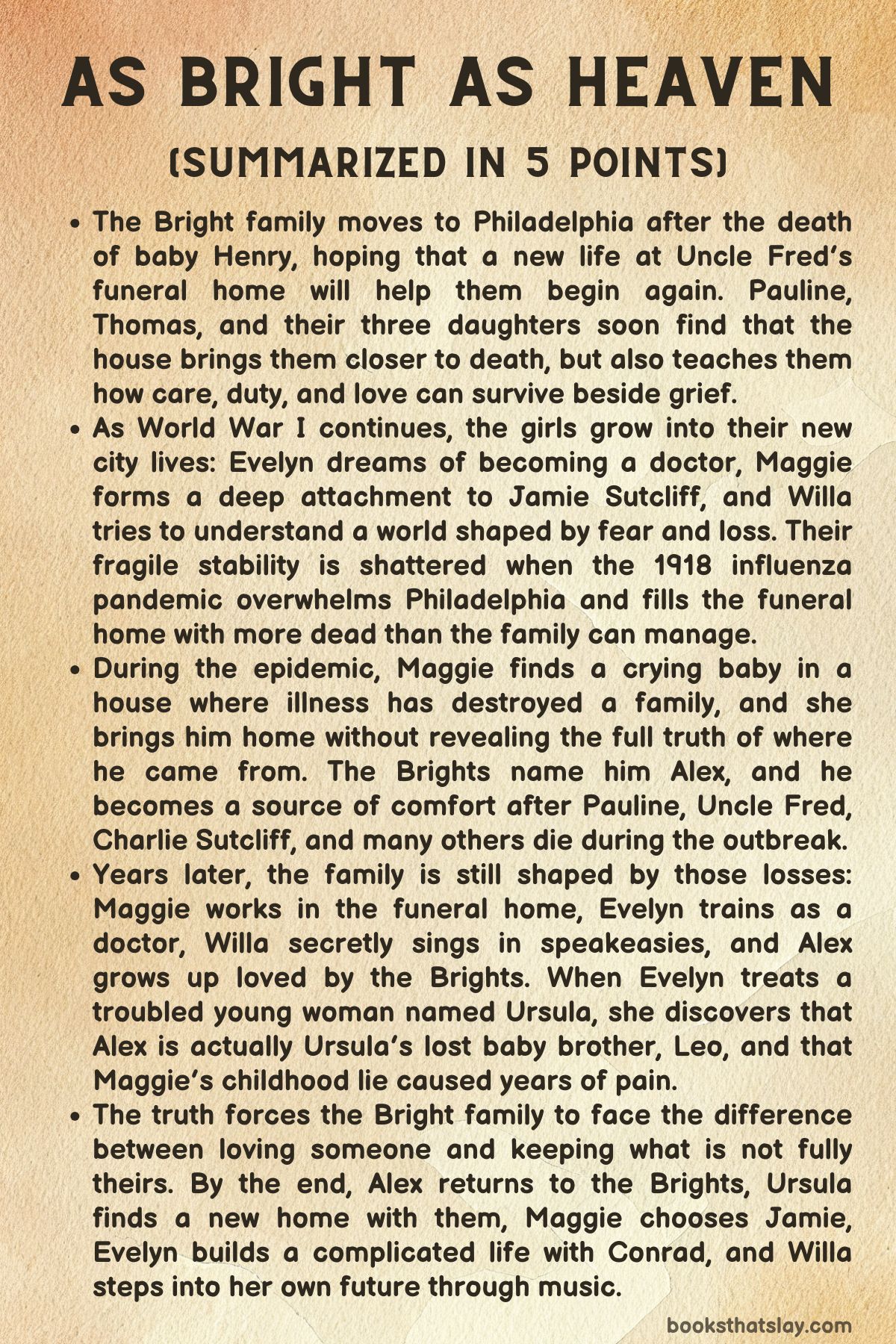
Characters
Pauline Adler Bright
Pauline is one of the emotional centers of the book, and her character is shaped by the death of her infant son, Henry. She begins the story as a mother who has been altered by grief, not simply saddened by it.
Her desire to leave Quakertown for Philadelphia is not just practical; it is an attempt to escape the daily presence of loss. Yet once she enters the funeral home, she does not run from death.
Instead, she slowly learns to stand beside it. Her work with the dead gives her a sense of purpose because it allows her to care for bodies after life has left them and to give comfort to the living.
In As Bright As Heaven, Pauline’s relationship with death is unusual because she sees it less as a monster and more as a companion she must understand. This does not mean she is cold or detached.
Her fierce struggle to save Willa from influenza shows the full force of her maternal love. Pauline’s death is devastating because she has become the family’s emotional guide, but her final understanding leaves behind a lasting idea: love remains close even when a person is gone.
Thomas Bright
Thomas is a steady, responsible husband and father whose grief often appears through duty rather than speech. He agrees to move to Philadelphia because he wants a better future for his family, and later he accepts the responsibility of the funeral home after Pauline and Uncle Fred die.
His character carries the burden of survival. While Pauline’s grief becomes reflective and spiritual, Thomas’s grief hardens into anger, especially toward Pauline’s mother for refusing to let the family return to Quakertown during the influenza outbreak.
This anger shows how badly he needs someone to blame for a loss that has no fair explanation. Thomas is also deeply loyal.
His love for Pauline remains so complete that he does not imagine remarrying. As a father, he is protective, but he is also practical enough to keep the household and business functioning after disaster.
His acceptance of Alex into the family shows his capacity for love beyond blood, while his later willingness to face the truth about Alex’s identity shows that his moral sense survives even when it costs him.
Evelyn Bright
Evelyn is the most intellectually driven of the Bright daughters. From the beginning, she is drawn to science, medicine, and explanation.
She wants to become a doctor because she believes knowledge can answer questions and reduce suffering. Yet the book repeatedly places her in situations where knowledge is not enough.
She understands the medical facts of influenza, but that does not help her accept why Willa lives and Pauline dies. Later, as a psychiatry resident, she studies the mind and tries to help people whose suffering is hidden beneath behavior, silence, or confusion.
Evelyn’s strength is her seriousness, but her weakness is her belief that if she can understand something, she can control it. Ursula’s case breaks this illusion.
When Evelyn realizes that Alex is Ursula’s lost brother, she is forced to confront not only Maggie’s lie but also her own decision not to question that lie years earlier. Her love for Conrad adds another layer to her character because it places desire and morality in conflict.
Evelyn is compassionate, disciplined, and intelligent, but she is also capable of longing for something complicated. Her development comes from learning that healing is not the same as solving.
Maggie Bright
Maggie is one of the most morally complex figures in the book. As a child, she is sensitive, observant, and hungry for emotional connection.
Her attachment to Jamie begins early, and her letters to him become an expression of devotion, hope, and innocence during a time of war. Maggie is also deeply affected by Henry’s death and by the emptiness left in the family.
When she finds the baby later known as Alex, her decision to take him comes from love, fear, grief, and selfishness all at once. She saves him, but she also hides the truth about his sister.
This makes her act both compassionate and damaging. Maggie grows into a capable young woman who works in the funeral home with skill and gentleness, suggesting that she has inherited Pauline’s ability to care for the dead and comfort the living.
Yet her deepest flaw is her desire to fix pain immediately, even when the right kind of repair requires honesty and time. Her relationship with Jamie reveals her loyalty and emotional patience, while her broken engagement to Palmer shows her refusal to accept a safe life that is not truthful.
Maggie’s arc is about learning that love cannot be built on concealment, even when concealment began as an act of protection.
Willa Bright
Willa experiences the tragedies of the story as a child, which makes her guilt especially painful. She does not have the adult understanding needed to separate illness from blame, so she convinces herself that she caused Pauline’s death by having the flu first.
This false guilt shapes much of her later behavior. Willa often feels that something in her life has been broken beyond repair, and her secret singing in speakeasies becomes a way to escape the heaviness of home.
Onstage, under the name Polly Adler, she can become someone admired, bright, and free from grief. Yet Willa is not simply rebellious.
She is lonely, imaginative, and desperate for a place where joy still feels possible. Her attachment to Alex is especially intense because he represents restored life after Henry and Pauline.
When Alex’s true identity is revealed, Willa reacts with anger because she feels another loss arriving. Over time, however, she begins to grow beyond blame.
Her connection with the Weisses helps her see that grief exists in many homes, not only hers. By the end, Willa’s singing becomes less like escape and more like self-expression.
Alex, or Leo Dabney
Alex, whose birth name is Leo, functions as both a character and a symbol of survival. As a baby, he enters the Bright household at the darkest point of the influenza crisis.
To the family, he becomes proof that life can still be held, fed, named, and loved even while death fills the city. For Maggie, he fills the space left by Henry and by Jamie’s absence.
For Thomas, he becomes a sonlike presence. For Willa, he is a source of comfort and continuity.
Yet Alex’s place in the family is built on an incomplete truth. He is loved deeply, but he also belongs to a past that has been hidden from him.
When his real identity is revealed, he becomes the center of a painful moral correction. His story forces the Brights to confront the difference between love and possession.
The fact that he eventually returns to them does not erase Maggie’s mistake, but it does suggest that family can be formed through care, truth, and forgiveness, not only biology.
Uncle Fred
Uncle Fred is practical, disciplined, and deeply connected to the funeral business. At first, he appears somewhat stern and businesslike, especially in the way he manages the funeral home, but the book gradually shows his humanity.
He has no children of his own and wants Thomas to inherit the business, which suggests that he sees the Brights as his continuation. His involvement with patriotic surveillance during the war reflects the suspicion and fear of the period, especially toward German Americans and antiwar voices.
Still, Fred is not presented as merely harsh. He cares about the dead and about the order needed to help grieving families.
His books and conversations with Evelyn encourage her interest in anatomy and medicine, making him an important influence on her future. His death during the influenza outbreak adds to the sense that the pandemic erases boundaries between caregiver and victim.
Fred’s life is marked by duty, and his legacy remains in the funeral home, the knowledge he passes on, and the family structure he helps create.
Jamie Sutcliff
Jamie is a figure of lost innocence and slow recovery. Before the war, he is kind, thoughtful, and appealing to Maggie because he treats her with respect and warmth.
His decision to go to war is connected to duty, but his letters show that he is not a simplistic patriot. He recognizes the shared humanity of people across borders, which makes his later damage more painful.
When he returns, he is alive in body but deeply wounded inside. His departure from Philadelphia after the war shows that he cannot simply resume his old identity.
Jamie’s later confession that Maggie’s letters helped keep him alive is one of the clearest signs of how small acts of love can matter across distance and time. He does not return as the untouched young man Maggie first admired, but as someone who has survived despair.
His relationship with Maggie matures because it is no longer based only on youthful longing. It becomes a bond between two people who have both been changed and who must choose honesty over fantasy.
Charlie Sutcliff
Charlie is gentle, trusting, and important to the emotional life of the early part of the book. His childlike mind makes him vulnerable, but it also allows him to respond to kindness without suspicion.
Maggie’s early friendship with him shows her tenderness and her instinct to protect people who are easily overlooked. Charlie’s admiration for Jamie also helps establish Jamie as a beloved older brother before the war changes him.
His death from influenza is especially painful because he represents innocence. He is not involved in war, politics, or adult ambition; he is simply one of the many ordinary people taken by illness.
Maggie’s guilt after his death is sharpened by Jamie’s request that she look after him. Through Charlie, the story shows that pandemics do not only take the old, the distant, or the unnamed.
They take people who are woven into daily routines, friendships, and promises.
Ursula Novak
Ursula is one of the most tragic characters in the novel because her suffering is built on a false belief. As a young girl, she survives the flu but loses her mother and believes she has also lost her baby brother.
Worse, the adults around her allow the idea to form that she may have caused Leo’s death. This accusation crushes her sense of self.
By the time Evelyn meets her, Ursula’s silence and suicidal despair come from years of guilt, abandonment, and emotional isolation. Her pencil box, with its small preserved objects, represents a life reduced to fragments of memory.
When she learns that Leo is alive, the truth does not magically erase her pain, but it gives her back a part of herself that had been wrongly destroyed. Ursula’s character shows how dangerous false stories can be when they settle around a child.
She also shows that healing can begin when someone is finally believed and when the hidden truth is brought into the open.
Conrad Reese
Conrad is introduced through his devotion to Sybil, his young wife who has dementia. His character is defined by tenderness, patience, and emotional exhaustion.
He visits Sybil faithfully and treats her not as a burden but as a person he still loves. This devotion attracts Evelyn because it represents the kind of committed love she wants.
At the same time, Conrad’s relationship with Evelyn creates a moral conflict. He is lonely, grieving the loss of the wife he knew while still caring for the wife who remains.
His love for Evelyn grows from shared sorrow and understanding, but it exists alongside his duty to Sybil. Conrad is not a careless adulterous figure; he is a man caught in a painful situation where love, loyalty, and need do not fit neatly together.
His decision to bring Sybil home and Evelyn’s later choice to join that life create an unusual household built on care, compromise, and emotional complexity.
Sybil Reese
Sybil is not given the same active role as many other characters, but her presence is important. She is young, yet dementia has altered her mind and future, making her illness feel especially unfair.
Through Sybil, the book expands its concern with the body’s fragility into the realm of the mind. Her condition challenges Evelyn’s medical confidence because psychiatry cannot simply restore what has been lost.
Sybil also complicates the romance between Evelyn and Conrad. She is not an obstacle in a shallow sense; she is a living person who deserves care and dignity.
Her role forces the reader to consider what marriage, loyalty, and compassion mean when illness changes one partner beyond recognition. Sybil’s character reminds us that suffering is not always dramatic or sudden.
Sometimes it is slow, quiet, and ongoing, requiring daily acts of patience from those who remain.
Gilbert Keane
Gilbert represents Evelyn’s first experience of romantic possibility. He is handsome, friendly, and associated with the excitement Evelyn feels in Philadelphia, where she can imagine a larger future for herself.
His connection with Evelyn is not developed into a long relationship, but that is part of his importance. He stands for a life that might have been.
His death from influenza gives Evelyn a private grief different from the loss of family. It is the grief of an unopened future.
Through Gilbert, the book shows how the pandemic did not only destroy existing relationships; it also erased possible ones. Evelyn’s later emotional reserve can be partly understood through this early loss.
Gilbert remains a memory of youth, promise, and the suddenness with which hope can disappear.
Palmer Towlerton
Palmer is a decent man, but he is not the right man for Maggie. His proposal offers her stability, respectability, and a life in Manhattan.
On the surface, he represents forward movement after years of grief and uncertainty. Maggie’s acceptance of his proposal shows her desire to choose a practical future and perhaps free herself from the old pull of Jamie.
Yet her hesitation reveals that affection is not the same as love. Palmer’s importance lies in the choice he forces Maggie to make.
By agreeing to marry him and then recognizing that she cannot, Maggie becomes more honest with herself. Palmer is not villainous or cruel; he is simply part of a life Maggie cannot fully inhabit.
His character helps clarify the difference between comfort and truth.
Dora Sutcliff
Dora Sutcliff is a mother marked by anxiety, love, and loss. Her fear when Jamie goes to war reflects the helplessness of parents whose children are claimed by national duty.
Her later loss of Charlie adds another layer of sorrow. Dora also helps care for Alex, showing that her grief does not close her off from others.
She is practical and present in the lives of the Brights, and her support matters because the family is often struggling to hold itself together. Dora’s views on Prohibition reveal her moral certainty and her dislike of alcohol’s damage, which places her firmly within the social world of the 1920s.
She is not as central as Pauline or the daughters, but she represents the many parents and neighbors whose lives were reshaped by war, illness, and the changing city.
Cal Dabney
Cal Dabney is a painful figure because his grief turns into blame. After losing Ines and believing Leo is dead, he directs his anger toward Ursula, a child who was herself sick and traumatized.
His inability to protect or comfort her contributes to her suffering. Cal’s later life, including remarriage and another child, suggests that he has tried to move on, but not in a way that repairs what he did to Ursula.
When he later allows Alex to return to the Brights, his choice can be read in more than one way. It may show that he recognizes where Alex feels most loved and secure, but it may also reveal his inability to fully claim responsibility for the past.
Cal is not simply evil, but he is morally weak in the face of grief. He shows how pain can make adults fail children who need them most.
Rita Dabney
Rita Dabney reflects the coldness that can grow around family reputation, resentment, and grief. As Ursula’s step-grandmother, she speaks about the girl with pity but not real tenderness.
Her statement that Ursula is not truly theirs exposes the conditional nature of her care. Rita’s attitude helps explain why Ursula is so emotionally abandoned.
She belongs nowhere securely: not fully to the Dabneys, not to the Brights, and not to the dead family she remembers. Rita is important because she shows how family structures can reject those who most need protection.
Her bitterness over Leo’s supposed death keeps her from seeing Ursula as another victim of the same tragedy.
Gretchen Weiss
Gretchen Weiss appears briefly, but her presence has lasting meaning, especially for Willa. As a German American child during wartime, she is marked by prejudice from others who associate her family with the enemy.
Her death from influenza shows that public suspicion and private suffering can exist at the same time. Later, Willa’s connection with Gretchen’s father and the family dog helps her rethink the simple fears and labels she heard as a child.
Gretchen’s character points to the harm caused by wartime prejudice and the way children inherit adult hostilities before they understand them. Though she dies young, her memory helps Willa grow toward empathy.
Mr. Weiss
Mr. Weiss becomes important later in Willa’s development. At first, he is part of the shadowy adult world Willa does not fully understand, especially when she recognizes him during the speakeasy raid.
But instead of becoming a threatening figure, he turns into a source of kindness and perspective. He helps Willa see that the Weiss family’s grief over Gretchen is real and that they are not outsiders to be feared.
His American voice surprises Willa because it challenges the wartime assumptions she absorbed. Through him, Willa begins to understand that identity is more complicated than labels like German, American, enemy, or neighbor.
Mr. Weiss helps move her away from fear and toward human recognition.
Lila
Lila is a protective figure in Willa’s secret life as a singer. As an older performer, she understands the risks of the speakeasy world better than Willa does.
She sees through Willa’s false identity and recognizes that the girl is younger and more vulnerable than she pretends. Lila’s care matters because Willa is seeking escape in a place that can easily exploit her.
Rather than encouraging Willa’s fantasy without concern, Lila tries to send her home when she senses emotional distress. Her role is brief but meaningful.
She represents a kind of rough, practical guardianship that exists outside the family home.
Henry Bright
Henry dies before the central action of the book fully begins, but his absence shapes everything. His death is the wound that pushes Pauline toward Philadelphia, changes the family’s emotional balance, and creates the empty space into which Alex later enters.
Henry is remembered as calm and angelic, but his real function in the story is not simply sentimental. He represents the first lesson the Brights learn about the fragility of the body and the permanence of loss.
The family never stops responding to his death, even when they do not speak of him directly. In this way, Henry is one of the book’s unseen forces.
Ines Novak Dabney
Ines, Ursula’s mother and Leo’s mother, is another character whose death shapes the lives of others. She dies during the influenza epidemic, leaving Ursula sick, frightened, and responsible for a baby brother in a ruined household.
Although she is not alive for most of the story, her photograph and memory become crucial evidence in uncovering Alex’s true identity. Ines represents the many parents whose deaths during the pandemic left children unprotected.
Her absence creates the conditions for Maggie’s choice, Ursula’s guilt, and Leo’s second life as Alex. In As Bright As Heaven, Ines’s lost motherhood stands beside Pauline’s, showing how one epidemic creates parallel griefs in different homes.
Themes
Death as Presence Rather Than Abstraction
Death in As Bright As Heaven is not treated as something distant, rare, or symbolic only. It is physically present in the funeral home, in the embalming room, in the bodies brought through the side entrance, and in the overwhelmed city during the influenza outbreak.
The Bright family cannot think of death as an idea because they handle its consequences every day. Pauline’s character especially changes the way the book presents mortality.
She does not make peace with death in a simple or cheerful way, but she begins to see it as part of human fragility rather than as a personal enemy. The funeral home setting makes this theme intimate.
Bodies are washed, dressed, arranged, and presented so that families can say goodbye. That work gives dignity to people who might otherwise become only numbers in a crisis.
During the pandemic, this dignity is strained because there are too many dead and too little time. The book shows that death can be terrifying, but it also shows that how the living respond to death matters.
Care for the dead becomes a form of care for the living, and mourning becomes one of the ways people remain human.
Grief, Survival, and the Changed Self
Grief does not simply pass through the characters; it changes who they are. Pauline is transformed by Henry’s death before the family ever reaches Philadelphia.
Evelyn’s losses sharpen her desire to understand the body and mind. Maggie’s grief makes her cling to Alex and later forces her to confront the harm caused by that need.
Willa’s grief becomes guilt, and because she is young, she mistakes survival for responsibility. The book presents grief as something that does not end neatly.
People continue to work, raise children, fall in love, and make choices, but the losses remain under the surface. Survival is not shown as a return to an earlier self.
Jamie comes back from the war alive, but not whole in the way people expect. Evelyn survives the flu years, but her faith in answers is shaken.
The Brights continue after Pauline’s death, yet their family life is permanently altered. This theme is powerful because it avoids easy comfort.
The characters do move forward, but moving forward means carrying what happened, not escaping it.
The Moral Cost of Love
Love in the story is often sincere, but sincerity does not make every action right. Maggie’s decision to take Alex is the clearest example.
She saves a baby from danger, and the Bright family gives him a loving home, but her refusal to tell the full truth causes Ursula years of suffering. The book asks the reader to sit with this discomfort.
Maggie is not heartless; in fact, she acts because she feels deeply. Yet her love becomes possessive when she decides that the baby belongs with her family because they need him.
This theme also appears in Evelyn and Conrad’s relationship. Their love is real, but it exists in the shadow of Sybil’s illness and Conrad’s marriage.
Thomas’s love for Pauline turns partly into anger after her death because he cannot bear the randomness of losing her. The story repeatedly shows that love can comfort, save, wound, and confuse.
The moral test is not whether a character feels love, but whether that love can face truth, duty, and the needs of others.
Truth, Healing, and Repair
Hidden truth damages nearly every life connected to Alex’s identity. Maggie’s lie begins as a frightened child’s attempt to keep a baby safe and preserve something good for her family, but the silence grows larger with time.
Alex is raised lovingly, yet he is separated from his sister and his original name. Ursula lives under the crushing belief that she caused her brother’s death.
Evelyn senses that something about Maggie’s story is incomplete but does not press hard enough, which later fills her with guilt. The revelation of the truth is painful because it threatens the family’s happiness, but it is also necessary.
Healing begins only when Ursula learns that Leo is alive and when the Brights accept that love does not give them the right to hide his past. The book presents repair as slow and imperfect.
Telling the truth does not immediately remove grief, restore lost years, or make every relationship simple. Yet it opens a path that secrecy has blocked.
Real healing requires honesty, patience, and the willingness to lose what was wrongly held.