It’s All In Your Head Summary, Characters and Themes
It’s All In Your Head by Sabina Nordqvist is a contemporary romance about chronic illness, disability, privacy, and the frightening gap between being seen and being understood. The story follows Skylar King, a woman living with idiopathic intracranial hypertension, and Brandon Pike, a former Olympic snowboarder whose life changed after a devastating accident.
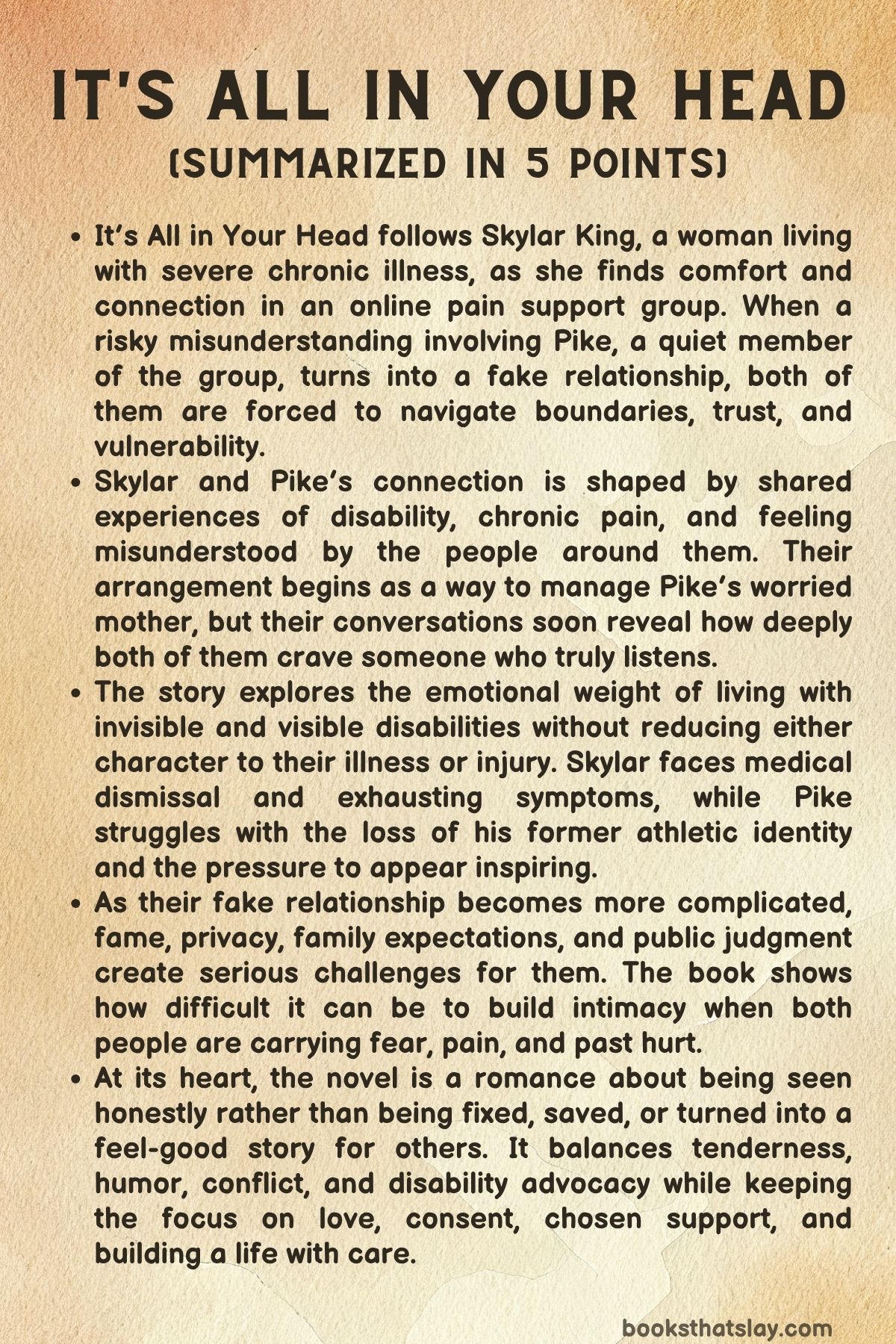
What begins as a messy lie to calm his anxious mother becomes a fake relationship that slowly turns real. The book explores pain without treating disabled lives as tragedies, showing love as something built through honesty, boundaries, care, and the courage to ask for support.
Summary
Skylar King spends New Year’s Eve in terrible pain during a relapse of idiopathic intracranial hypertension. Her condition brings crushing head pressure, vision trouble, dizziness, light sensitivity, tinnitus, nausea, and fear.
To get through the night, she turns to her online chronic pain support group, where she can be honest in a way she often cannot be elsewhere. One of the members, Pike, replies to her post.
Skylar has quietly noticed him for a long time. He is reserved, attractive, and mysterious, and his past posts suggest that he uses a cane, takes strong pain medication, and may be newly disabled.
Later that night, Pike posts a raw poem about pain, grief, and the harm of forced positivity. Skylar is moved by it, but his mother, Laurie, appears in the comments and panics.
She calls him Brandon and worries that the poem means he may hurt himself. She threatens to call the police for a wellness check.
Skylar fears that police involvement could make things worse, especially because Pike is disabled and relies on medication. Acting on impulse, she messages Laurie and lies that Pike is safe because he is asleep beside her.
Laurie assumes Skylar is Pike’s girlfriend.
When Pike learns what Skylar did, he is furious. He feels she crossed a line and inserted herself into his private life.
Skylar apologizes and explains that she was trying to protect him from a dangerous situation. Pike admits his mother loves him but does not know how to handle his disability or darker emotions.
Since Laurie now believes he has a serious girlfriend, Pike decides it may be easier to continue the lie for a while. Skylar, worried he might report her to the group admins, agrees to meet Laurie as his fake girlfriend.
Pike’s full name is Brandon Pike. He works at Element Ridge, a ski and snowboard shop, and uses a cane after a catastrophic snowboarding accident.
He was once a famous snowboarder with Olympic and X Games medals, but he now avoids attention, old friends, media invitations, and even his mother’s calls. He suspects Skylar might secretly know who he is, but her lack of snowboarding knowledge eases his fear.
Skylar and Pike meet for lunch to set rules. Skylar prepares carefully for safety and tells her friends where she is.
They discuss their health, limits, and expectations. Skylar explains her illness and the accommodations she needs.
Pike explains his pain, mobility limits, and need to plan around his body. They agree to two fake dates with Laurie and set boundaries around affection, including hand-holding, cheek kisses, and gentle touches, but no kissing on the mouth.
Their first dinner with Laurie quickly becomes complicated. Laurie is warm toward Skylar but intrusive toward Pike.
She praises his athletic past, brings up his fame, and suggests he could inspire disabled athletes. Skylar pushes back against the idea that disability has to be turned into inspiration for others.
During dinner, Laurie reveals Pike’s celebrity status, shocking Skylar. Skylar searches him online and discovers he is a two-time Olympic gold medalist whose career ended after a devastating accident.
She also finds stories about his public dating life. She feels blindsided and worries that his fame gives him power over her if their arrangement goes wrong.
On the drive home, Skylar confronts Pike for hiding his identity. Pike explains that he liked being treated as ordinary and no longer feels like the famous athlete people remember.
Before they can settle the argument, another car veers into their lane. Pike swerves, hits black ice, and crashes into a snowy ditch.
They are not badly hurt, but the car is stuck, the storm is worsening, and they have no reliable service or heat.
They are forced to walk through the snow toward help. Pike’s pain worsens, and Skylar’s condition flares from cold and exertion.
They eventually reach a house owned by David, who lets them stay for the night. Skylar is nervous about staying with a stranger, so Pike video-calls her friends Emy and Analia to reassure them.
In the guest room, there is only one bed. They shower, change, watch game shows, take a fake couple photo for Laurie, and talk more honestly about family, pain, and fear.
Their closeness becomes harder to dismiss.
The next day, Pike offers to accompany Skylar to a medical appointment. He has researched IIH and supports her as she asks Dr. Wharton about medication changes and imaging for venous sinus stenosis.
The doctor dismisses her concerns, focuses on her weight, refuses imaging, and makes a cruel comment. Pike is furious.
Afterward, he steals promotional pens from the supply closet as petty revenge. When they are almost caught, Skylar tells him to kiss her as cover.
The kiss becomes intense, revealing that their fake relationship has started to feel real.
Their connection deepens over the next weeks. Pike visits Skylar on Valentine’s Day with roses and homemade soup while she is recovering from a flare.
They talk about chronic pain, disability, guilt, fame, and sex. Pike opens up about how his accident changed his body and his relationship with desire.
Skylar responds with care, and their emotional bond strengthens.
Their second fake date with Laurie is disrupted by a reporter, Chris Blake, who ambushes them with photographs. Laurie arranged the interview because she believes public attention will prove Pike is doing well.
Pike is furious that Skylar has been pulled into his celebrity life. He bargains with Blake, promising an exclusive interview at the Shred Awards in Whistler if Blake drops the current story.
Then he fires Laurie as his manager.
In Whistler, Skylar and Pike act as a couple in public, but their feelings become increasingly real. They spend time with Pike’s snowboarding friends, and Skylar sees how much grief he carries over losing the sport that once defined him.
She defends him when others treat his current life as wasted potential. At the awards event, Pike is honored with a Legacy Award.
A slideshow of his past achievements overwhelms him, making him feel as though the old version of himself is gone forever. Skylar notices his pain and finds a quieter space for them.
Their attraction builds, but a misunderstanding stops them. Pike wants more than a casual hookup, while Skylar thinks he is rejecting emotional commitment.
Both are hurt, and they return home distant from each other.
Soon after, Skylar’s health collapses. She calls Pike when she is too sick to move, vomiting on the bathroom floor with severe head pain, aphasia, dizziness, and sensory distress.
Pike comes immediately, cleans her up, gives her medication, and calls for help when he cannot move her safely. He stays with her through a painful lumbar puncture and learns her pressure is high.
His care shows Skylar that support does not have to be earned through being easy.
Skylar recovers at Pike’s accessible home, and they grow closer. On her birthday, Pike surprises her with a limo, formal clothes, dinner, and a necklace.
He tells her the fake dating is over because his feelings are real. Skylar admits she cares about him too but needs time.
After a misunderstanding involving a casual contact from her past, she runs after Pike and makes clear that she wants him romantically, not just physically. They decide to try being together one day at a time.
Their happiness is threatened when a gossip article leaks private screenshots from the chronic pain support group. The article twists Skylar’s posts about illness, sex, family, work, and her past relationship, making it seem as though she is complaining about Pike.
It also leaks Pike’s posts and poem, leading strangers to speculate about his mental health. Skylar is devastated by the exposure of her private medical life.
Pike promises lawyers but refuses to make a public statement, believing silence will keep the story from growing.
Skylar feels abandoned. Her workplace puts her on probation, strangers mock her online, and hateful emails arrive.
She wants Pike to defend her publicly, but he keeps insisting silence is best. Their argument reveals deeper pain: Pike admits he is exhausted, hurting more, skipping physical therapy, and struggling to balance everything.
Skylar hears this as proof that she is too much for him and ends the relationship.
After the breakup, Skylar tries to prove she can still be fun and independent, but she breaks down. Pike isolates himself and writes pages addressed to her.
With help from Kal and Luis, he realizes Skylar likely believes he agrees with the cruel things people are saying about her. He understands that he never clearly told her she was not the problem.
When Skylar needs more imaging and another spinal tap, Pike does not force his way back in. Instead, he contacts Emy and Analia, who come in person to support her.
Skylar realizes her online friendships can become real-life care. Later, she learns she has severe bilateral venous sinus stenosis, likely causing her intracranial hypertension.
She also confronts the doctor who dismissed her and sets firmer boundaries with her mother.
Pike discovers that his father, not Laurie, leaked information to reporters for money. He apologizes to Laurie and speaks honestly with her about his depression, pain, and need for boundaries.
Then he appears on a late-night show. He condemns the leak, defends Skylar, calls out ableist reactions to disabled people’s private struggles, admits he failed to support her, and reveals that he loves her.
Afterward, Pike leaves Skylar a journal filled with letters, poems, memories, apologies, fears, hopes, and declarations of love. Skylar reads it, writes notes in the margins, and goes to his house.
Reporters wait outside, but she walks past them calmly with the journal. She and Pike talk honestly, apologize, admit their love, and agree to communicate about pain, energy, intimacy, needs, and fear instead of hiding.
Six months later, Skylar and Brandon are together. Skylar is building a care network for disabled women with Emy and Analia, while Brandon supports disability causes and manages his pain more honestly.
They are considering an accessible home together. Skylar still faces health uncertainty and possible surgery, but she has love, friendship, boundaries, and a future she wants to keep choosing.
Characters
Skylar King
Skylar King is the emotional center of It’s All In Your Head, and her character is shaped by the exhausting reality of living with idiopathic intracranial hypertension, chronic pain, medical dismissal, and the constant pressure to prove that her suffering is real. She is not written as a passive patient or as someone defined only by illness; instead, she is thoughtful, funny, guarded, impulsive, lonely, and deeply hungry for understanding.
Her decision to lie to Laurie about being Pike’s girlfriend begins as a desperate act of protection, but it also reveals Skylar’s instinct to intervene when she believes someone vulnerable may be harmed by systems that do not understand disability or mental health. That impulsiveness creates trouble, yet it comes from empathy rather than manipulation.
Throughout the book, Skylar is shown navigating pain not only as a medical condition but as a social experience: she has to manage symptoms, doctors, work expectations, family judgment, online exposure, and the fear that needing help makes her burdensome. Her relationship with Pike becomes important because he sees her pain without trying to minimize it, but Skylar’s growth is not limited to romance.
By the end of the story, she learns to accept support from friends, challenge medical mistreatment, set boundaries with her family, and imagine a future that includes both illness and joy. Skylar’s arc is powerful because she does not become “fixed”; she becomes more connected, more assertive, and more willing to believe that she deserves care.
Brandon Pike
Brandon Pike, often called Pike, is one of the most layered characters in the book because he is caught between who the world remembers him as and who he is now. As a former elite snowboarder with Olympic success, he carries the weight of public admiration, but after his catastrophic accident, fame becomes less like a gift and more like a haunting reminder of a life he can no longer inhabit.
Pike’s disability, chronic pain, cane use, medication, and emotional grief shape his present, yet he struggles to claim disabled identity fully because part of him still measures himself against the athlete he used to be. His silence, avoidance of media, and refusal to reconnect with parts of his old life show how deeply he is grieving.
At first, he is suspicious of Skylar, defensive, and angry when she intrudes into his private situation, but his guardedness makes sense because his fame has repeatedly made his life available for public consumption. As the story develops, Pike becomes more emotionally open.
He researches Skylar’s illness, supports her at medical appointments, cares for her during severe flares, and slowly learns that love is not about performing strength all the time. His biggest flaw is his tendency to believe silence is protection, especially during the gossip scandal, but that silence leaves Skylar feeling abandoned.
His public defense of her later shows real growth: he stops hiding behind a polished image and speaks honestly about pain, ableism, depression, privacy, and love. Pike’s character arc is about learning that he is not only the ghost of a great athlete; he is still a whole person capable of love, advocacy, vulnerability, and a meaningful future.
Laurie
Laurie is Pike’s mother, and she is a complicated figure because her concern for her son is genuine, but her methods are often intrusive, controlling, and harmful. She loves Pike deeply and fears losing him emotionally after his accident, yet she struggles to accept the darker parts of his grief.
When she sees his poem and panics, her instinct is to call the police, which shows how fear can turn care into control when someone does not understand disabled people’s need to express pain without being treated as dangerous or unstable. Laurie’s behavior during the fake relationship plot is revealing: she wants Pike to be happy, but she also wants evidence that he is recovering in a way she can recognize.
Her desire to push him into interviews, inspirational narratives, and public visibility reflects a common ableist pattern in which disabled people are expected to transform pain into a motivational story for others. Her arrangement with Chris Blake is a major violation because she exposes Skylar and Pike to public scrutiny without their consent.
Still, Laurie is not portrayed as purely cruel. She is frightened, grieving, and unable to separate motherhood from management.
When Pike fires her and later confronts her honestly, Laurie is forced to see that love cannot mean controlling his image, his career, his body, or his grief. Her character adds emotional tension because she represents the kind of care that can wound when it refuses to listen.
Emy
Emy is one of Skylar’s closest online friends and a vital part of the chronic pain support network. Her presence shows how online friendships can be emotionally real, especially for disabled people whose symptoms may limit traditional social life.
Emy is protective, observant, and practical. She investigates Pike’s identity, warns Skylar that he is actually Brandon Pike, and remains involved when Skylar’s fake relationship begins to collide with fame.
Although she often appears through texts and video calls, her role is not minor because she represents the safety net Skylar has built outside her family and workplace. Later, when Pike contacts Emy and Analia instead of forcing himself back into Skylar’s life, Emy’s arrival in person becomes a turning point.
It proves to Skylar that the relationships formed through illness and online vulnerability are not lesser than offline relationships. Emy helps shift Skylar’s understanding of support: care does not have to come only from romance, and friendship can become physically present when it matters most.
Her character brings warmth, loyalty, and emotional steadiness to the story.
Analia
Analia, like Emy, is part of Skylar’s chronic pain support group and one of the people who understands Skylar’s life without needing long explanations. Her character matters because she helps create a sense of community around Skylar before Pike fully enters her life.
Analia’s friendship offers Skylar a place where illness is not strange, embarrassing, or excessive. She is part of the group dynamic that allows Skylar to joke, panic, vent, and be believed.
When Analia comes in person with Emy to support Skylar through imaging and another spinal tap, her role becomes especially meaningful. She helps turn virtual solidarity into real-world care, showing that disabled community can cross the boundary between screen and physical presence.
Analia’s importance lies in her quiet reliability. She may not dominate the plot, but she helps anchor one of the book’s strongest ideas: that survival is easier when people who understand pain gather around one another.
Luis
Luis is Pike’s roommate, and he provides both comic warmth and emotional grounding in Pike’s life. His excitement when he thinks Pike has a girlfriend shows that he wants Pike to reconnect with ordinary joy, intimacy, and companionship after years of pain and withdrawal.
Luis is not just a lighthearted side character, though; he is part of Pike’s chosen support system. He sees Pike’s isolation more clearly than Pike himself often does.
After the breakup, Luis helps stage a small intervention with Kal, pushing Pike to stop hiding in his room and confront what he has failed to communicate to Skylar. Luis’s role is important because he reflects the kind of friendship Pike needs: someone who does not treat him like a fallen celebrity or a tragic figure, but also refuses to let him disappear into silence.
Through Luis, the book shows that disabled men also need everyday emotional care, accountability, and domestic companionship.
Cyrus
Cyrus is Luis’s boyfriend, and while he has a smaller role, he helps build the sense of a lived-in social world around Pike. His presence in Pike’s home life suggests that Pike is not completely alone, even when he feels emotionally isolated.
Cyrus also contributes to the warmth and normalcy of the household, especially in contrast to the public pressure surrounding Pike’s fame and Laurie’s interference. He is part of the supportive environment that makes Pike’s accessible home feel more like a place of community than simply a private retreat.
Though Cyrus is not central to the main romantic conflict, his character helps soften the atmosphere around Pike and shows that Pike’s life after the accident includes people who care about him outside his old snowboarding identity.
Kal / Kalle
Kal, also referred to as Kalle, is one of the most practical and emotionally perceptive supporting characters. He helps in moments when the main characters are physically or emotionally overwhelmed, such as when Skylar is too sick to move safely and Pike realizes he needs help.
Kal’s presence often brings stability. He is dependable, direct, and willing to intervene without making the situation about himself.
When Skylar breaks down after trying to go clubbing, Kal finds her and takes her home, showing that he understands the difference between independence and self-destruction. He also helps Pike recognize the emotional damage caused by his silence after the gossip scandal.
Kal functions as a bridge between crisis and clarity; he does not solve the central problems, but he helps the characters survive long enough to face them honestly. His role reinforces the book’s broader emphasis on care networks rather than isolated endurance.
David
David is the stranger who shelters Skylar and Pike after their car slides into a snowy ditch during the storm. His role is brief but important because he creates a tense situation in which trust, vulnerability, and safety become immediate concerns.
Skylar’s uneasiness about staying in a stranger’s house is understandable, especially given her physical vulnerability and the frightening circumstances. David’s presence allows the story to explore how disabled people often have to calculate risk differently: accepting help may be necessary, but it can also feel dangerous.
By offering shelter, David becomes part of a crisis that pushes Skylar and Pike into deeper intimacy. The night at his house gives them space to talk, rest, panic, laugh, and become more physically aware of one another.
David is less developed as an individual than as a catalyst, but his role matters because the storm sequence accelerates the trust between the central couple.
Dr. Wharton
Dr. Wharton is one of the clearest antagonistic figures in the story because he represents medical dismissal, fatphobia, arrogance, and the casual cruelty that chronically ill patients often face. His refusal to seriously consider Skylar’s concerns about venous sinus stenosis, his focus on her weight, and his cruel comment about stapling her mouth shut expose how damaging a doctor can be when he treats a patient’s body as a problem to be blamed rather than understood.
Skylar comes to him seeking care, information, and imaging, but he responds by minimizing her knowledge of her own condition. This scene is crucial because it shows that Skylar’s suffering is worsened not only by illness but by institutions that deny, delay, and shame.
Pike’s anger in the appointment validates Skylar’s experience, but the scene also makes clear that she has had to endure this kind of treatment long before Pike was present. Dr. Wharton’s character gives the book one of its strongest critiques of medical power used without compassion.
Dr. Richardson
Dr. Richardson functions as a contrast to Dr. Wharton because this doctor finally provides Skylar with information that validates what she has suspected about her body. When Skylar learns that she has severe bilateral venous sinus stenosis, it reframes her condition and confirms that her concerns were not exaggerated or imagined.
Dr. Richardson’s role is not as emotionally prominent as Pike’s or Skylar’s friends’, but the character is important because medical validation becomes part of Skylar’s healing. The diagnosis does not magically solve everything, and it may even open the door to more uncertainty and possible surgery, but it gives Skylar evidence and direction.
In a story where Skylar is repeatedly dismissed, Dr. Richardson represents the possibility of being listened to and taken seriously.
Chris Blake
Chris Blake is the reporter who ambushes Skylar and Pike, and he represents the invasive machinery of celebrity media. He is not interested in Skylar as a person or Pike as a grieving disabled man; he is interested in the story he can sell.
His willingness to photograph them, pressure them, and benefit from leaked information shows how fame can turn private pain into public property. Chris is especially threatening to Skylar because she does not have Pike’s fame, money, or public reputation to protect her.
For Pike, Chris is a reminder that even after leaving professional snowboarding, the public still feels entitled to him. Chris’s role becomes more disturbing when the later gossip article leaks private support-group posts, because he belongs to the same ecosystem of exposure and spectacle.
As a character, he embodies the harm caused when curiosity, profit, and entertainment are treated as more important than consent.
Jax
Jax is one of Pike’s snowboarding friends, and his character reveals the emotional gap between Pike’s old life and his current reality. Jax is connected to the world where Pike was celebrated for talent, risk, and athletic greatness.
His comments about Pike’s talent being wasted show that he does not fully understand how painful that framing is. To Pike, the issue is not simply that he stopped snowboarding; it is that the life, body, and identity he once knew were violently changed.
Jax’s surprise Legacy Award is meant as an honor, but it overwhelms Pike because it makes his former self feel publicly memorialized, almost as though he is watching a funeral for the person he used to be. Jax is not malicious, but he is careless in the way people can be when they love an earlier version of someone more clearly than the person standing in front of them.
His repeated drunken interruptions also add frustration and comedy, but beneath that, he helps expose how lonely Pike feels among people who knew him before disability.
Pike’s Snowboarding Friends
Pike’s wider group of snowboarding friends represents the life he has lost and the culture he no longer fully belongs to. They admire him, remember his greatness, and still connect him to the mountain world, but they do not always know how to support the disabled version of him.
Their presence in Whistler is emotionally charged because Pike is physically near the sport that made him famous while also being unable to participate in the way he once did. Skylar’s defense of Pike against the idea that his talent was wasted is important because it challenges the assumption that a disabled life is automatically a failed life.
Through these friends, the book explores how difficult it can be for people to adjust when someone’s identity changes after injury. They are not villains, but they reveal the pain caused by nostalgia when it refuses to make room for the present.
Pike’s Father
Pike’s father plays a smaller but damaging role in the story. His decision to leak the support group name to reporters for money is a severe betrayal because it exposes both Pike and Skylar to public humiliation, harassment, and emotional harm.
Unlike Laurie, whose violations often come from fear and misguided control, Pike’s father’s action appears more selfish and opportunistic. The leak deepens Pike’s shame and guilt because it leads to Skylar losing one of her main support spaces and becoming the target of public cruelty.
His role also complicates Pike’s family conflict: Pike initially suspects Laurie, but the truth forces him to reconsider where the betrayal actually came from. Pike’s father represents the danger of people who treat another person’s vulnerability as something with financial value.
Skylar’s Mother
Skylar’s mother is an important figure because she reflects the family pressure and emotional invalidation Skylar has endured alongside her illness. Although she is not as present as Pike or Laurie, her influence is felt in Skylar’s anxiety, defensiveness, and need to set boundaries.
Skylar’s confrontation with her mother later in the story shows that her growth is not only romantic but personal. She begins to reject the idea that she must make herself smaller, easier, or more acceptable to be loved by her family.
Her mother’s character helps explain why Skylar is so sensitive to being seen as “too much.” When Skylar finally establishes firmer boundaries, it marks a major step toward self-respect and emotional independence.
Skylar’s Parents
Skylar’s parents represent the family system Skylar has to navigate while already dealing with a painful and unpredictable illness. Their home is not presented as the primary place where Skylar feels safest or most understood, which makes her chosen relationships even more meaningful.
The tension with her parents adds another layer to Skylar’s loneliness because illness often forces her to need support from people who may not fully know how to give it. Her eventual decision to go to their house and set boundaries suggests that she is no longer willing to absorb family discomfort at the cost of her own emotional health.
In the book, her parents help highlight the difference between biological connection and truly supportive care.
Skylar’s Brother
Skylar’s brother is a background character, but news about his wife’s pregnancy affects Skylar because it touches the family pressures and emotional comparisons surrounding her life. His role matters less through direct action and more through what he represents: a version of adulthood that may appear more conventional, celebrated, or easier for the family to understand.
For Skylar, who is dealing with disabling illness, work instability, romantic uncertainty, and medical trauma, this family news intensifies her sense of being out of step with expectations. His presence helps show how ordinary family milestones can become emotionally complicated for someone whose body and future feel uncertain.
Skylar’s Sister-in-Law
Skylar’s sister-in-law, who is pregnant, functions mainly as part of the family context that unsettles Skylar. The pregnancy is not presented as wrong or negative in itself, but it creates emotional pressure because it reminds Skylar of the ways families often celebrate certain forms of progress while overlooking quieter battles for survival.
This character’s importance lies in how her pregnancy affects Skylar’s internal world. It adds to the sense that Skylar is trying to build a meaningful life while surrounded by expectations that may not fit her body, her health, or her timeline.
Owen
Owen is part of Skylar’s past, especially through the leaked posts that expose private details about her previous relationship and sex life. He is significant because the gossip article uses him as part of a distorted public narrative about Skylar.
Even though he is not central in the present action, his mention shows how women’s past relationships can be weaponized when private information becomes public. Owen’s role also helps reveal why the leak is so violating.
The issue is not only that strangers learn about Skylar’s illness; they also gain access to intimate parts of her emotional and sexual history. Through Owen, the book shows how privacy can be stripped away and rearranged into a story that harms the person at the center of it.
Marcus
Marcus is the casual hookup contact whose mention causes a misunderstanding between Skylar and Pike around the time Pike confesses his real feelings. His role is brief but emotionally useful because he forces Skylar and Pike to clarify what they actually want from each other.
For Pike, Marcus triggers insecurity and the fear that Skylar sees him only as a physical possibility rather than as someone she wants romantically. For Skylar, the misunderstanding pushes her to act with unusual directness: she runs after Pike and tells him she wants him in a real way.
Marcus therefore functions as a catalyst. He is not important because of who he is personally, but because his presence exposes the uncertainty between Skylar and Pike and helps move them from fake dating and desire into an intentional relationship.
Themes
Disability, Identity, and the Grief of a Changed Life
Disability is shown not only as a medical condition but as a complete reshaping of identity, routine, relationships, and self-image. Skylar and Pike both live with bodies that cannot be forced into ordinary expectations, yet their struggles are different enough to show how personal disability can be.
Skylar’s illness is unpredictable, often invisible, and repeatedly dismissed, while Pike’s injury is public, tied to fame, and connected to the loss of a former athletic self. It’s All In Your Head presents disability as something that demands planning, honesty, adaptation, and grief, not cheerful slogans.
Pike’s pain comes partly from losing snowboarding, but also from feeling trapped between who people remember and who he is now. Skylar, meanwhile, has had to defend the reality of her illness against doctors, family members, and strangers.
Their bond grows because they do not ask each other to perform wellness. Instead, they slowly learn to respect limits, name pain truthfully, and accept that a changed life can still hold desire, dignity, ambition, and love.
Medical Dismissal and the Fight to Be Believed
Skylar’s experience with doctors shows how damaging disbelief can be when someone is already living with severe pain. Her symptoms are serious, frightening, and disabling, yet medical authority often turns her body into a problem of weight, attitude, or exaggeration.
The cruelty of Dr. Wharton’s response is not just a bad appointment; it represents a wider pattern where chronically ill patients are expected to prove their suffering over and over before receiving proper care. Skylar’s search for imaging, answers, and treatment becomes a fight for basic recognition.
Pike’s presence at her appointment matters because he witnesses the dismissal directly and refuses to treat it as normal. Still, the story does not suggest that love alone fixes medical injustice.
Skylar needs better doctors, accurate testing, friends who can support her during procedures, and the confidence to challenge those who have minimized her condition. Her eventual diagnosis of severe bilateral venous sinus stenosis confirms what she already knew: her pain was real, and being ignored caused harm that should never have happened.
Privacy, Public Judgment, and the Violence of Exposure
The leak of private support-group posts becomes one of the most painful conflicts because it turns vulnerable communication into public entertainment. Skylar and Pike use the group as a place where disabled people can speak honestly without having to sound inspiring, polite, or easy to understand.
Once those posts are exposed, their grief, jokes, fear, sexuality, anger, and medical details are stripped of context and judged by strangers. Skylar suffers especially because she does not have Pike’s fame or public reputation to protect her.
Her workplace, online commenters, and threatening emails show how quickly private pain can become a public weapon. Pike’s first instinct to stay silent comes from his experience with celebrity scandal, but Skylar needs active defense because silence leaves her alone with the consequences.
It’s All In Your Head uses this conflict to question who gets sympathy, whose pain is believed, and how disabled people are punished for having complicated emotions. The eventual public defense matters because Pike finally names the harm instead of hiding from it.
Love as Care, Communication, and Mutual Boundaries
The romance develops through care rather than grand rescue. Skylar and Pike become close because they learn the practical details of each other’s pain: medication, mobility, flare-ups, fear of hospitals, exhaustion, sensory limits, and emotional shame.
Their fake relationship creates the surface of intimacy, but real intimacy begins when they stop performing and start being honest. Pike supports Skylar through appointments and severe illness, while Skylar protects Pike from being reduced to either a fallen champion or an inspirational symbol.
Yet the relationship also shows that care can become strained when people hide their limits. Pike withholds how exhausted and depressed he is, while Skylar assumes his pain means she is a burden.
Their breakup happens because love without clear communication leaves room for fear to take control. Their reconciliation is meaningful because they do not promise an easy future.
They agree to speak about needs, energy, intimacy, pain, and boundaries. Love becomes sustainable when it is not based on pretending to be fine, but on making honest rules together.