It’s Not Her Summary, Characters and Themes | Mary Kubica
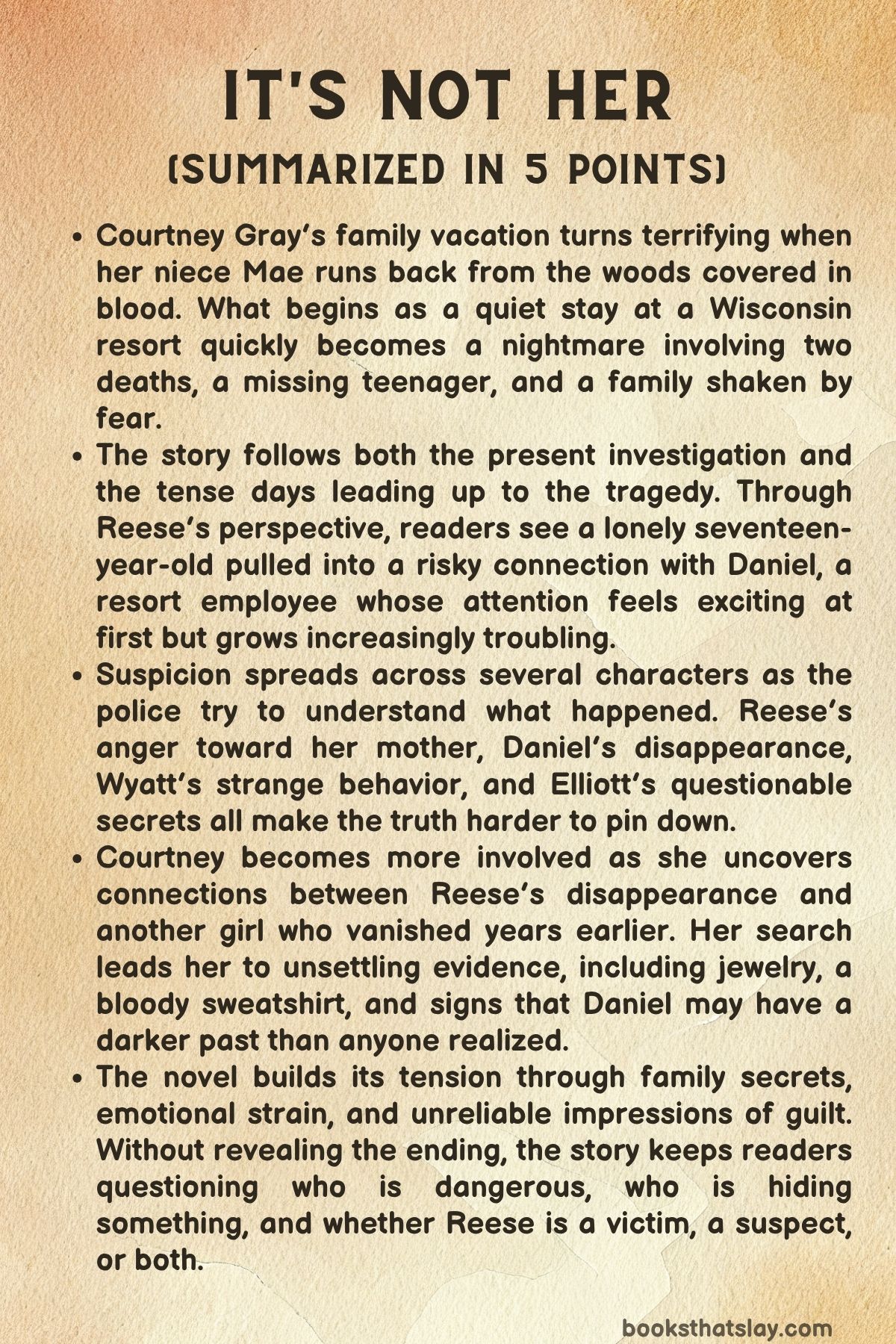
It’s Not Her by Mary Kubica is a tense psychological thriller set during a family vacation at a remote Wisconsin resort. The story begins with a shocking double murder and a missing teenager, then moves between the aftermath of the crime and the days leading up to it.
Through Courtney, an aunt trying to protect the surviving children, and Reese, a lonely seventeen-year-old drawn into danger, the book explores family strain, suspicion, manipulation, and fear. Kubica builds the mystery through small unsettling details, making every person at the resort seem capable of hiding something.
Summary
Courtney Gray is staying with her family at a rental cottage in the Northwoods of Wisconsin when her quiet vacation turns into a nightmare. She is washing dishes when her ten-year-old niece Mae comes running back through the trees in terror.
Mae had just left Courtney’s cottage after a sleepover with Courtney’s daughter Cass, so Courtney is immediately alarmed to see her return in such distress. Mae falls, gets up, and clings to Courtney, unable to explain what has happened.
Courtney notices blood on Mae’s hands and asks whether Mae’s mother, Emily, is at the family’s cottage. Mae nods, but she is too shocked to say more.
Courtney leaves Cass with Mae and hurries to the larger, more private cottage where her sister-in-law Emily is staying with her husband Nolan and their children. Courtney already knows the family vacation has been tense.
Emily and Nolan have been arguing, mainly because Nolan has been out of work for months and their marriage is under pressure. When Courtney reaches their cottage, she finds the front door open, which seems wrong because Emily is usually careful about keeping mosquitoes out.
Courtney calls for Emily, but no one answers. She phones Emily and hears the ringing from the screened porch.
When Courtney steps onto the porch, she sees blood everywhere. Then she sees Emily’s body on the floor.
Emily is dead, badly injured, and surrounded by blood. Courtney barely has time to react before Cass and Mae arrive despite being told to stay away.
Courtney tries to block their view and move them out, realizing that Mae must have already seen her mother and touched her, which explains the blood on her hands. As Courtney gets the girls toward the door, Cass screams.
Courtney turns and sees Nolan’s body at the top of the stairs. He is also dead, with blood on his face.
Terrified that the killer may still be nearby, Courtney runs with the girls back to her cottage. She worries about Emily and Nolan’s older children, Reese and Wyatt.
Cell service is poor, so Courtney decides to take Cass and Mae to the lodge, where there is Wi-Fi and a landline. At the lodge, they find Greta Dahl, who works at the resort, along with a man at the bar who makes Courtney uneasy.
Courtney tells Greta that Emily and Nolan are dead, and Greta calls the police.
As they wait, Mae vomits, Cass breaks down, and Courtney tries to contact her husband Elliott, who is out fishing. When the police arrive, they bring Wyatt with them.
He had been found asleep upstairs in the cottage, apparently drugged by Benadryl that Emily had given him the night before. Reese, Emily and Nolan’s seventeen-year-old daughter, is missing.
The story then shifts to the days before the murders through Reese’s point of view. Reese is angry about being forced to join the family vacation.
She feels trapped by her parents’ fighting, hurt by her friend Skylar’s distance, and constantly judged by Emily. At the resort, Reese meets Daniel, a handsome employee with a snake tattoo.
Daniel notices her, flirts with her, and makes her feel seen in a way she desperately wants. Reese becomes obsessed with him quickly.
Daniel begins meeting Reese in secret. He follows her, gives her weed, takes her into the woods, and brings her to an old cemetery.
Reese finds the attention exciting, but Daniel’s behavior is also troubling. Mae later says she heard Reese scream and cry when Daniel was inside the cottage, saying he was hurting and scaring her.
Daniel is older than Reese, though she does not fully understand the danger at first. His charm, attention, and secrecy make him seem thrilling to her, especially because she feels ignored and criticized by everyone else.
In the present, Detective Evans begins questioning Courtney, Wyatt, and Mae. Suspicion spreads in several directions.
Reese had fought with Emily and once said she wished her mother were dead, so police cannot rule her out. Daniel has disappeared from work and is revealed to be twenty-four, not the harmless young employee Reese may have imagined him to be.
Elliott also becomes a concern because Courtney cannot be completely sure where he was during the night. Her anxiety deepens when she finds disturbing photos of Reese in a bikini on Elliott’s iPad, making her wonder what he may have been hiding.
Police use Reese’s Snapchat location to organize a search in the woods. Courtney joins the volunteers and meets Joanna and Sam Matthews, whose daughter Kylie vanished years earlier in the same area.
During the search, someone notices what looks like hair in the grass. Courtney fears they have found Reese’s body, but it turns out to be animal remains.
The search ends without Reese. Emily and Nolan are confirmed to have been murdered by blunt force trauma, and Daniel becomes a stronger person of interest because of his disappearance and his secret connection to Reese.
As the earlier timeline continues, Reese grows more attached to Daniel. She examines herself in the mirror, thinking about her appearance and replaying his attention.
Emily interrupts her, making Reese feel judged again. At the pool, Courtney compliments Reese’s pink sweatshirt, but Emily criticizes Reese for cutting it up.
Reese feels embarrassed and resentful. Daniel appears nearby and stares at her in a way Emily notices.
Emily questions Reese, but Reese denies knowing him.
Daniel signals for Reese to follow him, and they meet behind the pool house. He complains that Emily is watching her, kisses Reese, and says he cannot stop thinking about her.
He asks her to meet him later that night at the pier. Reese sneaks out after paying Wyatt to stay quiet.
Daniel is waiting for her. Reese mentions the flower he left on her bed, which means he entered the cottage while the family was away.
Instead of being frightened, Reese is flattered. Daniel gives her beer and a gold beaded necklace.
He tells her he is obsessed with her and thinks he could fall in love with her. Reese, desperate to feel chosen, kisses him and stays with him until dawn.
Back in the present, Courtney remains stuck at the resort with Elliott and the children while the investigation continues. Detective Evans tells her that police found a bloody knife in Emily and Nolan’s cottage.
The blood and fingerprints on it do not belong to the victims, so everyone must provide elimination fingerprints. Emily and Nolan’s phones have been found, but Reese’s phone cannot be tracked if it is dead or switched off.
Courtney worries that Reese may be in danger, but she also cannot ignore the possibility that Reese may know more than anyone realizes.
Courtney visits Joanna and Sam Matthews to learn about Kylie’s disappearance. Joanna explains that Kylie vanished five years earlier while biking home from a friend’s house.
Sam became obsessed with investigating what happened to her. Courtney notices that Kylie wore a gold beaded necklace in a family photo.
It looks like the necklace Daniel gave Reese. Joanna shows Courtney Kylie’s untouched room and Sam’s box of evidence, including photos of the house where Kylie was last seen.
Courtney realizes that house had a green shed, and she later learns that Daniel Clarke lives directly across the street from it.
Courtney goes alone to Daniel’s house. She finds the back door partly open and lets herself inside.
The house is filthy, dark, and smells bad. The television has been left on, and items are scattered around.
In Daniel’s bedroom, Courtney finds expensive women’s jewelry and Reese’s pink sweatshirt under the bed. There is blood on the sleeve.
Before she can escape, she hears someone arrive and sees a gun pointed at her. It is Detective Evans, not Daniel.
Evans warns Courtney that breaking into Daniel’s house could damage the investigation, but he does take the sweatshirt as evidence. Outside, he notices bruises on Courtney’s face and asks about them.
Courtney admits Wyatt hit her while supposedly sleepwalking. Evans points out problems with Wyatt’s story.
Wyatt claimed he was dreaming about being late for school and looking for lunch, but that does not match the idea that he thought he was fighting an intruder. Evans also says police found no Benadryl, even though Wyatt claimed he had taken it.
In the past, Daniel’s true nature becomes clearer. Elliott catches Reese and Daniel nearly having sex in the woods.
Reese panics and threatens to accuse Elliott of being inappropriate if he tells her parents. Later, Reese sees Daniel flirting with another pretty girl at the resort.
He gives the girl jewelry and repeats the same romantic lines he used on Reese. Reese is crushed and avoids him.
That night Daniel appears outside the porch screen, angry that Reese did not meet him. He insults her, targets her insecurities, and tells her no one thinks she is pretty.
He warns her that she will regret rejecting him. Then he stays outside in the trees, watching the cottage while Reese realizes that the attention she once wanted has become a serious threat.
Characters
In It’s Not Her, the characters are shaped by fear, secrecy, family tension, and the unsettling uncertainty of who can be trusted. Each person in the story contributes to the atmosphere of suspicion, either by becoming a victim, a witness, a possible suspect, or someone whose past or behavior complicates the truth.
Courtney Gray
Courtney Gray is one of the central figures in the book because she becomes the first adult to discover the horrifying aftermath of Emily and Nolan’s murders. Her role begins in an ordinary domestic moment, washing dishes in her family’s rental cottage, which makes the sudden violence feel even more disturbing.
Courtney’s instinctive response to Mae’s panic shows her protective nature, especially as she immediately tries to understand what has happened while also keeping Cass and Mae safe. Her discovery of Emily’s body, followed by Nolan’s, forces her into a position of responsibility before she has time to process her own terror.
Courtney is also important because she is not just a witness; she becomes emotionally and morally entangled in the mystery. Her concern for Reese feels genuine, but her fear grows as evidence begins to point in different directions.
She worries about Daniel, about Reese’s possible involvement, about Wyatt’s strange behavior, and even about Elliott after finding disturbing photos of Reese on his iPad. This makes Courtney a character caught between loyalty and suspicion.
She wants to protect her family, but the book places her in a situation where protecting them may also mean questioning them.
Her character is defined by a mixture of courage, anxiety, and maternal instinct. Courtney repeatedly steps into danger, especially when she goes to Daniel’s house alone, even though that choice is reckless.
Her actions show how desperation can push an ordinary person into investigative behavior. She is not a trained detective, but her emotional connection to the victims and missing girl gives her a strong need to act.
Through Courtney, the story explores how trauma can sharpen fear, distort trust, and force a person to confront uncomfortable truths about the people closest to her.
Reese
Reese is one of the most emotionally complex characters in the story. At seventeen, she is caught between adolescence and adulthood, craving independence while still being deeply vulnerable.
Her anger toward her family, especially her mother Emily, is central to her character. She feels criticized, misunderstood, and trapped by the family vacation.
Her resentment is intensified by her parents’ fighting, her loneliness, and the feeling that people around her either ignore or judge her. These emotions make her especially susceptible to Daniel’s attention.
Reese’s relationship with Daniel reveals her longing to feel seen and desired. When he flatters her, gives her gifts, and claims to be obsessed with her, she interprets his behavior as romance rather than manipulation.
Her insecurity makes his attention powerful, and the book shows how easily predatory behavior can disguise itself as passion to someone desperate for validation. Daniel’s necklace, the secret meetings, the weed, the beer, and the late-night encounters all create a dangerous fantasy for Reese, one that feels exciting to her but increasingly alarming to the reader.
At the same time, Reese is not presented as simple or innocent in every way. She lashes out, threatens Elliott when he catches her with Daniel, and has previously said she wished her mother dead.
These details make her a figure of suspicion as well as sympathy. Her flaws do not erase her vulnerability; instead, they make her more believable.
Reese represents the emotional volatility of adolescence, especially when insecurity, anger, secrecy, and manipulation collide. Her disappearance becomes the emotional center of the mystery because she is both at risk and surrounded by unanswered questions.
Mae
Mae is one of the most tragic child characters in the book because she is directly exposed to violence before she can fully explain or understand it. Her scream in the woods begins the immediate crisis, and the blood on her hands becomes one of the first signs that something terrible has happened.
Mae’s shock, silence, vomiting, and panic all suggest that she has seen something deeply traumatic. She is not merely a witness in the practical sense; she is a child whose body and behavior reveal horror before language can.
Mae’s innocence makes the violence around her even more disturbing. She had only been leaving a sleepover with Cass, which places her in a normal childhood setting moments before everything collapses.
Her inability to clearly explain what happened heightens the suspense, but it also reflects the realistic confusion of a child in shock. She clings to Courtney because Courtney becomes the nearest source of safety after the loss of her mother and father.
Mae also contributes important information about Reese and Daniel. Her later revelation that she heard Reese scream and cry while Daniel was in the cottage changes the emotional meaning of Reese’s relationship with him.
Mae may not understand everything she heard, but her testimony suggests fear, coercion, or violence beneath Daniel’s romantic façade. In this way, Mae’s character quietly helps expose the darker truth behind what Reese thought was love.
Cass
Cass functions as a child caught in the radius of adult violence. She begins the story as Courtney’s daughter and Mae’s sleepover companion, but she is quickly pulled into a nightmare when she follows Courtney and Mae to Emily and Nolan’s cottage.
Her scream after seeing Nolan’s body intensifies the scene’s horror and shows how completely the children’s safety has been shattered.
Cass’s character is important because she reflects the cost of the crime on those who were not directly targeted. She did not seek out danger, yet she becomes a witness to something she should never have seen.
Her panic at the lodge shows that she is not simply a background child; she is emotionally affected by the violence and confusion around her. Through Cass, the story emphasizes that trauma spreads through families, touching even those who are only nearby.
She also strengthens Courtney’s role as a protective mother. Courtney’s decisions are shaped not only by the need to report the murders but also by the need to keep Cass safe.
Cass’s presence raises the stakes because Courtney must think like a witness, aunt, sister-in-law, and mother all at once. Cass may not drive the mystery directly, but she deepens its emotional impact.
Emily
Emily is a victim whose presence remains powerful even after her death. Before the murders, she is shown as careful, critical, and under pressure.
The open door of her cottage feels wrong to Courtney because Emily is normally cautious, even about keeping mosquitoes out. This small detail gives Emily a sense of order and control, making the violent scene on the porch feel even more shocking.
Emily’s marriage to Nolan is strained, largely because of his unemployment and the emotional pressure it has placed on the family. She is also shown as a mother whose relationship with Reese is tense.
Reese experiences Emily as judgmental, especially when Emily criticizes her appearance or choices. Yet Emily’s suspicion of Daniel also suggests that she is perceptive and protective.
When she notices the way Daniel looks at Reese, she senses danger, even though Reese denies knowing him.
Her character is therefore layered. To Reese, Emily can seem controlling and harsh; to Courtney, she is family; to the mystery, she is one of the murdered victims; and to the reader, she is someone whose warnings may have been justified.
Emily’s death removes her voice from the present action, but the conflicts surrounding her continue to shape the story. Her relationship with Reese is especially important because it creates both emotional motive and tragic regret.
Nolan
Nolan is another murder victim, and much of his characterization comes through the stress surrounding his family before his death. His unemployment has placed pressure on his marriage, and his fights with Emily suggest a household already strained before violence enters it.
This makes Nolan part of the domestic tension that surrounds the mystery. His death at the top of the stairs is shocking not only because it confirms a second murder, but also because it suggests the violence was intense and possibly personal.
Nolan’s role is quieter than Emily’s, but he remains significant because his death complicates any simple explanation. If only Emily had been killed, suspicion might more easily fall on someone with anger toward her.
Nolan’s murder broadens the mystery and raises questions about whether the killer intended to eliminate both parents, silence witnesses, or attack the family as a whole. His body also increases Courtney’s fear that the killer could still be nearby and that Reese and Wyatt may also be in danger.
As a father, Nolan is connected to the fractured family dynamic that Reese wants to escape. His presence in the story reflects adult failure and instability, especially the way financial and marital problems affect the children.
Even though he is not explored as deeply as Reese or Courtney, Nolan’s death is essential to the book’s atmosphere of dread and uncertainty.
Wyatt
Wyatt is one of the most suspicious and unsettling characters because his behavior after the murders does not fully make sense. He is found asleep upstairs, apparently drugged, but the later discovery that there is no Benadryl raises serious questions.
His claim that he had taken it becomes unstable, and Detective Evans’s observations make his account even more troubling. The fact that Wyatt later hits Courtney while supposedly sleepwalking adds another layer of unease.
Wyatt’s character works because he occupies an uncertain space between victim, witness, and possible threat. If he was truly drugged or asleep, then he is another child harmed by whatever happened.
But if parts of his story are false, then he may know more than he admits. His dream about being late for school and looking for lunch does not clearly match the idea that he mistook Courtney for an intruder, making his actions harder to dismiss.
He also represents the hidden instability inside the family. While Reese’s anger is visible and dramatic, Wyatt’s danger is quieter and stranger.
The bruises on Courtney’s face force the reader to consider whether violence in the story is limited to the obvious suspects or whether it may also come from within the family in less expected ways. Wyatt’s ambiguity makes him one of the book’s most unsettling figures.
Daniel Clarke
Daniel Clarke is one of the most dangerous characters in the story because he presents manipulation as romance. At first, he appears to Reese as handsome, exciting, and attentive.
His snake tattoo, flirtatious behavior, secret meetings, gifts, and intense declarations create the image of someone mysterious and desirable. To Reese, he seems like the first person who truly notices her.
To the reader, his behavior quickly becomes predatory.
Daniel’s age is crucial. He is twenty-four, while Reese is seventeen, which turns his pursuit of her into a troubling imbalance of power and maturity.
He follows her, meets her secretly, gives her weed and alcohol, enters her cottage, leaves gifts on her bed, and isolates her emotionally. These actions are not romantic gestures; they are signs of control.
His repeated use of the same lines and jewelry with another girl reveals that Reese is not special to him in the way he claims. He uses attention as a tool.
His darker side becomes clearer when Reese pulls away. He mocks her insecurity, says cruel things about her appearance, threatens her, and watches her from the trees.
This shift exposes the possessiveness beneath his charm. Daniel’s connection to Kylie’s disappearance through the necklace and his location near Abby’s house makes him even more sinister.
In It’s Not Her, Daniel embodies the danger of a predator who knows exactly how to exploit loneliness, insecurity, and the desire to be loved.
Elliott
Elliott is a deeply uncomfortable character because he is close to Courtney and the children, yet his behavior raises suspicion. His absence while fishing during the murders creates uncertainty about his whereabouts, and Courtney’s discovery of disturbing photos of Reese on his iPad makes him difficult to trust.
Even if his exact role in the crime is unclear, the photos create a moral shadow around him.
His encounter with Reese and Daniel in the woods also complicates him. On one level, Elliott catches them in a compromising and dangerous situation, which could have made him a protective adult.
However, Reese’s threat to accuse him of being inappropriate if he tells her parents reveals the unstable power dynamics around him. The later discovery of Reese’s photos makes that threat feel even more disturbing because it suggests that Elliott may already have crossed boundaries in private.
Elliott’s importance lies in how he affects Courtney’s trust. Courtney is not only afraid of an outside killer; she is forced to wonder whether her own husband is connected to something shameful or dangerous.
His character therefore turns the mystery inward. He represents the fear that danger may not come only from strangers like Daniel, but also from familiar people who seem safe.
Detective Evans
Detective Evans serves as the main figure of official investigation, but he is not merely a procedural presence. He questions Courtney, Wyatt, and Mae, and he introduces important evidence, including the bloody knife with unknown fingerprints and blood.
His role is to give structure to the chaos, but he also increases the tension by pointing out contradictions that others might prefer to ignore.
Evans is especially important in his interactions with Courtney. When he finds her inside Daniel’s house, he warns her that her actions could compromise evidence.
This shows him as practical and professionally focused, but not dismissive. He notices her bruises and asks questions, which suggests that he is attentive to details beyond the obvious crime scene.
His skepticism about Wyatt’s account also shows that he is willing to consider uncomfortable possibilities.
As a character, Evans represents reason inside a story filled with panic, grief, and emotional suspicion. He does not simply accept convenient explanations.
His presence pushes the investigation away from fear-based assumptions and toward evidence. At the same time, his discoveries often make the situation feel more frightening because each fact opens another possibility rather than closing the case.
Greta Dahl
Greta Dahl is a smaller but useful character because she connects Courtney to outside help at the lodge. When Courtney cannot get cell service, the lodge becomes the place where the horror is finally reported, and Greta is the person who calls the police.
Her presence brings a brief sense of order into the chaos.
Although Greta is not developed as deeply as the family members, her role matters because she belongs to the resort environment. She is part of the setting that initially seems like a vacation space but gradually becomes threatening.
The fact that Courtney encounters Greta alongside a suspicious man drinking at the bar adds to the uneasy atmosphere. Even ordinary resort workers and guests begin to feel potentially relevant because the killer’s identity is unknown.
Greta’s function is practical, but she also helps show Courtney’s isolation. Courtney has to leave the cottages and seek someone with access to communication.
Greta becomes the bridge between private family horror and official public response. Her character reinforces how remote and vulnerable the resort feels.
Joanna Matthews
Joanna Matthews is a grieving mother whose past loss mirrors Courtney’s present fear for Reese. Her daughter Kylie disappeared years earlier near the same area, and Joanna’s life has clearly been shaped by that unresolved trauma.
Through Joanna, the story expands beyond the immediate murders and suggests that the location may hold older dangers.
Joanna’s preservation of Kylie’s room is especially revealing. It shows a mother unable or unwilling to fully move on because there has been no closure.
The untouched room becomes a physical expression of grief, hope, and denial. Joanna is not simply a source of information; she is an emotional warning of what Courtney and the family could become if Reese is never found.
Her character also helps Courtney connect Kylie’s disappearance to Daniel. The family photo showing Kylie with a beaded gold necklace becomes crucial because Reese has a similar necklace.
Joanna’s grief therefore becomes part of the investigation. She represents the long-term devastation left behind when a young girl vanishes and the truth remains hidden.
Sam Matthews
Sam Matthews is another figure shaped by Kylie’s disappearance, but his grief takes a more investigative form. He becomes obsessed with gathering evidence, keeping a shoebox of materials related to the case.
His fixation shows how unresolved loss can turn into a private search for answers when official answers are not enough.
Sam’s character contrasts with Joanna’s. While Joanna preserves Kylie’s room, Sam preserves clues.
Both responses come from grief, but they reveal different ways of surviving the same trauma. Sam’s evidence, including photos connected to Abby’s house, becomes important because it helps Courtney realize that Daniel lives across the street from a key location in Kylie’s disappearance.
He also adds depth to the book’s atmosphere of long-standing menace. Sam’s obsession suggests that the danger surrounding Reese may not be new.
His character helps connect the present mystery to a pattern, making Daniel’s possible involvement feel more chilling. Sam is a reminder that some crimes do not end when the search stops; they continue to consume the people left behind.
Kylie Matthews
Kylie Matthews is absent from the present action, but her disappearance haunts the story. She vanished years earlier while biking home from a friend’s house, and her case becomes a disturbing parallel to Reese’s disappearance.
Like Reese, Kylie appears to have been a young girl whose life was interrupted by hidden danger in a place that should have been safe.
Kylie’s importance grows through objects and memory. The beaded gold necklace in her family photo becomes a possible link to Daniel, especially when similar jewelry appears in Reese’s possession and in Daniel’s house.
This transforms Kylie from a past tragedy into a key part of the present mystery. Her absence carries evidentiary weight.
As a character, Kylie represents the silent victims who remain powerful because of what happened to them. She does not speak in the story, but the grief surrounding her shapes Joanna, Sam, and Courtney’s understanding of the danger.
Her disappearance suggests that Reese’s situation may be part of something larger and more sinister than one family’s tragedy.
Skylar
Skylar is a minor but important figure in Reese’s emotional world. Reese feels hurt because Skylar is ignoring her, and that rejection contributes to her loneliness during the vacation.
Although Skylar does not appear as a major active presence, her absence helps explain Reese’s state of mind.
For a teenager like Reese, being ignored by a friend can feel devastating, especially when combined with family conflict and insecurity. Skylar’s distance leaves Reese more emotionally exposed.
This makes Daniel’s attention feel even more powerful because it arrives when Reese already feels unwanted and unseen.
Skylar’s role shows that vulnerability does not come from one source alone. Reese is not drawn to Daniel only because of her parents or only because of her insecurity.
She is affected by several emotional wounds at once, and Skylar’s rejection is one of them. In that sense, Skylar matters because she helps explain why Reese is so hungry for validation.
Abby
Abby is a minor character connected to Kylie’s disappearance. Her house is important because Kylie was last seen near it, and the detail of the green shed helps Courtney make a connection to Daniel’s location.
Abby herself is not deeply characterized, but her home becomes part of the mystery’s geography.
The importance of Abby lies in how ordinary details become meaningful after a disappearance. A house, a shed, and a street become clues because they are tied to the last known movements of a missing girl.
Abby’s connection to Kylie’s final known route helps bridge the old case with the present one.
Although Abby does not dominate the story, she contributes to the investigative pattern. Her presence reminds the reader that mysteries are often solved through small, overlooked details.
In the larger structure of the book, Abby’s house helps Courtney see that Daniel may be connected not only to Reese but also to Kylie.
Themes
The Danger of Being Desperate to Feel Chosen
Reese’s attraction to Daniel grows out of a deep hunger to be seen, admired, and valued. She feels criticized by her mother, ignored by her friend, and trapped in a family where conflict has become normal.
Daniel senses this weakness and uses it. His compliments, gifts, secret meetings, and intense attention make Reese feel special, but they are also tools of control.
What looks to her like romance quickly becomes manipulation. He enters private spaces, gives her alcohol and weed, watches her, pressures her, and then turns cruel when she pulls away.
The theme becomes especially painful because Reese is not foolish; she is lonely, insecure, and young. It’s Not Her shows how emotional need can make danger appear exciting, especially when someone mistakes possession for love.
Daniel’s behavior exposes the difference between genuine affection and predatory attention, while Reese’s response reveals how easily a person can accept harm when it arrives disguised as desire.
Family Strain and the Secrets Hidden Behind Ordinary Life
The families at the resort appear to be on vacation, but the setting hides tension, resentment, fear, and secrecy. Emily and Nolan’s marriage is already under pressure because of money, unemployment, and constant fighting.
Reese carries anger toward her mother and feels misunderstood in her own home. Courtney’s family also becomes unstable as Elliott’s behavior raises suspicion and the disturbing photos on his iPad make her question what kind of man she has been living with.
Even Wyatt’s strange actions create uncertainty inside the family circle. The murders do not create the fractures; they expose the ones already present.
The rental cottages, shared meals, poolside conversations, and family routines suggest normalcy, yet beneath them are mistrust, resentment, and emotional distance. The story uses this contrast to show that danger is not always outside the home.
Sometimes the most unsettling truths are already inside familiar relationships, waiting for crisis to reveal them.
Suspicion, Uncertainty, and the Collapse of Trust
After Emily and Nolan are found dead and Reese disappears, almost every person becomes a possible threat. Courtney cannot fully trust Daniel, Elliott, Reese, Wyatt, or even her own interpretation of events.
The bloody knife, the missing phone, the unexplained fingerprints, the drugging claim, and the photos on Elliott’s iPad all deepen this uncertainty. The investigation does not move in a straight line; each discovery shifts suspicion somewhere else.
This theme is powerful because Courtney is not simply solving a crime from a distance. She is protecting children, grieving, afraid, and forced to question people close to her.
Trust breaks down because evidence keeps pointing in different directions, and emotional loyalty becomes harder to separate from fear. It’s Not Her uses this confusion to show how trauma changes perception.
Once violence enters a family space, every silence, memory, and inconsistency begins to feel dangerous, and even loved ones can become strangers.
Violence Against Girls and the Fear of Repeated Patterns
Kylie’s earlier disappearance gives Reese’s situation a larger and darker meaning. What first seems like one family’s tragedy begins to echo an older wound in the same area.
Joanna and Sam’s grief shows the lasting damage caused when a girl vanishes and answers never come. The gold necklace connects Kylie and Reese in a disturbing way, suggesting that Daniel may not be only a threat in the present but part of a pattern of targeting vulnerable girls.
This theme adds moral weight to the mystery because the danger is not limited to one violent night. It reflects how young women can be watched, groomed, used, and then dismissed or blamed.
Reese’s insecurity makes her vulnerable, but the responsibility remains with the adult who exploits her. The story also shows how families left behind become trapped in unanswered questions.
Kylie’s untouched room and Sam’s collected evidence reveal grief that has hardened into obsession because justice has not arrived.