More Than Enough Summary, Characters and Themes
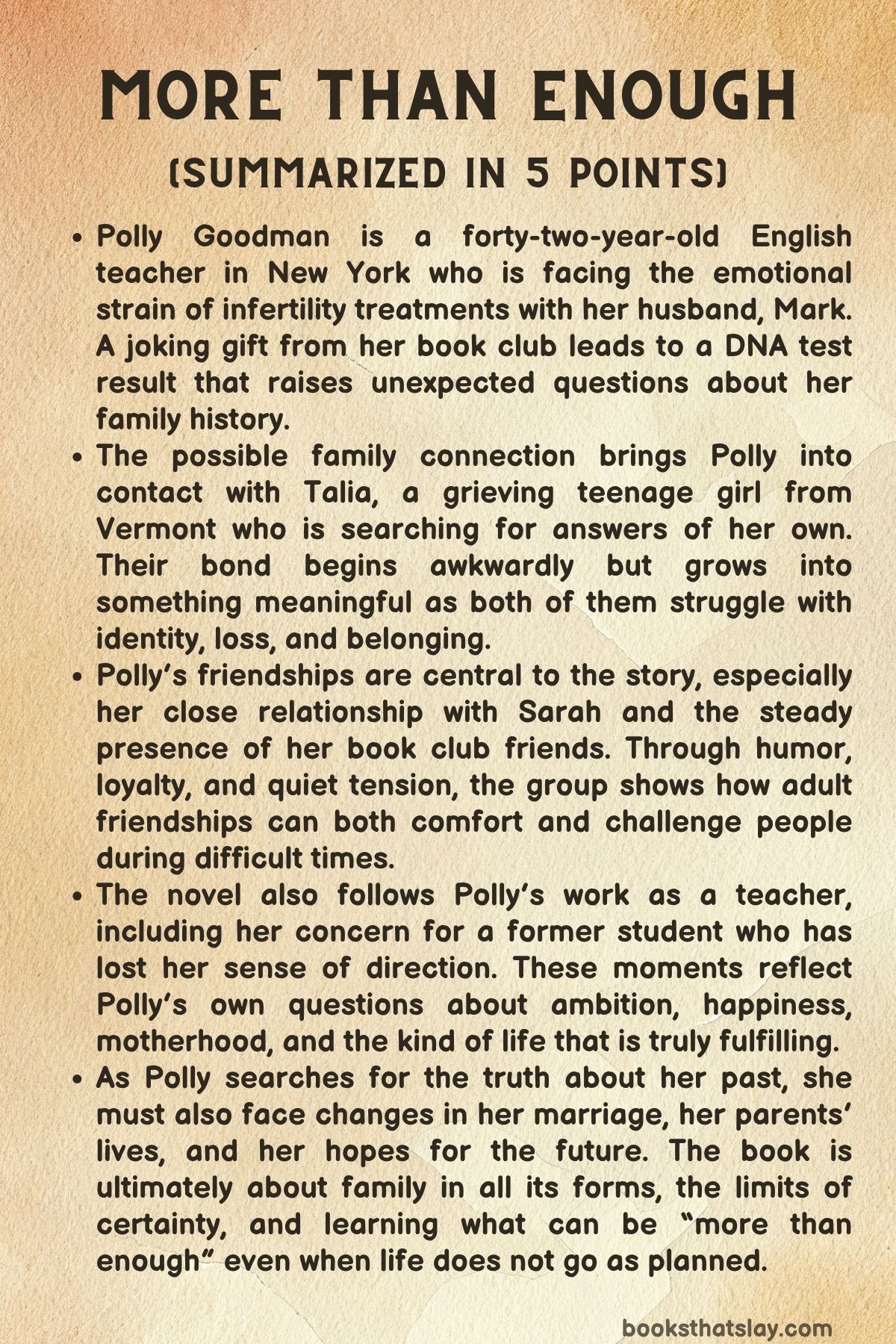
More Than Enough by Anna Quindlan is a contemporary family drama about identity, motherhood, friendship, and the difficult question of what makes a family real. The story follows Polly Goodman, a New York English teacher in her early forties, whose life is already strained by infertility treatments, her father’s dementia, and an emotionally complicated marriage.
When a DNA test reveals an unexpected relative, Polly is pulled into a search that changes how she understands her parents, herself, and the people she loves. The novel is intimate, reflective, and centered on ordinary lives altered by secrets, illness, grief, and late discoveries.
Summary
Polly Goodman is a forty-two-year-old English teacher in New York, married to Mark, a gentle and often distracted veterinarian who works with large animals at the Bronx Zoo. Their marriage is loving but strained by a long and painful attempt to have a child.
Fertility treatments have taken over much of Polly’s emotional life, making her think constantly about genetics, inheritance, motherhood, and what kind of future may still be possible for her.
At a birthday gathering with her book club friends Sarah, Helen, and Jamie, Polly receives a Roots & Branches DNA test as a joke. The gift is meant to be lighthearted, but Polly takes it seriously.
Because she has become increasingly anxious about family history and biological risk, she sends in the test. When the results arrive, they disturb her.
The company says she has a second-degree relative in its database. Polly had promised her friends she would report back about the results, but instead she hides the printout in her tote bag and keeps the information to herself.
Polly first talks to Mark, who thinks the result may not mean much and questions whether the test is accurate. She then speaks with her brother, Garrison.
Since a second-degree relative could be a niece or nephew, Polly asks if he might have fathered a child. Garrison, who is gay, says no, and he is sure the company has made a mistake.
The two siblings think through possible explanations: an unknown uncle, a secret child of one of their parents, or a faulty match. They also remember finding birth photographs when they were young, which convinces them that neither of them was adopted.
Life continues while Polly carries the mystery. She teaches her final classes of the school year, thinks about her failed first marriage to Benedict, and remembers how Sarah introduced her to Mark.
Mark, in his own quiet way, shows love through action. After helping deliver a breech zebra foal at the zoo, he leaves Polly two stuffed zebras as a tender message.
The gesture matters to Polly because Mark often seems absentminded, yet he can still reach her with kindness.
Soon Polly receives an email from Roots & Branches saying someone wants to contact her. The person is Talia Burton, a teenage girl from near Bennington, Vermont.
Talia says she loves fashion design and animals and hopes one day to live in New York. Polly visits her father, Jack, who has dementia and lives at Edgemere, to ask whether the family knows anyone in Vermont or anyone named Burton.
Jack is not able to help. His memory is fading, and Polly’s questions only underline how much of him is already slipping away.
Polly eventually drives to Vermont to meet Talia at a pie shop called Pie Is Infinite. Talia is Black or biracial, and Polly quickly understands that the girl had expected a connection to her late mother’s side of the family.
Talia is disappointed when Polly, a white woman, arrives. She admits she is only sixteen, not twenty-one as the DNA site required, and explains that her mother died in January.
Talia had hoped Polly might be a missing aunt or maternal relative who could help her understand where she came from. Polly cannot give her the answer she wanted, but she feels drawn to the girl and begins to care about her.
Polly later tells Sarah, Helen, and Jamie what has happened. Jamie is angry at the DNA company, Helen wonders whether the match still points to a real family link, and Sarah thinks first of Talia’s pain.
Polly keeps emailing Talia, especially about the girl’s clothing designs, and the relationship continues even though the truth is unclear.
Talia’s father, Stephen Burton, later contacts Polly and meets her in New York. He apologizes for Talia’s behavior and tells Polly about Talia’s mother, Marguerite.
Marguerite had been adopted from Ghana by a religious white family in Nebraska. She grew up feeling cut off from her origins and spent much of her life searching for identity and family.
After Talia was born, and after several miscarriages, Marguerite’s mental health worsened. She eventually died by suicide.
As Stephen speaks, Polly notices that he has the same unusual pointed ears she has. This makes her suspect that the DNA connection may come through Stephen, not through Marguerite.
Polly’s search continues. She drives with Sarah to Barbara Burton’s alpaca farm, wondering whether Barbara might somehow be part of her biological family.
Barbara already knows about Polly because of Talia. She tells Polly clearly that they are not related and that she is not Polly’s mother.
But Barbara, who believes herself to be a healer, also gives Polly an unsettling warning: Sarah should see a doctor soon. Polly is unsure whether to tell Sarah, afraid of sounding foolish but also afraid of ignoring something important.
Meanwhile, Polly and Mark’s fertility treatments become more discouraging. Dr. Betz tells them their options are narrowing and that further attempts may not work.
Surrogacy, donor eggs, embryo donation, and adoption are mentioned, but Polly cannot make herself feel ready for any of them. After the appointment, she breaks down in a restaurant, overwhelmed by the possible end of her hope for a child.
Her grief is not only about pregnancy, but about the version of life she had imagined for herself.
Polly also becomes involved again with Josephine, a former star student who has fallen apart emotionally after leaving Harvard. Josephine’s mother asks Polly for help, and Polly visits the young woman at a treatment facility called The Refuge.
Josephine explains that she had been forced onto a path shaped by her ambitious father and that she wanted joy rather than a life built around status and misery. Polly encourages her by sharing that she herself once walked away from a more prestigious academic path to teach high school because teaching made her happier.
Sarah later tells Polly that Barbara contacted her directly with the same warning. Sarah did go to the doctor, and the scans revealed serious complications from her earlier breast cancer, including lesions affecting her brain.
Sarah tells Polly that she is very sick and that nothing more can be done. She asks Polly to tell only Mark and to keep the book club from turning her illness into a “pity party.” Polly tries to protect Sarah’s wishes, but Jamie eventually senses that Sarah is sick again.
During a violent storm, a tree crashes into the home of Mark’s parents, Lou and Skipper, badly damaging the house. Sarah offers them her Connecticut cottage while repairs are made.
Lou and Skipper move in and grow attached to the place. Sarah, though weakening, remains generous and graceful, continuing to care for others even as her own life is ending.
Polly’s family mystery finally leads her to Andre Bettman, a woodworker. She begins to understand that Andre may be the missing link.
Polly confronts her mother, Judge Mary Goodman, and explains everything she has discovered. Mary first insists that Jack Goodman is Polly’s father in every way that matters.
Polly presses her about Andre, and at last Mary admits that she has only now understood that Polly was probably the result of her affair with Andre.
The revelation changes Polly’s sense of herself, but it does not erase the life she has lived. Jack, despite his dementia, remains the father who raised her.
Garrison remains her brother. Yet Polly now has another truth to carry, one that connects her search for Talia’s family to her own hidden origin.
Sarah dies peacefully in her sleep in her garden. She has arranged for there to be no funeral or memorial.
Carter, her stepson, meets Polly at the cottage, and Polly learns that Sarah has left the house to her. Polly walks through Sarah’s rooms and garden, feeling the weight of the gift and the depth of her loss.
Later, Polly and Mark spend Christmas Eve in the country house that still feels like Sarah’s. Around this time, after so much fear and disappointment, Polly discovers she is pregnant.
She plans to tell Garrison and eventually her mother. She also continues visiting Jack at Edgemere, where his memory is worsening, though he still briefly recognizes her.
By the end, Polly has lost Sarah, learned the truth about her biological father, and found an unexpected path toward motherhood. More Than Enough closes on a life reshaped by grief and surprise, but also by love that survives beyond blood, certainty, and loss.
Characters
Polly Goodman
Polly Goodman is the central character in More Than Enough, and her journey is shaped by uncertainty, longing, grief, and a deep need to understand where she belongs. At forty-two, she is living through the emotional exhaustion of infertility treatment while also trying to maintain her work, marriage, friendships, and family responsibilities.
Her DNA test result unsettles her because it opens a mystery at the exact moment when she is already preoccupied with genetics, inheritance, and motherhood. Polly is thoughtful and observant, but she is also private, often carrying emotional burdens quietly before sharing them with others.
Her connection with Talia reveals her tenderness and capacity for attachment, even when the relationship begins with confusion and disappointment. Polly’s search for biological truth is not simply curiosity; it reflects her larger struggle to understand identity, parenthood, and the meaning of family.
By the end of the story, her discovery about Andre Bettman, Sarah’s death, her father’s decline, and her own pregnancy all come together to make her life feel both broken open and newly possible.
Mark
Mark, Polly’s husband, is kind, gentle, and dependable, though sometimes emotionally absent in a way that frustrates Polly. As a large-animal veterinarian at the Bronx Zoo, he is most alive when caring for animals, and his work gives him a quiet dignity.
His successful delivery of the breech zebra foal shows his competence, patience, and instinctive tenderness. In his marriage, Mark is loving but not always fully tuned in to Polly’s inner turmoil, especially as she moves through infertility and the DNA mystery.
Still, he offers steadiness, and his small gestures, such as leaving the stuffed zebras, show that he expresses affection through actions more than speeches. Mark represents a form of love that is imperfect but loyal, grounded in daily presence rather than dramatic declarations.
Sarah
Sarah is one of the most emotionally powerful characters in the book because she combines generosity, wit, loyalty, and quiet suffering. She is wealthy and stylish, but her money never defines her as much as the way she uses it to care for others.
She gives gifts freely, offers her cottage to Mark’s parents after the storm damage, and later leaves that cottage to Polly, making her generosity both practical and deeply personal. Sarah’s illness gives her character a tragic grace.
She refuses to let her friends turn her life into a spectacle of pity, yet she does not become cold or distant. Her death in the garden feels deeply connected to who she is: composed, private, and surrounded by the beauty she helped create.
Sarah’s friendship with Polly is one of the emotional anchors of the story, and her absence leaves behind both grief and inheritance.
Helen
Helen is part of Polly’s book club circle and serves as one of the voices of reason and curiosity within the group. Unlike Jamie, who reacts with anger toward the DNA company, Helen remains open to the possibility that there may be a real genetic explanation behind the unexpected result.
This makes her thoughtful and analytical, someone who does not dismiss mystery too quickly. Helen’s role is quieter than Sarah’s or Polly’s, but she helps show the importance of female friendship in the story.
Through her, the book club becomes more than a social group; it becomes a place where secrets, fears, and emotional shocks are gradually absorbed.
Jamie
Jamie is direct, emotional, and protective. Her outrage at the DNA company after Polly reveals the situation shows her instinct to defend her friend and condemn anything that causes harm.
Jamie is not as restrained as Sarah or as contemplative as Helen; she responds strongly and openly. This makes her an important part of the friendship group because she says what others may only think.
Later, when she guesses that Sarah is sick again, her perception shows that she is more emotionally aware than she may first appear. Jamie brings energy and honesty to the circle, and her reactions often reveal the emotional stakes of what the others are trying to manage quietly.
Garrison
Garrison, Polly’s brother, is important because he represents the family identity Polly has always assumed to be stable. When Polly asks whether he might have had a child, his response helps narrow the mystery but also shows how strange and uncomfortable the DNA discovery is for both siblings.
His being gay becomes relevant to Polly’s first attempt to explain the possible second-degree relative, but his real significance lies in his shared history with Polly. Their memory of discovering birth photographs reassures them that neither was adopted, yet that reassurance does not solve the deeper question of Polly’s biological origins.
Garrison stands as part of the family Polly knows, even as she begins to realize that family truth may be more complicated than she believed.
Jack Goodman
Jack Goodman, Polly’s father, is a tender and sorrowful presence in the story. His dementia means that he can no longer fully answer Polly’s questions or help her understand the past.
This makes Polly’s search more painful because one of the people who might have offered emotional grounding is slipping away. Even so, Jack remains Polly’s father in a deeply meaningful sense.
His decline creates a contrast between biological truth and lived parenthood: whether or not he is Polly’s biological father, he is the man who raised her and belongs to her emotional history. His brief moments of recognition are moving because they remind Polly of what is being lost and what still remains.
Judge Mary Goodman
Judge Mary Goodman is controlled, formidable, and guarded. As Polly’s mother, she carries authority not only through her professional identity as a judge but also through the power she has held over family truth.
Her initial insistence that Jack Goodman is Polly’s father in every meaningful way reveals both defensiveness and conviction. She seems to believe that parenthood is defined by life, loyalty, and history rather than biology alone.
However, when Polly presses her about Andre Bettman, Mary is forced into a realization she may not have fully allowed herself to face. Her admission that Polly was probably the result of her affair with Andre reshapes the family story.
Mary is not presented simply as deceptive; she is complicated, proud, and human, someone whose past choices return with consequences she can no longer control.
Talia Burton
Talia Burton is a teenager marked by grief, longing, and a desperate need for connection. Her decision to use the DNA site despite being underage shows both impulsiveness and emotional urgency.
Having lost her mother, she hopes Polly might be a missing link to her maternal family, and her disappointment when Polly turns out to be white reveals how deeply she had imagined a different kind of reunion. Talia is creative, especially through her interest in fashion design, and she dreams of New York as a place where she might become herself.
Her relationship with Polly begins in misunderstanding but grows into something meaningful because both characters are searching for family in different ways. Talia’s role in More Than Enough is not only to launch the mystery but also to reveal how grief can make people reach toward strangers with hope.
Stephen Burton
Stephen Burton is Talia’s father and one of the keys to the genetic mystery. He appears responsible, apologetic, and protective when he contacts Polly after Talia’s meeting with her.
His explanation of Marguerite’s life gives emotional depth to Talia’s family background and helps Polly understand the pain behind Talia’s search. Stephen is also significant because his unusual pointed ears suggest that the DNA connection may come through him rather than through Talia’s mother.
This detail quietly redirects the mystery and connects Polly’s search to Andre Bettman. Stephen’s character carries his own grief: he has lost his wife, is raising a grieving daughter, and must manage the aftermath of Marguerite’s suffering.
He is not dramatic, but his presence deepens the book’s exploration of family, inheritance, and loss.
Marguerite Burton
Marguerite Burton is dead before much of the central action unfolds, but her absence shapes Talia and Stephen profoundly. Adopted from Ghana by a religious white family in Nebraska, she grows up disconnected from her origins, and this disconnection becomes a lasting wound.
Her search for identity mirrors Polly’s later search, though Marguerite’s pain is more devastating and unresolved. After Talia’s birth and several miscarriages, her mental health worsens, and her death by suicide leaves Talia with grief and unanswered questions.
Marguerite represents the emotional cost of being cut off from one’s roots. Through her, the story explores adoption, race, motherhood, depression, and the hunger to know where one comes from.
Barbara Burton
Barbara Burton is mysterious, unsettling, and strangely perceptive. As the owner of the alpaca farm and Talia’s grandmother, she is connected to the Burton family but denies being related to Polly or being Polly’s mother.
Her role becomes more unusual when she describes herself as a healer and warns that Sarah should see a doctor. Whether the warning is intuition, coincidence, or something more spiritual, it adds an eerie layer to the story.
Barbara’s calm certainty contrasts with Polly’s uncertainty. She helps close off one possible path in the family mystery while opening another kind of mystery through her warning about Sarah.
Josephine
Josephine is a former star student whose breakdown after leaving Harvard reflects the pressure of achievement without joy. She is intelligent and capable, but she has been pushed onto a path shaped by ambition, expectation, and her father’s plans rather than her own desires.
Her time at The Refuge shows her attempt to recover from a life that looked successful from the outside but felt unbearable within. Josephine’s conversations with Polly are important because they allow Polly to reflect on her own choices.
Polly once left a more prestigious academic path to teach high school because teaching made her happy, and this becomes a meaningful lesson for Josephine. Josephine’s character shows that success can become a trap when it is disconnected from self-knowledge.
Josephine’s Mother
Josephine’s mother is a concerned and somewhat desperate parent who turns to Polly for help when her daughter collapses emotionally. Her role is brief but important because she recognizes that Polly may be able to reach Josephine in a way others cannot.
She represents parental worry, but also the limits of parental understanding. By asking Polly to intervene, she acknowledges that Josephine needs more than pressure, status, or conventional success.
Her presence helps bring Josephine’s crisis into Polly’s life and allows Polly to act as a mentor outside the classroom.
Josephine’s Father
Josephine’s father is mostly seen through the impact of his ambition on his daughter. He represents the kind of parent who mistakes achievement for happiness and direction for love.
His plans for Josephine create a life that appears impressive but feels suffocating to her. Although he is not developed as fully as other characters, his influence is crucial because Josephine’s collapse is partly a rejection of the future he imagined for her.
He stands as a contrast to Polly’s more humane understanding of education, which values joy, purpose, and emotional survival over prestige.
Benedict
Benedict, Polly’s first husband, belongs to her past and helps explain the life she has moved beyond. His presence in Polly’s memories shows that her marriage to Mark was not her first attempt at building a settled adult life.
Benedict functions less as an active force in the present and more as a reminder of earlier mistakes, earlier versions of Polly, and the ways people change between one marriage and another. Through him, the story suggests that love and partnership are not fixed achievements but experiences shaped by timing, maturity, and self-understanding.
Dr. Betz
Dr. Betz represents the clinical reality of Polly and Mark’s infertility struggle. While Polly’s desire for a child is emotional and deeply personal, Dr. Betz must speak in terms of options, chances, and limits.
When Dr. Betz tells Polly and Mark that their possibilities are narrowing, the conversation becomes one of the most painful moments in Polly’s journey. Surrogacy, donor eggs, embryo donation, and adoption are all presented, but none feels simple to Polly.
Dr. Betz is not cruel; rather, the character embodies the hard medical facts that cannot be softened enough to protect Polly from grief.
Lou
Lou, Mark’s parent, becomes more visible after the storm damages the family house. The move to Sarah’s Connecticut cottage places Lou within the wider network of care that surrounds Polly and Mark.
Lou’s presence helps show that family life is not limited to biological mysteries or parent-child longing; it also includes aging parents, damaged homes, temporary refuge, and practical acts of kindness. Through Lou, the story expands the meaning of dependence and belonging.
Skipper
Skipper, Mark’s other parent, shares a similar role with Lou but also helps reveal the warmth of Sarah’s generosity. After the tree crashes into the house, Skipper’s move to the cottage shows how quickly lives can be disrupted and how important shelter becomes.
Skipper’s growing fondness for the place adds emotional texture to Sarah’s gift before Polly even knows the cottage will one day be hers. Like Lou, Skipper is part of the quieter family world around Polly and Mark, grounding the story in ordinary needs and ordinary gratitude.
Carter
Carter, Sarah’s stepson, appears most significantly after Sarah’s death. His meeting with Polly at the cottage becomes the moment when Polly learns that Sarah has left the house to her.
Carter’s role is restrained, but he acts as a bridge between Sarah’s private arrangements and Polly’s new reality. Through him, Sarah’s final act of love becomes known.
He also shows that Sarah’s life extended beyond the book club, even though her friendship with Polly remains central to the emotional inheritance she leaves behind.
Andre Bettman
Andre Bettman is the hidden figure at the center of Polly’s biological mystery. As a woodworker and Mary Goodman’s former lover, he represents the buried past that Polly eventually uncovers.
His significance is less about his direct presence and more about what he reveals: Polly’s identity has been shaped by a truth her family never openly faced. The possibility that Andre is Polly’s biological father complicates her understanding of herself, her mother, and Jack Goodman.
In More Than Enough, Andre stands for the way old choices can remain invisible for decades and still transform the present when they finally come to light.
Themes
Identity and the Uncertainty of Family
Polly’s search begins with a DNA result, but the deeper conflict is not simply about biology; it is about what makes someone belong to a family. In More Than Enough, the test disturbs Polly because it suggests that her life may contain a hidden truth, one that her parents, brother, and even she herself never fully understood.
Her conversations with Garrison and her mother show how fragile family stories can be when they depend on silence, memory, and loyalty. Jack may not be Polly’s biological father, yet his place in her life remains emotionally real.
At the same time, Talia’s longing for a maternal connection shows the pain of growing up with unanswered questions. Through Polly and Talia, the novel presents identity as something shaped by blood, upbringing, grief, choice, and need.
The truth matters, but it does not erase the relationships that already exist.
Motherhood, Infertility, and Emotional Loss
Polly’s infertility struggle gives the story a steady emotional pressure. Her desire for a child is not shown as simple longing, but as a cycle of hope, medical exhaustion, disappointment, and private grief.
Each treatment forces her to measure her body against possibility, and each failed step makes the future feel smaller. The discussion of surrogacy, donor eggs, embryo donation, and adoption shows that motherhood is not only a biological question, but Polly’s hesitation reveals how deeply personal each option feels.
Her grief in the restaurant after speaking with Dr. Betz shows that infertility is also a form of mourning: she is grieving a life she imagined but may never have. This theme is strengthened by Marguerite’s miscarriages, Sarah’s caretaking presence, and Polly’s unexpected pregnancy near the end.
Motherhood appears as desire, loss, fear, inheritance, and finally uncertain renewal.
Friendship, Care, and Chosen Family
The friendship among Polly, Sarah, Helen, and Jamie offers emotional shelter in a story filled with unstable family ties. Their book club begins as a social circle, but it becomes a chosen family where secrets, illness, anger, loyalty, and grief can be held.
Sarah is central to this theme because her generosity is active rather than symbolic. She buys gifts, offers her cottage to Mark’s parents, supports Polly, and tries to manage her own illness without making herself the center of pity.
Polly’s difficulty in hiding Sarah’s condition from Helen and Jamie shows how friendship creates obligations that can be as complicated as family duties. After Sarah’s death, the cottage becomes more than property; it becomes a physical sign of love, memory, and trust.
The novel suggests that family is not limited to origin. It can also be built through years of attention, shared history, and practical acts of care.
Grief, Acceptance, and Continuing Life
Loss appears in several forms: Talia mourns her mother, Polly watches her father fade through dementia, Sarah faces death from cancer, and Polly grieves the possible loss of motherhood. In More Than Enough, grief is not treated as one dramatic event but as something that changes daily life.
Jack’s dementia is especially painful because he is physically present while parts of him are disappearing. Sarah’s decline brings another kind of sorrow, since she remains graceful and generous even as others struggle to accept what is happening.
Talia’s grief is restless and searching, pushing her toward DNA testing and a hoped-for connection to her mother’s past. Polly’s own grief is quieter but constant, tied to infertility, family uncertainty, and Sarah’s death.
Yet the ending does not leave life frozen in loss. Sarah’s cottage, Polly’s pregnancy, and her continued care for others suggest that acceptance does not mean forgetting; it means carrying love forward.